

Agri-Robotics India 2026 – Harvesting Robots, Weeding Bots & Cost-Benefit Analysis
Agri-robotics India 2026 is rapidly transforming how 140 million farming households grow, weed, and harvest crops — and the numbers are impossible to ignore. India’s agricultural robots market, valued at USD 630 million in 2023, is projected to reach USD 2,653 million by 2030 at a CAGR of 22.8%. If you are a farmer, agri-entrepreneur, agri-science graduate, or rural startup founder looking to understand harvesting robots, weeding bots, costs, government subsidies, and real return on investment, this is the most complete guide available for 2026. This guide covers everything: robot types, price tables, cost-benefit analysis, top Indian brands, government subsidy schemes, who should invest, and a detailed comparison vs traditional farm labour.

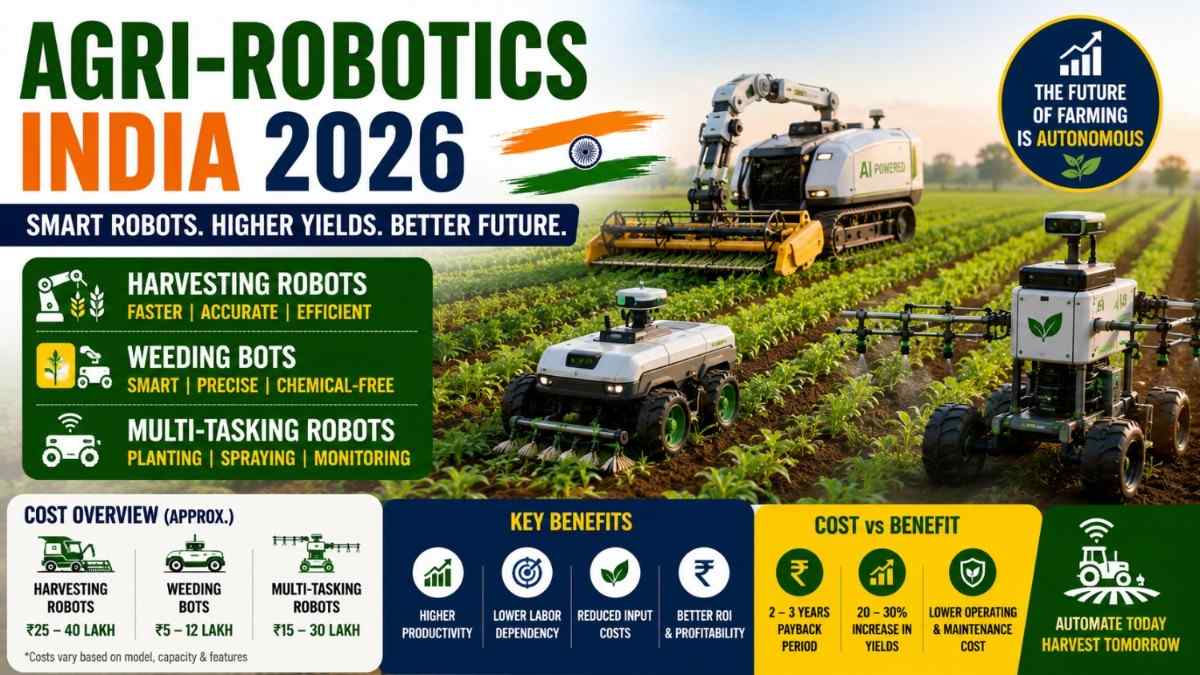
- What Is Agri-Robotics India 2026?
- Types of Agri-Robots: Harvesting, Weeding & More
- Agri-Robotics Cost in India – Price Table 2026
- Cost-Benefit Analysis of Agri-Robots for Indian Farmers
- Government Subsidy for Agri-Robots India 2026
- Top Agri-Robotics Companies in India
- Who Should Invest in Agri-Robotics India 2026?
- Agri-Robotics vs Traditional Farm Labour – Comparison
- High-Value Agri-Tech Terms Every Farmer Must Know
- FAQ – Agri-Robotics India 2026
| India Market Value (2023) | USD 630 million (~Rs.5,250 crore) |
| Projected Market (2030) | USD 2,653 million (~Rs.22,100 crore) |
| Market Growth Rate | 22.8% CAGR (2024–2030) |
| Weeding Bot Price (India) | Rs.2 lakh – Rs.8 lakh (domestic) |
| Harvesting Robot Price | Rs.4 lakh – Rs.18 lakh |
| Labour Cost Savings | 60–70% reduction |
| Typical ROI Period | 2–4 years (medium-large farms) |
| Govt. Subsidy Available | Up to 100% (drones); 40–50% (machinery) |
| Indian Startups (2026) | 30+ active agri-robotics startups |
What Is Agri-Robotics India 2026?
Agri-robotics refers to the use of autonomous, semi-autonomous, and remotely operated machines — powered by artificial intelligence (AI), computer vision, GPS navigation, and IoT sensors — to carry out farm tasks that were previously done by human labour. Unlike traditional farm mechanization (tractors, threshers), agri-robots in 2026 make real-time decisions: they can identify weeds from crops, selectively pick ripe fruits, navigate uneven terrain, and map fields autonomously.
India’s unique agricultural challenges — chronic labour shortage, rising farm wages, fragmented landholdings, and post-harvest losses of up to 20% — make agri-robotics not just useful, but urgent. The Indian Council of Agricultural Research (ICAR) has identified farm automation as one of its top 5 priority research areas for 2026–2030. With over 30 active Indian startups developing precision farming robots, and global players like John Deere, Kubota, and AGCO entering the Indian market, the 2026 landscape is the most dynamic it has ever been.

Types of Agri-Robots: Harvesting, Weeding & More
The agri-robotics ecosystem in India covers 6 major robot categories, each targeting a specific farm operation. Here is a breakdown of all types currently available or in advanced trials in 2026:
- 🌾 Harvesting Robots: Autonomous arms and mobile platforms that selectively pick ripe produce — cotton, strawberries, grapes, tomatoes, and paddy. India’s first cotton-picking robot (by Green Robot Machinery, Bengaluru) has a market price of Rs.4–5 lakh. Advanced autonomous harvesting units for paddy and wheat range from Rs.8–18 lakh.
- 🌿 Weeding Robots (Weeding Bots): Battery-powered robots that use mechanical tines, rotary blades, or laser-based systems to uproot or cut weeds between crop rows without disturbing plants. Indian models from FarmRobo and Farm Sathi start at Rs.2.5 lakh. These bots operate at 3–5 km/h, covering 20–40 acres daily.
- 🚁 Agricultural Drones (UAVs): The largest and fastest-growing segment. Drones like the Agribot (Rs.6.78 lakh+GST) and DJI Agras series handle crop spraying, monitoring, seeding, and mapping. UAVs dominate with a projected 46.52% market share in 2026 globally.
- 🚜 Autonomous Tractors: GPS + AI-guided tractors capable of plowing, sowing, and irrigating with minimal human input. International brands (John Deere, Kubota) lead this segment; Indian versions are in prototype stage at ICAR and IIT research labs.
- 💧 Precision Spraying Robots: Ground-based robots with computer vision that identify diseased plants and spot-spray only affected areas, reducing herbicide use by up to 60%. Priced at Rs.5–12 lakh for Indian market configurations.
- 🌱 Seeding & Transplanting Robots: Robotic seeders for paddy transplanting and vegetable seedling placement. Paddy transplanting robots reduce labour cost by 65% compared to manual transplanting and are available at Rs.3–7 lakh.
Agri-Robotics Cost in India – Price Table 2026
Understanding the cost of agri-robotics in India requires separating domestic (Make in India) models from imported units. Below is the most comprehensive agri-robot price table available for 2026, based on current market data:
| Robot Type | Indian Model Price | Imported Model Price | Annual Maintenance | RaaS (Per Acre) |
|---|---|---|---|---|
| Weeding Bot | Rs.2–8 lakh | Rs.10–20 lakh | Rs.15,000–30,000/yr | Rs.800–1,500 |
| Harvesting Robot (cotton/fruit) | Rs.4–10 lakh | Rs.12–18 lakh | Rs.20,000–50,000/yr | Rs.1,200–2,500 |
| Agricultural Drone (UAV) | Rs.5–8 lakh | Rs.8–15 lakh | Rs.10,000–20,000/yr | Rs.400–800 |
| Precision Spraying Robot | Rs.5–12 lakh | Rs.15–25 lakh | Rs.20,000–40,000/yr | Rs.600–1,200 |
| Paddy Transplanting Robot | Rs.3–7 lakh | Rs.8–12 lakh | Rs.12,000–25,000/yr | Rs.500–1,000 |
| Autonomous Tractor | Prototype stage | Rs.30–60 lakh | Rs.50,000–1,00,000/yr | Rs.1,500–3,000 |
Note: Robotics-as-a-Service (RaaS) models allow farmers to pay per-acre without buying the robot — ideal for small landholders under 5 acres. Many Indian agri-robotics startups now offer RaaS as their primary go-to-market model for rural India.
Cost-Benefit Analysis of Agri-Robots for Indian Farmers
The core question every farmer asks: Is an agri-robot worth the investment? Here is a detailed cost-benefit analysis based on a 10-acre farm scenario for 2026, comparing agri-robotics against traditional manual labour:
| Cost/Benefit Parameter | Manual Labour (10 acres/year) | Agri-Robot (10 acres/year) | Annual Saving |
|---|---|---|---|
| Weeding Labour Cost | Rs.40,000–60,000 | Rs.8,000–15,000 (power/maintenance) | Rs.32,000–45,000 |
| Harvesting Labour Cost | Rs.50,000–80,000 | Rs.12,000–20,000 (amortised) | Rs.38,000–60,000 |
| Pesticide/Herbicide Cost | Rs.20,000–35,000 | Rs.8,000–12,000 (precision spraying) | Rs.12,000–23,000 |
| Post-Harvest Loss | 15–20% of yield value | 5–8% (precise, timely harvest) | Rs.20,000–40,000 |
| Total Annual Saving | — | — | Rs.1,02,000–1,68,000 |
| Robot Investment (one-time) | — | Rs.3–5 lakh (weeding bot) | Break-even: 2–4 years |
Additionally, FarmRobo’s autonomous field robots (made specifically for Indian farms) claim labour cost reductions of up to 70% and have been proven on 1,000+ acres across India. The Indian Council of Agricultural Research (ICAR) trials on precision weeding robots showed a 65% reduction in weed management costs over 2 seasons.
For small farmers with under 3 acres, the RaaS model is the most financially sensible option in 2026 — paying Rs.800–2,000 per acre for drone or weeding-bot services avoids the upfront capital barrier entirely, while still delivering 40–55% savings over manual labour.
Government Subsidy for Agri-Robots India 2026
The Government of India has made farm automation a national priority, backing agri-robotics through multiple schemes. Here is the complete subsidy landscape for 2026:
| Scheme Name | Administering Body | Subsidy Amount | Eligible Category |
|---|---|---|---|
| SMAM (Sub-Mission on Agricultural Mechanisation) | Ministry of Agriculture | 40–50% on machinery | All farmers; SC/ST get higher slab |
| Agriculture Drone Subsidy | DAC&FW | Up to 100% cost (FPOs, SHGs) | FPOs, Women SHGs, SC/ST farmers |
| RKVY-RAFTAR | Ministry of Agriculture | Grants up to Rs.25 lakh | Agri-startups, FPOs, farmers |
| DST Innovation Challenge 2026 | Dept. of Science & Technology | Grants for indigenous hardware | Robotics startups, R&D institutes |
| Atmanirbhar Bharat Innovation Challenge | NITI Aayog / DST | Up to Rs.1 crore | DPIIT-recognised startups |
For detailed, updated subsidy eligibility and application procedures, visit the Ministry of Agriculture & Farmers Welfare official portal and the ICAR official website. Farmer Producer Organisations (FPOs) and women-led Self-Help Groups (SHGs) are eligible for the highest subsidy tier — up to 100% on agriculture drones — under the current 2026 notification.
Top Agri-Robotics Companies in India 2026
India’s agri-robotics startup ecosystem has grown explosively. Indian startups raised over Rs.375 crore (USD 45 million) in agri-robotics and farm automation in H1 2026 alone — a 120% year-on-year increase. Here are the leading players shaping the Indian precision farming landscape:
- 🤖 FarmRobo (India): Bangalore-based, offers the R1 and R5 autonomous field robots for weeding, tilling, and row-crop management. Battery-powered, engineered for Indian field conditions, proven on 1,000+ acres. Labour cost savings of 70% claimed.
- 🌾 Farm Sathi (India): Offers Robotics-as-a-Service (RaaS) model — fully electric farm robots for tilling, spraying, and weeding. Remote-controlled and autonomous modes. Targets small and marginal farmers who cannot afford outright purchase.
- 🚜 AgriBot Solutions (India): Secured Rs.416 crore (USD 5 million) in 2026 funding to deploy autonomous agricultural harvesting robots specifically across Punjab and Haryana.
- 🌿 Cropper Technologies (India): Focused on crop-specific modular robot platforms. Developing robots for sugarcane, cotton, and horticulture harvesting with AI-based selective picking.
- 🛸 BharatBotics (India): Bengaluru-based robotics firm offering agri-automation hardware at Rs.1–1.5 lakh ($12,000–18,000 range) — well below the Rs.3.3 lakh ($40,000) imported equivalent.
- 🌏 John Deere, Kubota, AGCO (International): Global leaders in autonomous tractors and precision farming machinery. Kubota Agricultural Machinery India has increased its dealer network and localised parts supply in 2026.
- 📡 Farmonaut (India): Combines satellite-powered crop advisory with ground robotics data — offering integrated precision farming platforms for large farms and FPOs.
Who Should Invest in Agri-Robotics India 2026?
Agri-robotics is not a one-size-fits-all investment. Here is a clear profile of who should consider investing in 2026:
- 🧑🌾 Large Farmers (10+ acres): Outright purchase of weeding bots and harvesting robots makes strong financial sense — ROI within 2–3 seasons. Labour savings of Rs.1–1.5 lakh per year justify the investment.
- 👩🌾 Women Farmer Groups (SHGs/FPOs): Eligible for up to 100% drone subsidy under Govt. of India schemes. Shared ownership of one robot among 10–15 members dramatically cuts per-farmer cost.
- 🌾 Cotton, Vegetable & Horticulture Farmers: Crops with high harvest labour costs and post-harvest sensitivity (strawberry, grapes, tomato, cotton) deliver the fastest ROI from harvesting robots.
- 🏢 Agri-Startups & Entrepreneurs: The RaaS model allows entrepreneurs to buy 1–2 robots and offer per-acre services to 50–100 farmers, generating Rs.3–8 lakh annual revenue per robot deployed.
- 🎓 Agriculture Graduates & B.Sc. Agri Students: Understanding agri-robotics opens career pathways in precision farming startups, agri-tech companies, ICAR research labs, and international agri-firms offering packages of Rs.4–12 lakh per annum.
- 🏦 FPOs (Farmer Producer Organisations): Pooling resources to purchase robotic equipment qualifies FPOs for the highest government subsidy slabs and allows amortisation across hundreds of acres.
- 🌱 Small Farmers (Under 3 acres): Should use RaaS (pay-per-use) model rather than purchasing. Drone spraying services at Rs.400–800/acre and weeding-bot services at Rs.800–1,500/acre are cost-effective without capital commitment.
- 🔬 Agri-Tech Researchers & ICAR Scientists: With DST and RKVY grants available up to Rs.25 lakh for farm robotics R&D, this is an ideal time to convert lab prototypes into field-deployable solutions.
Agri-Robotics vs Traditional Farm Labour – Comparison 2026
| Parameter | Agri-Robotics 2026 | Traditional Manual Labour |
|---|---|---|
| Labour Cost (10 acres/season) | Rs.20,000–35,000 (operational) | Rs.80,000–1,20,000 |
| Availability | 24/7 operation, no seasonal gap | Acute shortage during peak seasons |
| Precision | AI-guided, 95%+ accuracy (selective harvest/weed) | Variable; human fatigue affects quality |
| Herbicide / Input Use | Reduced by 60% (spot-spray technology) | Blanket application, high waste |
| Post-Harvest Loss | 5–8% (timely, gentle handling) | 15–20% (delays, rough handling) |
| Upfront Investment | Rs.2–18 lakh (or Rs.0 via RaaS) | Zero (daily wage) |
| Break-Even Period | 2–4 years (medium-large farms) | No break-even — recurring cost every season |
| Skill Required | Basic training (1–3 days); app-based control | Unskilled / semi-skilled labour |
| Best For | Farms 5+ acres, FPOs, agri-entrepreneurs | Farms under 2 acres, irregular tasks |
High-Value Agri-Tech Terms Every Farmer & Investor Must Know
- 💡 Precision Farming India: Use of GPS, sensors, drones, and data analytics to apply inputs (water, fertiliser, pesticides) only where and when needed — cutting costs by 30–50% per crop cycle.
- 🤖 Robotics-as-a-Service (RaaS): Pay-per-use model where farmers hire agri-robots by the hour or acre instead of buying. Eliminates upfront capital; ideal for small and marginal farmers.
- 📡 IoT in Agriculture: Internet of Things sensors embedded in soil, irrigation systems, and robots that relay real-time data to a central app — enabling remote farm management.
- 🌱 Smart Farming India 2026: Integration of robotics, satellite monitoring, data analytics, and AI advisory platforms (like Jeevn AI and Farmonaut) for an end-to-end intelligent farm ecosystem.
- 🛸 Agricultural Drone India: UAVs used for crop spraying, mapping, monitoring, and seeding. India’s agriculture drone market is supported by a dedicated government subsidy — Rs.0 cost for FPOs and SHGs under current SMAM drone policy.
- 🌿 Computer Vision Weeding: AI camera systems on weeding bots that distinguish crop plants from weeds at 95%+ accuracy — enabling mechanical or laser-based removal of only weeds without crop damage.
- 🔬 ICAR Farm Mechanization: Indian Council of Agricultural Research-funded research and trials on robotic harvesters, precision seeders, and autonomous tractors across its 100+ research stations nationwide.
- 💰 Agri-Tech Startup India Funding: Agri-robotics startups in India raised over Rs.375 crore (USD 45 million) in H1 2026 — a 120% year-on-year surge, backed by Sequoia India, IFCI Capital, and DST grants.
- 🌾 Post-Harvest Loss Reduction: Robotic harvesters reduce India’s annual post-harvest losses (estimated at Rs.92,000 crore) by enabling timely, precision harvesting. Even a 5% improvement represents Rs.4,600 crore saved nationally.
- 🏭 Make in India Agri-Robots: Domestically manufactured robots priced at Rs.1–10 lakh vs Rs.3.3–15 lakh for imports — making Indian agri-robotics startups the most price-competitive globally for emerging market conditions.
FAQ – Agri-Robotics India 2026
What is agri-robotics and how is it used in India?
Agri-robotics India 2026 refers to the use of autonomous and semi-autonomous machines — including harvesting robots, weeding bots, spraying drones, and seeding robots — to automate repetitive farm tasks. In India, agri-robots are deployed across paddy, cotton, sugarcane, vegetable, and fruit crops to reduce dependency on seasonal farm labour and cut input costs by up to 60%. Over 30 Indian startups are actively developing and deploying these solutions as of 2026.
What is the price of a harvesting robot in India in 2026?
The price of a harvesting robot in India in 2026 ranges from Rs.4 lakh to Rs.18 lakh depending on crop type, automation level, and brand. Domestically manufactured units (like FarmRobo R1/R5 and AgriBot) cost Rs.4–10 lakh, while imported harvesting robots can go up to Rs.18 lakh or above. Government subsidies under SMAM and RKVY can reduce the effective cost by 40–50%, making agri-robotics accessible for medium and large farmers.
How much does a weeding bot cost in India?
A weeding bot in India costs between Rs.2 lakh and Rs.8 lakh for domestic models in 2026. Robotic weeding solutions like Farm Sathi and FarmRobo offer battery-powered, remote-controlled models starting at Rs.2.5 lakh. Imported mechanical weeding robots average Rs.10–20 lakh. For small farmers, the RaaS (Robotics-as-a-Service) model is available at Rs.800–Rs.1,500 per acre with no upfront purchase cost required.
What is the ROI of agri-robots for Indian farmers?
The ROI of agri-robotics in India varies by farm size and crop type, but most field data shows break-even within 2–4 years for medium-to-large farms. A weeding bot costing Rs.3 lakh can save Rs.80,000–Rs.1.2 lakh per year in labour costs on a 10-acre farm. A harvesting robot reduces post-harvest losses by 15–20% and cuts harvest labour costs by 60–70%, delivering ROI within 3 seasons on farms above 10 acres.
Is there a government subsidy for agricultural robots in India?
Yes — multiple government subsidy schemes are active in 2026. The SMAM (Sub-Mission on Agricultural Mechanisation) provides 40–50% subsidy on agri-machinery. Agriculture drones (like the Agribot at Rs.6.78 lakh+GST) qualify for up to 100% subsidy for FPOs, women SHGs, and SC/ST farmers. The DST Innovation Challenge 2026 offers grants for indigenous agri-hardware prototypes. Visit the official Ministry of Agriculture portal for updated applications.
Which are the top agri-robotics companies in India?
Top agri-robotics companies in India in 2026 include FarmRobo (weeding and tilling robots), Farm Sathi (RaaS precision farming), AgriBot Solutions (autonomous harvesting in Punjab/Haryana), Cropper Technologies (modular crop robots), BharatBotics (low-cost agri-automation), and Farmonaut (satellite + robotics integration). Global players — John Deere, Kubota Agricultural Machinery India, and AGCO — are also expanding their precision farming robot range specifically for Indian conditions.
What crops are agri-robots suitable for in India?
Agri-robotics India 2026 supports paddy, cotton, sugarcane, wheat, vegetables (tomato, chilli, capsicum), and fruits (strawberry, grapes, mango). Cotton-picking robots, paddy transplanting robots, vegetable harvesting arms, and inter-row weeding bots are commercially available. Modular robot designs being developed and trialled by ICAR-affiliated labs in 2026 are specifically engineered for multi-crop, multi-task operations on Indian field conditions.
What is the difference between agri-robotics and farm mechanization?
Farm mechanization uses tractors, threshers, and powered equipment to replace manual effort with consistent machine force. Agri-robotics India 2026 goes significantly further — using AI, computer vision, GPS, and IoT sensors to build autonomous machines that navigate independently, make real-time decisions (e.g., identifying a ripe fruit vs an unripe one), and perform precision operations that conventional machinery cannot replicate. In short: mechanization automates effort; agri-robotics automates intelligence.
Last Updated: May 2026 | This guide is regularly reviewed and updated for accuracy. Bookmark this page for the latest agri-robotics India 2026 news, subsidy updates, and robot price revisions.