

National Makhana Board 2026 is India’s most significant institutional move to transform the fox nut sector — backed by a Rs.476.03 crore Central Sector Scheme running from 2025–26 to 2030–31. If you grow makhana in Bihar, process fox nuts for branded markets, or plan to export Mithila Makhana globally, this guide covers every benefit, subsidy, and opportunity the Board unlocks for you.

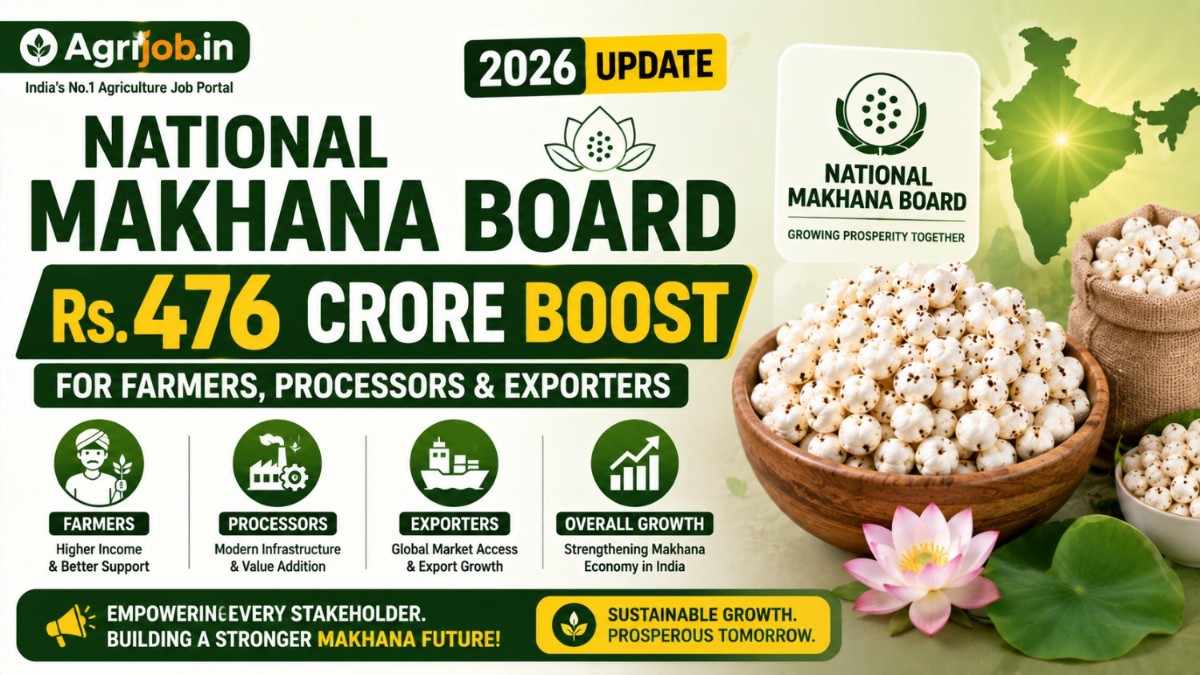
The National Makhana Board was launched by PM Narendra Modi on 15 September 2025 in Purnea, Bihar, under a Rs.476.03 crore Central Sector Scheme (2025–2031). It provides subsidies up to Rs.72,750/hectare for farmers, up to Rs.3.5 crore for large processing units, and actively promotes Mithila Makhana exports — with India already exporting 25,130 MT annually.
- Launched by: PM Narendra Modi, 15 September 2025, Purnea, Bihar
- Announced in: Union Budget 2025–26
- Central Scheme Budget: Rs.476.03 crore (2025–26 to 2030–31)
- Headquarters: Purnea, Bihar
- Farmer Subsidy (Cultivation): Up to Rs.72,750 per hectare (75% of cost)
- Processing Unit Subsidy: Rs.5 lakh (micro) to Rs.3.5 crore (large)</
- Bihar’s Share of India Production: ~90% (over 15,000 hectares)
- Annual Makhana Exports: 25,130 MT (worth USD 226.5 million in 2023–24)
- GI Tag: Mithila Makhana — awarded 16 August 2022
- Domestic Market Size: Expected to reach Rs.11,000–12,000 crore by 2029–30
📋 Table of Contents
- What Is the National Makhana Board 2026?
- Who Should Read This Guide?
- Rs.476 Crore Scheme — Budget Breakdown & Value
- Benefits for Makhana Farmers in Bihar
- Benefits for Makhana Processors & Entrepreneurs
- Benefits for Makhana Exporters
- How to Apply for Makhana Board Schemes — Step-by-Step
- Makhana vs Other Agri-Export Crops — Comparison
- Pros and Cons of the National Makhana Board
- Important Terms Related to National Makhana Board
- Important Dates & Timeline
- Important Links
- Conclusion
- Key Takeaways
- Frequently Asked Questions
What Is the National Makhana Board 2026 and Why Does It Matter?
The National Makhana Board is a dedicated central government body established under the Ministry of Agriculture and Farmers Welfare to regulate, develop, and promote India’s makhana (fox nut) sector from farm to global market. Announced in the Union Budget 2025–26 and formally launched on 15 September 2025 by Prime Minister Narendra Modi in Purnea, Bihar, it is the first institution of its kind for the fox nut industry in India.
Makhana — botanically Euryale ferox — is cultivated in freshwater ponds and wetlands across Bihar’s Mithilanchal region, earning the nickname “White Gold.” Bihar produces nearly 90% of India’s total makhana output across more than 15,000 hectares, supporting over five lakh farming families, many from the marginalised Mallah community. Despite its global demand, farmers historically earned modest incomes due to middlemen, poor infrastructure, and limited branding. The National Makhana Board directly addresses every one of these gaps.

The Board is headquartered in Purnea — the heart of the Seemanchal-Mithila production belt — and oversees a six-year Rs.476.03 crore Central Sector Scheme covering research, quality seeds, processing infrastructure, branding, and export promotion through 2030–31.
| Parameter | Detail |
|---|---|
| Official Name | National Makhana Board (Rashtriya Makhana Board) |
| Governing Ministry | Ministry of Agriculture and Farmers Welfare |
| Launch Date | 15 September 2025 |
| Launch Location | Purnea, Bihar |
| First Board Meeting | December 2025, Krishi Bhawan, New Delhi |
| Chaired by (First Meeting) | Devesh Chaturvedi, Secretary, DAFE |
| State Scheme (2026–27) | Bihar Makhana Vikas Yojana / Makhana Development Scheme |
| Research Arm | NRC Makhana, Darbhanga; SAU Sabour; CAU Samastipur |
Who Should Read This Guide?
- 🌾 Makhana farmers in Bihar — Learn about the Rs.72,750/hectare subsidy, quality seeds, and FPO benefits.
- 🏭 Makhana processors and entrepreneurs — Claim subsidies up to Rs.3.5 crore for setting up or upgrading processing units.
- 🚢 Exporters and trading companies — Understand GI tag leverage, new cargo terminal plans, and export compliance support.
- 🌱 Farmers from other states considering makhana — Discover how the Board is expanding cultivation beyond Bihar’s 16 districts.
- 📊 Agri-investors and FPO promoters — Explore public-private partnership opportunities under the Rs.476 crore scheme.
- 🎓 Agriculture students and UPSC aspirants — Get a complete factual overview of the Board’s structure, mandate, and significance.
- 🛒 Branded food companies — Learn how the Board facilitates GI-tagged Mithila Makhana sourcing for premium packaging.
- 🧑💻 Rural entrepreneurs and startups — Identify entry points in value addition, flavoured makhana, makhana flour, and snacks.
Rs.476 Crore Central Sector Scheme — Budget Breakdown and Value Chain Coverage
The Central Sector Scheme for Development of Makhana (2025–26 to 2030–31) allocates Rs.476.03 crore across six components to modernise the entire makhana value chain. At its inaugural meeting in December 2025, the National Makhana Board reviewed Annual Action Plans from states and research institutions before approving budgets under each component.
| Scheme Component | Focus Area |
|---|---|
| Research & Innovation | High-yield varieties (Swarn Vaidehi, Sabour Makhana-1), water management, pest resistance |
| Quality Seed Production | Seed supply via SAU Sabour and CAU Samastipur; 75% subsidy on certified seeds |
| Farmer Capacity Building | Training by NRC Darbhanga; trainer-of-trainers programme for all states |
| Post-Harvest Management | Cold storage units, cargo terminals near production clusters, drying technology |
| Value Addition & Branding | Flavoured makhana, makhana flour, organic-certified processing; “Mithila Makhana” brand |
| Export Promotion | APEDA linkage, global food expos (AAHAR 2026), FSSAI & organic certification support |
The domestic makhana market has grown at 17–18% annually from 2021–22 to 2024–25 and is projected to reach Rs.11,000–12,000 crore by 2029–30, driven by health-conscious snacking and premiumisation. The scheme positions India to capture a far larger share of global fox nut trade, where India already dominates with nearly 80% of world supply.
Benefits for Makhana Farmers in Bihar — Subsidies, Seeds, and FPO Support
The Bihar Makhana Vikas Yojana 2026–27, launched in April 2026, directly implements the National Makhana Board’s mandate at the state level. Farmers across 16 districts of Bihar can claim production subsidies, quality seeds, and tool kits through this scheme.
- 💰 Cultivation Subsidy: Up to Rs.72,750 per hectare (75% of production cost), covering pond preparation, planting, and harvesting.
- 🌱 Quality Seeds at Subsidised Rate: Swarn Vaidehi seeds at Rs.4,950/ha subsidy; Sabour Makhana-1 seeds at Rs.5,737.50/ha subsidy — only Rs.225/kg paid by farmer.
- 🧰 Traditional Tool Kits: Bamboo and wood-based harvesting tools provided to both landholding and non-landholding farmers.
- 👩🌾 Women Farmer Priority: 30% reservation for women beneficiaries under DBT-linked payouts.
- 🤝 FPO Formation Support: The Board promotes Farmer-Producer Organisations (FPOs) to reduce middlemen, improve collective bargaining, and access bulk processing facilities.
- 📡 MSP Mechanism (Planned): A Minimum Support Price framework is under development to protect farmers from price volatility.
- 🔬 Free Training: NRC Makhana, Darbhanga conducts training on cultivation, grading, packaging, and export compliance for registered farmers.
Eligible districts include Katihar, Purnia, Darbhanga, Madhubani, Kishanganj, Supaul, Araria, Madhepura, Saharsa, Khagaria, Samastipur, Bhagalpur, Sitamarhi, East Champaran, West Champaran, and Muzaffarpur. Land eligibility: minimum 0.25 acres (0.1 ha) to maximum 10 acres (4 ha). Non-landholding farmers qualify using a lease agreement form.
Benefits for Makhana Processors and Entrepreneurs — Unit Subsidies and Training
Processing remains the biggest value-gap in the makhana chain. Raw seeds fetch far less than popped, graded, and branded makhana — and the National Makhana Board’s scheme directly incentivises investment in processing infrastructure at every scale.
| Processing Unit Scale | Maximum Subsidy Available |
|---|---|
| Micro Unit | Rs.5 lakh |
| Small Unit | Rs.19.5 lakh |
| Medium Unit | Rs.1.5 crore |
| Large Unit | Rs.3.5 crore |
- 🏭 Register on the Bihar Horticulture DBT portal (horticulture.bihar.gov.in) to claim processing unit subsidies.
- 🎓 Training in flavoured makhana production, makhana flour, makhana kheer mix, and organic certification is available at NRC Darbhanga.
- 📦 The Board provides guidance on FSSAI compliance, organic certification, barcode labelling, and export-standard packaging.
- ⚙️ Subsidies cover cleaning, grading, popping, and roasting machines — reducing capital cost significantly for new entrants.
- 🏪 State-backed e-commerce linkages (and participation at AAHAR 2026) connect processors directly with domestic urban buyers and international importers.
GI-tagged “Mithila Makhana” commands a 10–15% price premium in US and EU markets over non-tagged fox nuts. Ensure your processing unit sources exclusively from the Mithilanchal region and maintains traceability documentation — this is the fastest way to access premium export contracts. Partner with your nearest NRC Makhana field centre for quality audit support.
Benefits for Makhana Exporters — GI Tag, Cargo Terminals, and Global Markets
India’s makhana exports grew nearly 4X from 6,700 MT in 2020 to 25,130 MT in 2024, recording a 39% CAGR. The National Makhana Board is now building the infrastructure to sustain and multiply this growth. Key export markets include the United States, United Kingdom, UAE, Australia, Japan, Singapore, Nepal, and Bangladesh.
- 🚚 New Cargo Terminals: Annual Action Plans cleared in early 2026 include establishing cargo terminals and cold storage units near Purnea, Katihar, Araria, and Kishanganj production clusters.
- 🏷️ GI Tag Leverage: The GI tag (awarded August 2022) gives “Mithila Makhana” legal protection and brand identity — exporters using it command a 10–15% price premium in the US and EU. Organic-certified makhana earns a further 20–35% premium.
- 📋 APEDA Linkage: The Board works through APEDA to list exporters on global platforms and participate in international food expos.
- 🧪 Quality Control: Standardised testing labs are being established to ensure FSSAI compliance and import-country food safety standards (FDA, EFSA).
- 🛃 Daak Ghar Niryat Kendra: Bihar has 46 Post Office Export Centres (DNK) for small exporters — providing online documentation support, custom clearance, and affordable logistics.
- 🌍 Export Price (2025–26): FOB price ranges from USD 7–12/kg for standard grade; GI-tagged Mithila Makhana fetches USD 12–20/kg in premium markets.
India has now overtaken Pakistan and China to become the world’s largest makhana exporter by shipment volume. With the Board’s cargo terminal investments and quality standardisation, the target is to raise the export share from the current 1% of production to significantly higher levels.
How to Apply for National Makhana Board Schemes — Step-by-Step Process
- Register on DBT Portal: Visit the Bihar Horticulture DBT portal at horticulture.bihar.gov.in. Complete Aadhaar-based registration using OTP, Bio-Auth, or IRIS verification.
- Select Your Scheme: Choose the relevant sub-scheme — makhana seed distribution, cultivation subsidy, or processing unit grant — from the scheme list on the portal.
- Upload Documents: Land documents (for ryot farmers) or lease agreement form (for non-ryot/tenant farmers); recent revenue receipt; Aadhaar card; bank account details linked to DBT.
- Submit Application: Applications are processed on a first-come, first-served basis. Women farmers receive 30% reserved allocation — apply early to secure benefits.
- Verification and Approval: District Horticulture Officer (DHO) verifies land records and application details. On-field inspection may be conducted for processing unit grants.
- DBT Credit: Approved subsidy amounts are directly credited to your Aadhaar-linked bank account via the SNA Sparsh portal.
- For Exporters: Register with APEDA at apeda.gov.in for export certification, IEC code, and eligibility for trade promotion support under the Rs.476 crore scheme.
Makhana vs Other Agri-Export Crops — How Does It Compare?
| Parameter | Makhana (Fox Nut) | Basmati Rice | Turmeric |
|---|---|---|---|
| Export Value (2023–24) | USD 226.5 million | ~USD 5.8 billion | ~USD 222 million |
| GI Tag | Yes (Mithila Makhana) | Yes (multiple varieties) | Yes (multiple) |
| Dedicated Central Board | Yes (2025) | No | Yes (Turmeric Board, 2024) |
| CAGR of Exports | 39% (2020–2024) | ~8–10% | ~12–15% |
| Domestic Market Growth | 17–18% annually | 3–5% annually | 8–10% annually |
| Subsidy Available (Cultivation) | 75% (up to Rs.72,750/ha) | ~50% various schemes | 50–75% various schemes |
| Export Price Premium | USD 7–20/kg (grade-dependent) | USD 0.5–2/kg | USD 2–6/kg |
| Production Geography | 90% Bihar only | Punjab, Haryana, UP | AP, Telangana, Tamil Nadu |
| Market Stage | Emerging Superfood | Mature | Growing |
| Income Potential | Very High (premiumisation) | Moderate | High |
Among India’s niche agri-export crops, makhana stands out for its extraordinary export CAGR (39%), its untapped export potential (currently only 1% of production is exported), and its premium price positioning as a global superfood. The National Makhana Board is the single most important institutional catalyst the sector has ever had. For Bihar farmers and processors willing to adopt modern techniques, the next five years represent a generational income opportunity.
Pros and Cons of the National Makhana Board
Advantages
- ✅ First-ever dedicated institution for the makhana sector — provides focused policy attention and funding unavailable before.
- ✅ Generous subsidies at 75% of cost for both cultivation and processing, significantly de-risking investment for small farmers.
- ✅ GI tag combined with Board branding creates a powerful “Mithila Makhana” global identity that commands premium prices.
- ✅ Direct market linkages through FPOs, e-commerce platforms, and global food expos eliminate middlemen and increase farmer income.
- ✅ Rs.476 crore over six years ensures sustained funding — not a one-year scheme that lapses.
Challenges and Limitations
- ⚠️ Geographic concentration risk: 90% production in Bihar makes the sector vulnerable to floods and climate events — diversification to other states is slow.
- ⚠️ DBT portal bottlenecks: Subsidy disbursement delays on the SNA Sparsh portal have been reported in early implementation months.
- ⚠️ MSP mechanism not yet operational: A Minimum Support Price framework is planned but not yet implemented, leaving farmers exposed to seasonal price volatility.
Important Terms Related to National Makhana Board 2026
Understanding these terms helps you navigate schemes, applications, and market documents effectively.
- Euryale ferox: The botanical name of makhana (fox nut / gorgon nut). Grown in freshwater ponds and wetlands — not a dryland crop.
- GI Tag (Geographical Indication): Legal protection awarded to “Mithila Makhana” on 16 August 2022, certifying origin and quality. Commands 10–15% price premium globally.
- Central Sector Scheme: A 100% centrally funded government programme — as opposed to Centrally Sponsored Schemes, which are cost-shared with states.
- FPO (Farmer Producer Organisation): A collective of farmers registered as a company to access bulk inputs, common processing, and direct market linkages without middlemen.
- DBT (Direct Benefit Transfer): Government subsidy amounts credited directly to the farmer’s Aadhaar-linked bank account — reduces leakage and ensures full benefit reaches the intended recipient.
- NRC Makhana: National Research Centre for Makhana, Darbhanga — the premier government research institution for makhana variety development and agronomy.
- SAU Sabour: State Agriculture University, Sabour (Bhagalpur) — produces certified makhana seed stock for Bihar farmers.
- CAU Samastipur: Central Agriculture University, Samastipur — contributes to national makhana research and seed multiplication.
- APEDA: Agricultural and Processed Food Products Export Development Authority — the nodal agency for agricultural export certification, registration, and promotion in India.
- PMFME Scheme: PM Formalization of Micro Food Enterprises — an additional scheme that complements Makhana Board grants for micro food processing units.
Important Dates and Timeline — National Makhana Board 2026
| Date / Period | Event / Milestone |
|---|---|
| August 2022 | GI Tag awarded to “Mithila Makhana” |
| Union Budget 2025–26 (February 2025) | National Makhana Board announced by Finance Minister |
| 15 September 2025 | National Makhana Board officially launched by PM Modi in Purnea, Bihar |
| December 2025 | First Board meeting held at Krishi Bhawan, New Delhi; Rs.476.03 crore scheme approved |
| January 2026 | Member nomination deadline for Board positions (as per Bihar Horticulture portal) |
| April 2026 | Bihar Makhana Vikas Yojana / Makhana Development Scheme 2026–27 launched |
| 2025–26 to 2030–31 | Six-year Central Sector Scheme implementation period |
| 2029–30 (Target) | Domestic makhana market projected at Rs.11,000–12,000 crore |
Important Links — National Makhana Board and Related Resources
| Resource | Link |
|---|---|
| National Makhana Board Official Portal (Bihar) | horticulture.bihar.gov.in — Makhana Board |
| PIB Press Release — First Board Meeting | PIB: Rs.476 Crore Scheme Announced (pib.gov.in) |
| APEDA — Makhana Export Registration | APEDA Official Portal (apeda.gov.in) |
| APEDA Monthly Makhana Dashboard (Oct 2025) | APEDA Makhana Market Dashboard PDF |
| Bihar Horticulture DBT Portal — Apply for Subsidies | Bihar Horticulture Department (horticulture.bihar.gov.in) |
| IBEF Research — Makhana Goes Global | IBEF: Makhana Export Strategies (ibef.org) |
Conclusion — What the National Makhana Board 2026 Means for the Sector
The National Makhana Board 2026 is the most consequential policy action ever taken for India’s fox nut sector. With Rs.476.03 crore deployed over six years, it addresses every structural weakness — from poor-quality seeds and lack of cold storage to absent branding and limited export infrastructure. For the first time, Bihar’s five lakh makhana farming families, thousands of small processors, and a growing community of exporters have a single institutional champion backing them with funding, research, training, and market access.
If you are a farmer, apply for the 75% cultivation subsidy on the Bihar Horticulture portal before your district’s annual allocation is exhausted. If you are a processor or entrepreneur, the Rs.3.5 crore large-unit subsidy is one of the most generous agri-processing grants available in India today. Bookmark this page — we update it whenever the Board issues new notifications, subsidy cycles, or export guidelines.
- The National Makhana Board was launched on 15 September 2025 in Purnea, Bihar — the first dedicated central body for India’s fox nut sector.
- A Rs.476.03 crore Central Sector Scheme (2025–2031) funds research, seeds, processing, branding, and exports across the full value chain.
- Bihar farmers can claim up to Rs.72,750 per hectare (75% subsidy) under the Makhana Development Scheme 2026–27 via the DBT portal.
- Processing unit subsidies range from Rs.5 lakh (micro) to Rs.3.5 crore (large scale) — directly reducing capital barriers for entrepreneurs.
- India already exports 25,130 MT of makhana annually at 39% CAGR; GI-tagged Mithila Makhana fetches USD 12–20/kg in premium markets.
- Apply at horticulture.bihar.gov.in; exporters register with APEDA at apeda.gov.in for scheme benefits and export promotion support.
Frequently Asked Questions About National Makhana Board 2026
What is the National Makhana Board and when was it established?
The National Makhana Board is a central government body under the Ministry of Agriculture and Farmers Welfare established to regulate, develop, and promote India’s makhana sector. It was officially launched by Prime Minister Narendra Modi on 15 September 2025 in Purnea, Bihar, fulfilling an announcement made in the Union Budget 2025–26. Its mandate covers the full value chain — from cultivation and research to processing, branding, and exports.
What is the total budget allocated for the National Makhana Board scheme?
The Union Government has approved a Central Sector Scheme for Development of Makhana with a total outlay of Rs.476.03 crore for the six-year period from 2025–26 to 2030–31. This budget covers research and innovation, quality seed production, farmer training, post-harvest infrastructure, value addition, branding, and export promotion. It is a 100% centrally funded scheme.
How much subsidy can makhana farmers claim in Bihar in 2026?
Under the Bihar Makhana Development Scheme 2026–27 (linked to the National Makhana Board), eligible farmers can receive up to Rs.72,750 per hectare as a 75% subsidy on cultivation costs. Additionally, certified seeds of varieties like Swarn Vaidehi and Sabour Makhana-1 are available at highly subsidised rates (75% subsidy, farmer pays only Rs.225/kg). Benefits are disbursed via DBT directly to the farmer’s Aadhaar-linked bank account.
Which districts of Bihar are eligible for Makhana Board subsidies?
The Makhana Development Scheme 2026–27 covers 16 districts of Bihar: Katihar, Purnia, Darbhanga, Madhubani, Kishanganj, Supaul, Araria, Madhepura, Saharsa, Khagaria, Samastipur, Bhagalpur, Sitamarhi, East Champaran, West Champaran, and Muzaffarpur. Both landholding and non-landholding (tenant) farmers are eligible. Minimum land: 0.25 acres; maximum: 10 acres (4 hectares).
What subsidies are available for setting up a makhana processing unit?
The National Makhana Board scheme provides processing unit subsidies in four tiers: Rs.5 lakh for micro units, Rs.19.5 lakh for small units, Rs.1.5 crore for medium units, and up to Rs.3.5 crore for large units. Entrepreneurs register on the Bihar Horticulture DBT portal (horticulture.bihar.gov.in) and select the processing unit grant component. The subsidy covers cleaning, grading, popping, and roasting machinery along with cold storage installation costs.
What is the GI tag for Mithila Makhana and how does it benefit exporters?
The Geographical Indication (GI) tag for “Mithila Makhana” was awarded on 16 August 2022, giving legal protection and premium brand identity to fox nuts grown in Bihar’s Mithilanchal region. For exporters, the GI tag commands a 10–15% price premium in US and EU markets over non-tagged fox nuts. Organic-certified Mithila Makhana earns a further 20–35% premium. The National Makhana Board actively promotes the GI brand through APEDA linkages and international food expos.
How much does India currently export makhana and which countries import it?
India exported 25,130 MT of makhana in 2024, growing at a 39% CAGR from just 6,700 MT in 2020. In 2023–24, total makhana exports were valued at USD 226.5 million (approximately 1.62 lakh tonnes of seed makhana). Key importing countries include the United States, United Kingdom, UAE, Australia, Japan, Singapore, Nepal, and Bangladesh. India now holds the top position globally as the largest makhana exporter by shipment volume.
How do I apply for makhana subsidy under the National Makhana Board scheme?
Visit the Bihar Horticulture DBT portal at horticulture.bihar.gov.in and complete Aadhaar-based registration. Select the relevant scheme (cultivation subsidy, seed distribution, or processing unit grant), upload land documents or lease agreement, and submit. Subsidy is disbursed via SNA Sparsh DBT into your bank account. Applications are processed on a first-come, first-served basis with 30% reservation for women farmers. For export-related support, register with APEDA at apeda.gov.in.
What research institutions support the National Makhana Board?
The National Makhana Board’s research ecosystem is built on three institutions: the National Research Centre (NRC) for Makhana in Darbhanga — the premier variety development and agronomy centre; State Agriculture University (SAU) Sabour, Bhagalpur — which supplies certified seeds; and Central Agriculture University (CAU) Samastipur — which contributes to national seed multiplication and trainer-of-trainers programmes for states expanding makhana cultivation beyond Bihar.
Will the National Makhana Board expand makhana cultivation beyond Bihar?
Yes. The Board’s mandate explicitly covers all makhana-producing states, not just Bihar. Annual Action Plans approved at the December 2025 meeting include training programmes for trainers from multiple states — enabling systematic expansion into states with similar wetland and pond ecosystems such as West Bengal, Odisha, Assam, and Manipur. However, Bihar will remain the dominant production hub given its existing infrastructure, expertise, and the “Mithila Makhana” GI tag advantage.
Last Updated: July 2026 | Agrijob.in | Author: Nitish Singh
This guide is reviewed and updated regularly for accuracy. Bookmark this page for the latest National Makhana Board notifications, subsidy cycles, and export policy updates.
Disclaimer: This article is for informational purposes only. Subsidy amounts, eligibility criteria, and scheme details are subject to change as per official government notifications. Always verify current figures on the official Bihar Horticulture portal (horticulture.bihar.gov.in) and the Ministry of Agriculture website (agriculture.gov.in) before applying.