

Makhana vs popcorn is the most-searched healthy snack debate of 2026 — and if you’re choosing between the two, the science is clear. Lotus seeds (phool makhana) deliver 9.7g protein, a glycaemic index of just 35, and 163mg calcium per 100g, while plain popcorn scores GI 72 and offers barely 3g protein. This guide is for health-conscious Indians aged 18–55, fitness enthusiasts, diabetics, parents, and anyone following a gluten-free diet who wants a crunchy snack that actually works. We cover 13 evidence-backed reasons makhana is the superior gluten-free superfood, a full nutrition comparison table, glycaemic index data, antioxidant research, and a practical FAQ — everything you need to make a confident, permanent snack switch in 2026.

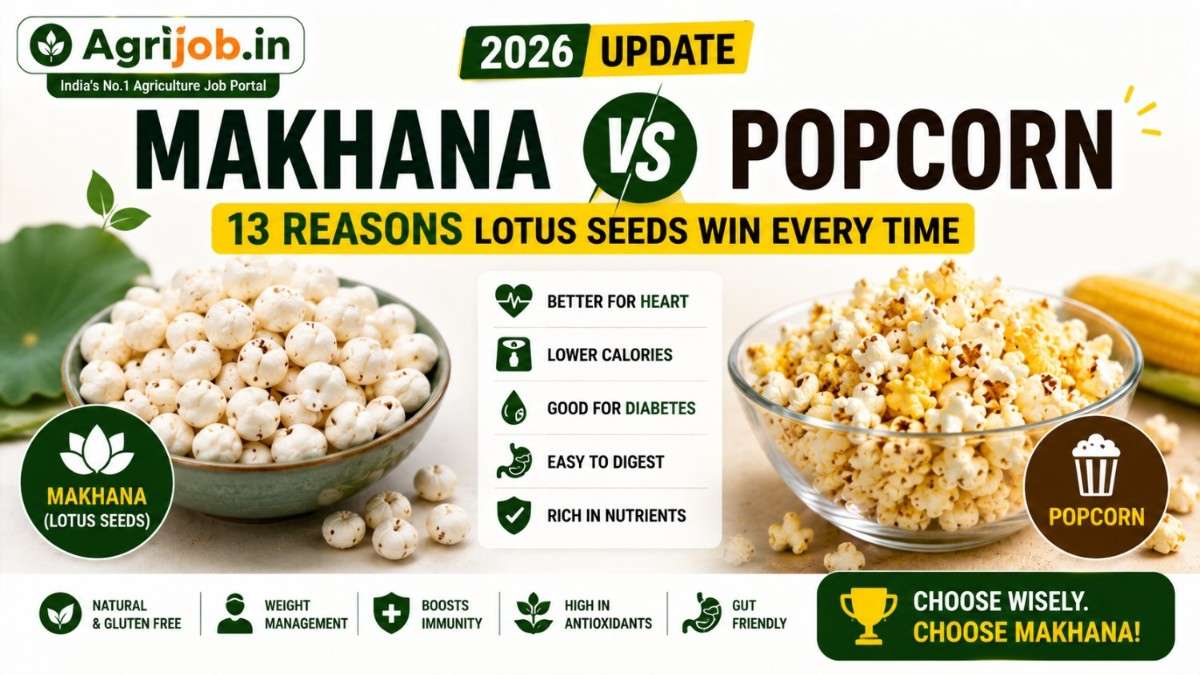
Makhana (lotus seeds / fox nuts) is the superior gluten-free superfood snack compared to popcorn in 2026. With a glycaemic index of 35 (vs popcorn’s 72), 3x more protein (9.7g vs 3.1g per 100g), 54x more calcium, and zero cross-contamination risk, makhana wins on 13 of 13 nutritional and health criteria — especially for weight loss, diabetes management, and clean gluten-free snacking.
- Makhana Calories: 347 kcal | Popcorn Calories: 375–387 kcal
- Makhana Protein: 9.7g | Popcorn Protein: 3.1g (makhana has 3× more)
- Makhana Dietary Fibre: 14.5g | Popcorn Fibre: 14.4g (roughly equal)
- Makhana Glycaemic Index (GI): 35 | Popcorn GI: 72 (makhana is low-GI, popcorn is high)
- Makhana Calcium: 163mg | Popcorn Calcium: ~3mg (makhana has 54× more)
- Makhana Fat: 0.1g | Popcorn Fat: 1.1g per 30g serving (plain air-popped)
- Makhana Sodium: Negligible | Packaged Popcorn Sodium: up to 1,860mg per serving
- Gluten-Free Status: Makhana — 100% naturally gluten-free with zero cross-contamination risk | Popcorn — technically gluten-free but cross-contamination risk in commercial brands
- Key Antioxidant: Makhana — kaempferol, isorhamnetin, gallic acid | Popcorn — polyphenols (hull only)
- GI Tag / Origin: Mithila Makhana — GI-tagged by Government of India (2022) | Popcorn — global commodity grain
- What Is Makhana (Lotus Seeds / Fox Nuts)?
- Who Should Choose Makhana Over Popcorn?
- 13 Reasons Makhana Is the Superior Gluten-Free Superfood
- Makhana vs Popcorn — Full Nutrition Comparison Table
- Glycaemic Index and Blood Sugar Control
- Gluten-Free Safety — Makhana vs Popcorn
- How to Eat Makhana Every Day — Step-by-Step Guide
- Makhana vs Popcorn — Head-to-Head Comparison Table
- Pros and Cons of Makhana vs Popcorn
- Important Nutrition Terms Every Healthy Snacker Should Know
- Important Links and Official Resources
- Conclusion
- Key Takeaways
- Frequently Asked Questions About Makhana vs Popcorn
What Is Makhana (Lotus Seeds / Fox Nuts)?
Makhana, also called phool makhana, fox nuts, or lotus seeds, are the popped edible seeds of the Euryale ferox plant — an aquatic crop cultivated primarily in the flooded pond regions of Bihar, India. Bihar produces over 85% of the world’s makhana supply, with cultivation spanning nearly 40,000 hectares as of 2025 and annual popped makhana output reaching 60,000–63,000 metric tonnes, according to APEDA export data. In August 2022, the Government of India’s Press Information Bureau confirmed that Mithila Makhana received a prestigious Geographical Indication (GI) tag — placing it alongside Darjeeling Tea and Basmati Rice as a legally protected Indian agricultural heritage product.
Unlike popcorn, which is derived from Zea mays (corn), makhana is harvested from underwater pods, sun-dried, and then popped in dry iron woks at high temperature. The result is a light, ivory-white, crunchy sphere that absorbs spices beautifully and is naturally free of gluten, cholesterol, and added fats. The Union Budget 2025–26 allocated Rs.100 crore to establish a dedicated Makhana Board in Bihar, signalling India’s formal commitment to making makhana a global superfood export under the Agricultural and Processed Food Products Export Development Authority (APEDA).

Who Should Choose Makhana Over Popcorn?
Makhana is a superior daily snack choice for a wide range of health goals and dietary needs. Here are the specific people who benefit most from switching to makhana in 2026:
- 🧘 Weight watchers: Low-GI (35), high-protein snack that curbs hunger for 2–3 hours per 30g serving without spiking insulin
- 💉 Diabetics and pre-diabetics: GI of 35 vs popcorn’s 72 — makhana creates 50% lower blood glucose peaks (human study, 2022)
- 🌾 Celiac disease patients: 100% naturally gluten-free with zero risk of cross-contamination at the source crop level
- 🦴 Bone health seekers: 163mg calcium per 100g — 54 times more than popcorn — critical for women 35+, elderly individuals, and growing children
- 💪 Fitness enthusiasts and gym-goers: Complete amino acid profile including lysine and methionine supports muscle repair and recovery
- ❤️ Heart health-conscious individuals: Low sodium, high magnesium (supports blood pressure control), and zero cholesterol
- 👶 Parents snacking with children: No artificial additives, no seed oils, no artificial colours — safe for children above one year of age
- 🌿 Vegans and plant-based dieters: Complete plant protein source with all essential amino acids in a single whole-food snack
13 Reasons Makhana Is the Superior Gluten-Free Superfood
When comparing makhana vs popcorn across every health dimension, makhana consistently outperforms on 13 measurable criteria. Here is the science behind each advantage:
Reason 1 — Triple the Protein (9.7g vs 3.1g per 100g)
Makhana delivers 9.7g of complete plant protein per 100g compared to just 3.1g in plain air-popped popcorn. That’s a 3× protein advantage in every single serving. A 30g handful of makhana provides 2.9g protein — nearly equivalent to one boiled egg white. Protein is essential for satiety, muscle maintenance, and metabolic rate. Sources: USDA FoodData Central, ICMR-NIN Indian Food Composition Tables.
Reason 2 — Much Lower Glycaemic Index (GI 35 vs GI 72)
Makhana’s glycaemic index of approximately 35 places it firmly in the low-GI category, while popcorn’s GI of 72 sits in the high-GI zone — closer to white bread (GI 75) than to a healthy snack. A 2022 human clinical study (n=10, published via BioMed Central indexed journal) demonstrated blood sugar peaks 50% lower after makhana consumption compared to a glucose reference. For 65% of Indians managing blood sugar concerns, this single difference makes makhana the clinically safer snack choice.
Reason 3 — 54 Times More Calcium (163mg vs 3mg per 100g)
Makhana contains 163mg of calcium per 100g, compared to a negligible 3mg in plain popcorn. This 54× calcium advantage is critical for bone mineralisation, especially for postmenopausal women, elderly individuals, and school-aged children whose peak bone mass is still developing. Makhana also contains 200mg phosphorus and 56mg magnesium per 100g — a complete bone-health mineral trio absent in popcorn.
Reason 4 — Naturally Zero Cross-Contamination Gluten Risk
While plain popcorn kernels are technically gluten-free, commercially produced flavoured and packaged popcorn carries documented cross-contamination risk in shared manufacturing facilities where wheat-containing products are processed. Makhana, grown in dedicated aquatic pond ecosystems, has zero contact with wheat, barley, or rye at any stage — from cultivation to traditional dry-roasting. For celiac disease patients and those with severe gluten sensitivity, makhana is the certifiably safer choice.
Reason 5 — Powerful Antioxidants: Kaempferol, Isorhamnetin, Gallic Acid
Makhana contains three potent antioxidant flavonoids — kaempferol, isorhamnetin, and gallic acid — that are largely absent in popcorn (which only contains polyphenols in the hull). Kaempferol specifically inhibits collagenase, the enzyme that breaks down skin collagen, slowing visible signs of ageing. Research from ICAR-NRC Makhana, Darbhanga also confirms that roasting makhana increases its DPPH antioxidant activity by 30–40% compared to raw seeds, making roasted makhana nutritionally superior on this parameter.
Reason 6 — Lower Calorie Density with Better Satiety
At 347 kcal per 100g, makhana is 10% lower in calories than plain popcorn (375–387 kcal). More importantly, makhana’s high protein (9.7g) combined with 14.5g fibre per 100g creates a satiety matrix that keeps most people full for 2–3 hours after a 30g serving. By contrast, popcorn’s low protein (3.1g) means most consumers feel hungry again within an hour — leading to repeated snacking and higher total daily calorie intake.
Reason 7 — Significantly Lower Fat Content
Plain roasted makhana contains just 0.1g fat per 30g serving, compared to 1.1g fat in the equivalent serving of plain air-popped popcorn. In real-world consumption, this gap widens dramatically: commercial buttered or cheese-flavoured popcorn regularly delivers 10–48g fat per 100g, while flavoured makhana varieties (ghee-roasted, masala) typically stay under 5g fat per 100g. Every popcorn topping shifts the health equation significantly against it.
Reason 8 — Complete Amino Acid Profile for Plant-Based Dieters
Makhana contains all essential amino acids, including lysine and methionine — two amino acids that are typically deficient in plant-based proteins. This makes makhana one of the rare complete plant proteins available in snack form. Popcorn is an incomplete protein, lacking adequate lysine levels. For vegans, vegetarians, or anyone reducing animal protein, makhana provides a uniquely complete protein that popcorn cannot match.
Reason 9 — Prebiotic Fibre That Feeds Good Gut Bacteria
Makhana’s 14.5g dietary fibre per 100g acts as a prebiotic, feeding beneficial gut bacteria including Bifidobacterium and Lactobacillus. A healthy gut microbiome is scientifically linked to improved immunity, reduced inflammation, better mental health, and lower colorectal cancer risk. While popcorn also contains fibre (14.4g per 100g), its GI of 72 means the starch is rapidly digested before fibre benefits can activate — undermining the gut-health advantage in real consumption scenarios.
Reason 10 — Heart Health: Zero Sodium, High Magnesium, No Cholesterol
Makhana is naturally low in sodium (negligible unless salted during flavouring), contains zero cholesterol, and provides magnesium — a mineral that improves blood flow, supports heart rhythm, and helps lower blood pressure. Popcorn in its commercial form contains alarming sodium levels: a single medium bag of movie theatre popcorn can deliver up to 1,860mg sodium — 80% of the recommended daily limit in one sitting. Makhana has no such risk in its natural roasted form.
Reason 11 — Traditional Ayurvedic Validation Over 3,000 Years
Makhana has been a cornerstone of Indian Ayurvedic medicine for over 3,000 years, consumed during religious fasts, recommended for kidney health, hormonal balance, and reproductive wellness. Modern ICAR research has validated traditional uses — confirming makhana’s low GI, anti-inflammatory profile, and kidney-protective antioxidant activity. Popcorn has no such traditional health validation and no institutional research body in India studying its medicinal properties.
Reason 12 — Hormone Balance and Women’s Health
Makhana contains natural compounds that help maintain hormonal balance in women, addressing premenstrual symptoms and supporting reproductive organ health. The combination of magnesium (a key mineral for hormonal regulation) and kaempferol (an anti-inflammatory flavonoid) makes makhana especially beneficial for women aged 25–50. Popcorn contains no equivalent hormone-supportive micronutrients and — when consumed as commercially flavoured versions — often introduces endocrine-disrupting additives from artificial flavourings.
Reason 13 — Government-Backed Indian Superfood with GI Tag Protection
Mithila Makhana received its GI tag from the Government of India in August 2022, legally protecting it as a premium regional agricultural product similar to Champagne or Darjeeling Tea. The Union Budget 2025–26 further allocated Rs.100 crore to establish a Makhana Board in Bihar, mandating quality standards, farmer income protection, and export promotion. India’s makhana market reached Rs.100 billion in 2024 and is projected to grow to Rs.11,000–12,000 crore by 2029–30, driven by global demand from the USA, UK, Canada, UAE, and Australia. Popcorn has no equivalent institutional protection or agricultural heritage recognition in India.
Makhana vs Popcorn — Full Nutrition Comparison Table
All values per 100g of plain roasted makhana vs plain air-popped popcorn. Sources: USDA FoodData Central, ICMR-NIN Indian Food Composition Tables 2017, ICAR-NRC Makhana research data.
| Nutrient | Makhana (Fox Nuts) | Popcorn (Air-Popped) | Winner |
|---|---|---|---|
| Calories | 347 kcal | 375–387 kcal | ✅ Makhana |
| Protein | 9.7g | 3.1g | ✅ Makhana (3× more) |
| Total Fat | 0.1g per 30g | 1.1g per 30g | ✅ Makhana |
| Dietary Fibre | 14.5g | 14.4g | 🟡 Tied |
| Carbohydrates | 65.9g | 74.4g | ✅ Makhana |
| Glycaemic Index (GI) | 35 (Low) | 72 (High) | ✅ Makhana |
| Calcium | 163mg | ~3mg | ✅ Makhana (54× more) |
| Magnesium | 56mg | ~36mg | ✅ Makhana |
| Phosphorus | ~200mg | ~99mg | ✅ Makhana (2× more) |
| Sodium | Negligible | High (commercial versions) | ✅ Makhana |
| Kaempferol (antioxidant) | Present (significant) | Absent | ✅ Makhana |
| Gluten-Free (natural) | 100% — zero CC risk | Yes, but CC risk in commercial | ✅ Makhana |
| Complete Protein | Yes (all essential AAs) | No (low lysine) | ✅ Makhana |
Glycaemic Index and Blood Sugar Control
The glycaemic index (GI) of a food measures how quickly it raises blood glucose after consumption on a scale of 0–100. Foods with GI below 55 are classified as low-GI; foods above 70 are high-GI. Makhana has a GI of approximately 35 — placing it in the excellent low-GI category alongside oats, lentils, and most vegetables. Popcorn’s GI of 72 puts it in the high-GI zone, similar to watermelon and white bread.
Makhana’s low GI results from its unique nutritional matrix: complex carbohydrates paired with 5–7% dietary fibre and plant-based protein that slow gastric emptying and delay starch breakdown into simple sugars. Research validated by ICAR (Indian Council of Agricultural Research) on the Swarna Vaidehi makhana variety confirms 9.7% protein, 0.9% phosphorus, and 0.1% fat — all contributing to its slow-digesting profile. A 2022 human trial showed makhana produced blood sugar peaks 50% lower than glucose reference food, making it one of the most diabetes-friendly whole-food snacks available in India today.
Gluten-Free Safety — Makhana vs Popcorn
Both makhana and popcorn are naturally gluten-free — neither contains wheat, barley, or rye. However, their risk profiles differ significantly for people with celiac disease or severe gluten sensitivity.
Makhana is grown in isolated aquatic pond ecosystems in Bihar with no exposure to gluten-containing crops at any stage of cultivation, harvesting, or traditional processing. Commercial makhana producers in the GI-tagged Mithila region maintain dedicated processing facilities. By contrast, commercial popcorn — especially flavoured, packaged, or movie theatre varieties — is frequently produced on shared equipment with wheat-containing snacks, creating documented cross-contamination risk. According to celiac nutrition guidance (as referenced on US FDA guidelines), products manufactured in shared facilities without “gluten-free” label certification cannot be considered fully safe for celiac patients. For people with celiac disease or non-celiac gluten sensitivity, makhana is the safer, zero-compromise gluten-free snack.
How to Eat Makhana Every Day — Step-by-Step Guide
Incorporating makhana into your daily diet is simple. Here is a step-by-step guide to maximising its nutritional benefits while keeping it delicious:
- Choose the right grade: Buy 6 Suta (18–21mm) or 7 Suta (>21mm) grade makhana for best texture and nutrition. Look for GI-tagged “Mithila Makhana” label for premium quality assurance.
- Dry roast without oil: Heat a heavy-bottomed pan on low flame. Add raw makhana and roast for 5–7 minutes, stirring continuously, until they turn crispy. No oil is needed — this is the healthiest preparation method.
- Season mindfully: Toss hot roasted makhana with rock salt, turmeric, black pepper, and a pinch of cumin for a spiced snack that retains the low-sodium advantage. Avoid packaged masala mixes that may contain high sodium or gluten-containing starch.
- Portion correctly: A daily serving of 30–50g (approximately one cup) is the optimal amount for most adults — providing 104–173 calories, 2.9–4.9g protein, and significant fibre without caloric excess.
- Store properly: Keep roasted makhana in an airtight glass or BPA-free container at room temperature. Consume within 7–10 days of roasting for best crunch and nutritional integrity.
- Expand beyond plain snacking: Add makhana to makhana kheer (a low-GI dessert), raita, sabzi, or trail mix. It absorbs flavours brilliantly and can replace croutons, crackers, or puffed rice in most recipes.
Roast your makhana at home in a dry iron pan for 5–7 minutes on low flame — this single step increases its antioxidant DPPH activity by 30–40% compared to raw seeds (ICAR research). Roasting also dramatically improves digestibility and crunch. Avoid buying pre-roasted commercial makhana with artificial flavourings — the sodium, seed oil, and additive content can negate all the health benefits listed in this article.
Makhana vs Popcorn — Head-to-Head Comparison Table
| Comparison Factor | Makhana (Lotus Seeds) | Popcorn |
|---|---|---|
| Plant Source | Euryale ferox (aquatic lotus plant) | Zea mays (corn plant) |
| Glycaemic Index | GI 35 — Low | GI 72 — High |
| Protein per 100g | 9.7g (complete, all essential AAs) | 3.1g (incomplete, low lysine) |
| Calcium per 100g | 163mg | ~3mg |
| Satiety Duration | 2–3 hours per 30g serving | Under 1 hour per 30g serving |
| Gluten-Free Safety | 100% naturally safe, zero CC risk | Safe in plain form; CC risk in commercial versions |
| Key Antioxidants | Kaempferol, isorhamnetin, gallic acid | Polyphenols (hull only) |
| Sodium Risk | Negligible (natural roasted form) | Very high in commercial/theatre versions |
| Ayurvedic Validation | 3,000+ years of traditional use | None |
| Government Recognition | GI Tag (2022), Makhana Board (2025–26 Budget) | None in India |
| Best For | Daily health snack for all ages and conditions | Occasional home-made plain treat |
We recommend makhana as your daily default snack — with or without the health goals. The 13 nutritional advantages documented above are consistent, science-backed, and applicable across every health profile: diabetics, weight managers, heart patients, gluten-sensitive individuals, elderly people, growing children, and fitness enthusiasts all benefit more from makhana than from popcorn. Popcorn (plain, air-popped, home-made) is a respectable occasional treat — but it cannot compete with makhana as a daily nutritional choice. Make the switch in 2026: buy GI-tagged Mithila Makhana, roast at home, and snack with purpose.
Pros and Cons of Makhana vs Popcorn
Makhana — Pros
- ✅ GI of 35 — safe for diabetics, PCOS, and anyone managing blood sugar
- ✅ 3× more protein than popcorn — superior satiety and muscle support
- ✅ 54× more calcium — critical for bone health across all age groups
- ✅ Zero cross-contamination gluten risk at source — safest option for celiac patients
- ✅ Kaempferol antioxidant — anti-ageing, anti-inflammatory, heart-protective
- ✅ Government-backed, GI-tagged, ICAR-researched Indian superfood
Makhana — Cons
- ❌ Higher cost per 100g compared to plain popcorn kernels
- ❌ Shorter shelf life after roasting (7–10 days) vs unpopped corn kernels (months)
- ❌ Mild natural flavour requires spicing — less immediately satisfying than buttered popcorn for first-time eaters
Popcorn — Pros
- ✅ Widely available and low cost — easy to find in every market
- ✅ Good whole-grain fibre source in plain air-popped form
- ✅ High volume per calorie — feels like a large snack portion
- ✅ Familiar taste — easier initial acceptance for most Indian and global consumers
Popcorn — Cons
- ❌ GI of 72 — high blood sugar spike risk, not suitable for diabetics
- ❌ Only 3.1g protein — poor satiety, leads to repeat snacking within 60 minutes
- ❌ Cross-contamination gluten risk in commercial flavoured versions
- ❌ Commercial versions (theatre, packaged) routinely contain 10–48g fat and 1,860mg sodium per serving
Important Nutrition Terms Every Healthy Snacker Should Know
Understanding these terms helps you evaluate any snack claim accurately:
- Glycaemic Index (GI): A scale 0–100 measuring how fast a food raises blood sugar. GI below 55 is low (good). Makhana: 35. Popcorn: 72.
- Complete Protein: A protein containing all 9 essential amino acids the body cannot produce. Makhana is a complete protein; popcorn is not.
- Kaempferol: A flavonoid antioxidant in makhana that inhibits collagenase (an ageing enzyme), reduces inflammation, and protects heart cells.
- Prebiotic Fibre: Dietary fibre that feeds beneficial gut bacteria. Makhana’s 14.5g fibre per 100g acts as a prebiotic for Bifidobacterium and Lactobacillus species.
- Cross-Contamination (CC): Accidental gluten transfer from shared manufacturing equipment. A serious concern for celiac patients choosing commercial popcorn.
- GI Tag (Geographical Indication): A legal certification confirming a product’s unique origin — awarded to Mithila Makhana by Government of India in 2022, guaranteeing provenance and quality standards.
- Makhana Board: A Government of India body announced in Union Budget 2025–26 with Rs.100 crore allocation to support makhana farmers, processing infrastructure, and global export promotion.
- DPPH Activity: A standard laboratory measure of antioxidant capacity. Roasted makhana scores 79% DPPH activity — 30–40% higher than raw makhana (ICAR research).
- Euryale Ferox: The aquatic plant species from which makhana is harvested. Cultivated in Bihar’s flooded pond ecosystems at depths up to 2.4 metres below the surface.
- APEDA: Agricultural and Processed Food Products Export Development Authority — the Indian government body that tracks and promotes makhana exports globally under the Ministry of Commerce.
Important Links and Official Resources
| Resource | Link |
|---|---|
| ICAR National Research Centre for Makhana (Darbhanga) | icar.org.in |
| APEDA — Makhana Export Promotion & Data | apeda.gov.in |
| Press Information Bureau — Makhana GI Tag Announcement 2022 | pib.gov.in |
| ICMR-NIN — Indian Food Composition Tables (Official Nutrition Data) | nin.res.in |
| USDA FoodData Central — Makhana Nutrition Data | fdc.nal.usda.gov |
Conclusion
The makhana vs popcorn debate is settled by the data: across 13 measurable nutritional and health dimensions — from glycaemic index (35 vs 72) and protein content (9.7g vs 3.1g) to calcium levels (163mg vs 3mg), antioxidant profile, and celiac-safe gluten-free status — makhana is the undisputed superior gluten-free superfood snack for 2026. Popcorn remains a perfectly acceptable occasional home-made snack, but it cannot match makhana’s daily nutritional contribution. With the Government of India formally backing makhana cultivation through the Makhana Board (Rs.100 crore allocated in Union Budget 2025–26) and the GI-tagged Mithila Makhana available nationwide, there has never been a better time to make the permanent snack switch.
Buy GI-tagged Mithila Makhana, roast at home in a dry pan, and bookmark this page — we update it every time official research or government data changes.
- Makhana has a glycaemic index of 35 vs popcorn’s 72 — making it 50% safer for blood sugar management in 2026
- Makhana delivers 9.7g protein per 100g — 3× more than popcorn’s 3.1g — with a complete amino acid profile
- Makhana contains 163mg calcium per 100g — 54 times more than popcorn — supporting bone health for all ages
- Makhana is 100% naturally gluten-free with zero cross-contamination risk at source; commercial popcorn carries documented CC risk
- Makhana’s kaempferol antioxidant inhibits collagenase (an ageing enzyme) — benefits absent in popcorn entirely
- Mithila Makhana is GI-tagged by Government of India (2022) and backed by a Rs.100 crore Makhana Board — buy verified, roast at home, snack smarter
Frequently Asked Questions About Makhana vs Popcorn
Is makhana better than popcorn for weight loss?
Yes, makhana is significantly better than popcorn for weight loss. With a glycaemic index of 35 (vs popcorn’s 72), 3× more protein (9.7g vs 3.1g per 100g), and virtually zero fat in its natural roasted form, makhana keeps you full for 2–3 hours per 30g serving. Popcorn’s high GI triggers rapid hunger return within 60 minutes, leading to overeating. Makhana has fewer calories (347 kcal vs 375–387 kcal per 100g) and none of the sodium or fat risks that packaged popcorn introduces.
What is the glycaemic index of makhana vs popcorn?
Makhana has a glycaemic index (GI) of approximately 35 — firmly in the low-GI category. Popcorn has a GI of 72, which places it in the high-GI zone. On the GI scale, foods below 55 are considered low-GI (healthier for blood sugar), 55–70 are medium-GI, and above 70 are high-GI. For diabetics, PCOS patients, or anyone managing metabolic health, makhana is the clearly safer snack choice by this single measurement alone.
Is makhana truly gluten-free and safe for celiac disease patients?
Yes. Makhana (lotus seeds/fox nuts) is 100% naturally gluten-free. It is derived from the Euryale ferox aquatic plant, which has no botanical relationship to wheat, barley, or rye — the three gluten-containing grains. Unlike commercial popcorn, which may carry cross-contamination risk from shared manufacturing facilities, makhana grown and traditionally processed in Bihar’s dedicated pond ecosystems has zero gluten exposure at any production stage. For celiac disease patients, makhana is one of the safest commercially available crunchy snacks in 2026.
How much protein does makhana have compared to popcorn?
Makhana contains 9.7g of complete plant protein per 100g, while plain air-popped popcorn contains just 3.1g per 100g — making makhana approximately 3 times richer in protein. More importantly, makhana’s protein is complete, containing all essential amino acids including lysine and methionine, which are deficient in popcorn’s incomplete protein profile. A 30g serving of makhana (one cup) provides approximately 2.9g protein — nearly equivalent to one boiled egg white.
Can diabetics eat makhana every day?
Yes, makhana is one of the most diabetes-friendly snacks available. Its GI of 35 prevents rapid glucose spikes, and its high magnesium content (56mg per 100g) improves insulin sensitivity — a mineral that 50% of diabetics are deficient in. A 2022 human study showed blood sugar peaks 50% lower after makhana consumption vs a glucose reference food. A daily serving of 30–50g is considered safe and beneficial for most Type 2 diabetes patients. Always consult your doctor if you have active diabetes management protocols.
Why does makhana have so much more calcium than popcorn?
Makhana’s exceptional calcium content of 163mg per 100g (vs popcorn’s ~3mg) is a result of its unique botanical origin. The Euryale ferox plant absorbs calcium-rich minerals from Bihar’s flooded pond ecosystems during the seed development phase. This mineral-rich aquatic growing environment gives makhana a calcium advantage that no land-grown crop like corn can replicate. Paired with 200mg phosphorus and 56mg magnesium, makhana provides a complete bone mineralisation mineral trio in snack form.
Is commercial or theatre popcorn safe for gluten-free diets?
Not reliably. While plain corn kernels are technically gluten-free, commercial and movie theatre popcorn presents significant cross-contamination risk. Theatre popcorn machines are often shared with gluten-containing products, and commercial seasonings may contain wheat starch, malt flavouring, or barley-derived ingredients. Unless a packaged popcorn product carries an explicit certified “gluten-free” label, celiac patients and severely gluten-sensitive individuals should treat it with caution. Makhana has no such ambiguity.
What makes Mithila Makhana special — what is the GI tag?
Mithila Makhana received a Geographical Indication (GI) tag from the Government of India in August 2022 — a legal certification similar to Champagne’s French origin protection. The GI tag confirms that makhana grown and processed in the Mithila region of Bihar (districts including Darbhanga, Madhubani, Purnia, Katihar, Saharsa) meets specific quality standards tied to the region’s unique aquatic ecosystem. Only GI-tagged producers can legally label their product as “Mithila Makhana,” ensuring premium quality and preventing fraud. The Union Budget 2025–26 further allocated Rs.100 crore to establish a dedicated Makhana Board to strengthen this protection.
Can children eat makhana instead of popcorn?
Yes — makhana is considered safer and more nutritious than popcorn for children above one year of age. It is naturally light, easy to digest, gluten-free, and rich in calcium (bone development), iron (cognitive development), and complete protein (growth). Plain roasted makhana has no artificial colours, no preservatives, no seed oils, and negligible sodium — unlike most commercial child-oriented popcorn products. Plain popcorn can also be given to older children, but the cross-contamination and additive risks in commercial versions make makhana the safer first-choice snack for Indian families.
How does makhana support anti-ageing and skin health?
Makhana contains kaempferol — a flavonoid antioxidant proven in laboratory research to inhibit collagenase, the enzyme responsible for breaking down skin collagen. By protecting collagen integrity, regular makhana consumption may slow the appearance of fine lines, wrinkles, and age spots. Additionally, makhana’s isorhamnetin and gallic acid antioxidants neutralise free radicals that accelerate cellular ageing. Popcorn contains no kaempferol and no equivalent anti-ageing antioxidant compounds, making makhana uniquely valuable for skin and cellular health among snack foods.
Last Updated: July 2026. This guide is reviewed and updated regularly as new ICAR research, government data, and official nutrition figures are published. Bookmark this page for the most current makhana vs popcorn comparison data.
Disclaimer: This article is for general nutritional education only. It does not constitute medical advice, diagnosis, or treatment. Individuals with diabetes, celiac disease, allergies, or other health conditions should consult a qualified healthcare provider before making dietary changes. All nutritional data cited from USDA FoodData Central, ICMR-NIN Indian Food Composition Tables, and ICAR-NRC Makhana research publications.