

Poultry house automation 2026 is the single biggest lever Indian commercial farmers can pull to cut production costs and boost net returns — with climate control and auto-feeding systems now delivering 18–22% higher operational efficiency compared to manual management. This guide is for broiler and layer farmers running 5,000–20,000 birds who want a clear-eyed answer: what does automation actually cost in India, and how fast does it pay back?

Inside, you will find investment breakdowns by farm size, FCR improvement data, NABARD and NLM subsidy details for 2026, a side-by-side comparison of EC sheds vs open sheds, step-by-step implementation guidance, and a verified ROI calculation based on real Indian poultry farm figures.
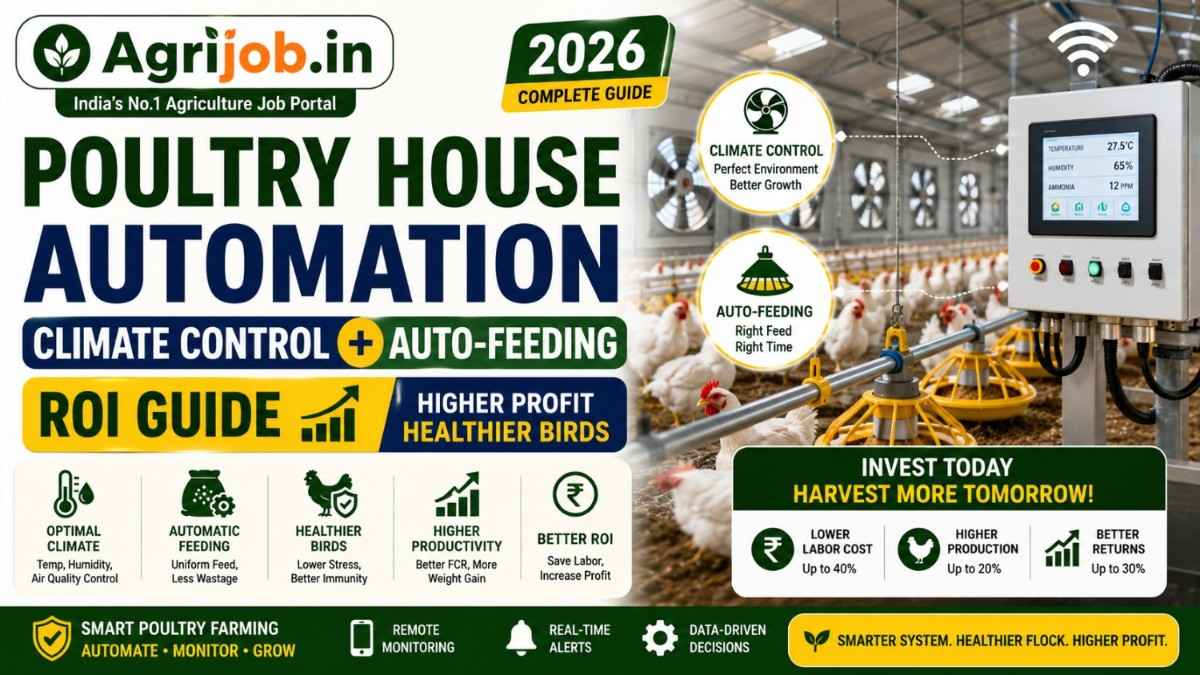
Poultry house automation — combining climate control (fans, cooling pads, sensors) and auto-feeding lines — costs Rs.8–35 lakh for a 10,000-bird Indian farm in 2026. Most farms recover this investment in 2.8–3.5 years through feed savings of 5–10%, mortality reduction of 10–15%, and labour savings of 20–30%, resulting in net monthly income gains of Rs.50,000–Rs.1,40,000 depending on flock size and shed type.
- Automation system cost (10,000 birds): Rs.8–18 lakh (basic IoT) to Rs.20–35 lakh (full EC shed)
- Payback period: 2.8–3.5 years (EC shed) vs 3.9 years (traditional open shed)
- FCR improvement: 0.1–0.2 points with climate-controlled environment
- Mortality reduction: 2–3% lower with EC sheds; 10–15% with early disease detection IoT
- Energy savings: 30–40% reduction in power consumption with smart ventilation
- Labour savings: 20–30% fewer man-hours per batch
- NLM subsidy available: 50% capital subsidy up to Rs.25 lakh for eligible poultry units
- NABARD PVCF subsidy: 25% (general) / 33.33% (SC/ST/NE states) back-ended
- Monthly income gain (10,000 birds): Rs.70,000–Rs.1,40,000 additional vs manual farm
- Global market size (2026): USD 414 million — growing at 3.9% CAGR to 2034
- What Is Poultry House Automation and Why It Matters in 2026
- Who Should Invest in Poultry House Automation?
- Investment Cost Breakdown: Climate Control + Auto-Feeding Systems
- Eligibility and Government Subsidies for Automation in 2026
- How Poultry House Automation Works: Step-by-Step Setup Guide
- EC Shed vs Open Shed: Complete Comparison for Indian Farmers
- Advantages and Disadvantages of Poultry House Automation
- Important Terms and Concepts in Poultry Automation
- ROI and Net Returns: Real Numbers for Indian Poultry Farms
- Important Links and Resources
- Conclusion
- Key Takeaways
- Frequently Asked Questions About Poultry House Automation 2026
What Is Poultry House Automation and Why It Matters in 2026
Poultry house automation is the integration of IoT sensors, electronic controllers, and mechanised equipment to manage temperature, humidity, ventilation, feeding, watering, and lighting inside a poultry shed — without constant manual intervention. In 2026, it is the defining difference between farms that earn Rs.2.5–4.5 lakh per month per 10,000 birds and those barely covering costs.

Feed accounts for 60–70% of total poultry production cost in India, and heat stress alone can cut feed intake and egg production by 10–20% during summer months in states like Andhra Pradesh, Tamil Nadu, and Maharashtra. Automation directly attacks both problems: climate control keeps birds in thermal comfort zones, and auto-feeding lines deliver precise rations that cut waste by 5–10%.
The global poultry house climate controller market was valued at USD 414 million in 2026 and is growing at 3.9% CAGR, driven by rising poultry consumption and farmer adoption of Environmentally Controlled (EC) sheds. India is among the fastest-growing markets in Asia Pacific, with NABARD and NLM subsidies actively supporting this transition.
What Systems Does Poultry House Automation Include?
- Climate control: Temperature and humidity sensors, exhaust fans, evaporative cooling pads, fogging systems, inlet side curtains, and electronic controllers
- Auto-feeding lines: Motorised feed augers, pan feeders, and feed silos that deliver measured rations by bird age and growth stage
- Auto-drinker systems: Nipple drinker lines with water meters and pressure regulators
- Lighting automation: Programmable LED schedules that regulate growth cycles and laying behaviour
- Gas monitoring: CO₂ and ammonia sensors that trigger ventilation to protect flock health
- Remote monitoring: IoT dashboards and mobile apps giving real-time alerts from anywhere
Who Should Invest in Poultry House Automation?
- 🐔 Commercial broiler farmers with 5,000+ birds — at this scale, feed savings alone from a 0.1 FCR improvement cover automation EMIs within two production cycles
- 🥚 Layer farm operators running 10,000+ hens — temperature spikes above 32°C directly cut egg laying rate; climate control protects this revenue daily
- 👨🌾 First-time farmers entering contract farming — integrators like Venky’s, Suguna, and IB Group require EC sheds for premium contracts paying Rs.85–Rs.100+ per bird growing charge
- 📈 Farmers expanding from open sheds to EC housing — payback on incremental investment is 2.8 years vs 3.9 years for a like-for-like open shed
- 💰 Entrepreneurs targeting NABARD or NLM subsidies — automation investments are explicitly eligible under the National Livestock Mission capital subsidy of 50% up to Rs.25 lakh
- 🌡️ Farmers in high-heat states (AP, TN, Maharashtra, Punjab, Telangana) — heat stress losses run into lakhs per batch; climate control is a direct loss-prevention tool
- 👩💼 Women entrepreneurs and SC/ST applicants — NABARD offers 33.33% back-ended subsidy, making automation more affordable than open-shed alternatives
- 🏗️ Existing farm owners upgrading infrastructure — retrofit IoT sensor packages start at Rs.75,000–Rs.1.5 lakh and integrate with existing fans and feeders
Investment Cost Breakdown: Climate Control + Auto-Feeding Systems
The investment in poultry house automation varies significantly by shed type, bird capacity, and technology depth. Based on 2026 Indian market rates, here is what farmers can expect to pay:
Automation Cost by Farm Scale (2026 Indian Prices)
| Farm Scale | EC Shed Construction Cost | Climate Control System | Auto-Feeding Line | IoT / Controller | Total Automation Investment |
|---|---|---|---|---|---|
| 5,000 birds | Rs.18–25 lakh | Rs.2–4 lakh | Rs.1.5–3 lakh | Rs.50,000–1 lakh | Rs.4–8 lakh |
| 10,000 birds | Rs.40–55 lakh | Rs.4–8 lakh | Rs.3–6 lakh | Rs.1–1.5 lakh | Rs.8–15.5 lakh |
| 20,000 birds | Rs.1.13–1.35 crore | Rs.8–14 lakh | Rs.6–12 lakh | Rs.1.5–2.5 lakh | Rs.15.5–28.5 lakh |
Note: EC shed construction costs above include structure, insulation (PIR/PUF/Rockwool), roofing, and basic electrical. Automation costs are for equipment only. Costs vary by location and contractor. Source: KIPL EC Shed project reports and IndiaMART supplier data, July 2026.
Component-Wise Cost Breakdown (10,000-Bird Broiler EC Farm)
| Component | Specification | Approximate Cost (Rs.) |
|---|---|---|
| Exhaust fans (tunnel ventilation) | 8–12 fans, 1.25 m diameter | 2,00,000–3,50,000 |
| Evaporative cooling pads | Cellulose pad wall, 1.5 m height | 80,000–1,40,000 |
| Electronic climate controller | Multi-zone, IoT-enabled | 60,000–1,20,000 |
| Auto-feeding line (pan feeders) | 2 lines × 500 m, 600 pans | 2,50,000–4,50,000 |
| Nipple drinker lines + water meter | 4 lines × 100 m | 80,000–1,40,000 |
| Feed silo (2-tonne capacity) | Galvanised steel | 60,000–1,00,000 |
| Temperature/humidity sensors | 4–6 sensor nodes | 20,000–50,000 |
| Ammonia / CO₂ sensor | 1–2 units | 15,000–35,000 |
| Mobile app / cloud dashboard | Annual subscription | 12,000–30,000/year |
| Electrical wiring + installation | Labour + materials | 80,000–1,50,000 |
| Total (10,000 birds) | Rs.8,57,000–Rs.15,65,000 |
Eligibility and Government Subsidies for Automation in 2026
The Government of India actively supports poultry house automation through two flagship schemes in 2026. Both are operational and accepting applications through their respective portals.
National Livestock Mission (NLM) — 50% Capital Subsidy
The National Livestock Mission, administered by the Department of Animal Husbandry and Dairying (DAHD), provides a 50% capital subsidy up to Rs.25 lakh for establishment of rural poultry farms including infrastructure, equipment, and automation systems. Apply at nlm.udyamimitra.in.
NABARD Poultry Venture Capital Fund (PVCF) — Back-Ended Subsidy
NABARD’s PVCF scheme (channelised through scheduled commercial banks, RRBs, and cooperative banks) provides back-ended capital subsidy for poultry farm investments:
| Category | Subsidy Rate | How It Works |
|---|---|---|
| General Category | 25% of project cost | Bank loan repaid first; subsidy adjusted after 12 months of satisfactory operation |
| SC / ST / Women | 33.33% of project cost | Same back-ended mechanism; higher adjustment amount |
| North East / Hilly States | 33.33% of project cost | Applicable to Sikkim, NE states, and designated hilly regions |
| Minimum bank loan required | 40% of total project cost | Subsidy not available without minimum 40% bank loan component |
| Entrepreneur’s margin (below Rs.1 lakh) | As per RBI norms | Banks may waive margin for micro-loans |
| Repayment period | 5–9 years | Grace period of 6 months to 1 year typically available |
Animal Husbandry Infrastructure Development Fund (AHIDF)
Under AtmaNirbhar Bharat, the AHIDF (Rs.15,000 crore corpus) provides a 3% interest subvention on loans for poultry meat processing and automation infrastructure. Eligible applicants can cover up to 90% of project cost through bank loans with only 10% margin. Apply at ahidf.udyamimitra.in.
How Poultry House Automation Works: Step-by-Step Setup Guide
Setting up a complete climate control and auto-feeding system for your poultry house in 2026 follows this sequence. Each step builds on the last — skipping any one stage reduces system effectiveness significantly.
- Conduct a farm site assessment — Measure shed dimensions, prevailing wind direction, ambient temperature range, and existing electrical capacity. This determines fan sizing (CFM), cooling pad area, and feeder line configuration needed.
- Design your ventilation system first — Tunnel ventilation (negative pressure) is the most effective system for tropical Indian climates. Place high-velocity exhaust fans at one end and cellulose cooling pads at the other end of the shed for cross-ventilation at bird level.
- Install the electronic climate controller — Mount the IoT-enabled central controller in a weatherproof cabinet. Connect it to temperature, humidity, CO₂, and ammonia sensors placed at bird height (not ceiling level) at minimum 3 zones across the shed length.
- Set up the auto-feeding line — Install auger feed lines from the external silo into the shed. Position pan feeders at correct heights for bird age and flock density. Programme feed schedules by day of age (DOA) into the controller.
- Connect drinker lines and water meters — Nipple drinker lines should run parallel to feeder lines with individual pressure regulators. Water consumption data is one of the earliest disease indicators — connect it to your monitoring dashboard.
- Programme your climate parameters — Set target temperature curves by bird age (Day 1: 33–35°C; Day 7: 30–32°C; Day 21+: 24–28°C). Programme alarm thresholds for CO₂ (above 3,000 ppm) and ammonia (above 25 ppm).
- Test all systems before bird placement — Run a 48-hour dry test with all fans, feeders, drinkers, and sensors active. Verify temperature uniformity across the shed (variance under ±1°C). Calibrate all sensors against certified reference devices.
- Connect to remote monitoring app — Activate the mobile dashboard. Verify you receive real-time alerts for temperature excursions, feed motor failures, and water line pressure drops on your smartphone.
Install sensors at bird height, not at ceiling level. Birds breathe air at 15–30 cm from the floor in the first week and at 30–60 cm thereafter. Ceiling-mounted sensors consistently read 3–5°C lower than the actual temperature birds experience — giving you false “all clear” readings during heat stress events. This single correction can save an entire batch.
EC Shed vs Open Shed: Complete Comparison for Indian Farmers
The choice between an Environmentally Controlled (EC) shed and a traditional open-sided shed is the single biggest investment decision for Indian poultry farmers in 2026. Here is how they compare across every dimension that affects profitability:
| Comparison Factor | Open Shed (Traditional) | EC Shed (Automated) |
|---|---|---|
| Construction cost per sq ft | Rs.450–650 | Rs.1,200–1,800 |
| Birds per sq ft (stocking density) | 0.7–0.8 birds | 1.0–1.2 birds (50% more) |
| Temperature control | Seasonal — uncontrolled | Year-round — ±1°C precision |
| Mortality rate | 4–6% per batch | 2–3% per batch |
| FCR (broiler) | 1.8–2.0 | 1.6–1.8 |
| Feed waste | 8–12% | 3–5% |
| Labour per 10,000 birds | 4–5 workers | 2–3 workers |
| Annual electricity cost | Rs.60,000–80,000 | Rs.40,000–55,000 (smart ventilation) |
| Shed lifespan | 8–12 years | 20–25 years |
| Payback period | 3.5–3.9 years | 2.8–3.2 years |
| Monthly net income (10,000 birds) | Rs.1,80,000–Rs.2,50,000 | Rs.2,50,000–Rs.4,50,000 |
| Contract farming eligibility | Varies (lower-tier contracts) | Required for premium Venky’s/Suguna EC contracts |
For any new poultry farm above 5,000 birds in India in 2026, we recommend EC sheds with full climate automation over traditional open sheds — even accounting for the higher upfront cost. The 50% higher stocking density, 2-year shorter payback, and premium contract farming eligibility make the incremental investment strongly positive. Use the NLM 50% subsidy (up to Rs.25 lakh) to fund the difference. Open sheds are still viable for farms below 2,000 birds with tight capital constraints, but expanding them later costs more than building right the first time.
Advantages and Disadvantages of Poultry House Automation
Advantages
- ✅ 18–22% overall efficiency improvement over manual management (global benchmark, IoT climate controller studies 2026)
- ✅ FCR improves by 0.1–0.2 points with precise feeding and climate control — on a 10,000-bird farm, this means Rs.50,000–Rs.80,000 saved per batch in feed cost alone
- ✅ Mortality drops 2–3% in EC sheds vs open sheds — at Rs.50 per bird dead, this saves Rs.10,000–Rs.15,000 per 10,000-bird batch
- ✅ Labour requirements cut by 20–30% — reduces payroll cost by Rs.20,000–Rs.35,000/month on a 10,000-bird farm
- ✅ Remote monitoring via mobile app eliminates the need for overnight farm supervisors for basic alerts
- ✅ Energy savings of 30–40% through demand-based ventilation compared to manual fan operation
Disadvantages
- ❌ High upfront capital requirement — Rs.8–35 lakh automation investment is beyond reach for small farmers without subsidy support or bank financing
- ❌ Power dependency is critical — EC sheds require uninterrupted electricity; a generator backup (Rs.1–2 lakh) is mandatory, adding to capex
- ❌ Technical knowledge gap — operating IoT controllers, calibrating sensors, and troubleshooting software requires training that most rural farmers currently lack
- ❌ Maintenance complexity — cooling pad clogging, fan belt failures, and sensor drift require regular scheduled maintenance; neglect quickly erodes efficiency gains
Important Terms and Concepts in Poultry Automation
Understanding these key terms helps farmers evaluate vendors, compare quotes, and make better automation investment decisions:
- FCR (Feed Conversion Ratio): Kilograms of feed required to produce 1 kg of live body weight. Industry benchmark for broilers: 1.6–1.8 with automation vs 1.8–2.0 in open sheds. Every 0.1 FCR improvement saves Rs.35,000–Rs.55,000 per 10,000-bird batch at current feed prices.
- EC Shed (Environmentally Controlled Shed): A fully insulated, closed poultry house with automated tunnel ventilation, cooling pads, and electronic climate controllers. Costs Rs.1,200–1,800 per sq ft vs Rs.450–650 for open sheds but delivers 20–25 year lifespan and 50% higher stocking density.
- Tunnel Ventilation (Negative Pressure): A ventilation design where exhaust fans create negative pressure that pulls fresh air through cellulose cooling pads at one end of the shed. This delivers uniform wind-chill across the entire flock — the most effective cooling method for Indian tropical climates.
- Evaporative Cooling Pads: Cellulose or corrugated paper pads kept wet by a recirculating pump. Incoming air passes through them and cools by 6–10°C through evaporation — the primary cooling mechanism in Indian EC sheds.
- IoT Controller (Farm Management Controller): The central brain of automation — reads sensor data, executes programmed climate curves, controls fans and feeding motors, and sends alerts to the farmer’s mobile app. Leading brands in India include Fancom, SKOV, and domestic IoT providers.
- Heat Stress: Physiological condition when ambient temperature exceeds a bird’s thermal comfort zone (above 27–28°C for adult broilers). Even 2 hours of daily heat stress reduces daily weight gain by 30–40 grams and increases mortality. EC sheds eliminate this entirely.
- Auto-Feeding Line: An electromechanical feed distribution system using motorised augers to carry feed from external silos into the shed and distribute it to pan feeders at programmed intervals. Reduces feed waste from 8–12% (manual) to 3–5%.
- Ammonia Monitoring: Ammonia from bird litter builds up in poorly ventilated sheds, damaging respiratory tracts and increasing disease susceptibility. Automated ventilation triggered by NH₃ sensors keeps ammonia below 25 ppm — the safe threshold for broilers.
- Digital Agriculture Mission: Government of India’s 2023–2028 initiative promoting IoT and data-driven farming, under which poultry automation investments receive policy support and potential credit-linked subsidy through allied schemes.
- AHIDF (Animal Husbandry Infrastructure Development Fund): Rs.15,000 crore fund offering 3% interest subvention on loans for poultry infrastructure including automation equipment, covering up to 90% of project cost with only 10% borrower contribution.
ROI and Net Returns: Real Numbers for Indian Poultry Farms
The following analysis is based on a 10,000-bird broiler farm running 6 batches per year with contract farming arrangements, comparing manual open-shed vs full EC shed with automation. All figures use 2026 Indian market rates.
Annual Savings from Automation (10,000-Bird Farm, 6 Batches/Year)
| Saving Category | Calculation Basis | Annual Saving (Rs.) |
|---|---|---|
| Feed cost saving (FCR improvement 0.15 points) | 1.5 kg/bird × 10,000 birds × 6 batches × Rs.25/kg | 2,25,000 |
| Feed waste reduction (8% → 4%) | 4% of 20,000 kg feed/batch × 6 batches × Rs.25/kg | 30,000 |
| Mortality reduction (4% → 2%) | 200 fewer dead birds/batch × 6 batches × Rs.50 value/bird | 60,000 |
| Labour saving (2 fewer workers) | 2 workers × Rs.12,000/month × 12 months | 2,88,000 |
| Higher bird weight premium | +100g/bird × 10,000 birds × 6 batches × Rs.100/kg | 60,000 |
| Energy saving (30% reduction) | 30% of Rs.70,000 annual electricity cost | 21,000 |
| Total Annual Saving | Rs.6,84,000 |
ROI Calculation: 10,000-Bird EC Shed Automation
| Parameter | Value |
|---|---|
| Total automation investment | Rs.12 lakh (mid-range, 10,000 birds) |
| NLM subsidy (50%, up to Rs.25 lakh) | Rs.6 lakh adjustment (if eligible) |
| Net investment after subsidy | Rs.6 lakh |
| Annual savings generated | Rs.6,84,000 |
| Payback period (without subsidy) | 21 months (under 2 years) |
| Payback period (with 50% NLM subsidy) | 10–11 months |
| 10-year net return on automation investment | Rs.68.4 lakh savings against Rs.12 lakh investment |
Monthly Income Comparison: Automated vs Manual Farm
| Farm Type | Monthly Net Income (10,000 Birds) | Key Driver |
|---|---|---|
| Traditional open shed, manual management | Rs.1,80,000–Rs.2,50,000 | High feed waste, labour cost, seasonal mortality |
| EC shed with climate control only | Rs.2,50,000–Rs.3,20,000 | Lower mortality, better FCR, premium contracts |
| Full EC automation (climate + auto-feed + IoT) | Rs.3,00,000–Rs.4,50,000 | All savings stacked: feed + labour + mortality + weight |
| Layer farm, 10,000 hens, full automation | Rs.3,00,000–Rs.4,00,000 | Stable laying rate, energy efficiency, lower manpower |
Important Links and Resources
| Resource | Link |
|---|---|
| National Livestock Mission — Official Scheme Page | dahd.gov.in |
| NLM Online Application Portal | nlm.udyamimitra.in |
| NABARD Poultry Venture Capital Fund | nabard.org |
| AHIDF Application Portal | ahidf.udyamimitra.in |
| ICAR Poultry Research — Technical Guidance | icar.org.in |
| Poultry Farm Business Plan 2026 — Agrijob.in | Poultry Farming Business Plan Guide |
| NABARD Agriculture Loan Schemes 2026 — Agrijob.in | NABARD Agriculture Loan Schemes 2026 |
| Dairy Farm Business Plan India 2026 — Agrijob.in | Dairy Farm Business Plan India 2026 |
Conclusion: Is Poultry House Automation Worth It in 2026?
Poultry house automation — combining climate control with auto-feeding systems — is not a luxury for Indian commercial farmers in 2026; it is the lowest-risk, fastest-payback capital investment available in the sector. A 10,000-bird EC shed generates Rs.6.84 lakh in annual savings against an automation investment of Rs.8–15 lakh, delivering full payback in under 2 years without subsidy and under 12 months with the NLM 50% capital subsidy.
Whether you are setting up a new farm or upgrading an existing open shed, start your automation journey by applying for NLM subsidy at nlm.udyamimitra.in and preparing a Detailed Project Report with the help of your nearest NABARD-linked bank. Bookmark this page — we update it whenever government scheme terms or market rates change.
- Poultry house automation (climate control + auto-feeding) costs Rs.8–15 lakh for a 10,000-bird farm in 2026 and pays back in 2.8–3.5 years without subsidy
- NLM provides a 50% capital subsidy up to Rs.25 lakh; NABARD PVCF offers 25–33.33% back-ended subsidy — dramatically improving ROI
- FCR improves by 0.1–0.2 points with automation, saving Rs.2.25 lakh per year in feed cost on a 10,000-bird farm running 6 batches
- EC sheds reduce mortality by 2–3% and labour by 20–30% — adding Rs.3.5 lakh+ in combined annual savings over manual management
- Smart climate control eliminates heat stress losses that cost Indian broiler farmers Rs.10,000–Rs.50,000 per batch during summer months
- Apply at nlm.udyamimitra.in for NLM subsidy; approach any NABARD-linked bank with a DPR to activate PVCF back-ended subsidy
Frequently Asked Questions About Poultry House Automation 2026
What is poultry house automation and what does it include?
Poultry house automation is the use of IoT sensors, electronic climate controllers, auto-feeding lines, auto-drinker systems, and programmable lighting to manage a poultry shed with minimal manual labour. A complete system for a 10,000-bird broiler farm includes exhaust fans, evaporative cooling pads, a central controller, two auto-feeder lines with pan feeders, nipple drinker lines, and a mobile monitoring app. In 2026, costs range from Rs.8 lakh (basic IoT retrofit) to Rs.35 lakh (full EC shed build-out) for a 10,000-bird operation in India.
How much does a climate control system cost for a poultry farm in India?
A climate control system for a 10,000-bird poultry house in India costs approximately Rs.4–8 lakh in 2026, covering exhaust fans (Rs.2–3.5 lakh), evaporative cooling pads (Rs.80,000–1.4 lakh), electronic controller (Rs.60,000–1.2 lakh), and temperature/ammonia sensors (Rs.35,000–85,000). This is separate from the EC shed construction cost (Rs.40–55 lakh). For a 5,000-bird farm, climate control alone costs Rs.2–4 lakh.
What government subsidy is available for poultry house automation in 2026?
Two main subsidies are available in 2026. The National Livestock Mission (NLM), administered by the Department of Animal Husbandry and Dairying, provides a 50% capital subsidy up to Rs.25 lakh for eligible poultry farm establishments including automation equipment — apply at nlm.udyamimitra.in. NABARD’s Poultry Venture Capital Fund provides a back-ended subsidy of 25% for general category farmers and 33.33% for SC/ST and North East state applicants, channelised through scheduled commercial banks after 12 months of operation. The AHIDF additionally offers 3% interest subvention on loans for poultry infrastructure with 90% project cost coverage.
How much does an auto-feeding system cost for 10,000 poultry birds?
An auto-feeding line system for 10,000 birds costs Rs.3–6 lakh in India in 2026. This includes a 2-tonne galvanised steel external feed silo (Rs.60,000–1 lakh), two motor-driven auger feed lines each approximately 100 metres long, and approximately 600 pan feeders. The system reduces feed waste from 8–12% (manual) to 3–5% and eliminates the need for 1–2 full-time feed workers, generating savings of Rs.25,000–40,000 per month on a 10,000-bird farm.
What is the ROI and payback period for poultry automation in India?
A 10,000-bird broiler farm investing Rs.12 lakh in full poultry house automation can expect annual savings of Rs.6.84 lakh from combined feed, labour, mortality, and energy reductions. This gives a payback period of approximately 21 months without subsidy, and under 12 months when the NLM 50% capital subsidy is applied. Over 10 years, the automation investment generates Rs.68.4 lakh in cumulative savings against a one-time investment of Rs.12 lakh — an ROI of approximately 470%.
What is the difference between an EC shed and a traditional open poultry shed?
An EC (Environmentally Controlled) shed is a fully insulated, closed poultry house with automated tunnel ventilation, evaporative cooling pads, and electronic climate controllers that maintain temperature within ±1°C year-round. Traditional open sheds use manual curtain systems with no climate precision. EC sheds cost Rs.1,200–1,800 per sq ft vs Rs.450–650 for open sheds, but house 50% more birds per sq ft, reduce mortality by 2–3%, improve FCR by 0.15–0.2 points, and have a 20–25 year lifespan vs 8–12 years for open sheds.
How does climate control improve Feed Conversion Ratio (FCR) in poultry?
Climate control improves FCR by keeping birds within their thermal comfort zone (24–28°C for adult broilers), which means birds use feed energy for growth rather than thermoregulation. When ambient temperature rises above 28°C, broilers reduce feed intake by 1–1.5% per degree Celsius rise and divert energy to cooling themselves — this directly worsens FCR. Automated climate control eliminates heat stress entirely, consistently delivering an FCR improvement of 0.1–0.2 points compared to open sheds. On a 10,000-bird farm running 6 batches per year, this saves Rs.2.25 lakh annually in feed costs.
Can small poultry farms with fewer than 5,000 birds benefit from automation?
Yes, but the approach is different. For farms below 5,000 birds, full EC shed automation is typically not cost-effective without subsidy. Instead, these farmers benefit most from entry-level IoT retrofit packages — temperature and humidity sensors with basic fan automation (Rs.50,000–Rs.1.5 lakh) and manual feeding with feed waste reduction trays. Research published by EPRA Journals (May 2026) showed that even a low-cost IoT monitoring system using NodeMCU ESP8266 microcontrollers significantly reduces heat stress and feeding errors on small Indian farms at a cost of under Rs.1 lakh.
What is the ideal temperature to maintain in a poultry house?
Optimal temperature targets in a poultry house vary by bird age. For broiler chicks in the first week (Day 1–7), maintain 33–35°C to prevent chilling. From Day 8–14, reduce to 30–32°C. From Day 15–21, target 28–30°C. After Day 21 through market age, maintain 24–28°C. For adult layer hens, the optimal range is 18–24°C for peak egg production. Automated climate controllers programmed with these temperature curves maintain conditions without human intervention, preventing both chilling (early weeks) and heat stress (later weeks) — the two biggest mortality causes in Indian poultry houses.
How do I apply for NABARD subsidy for poultry automation?
To apply for NABARD’s Poultry Venture Capital Fund subsidy for poultry automation, prepare a Detailed Project Report (DPR) covering your shed specifications, automation equipment list with costs, and projected income and repayment schedule. Submit this to any scheduled commercial bank, Regional Rural Bank (RRB), or cooperative bank affiliated with NABARD. The bank sanctions the term loan, disburses funds, and after 12 months of satisfactory operation, NABARD releases the back-ended subsidy (25% or 33.33%) which is adjusted against your outstanding loan principal. Register on Udyam MSME portal before applying to improve loan eligibility. For NLM 50% subsidy, apply directly at nlm.udyamimitra.in.
This guide is reviewed and updated regularly for accuracy. Subsidy rates, scheme eligibility, and automation equipment prices change periodically. Bookmark this page and check back before making investment decisions. Always verify current subsidy amounts and application procedures directly with your nearest NABARD office or at the official NLM portal before investing.
The financial projections and ROI figures in this article are estimates based on publicly available market data and industry benchmarks for 2026. Actual returns will vary based on bird breed, local feed prices, market rates, farm management practices, and geographic location. This is not financial or investment advice. Consult a NABARD-empanelled consultant or your district Animal Husbandry Officer before making capital investment decisions. All government scheme details are subject to revision — verify at official government portals before applying.