
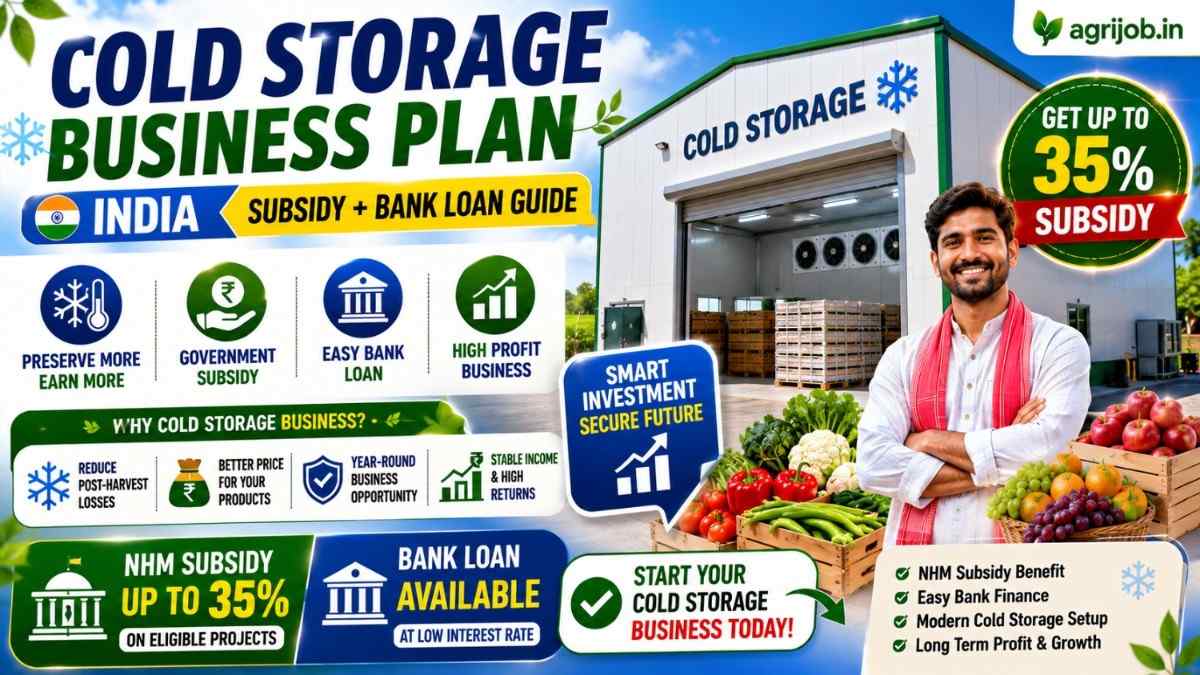
Cold Storage Business Plan India 2026
A cold storage business plan India 2026 is one of the most reliable ways for farmers, FPOs and rural entrepreneurs to earn steady income from India’s Rs.4,600 crore post-harvest infrastructure push. This guide is for anyone — a progressive farmer, an FPO board member, or a first-time agri-entrepreneur — who wants to combine a government subsidy of up to Rs.25 lakh under the NHM scheme with a bank term loan to set up a viable cold storage unit. This guide covers everything: real subsidy percentages, project cost per MT, the exact bank loan process, eligibility, application steps, a full feasibility breakdown, and a comparison against renting warehouse space instead.

📋 Table of Contents
- What Is a Cold Storage Business in India?
- Key Facts at a Glance
- NHM Subsidy & Money: How Rs.25 Lakh Works
- Cold Storage Project Cost Breakdown (Per MT)
- Eligibility & Application Fee
- Bank Loan Process: NABARD & AIF
- Step-by-Step Application Process
- Who Should Apply for Cold Storage Subsidy?
- Feasibility Report: Revenue & Break-Even
- Cold Storage Ownership vs Renting Warehouse Space
- High-Value Cold Chain Terms You Must Know
- Glossary of Key Terms
- FAQs
What Is a Cold Storage Business in India?
A cold storage business involves building a temperature-controlled warehouse where fruits, vegetables, spices, dairy or other perishable produce is stored to extend shelf life and reduce post-harvest losses. In India, this sits at the centre of government policy because national post-harvest losses in fruits range from 6% to 15% and in vegetables from 5% to 12%, according to a 2022 NABCONS study commissioned by the Ministry of Food Processing Industries. Every cold storage unit built reduces this waste and gives farmers better bargaining power against distress selling. That is exactly why the National Horticulture Mission (NHM), National Horticulture Board (NHB), NABARD, and the Agriculture Infrastructure Fund (AIF) all offer combined support — capital subsidy plus concessional bank loans — to entrepreneurs willing to set one up.

Key Facts at a Glance
🔑 Key Facts: Cold Storage Business Plan India 2026
- Scheme: NHM / MIDH Capital Investment Subsidy + Bank Term Loan
- Subsidy Rate: 35% (General Areas) / 50% (NE, Hilly & Scheduled Areas)
- Typical Subsidy Amount: Rs.20-25 lakh on a Rs.65-75 lakh project
- Max Capacity Under NHM: Up to 5,000 MT per project
- Bank Loan Share: 65-75% of project cost (up to 95% for cooperatives)
- Loan Tenure: 7-11 years, with 1-2 year moratorium
- Subsidy Type: Credit-linked, back-ended (released after project completion)
- Implementing Agency: State Horticulture Mission / NHB / NABARD
- Application Mode: Online DPR submission + offline bank loan tie-up
NHM Subsidy & Money: How the Rs.25 Lakh Figure Works
The core financial pillar of any cold storage business plan India 2026 is understanding exactly how the subsidy is calculated. Under the National Horticulture Mission, a sub-scheme of the Mission for Integrated Development of Horticulture (MIDH), the Department of Agriculture & Farmers Welfare provides a credit-linked, back-ended subsidy at 35% of the capital cost of the project in general areas and 50% in North-Eastern, Hilly and Scheduled Areas, for cold storage and Controlled Atmosphere (CA) store units up to 5,000 MT capacity. This is why entrepreneurs building a mid-sized unit costing around Rs.65-75 lakh commonly receive a subsidy close to Rs.25 lakh — the number quoted widely in agri-finance circles for 2026.
| Cold Storage Capacity | Approx. Project Cost | Subsidy Rate | Subsidy Amount (Approx.) |
|---|---|---|---|
| 500 MT (single chamber) | Rs.40-50 lakh | 35% | Rs.14-17.5 lakh |
| 1,000 MT (multi-chamber) | Rs.65-75 lakh | 35% | Rs.22.75-26.25 lakh |
| 2,000 MT (multi-chamber) | Rs.1.2-1.5 crore | 35% | Rs.42-52.5 lakh |
| 5,000 MT (max NHM limit) | Rs.3-4 crore | 35% | Rs.1.05-1.4 crore |
| 1,000 MT (NE/Hilly/Scheduled Area) | Rs.65-75 lakh | 50% | Rs.32.5-37.5 lakh |
Beyond NHM, entrepreneurs building larger capacity (above 5,000 MT and up to 10,000 MT) can apply to the National Horticulture Board (NHB) instead, which offers the same 35-50% subsidy rate but with a higher project ceiling — the maximum subsidy per project cannot exceed Rs.7.5 crore. For integrated cold chain projects that include processing and value addition, the MoFPI Pradhan Mantri Kisan SAMPADA Yojana component offers grant-in-aid at 35-50% for storage/transport infrastructure and 50-75% for value-addition infrastructure, capped at Rs.10 crore per project — though standalone cold storages without processing are not covered under this specific PMKSY component.
Cold Storage Project Cost Breakdown (Per MT)
Annual earning potential depends heavily on getting the project cost structure right from day one. A realistic cold storage business plan budgets for land, civil construction, refrigeration plant, insulation, and working capital separately, since lenders and subsidy committees scrutinise each head in the Detailed Project Report (DPR).
| Cost Head | Approx. Share of Project Cost | Notes |
|---|---|---|
| Land (owned/leased) | 10-15% | Clear title or registered lease required |
| Civil construction & insulation | 35-40% | PUF panels, flooring, loading dock |
| Refrigeration plant & machinery | 30-35% | Compressors, condensers, evaporators |
| Electrical installation & backup power | 8-10% | Generator set is a major recurring cost saver |
| Pre-operative & working capital | 5-8% | Staff, insurance, first-year running cost |
Eligibility & Application Fee
Eligibility for NHM and NHB cold storage subsidy is broad by design, covering individual entrepreneurs, partnership firms, private and public limited companies, cooperatives, Self Help Groups, Farmer Producer Organisations (FPOs), and Central/State PSUs. There is no separate government “application fee” for the subsidy itself — the real cost lies in preparing a bank-appraisal-ready DPR, which typically costs Rs.15,000-50,000 depending on project size and the technical consultant engaged.
- ✅ Applicant must hold clear land title or a registered leasehold right
- ✅ Only one project per family or legal entity is eligible under NHB rules
- ✅ Project must follow NCCD technical standards and WDRA norms
- ✅ DPR, Basic Data Sheet and Technical Standards must match NHB/NHM prescribed formats
- ✅ Bank in-principle loan approval is mandatory before construction begins
- ✅ FPOs, SC/ST, women and Panchayat-backed applicants often get priority scoring
Bank Loan Process: NABARD & Agriculture Infrastructure Fund
Since NHM and NHB subsidies are back-ended, a bank term loan is not optional — it is the backbone of project funding until the subsidy is credited after completion. NABARD supports this through its Warehouse Infrastructure Fund, refinancing commercial banks, RRBs, cooperative banks and State Financial Corporations for cold storage projects with a minimum aggregate capacity of 5,000 MT. Private entrepreneurs and companies can access up to 75% of project cost with 7+ year tenure, while cooperatives, federations and government-sponsored agencies can access up to 95% financing. Interest is charged at NABARD’s Prime Lending Rate plus a Risk Premium (and a Tenor Premium for loans beyond 7 years).
For smaller entrepreneurs who don’t meet the 5,000 MT NABARD threshold, the Agriculture Infrastructure Fund (AIF) is the more practical route. AIF does not give a direct capital subsidy — instead it provides a 3% interest subvention on term loans up to Rs.2 crore per project, for a period of 7 years, sanctioned through any scheduled bank, NBFC or cooperative bank. Combined with an NHM capital subsidy, this materially reduces both the upfront cost and the ongoing EMI burden, which is why most successful cold storage business plan applications in 2026 stack AIF interest subvention with NHM back-ended subsidy.
| Funding Source | Type of Support | Loan/Grant Share | Tenure |
|---|---|---|---|
| NHM (MIDH) | Back-ended capital subsidy | 35-50% of project cost | Released post-completion |
| NHB | Back-ended capital subsidy | 35-50%, max Rs.7.5 Cr | Released post-completion |
| NABARD Warehouse Infra Fund | Refinanced term loan | 75-95% of project cost | 7-11 years |
| Agriculture Infrastructure Fund | 3% interest subvention | Up to Rs.2 crore loan | 7 years |
💡 Pro Tip: Apply for bank in-principle loan approval before submitting your DPR to the State Horticulture Mission or NHB. Almost every cold storage subsidy rejection in 2026 traces back to a missing or delayed bank sanction letter — get this locked first, then move to the subsidy portal.
Step-by-Step Application Process
- Prepare a concept note and validate feasibility with your nearest Krishi Vigyan Kendra, NABARD District Development Manager, or State Horticulture Department office.
- Get a Detailed Project Report (DPR) prepared in the NHM/NHB prescribed format, including Basic Data Sheet and technical specifications compliant with NCCD standards.
- Approach a scheduled bank or cooperative bank for in-principle term loan approval based on the DPR.
- Submit the online application for In-Principle Approval (IPA) on the NHB portal (nhb.gov.in) or through your State Horticulture Mission for NHM cases.
- Once IPA is granted, get the term loan formally sanctioned and disbursed by your bank.
- Begin construction only after loan sanction — starting earlier can disqualify the project from subsidy eligibility.
- Complete construction, install refrigeration machinery, and obtain WDRA/NCCD compliance certification.
- Request a joint physical inspection by the sanctioning agency and lending bank to verify the completed project against the DPR.
- Subsidy is credited to the Subsidy Reserve Fund account maintained with your lending bank, and adjusted against your loan.
Who Should Apply for Cold Storage Subsidy?
- 🧑🌾 Progressive farmers with 1-3 acres of land near a mandi or production cluster
- 👩🌾 Women entrepreneurs and Self Help Group members seeking priority scoring
- 🏢 FPOs looking to add value-chain infrastructure for member farmers
- 🤝 Cooperative societies wanting higher loan coverage of up to 95%
- 📦 Traders and commission agents already handling perishable produce
- 🌾 SC/ST category promoters eligible for enhanced subsidy consideration
- 🏭 Small agri-business owners diversifying from trading into storage infrastructure
- 🌍 Export-oriented entrepreneurs needing pre-shipment cold chain capacity
Feasibility Report: Revenue & Break-Even for a 1,000 MT Unit
A step-by-step feasibility report is the single most important document a bank appraisal officer checks before sanctioning a term loan. For a representative 1,000 MT multi-chamber cold storage costing Rs.70 lakh, here is how the numbers typically work in a general area, assuming a 35% NHM subsidy of roughly Rs.24.5 lakh:
| Feasibility Metric | Approx. Figure |
|---|---|
| Total Project Cost | Rs.70 lakh |
| NHM Subsidy (35%) | Rs.24.5 lakh |
| Bank Term Loan (65-70%) | Rs.46-49 lakh |
| Promoter’s Margin Money | Rs.5-8 lakh |
| Average Rental Rate | Rs.6-9 per bag/month (varies by crop & region) |
| Realistic Annual Occupancy | 60-75% (higher during peak harvest season) |
| Estimated Annual Gross Revenue | Rs.14-20 lakh |
| Annual Operating Cost (power, staff, maintenance) | Rs.6-9 lakh |
| Typical Break-Even Period | 4-6 years post-subsidy credit |
Power cost is consistently the largest recurring expense in any cold storage business, often 40-50% of total operating cost. Entrepreneurs who invest in energy-efficient compressors, proper PUF insulation, and where possible a rooftop solar backup, materially improve their break-even timeline and long-term margins.
Cold Storage Ownership vs Renting Warehouse Space
| Factor | Own Cold Storage (Subsidy + Loan) | Renting Warehouse Space |
|---|---|---|
| Upfront Investment | Rs.5-8 lakh margin money (after subsidy + loan) | Minimal to none |
| Long-Term Cost | Lower after loan closure | Recurring rent, rises every year |
| Control Over Storage Quality | Full control on temperature & handling | Dependent on third-party operator |
| Income Potential | Earn rental income from other farmers too | None — pure cost centre |
| Government Support | 35-50% subsidy + concessional loan | Not applicable |
| Time to Operational | 12-18 months (construction + approvals) | Immediate |
| Asset Creation | Builds a durable business asset | No asset ownership |
| Best For | Entrepreneurs, FPOs, cooperatives with land | Small farmers needing short-term storage only |
🏆 Expert Verdict: If you have access to land and can arrange the 8-12% margin money, owning a subsidised cold storage unit outperforms renting within 5-6 years and converts into a long-term income asset. Renting only makes sense as a short-term bridge while your own project is under construction.
High-Value Cold Chain Terms You Must Know
- Back-ended subsidy: Government grant released only after project completion and joint inspection, not upfront.
- Controlled Atmosphere (CA) storage: Advanced storage that regulates oxygen and CO2 levels to extend shelf life, commanding higher rental rates than standard cold storage.
- Detailed Project Report (DPR): The technical and financial blueprint required for both bank loan sanction and subsidy approval.
- Interest subvention: A government-funded reduction in loan interest rate, such as the 3% AIF subvention on cold storage loans up to Rs.2 crore.
- Subsidy Reserve Fund: A bank-held account where back-ended subsidy is parked and adjusted against the term loan.
- WDRA compliance: Warehouse Development and Regulatory Authority standards that storage infrastructure must meet to qualify for institutional financing.
- NCCD standards: National Centre for Cold-chain Development technical protocols that all subsidised cold storage projects must follow.
- Margin money: The entrepreneur’s own capital contribution, typically 8-15% of total project cost after loan and subsidy.
Glossary of Key Terms
- NHM: National Horticulture Mission, sub-scheme under MIDH offering cold storage capital subsidy
- NHB: National Horticulture Board, handles larger cold storage capacity subsidy
- MIDH: Mission for Integrated Development of Horticulture, the parent umbrella scheme
- AIF: Agriculture Infrastructure Fund, offers 3% interest subvention on post-harvest infra loans
- MT: Metric Tonne, standard unit for measuring cold storage capacity
- IPA: In-Principle Approval issued before loan disbursement and construction start
For official scheme guidelines and updates, refer to the National Horticulture Board capital investment subsidy page, the NABARD Warehouse Infrastructure Fund scheme, the Agriculture Infrastructure Fund portal, and the PIB release on MIDH cold storage assistance for the most current subsidy notifications before applying.
Frequently Asked Questions
How much subsidy is available for a cold storage business in India in 2026?
Under the NHM/MIDH scheme, entrepreneurs can get a credit-linked back-ended subsidy of 35% of the capital cost in general areas and 50% in North-Eastern, Hilly and Scheduled Areas, for cold storage capacity up to 5,000 MT. On a typical Rs.70 lakh project this works out to roughly Rs.24-25 lakh subsidy, which is where the commonly quoted Rs.25 lakh NHM subsidy figure comes from.
What is the minimum investment to start a cold storage business plan in India?
A small 500 MT single-chamber cold storage typically costs Rs.35-50 lakh, while a 5,000 MT multi-chamber unit can cost Rs.2.5-4 crore depending on location, technology and civil work. Most entrepreneurs fund 10-25% as margin money, 65-75% through a bank term loan, and claim the balance as back-ended subsidy after project completion.
Which bank gives loans for cold storage projects under NABARD?
NABARD refinances cold storage and warehouse loans through commercial banks, RRBs, cooperative banks and State Financial Corporations. Entrepreneurs apply directly to their branch bank, which sanctions the term loan and then claims refinance support from NABARD, subject to WDRA and NCCD technical compliance.
Is NHM subsidy released before or after construction of the cold storage?
NHM subsidy is back-ended, meaning it is released only after the cold storage is fully constructed, the bank term loan is disbursed, and a joint physical inspection confirms the project matches the approved Detailed Project Report. The subsidy amount is then credited to the Subsidy Reserve Fund account maintained with the lending bank.
What documents are required for a cold storage subsidy application?
Core documents include Aadhaar and PAN of the applicant, land ownership or registered lease documents, a Detailed Project Report (DPR) prepared as per NHM/NHB format, bank in-principle loan approval letter, vendor quotations for cooling equipment, and entity registration certificates for FPOs, cooperatives or companies applying.
Can a small farmer or FPO apply for cold storage subsidy under NHM?
Yes. NHM cold storage subsidy is open to individual entrepreneurs, farmers, Farmer Producer Organisations (FPOs), Self Help Groups, cooperatives, partnership firms and private companies. FPOs and SC/ST/women promoters often get priority scoring in state-level project approval committees.
What is the difference between NHM and NHB cold storage subsidy schemes?
NHM (under MIDH) covers new cold storage and CA store projects up to 5,000 MT capacity with 35-50% subsidy, implemented through State Horticulture Missions. NHB covers larger cold storage projects above 5,000 MT and up to 10,000 MT, with a similar 35-50% subsidy rate but a higher project ceiling, implemented directly by the National Horticulture Board.
How long does it take to get cold storage subsidy approval in India?
From DPR submission to subsidy credit, the typical timeline is 6 to 18 months, covering in-principle approval, bank loan sanction, construction, joint physical inspection, and final subsidy release. Delays usually happen at the bank loan sanction and joint inspection stages, so keeping documentation complete speeds up the process.
Is cold storage business profitable in India in 2026?
Cold storage remains a strong evergreen agribusiness because post-harvest losses in fruits and vegetables still run between 6% and 15% nationally, creating consistent rental demand from farmers, traders and FPOs. Profitability depends on location near a mandi or production cluster, occupancy rate through the year, and controlling power costs, which are the single largest recurring expense.
This guide is regularly reviewed and updated for accuracy. Bookmark this page for the latest cold storage subsidy and bank loan notifications for 2026.
Last Updated: July 2026