

Business Type: Spice Processing & Packaging Unit
Total Investment Needed: Rs.12 Lakh – Rs.25 Lakh
Core Subsidy: PMFME 35% (up to Rs.10 Lakh) / PMEGP 15-35%
Mandatory Registrations: FSSAI + Udyam (MSME) + APEDA
Setup Time: 60–90 Days
Break-even Period: 18–30 Months
Eligible Applicants: Individuals, Partnerships, FPOs, SHGs, Companies
Application Mode: 100% Online (FoSCoS, Udyam, PMFME, APEDA Portals)
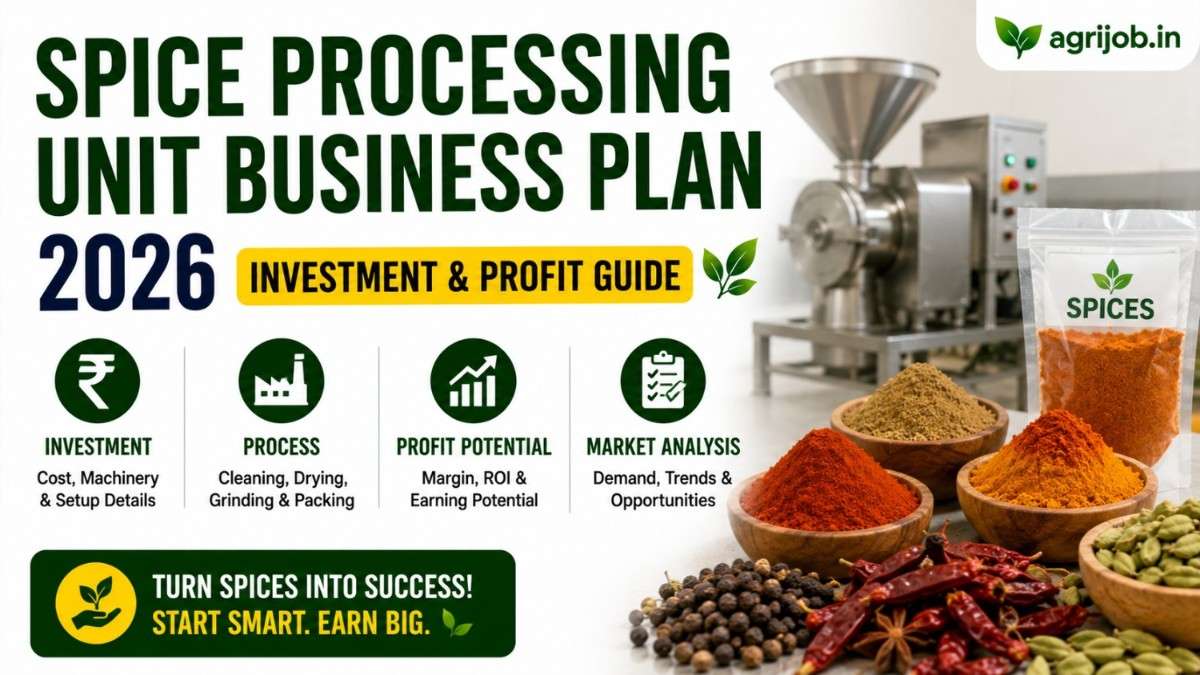
The spice processing unit business plan 2026 is one of the most accessible agri-business opportunities for Indian entrepreneurs right now, combining a Rs.12 lakh entry-level investment with steady, **non-seasonal household demand**. This guide is built for first-generation entrepreneurs, FPOs, SHGs and existing kirana traders who want to move from trading raw spices to **branded, FSSAI-compliant powders**. Whether you’re targeting turmeric, chilli, coriander or blended masalas, this guide covers everything: machinery and investment breakdown, FSSAI + Udyam + APEDA registration steps, government subsidy stacking (PMFME, PMEGP, MSE-SPICE), income projections, and a step-by-step application process to get your unit running within 90 days.

- Why a Spice Processing Unit Business Plan 2026 Makes Sense
- Investment & Money: Rs.12 Lakh Cost Breakdown
- FSSAI License: Eligibility, Process & Fees
- MSME Udyam Registration: Eligibility & Benefits
- APEDA Registration: Process for Spice Exporters
- Government Subsidy Schemes: PMFME, PMEGP & MSE-SPICE
- Step-by-Step Application Process
- Who Should Apply for This Spice Processing Unit Business Plan?
- Spice Processing Unit vs Raw Spice Trading
- High-Value Spice Business Terms You Must Know
- Frequently Asked Questions
Why a Spice Processing Unit Business Plan 2026 Makes Sense
India remains the world’s largest spice producer, consumer and exporter, and the domestic spice market itself reached a value of around Rs.94,927 crore in 2025 and is projected to grow at roughly 9.20% CAGR through 2035. On the export side, India shipped about 1.799 million tonnes of spices and spice products in FY 2024-25, earning export revenues of approximately USD 4.72 billion. For a new entrant, this means the spice processing unit business plan 2026 is entering a category with proven, recession-resistant household demand — Indian families simply do not stop buying turmeric and chilli powder.
Crucially, powdered spice formats already lead the India spices market with roughly 44.8-58% category share, which is exactly the product segment a small grinding-and-packaging unit produces. Geographically Indicated spices such as Byadgi chilli and Lakadong turmeric command 2-4x price premiums over generic equivalents, giving district-level entrepreneurs a genuine route to premium pricing if they source carefully.

- 🌶️ Year-round demand — unlike seasonal crops, spice powder consumption never stops
- 📦 Long shelf life — properly packaged spice powder reduces inventory wastage risk
- 🏭 Low technology barrier — turmeric and spice processing requires simple machinery, making production easy to start and scale
- 💰 Multiple subsidy stacking options — PMFME, PMEGP and MSE-SPICE all support this category
- 🌍 Strong export pipeline via APEDA and Spices Board registration for future scale-up
Investment & Money: Rs.12 Lakh Cost Breakdown
The core of any spice processing unit business plan 2026 is an honest cost table. Below is a representative Rs.12 lakh setup for a single-shift unit producing turmeric, chilli, coriander and cumin powder — figures are indicative and should be adjusted to your DPR (Detailed Project Report) and machinery quotations.
| Cost Head | Rural Unit (Rs.) | Urban/Metro Unit (Rs.) | Annual Equivalent (Rs.) |
|---|---|---|---|
| Cleaning & grading machine | 85,000 | 1,05,000 | One-time CapEx |
| Pulverizer / hammer mill grinder | 2,40,000 | 2,80,000 | One-time CapEx |
| Sieving & sifting unit | 65,000 | 78,000 | One-time CapEx |
| Weighing & automatic packing machine | 1,80,000 | 2,20,000 | One-time CapEx |
| Building rent / civil work (1 year) | 72,000 | 1,44,000 | 72,000–1,44,000 |
| Raw material — first batch (2 months) | 3,20,000 | 3,60,000 | 19,20,000–21,60,000 (annual) |
| Packaging material & branding (3 months) | 90,000 | 1,10,000 | 3,60,000–4,40,000 (annual) |
| Licensing, registration & misc. setup | 48,000 | 53,000 | One-time |
| Total Project Cost | ~Rs.11,00,000 | ~Rs.13,50,000 | — |
These figures align closely with published project reports: a representative spice grinding and packaging unit project report puts total project cost at Rs.18.45 lakh, financed via 40% equity and 60% loan, with an IRR of around 18%. A smaller turmeric/chilli-focused unit from a government PMRY profile shows a monthly turnover of roughly Rs.7.25 lakh, producing an annual turnover of approximately Rs.87 lakh against a net profit ratio of about 7.5% and a rate of return near 62%. Most spice processing businesses break even in eighteen to thirty months and recover full investment in three to four years.
FSSAI License: Eligibility, Process & Fees
FSSAI compliance is the single most important legal pillar of any spice processing unit business plan 2026, since spices are consumed directly and contamination risk during grinding is high. Any individual or business involved in manufacturing, processing, packaging, storage, distribution, import, or sale of food products in India needs an FSSAI registration or license, and since 2020, all applications must be submitted online through the Foscos portal — offline applications are no longer accepted.
| License Type | Annual Turnover | Govt. Fee (per year) | Processing Time |
|---|---|---|---|
| Basic Registration | Up to Rs.12 Lakh | Rs.100 – Rs.500 | 7–10 working days |
| State License | Rs.12 Lakh – Rs.20 Crore | Rs.2,000 – Rs.5,000 | 30–60 days |
| Central License | Above Rs.20 Crore / Multi-State / Export | Rs.7,500 | 60–90 days |
- 📝 Register on the FoSCoS portal (foscos.fssai.gov.in) and select “Spices and Condiments” as the correct product category
- 📄 Submit Form-B along with a blueprint/layout plan of the processing unit, list of directors/partners, and a food safety management system plan
- 🏠 Attach proof of premises possession (rent agreement or utility bill) and a municipal NOC
- 🔍 Await inspection — FSSAI officers may inspect the premises for food safety and hygiene compliance before license issuance
- ✅ Download your 14-digit FSSAI number and display it on every package and signboard
MSME Udyam Registration: Eligibility & Benefits
Udyam (MSME) registration is the gateway that unlocks every government subsidy referenced in this spice processing unit business plan 2026. As of the latest update, MSME classification is based solely on annual turnover rather than the older investment-in-plant-and-machinery model, which simplifies qualification for a new spice unit considerably.
- 🆓 Udyam registration is completely free, requires no agents, and takes under 30 minutes online
- 🔗 Provide the Aadhaar number of the proprietor/partner and validate via OTP, then self-identify your NIC code and turnover
- 🏦 Udyam-registered businesses get faster loan approvals and interest rates often 1–2% below base rate
- 📜 Mandatory pre-requisite for PMFME, PMEGP, MSE-SPICE and CGTMSE collateral-free loan schemes
- 🛡️ Enforceable payment timelines and government purchase preference under the MSMED Act apply only to registered units
APEDA Registration: Process for Spice Exporters
While not mandatory for purely domestic sale, APEDA registration converts your spice processing unit business plan 2026 into an export-ready enterprise from day one. The RCMC typically takes 10 to 15 days to issue with complete documents and costs around Rs.5,900 in government fees, staying valid for five years. The entire process runs through apeda.gov.in with no physical submission required.
- 🌐 Visit the APEDA portal and click “Register as Member,” then verify via OTP using your IEC code, email and mobile
- 🧾 Fill in business details — company name, registered address, products you plan to export, and bank account information
- 📤 Upload all checklist documents including PAN, GST certificate, IEC and a CA-issued export turnover (or NIL) certificate
- 💳 Pay the registration fee online via NEFT, card or net banking
- 📬 Receive your RCMC certificate — valid for 5 years with auto-renewal
For spice-specific export compliance, the Spices Board’s CRES certificate works alongside APEDA: the CRES is a statutory export licence mandatory for all 52 notified spice varieties, with a government fee of Rs.5,000 for new registration. A valid FSSAI licence is required as a supporting document for CRES, reinforcing why the FSSAI step above must come first.
Government Subsidy Schemes: PMFME, PMEGP & MSE-SPICE
This is the section that determines how much of your Rs.12 lakh actually comes out of your own pocket. A well-prepared spice processing unit business plan 2026 applies to exactly one of the following three schemes — they cannot be combined for the same unit.
| Scheme | Subsidy Rate | Maximum Cap | Best Suited For |
|---|---|---|---|
| PMFME (Individual Unit) | 35% credit-linked capital subsidy | Rs.10 Lakh per unit | New ODOP-aligned units, SHGs, FPOs |
| PMEGP (Rural, Special Category) | Up to 35% margin money | Rs.50 Lakh project cost ceiling | Women, SC/ST, first-time rural entrepreneurs |
| MSE-SPICE (Brownfield Upgrade) | 25% subsidy on plant & machinery | Rs.12.5 Lakh capped | Existing units upgrading machinery/tech |
Under PMFME, beneficiaries must contribute at least 10% of the project cost as margin money, with the remainder financed through standard bank credit, and applicants must possess or formally undertake to obtain Udyam Registration and a valid FSSAI license — confirming the registration sequence covered earlier in this guide. Meanwhile, PMEGP’s subsidy structure is sharply tiered by category and location: general category applicants get 15% subsidy in urban areas and 25% in rural areas, while special category applicants (women, SC/ST, minorities, ex-servicemen, PwD) receive 25% urban and 35% rural.
- 💵 A worked PMEGP example: a Rs.25 lakh food processing unit in rural Rajasthan/MP receives Rs.6.25 lakh subsidy (25% general/rural rate), requires Rs.2.5 lakh own contribution, and finances Rs.16.25 lakh through bank loan
- 📊 At that scale, monthly revenue at 60% capacity runs Rs.1.2–1.4 lakh, rising to Rs.1.9–2.2 lakh at full capacity, with gross margins of 28–34%
- 🏦 Projects costing up to Rs.10 lakh under PMEGP are exempt from collateral security as per RBI guidelines
- 🌾 MSE-SPICE applies only to brownfield (existing) units investing in technology upgrades — greenfield/new projects are not eligible under this specific scheme
- 👩🌾 Women entrepreneurs automatically qualify as special category, accessing the higher 35% rural subsidy tier under both PMEGP and several state-level food missions
Step-by-Step Application Process
Bringing every registration and subsidy thread together, here is the full sequence for executing your spice processing unit business plan 2026 from paperwork to production:
- 📐 Prepare a Detailed Project Report (DPR) covering machinery quotations, capacity, raw material plan and 3-year cash flow projections
- 🆔 Complete Udyam (MSME) registration online — free, instant, Aadhaar-linked
- 🍽️ Apply for FSSAI Basic Registration or State License via the FoSCoS portal under “Spices and Condiments”
- 🏦 Submit your DPR to a nationalised bank or NBFC under your chosen scheme (PMFME / PMEGP / MSE-SPICE)
- 🎓 Complete mandatory EDP (Entrepreneurship Development Programme) training where applicable — 10 working days for project cost above Rs.5 lakh
- 🏭 Install machinery, complete trial production runs, and finalise packaging design with FSSAI number printed
- 🌍 Apply for APEDA RCMC (and Spices Board CRES if exporting) in parallel — this does not delay domestic launch
- 📦 Launch with local distributors, kirana tie-ups, and online marketplace listings simultaneously
Who Should Apply for This Spice Processing Unit Business Plan?
- 👩🌾 Women entrepreneurs seeking the higher 35% rural PMEGP/MSE-SPICE subsidy tier
- 🌱 Farmer Producer Organisations (FPOs) wanting to add value to raw spice harvests instead of selling at mandi rates
- 🏘️ Rural and semi-urban first-generation entrepreneurs with limited starting capital
- 🛍️ Existing kirana or wholesale traders looking to move into branded, packaged products
- 🎓 Graduates and agri-business students exploring food processing as a career path
- 👥 Self-Help Groups (SHGs) targeting PMFME’s seed capital and federation-level subsidy
- 🌍 Small exporters wanting to combine domestic sale with international shipment via APEDA
- ♿ SC/ST/OBC/PwBD category applicants eligible for the highest subsidy slabs under PMEGP
Spice Processing Unit vs Raw Spice Trading
| Factor | Spice Processing Unit | Raw Spice Trading |
|---|---|---|
| Typical Margin | 25–35% (branded powder) | 5–10% (commodity trading) |
| Investment Needed | Rs.12–25 Lakh | Rs.3–8 Lakh (working capital only) |
| Government Subsidy Access | PMFME, PMEGP, MSE-SPICE eligible | Largely ineligible (no processing) |
| Shelf Life Risk | Low (packaged, sealed) | Moderate (bulk storage loss) |
| Brand Value Potential | High — builds customer loyalty | Low — commodity pricing only |
| Export Readiness | APEDA/Spices Board ready | Requires separate processing tie-up |
| Time to Profitability | 18–30 months break-even | Faster cash cycle, lower ceiling |
High-Value Spice Business Terms You Must Know
- 🌐 Udyam Registration — the official free MSME certificate; mandatory gateway to nearly every subsidy in this guide
- 📜 RCMC (Registration-cum-Membership Certificate) — the APEDA/Spices Board document permitting legal export, costing roughly Rs.5,000–10,000
- 🏷️ CRES (Certificate of Registration as Exporter of Spices) — statutory licence for the 52 notified spice varieties, fee around Rs.5,000
- 💰 Credit-Linked Capital Subsidy — the PMFME/MSE-SPICE structure where the subsidy is released only after bank loan disbursement
- 🏗️ Brownfield vs Greenfield Project — brownfield means upgrading an existing unit (MSE-SPICE eligible); greenfield means a fresh new unit (PMEGP/PMFME eligible)
- 📦 One District One Product (ODOP) — PMFME’s priority framework that favours one signature product per district for branding support
- 🛡️ CGTMSE Cover — the collateral-free loan guarantee mechanism that often accompanies PMEGP-financed spice units
- 📈 FoSCoS Portal — the mandatory online system for all FSSAI registration and license applications since 2020
- 🌶️ GI-Tagged Spices — Geographically Indicated varieties like Byadgi chilli or Lakadong turmeric that command premium pricing
- 🏦 Margin Money — the non-repayable PMEGP subsidy portion held in a lock-in TDR account for three years
Frequently Asked Questions
What is a spice processing unit business plan?
A spice processing unit business plan 2026 is a structured project covering cleaning, grinding, blending and packaging raw spices like turmeric, chilli and coriander into branded powders. It includes machinery selection, FSSAI licensing, MSME Udyam registration, and a cost-revenue projection for bank loan approval.
How much investment is needed to start a spice processing unit?
A small to mid-scale spice processing unit business plan 2026 typically needs Rs.12 lakh to Rs.25 lakh, covering machinery, building rent, working capital and packaging. This figure can drop significantly after PMFME’s 35% credit-linked subsidy or PMEGP margin money is applied.
Is FSSAI license mandatory for a spice processing business?
Yes, FSSAI registration or license is legally mandatory for every spice processing unit business plan 2026 in India. Basic Registration suits turnover below Rs.12 lakh, while State License is required between Rs.12 lakh and Rs.20 crore turnover.
What is the eligibility for MSME registration for spice units?
Any individual, proprietorship, partnership or company processing spices in India can register under Udyam, the official MSME portal. There is no minimum investment requirement, and the spice processing unit business plan 2026 becomes eligible for PMEGP, PMFME and MSE-SPICE subsidies only after Udyam registration.
How does APEDA registration help a spice processing unit?
APEDA registration issues an RCMC certificate that legally authorises a spice processing unit business plan 2026 to export scheduled spice products internationally. It unlocks export subsidies, market intelligence reports, and access to global trade fairs organised by the authority.
What subsidy schemes apply to a spice processing unit?
A spice processing unit business plan 2026 can combine PMFME’s 35% capital subsidy (up to Rs.10 lakh), PMEGP margin money of 15-35%, or the MSE-SPICE scheme’s 25% plant and machinery subsidy capped at Rs.12.5 lakh, depending on whether the unit is new (greenfield) or upgrading (brownfield).
What is the difference between FSSAI registration and FSSAI license?
Within any spice processing unit business plan 2026, FSSAI Basic Registration applies to turnover under Rs.12 lakh, while a State or Central License is mandatory above that threshold. Both display a 14-digit number on packaging, but licenses involve documentation, inspection, and category-wise fee structures.
How long does it take to set up a spice processing unit?
A typical spice processing unit business plan 2026 takes 60 to 90 days from registration to commercial production, factoring in FSSAI license processing (30-60 days), machinery installation, and trial runs. APEDA RCMC and Udyam registration can run in parallel and rarely cause delays.
Which spices are most profitable for a small processing unit?
Turmeric, chilli, coriander and cumin powders are the most consistently profitable choices in a spice processing unit business plan 2026 due to year-round household demand and established mandi supply chains. Blended masalas typically carry higher margins than single-spice powders because of branding and value addition.
Can women entrepreneurs get extra benefits for a spice unit?
Yes, women fall under the special category for both PMEGP and MSE-SPICE schemes within a spice processing unit business plan 2026, qualifying for up to 35% subsidy in rural areas compared to 15-25% for general category urban applicants. Several state missions also offer additional handholding support for women-led food units.
This guide is regularly reviewed and updated for accuracy. Bookmark this page for the latest notifications on PMFME, PMEGP and FSSAI rule changes.
Useful authority links for your spice processing unit business plan 2026: FSSAI FoSCoS Portal for license applications, Udyam Registration Portal for free MSME registration, APEDA RCMC Services for export certification, and PMFME Official Portal for the 35% subsidy application. Explore more agri-business ideas on Agrijob.in and check our government schemes category for related subsidy updates.
Last Updated: June 2026