

Tulsi essential oil distillation unit 2026 setups are drawing serious interest from Indian farmers, FPOs and agri-entrepreneurs who want to move beyond selling raw herb and capture the real value addition in essential oils. With a realistic Rs.2.5 lakh investment, the right machinery and government support, a small unit can also become export-ready. This guide covers everything: the full investment breakdown, the CSIR Aroma Mission subsidy, step-by-step setup, the exact export documents required, CHEMEXCIL RCMC registration, and the ISO/GMP certification process needed to sell Tulsi oil abroad.

- Crop/Product: Tulsi (Holy Basil, Ocimum sanctum) Essential Oil
- Extraction Method: Steam distillation
- Approx. Setup Investment: Rs.2-2.5 lakh (small cottage-scale unit)
- 2026 Market Price: Rs.1,200-3,000 per litre/kg depending on grade
- Government Scheme: CSIR Aroma Mission (distillation + buyback support)
- Key Export Body: CHEMEXCIL (not APEDA) for essential oils
- Core Certifications: ISO 9001, GMP, optional Organic/Ecocert
- Core Export Documents: IEC, GST, CHEMEXCIL RCMC, COA/GC-MS report
- 1. What Is a Tulsi Essential Oil Distillation Unit & Why 2026 Is a Good Time
- 2. Who Should Set Up a Tulsi Distillation Unit?
- 3. Money: Rs.2.5 Lakh Investment Breakdown & Profit Potential
- 4. Eligibility & Aroma Mission Subsidy Support
- 5. Step-by-Step: How to Set Up Your Distillation Unit
- 6. Export Documents Required: IEC to CHEMEXCIL RCMC Checklist
- 7. ISO & GMP Certification Process for Tulsi Oil Export
- 8. High-Value Tulsi Oil & Export Terms You Must Know
- 9. Distillation Unit vs Selling Raw Tulsi Biomass: Which Is Better?
- 10. Frequently Asked Questions
What Is a Tulsi Essential Oil Distillation Unit & Why 2026 Is a Good Time
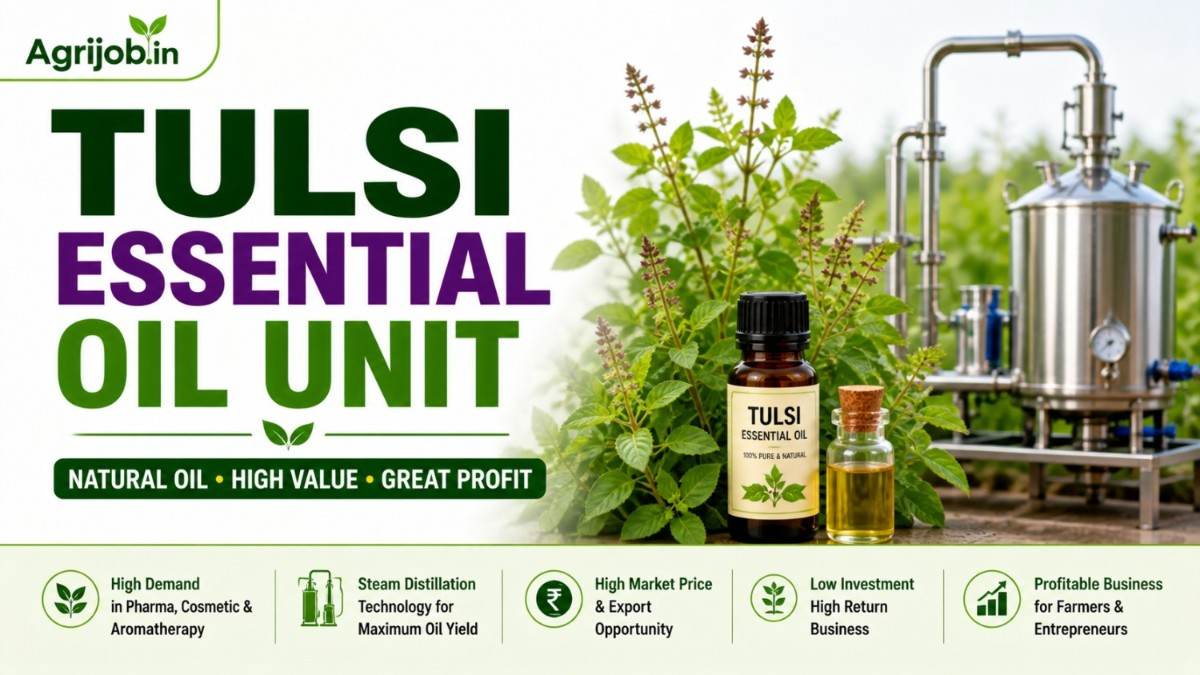
A Tulsi essential oil distillation unit uses steam distillation to separate the aromatic, medicinally active oil from harvested Tulsi (Ocimum sanctum) leaves and stems. Steam passes through chopped biomass, vaporises the volatile oil, and the vapour is condensed and separated into oil and hydrosol. The oil itself is rich in linalool, eugenol and methyl chavicol, which is why pharmaceutical, cosmetic and aromatherapy buyers pay a strong premium over raw herb prices.
2026 favours new entrants for two reasons. First, raw Tulsi has almost no organised mandi, so a grower who only sells fresh leaf earns far less than one who distills and sells oil. Second, the government’s CSIR Aroma Mission is actively pushing distillation infrastructure and buyback support into farmer clusters, which lowers the barrier for someone starting at the Rs.2-2.5 lakh scale rather than needing an industrial-size plant.

Who Should Set Up a Tulsi Distillation Unit?
- 🌿 Tulsi growers with 1-3 acres wanting to add value instead of selling raw leaf to traders
- 👥 FPOs aggregating Tulsi from multiple small farms to run one shared distillation unit
- 🧑🌾 Agri-entrepreneurs targeting the pharmaceutical, cosmetic and aromatherapy oil market
- 👩🌾 Women SHG groups, since several Aroma Mission cluster projects prioritise inclusive participation
- 🏞️ Farmers in CSIR-CIMAP, CSIR-IIIM or CSIR-NEIST priority zones (J&K, Northeast, UP, MP belts)
- 📦 Existing herb/spice processors wanting to diversify into essential oil value addition
- 🎓 Agriculture or chemistry graduates exploring an agro-processing startup with export potential
- 💧 Growers with assured year-round biomass supply, since a distillation unit needs steady feedstock
Money: Rs.2.5 Lakh Investment Breakdown & Profit Potential
Commercial listings for a small batch steam distillation/expeller unit in India start around Rs.1-1.5 lakh, which forms the bulk of a Rs.2.5 lakh project when shed, raw material, packaging and registration costs are added. Treat the figures below as an illustrative cottage-scale plan, not a fixed quotation; always get at least two machinery quotes before committing funds.
| Cost Head | Rural/Cluster Setup | Semi-Urban Setup | Notes |
|---|---|---|---|
| Steam distillation unit/boiler | Rs.1,00,000-1,50,000 | Rs.1,30,000-1,80,000 | MS or SS construction; SS for export-grade hygiene |
| Shed/civil work | Rs.30,000-50,000 | Rs.50,000-80,000 | Can use existing farm shed to cut cost |
| First-batch raw biomass | Rs.10,000-30,000 | Rs.20,000-40,000 | Lower if self-grown Tulsi is used |
| Storage drums, bottling, labels | Rs.10,000-15,000 | Rs.10,000-15,000 | HDPE drums or glass bottles per buyer need |
| Registration (IEC, GST, RCMC) | Rs.5,000-15,000 | Rs.5,000-15,000 | One-time cost, covered in Section 6 |
| Annual earning potential | Rs.1.5-3 lakh/year | Rs.2-4 lakh/year | At Rs.1,200-3,000/litre, scaling with batches run |
Profit depends heavily on oil recovery, which varies by Tulsi chemotype, harvest stage and distillation efficiency, so always run a small trial batch with your specific unit before scaling production or signing export orders.
Eligibility & Aroma Mission Subsidy Support
- 📜 Farmer or FPO with land records and a cluster of aromatic crop cultivation (around 20 hectares per distillation unit under Aroma Mission norms)
- 🧾 Aadhaar, PAN and active bank account for any DBT-linked support
- 🌱 Willingness to grow Tulsi or other approved aromatic crops as the feedstock base
- 🏛️ Registration through the nearest CSIR participating lab (CIMAP Lucknow, IIIM Jammu, or NEIST Jorhat depending on your region)
- 👥 Priority consideration for clusters in degraded/rain-fed land and the Northeast/J&K priority zones
- 💰 No fixed application fee for joining an Aroma Mission cluster; the institute extends technical know-how, planting material guidance and distillation unit support directly
The CSIR Aroma Mission installs distillation units of around 1 tonne capacity or less in clusters of aromatic-crop villages and builds in a buyback mechanism so growers are not left searching for a buyer after harvest. Reported income gains for participating farmers range from roughly Rs.30,000 to Rs.70,000 per hectare per year across different CSIR institute reports, so always confirm the current cluster terms with your nearest participating lab before planning your cropping area.
Step-by-Step: How to Set Up Your Distillation Unit
- Confirm a steady Tulsi biomass supply, either from your own land or an FPO-aggregated cluster.
- Get at least two machinery quotes for a small steam distillation unit; prefer SS contact parts for export-grade hygiene.
- Identify your subsidy route: approach CIMAP Lucknow, IIIM Jammu or NEIST Jorhat to check current Aroma Mission cluster support in your district.
- Set up the shed, water source and fuel arrangement (many CSIR-designed units can run on agro-waste/spent biomass fuel).
- Run trial distillation batches to measure oil recovery and refine harvest timing for your specific Tulsi chemotype.
- Send an oil sample for a GC-MS based lab test to get your Certificate of Analysis (COA) before quoting any export buyer.
- Register your business entity, open a current account, and begin the export documentation process described in Section 6.
- Package, label and store oil in airtight, light-protected containers to preserve quality until shipment.
Export Documents Required: IEC to CHEMEXCIL RCMC Checklist
Many first-time exporters wrongly assume essential oils need APEDA registration. They do not. Tulsi oil falls under CHEMEXCIL (Basic Chemicals, Cosmetics & Dyes Export Promotion Council), specifically its Cosmetics, Soaps, Toiletries & Essential Oils panel. Here is the correct document trail.
| Stage | Document/Registration | Issuing Authority |
|---|---|---|
| Business setup | PAN, GST registration, export current account | Income Tax Dept., GST Dept., Bank |
| Trade licence | Importer Exporter Code (IEC) | DGFT |
| Export council | CHEMEXCIL RCMC (Cosmetics/Essential Oils panel) | CHEMEXCIL, Ministry of Commerce |
| Food-use only | FSSAI licence (only if oil is sold for ingestible/flavouring use) | FSSAI |
| Quality proof | Certificate of Analysis with GC-MS report | Accredited testing lab |
| Shipment | Commercial Invoice, Packing List, Certificate of Origin, MSDS, Bill of Lading/Airway Bill | Exporter, Customs, Shipping line |
Keep your IEC, GST and CHEMEXCIL RCMC valid and renewed (RCMC is typically renewed annually), since an expired registration can hold up a shipment at the last stage even after your product passes every quality check.
ISO & GMP Certification Process for Tulsi Oil Export
Neither ISO 9001 nor GMP certification is legally compulsory to export from India, but in practice most overseas buyers, especially in the EU and US, treat them as a non-negotiable trust signal before placing a recurring order.
- Gap assessment: an accredited certification body reviews your current process, hygiene and documentation against ISO 9001/GMP requirements.
- Documentation: build Standard Operating Procedures for harvesting, distillation, filtration, storage and batch traceability.
- Implementation: train staff, fix infrastructure gaps (clean room, contact-surface hygiene, pest control) flagged in the gap assessment.
- Stage 1 audit: the certification body checks your documented quality management system on paper.
- Stage 2 audit: an on-site audit verifies your distillation unit is actually following the documented process.
- Certification issuance: once non-conformities are closed, you receive your ISO 9001 and/or GMP certificate, typically valid for 1-3 years with periodic surveillance audits.
- Optional premium layer: organic certification (India NPOP, USDA Organic, or EU Ecocert) for buyers paying extra for certified-organic Tulsi oil.
Always verify that your chosen certification body is properly accredited; an uncertified “instant” certificate offered at an unusually low price is rarely accepted by serious international buyers and can damage your credibility instead of building it.
High-Value Tulsi Oil & Export Terms You Must Know
- CHEMEXCIL RCMC: The mandatory Registration-Cum-Membership Certificate for essential oil exporters, not APEDA.
- GC-MS report: Gas Chromatography-Mass Spectrometry analysis confirming oil composition (linalool, eugenol, methyl chavicol levels) for buyers.
- Chemotype: Different Tulsi chemical profiles (Eugenol-type, Methyl chavicol-type) that directly affect oil price and end-use suitability.
- Hydrosol: The aromatic water by-product of distillation, sellable separately to cosmetic and skincare buyers.
- Aroma Mission buyback: CSIR’s mechanism to assure remunerative prices to growers supplying aromatic-crop biomass.
- Certificate of Analysis (COA): A batch-specific quality document export buyers almost always request before payment.
- NPOP/USDA Organic/EU Ecocert: Organic certifications that unlock premium pricing in export markets.
- MSDS: Material Safety Data Sheet required for international shipment of essential oils as a chemical product.
- FPO aggregation: Farmer Producer Organisations pooling biomass to justify one shared distillation unit and export registration.
- Oil recovery rate: The percentage/litre-per-tonne yield of oil from fresh biomass, the single biggest driver of unit profitability.
Distillation Unit vs Selling Raw Tulsi Biomass: Which Is Better?
| Parameter | Own Distillation Unit | Sell Raw Tulsi Biomass |
|---|---|---|
| Upfront investment | Rs.2-2.5 lakh | Minimal, mainly cultivation cost |
| Value capture | High; captures oil-stage margin | Low; sold at raw-herb price to a trader |
| Market access | Can sell directly to pharma/cosmetic/export buyers | Dependent on local trader/aggregator demand |
| Skill/effort needed | Higher; distillation, quality testing, compliance | Lower; just harvest and deliver |
| Government support | Aroma Mission infrastructure + buyback assistance | Limited, mostly cultivation-stage subsidies only |
| Best for | FPOs and committed agri-entrepreneurs | First-time growers testing the crop |
Frequently Asked Questions
How much does a Tulsi essential oil distillation unit cost in 2026?
A small cottage-scale steam distillation unit, shed, raw material, packaging and registration together typically cost around Rs.2-2.5 lakh in 2026, based on commercial distillation machinery listed between Rs.1-1.5 lakh for a small batch unit, plus working capital and compliance costs.
Is there a government subsidy for setting up a Tulsi distillation unit?
Yes, the CSIR Aroma Mission provides technical and infrastructural support for installing small-capacity distillation units in farmer clusters growing aromatic crops including Tulsi, along with buyback assistance to ensure remunerative prices.
What documents are required to export Tulsi essential oil from India?
Exporters need an Importer Exporter Code (IEC) from DGFT, PAN, GST registration, a current account, CHEMEXCIL RCMC registration, and shipment-level documents like commercial invoice, packing list, certificate of origin and a GC-MS based certificate of analysis.
Is APEDA registration required for Tulsi oil export?
No. Essential oils are not an APEDA scheduled product; the relevant export promotion council is CHEMEXCIL, under its Cosmetics, Soaps, Toiletries & Essential Oils panel. FSSAI may still be needed only if the oil is sold for food-flavouring or ingestible use.
Is ISO certification mandatory to export Tulsi essential oil?
ISO 9001 and GMP certification are not legally mandatory in India, but most international buyers treat them as a practical requirement for credibility, consistent quality and entry into regulated markets like the EU and USA.
What is the current market price of Tulsi essential oil?
As of 2026, Tulsi essential oil trades broadly between Rs.1,200 and Rs.3,000 per litre/kg depending on chemotype, purity and extraction method, with premium chemotype-specific or organic-certified oils commanding higher export prices.
How much Tulsi biomass is needed to produce one litre of oil?
Tulsi gives a modest oil yield compared to crops like lemongrass, so growers should expect to process a sizeable quantity of fresh herbage per litre of oil; exact recovery depends on variety and harvest stage, so run a trial batch before scaling up.
Should I start with raw Tulsi biomass sale or invest in a distillation unit?
Selling raw biomass needs lower investment and is safer for first-time growers, while owning a distillation unit needs higher upfront cost but captures the much larger value addition of converting raw herb into essential oil, which is the better long-term route for FPOs and serious agri-entrepreneurs.
This guide is regularly reviewed and updated for accuracy. Bookmark this page for the latest Tulsi essential oil distillation unit and export updates for 2026.
Last Updated: June 2026
Sources & further reading: CSIR Aroma Mission (CIMAP) | CHEMEXCIL | DGFT (IEC Registration) | FSSAI