

Safed Musli contract farming 2026 has become one of the most searched medicinal-crop opportunities among Indian farmers, FPOs and agri-entrepreneurs chasing better-than-grain returns. With Ayurvedic majors like Patanjali, Himalaya and Dabur all sourcing this high-value root, growers naturally want to know which company really offers the best buyback rate and the safest profit path. This guide covers everything: how each company’s sourcing model actually works, real 2026 market prices, the NMPB subsidy, step-by-step application, fraud warnings, and an FAQ section answering the questions every Safed Musli grower asks before signing a contract.

- Crop: Safed Musli (Chlorophytum borivilianum)
- Major Buyers: Patanjali, Himalaya, Dabur, Baidyanath, Zandu, herbal traders
- 2026 Market Rate (dry): Rs.300-900/kg medium, Rs.1,000-2,500/kg high quality
- Typical Yield: 20-25 quintals/acre fresh; about 5 tonnes/hectare per ICAR estimates
- Estimated Profit: Rs.1.5 lakh-Rs.5 lakh per acre per year
- Government Subsidy: NMPB Contractual Farming Scheme, ~30% of input cost
- Crop Duration: 8-9 months (planted June-July, harvested Feb-March)
- Best Soil: Well-drained sandy loam, rich in organic matter
- 1. What Is Safed Musli & Why Contract Farming Works in 2026
- 2. Patanjali vs Himalaya vs Dabur: Sourcing & Buyback Compared
- 3. Who Should Apply for Safed Musli Contract Farming?
- 4. Money: Cost, Yield, Price & Profit Per Acre
- 5. Eligibility & NMPB Subsidy Rules
- 6. Step-by-Step: How to Start Safed Musli Contract Farming
- 7. High-Value Safed Musli Terms You Must Know
- 8. Contract Farming vs Open Market Sale: Which Is Better?
- 9. How to Avoid Fake Buyback Contracts & Frauds
- 10. Frequently Asked Questions
What Is Safed Musli & Why Contract Farming Works in 2026
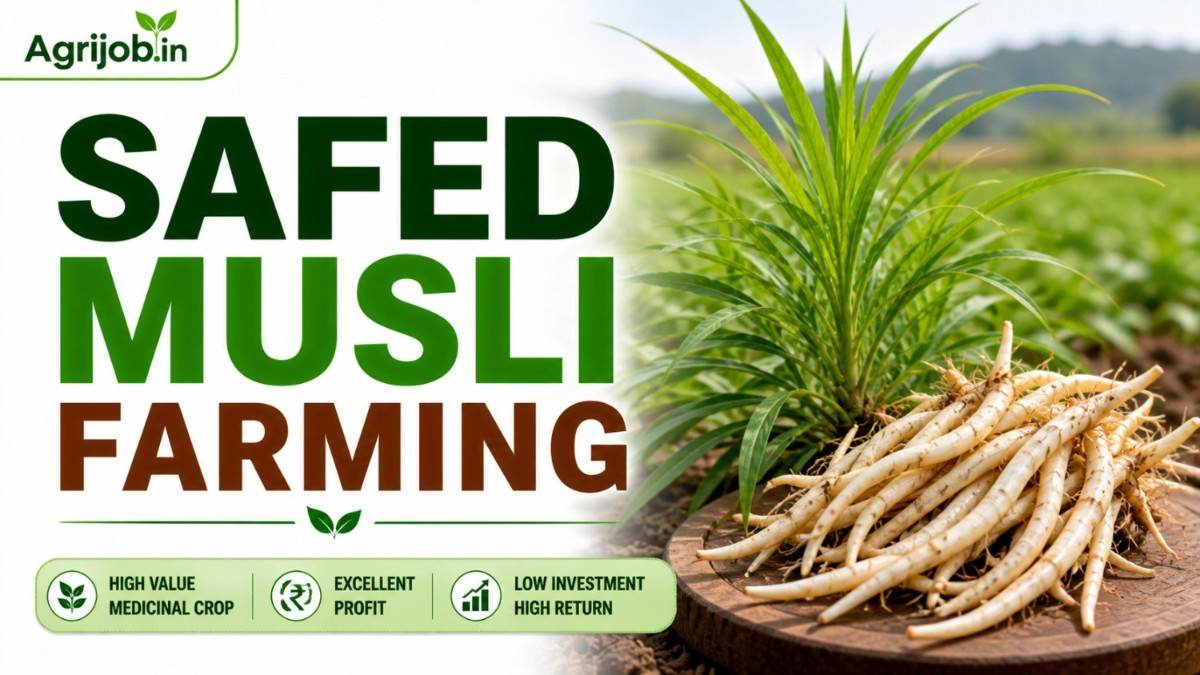
Safed Musli (botanically Chlorophytum borivilianum) is a tuberous medicinal herb used across Ayurveda, Unani and homeopathy for boosting vitality, immunity and managing gynaecological disorders. India’s annual demand for dried roots is estimated near 35,000 tonnes, while wild and cultivated supply covers only a fraction of that, which is exactly why it ranks among the National Medicinal Plants Board’s priority species for cultivation and export promotion.
Because Safed Musli has no commodity mandi like wheat or rice, price discovery is harder for an individual grower. This is where contract farming and buyback agreements matter: a company, NGO-backed programme, or the government’s own Contractual Farming Scheme commits in advance to purchase your dried roots, removing the biggest risk in medicinal-plant cultivation — having a harvest with no confirmed buyer. For freshers, FPOs and category-wise reserved candidates exploring agri-entrepreneurship, this single feature is what separates Safed Musli from most other cash crops in 2026.

Patanjali vs Himalaya vs Dabur: Sourcing & Buyback Compared
Here is the honest answer farmers actually need: none of the three companies publish a fixed, guaranteed per-kg Safed Musli buyback rate on their official websites. What differs is how each company structures its farmer relationship, and that difference matters more than any number a local agent quotes you on WhatsApp.
| Factor | Patanjali | Himalaya | Dabur |
|---|---|---|---|
| Sourcing model | Official “Contract Herbal Farming” self-registration form on patanjaliayurved.org | “Kisaan Mitra” direct farmer purchase programme | Direct farmer/nursery network for rare medicinal herbs |
| Published buyback rate | Not published; case-by-case after registration | Predetermined price by mutual agreement, not a public rate card | Not published; linked to sustainable-sourcing contracts |
| Farmer scale (reported) | Open enrollment, scale not publicly disclosed | 1,100+ farmers, 1,000+ acres under farming partnerships | About 15,000 farmers, 15,000+ acres (2026) |
| Price assurance | Application-based, depends on land/Mandi proximity criteria | Fair-trade premium of 15-20% above cultivation cost reported | Free nursery saplings; contract tied to sustainable sourcing targets |
| Safed Musli specific | General herbal farming form, not Musli-exclusive | Documented mainly for Tulsi, Alfalfa; Musli not specifically confirmed | Sources rare/endangered herbs broadly; Musli not separately confirmed |
| Entry process | Online form with land, Aadhaar, nearby mandi details | Through NGO partners like NAAM Foundation or regional teams | Through registered vendor/FPO network |
| Best suited for | Individual farmers wanting direct, self-service enrollment | Small/marginal farmers wanting price certainty before sowing | FPOs and larger acreage growers seeking volume contracts |
Who Should Apply for Safed Musli Contract Farming?
- 🌱 Farmers with 0.5-5 acres of well-drained sandy loam land wanting a high-value alternative to grain crops
- 👩🌾 Women farmers and SHG members, since several NMPB and Himalaya-linked programmes prioritise inclusive enrollment
- 🏛️ SC/ST/OBC/EWS category farmers eligible for higher subsidy slabs under medicinal-plant schemes
- 🧑🌾 Agri-entrepreneurs and FPOs aggregating multiple small holdings for a larger buyback contract
- 📦 Farmers near Khairabadi (Delhi), Neemuch (MP) or Ahmedabad mandis with easier market access
- 🎓 Agriculture graduates exploring high-CPC medicinal-crop ventures as a startup model
- 🏞️ Landowners in Madhya Pradesh, Gujarat, Rajasthan, Chhattisgarh and Odisha — the traditional Musli belt
- 💧 Growers with assured rainy-season moisture or basic drip irrigation for the June-July sowing window
Money: Cost, Yield, Price & Profit Per Acre
Every Safed Musli profit claim online should be checked against ICAR and government figures, not just marketing blogs. As per Indian Council of Agricultural Research estimates, cultivation cost runs near Rs.4.5 lakh per hectare, with productivity of about 5 tonnes per hectare, giving most growers a remunerative price band rather than a guaranteed lakhs-per-month story.
| Item | Rural Belt (MP/Rajasthan) | Semi-Urban Setup | Annual Earning Potential |
|---|---|---|---|
| Seed/tuber cost (1 acre, ~400-450kg) | Rs.75,000-1,50,000 | Rs.1,00,000-1,50,000 | — |
| Land prep, fertiliser, labour | Rs.50,000-80,000 | Rs.70,000-1,00,000 | — |
| Dry root price (medium quality) | Rs.300-900/kg | Rs.300-900/kg | Rs.1.5-2.5 lakh/acre |
| Dry root price (high quality, white) | Rs.1,000-2,500/kg | Rs.1,000-2,500/kg | Rs.2.5-5 lakh/acre |
| NMPB subsidy support | ~30% of input cost | ~30% of input cost | Reduces upfront risk |
Storage discipline directly protects this profit: dry tubers to below 8-9% moisture, treat with recommended fungicide, and store in sand pits or a cool room to preserve quality for 6-8 months without losing the high-quality price tier.
Eligibility & NMPB Subsidy Rules
- 📜 Land ownership or valid lease document in the applicant’s name
- 🧾 Aadhaar card and active bank account linked for DBT-based subsidy credit
- 🌱 Soil and water test report confirming suitability for Chlorophytum borivilianum
- 🏛️ Registration through your State Medicinal Plants Board or NMPB-recognised implementing agency
- 💰 Application fee/registration: typically nil for NMPB scheme; private buyback agreements may need a stamped agreement paper
- 👥 Category-wise relaxation: higher subsidy percentage often available for SC/ST/women growers under medicinal-plant schemes — confirm current slab with your district horticulture/agriculture officer
The NMPB Contractual Farming Scheme provides financial assistance of roughly 30% of input cost, cited in parliamentary records as approximately Rs.2.25 lakh per acre for Safed Musli; since 2002-03 the Board has sanctioned funding for 880 such projects nationwide. These exact slabs are revised periodically, so always confirm the live figure with your State Medicinal Plants Board before finalising a sowing budget.
Step-by-Step: How to Start Safed Musli Contract Farming
- Test your soil for drainage and organic content; Safed Musli needs sandy loam, never hard or acidic soil.
- Shortlist a buyback route: NMPB Contractual Farming Scheme, a verified private contract-farming firm, or direct registration with Patanjali’s Contract Herbal Farming form.
- Submit land documents, Aadhaar, bank details and nearby mandi information as part of registration.
- Sign a written, stamped buyback or supply agreement before paying any advance for seed/tuber material.
- Procure certified tubers (400-450kg/acre) and treat seed with recommended fungicide before sowing in June-July.
- Follow the package of practices for spacing, weeding and rainy-season moisture management for 8-9 months.
- Harvest in February-March, dry to 8-9% moisture, grade by colour and size, then deliver against your buyback contract.
- Apply for NMPB/State subsidy disbursement after submitting harvest and quality documentation.
High-Value Safed Musli Terms You Must Know
- NMPB Contractual Farming Scheme: Government programme offering ~30% input-cost subsidy and buyer linkage for registered medicinal-plant growers.
- Chlorophytum borivilianum: The botanical name for Safed Musli; always check this on seed/tuber invoices to avoid adulterated varieties.
- Buyback agreement: A signed, ideally court-stamped contract guaranteeing a company will purchase your harvest at an agreed basis.
- Saponin content: The active medicinal compound (2-15%) that determines Ayurvedic-grade pricing for dried roots.
- FPO aggregation: Farmer Producer Organisations pooling small holdings to negotiate bulk buyback rates, often earning Rs.10,000-50,000 more per tonne than solo sellers.
- Agmarknet/eNAM price check: Government portals to verify real mandi prices before accepting any private buyback offer.
- Kisaan Mitra: Himalaya’s direct-farmer purchase initiative paying a 15-20% fair-trade premium over cultivation cost.
- Sustainable contract farming: Dabur’s stated FY 2025-26 target of sourcing 100% of critically endangered herbs through farmer contracts, reaching 78% in FY 2023-24.
- AIF (Agriculture Infrastructure Fund): Can be used by FPOs to build drying/grading units, protecting the high-quality price tier of Rs.1,000-2,500/kg.
- Moisture grading: Dried roots above 8-9% moisture are typically downgraded to the lower Rs.300-900/kg price band.
Contract Farming vs Open Market Sale: Which Is Better?
| Parameter | Contract/Buyback Farming | Open Market Sale (Mandi/Trader) |
|---|---|---|
| Price certainty | Agreed in advance, lower volatility | Depends on Khairabadi/Neemuch mandi rates on sale day |
| Risk of no buyer | Low, buyer committed before sowing | Moderate, depends on demand cycle |
| Input support | Often includes seed, training, technical visits | Farmer bears full input cost alone |
| Fraud exposure | Higher if agreement is verbal/unverified | Lower, payment is immediate on sale |
| Best for | First-time growers wanting price safety | Experienced growers confident in quality grading |
| Subsidy linkage | Easier under NMPB Contractual Farming Scheme | Subsidy claim still possible but separate from sale |
How to Avoid Fake Buyback Contracts & Frauds
Medicinal-plant contract farming, including Safed Musli, has a documented history of fraudulent local agents promising inflated buyback rates to sell overpriced tubers, then disappearing before harvest. Protecting your investment matters more than chasing the highest quoted rate.
- 🔍 Verify the company’s registration and physical address before paying anything
- 📝 Insist on a written, dated and ideally court-stamped buyback agreement, not a verbal promise
- 💸 Avoid 100% upfront seed payment; reputable models split payment before and after planting
- 📊 Cross-check quoted rates against Agmarknet/eNAM mandi data for Safed Musli before signing
- 🏛️ Prefer NMPB-registered or well-known brand programmes (like Patanjali’s official form or Himalaya’s Kisaan Mitra) over unknown WhatsApp/Instagram agents
- 👥 Talk to existing farmers in the programme directly rather than relying only on company testimonials
Frequently Asked Questions
Does Patanjali give the best buyback rate for Safed Musli?
No single company publishes a fixed per-kg buyback rate for Safed Musli contract farming. Patanjali runs an official Contract Herbal Farming registration program, but the final price depends on quality, mandi rates and mutual negotiation, not a guaranteed published rate.
What is Safed Musli contract farming?
It is an arrangement where a company, NGO-backed programme, or the NMPB Contractual Farming Scheme agrees in advance to purchase a farmer’s Chlorophytum borivilianum harvest, reducing the price risk that normally comes with growing a non-mandi medicinal crop.
How much profit can I earn per acre from Safed Musli farming in 2026?
At March 2026 rates of Rs.1,000-2,500/kg for high-quality dried roots and Rs.300-900/kg for medium quality, most verified sources estimate net profit between Rs.1.5 lakh and Rs.5 lakh per acre per year, depending on yield, drying quality and the buyer you choose.
What subsidy does the government give for Safed Musli cultivation?
The NMPB provides financial assistance of around 30% of input cost under its Contractual Farming Scheme, cited in parliamentary records as roughly Rs.2.25 lakh per acre for Safed Musli, though exact slabs change periodically and should be confirmed with your State Medicinal Plants Board.
Does Himalaya have a direct buyback program for farmers?
Yes, Himalaya Wellness runs the Kisaan Mitra initiative, purchasing herbs directly from over 1,100 farmers at a predetermined, mutually agreed price with a reported fair-trade premium of 15-20% over cultivation cost, though it is documented mainly for herbs like Tulsi and Alfalfa rather than confirmed as Safed Musli-specific.
How does Dabur source Safed Musli and other medicinal herbs?
Dabur works with close to 15,000 farmers across more than 15,000 acres for rare and critically endangered medicinal herbs, providing free nursery saplings and targeting 100% sustainable contract-farming sourcing, rather than publishing an open per-kg buyback rate.
What documents are needed to start Safed Musli contract farming?
You typically need land ownership or lease papers, an Aadhaar card, bank account details, a soil test report, and a signed buyback agreement, ideally stamped at your local district court for legal protection.
How can I avoid fake Safed Musli buyback contract scams?
Verify the company’s registration, insist on a written and stamped buyback agreement, avoid large upfront seed payments to unknown agents, cross-check market rates on Agmarknet, and prefer NMPB-registered or known-brand programmes over unverified middlemen.
This guide is regularly reviewed and updated for accuracy. Bookmark this page for the latest Safed Musli contract farming notifications and 2026 buyback updates.
Last Updated: June 2026
Sources & further reading: National Medicinal Plants Board (NMPB) | Ministry of AYUSH | CIMAP Lucknow (ICAR) | Agmarknet Mandi Prices