

Ashwagandha Farming Profit Per Acre 2026: Rs.1.2–2.8 Lakh + Direct Buyer Company List
Ashwagandha farming profit per acre in 2026 is one of the most searched topics among Indian dryland farmers — and for good reason. With mandi prices ranging from Rs.150 to Rs.280 per kg and input costs as low as Rs.12,000–Rs.20,500 per acre, this drought-tolerant medicinal crop is quietly transforming barren Kharif-season land into a Rs.1.2–Rs.2.8 lakh income source in just 5–6 months. India produces nearly 85% of the world’s Ashwagandha supply, cultivated across 14,000+ hectares primarily in Madhya Pradesh, Rajasthan, and Uttar Pradesh — yet millions of eligible farmers still haven’t switched. This complete guide covers realistic profit calculations, current 2026 mandi prices, state-wise income breakdown, direct buyer company list, cultivation cost, eligibility, and everything a small and marginal farmer needs to start earning from this high-demand ayurvedic crop.

- What Is Ashwagandha Farming? 2026 Overview
- Ashwagandha Farming Profit Per Acre – Realistic Numbers 2026
- Cultivation Cost Per Acre: Full Breakdown 2026
- Ashwagandha Mandi Price Per Kg in 2026
- Direct Buyer Company List: Who Buys Ashwagandha from Farmers
- Ashwagandha Farming vs Wheat Farming – Comparison Table
- Who Should Start Ashwagandha Farming in 2026?
- Step-by-Step Cultivation Process: Sowing to Harvest
- High-Value Medicinal Crop Terms Every Farmer Must Know
- Frequently Asked Questions (FAQs)
What Is Ashwagandha Farming? 2026 Overview
Ashwagandha (Withania somnifera), commonly called Indian Ginseng, is a drought-tolerant medicinal shrub belonging to the Solanaceae family. Its roots and seeds are the primary commercial products, forming the backbone of India’s Rs.1,200-crore+ medicinal plant sector. Cultivated mainly during the Kharif or Rabi season across dry and semi-arid regions, Ashwagandha thrives on sandy loam to light red soil with a pH of 7.5–8.0 and annual rainfall of just 500–750mm.
The global Ashwagandha market was valued at approximately USD 820 million in 2025 and is projected to grow at a CAGR of 9.6% to reach USD 1.72 billion by 2033. India accounts for nearly 85–95% of global Ashwagandha supply, making Indian farmers the backbone of a billion-dollar international wellness industry. Demand is surging across the USA, Germany, UK, and Australia — driven by growing consumer interest in adaptogenic herbs, stress management, and Ayurvedic medicine.

| Crop Type | Medicinal / Ayurvedic Herb (Kharif / Rabi) |
| Input Cost Per Acre | Rs.12,000 – Rs.20,500 |
| Net Profit Per Acre (2026) | Rs.1,20,000 – Rs.2,80,000 |
| Mandi Price (May 2026) | Rs.150 – Rs.280 per kg (Rs.15,000–Rs.28,000/quintal) |
| Crop Duration | 5–6 months (Sow July–Aug; Harvest Jan–Mar) |
| Yield Per Acre (Roots) | 300–500 kg (dry roots) |
| Seed Yield Per Acre | 50–80 kg |
| Top Producing States | MP (Neemuch, Mandsaur), Rajasthan (Nagaur), Gujarat, UP |
| Water Requirement | Minimal – 1 to 2 irrigations per season |
| ROI | 500–700% in a single season |
Ashwagandha Farming Profit Per Acre – Realistic Numbers 2026
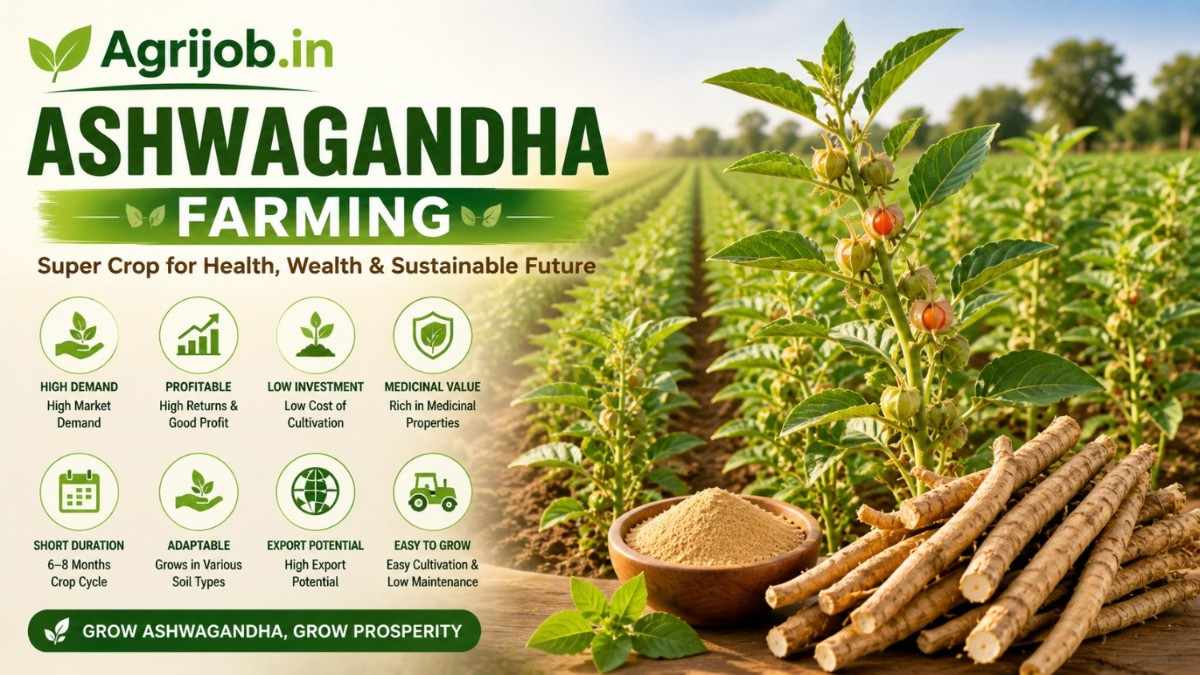
The honest answer to “how much profit can I earn from Ashwagandha farming per acre?” depends on 3 variables: your yield, your selling price, and whether you sell through a mandi or directly to buyers. Below is a realistic, scenario-based income table for 2026 to help farmers plan confidently.
| Scenario | Root Yield/Acre | Selling Price | Gross Income | Total Cost | Net Profit |
|---|---|---|---|---|---|
| Conservative (Mandi) | 300 kg | Rs.150/kg | Rs.45,000 | Rs.18,000 | Rs.27,000–Rs.45,000* |
| Realistic (Mandi) | 400 kg | Rs.200/kg | Rs.80,000 | Rs.18,000 | Rs.62,000 |
| Good Season (Mandi) | 500 kg | Rs.250/kg | Rs.1,25,000 | Rs.20,500 | Rs.1,04,500 |
| Direct Buyer / Processor | 400 kg | Rs.350/kg | Rs.1,40,000 | Rs.20,500 | Rs.1,19,500 |
| Premium (Root + Seed) | 450 kg + 60 kg seed | Rs.280/kg + Rs.150/kg seed | Rs.1,26,000 + Rs.9,000 | Rs.20,500 | Rs.1,14,500 |
| Organic Certified (Export) | 350 kg | Rs.600/kg | Rs.2,10,000 | Rs.25,000 | Rs.1,85,000 |
| Premium Organic (Export) | 450 kg | Rs.650/kg | Rs.2,92,500 | Rs.25,000 | Rs.2,67,500 |
*Note: Conservative scenario assumes non-graded roots sold at floor price. Adding seed income of Rs.7,500–Rs.12,000/acre (50–80 kg at Rs.150/kg) to any scenario above improves profit further. The Rs.1.2–Rs.2.8 lakh headline range covers the “Realistic to Premium Organic” band that most serious 2026 growers target.
Cultivation Cost Per Acre: Full Breakdown 2026
One of Ashwagandha’s biggest advantages over competing cash crops is its remarkably low input cost of just Rs.12,000–Rs.20,500 per acre. Compared to vegetables (Rs.40,000–Rs.80,000/acre) or sugarcane (Rs.45,000–Rs.65,000/acre), this crop gives exceptional returns on a shoestring budget — ideal for small and marginal farmers in dry belts.
| Cost Head | Low Estimate | High Estimate | Notes |
|---|---|---|---|
| Certified Seeds (4–5 kg/acre) | Rs.2,000 | Rs.3,000 | Jawahar Asgand-20 or Poshita variety preferred |
| Land Preparation (Ploughing + Harrowing) | Rs.1,500 | Rs.2,500 | 2 deep ploughings + 2–3 harrowings |
| Organic Fertilizer (FYM/Vermicompost 4–8 tonnes) | Rs.3,000 | Rs.5,000 | Ashwagandha prefers organic inputs; avoid chemicals |
| Labour (Sowing + Weeding + Harvesting) | Rs.4,000 | Rs.6,000 | Varies by state wage rates; 2–3 rounds of weeding |
| Irrigation (1–2 rounds only) | Rs.1,000 | Rs.2,000 | Rain-fed crop; irrigation needed only in dry spells |
| Biopesticide / Neem Spray | Rs.500 | Rs.1,000 | Nematode management; no heavy pesticide load |
| Post-Harvest (Drying + Sorting + Cleaning) | Rs.2,000 | Rs.4,500 | Sun-drying for 7–10 days; grading increases value |
| Total Per Acre | Rs.12,000 | Rs.20,500 | For organic-certified: add Rs.4,000–Rs.5,000 |
Farmers using CSIR-CIMAP certified seeds from CSIR-Central Institute of Medicinal and Aromatic Plants (CIMAP), Lucknow report higher yields of 450–550 kg dry roots/acre. State agriculture departments in Madhya Pradesh and Rajasthan also provide subsidised seeds under various schemes — check with your nearest Krishi Vigyan Kendra (KVK) before purchasing.
Ashwagandha Mandi Price Per Kg in 2026 – Latest Rates
Understanding current Ashwagandha mandi prices is essential before you plan your selling strategy. As of May–June 2026, the national average mandi rate is Rs.165/kg (Rs.16,500/quintal) while the Neemuch APMC — India’s largest Ashwagandha trading hub — shows rates between Rs.155–Rs.280/kg depending on grade and lot size.
| Market / Grade | Price Per Kg (2026) | Price Per Quintal | Notes |
|---|---|---|---|
| National Mandi Average | Rs.150–Rs.170/kg | Rs.15,000–Rs.17,000 | KisanDeals / CommodityOnline live data |
| Neemuch APMC (MP) | Rs.155–Rs.280/kg | Rs.15,500–Rs.28,000 | India’s #1 Ashwagandha mandi; premium for quality |
| Nagaur (Rajasthan) | Rs.140–Rs.220/kg | Rs.14,000–Rs.22,000 | Second-largest hub; slightly lower than Neemuch |
| Direct to Processors | Rs.250–Rs.400/kg | Rs.25,000–Rs.40,000 | Requires pre-booking agreement with buyer company |
| Organic Certified (Domestic) | Rs.400–Rs.600/kg | Rs.40,000–Rs.60,000 | APEDA / PGS-India organic certificate required |
| Export Quality (Organic) | Rs.1,200–Rs.1,500/kg | Rs.1,20,000–Rs.1,50,000 | Standardised KSM-66 / Sensoril extract grade roots |
| Ashwagandha Seeds | Rs.108–Rs.275/kg | Rs.10,800–Rs.27,500 | Neemuch IndiaMART pricing, March 2026 |
Track live mandi rates at Agmarknet (Government of India APMC Price Portal) or download the eNAM app by the Ministry of Agriculture to access real-time prices across all major mandis before selling.
Direct Buyer Company List: Who Buys Ashwagandha from Farmers 2026
Selling directly to buyer companies instead of local middlemen can increase your per-kg realisation by Rs.80–Rs.200, significantly boosting Ashwagandha farming profit per acre. Below are the major companies that procure Ashwagandha directly from Indian farmers through contract farming, direct purchase, or buyback agreements in 2026.
- 🏭 Dabur India Ltd – One of India’s largest Ayurvedic FMCG companies, Dabur has been working directly with farmers for over 30 years. They provide inputs, technical guidance, and assured buyback for Ashwagandha roots meeting their quality standards. Contact: dabur.com / corporate office New Delhi. Procurement rate: Rs.250–Rs.350/kg for Grade-A roots.
- 🏭 Patanjali Ayurved Ltd – Baba Ramdev’s company runs an active contract herbal farming programme. Farmers can register at patanjaliayurved.org/contract-herbal-farming. Based in Haridwar, Uttarakhand; major procurement centres in MP and Rajasthan. Procurement rate: Rs.200–Rs.300/kg.
- 🏭 The Himalaya Wellness Company – Bengaluru-based Himalaya sources Ashwagandha roots for their broad herbal supplement range. They work with farmer cooperatives and FPOs. Procurement rate: Rs.230–Rs.320/kg for approved grades.
- 🏭 Organic India Pvt Ltd – Lucknow-based company that specialises in certified organic herbs. They offer higher prices of Rs.400–Rs.600/kg for PGS/NPOP certified organic Ashwagandha roots. They actively assist farmers with organic certification.
- 🏭 Emami Ltd – Kolkata-based FMCG giant procures Ashwagandha for their Zandu Ayurvedic product range. Procurement contact through their agricultural raw materials division.
- 🏭 Baidyanath Group – One of India’s oldest Ayurvedic companies (est. 1917), Baidyanath procures medicinal herbs including Ashwagandha for classical formulations. Based in Kolkata and Nagpur.
- 🏭 Charak Pharma Pvt Ltd – Mumbai-based certified Ayurvedic manufacturer established 1947. Procures Ashwagandha for powders, capsules, and tablets.
- 🏭 Maatitatva Agro Industries Pvt Ltd – Indore-based company offering structured Ashwagandha contract farming in Madhya Pradesh with assured buyback. Contact through IndiaMART or direct at Indore, MP.
- 🏭 VCA Healthcare – Active Ashwagandha supplier and processor; works with farmers in Rajasthan for root procurement at processor-direct prices.
- 🏭 NABARD / NMPB-supported FPOs – The National Medicinal Plants Board under the Ministry of AYUSH facilitates farmer-to-company linkages through its Mission for Integrated Development of Horticulture (MIDH) scheme. Farmers organised in FPOs (Farmer Producer Organisations) can access better prices.
Before approaching any buyer company, ensure your Ashwagandha meets these 3 requirements: (1) Proper sun-drying to below 10% moisture content, (2) Clean sorting — remove soil, stones, and damaged roots, (3) Grading by root thickness — A-grade roots (thick, pale brown) fetch 30–50% more than B/C grade. For organic premium pricing, obtain PGS-India certification (free government scheme) or apply through your state agriculture department. Register at the National Medicinal Plants Board (NMPB) portal for scheme benefits and buyer linkage support.
Ashwagandha Farming vs Wheat Farming – Which Is More Profitable?
Many dry-belt farmers still default to wheat or jowar, unaware of the income gap that exists. Here is a side-by-side comparison of Ashwagandha farming versus wheat farming on 1 acre of dryland in 2026.
| Parameter | Ashwagandha Farming | Wheat Farming |
|---|---|---|
| Input Cost Per Acre | Rs.12,000–Rs.20,500 | Rs.18,000–Rs.28,000 |
| Crop Duration | 5–6 months | 5–6 months |
| Water Requirement | 1–2 irrigations (minimal) | 4–6 irrigations (moderate) |
| Gross Income Per Acre | Rs.60,000–Rs.2,90,000 | Rs.28,000–Rs.40,000 |
| Net Profit Per Acre | Rs.45,000–Rs.2,70,000 | Rs.10,000–Rs.22,000 |
| ROI % | 500–700% | 40–70% |
| MSP Support | No (market-driven) | Yes (Govt MSP available) |
| Export Demand | Very High (USA, EU) | Limited |
| Market Risk | Medium (price fluctuations) | Low (MSP floor price) |
| Best For | Dry/semi-arid land farmers seeking high income | Irrigated land with MSP security preference |
Ashwagandha farming is the clear winner for dry and semi-arid land in 2026 where wheat struggles to break even. The 500–700% ROI vs wheat’s 40–70% ROI speaks for itself. The main risk is market price volatility — but with direct buyer company agreements and organic certification as a price floor, most serious Ashwagandha farmers effectively de-risk their income. Our recommendation: start with 1 acre as a trial crop alongside your existing rotation, build direct buyer relationships, and scale up after your first successful harvest.
Who Should Start Ashwagandha Farming in 2026?
Ashwagandha farming is uniquely suited for several farmer profiles that have historically struggled with low income from conventional crops. If any of the following describes you, 2026 is a strong year to make the switch.
- 🌾 Dryland and Rainfed Farmers in MP, Rajasthan, UP, Gujarat — Ashwagandha’s drought tolerance makes it the most profitable option available on low-rainfall, poor-soil land where wheat and jowar barely break even.
- 👨🌾 Small and Marginal Farmers (1–5 Acres) — The low Rs.12,000–Rs.20,500/acre input cost makes Ashwagandha accessible without large capital outlay or loans. A 1-acre trial costs less than a smartphone.
- 👩🌾 Women Farmers Under PM-KISAN or SHG Groups — Ashwagandha requires mostly light-labour tasks (weeding, sorting, drying) that fit well with women farmer schedules. Several NABARD-backed SHGs in Neemuch are already running profitable Ashwagandha units.
- 🧑💼 Educated Agri-Entrepreneurs Aged 20–35 — Young farmers with market awareness can skip the mandi entirely, directly contact companies like Organic India, and achieve Rs.400–Rs.600/kg — pushing per-acre profit above Rs.2.5 lakh.
- 🏦 SC/ST Farmers with Free Land Under State Schemes — Several state governments provide additional subsidies on seed and organic certification to SC/ST farmers under NMPB and MIDH schemes. Net input cost can drop to Rs.7,000–Rs.10,000/acre after subsidy.
- 🌱 Farmers Already Growing Other Medicinal Crops — If you currently grow Shatavari, Sarpgandha, or Tulsi, adding Ashwagandha in rotation increases soil health (nematode management with crop rotation) and diversifies income streams.
- 📦 FPO / Farmer Producer Organisation Members — FPOs can negotiate bulk procurement contracts with Dabur, Himalaya, or Organic India at Rs.300–Rs.400/kg — 30–50% above what individual mandi sellers receive.
- 🚜 Farmers Leasing Barren or Fallow Land at Low Rent — Ashwagandha’s ability to grow on degraded, low-fertility land means leasing barren land at Rs.3,000–Rs.5,000/acre and earning Rs.1 lakh+ profit is a viable arbitrage business model in 2026.
Step-by-Step Cultivation Process: Sowing to Harvest 2026
Following the correct Ashwagandha cultivation process significantly impacts both yield and root quality — the 2 factors that determine your final profit. Here is the complete 10-step process used by successful farmers in Neemuch and Nagaur in 2026.
- 🗓️ Land Selection (May–June): Choose sandy loam to light red soil with pH 7.5–8.0 and good drainage. Avoid waterlogged or heavy clay soils — they rot roots. Altitude of 600–1,200 metres is optimal.
- 🚜 Land Preparation (June): Deep plough to 20–25 cm using a mouldboard plough. Follow with 2–3 cross harrowings to achieve fine tilth. Apply 4–8 tonnes of well-decomposed FYM or vermicompost per acre and mix into soil.
- 🌱 Seed Selection (June–July): Use certified seeds of improved varieties — Jawahar Asgand-20 (JNKVV, Jabalpur) or Poshita (CSIR-CIMAP) are recommended for MP and Rajasthan. Seed rate: 4–5 kg per acre.
- 🌧️ Sowing (July–August): Sow seeds at the onset of the monsoon by broadcasting or line sowing at 30 × 15 cm spacing. Cover lightly with soil. Germination occurs in 7–10 days under adequate moisture.
- ✂️ Thinning (August): After 3–4 weeks, thin seedlings to maintain 15 cm spacing within rows. Remove weak seedlings and keep 1 healthy plant per spot. Gap-fill any bare patches.
- 🌿 Weeding (August–October): Perform 2–3 rounds of manual weeding. First weeding at 3 weeks after sowing is critical. Second at 6–7 weeks. Minimise weed competition especially in early growth stage.
- 💧 Irrigation (October–December): Ashwagandha is largely rain-fed but may need 1–2 protective irrigations during dry spells between November and January. Avoid overwatering — keep soil moist, not wet.
- 🐛 Pest Management (October–January): Watch for root-knot nematodes (Meloidogyne incognita). Apply neem cake @ 100 kg/acre at sowing and use crop rotation with marigold or sorghum in next season. No heavy pesticides required.
- 🌾 Harvesting (January–March): Harvest when leaves start yellowing and berries turn red-orange. Dig roots carefully using a spade or root digger to a depth of 25–30 cm. Avoid root breakage — damaged roots fetch lower prices.
- ☀️ Post-Harvest Processing: Wash roots, cut into 7–10 cm pieces, and sun-dry for 7–10 days to below 10% moisture. Sort and grade by thickness: A-grade (thick, pale), B-grade (medium), C-grade (thin, dark). Pack in clean jute bags for mandi or buyer delivery.
High-Value Medicinal Crop Terms Every Ashwagandha Farmer Must Know
Understanding the key terminology used in the Ashwagandha and medicinal crop trade helps farmers negotiate better prices, access government schemes, and build credibility with buyer companies. These are the most important terms driving high-value transactions in India’s Rs.1,200-crore+ medicinal plant sector.
- 💊 KSM-66 / Sensoril Extract: Branded standardised Ashwagandha root extracts commanding Rs.1,200–Rs.1,500/kg for raw material supply. Roots for KSM-66 production (Ixoreal Biomed, Hyderabad) must meet strict withanolide content standards (>5%). Farmers supplying to extract manufacturers earn the highest prices.
- 🌿 Withanolides: The active phytochemical compounds in Ashwagandha roots that determine medicinal potency and buyer price. Higher withanolide content (typically 3–8%) = higher procurement price. CSIR-CIMAP certified varieties ensure better withanolide profiles.
- 📜 NPOP Certification (National Programme for Organic Production): India’s national organic certification standard under APEDA. Obtaining NPOP certification allows Ashwagandha farmers to access export markets at Rs.1,200+/kg. Certification takes 3 years of documented organic practice.
- 📗 PGS-India (Participatory Guarantee System): A free, faster organic certification route under the Ministry of Agriculture. Ideal for small farmers wanting to access domestic organic buyers at Rs.400–Rs.600/kg without the 3-year NPOP wait.
- 🏛️ NMPB (National Medicinal Plants Board): Government body under Ministry of AYUSH that provides financial assistance, seed subsidies, and market linkage support to medicinal plant farmers. Check schemes at nmpb.nic.in.
- 🏪 APMC / eNAM: Agricultural Produce Market Committees and the Electronic National Agriculture Market platform where Ashwagandha is traded. Neemuch APMC is India’s price-setting hub. Register on eNAM at enam.gov.in for direct online trading.
- 🤝 Contract Farming: A pre-harvest agreement between farmer and buyer company guaranteeing a fixed price per kg, eliminating mandi price risk. Dabur, Patanjali, and Organic India offer such agreements — critical for income security for first-time growers.
- 📦 FPO (Farmer Producer Organisation): Collective of 100–500 farmers that negotiates bulk procurement contracts with companies at 30–50% better rates than individual sellers. NABARD and SFAC provide Rs.15 lakh equity grants to registered FPOs — a major income multiplier for Ashwagandha farmers.
- 🔬 Adaptogens: The global wellness category that includes Ashwagandha. The global adaptogen market is growing at 9%+ CAGR and is the primary driver of rising international demand from the USA, Germany, and UK — markets paying Rs.1,200–Rs.1,500/kg for certified Indian roots.
- 🌏 GI Tag (Neemuch Ashwagandha): A geographical indication movement in Neemuch district that, once formalised, will allow Neemuch-origin Ashwagandha to command a geographic premium in export markets — similar to Darjeeling Tea’s global premium positioning.
Frequently Asked Questions – Ashwagandha Farming Profit Per Acre 2026
What is the realistic Ashwagandha farming profit per acre in 2026?
Realistic Ashwagandha farming profit per acre in 2026 ranges from Rs.1.2 lakh to Rs.2.8 lakh depending on yield, selling channel, and market price. At mandi rates of Rs.150–Rs.280/kg with a yield of 300–500 kg dry roots per acre, gross income ranges from Rs.45,000 to Rs.1.4 lakh after deducting total input costs of Rs.12,000–Rs.20,500 per acre. Farmers selling directly to companies like Dabur or Patanjali at Rs.250–Rs.400/kg, or achieving organic certification for Rs.400–Rs.600/kg, consistently hit the Rs.1.5–Rs.2.8 lakh range.
How much does Ashwagandha cultivation cost per acre in India 2026?
The total cultivation cost of Ashwagandha per acre in India for 2026 ranges between Rs.12,000 and Rs.20,500. The main cost heads are: seeds Rs.2,000–Rs.3,000, organic fertilizer Rs.3,000–Rs.5,000, labour Rs.4,000–Rs.6,000, irrigation Rs.1,000–Rs.2,000, biopesticide Rs.500–Rs.1,000, and post-harvest processing Rs.2,000–Rs.4,500. For organic certified production (to access Rs.400–Rs.600/kg rates), add Rs.4,000–Rs.5,000 for certification and additional organic inputs.
What is the current Ashwagandha mandi rate in India (June 2026)?
As of May–June 2026, the live Ashwagandha mandi rate in India averages Rs.150–Rs.170 per kg (Rs.15,000–Rs.17,000/quintal) nationally, with Neemuch APMC showing prices of Rs.155–Rs.280/kg depending on quality and lot size. The highest recorded mandi rate is Rs.198/kg and the lowest Rs.150/kg as of recent live data on CommodityOnline. Organic-certified Ashwagandha supplied to processors commands Rs.400–Rs.600/kg, while export-grade roots for branded extract companies fetch Rs.1,200–Rs.1,500/kg.
Which companies buy Ashwagandha directly from farmers in India?
Major companies that purchase Ashwagandha directly from Indian farmers in 2026 include Dabur India Ltd, Patanjali Ayurved, Himalaya Wellness Company, Organic India, Baidyanath Group, Emami Ltd, Charak Pharma, and Maatitatva Agro Industries. Patanjali has a dedicated contract herbal farming programme available at patanjaliayurved.org. Dabur has 30+ years of direct farmer partnerships. Organic India offers the highest rates (Rs.400–Rs.600/kg) for PGS-certified farmers. Farmers organised in FPOs can negotiate even better bulk rates with all these companies.
How long does Ashwagandha crop take from sowing to harvest?
Ashwagandha is a 5–6 month crop in India. Seeds are typically sown in July–August at the onset of the Kharif monsoon and roots are harvested between January and March when leaves begin to yellow and berries turn red-orange. After harvest, roots require 7–10 days of sun-drying before they are ready for sale. The short crop cycle allows Ashwagandha to fit neatly into a single Kharif slot on rain-fed dryland without disrupting existing Rabi crop rotations.
Which states in India are best for Ashwagandha farming?
Madhya Pradesh (Neemuch, Mandsaur, Manasa districts) is India’s undisputed Ashwagandha capital and hosts the nation’s largest trading mandi. Rajasthan (Nagaur district) is the second major hub. Other suitable states include Gujarat, Uttar Pradesh, Punjab, and parts of Himachal Pradesh. Ashwagandha thrives in dry, semi-arid conditions with sandy loam to light red well-drained soil (pH 7.5–8.0) and annual rainfall of 500–750mm. It does not grow well in waterlogged or heavy clay soils or in high-humidity coastal regions.
Can farmers earn from Ashwagandha seeds as well as roots?
Yes — Ashwagandha produces both roots and seeds, providing dual income from a single crop. Per acre, farmers harvest 50–80 kg of cleaned seeds in addition to 300–500 kg of dry roots. Seeds currently trade at Rs.108–Rs.275 per kg at Neemuch (March 2026 IndiaMART data). A good seed harvest of 60 kg at Rs.150/kg adds Rs.9,000 in additional income per acre — essentially free money on top of your root income. Some farmers specifically cultivate certain rows for seed production at even higher seed densities.
What is the ROI of Ashwagandha farming compared to other crops?
Ashwagandha farming delivers an ROI of 500–700% in a single 5–6 month season — one of the highest of any crop cultivable on Indian dryland. For context: wheat returns 40–70% ROI, jowar 30–60%, and even tomato (with much higher input costs of Rs.40,000–Rs.80,000/acre) returns 100–200% in a good season with significant risk. Ashwagandha’s combination of very low input cost (Rs.12,000–Rs.20,500/acre), minimal irrigation, and strong market demand makes its ROI profile exceptional — and explains why farmers in Neemuch have been quietly generating Rs.1–Rs.3 lakh per acre for years while most of the country is unaware.
This guide is regularly reviewed and updated for accuracy with the latest 2026 mandi prices and buyer company information. Bookmark this page and check back for the latest Ashwagandha farming income updates.
Related Reading: Explore more high-profit agri-business ideas and medicinal crop farming guides on Agrijob.in – Agri Business Ideas. For government scheme support on medicinal crop cultivation, visit National Medicinal Plants Board (NMPB) and eNAM – Electronic National Agriculture Market.
Last Updated: June 2026 | Author: Nitish Singh | Agrijob.in