

Organic Turmeric EU Export 2026 – NPOP to NOP, Rs.3 Lakh Cost & 7-Step Guide
Organic turmeric EU export certification 2026 is the single most important investment an Indian turmeric farmer or FPO can make to access premium European markets. With organic turmeric powder fetching EUR 8-15/kg in Germany and the Netherlands — 3 to 5 times the conventional price — the Rs.1.5-Rs.3 lakh annual certification cost pays back within a single container shipment. Yet most farmer-exporters lose time and money due to confusion between NPOP, NOP, and EU Organic standards, and avoidable errors in TRACES NT documentation. This complete 2026 guide covers every step: what NPOP, NOP, and EU Organic certification mean, how the NPOP-to-NOP conversion process works, the exact cost breakdown, which APEDA-accredited certification body to choose, how to generate Transaction Certificates on TraceNet 2.0, and what income is realistically possible.

- NPOP & EU Organic Equivalency for Turmeric in 2026
- NPOP vs NOP vs EU Organic: Key Differences
- Cost of Organic Turmeric EU Export Certification
- Who Should Pursue Organic Turmeric EU Export Certification?
- 7-Step NPOP to NOP Conversion Process (2026)
- Top APEDA-Accredited Certification Bodies for Turmeric
- TRACES NT & Transaction Certificate: How It Works
- Full Document Checklist for EU Organic Turmeric Export
- Income Potential: Organic Turmeric EU Export 2026
- High-Value Organic Export Terms You Must Know
- Frequently Asked Questions
| Primary Certification | NPOP (India Organic) — EU Equivalent |
| EU Equivalency Status | Full equivalency since 2008 (EU Regulation 2018/848) |
| NPOP Certification Cost | Rs.30,000 – Rs.50,000/year (individual farm) |
| NOP Add-On Cost | Rs.50,000 – Rs.1,00,000/year (USDA-accredited CB) |
| Conversion Period | 3 years (36 months) from last prohibited input |
| EU Port Entry Requirement | TRACES NT Transaction Certificate (24 hrs before arrival) |
| Organic Turmeric EU Price | EUR 8–15/kg (Lakadong); EUR 3–6/kg (standard powder) |
| Top Accreditation Bodies | Control Union, Ecocert, OneCert, IMO, Aditi |
| Governing Authority | APEDA, Ministry of Commerce & Industry, Govt. of India |
NPOP & EU Organic Equivalency for Turmeric in 2026
India’s National Programme for Organic Production (NPOP) has held EU equivalency recognition since 2008 — one of the most valuable trade advantages available to Indian organic farmers. Under this bilateral arrangement governed by EU Regulation 2018/848, Indian NPOP-certified turmeric, spices, and other unprocessed plant products can be sold in all 27 EU member countries as organic without requiring a separate EU certificate from a European certifier. This equivalency translates directly into a 30-80% price premium at the farm gate for certified organic turmeric EU export.
India was named “Country of the Year” at BIOFACH 2026 in Nuremberg — the world’s largest organic trade fair — with over 100 Indian companies exhibiting. The APEDA chairman confirmed in February 2026 that the organic sector has “huge opportunities for both sides” with an India-EU trade pact currently being negotiated. India’s total organic food exports reached 3.68 lakh metric tonnes worth USD 665.97 million in FY 2024-25, recovering strongly from FY 2023-24’s USD 494.80 million. Organic spices including turmeric are among the fastest-growing categories, with 12%+ annual demand growth in EU markets.

The 8th Edition of NPOP was launched in January 2025, introducing 5 new digital platforms including TraceNet 2.0, grower group legal recognition, and a shortened conversion period for chemically untreated land. For turmeric farmers in Telangana, Andhra Pradesh, Maharashtra, Tamil Nadu, and Meghalaya (Lakadong), the 2026 regulatory environment has never been more favourable for entering EU organic export markets.
NPOP vs NOP vs EU Organic: Key Differences for Turmeric Exporters
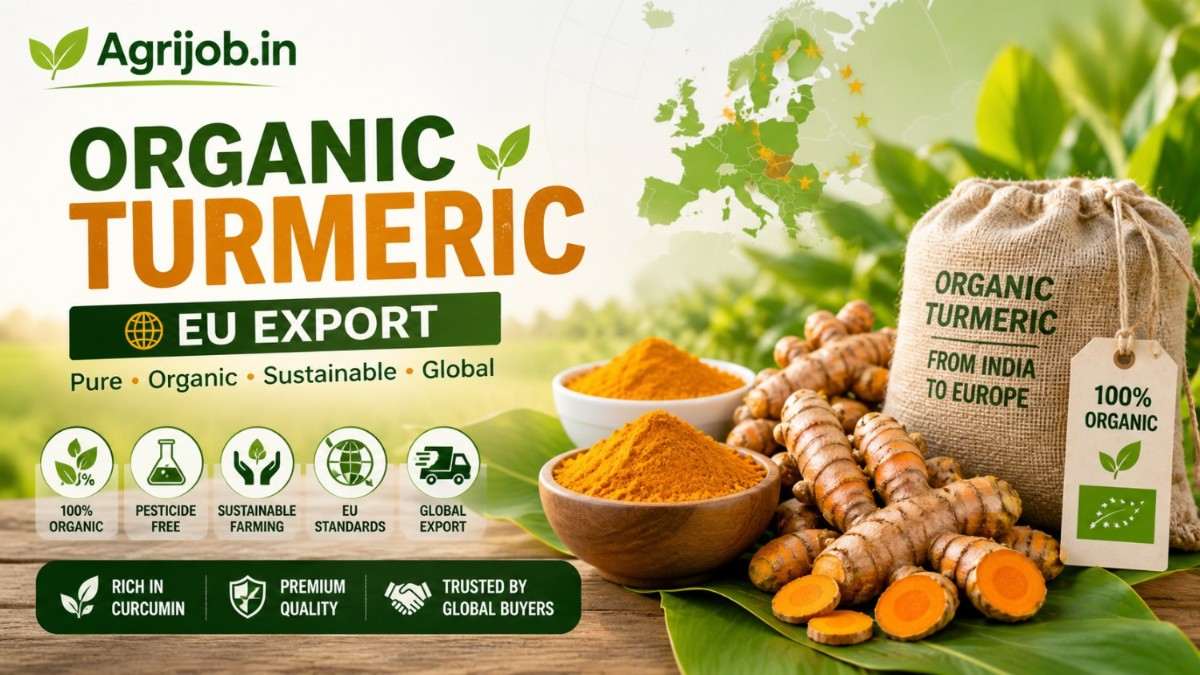
Understanding the difference between NPOP, NOP (USDA), and EU Organic certification is critical for planning your organic turmeric EU export certification strategy. Each standard governs a different market, and the cost, timeline, and documentation requirements vary significantly.
| Parameter | NPOP (India) | NOP/USDA (USA) | EU Organic (Europe) |
|---|---|---|---|
| Governing Body | APEDA, Ministry of Commerce | USDA Agricultural Marketing Service | European Commission (DG SANTE) |
| Regulation | NPOP 8th Edition (2025) | 7 CFR Part 205 | EU Regulation 2018/848 |
| India Equivalency | Base certificate | Partial (unprocessed crops only) | Full (unprocessed plant products) |
| Annual Cost (India farm) | Rs.30,000–Rs.50,000 | Rs.50,000–Rs.1,00,000 (add-on) | Covered by NPOP equivalency |
| Conversion Period | 3 years | 3 years | 3 years (NPOP satisfies this) |
| Shipment Document | TraceNet TC | NOP Transaction Certificate | TRACES NT Certificate of Inspection |
| Valid for Turmeric Powder? | Yes (processed plant products) | Yes (with NOP CB) | Yes (via NPOP equivalency) |
| Livestock/Dairy Covered? | Yes | Yes | Requires separate EU certification |
| Best For | EU, Switzerland export | USA, Canada export | All EU-27 member countries |
Cost of Organic Turmeric EU Export Certification 2026
The full cost of organic turmeric EU export certification in 2026 covers 4 categories: certification body fees, lab testing, documentation, and logistics compliance. Here is the complete breakdown for both individual farmers and FPOs (Farmer Producer Organisations):
| Cost Component | Individual Farm (<10 acres) | FPO/Grower Group (50+ acres) | Annual / Per Shipment |
|---|---|---|---|
| NPOP Certification (CB fee) | Rs.30,000–Rs.50,000 | Rs.80,000–Rs.1,50,000 | Annual |
| NOP (USDA) Add-On | Rs.50,000–Rs.1,00,000 | Rs.1,00,000–Rs.2,00,000 | Annual |
| Inspection Fee (on-site audit) | Rs.10,000–Rs.25,000 | Rs.25,000–Rs.60,000 | Annual |
| Lab Testing (MRL, HM, Curcumin) | Rs.50,000–Rs.1,00,000 | Rs.1,00,000–Rs.3,00,000 | Per container |
| APEDA Exporter Registration | Free (online) | Free (online) | One-time |
| TraceNet TC Generation | Rs.500–Rs.2,000 | Rs.2,000–Rs.5,000 | Per shipment |
| TRACES NT Documentation | Handled by importer/agent | Handled by importer/agent | Per shipment |
| Spices Board OSCS Certificate | Rs.2,000–Rs.5,000 | Rs.5,000–Rs.15,000 | Per shipment |
| Total First-Year Cost (NPOP only) | Rs.95,000–Rs.1,80,000 | Rs.2,15,000–Rs.5,30,000 | — |
| Total First-Year Cost (NPOP+NOP) | Rs.1,45,000–Rs.2,80,000 | Rs.3,15,000–Rs.7,30,000 | — |
For small and marginal farmers, the per-farmer cost under Group Certification through an FPO ICS (Internal Control System) can be dramatically reduced to Rs.10,000–Rs.25,000 per farmer per year, with the FPO holding the master NPOP certificate collectively. Government schemes under APEDA’s National Programme for Organic Production also provide financial assistance for sampling and lab testing for registered grower groups.
Who Should Pursue Organic Turmeric EU Export Certification?
- 🌿 Individual turmeric farmers (5+ acres) in Telangana, Andhra Pradesh, Maharashtra, Tamil Nadu, or Meghalaya who have avoided chemical inputs for 1-3+ years and want to access EU organic premium pricing of EUR 3–15/kg.
- 🏘️ Farmer Producer Organisations (FPOs) with 20+ member farmers who want to collectively hold NPOP certification under an ICS model, reducing per-farmer cost to Rs.10,000–Rs.25,000/year.
- 📦 Spice processors and traders who source turmeric from NPOP-certified farms and want to export value-added products (turmeric powder, extract, capsules) to German, Dutch, or French buyers.
- 🎓 Agriculture graduates and agri-entrepreneurs looking to build an export business in the high-growth organic spices sector (12%+ annual demand growth in EU in 2026).
- 🌾 Lakadong turmeric growers in Meghalaya whose rare 7-12% curcumin variety commands the highest premium (EUR 8–15/kg) in European supplement and nutraceutical markets.
- 💼 Export management companies and trading houses building a certified organic spice supply chain for European private-label grocery chains, pharmaceutical ingredient buyers, and health food distributors.
- 🏭 Erode, Salem, and Nizamabad variety farmers who produce the bulk commercial grades (3-5% curcumin) and want to supply German curry powder manufacturers, Dutch re-export hubs at Rotterdam, or French artisanal food brands.
- 🌐 FPOs planning dual EU + USA market access who want NPOP+NOP (USDA) dual certification in a single inspection cycle to maximise revenue from both EUR and USD-priced premium markets.
7-Step NPOP to NOP Conversion Process for Organic Turmeric EU Export (2026)
The organic turmeric EU export certification process follows a structured 7-step pathway. Most steps for NPOP and NOP can be completed simultaneously when you choose a CB that holds both accreditations, saving 6-12 months of total timeline.
- Stop All Prohibited Inputs (Day 1 of Conversion) — Immediately cease all synthetic pesticides, herbicides, chemical fertilisers, and GMO inputs. Document this date precisely — it is the legal start of your 3-year conversion period under both NPOP and NOP standards. Keep purchase invoices, old chemical records, and a written farm diary from Day 1 onwards. If your land has had no chemical treatment for 1-2 years already, you may be partly through the conversion period.
- Choose an APEDA-Accredited Certification Body (CB) — Select a CB from APEDA’s list of 37 active accredited certification bodies. For EU-only export, any APEDA-accredited CB is sufficient. For USA (NOP) export, choose a CB that also holds USDA accreditation (Control Union, OneCert Asia, IMO Control, Ecocert India). Compare fees, geographic service area in your state, and how quickly they process applications. Register at APEDA’s NPOP portal and identify your CB.
- Prepare the Organic System Plan (OSP) — The OSP is the core certification document. It must include: detailed farm map with survey numbers, crop rotation plan, all input sources (seeds, manure, bio-inputs), pest and disease management methods using only permitted inputs, water source documentation, storage facility description, harvest and post-harvest handling procedures, and a declaration of non-use of prohibited substances. The OSP must be updated annually. Professional consultants charge Rs.10,000–Rs.25,000 to prepare an OSP; your CB may also offer this service.
- Submit Application and Undergo On-Site Inspection — Submit the OSP, land records, farm maps, input purchase invoices (last 3 years), and conversion evidence to your chosen CB. The CB will conduct a preliminary desk review (2-4 weeks) followed by a physical on-site inspection by a trained organic inspector. The inspector verifies that your farm practices match the OSP, checks input storage areas, interviews farm workers, and collects soil and plant samples if required. Inspection fee is Rs.10,000–Rs.25,000 for individual farms.
- Complete the 3-Year Conversion Period — During the conversion period, your land is managed organically but produce cannot be labelled or sold as “certified organic.” However, single-ingredient products from land in conversion for at least 12 months can be sold as “in-conversion organic” in certain EU markets. Annual renewal audits are mandatory every year. If NOP (USA) certification is required, your CB simultaneously evaluates your farm against USDA NOP standards under the same inspection visit.
- Receive NPOP Scope Certificate and Register on TraceNet 2.0 — After successful completion of the conversion period and annual audit, your CB issues a NPOP Scope Certificate specifying your certified products (e.g., organic turmeric fingers, organic turmeric powder) and validity dates. This certificate is registered on APEDA’s TraceNet 2.0 system. For each commercial shipment, your CB generates a Transaction Certificate (TC) on TraceNet with a unique verifiable code. The TC is the document your EU importer needs to complete TRACES NT registration.
- Complete TRACES NT Pre-Notification for Each EU Shipment — Every organic turmeric shipment entering the EU must be registered on the European Commission’s TRACES NT platform at least 24 hours before arrival at the EU port of entry (Rotterdam, Hamburg, Antwerp, etc.). Your EU importer or their customs agent completes the TRACES NT Certificate of Inspection (COI) using your TraceNet TC details. Missing or late TRACES NT notification results in automatic detention at port. Also obtain a Spices Board OSCS certificate and submit all lab test COAs (curcumin, pesticide MRL, heavy metals, aflatoxin) from an NABL-accredited laboratory before each shipment.
Top APEDA-Accredited Certification Bodies for Organic Turmeric Export 2026
Choosing the right APEDA-accredited certification body for your organic turmeric EU export is one of the most important decisions you will make. As of 2026, there are 37 active CBs in India. The table below compares the 6 most recommended for turmeric farmer-exporters:
| Certification Body | NPOP Accredited | USDA-NOP Accredited | EU Market Recognition | Best For | Approx. Annual Fee |
|---|---|---|---|---|---|
| Control Union Certifications | Yes | Yes | Strong (EU-listed CB) | Large farms, FPOs, dual NPOP+NOP | Rs.60,000–Rs.1,20,000 |
| Ecocert India | Yes | Yes | Very Strong (French CB, EU-native) | EU-focused exporters, premium brands | Rs.50,000–Rs.1,00,000 |
| OneCert Asia | Yes | Yes | Strong | Mid-size farms, cost-effective | Rs.35,000–Rs.80,000 |
| IMO Control | Yes | Yes | Strong (Swiss CB) | EU + Switzerland markets | Rs.45,000–Rs.90,000 |
| Aditi Organic Certifications | Yes | No | Good (EU-listed) | South & Central India, EU-only exporters | Rs.30,000–Rs.60,000 |
| INDOCERT | Yes | No | Good | Kerala, South India small farms | Rs.30,000–Rs.55,000 |
TRACES NT & Transaction Certificate: How It Works for Organic Turmeric EU Export
The TRACES NT (Trade Control and Expert System New Technology) platform is the European Commission’s mandatory digital gateway for all organic product imports into the EU-27. Every organic turmeric shipment — regardless of the validity of your NPOP certificate — requires a Certificate of Inspection (COI) on TRACES NT before the vessel arrives at an EU port. Here is exactly how the TraceNet-to-TRACES NT workflow operates in 2026:
- 📋 Step 1 — Generate TraceNet TC: Before each shipment, your APEDA-accredited CB generates a Transaction Certificate (TC) on TraceNet 2.0 covering the specific consignment (product, quantity, lot number, origin farm, processing facility). The TC has a unique verifiable code and is digitally signed by the CB.
- 📤 Step 2 — Share TC with EU Importer: Send the TraceNet TC to your EU buyer at least 5-7 working days before vessel departure to give them time for TRACES NT registration.
- 🖥️ Step 3 — EU Importer Registers COI on TRACES NT: Your EU importer (or their customs broker) creates a Certificate of Inspection (COI) Part I on TRACES NT using your TraceNet TC details. This must be completed and submitted at least 24 hours before vessel arrival at the EU port.
- 🔍 Step 4 — EU Customs Authority Completes COI Part II: The relevant EU competent authority (e.g., NVWA in the Netherlands, ZLS in Germany) inspects the COI on TRACES NT and either endorses or flags the shipment for physical inspection.
- ✅ Step 5 — Release and Organic Label Authorisation: Once the COI is fully endorsed on TRACES NT, your importer is authorised to receive the goods and market them with the EU organic logo in the local market.
For the TRACES NT platform and EU organic operator database, access the official European Commission TRACES NT Organic Operator Directory to verify your CB is listed as an approved control body in the EU system.
Full Document Checklist for Organic Turmeric EU Export 2026
A single missing document can result in rejection at EU ports of entry. Here is the complete 8-document checklist every organic turmeric EU export shipment requires in 2026:
| # | Document | Issued By | Mandatory? |
|---|---|---|---|
| 1 | NPOP Scope Certificate | APEDA-accredited CB (via TraceNet 2.0) | Yes |
| 2 | Transaction Certificate (TraceNet TC) | APEDA-accredited CB | Yes |
| 3 | TRACES NT Certificate of Inspection (COI) | EU Competent Authority (via TRACES NT) | Yes |
| 4 | Spices Board OSCS Certificate | Spices Board of India | Yes (for all Indian spice shipments to EU) |
| 5 | Certificate of Analysis (COA) | NABL-accredited laboratory | Yes (curcumin HPLC, pesticide GC-MS, heavy metals ICP-MS, aflatoxin) |
| 6 | Phytosanitary Certificate | State Department of Agriculture | Yes |
| 7 | Certificate of Origin (CO) | Export Inspection Council / Chamber of Commerce | Yes |
| 8 | Commercial Invoice, Packing List, Bill of Lading | Exporter / Shipping line | Yes |
Additional documents required for EU entry include FSSAI food business operator licence, IE Code (Import Export Code from DGFT), and APEDA exporter registration. For NOP (USA) shipments, add an FDA Facility Registration certificate and FSVP (Foreign Supplier Verification Program) compliance documentation. More details on Spices Board certification are available at the Spices Board of India official website.
Income Potential: Organic Turmeric EU Export 2026
The income potential from organic turmeric EU export in 2026 is significantly higher than domestic or conventional export markets. EU markets pay a 30-80% premium for certified organic turmeric — and for rare varieties like Lakadong (7-12% curcumin), the premium can exceed 300% over conventional Erode-grade powder.
| Farmer/Exporter Profile | Farm Size | Annual Yield | FOB Price (Organic EU) | Gross FOB Revenue | Net Income (after costs) |
|---|---|---|---|---|---|
| Individual turmeric farmer (Erode, TN) | 5 acres | ~15 MT fingers | Rs.120–Rs.180/kg | Rs.18–Rs.27 lakh | Rs.12–Rs.20 lakh/year |
| FPO (Nizamabad, Telangana) | 50 acres | ~150 MT powder | Rs.200–Rs.280/kg | Rs.3–Rs.4.2 crore | Rs.1.8–Rs.2.8 crore/year |
| Lakadong Turmeric Farmer (Meghalaya) | 3 acres | ~6 MT fingers | Rs.500–Rs.900/kg (EUR 8–15) | Rs.30–Rs.54 lakh | Rs.22–Rs.42 lakh/year |
| Value-Added Processor (Turmeric Powder) | Sourcing-based | 100 MT powder | Rs.250–Rs.400/kg | Rs.2.5–Rs.4 crore | Rs.60 lakh–Rs.1.2 crore/year |
For comparison, conventional turmeric (non-organic) fetches Rs.60–Rs.90/kg FOB. The organic certification cost of Rs.1.5–Rs.3 lakh/year is recovered within 1-2 EU shipment containers for most FPO-scale operations. India’s organic turmeric powder recorded a 51% export growth recently, with Germany (EUR 320 million in turmeric supplement imports annually) and the Netherlands (EUR 250 million via Rotterdam re-exports) being the two largest EU destination markets.
High-Value Organic Export Terms You Must Know
These 10 terms are the most searched — and highest-paying — keywords in the organic turmeric export sector. Understanding them is essential for anyone building a certified organic turmeric EU export business in 2026:
- 🌿 NPOP TraceNet 2.0 — APEDA’s upgraded digital traceability platform (launched January 2025) that generates Scope Certificates and Transaction Certificates for all NPOP-certified organic products. Mandatory for all organic exports from India.
- 📋 TRACES NT (EU) — European Commission’s Trade Control and Expert System New Technology. Every organic shipment entering the EU must have a Certificate of Inspection (COI) on TRACES NT at least 24 hours before port arrival — the most critical compliance step for organic turmeric EU export.
- 💛 Curcumin Content (HPLC) — The key quality metric for turmeric export. Standard Erode/Nizamabad grades: 2-5% curcumin. Lakadong (Meghalaya): 7-12% curcumin. EU pharmaceutical buyers require minimum 3% curcumin certified by HPLC from an NABL-accredited lab. Higher curcumin = higher FOB price (Rs.120–Rs.900/kg range).
- 🧪 MRL Compliance (Pesticide Maximum Residue Levels) — EU Regulation EC 396/2005 sets strict MRLs — for many pesticides, the EU limit is 0.01 ppm (effectively zero). Organic certification drastically reduces MRL violation risk, which causes 92% of Indian spice shipment rejections at EU ports. NABL lab testing costs Rs.50,000–Rs.1.5 lakh per container.
- ♨️ Steam Sterilization (E-St.) — Since 2021, Ethylene Oxide (ETO) fumigation has been banned by the EU for spices. Steam sterilization is now the required microbial reduction method. EU buyers (especially in Germany and France) mandate E-St. certification. A continuous steam sterilizer investment of Rs.1.5–Rs.2 crore typically recovers within 14-18 months via 15-20% higher pricing and zero rejection losses.
- 📜 Spices Board OSCS (Organic Spices Certification Scheme) — Mandatory for all Indian spice shipments to the EU. Issued by the Spices Board of India, the OSCS certificate verifies organic compliance at the processing/packing stage, complementing the farm-level NPOP Scope Certificate.
- 🌐 APEDA Exporter Registration — Free online registration at apeda.gov.in, mandatory for all Indian agri-product exporters. Required before applying for TraceNet, NPOP accreditation, or obtaining IEC for organic exports. Combined with FSSAI FBO registration for processed products.
- 🏷️ Transaction Certificate (TC) — Shipment-level traceability document generated on TraceNet 2.0 (India) or by the certifying body per NOP standards (USA). Links the certified farm/FPO to the specific export consignment. Required for TRACES NT registration and serves as the buyer’s guarantee of organic authenticity.
- 🌾 ICS (Internal Control System) — A group certification model where an FPO holds the NPOP certificate collectively and manages individual farmer compliance through internal inspections. Under the 8th Edition NPOP (2025), ICS grower groups now have legal recognition, reducing per-farmer certification cost to Rs.10,000–Rs.25,000/year vs Rs.30,000–Rs.50,000 individually.
- 🇩🇪 BIOFACH (Nuremberg, Germany) — The world’s largest organic trade fair, held annually in February. India was “Country of the Year” at BIOFACH 2026. Attending as an exhibitor (Rs.3–Rs.8 lakh total cost) gives direct access to German, Dutch, French, and Scandinavian organic importers who pay EUR 8–15/kg for certified Lakadong turmeric powder.
Frequently Asked Questions — Organic Turmeric EU Export Certification 2026
What is NPOP certification for organic turmeric EU export?
NPOP (National Programme for Organic Production) is India’s official organic certification standard managed by APEDA under the Ministry of Commerce. For organic turmeric EU export, NPOP certification is recognised as equivalent to EU Regulation 2018/848, meaning Indian NPOP-certified turmeric can be sold in all 27 EU member countries as organic without requiring a separate EU certificate. The annual certification cost is Rs.30,000–Rs.50,000 for individual farms and Rs.10,000–Rs.25,000 per farmer under FPO group certification.
Is NPOP certificate valid for USA organic turmeric export?
NPOP certification alone is not sufficient for USA organic turmeric export as “USDA Organic.” US-bound turmeric must be certified by a USDA-accredited Certifying Agent (ACA). Many Indian CBs such as Control Union, OneCert Asia, and IMO Control hold both NPOP and USDA-NOP accreditation, enabling dual certification in a single inspection process for Rs.50,000–Rs.1 lakh additional cost. APEDA is actively seeking NOP equivalency with the USDA as of May 2026, but it has not been formally granted yet.
How long does the NPOP organic conversion period take?
The NPOP conversion period is 3 full years (36 months) from the last use of any prohibited synthetic inputs. Under the 8th Edition NPOP (2025), the conversion period may be shortened for land with documented history of no chemical treatment. During the first 12 months of conversion, single-ingredient crop products can be sold as “in-conversion organic” in certain EU markets, providing some early income. Annual audits by your APEDA-accredited CB are mandatory throughout the conversion period.
What is the total cost of organic turmeric EU export certification in 2026?
Total first-year cost of organic turmeric EU export certification ranges from Rs.95,000–Rs.1,80,000 for individual farms (NPOP only) to Rs.3,15,000–Rs.7,30,000 for FPOs seeking dual NPOP+NOP certification. The main cost components are: CB certification fee (Rs.30,000–Rs.1,50,000), inspection charges, lab testing (Rs.50,000–Rs.3,00,000 per container), and Spices Board OSCS fees. Government schemes under APEDA can subsidise lab testing costs for registered grower groups.
What is TRACES NT and why is it mandatory for organic turmeric EU export?
TRACES NT (Trade Control and Expert System New Technology) is the European Commission’s mandatory digital platform for all organic product imports into the EU. Every organic turmeric EU export shipment must have a Certificate of Inspection (COI) registered on TRACES NT at least 24 hours before the vessel arrives at an EU port like Rotterdam or Hamburg. Without a valid COI, the shipment will be automatically detained — even if the NPOP certificate is valid. Your EU importer’s customs broker completes the TRACES NT registration using your TraceNet Transaction Certificate (TC).
Which is the best APEDA-accredited certification body for organic turmeric?
For EU-only organic turmeric export, Aditi Organic Certifications (Rs.30,000–Rs.60,000/year) and OneCert Asia (Rs.35,000–Rs.80,000/year) are the most cost-effective APEDA-accredited choices. For dual NPOP+NOP (EU+USA markets), Control Union Certifications and Ecocert India offer the strongest recognition in both markets. Choose a CB with established presence in your state (Tamil Nadu, Telangana, Andhra Pradesh, Maharashtra, or Meghalaya) for faster inspection turnaround.
What income can I earn from organic turmeric EU export?
Certified organic turmeric commands a 30-80% premium over conventional grades in EU markets. Standard organic turmeric powder fetches EUR 3–6/kg vs EUR 1–2/kg conventional. Lakadong variety (7-12% curcumin) earns EUR 8–15/kg. An individual farmer with 5 acres in Tamil Nadu can realistically earn Rs.12–Rs.20 lakh/year net from organic turmeric EU export. An FPO with 50 acres can earn Rs.1.8–Rs.2.8 crore/year after all costs. India’s organic turmeric export recorded 51% growth recently, with Germany and the Netherlands as the top EU buyers.
What documents are required for organic turmeric EU export?
The 8 mandatory documents for organic turmeric EU export are: (1) NPOP Scope Certificate, (2) TraceNet Transaction Certificate (TC), (3) TRACES NT Certificate of Inspection (COI), (4) Spices Board OSCS certificate, (5) COA from NABL-accredited lab (curcumin HPLC, pesticide MRL, heavy metals ICP-MS, aflatoxin), (6) Phytosanitary Certificate, (7) Certificate of Origin, and (8) Commercial Invoice, Packing List, and Bill of Lading. Missing any one of these documents results in port detention. Refer to the CBI EU Market Entry Guide for Turmeric for detailed EU labelling requirements.
Can FPOs get group NPOP certification for organic turmeric EU export?
Yes. Under the 8th Edition NPOP (2025), grower groups and FPOs now have legal recognition for group certification through an Internal Control System (ICS). The FPO holds the master NPOP Scope Certificate, while individual farmers are registered under the group’s ICS. This reduces per-farmer certification cost to Rs.10,000–Rs.25,000/year vs Rs.30,000–Rs.50,000 for individual certification. Group certification is the most practical model for turmeric FPOs in Nizamabad, Erode, or Jaintia Hills planning organic turmeric EU export at scale.