
Rashtriya Krishi Vikas Yojana 2026 – Funding & How to Apply
Rashtriya Krishi Vikas Yojana 2026 (PM-RKVY) is India’s most powerful agricultural development scheme, offering Rs.8,550 crore in central funding to states, farmers, and agri-entrepreneurs this financial year — a 22% jump over the previous year’s revised estimates. Whether you are a state government official seeking infrastructure project funding, an agri-startup founder looking for seed grants up to Rs.25 lakh, or a farmer-producer organisation wanting to scale operations, PM-RKVY 2026 has a dedicated funding window for you. This complete guide covers everything: what RKVY is, its 2026 budget allocation, state-wise funding distribution, project proposal process, eligibility criteria, agripreneurship grants, comparison with other schemes, and step-by-step application instructions.

- What is Rashtriya Krishi Vikas Yojana 2026?
- RKVY 2026 Budget Allocation – Rs.8,550 Crore Breakdown
- State-Wise RKVY Funding Allocation & Eligibility
- 5 Key Components Funded Under RKVY 2026
- RKVY Agripreneurship Grant – Up to Rs.25 Lakh for Startups
- RKVY Eligibility Criteria – States, Startups & Farmers
- How to Apply for RKVY 2026 Project Proposals – Step by Step
- Who Should Apply for Rashtriya Krishi Vikas Yojana 2026?
- RKVY vs PM-KISAN – Comparison Table
- High-Value Agriculture Scheme Terms You Must Know
- Frequently Asked Questions (FAQ)
| Scheme Name | PM Rashtriya Krishi Vikas Yojana (PM-RKVY) |
| Nodal Ministry | Ministry of Agriculture & Farmers Welfare, Govt. of India |
| 2026-27 Budget Allocation | Rs.8,550 crore (22% increase over 2025-26 RE) |
| Total Scheme Outlay (Period) | Rs.57,074.72 crore (PM-RKVY component) |
| Funding Pattern | 60:40 (Centre:State); 90:10 for NE & Himalayan States |
| Agri-Startup Grant (Pre-seed) | Up to Rs.5 lakh |
| Agri-Startup Grant (Seed Stage) | Up to Rs.25 lakh |
| Covered States/UTs | All 28 States & 8 Union Territories |
| Scheme Launch Year | 2007 (revamped as PM-RKVY in Oct 2024) |
| Official Website | agricoop.nic.in / manage.gov.in |
What is Rashtriya Krishi Vikas Yojana 2026?
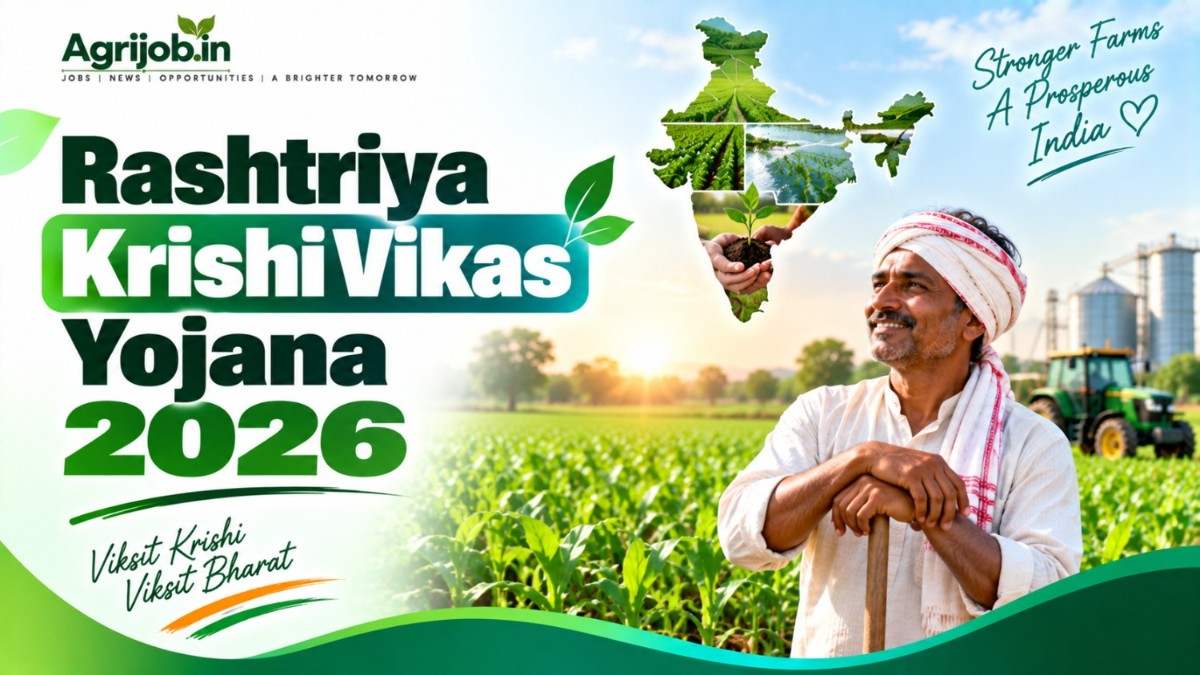
Rashtriya Krishi Vikas Yojana (RKVY) is a flagship Centrally Sponsored Scheme (CSS) of the Government of India launched in 2007 under the National Development Council (NDC) with the objective of incentivising states to enhance public investment in agriculture and allied sectors. In October 2024, the Union Cabinet chaired by Prime Minister Narendra Modi approved a major restructuring of all agricultural CSS into two umbrella schemes — PM Rashtriya Krishi Vikas Yojana (PM-RKVY) and Krishonnati Yojana (KY) — giving states far greater flexibility to design and fund local farm development priorities.
The scheme has been through two major transformations: in 2017, it was revamped as RKVY-RAFTAAR (Remunerative Approaches for Agriculture and Allied Sector Rejuvenation) to actively promote agri-entrepreneurship; then in 2024, it was consolidated into PM-RKVY with an expanded scope. In 2026, PM-RKVY continues to be the single most important vehicle for state-level agricultural capital investment in India, covering soil health, mechanisation, crop diversification, rainfed farming, irrigation, and a vibrant agri-startup ecosystem.

A key 2026 policy change allows state governments to re-allocate RKVY funds between components based on their specific agricultural needs, without seeking central approval for each sub-scheme — making the programme far more responsive to ground-level realities in Bihar, Odisha, Assam, Rajasthan, and other major agriculture states.
RKVY 2026 Budget Allocation – Rs.8,550 Crore Breakdown
The Union Budget 2026-27 has allocated Rs.8,550 crore to the Rashtriya Krishi Vikas Yojana, representing a 22% increase over the revised estimate of Rs.7,000 crore for 2025-26. This is part of a total Ministry of Agriculture and Farmers Welfare budget of Rs.1,40,529 crore — 5.4% higher than the 2025-26 revised estimate. The PM-RKVY component alone carries a total proposed period expenditure of Rs.57,074.72 crore, with a combined total (PM-RKVY + Krishonnati Yojana) of Rs.1,01,321.61 crore.
| Financial Year | RKVY Budget Allocation (Rs. Crore) | Change vs Previous Year | Key Focus |
|---|---|---|---|
| 2023-24 | 7,150 | — | RKVY-RAFTAAR, Infrastructure |
| 2024-25 | 7,500 (approx.) | +5% | Agri-startup ecosystem |
| 2025-26 (RE) | 7,000 | Revised downward | Scheme restructuring |
| 2026-27 (BE) | 8,550 | +22% | PM-RKVY full rollout |
The total projected central share of the Department of Agriculture & Farmers Welfare across PM-RKVY and Krishonnati Yojana is Rs.69,088.98 crore, while states are expected to contribute Rs.32,232.63 crore — reflecting the 60:40 funding ratio for general category states and 90:10 for North Eastern and Himalayan states such as Arunachal Pradesh, Manipur, Meghalaya, Sikkim, Himachal Pradesh, and Uttarakhand.
State-Wise RKVY Funding Allocation & Eligibility
All 28 states and 8 Union Territories of India are eligible for Rashtriya Krishi Vikas Yojana 2026 funding. However, actual allocation is not fixed by formula alone — states must prepare and submit State Agricultural Plans (SAPs) and District Agricultural Plans (DAPs), which form the basis of their Annual Action Plan (AAP). A crucial 2026 reform is that states can now get their entire AAP approved in one go rather than seeking approval scheme by scheme, significantly reducing bureaucratic delay.
| State / Region | Funding Ratio (Centre:State) | Key Agriculture Focus | Major RKVY Sectors |
|---|---|---|---|
| Uttar Pradesh | 60:40 | Wheat, sugarcane, horticulture | Mechanisation, crop diversification |
| Madhya Pradesh | 60:40 | Soybean, wheat, pulses | Rainfed area development, soil health |
| Maharashtra | 60:40 | Cotton, onion, sugarcane | Irrigation, agri-infrastructure |
| Punjab | 60:40 | Paddy, wheat, maize | Crop diversification (CDP) |
| Rajasthan | 60:40 | Bajra, mustard, groundnut | Rainfed farming, FPO development |
| Bihar | 60:40 | Maize, vegetables, fisheries | Post-harvest, storage infrastructure |
| Karnataka | 60:40 | Ragi, coffee, horticulture | Allied sectors, agri-startup incubation |
| North Eastern States | 90:10 | Rice, horticulture, bamboo | Agri-infrastructure, organic farming |
| Himalayan States | 90:10 | Apple, off-season vegetables | High-value horticulture, mechanisation |
State eligibility under Rashtriya Krishi Vikas Yojana 2026 is conditional: a state must maintain or increase its agriculture and allied sector expenditure compared to its 3-year baseline average. If a state reduces its own-budget commitment to agriculture after receiving RKVY funds, it must return the remaining central funds. This mechanism ensures additionality — states must spend more on farming, not substitute RKVY grants for their own planned outlays.
5 Key Components Funded Under RKVY 2026
The current PM-RKVY 2026 framework funds 5 core sub-components, covering the full agricultural value chain from soil to market. States can mix and match allocations across components based on their Annual Action Plan, with the new flexibility to re-allocate between sub-heads without fresh central approval:
- 🌱 Soil Health & Fertility Management: Funds for soil testing laboratories, micro-nutrient application, organic matter enhancement, and biofertiliser distribution. States like Bihar and Odisha are major beneficiaries with high soil degradation challenges.
- 🚜 Agricultural Mechanisation & Technology: Custom Hiring Centres (CHCs), farm machinery banks, precision agriculture tools, drone-based spraying, and post-harvest machinery. This component has seen 35%+ of annual outlay in most states.
- 🌾 Crop Diversification & Allied Sector Development: Includes horticulture, sericulture, fisheries, animal husbandry, and beekeeping. Punjab and Haryana receive significant crop diversification funds to reduce paddy-wheat monoculture dependency.
- 🌧️ Rainfed Area Development: Watershed projects, water harvesting structures, dryland horticulture, and integrated farming systems for the 60% of India’s cultivated area that is still rain-dependent.
- 💧 Irrigation Infrastructure: Field-level water distribution systems, micro-irrigation (drip and sprinkler), farm pond creation, and canal renovation — especially in drought-prone Rajasthan, Madhya Pradesh, and Vidarbha region of Maharashtra.
In addition to these 5 production-focused components, 30% of RKVY’s annual outlay is earmarked for national priorities including the Innovation & Agri-Entrepreneurship Programme (RKVY-RAFTAAR), Knowledge Partners (KPs), and RKVY Agri-Business Incubators (R-ABIs) hosted at premier institutions like IIT Kanpur, MANAGE Hyderabad, ICAR institutes, and agricultural universities across India.
RKVY Agripreneurship Grant – Up to Rs.25 Lakh for Startups
One of the most exciting opportunities under Rashtriya Krishi Vikas Yojana 2026 for young agri-entrepreneurs and agritech innovators is the RKVY-RAFTAAR Innovation & Agri-Entrepreneurship Programme. This sub-component provides equity-free grant funding, incubation, and mentorship to Indian agri-startups at two distinct stages:
| Stage | Grant Amount | Stage Description | Funding Trigger |
|---|---|---|---|
| Agripreneurship Orientation Program (AOP) | Up to Rs.5 lakh | 1-month mentorship internship; idea validation; prototype creation | Successful pitch after AOP completion |
| Pre-Seed / Idea Stage (SAIP) | Up to Rs.5 lakh | Build minimum viable product (MVP); proof of concept | Selected by R-ABI incubator |
| Seed Stage Funding | Up to Rs.25 lakh | Scale MVP to market-ready product; pilot testing | Milestone-based evaluation by KP/R-ABI |
| Follow-on Funding | Market-linked | Investor connect, pitching platforms, partner network | Demo Day and investor introductions |
The programme is implemented through a national network of RKVY Agri-Business Incubators (R-ABIs) hosted at institutions such as IIT Kanpur, MANAGE (National Institute of Agricultural Extension Management, Hyderabad), Nutrihub ICAR-IIMR, and state agricultural universities. As of 2026, the latest cohort deadline for the IIT Kanpur R-ABI was March 2026, with new cohorts announced quarterly through the MANAGE official portal.
RKVY Eligibility Criteria – States, Startups & Farmers
Rashtriya Krishi Vikas Yojana 2026 has two distinct eligibility tracks — one for state governments (infrastructure and development projects) and one for individual entrepreneurs and startups (RKVY-RAFTAAR agripreneurship grants):
Eligibility for State Governments (Infrastructure Projects)
- ✅ All 28 States & 8 UTs of India are eligible to submit project proposals under RKVY 2026.
- ✅ State must have a State Agricultural Plan (SAP) and District Agricultural Plans (DAPs) prepared and ready.
- ✅ State’s Plan expenditure on agriculture and allied sectors must be maintained or increased over the 3-year baseline average — failure to do so disqualifies the state from new RKVY releases.
- ✅ State must submit a 100% Utilization Certificate (UC) for all funds released in the previous financial year before the second instalment is released.
- ✅ Quarterly Physical and Financial Progress Reports must be submitted in specified format to the central RKVY management unit.
- ✅ States must give priority to marginalized and small/marginal farmers, women farmers, SC/ST communities, and farmers in rainfed and drought-prone areas.
Eligibility for Agri-Startup / Agripreneurship Grants
- 🌟 Applicant must be an Indian citizen or a registered legal entity (Private Ltd, LLP, FPC, etc.) in India.
- 🌟 Must have an innovative idea in agribusiness — based on technology, process, service, or new business model for agriculture and allied sectors.
- 🌟 Applicant must be willing to pursue the agri-entrepreneurial aspiration full-time — part-time applications are not eligible.
- 🌟 Must have an initial business plan or proposal demonstrating the idea’s potential, market size, and implementation approach.
- 🌟 For seed-stage grants (up to Rs.25 lakh), startup must have a working MVP and be ready for incubation with a selected R-ABI.
- 🌟 No upper age limit — both fresh graduates (22+ years) and experienced agri-professionals can apply.
- 🌟 Women agripreneurs, SC/ST founders, and applicants from North East and Himalayan states are given special priority in selection.
How to Apply for RKVY 2026 Project Proposals – Step by Step
The application process for Rashtriya Krishi Vikas Yojana 2026 differs based on whether you are a state government body or an individual agri-entrepreneur. Below are both processes:
For State Governments – Submitting RKVY Project Proposals
- Prepare District Agricultural Plans (DAPs): Each district must have an up-to-date DAP identifying local agricultural priorities, gaps, and proposed interventions. DAPs are the building blocks of the state’s RKVY submission.
- Compile State Agricultural Plan (SAP): The state consolidates all DAPs into a State Agricultural Plan covering all sectors — crops, horticulture, fisheries, animal husbandry, mechanisation — with budget estimates and expected outcomes.
- Prepare Annual Action Plan (AAP): The state converts the SAP priorities into an Annual Action Plan for the coming financial year, listing specific projects with DPR (Detailed Project Reports), costs, timelines, and funding requirements.
- Submit AAP to Department of Agriculture & Farmers Welfare: From 2026 onwards, states submit the full AAP in one go to the DA&FW’s RKVY management portal. The AAP is now approved holistically — not scheme by scheme — reducing processing time significantly.
- Await Central Approval and First Instalment Release: After AAP approval, the central government releases 50% of sanctioned funds as the first instalment. States must acknowledge receipt and issue counter-part funds from their own budget.
- Implement Projects and Submit Quarterly Reports: Implementing agencies carry out the projects and submit quarterly physical and financial progress reports to the central RKVY portal.
- Submit Utilization Certificate for Second Instalment: Once 100% UC for the first instalment is submitted and verified, the second 50% instalment is released by the central government.
For Agri-Entrepreneurs – Applying for RKVY RAFTAAR Startup Grant
- Identify the Right R-ABI / Knowledge Partner: Visit the Department of Agriculture & Farmers Welfare (agricoop.nic.in) website or MANAGE-CIA portal to find the active R-ABI incubators currently accepting applications. Options include IIT Kanpur, ICAR institutes, and MANAGE Hyderabad.
- Register and Prepare Your Business Proposal: Create a detailed business plan covering your innovative agri-business idea, target beneficiaries (farmers, FPOs, agri-value chain players), market size, technology approach, and financial projections for 3 years.
- Submit Online Application: Apply through the designated incubator’s online application portal. Upload all required documents: identity proof, business plan, financial projections, incorporation certificate (if incorporated), and team details.
- Screening and Shortlisting: Applications are evaluated on innovation, feasibility, scalability, and alignment with agriculture and allied sector goals. Shortlisted candidates are invited for an online or in-person pitch.
- Pitch Presentation to Selection Committee: Present your idea/MVP to a panel of agricultural experts, mentors, and industry professionals from the R-ABI ecosystem. Women and SC/ST founders get additional evaluation points.
- Enroll in Agripreneurship Orientation Program (AOP): If selected for AOP, spend 1 month working with existing agri-startups, mentors, and the incubator team to validate and refine your idea.
- Receive Grant-in-Aid & Incubation Support: After successful AOP or SAIP evaluation, grants of up to Rs.5 lakh (pre-seed) or Rs.25 lakh (seed stage) are disbursed in milestone-linked tranches. Incubation facilities, mentoring, and investor networking are provided alongside the grant.
Who Should Apply for Rashtriya Krishi Vikas Yojana 2026?
- 🧑🌾 State Agriculture Department Officials: Officials responsible for preparing SAPs, DAPs, and Annual Action Plans who need to secure maximum RKVY funds for their state’s agricultural development in 2026-27.
- 🚀 Agritech Startup Founders: Entrepreneurs with innovative solutions in precision agriculture, agri-AI, drone technology, farm-to-market platforms, or agri-fintech who need equity-free government grants up to Rs.25 lakh to scale their MVP.
- 👩🌾 Women Agripreneurs: Women founders and women farmer group leaders who get priority consideration in the RKVY-RAFTAAR selection process and can access grants without needing collateral or equity dilution.
- 🏘️ Farmer Producer Organisations (FPOs): FPOs seeking RKVY funding for collective infrastructure — cold storage, processing units, common service centres, and market linkage projects under the RKVY DPR component.
- 🎓 Agriculture Graduates & Researchers: Fresh BSc Agri / MSc Agri / PhD graduates from UGC-recognised universities who want to commercialise their research as an agri-startup under the RKVY incubation ecosystem.
- 🏔️ Entrepreneurs from North East & Himalayan States: Agripreneurs from Assam, Manipur, Meghalaya, Arunachal Pradesh, Himachal Pradesh, Uttarakhand, and Sikkim, where the 90:10 funding ratio makes RKVY-backed projects far easier to launch.
- 🌱 Organic Farming & Natural Farming Practitioners: Farmers and agri-entrepreneurs working on organic input production, bio-pesticide manufacture, soil microbiome solutions, and zero-budget farming who find strong alignment with RKVY’s soil health component.
- 📦 Post-Harvest & Agri-Logistics Entrepreneurs: Innovators addressing post-harvest losses — cold chain logistics, agri-warehousing, food processing micro-units — which are high-priority areas under RKVY 2026 infrastructure funding.
RKVY vs PM-KISAN – Which Government Agriculture Scheme Is Right for You?
| Parameter | Rashtriya Krishi Vikas Yojana (RKVY) 2026 | PM-KISAN Samman Nidhi |
|---|---|---|
| Primary Beneficiary | States, FPOs, Agri-startups, Entrepreneurs | Individual farm families |
| 2026 Budget | Rs.8,550 crore | Rs.63,500 crore |
| Type of Support | Project grants, infrastructure, startup incubation | Direct income support (cash transfer) |
| Maximum Individual Benefit | Up to Rs.25 lakh (startup seed grant) | Rs.6,000/year (Rs.2,000 per instalment) |
| Application Process | Project proposals / R-ABI incubator selection | Aadhaar-linked self-registration on PM-KISAN portal |
| Best For | Capital-intensive projects, innovation, scaling farm businesses | Income support, small farm operational expenses |
| Category Benefits | Extra priority for NE/Himalayan states, women, SC/ST startups | All landholding farmer families |
| Funding Nature | Grant-in-aid, not repayable (equity-free) | Direct benefit transfer, not repayable |
| Timeline to Receive Funds | 3–6 months (project approval + instalment release) | 4 months per instalment (quarterly) |
High-Value Agriculture Scheme Terms You Must Know in 2026
- 💼 Centrally Sponsored Scheme (CSS): A category of Indian government schemes co-funded by Centre and States. RKVY is a CSS — states must match a portion of central funds. Major CSSs in agriculture include RKVY, PM-KISAN, PMFBY, and PM-Krishi Sinchai Yojana. Central outlay for all agriculture CSS in 2026-27 is over Rs.1.4 lakh crore.
- 📄 Detailed Project Report (DPR): A comprehensive project document that states must prepare to access RKVY funds for specific infrastructure or development initiatives. A well-prepared DPR with clear cost-benefit analysis and agro-climatic justification has higher approval rates.
- 🏭 R-ABI (RKVY Agri-Business Incubator): Government-recognised incubators hosted at premier institutions that run the RKVY startup grant programme. R-ABIs provide both funding (up to Rs.25 lakh) and non-monetary incubation support — lab access, legal advice, investor introductions, and co-working space.
- 🧾 Utilization Certificate (UC): A mandatory government document certifying that RKVY funds were spent as approved. States must submit 100% UCs before receiving their second instalment. Delays in UC submission are the most common reason for RKVY fund disbursement delays.
- 🌐 Annual Action Plan (AAP): The annual blueprint that states submit to secure RKVY funding. From 2026, the entire AAP can be approved in one go — a major reform that reduces waiting time from 6–12 months to as little as 2–3 months.
- 🤝 FPO (Farmer Producer Organisation): A company of farmers who pool resources for collective marketing, input procurement, and infrastructure. FPOs are among the priority beneficiaries of RKVY’s Detailed Project Report component. NABARD and SFAC support FPO formation under parallel government schemes.
- 💧 Micro-Irrigation: Drip and sprinkler systems funded under RKVY’s irrigation component. India has one of the world’s largest drip irrigation potential areas — RKVY funds help states bridge the gap between potential and installed capacity, especially in Rajasthan, Gujarat, and Karnataka.
- 🏆 MANAGE (National Institute of Agricultural Extension Management): Hyderabad-based apex national institute under DA&FW that coordinates the RKVY-RAFTAAR agripreneurship programme, manages R-ABI networks, and runs AOP batches. Visit manage.gov.in for the latest RKVY cohort openings.
Frequently Asked Questions – Rashtriya Krishi Vikas Yojana 2026
What is Rashtriya Krishi Vikas Yojana (RKVY)?
Rashtriya Krishi Vikas Yojana is a flagship Centrally Sponsored Scheme launched in 2007 by the Government of India to incentivise states to invest more in agriculture and allied sectors. Now rebranded as PM-RKVY (Pradhan Mantri Rashtriya Krishi Vikas Yojana) after October 2024 restructuring, it funds agricultural infrastructure, mechanisation, crop diversification, rainfed area development, irrigation, and agri-startup incubation across all Indian states. In 2026-27, Rs.8,550 crore has been allocated to this scheme.
How much funding is allocated under RKVY in 2026-27?
The Union Budget 2026-27 has allocated Rs.8,550 crore to Rashtriya Krishi Vikas Yojana, which is 22% higher than the Rs.7,000 crore revised estimate for 2025-26. The broader PM-RKVY component carries a total scheme-period proposed expenditure of Rs.57,074.72 crore. The combined total of PM-RKVY and Krishonnati Yojana is Rs.1,01,321.61 crore, with a central share of Rs.69,088.98 crore and state share of Rs.32,232.63 crore.
What is the Centre-State funding ratio under RKVY 2026?
The Rashtriya Krishi Vikas Yojana follows a 60:40 Centre-to-State funding ratio for general category states, meaning states bear 40% of project costs from their own budget. For North Eastern states (Assam, Arunachal Pradesh, Manipur, Meghalaya, Mizoram, Nagaland, Tripura, Sikkim) and Himalayan states (Himachal Pradesh, Uttarakhand, and J&K), the ratio is 90:10 — making RKVY projects extremely affordable for these states. Funds are released in 2 equal instalments of 50% each.
Who is eligible to apply for RKVY project proposals in 2026?
For state-level infrastructure projects, all 28 State Governments and 8 Union Territories of India are eligible, provided they maintain their baseline agriculture expenditure and have prepared State Agricultural Plans and District Agricultural Plans. For agri-startup grants under the RKVY-RAFTAAR Innovation Programme, any Indian citizen or registered entity with an innovative agri-business idea can apply through a RKVY Agri-Business Incubator (R-ABI). SC/ST founders, women agripreneurs, and applicants from North Eastern states get priority in startup selection.
How much grant money can an agri-startup get under RKVY?
Under the RKVY-RAFTAAR agripreneurship programme, pre-seed stage startups can receive up to Rs.5 lakh as an idea-stage grant after successfully completing the 1-month Agripreneurship Orientation Program (AOP). Startups with a working MVP (Minimum Viable Product) at the seed stage can receive up to Rs.25 lakh in milestone-driven grant-in-aid. All grants are equity-free — the government takes no ownership stake in the startup. Additional follow-on funding opportunities are provided through investor connect events and Demo Days organised by R-ABIs.
What documents are needed to submit an RKVY project proposal?
For state-level RKVY project proposals, required documents include: State Agricultural Plan (SAP), District Agricultural Plans (DAPs), Detailed Project Report (DPR) with cost estimates and outcomes, Quarterly Physical and Financial Progress Reports for ongoing projects, and 100% Utilization Certificate for previous year’s RKVY funds. For agripreneurship grants, applicants need identity proof, a detailed business plan, financial projections, team bios, and incorporation documents if already registered. Applications are submitted through designated R-ABI incubator portals.
Which are the main components funded under RKVY 2026?
Rashtriya Krishi Vikas Yojana 2026 funds 5 main components: (1) Soil health and fertility management, (2) Agricultural mechanisation and technology, (3) Crop diversification and allied sector development including horticulture, fisheries and animal husbandry, (4) Rainfed area development and watershed projects, and (5) Irrigation infrastructure. The RKVY-RAFTAAR sub-scheme additionally supports agri-startups through R-ABIs, agripreneurship orientation programs, and seed-stage grants of up to Rs.25 lakh.
How is RKVY different from PM-KISAN?
PM-KISAN provides direct income support of Rs.6,000 per year to all landholding farmer families through DBT — it is a simple cash transfer scheme with no project component. Rashtriya Krishi Vikas Yojana, on the other hand, is a project-based scheme that funds agricultural infrastructure, mechanisation, startup incubation, and allied sector development. RKVY benefits state governments, FPOs, and agri-entrepreneurs who want to build large-scale or innovative agriculture projects — not individual subsistence farmers. In 2026-27, PM-KISAN received Rs.63,500 crore versus Rs.8,550 crore for RKVY.
How do I find RKVY R-ABI incubators currently accepting applications?
The best way to find currently active R-ABI incubators accepting RKVY startup applications is to check the MANAGE-CIA portal (manage.gov.in) and the Department of Agriculture & Farmers Welfare website (agricoop.nic.in). Individual R-ABIs such as IIT Kanpur, Nutrihub ICAR-IIMR (Hyderabad), and state agricultural universities also publish cohort-specific application windows. You can also follow Agrijob.in for the latest RKVY agripreneurship call updates.
For the latest RKVY 2026 project guidelines, state-wise allocation updates, and agripreneurship grant calls, also check our related guides on Agriculture Government Schemes India and AgriTech Startups India 2026.
This guide is regularly reviewed and updated for accuracy. Bookmark this page for the latest Rashtriya Krishi Vikas Yojana 2026 notifications, state allocation updates, and agripreneurship grant windows.
Last Updated: June 2026