

Warehouse Receipt Financing Farmers 2026 – Complete Guide to Get Loan Against Stored Crops
Warehouse Receipt Financing Farmers 2026 is a government-backed scheme that allows farmers across India to get instant loans against their stored agricultural produce — without selling at distress prices. Under this scheme, farmers store their crops in a WDRA-registered warehouse, receive an electronic Negotiable Warehouse Receipt (e-NWR), and pledge it with any nationalised bank to get up to 75% of the crop’s value as loan at just 7% per annum for small and marginal farmers. Eligible NRIs returning to India with farming interests may also benefit from this scheme. Read on for complete details and apply via agrijob.in.

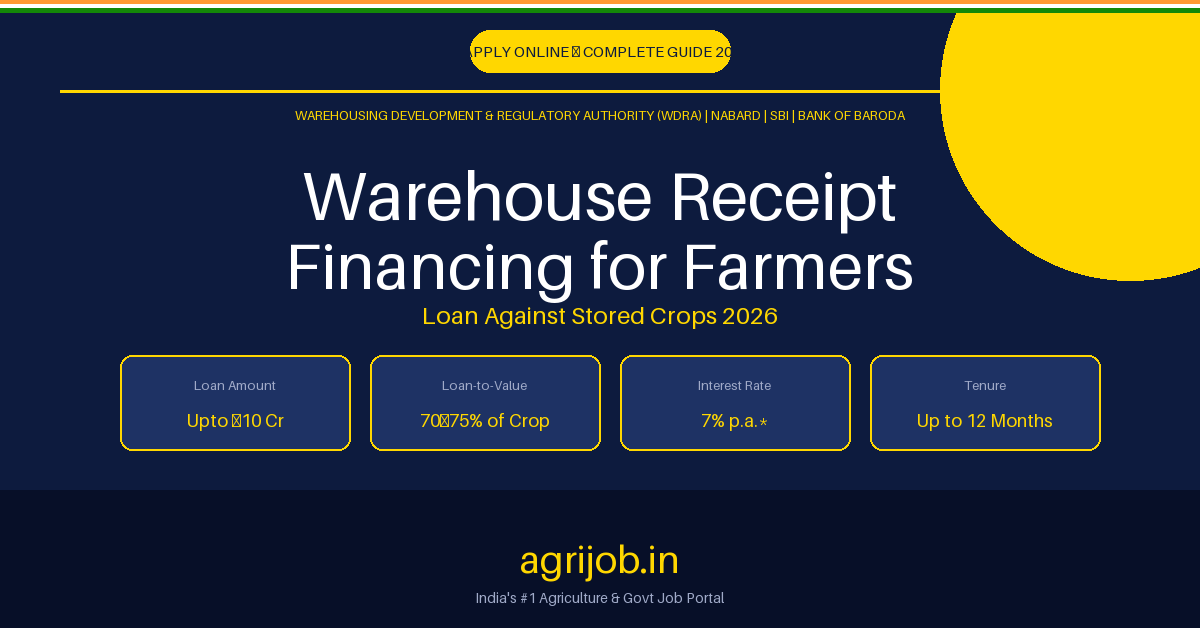
Table of Contents
Warehouse Receipt Financing Farmers 2026 – Quick Overview
| Detail | Information |
|---|---|
| Scheme Name | Warehouse Receipt Financing / e-NWR Pledge Financing |
| Regulatory Authority | Warehousing Development and Regulatory Authority (WDRA) |
| Participating Banks | SBI, Bank of Baroda, Bank of India, NABARD, ICICI Bank, Federal Bank, Bank of Maharashtra, L&T Finance and all PSU Banks |
| Loan Amount | Up to ₹10 Crore (SBI: 75% LTV | Federal Bank: 70% LTV, max ₹25 Cr) |
| Interest Rate | 7% p.a. for small & marginal farmers (subject to GOI Interest Subvention Scheme) |
| Loan Tenure | Maximum 12 months (up to 1 month before commodity shelf life) |
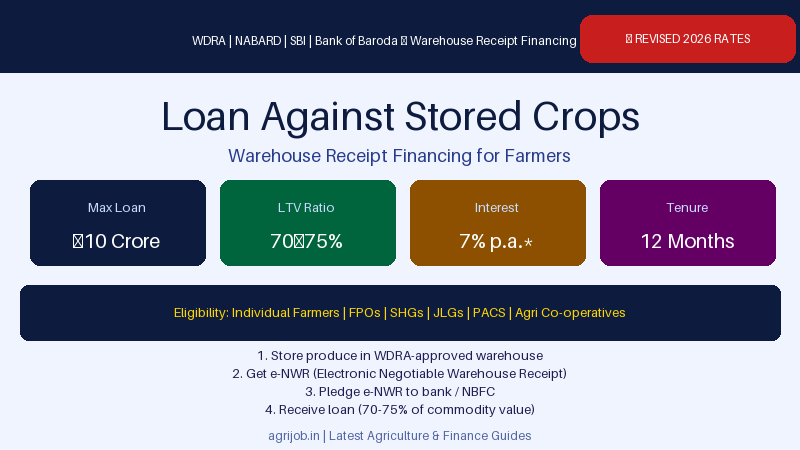
| Eligible Beneficiaries | Individual farmers (single/joint), FPOs, SHGs, JLGs, PACS, Agro-food processing units |
| Commodity Types | Grains, pulses, oilseeds, spices and all non-perishable agri produce |
| Apply At | wdra.gov.in → find nearest registered warehouse |
| New Govt Initiative | CGS-NPF (Credit Guarantee Scheme for e-NWR based Pledge Financing) – launched Dec 2024 |
What is Warehouse Receipt Financing? – Full Explanation
Warehouse Receipt Financing Farmers 2026 is a post-harvest credit facility where a farmer’s stored crop acts as collateral. Instead of selling grain at rock-bottom post-harvest prices, a farmer stores it in a certified godown and receives a receipt — called an e-NWR (electronic Negotiable Warehouse Receipt). This digital receipt is issued through repositories approved by WDRA: NERL (National e-Repository Limited) and CCRL (CDSL Commodity Repository Limited).
The farmer pledges this e-NWR with a bank. The bank values the produce (at the lower of MSP, market price, or e-NWR value) and sanctions a loan of 70–75% of that value. The farmer uses the cash for next season’s seeds, fertilisers, or family expenses — and repays when prices improve. This breaks the cycle of distress selling that has trapped generations of Indian farmers.

In December 2024, the Union Government launched the CGS-NPF Scheme (Credit Guarantee Scheme for e-NWR based Pledge Financing) to further boost banker confidence in lending against e-NWRs. This scheme gives a guarantee cover on loans and has a minimal guarantee fee for small & marginal farmers, women, SC, ST and Divyangjan (PwD) farmers.
Loan Amount & Interest Rate – Warehouse Receipt Financing 2026
| Bank / Lender | Max Loan Amount | LTV (Loan-to-Value) | Interest Rate |
|---|---|---|---|
| State Bank of India (SBI) | Based on e-NWR value | 75% | 7% p.a.* for small & marginal farmers |
| Bank of Baroda | As per e-NWR value | 70–75% | As per bank rate |
| Bank of India | Up to ₹75 Lakh (WDRA cold storage) | 70% | As per bank rate |
| Federal Bank | Up to ₹25 Crore | 70% | As per priority sector rate |
| ICICI Bank | Up to ₹40 Crore (credit line) | 70–80% | Q4 FY2026 rates applicable |
| L&T Finance | ₹1 Lakh – ₹10 Crore | 70–80% | Competitive, based on profile |
| Bank of Maharashtra | As per scheme | 70–75% | As per bank rate |
*Interest Subvention: Small and marginal farmers holding a Kisan Credit Card (KCC) get the benefit of the Government of India Interest Subvention Scheme at 7% p.a. for up to 6 months. This is one of the most affordable agricultural credit options available in India in 2026.
Eligibility – Who Can Apply for Warehouse Receipt Financing 2026
- Individual farmers — both owner-farmers and tenant/sharecropper farmers
- Joint farmers (two or more farmers applying together)
- Farmer Producer Organisations (FPOs) and Farmer Producer Companies (FPCs)
- Self Help Groups (SHGs) and Joint Liability Groups (JLGs) of farmers
- Primary Agricultural Co-operative Credit Societies (PACS)
- Agro-food processing units and farmer co-operative societies
- Small traders and MSMEs dealing in agricultural commodities
There is no age bar for this scheme. Any farmer who stores produce in a WDRA-registered warehouse is eligible. The scheme covers all major food crops, pulses, oilseeds, spices, and non-perishable horticultural produce stored under certified conditions.
Documents Required for Warehouse Receipt Loan 2026
- Identity Proof: Aadhaar Card, Voter ID, Passport or PAN Card
- Address Proof: Aadhaar, ration card, utility bill or bank statement
- e-NWR / Warehouse Receipt: Issued by WDRA-registered warehouse (digital via NERL / CCRL)
- Bank Account Details: Passbook or cancelled cheque
- KCC (Kisan Credit Card): Required to avail the 7% interest subvention benefit
- Passport-size photographs
- Commodity details: Type, quantity, and quality certificate from warehouse
Eligible Commodities – Crops You Can Store & Pledge 2026
The following agricultural and horticultural commodities are eligible for Warehouse Receipt Financing in 2026 when stored in WDRA-registered warehouses:
- Food Grains: Wheat, Rice (Paddy), Maize, Sorghum, Millet
- Pulses: Tur (Arhar), Chana (Gram), Moong, Urad, Masoor
- Oilseeds: Soybean, Mustard, Sunflower, Groundnut, Sesame
- Spices: Turmeric, Chilli, Coriander, Cumin, Cardamom
- Cash Crops: Cotton (lint), Jute
- Horticulture produce stored in WDRA-accredited cold storage
Step-by-Step Process – How to Get Warehouse Receipt Loan in 2026
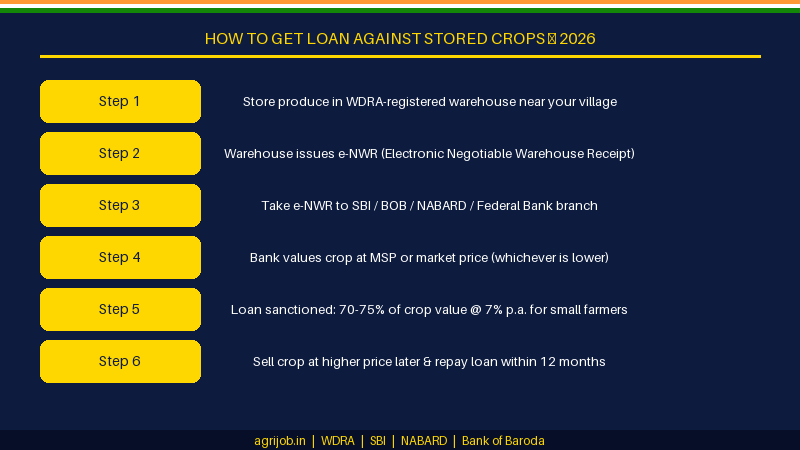
- Find a WDRA-Registered Warehouse: Visit wdra.gov.in and use the warehouse search to find a registered godown near your village or district.
- Store Your Produce: Deliver your harvested crop to the WDRA-registered warehouse. The warehouse will inspect, grade, and certify the quality and quantity of your produce.
- Receive Your e-NWR: The warehouse issues an electronic Negotiable Warehouse Receipt (e-NWR) digitally via NERL or CCRL repositories. This receipt is your loan instrument.
- Visit Your Bank: Take your e-NWR and required documents to the nearest branch of SBI, Bank of Baroda, Bank of India, Federal Bank, ICICI Bank, L&T Finance, or any participating lender.
- Loan Valuation: The bank values your commodity at the lowest of — MSP, current market price, or e-NWR value — and calculates the loan at 70–75% of that figure minus the margin.
- Loan Disbursement: Upon approval, the loan amount is credited directly to your bank account. Lien is marked on the e-NWR through the repository system (NERL / CCRL).
- Sell at Right Time & Repay: When market prices improve, sell your stored commodity, repay the loan (principal + 7% interest), and the lien on your e-NWR is released.
Selection Process / Loan Sanction Process
- Application submission at bank branch with e-NWR + KYC documents
- Document verification and commodity valuation by bank officer
- Credit assessment (priority sector lending norms apply)
- Lien marking on e-NWR via NERL / CCRL digital repository
- Loan sanction and disbursement to farmer’s account
- Loan repayment within 12 months + release of lien
New CGS-NPF Scheme 2024–2026 – Credit Guarantee for e-NWR Financing
The Union Minister of Consumer Affairs, Food & Public Distribution launched the Credit Guarantee Scheme for e-NWR based Pledge Financing (CGS-NPF) in December 2024. This scheme is a landmark initiative that provides a guarantee cover to banks for loans given against e-NWRs — covering both credit risk and warehouseman risk.
Key features of CGS-NPF include: a minimal guarantee fee for small & marginal farmers, women, SC/ST, and PwD farmers; coverage for small traders (MSMEs), FPOs, and co-operatives; and an ambitious target of registering 40,000 warehouses with WDRA in the next 1–2 years. The government aims to dramatically increase the share of post-harvest lending against e-NWRs — currently only ~1.24 million tonnes out of India’s ~330 million tonne food grain production are financed via this route.
Is Warehouse Receipt Financing a Good Option for NRIs and International Agriculture Graduates?
For NRIs returning to India who own agricultural land or have inherited farmland, Warehouse Receipt Financing represents a highly attractive financial instrument. Unlike traditional land-mortgage loans that take months to process, e-NWR loans can be sanctioned within days — making them ideal for those managing farm operations remotely or after returning from abroad.
When comparing India vs USA or India vs UK agricultural credit, India’s warehouse receipt loan system is one of the few mechanisms that operates close to commodity-backed finance models used in Chicago Mercantile Exchange (CME) warehousing programs. However, Indian interest rates at 7% p.a. under the government subvention scheme are far more accessible than typical commodity-backed lending rates abroad (often 8–12%).
International students of agriculture from Indian universities who return home after completing BSc / MSc Agriculture degrees abroad can advise their family farmers to use this scheme immediately after the Kharif or Rabi harvest. For agriculture graduates in India for NRIs or those connected to diaspora farming communities, this is also a viable business advisory opportunity in agri-finance and warehouse management consulting.
Benefits of Warehouse Receipt Financing Farmers 2026
- Avoids Distress Selling: Farmers can hold their produce and wait for prices to rise instead of selling immediately after harvest at lowest prices
- Instant Liquidity: Get 70–75% of crop value as cash within days without selling a single grain
- Low Interest Rate: 7% p.a. for small farmers under GOI Interest Subvention — cheaper than most personal loans or moneylender rates
- Digital & Secure: The e-NWR system on NERL / CCRL is tamper-proof, reducing fraud and enabling real-time lender verification
- No Land Mortgage Needed: The stored commodity is the only collateral — no land documents needed for pledge financing
- Boosts Farmer Income: Studies show farmers using warehouse financing earn 15–25% more on their produce by timing the market
- Covered by Guarantee: CGS-NPF scheme gives bankers confidence, making loan approvals faster and easier
Important Links – Warehouse Receipt Financing 2026
| Resource | Link |
|---|---|
| WDRA Official Website | wdra.gov.in |
| WDRA FAQ – Warehouse Receipt Loans | wdra.gov.in/faqs |
| SBI Warehouse Receipt Financing | SBI Agri Warehouse Loan |
| Bank of Baroda e-NWR Finance | BoB Warehouse Finance |
| CGS-NPF Scheme – PIB Press Release | PIB.gov.in – CGS-NPF Launch |
| More Agriculture Finance Guides | Latest Agriculture Jobs |
| Latest Govt Schemes 2026 | Govt Jobs & Schemes 2026 |
| Join Our Telegram for Alerts | agrijob.in Telegram Channel |
Frequently Asked Questions about Warehouse Receipt Financing Farmers 2026
Q1. What is Warehouse Receipt Financing Farmers 2026?
Warehouse Receipt Financing Farmers 2026 is a government-facilitated credit scheme where Indian farmers store their harvested produce in WDRA-registered warehouses, receive an electronic Negotiable Warehouse Receipt (e-NWR), and pledge it with a bank to get an instant loan of 70–75% of the crop’s value at as low as 7% interest per annum.
Q2. Which bank gives the best loan against warehouse receipt in India in 2026?
SBI (State Bank of India) is the most popular, offering 75% LTV and 7% p.a. for small farmers. Bank of Baroda, Federal Bank, ICICI Bank, and L&T Finance also offer competitive terms. Compare rates at the nearest branch before applying.
Q3. What crops are eligible for warehouse receipt loan in 2026?
All major food grains (wheat, rice, maize), pulses (tur, chana, moong), oilseeds (soybean, mustard, groundnut), spices (turmeric, chilli, cumin), cotton, jute, and non-perishable horticultural produce stored in accredited cold storage are eligible.
Q4. Can NRIs or Indian students abroad apply for warehouse receipt financing?
NRIs who own agricultural land in India and are involved in farming operations can benefit from this scheme through a family member or Power of Attorney. There is no specific bar on NRI participation as landowners or FPO members. International agriculture graduates returning to India should especially explore this scheme to support their family farms.
Q5. What is the maximum loan I can get against a warehouse receipt?
The loan is 70–75% of the commodity value (MSP or market price, whichever is lower). L&T Finance offers up to ₹10 Crore; Federal Bank up to ₹25 Crore; ICICI Bank offers a credit line up to ₹40 Crore for traders. Individual farmers typically get ₹1 Lakh to ₹25 Lakh depending on produce volume.
Q6. What is the CGS-NPF scheme and how does it help farmers?
CGS-NPF (Credit Guarantee Scheme for e-NWR based Pledge Financing) was launched in December 2024 by the Union Government. It gives banks a government-backed guarantee on loans disbursed against e-NWRs. This reduces the bank’s risk, making them more willing to lend to small farmers. The guarantee fee is minimal for small & marginal farmers, women, SC, ST and PwD farmers.
Final Thoughts on Warehouse Receipt Financing Farmers 2026
Warehouse Receipt Financing Farmers 2026 is one of the most powerful financial tools available to Indian farmers today — yet it remains severely underutilised. With the Government of India’s new CGS-NPF guarantee scheme, WDRA’s expanding warehouse network, and banks like SBI offering loans at just 7% per annum, there has never been a better time for farmers to stop distress selling and start leveraging their stored crops as financial assets. Whether you grow wheat in Punjab, soybean in Madhya Pradesh, or turmeric in Telangana — if you have a WDRA-registered warehouse nearby, you can access this scheme immediately. Visit agrijob.in for more agriculture finance guides, government schemes, and agri job updates 2026.
Disclaimer: This Agricultural jobs related information is only for the purpose of providing information to you and for Agricultural career advancement of Agricultural, Horticulture, Agronomy, Soil Science, Plant Breeding, Agriculture Marketing, Forestry, Poultry, Fisheries, Agri Business Management Graduates. We are not representing this employer or any Employment Agency nor we guarantee any employment. We do not ask candidates for any fees, Personal Information like (Bank OTP, Credit-Debit Card No, Aadhar Card OTP etc.) Please be Aware And never Share Such Information to any one or In the Name of agrijob.in. Please verify the correctness of the Agri jobs details yourself. We do not offer any guarantee on correctness of any details mentioned here. If a candidate pays any amount to anyone claiming to represent any company then it would be the responsibility of that candidate and he cannot hold us or the concerned employer responsible for such fraudulent activities.