

AI in Agriculture India 2026
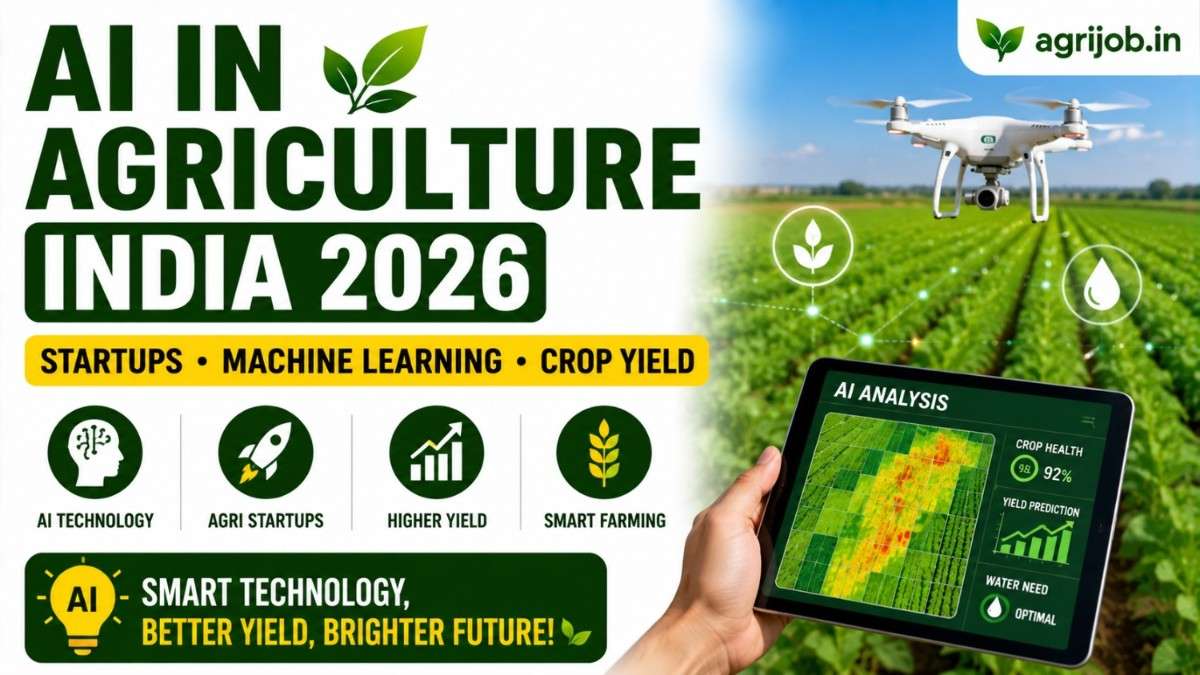
AI in agriculture India 2026 is the sector’s defining transformation — reshaping how 140 million farming households make decisions on water, fertiliser, pest management, and market timing. From machine learning crop advisory apps delivering 27% yield improvements to satellite-powered platforms digitising millions of acres, Indian agritech startups are turning a USD 452 billion agricultural economy into a data-driven powerhouse. This guide profiles India’s 10 leading AI agritech startups using machine learning to boost crop yield, covers their funding, key technologies, proven impact, salary benchmarks for agritech careers, and a step-by-step guide to landing a job in India’s fastest-growing agri-technology sector in 2026.

- AI in Agriculture India – 2026 Market Overview
- 10 Top AI Agritech Startups Using Machine Learning to Boost Crop Yield
- 1. DeHaat – Full-Stack AI Farm Advisory
- 2. CropIn – Satellite + ML Farm Intelligence
- 3. Fasal – AI-Powered IoT Horticulture Platform
- 4. AgroStar – Decision Intelligence at Scale
- 5. BharatAgri – Hyper-Local ML Advisory
- 6. SatSure – Satellite Analytics & Crop Risk AI
- 7. Ninjacart – AI Supply Chain & Market Intelligence
- 8. Intello Labs – Computer Vision Produce Grading
- 9. Gramophone – AI Input Commerce & Advisory
- 10. Stellapps – AI for Dairy & Livestock Farming
- AI Agritech Careers & Salary Guide India 2026
- Who Should Target AI Agritech Jobs?
- How to Get Hired at an AI Agritech Startup – Step by Step
- AI Agritech Jobs vs Government Agriculture Jobs – Comparison
- High-Value AI Agriculture Career Terms You Must Know
- Frequently Asked Questions (FAQs)
AI in Agriculture India – 2026 Market Overview
India’s applied AI in agriculture market was valued at USD 175.7 million in 2024 and is projected to surge to USD 5,205 million by 2035, growing at an extraordinary CAGR of 36.08% — making it one of the fastest-growing AI application verticals in the country. Within the broader agritech landscape, India’s total agritech market is expected to grow from USD 9 billion in 2025 to USD 28 billion by 2030 at a 25% CAGR (Inc42 & StarAgri, 2025). The AI agritech sub-segment is growing even faster — from USD 900 million in 2025 to USD 5.6 billion by 2030 at a 44% CAGR, nearly double the rest of the sector.
| India Applied AI in Agriculture Market (2024) | USD 175.7 Million |
| Projected Market Size (2035) | USD 5,205 Million (CAGR 36.08%) |
| India Agritech Market (2025) | USD 9 Billion |
| India Agritech Market (2030 Projection) | USD 28 Billion (CAGR 25%) |
| Active Agritech Startups in India | 3,000+ (1,300+ AI-focused in 2026) |
| Cumulative Agritech Funding India | ~USD 4–5 Billion |
| Crop Yield Improvement (AI advisory) | Up to 27% (AgroStar ESG Report) |
| Govt. Digital Agriculture Mission Outlay | Rs.2,817 crore (FY24–FY26) |
Three structural forces are driving this acceleration in 2026. First, India’s 140 million smallholder farming households operate in a sector with less than 1% tech penetration — meaning the opportunity for AI to add value is enormous. Second, the government’s Digital Agriculture Mission (Rs.2,817 crore) and Agriculture Accelerator Fund (Rs.500 crore) are providing ecosystem capital for agritech growth. Third, in January 2025, MeitY and IIT Indore jointly launched AgriHub, India’s first dedicated AI centre of excellence for agriculture, accelerating R&D-to-deployment pipelines for the next generation of agritech startups. AI adoption in Indian agriculture is concentrated across 6 key use cases: yield forecasting, water optimisation, credit underwriting, insurance pricing, pest/disease detection, and commodity price discovery.

10 Top AI Agritech Startups in India Using Machine Learning 2026
Here is a consolidated view of India’s 10 most impactful AI agriculture startups ranked by total funding, ML application depth, and proven farmer impact as of May 2026:
| # | Startup | Founded | HQ | Total Funding | Core AI Application | Farmers Reached |
|---|---|---|---|---|---|---|
| 1 | DeHaat | 2012 | Patna / Gurugram | USD 270M+ | Full-stack AI advisory, crop calendar, disease alerts | 1.8M+ (12 states) |
| 2 | CropIn | 2010 | Bengaluru | USD 46.4M+ | Satellite + ML farm intelligence, SmartFarm SaaS | 6.9M+ (52 countries) |
| 3 | Fasal | 2018 | Bengaluru | USD 15M+ | IoT + AI micro-climate advisory for horticulture | Thousands (Maharashtra, Karnataka) |
| 4 | AgroStar | 2013 | Pune | USD 115M+ | AI decision intelligence, 10M+ agronomy queries resolved | 5M+ (4 states) |
| 5 | BharatAgri | 2017 | Pune | USD 17.6M | Hyper-local ML crop advisory (soil + weather + crop data) | Millions (Hindi belt) |
| 6 | SatSure | 2017 | Bengaluru | USD 28.9M | Satellite imagery analytics, ML crop risk & insurance | Millions of acres mapped |
| 7 | Ninjacart | 2015 | Bengaluru | USD 508M+ | AI supply chain, demand forecasting, price discovery | Millions (B2B supply chain) |
| 8 | Intello Labs | 2016 | Gurugram | Funded | Computer vision produce quality grading (800K+ images trained) | Supply chain enterprises |
| 9 | Gramophone | 2016 | Indore | Funded | AI input commerce + advisory (MP, CG, Rajasthan) | Millions (Central India) |
| 10 | Stellapps | 2011 | Bengaluru | Funded | AI for dairy farm efficiency, milk quality, livestock health | Dairy farmers across India |
1. DeHaat – Full-Stack AI Farm Advisory Platform
DeHaat (Green Agrevolution Pvt. Ltd.) is India’s most comprehensive full-stack agritech platform, providing farmers with end-to-end services from seed selection to market linkage — all powered by AI. Founded in 2012 by Shashank Kumar in Patna, DeHaat has raised over USD 270 million from investors including Sofina Ventures, Temasek, RTP Global, Prosus Ventures, and Lightrock India, reaching a valuation of USD 700–800 million. By March 2024, DeHaat had scaled its AI-advisory engine to serve 1.8 million farmers across 12 Indian states, covering 35 crop varieties with localised crop calendars and disease/pest alerts.
- 🤖 AI Technology: Machine learning models trained on India-specific crop data deliver hyper-local advisory via multilingual mobile apps and IVR contact centres. The AI engine integrates soil test data, satellite imagery, weather station feeds, and historical yield data to generate crop-specific recommendations.
- 🌾 Key ML Use Cases: Crop disease early warning (35 crops), personalised fertiliser prescription, irrigation scheduling, pest outbreak prediction, and market price forecasting to guide selling decisions.
- 💰 Proven Impact: DeHaat’s AI advisory has demonstrably reduced intermediary dependence and stabilised farmer incomes across Bihar, UP, Odisha, and West Bengal — some of India’s most marginalised agricultural regions.
- 👔 Hiring at DeHaat: Actively recruits BSc/MSc Agriculture graduates as Agronomy Advisors (Rs.4–7 LPA), Data Analysts (Rs.7–12 LPA), and ML Engineers (Rs.12–20 LPA). Apply at dehaat.com/careers.
2. CropIn – Satellite & ML Farm Intelligence SaaS
CropIn Technology Solutions, founded in 2010 by Krishna Kumar and Kunal Prasad in Bengaluru, is a pioneering farm data intelligence company that transforms farm-level data into actionable insights for agribusinesses, banks, insurers, and governments. CropIn has raised over USD 46.4 million and its AI-powered SmartFarm platform has digitised millions of acres of farmland globally, serving over 250 agribusiness clients across 52 countries. CropIn stands out as the only Indian agritech startup with a true global footprint in enterprise farm intelligence.
- 🛰️ AI Technology: CropIn’s ML platform combines satellite imagery, IoT sensors, and computer vision to provide end-to-end crop lifecycle monitoring. CNN-LSTM and SARIMA hybrid models power yield prediction with up to 59% accuracy improvement over traditional methods.
- 📊 Key ML Use Cases: Plot-level crop health monitoring, satellite-based yield forecasting, weather risk assessment, supply chain traceability for export compliance, and agri-lending credit underwriting for banks.
- 🌍 Proven Impact: CropIn’s platform has reached 6.9 million farmers globally. Indian state governments use CropIn’s satellite monitoring layer for crop insurance premium computation and disaster compensation under PMFBY.
- 👔 Hiring at CropIn: Seeks Remote Sensing Analysts (Rs.6–12 LPA), Product Managers (Rs.12–20 LPA), and Data Scientists (Rs.15–25 LPA). Graduates from IARI, PAU, and IISc with GIS or ML skills are preferred. Apply at cropin.com/careers.
3. Fasal – AI-Powered IoT Horticulture Platform
Fasal (Wolkus Technology Solutions), founded in 2018 and headquartered in Bengaluru, is India’s most specialised precision farming platform for horticulture crops — grapes, tomatoes, pomegranates, capsicum, strawberries, and more. Fasal has raised over USD 15 million and formally launched its AI-powered micro-climate advisory in Karnataka, Maharashtra, and Telangana in February 2025, with field trials demonstrating a 20% reduction in water and pesticide use within the first season of adoption.
- 📡 AI Technology: Fasal deploys farm-level IoT sensor nodes measuring temperature, humidity, soil moisture, wind speed, and leaf wetness. These feed into AI algorithms that generate crop-specific pest and disease risk scores with 5–7 day advance warning — enabling timely, targeted, low-dose interventions.
- 💧 Key ML Use Cases: Real-time micro-climate monitoring, AI-driven disease pressure forecasting, automated irrigation scheduling, post-harvest quality prediction, and precision nutrition management for high-value horticultural crops.
- 🏆 Proven Impact: Fasal’s IoT sensors have saved an estimated 3 billion litres of irrigation water across its deployments. Grape growers in Nashik using Fasal report 25–30% reduction in fungicide applications while maintaining yield quality for export markets.
- 👔 Hiring at Fasal: Recruits Horticulture Agronomists (Rs.5–8 LPA), IoT Field Engineers (Rs.5–9 LPA), and Data Scientists with plant physiology knowledge (Rs.12–20 LPA). Apply at fasal.co/careers.
4. AgroStar – AI Decision Intelligence at Scale
AgroStar, founded in 2013 in Pune, is one of India’s largest and most impactful AI-driven agri platforms with over 5 million active farmer users across Rajasthan, Uttar Pradesh, Maharashtra, and Madhya Pradesh. AgroStar has raised over USD 115 million (including a Rs.725 crore Series D) with USD 30 million from Just Climate in November 2025, signalling a strong pivot toward climate-resilient and sustainable agriculture. AgroStar’s ESG Impact Report 2024 documented that its AI advisory platform resolved over 10 million agronomy queries, boosting yields by 27% and cutting input costs by 17% across its user base.
- 🤖 AI Technology: AgroStar’s decision intelligence engine combines AI-enabled agronomy with digital input commerce — replacing guesswork with crop-specific guidance delivered via a voice-enabled app in Hindi and regional languages. The AI engine resolves farmer queries on pest identification, product selection, dosage, and application timing.
- 📱 Key ML Use Cases: AI-powered agronomy Q&A (10M+ queries), ML-based product recommendation, crop disease image diagnosis via smartphone camera, weather-linked advisory, and connections with 25+ export markets for premium price discovery.
- 🌿 Proven Impact: 27% average yield improvement and 17% input cost reduction are the highest verified AI impact numbers reported by any Indian agritech startup in 2024–25. AgroStar’s voice app serves farmers who cannot read, making AI accessible to India’s most digitally excluded agricultural communities.
- 👔 Hiring at AgroStar: Actively recruits Agronomists (Rs.4–7 LPA), AI Content Specialists (Rs.5–9 LPA), and ML Engineers (Rs.12–20 LPA). See openings at Naukri.in and LinkedIn under “AgroStar jobs”.
5. BharatAgri – Hyper-Local Machine Learning Advisory
BharatAgri, founded in 2017 in Pune and backed with USD 17.6 million, delivers hyper-local agronomy guidance based on the combination of soil data, crop cycles, weather conditions, and historical farm records. The platform provides farmers with structured irrigation schedules, nutrient management plans, and pest control calendars specifically calibrated to their crop, location, and growth stage. BharatAgri competes directly with DeHaat and AgroStar in the Hindi-belt advisory market, with a focus on Madhya Pradesh, Rajasthan, Maharashtra, and Gujarat.
- 🌱 AI Technology: BharatAgri’s ML engine builds farmer-specific crop plans by integrating soil health card data, local weather station feeds, and crop-specific agronomy models. Advisory is delivered via a simple WhatsApp-style interface in Hindi and Marathi, maximising adoption among first-time smartphone users.
- 📊 Key ML Use Cases: Personalised crop calendar generation, soil-adjusted fertiliser scheduling, disease risk scoring, irrigation timing optimisation, and real-time pest alerts based on weather trigger models.
- 💡 Proven Impact: BharatAgri’s precision agronomy has demonstrably optimised farm inputs and minimised crop risk, with multiple field trial studies showing improved cost efficiency and yield outcomes. The platform is increasingly used by agri-input companies for last-mile advisory delivery.
- 👔 Hiring at BharatAgri: Recruits Agronomy Content Writers (Rs.3.5–6 LPA), Field Implementation Executives (Rs.4–7 LPA), and Backend ML Engineers (Rs.10–18 LPA). Apply at bharatagri.com or LinkedIn.
6. SatSure – Satellite Analytics & Crop Risk AI
SatSure Analytics India, founded in 2017 by Rashmit Singh Sukhmani and Abhishek Raju with Prateep Basu as CEO, is India’s leading satellite imagery analytics company for agriculture, infrastructure, and insurance applications. SatSure has raised USD 28.9 million across 12 funding rounds including a Series A round in September 2025 backed by Baring Private Equity Partners India and the IndiaAI Startups Global Acceleration Programme. In August 2025, Perfios partnered with SatSure to revolutionise agri-lending with earth intelligence — a landmark integration of satellite data into India’s formal agricultural credit system.
- 🛰️ AI Technology: SatSure processes multi-temporal satellite imagery using deep learning models to generate crop type maps, crop health indices, yield forecasts, flood risk assessments, and drought probability scores at district and plot levels. SatSure was among the bidders shortlisted by IN-SPACe for building India’s national Earth Observation system in 2025.
- 📐 Key ML Use Cases: Crop insurance premium computation (PMFBY implementation), agri-loan risk underwriting for banks, state government crop damage assessment, commodity trade intelligence, and climate risk analytics for institutional investors.
- 🌐 Global Impact: In August 2025, SatSure partnered with KALRO (Kenya Agricultural and Livestock Research Organization) for satellite-based agricultural transformation in Kenya — demonstrating its platform’s global applicability. SatSure’s earth intelligence tools are also used by Indian state governments for drought monitoring across 15+ states.
- 👔 Hiring at SatSure: Actively recruits Remote Sensing Scientists (Rs.8–15 LPA), Geospatial Data Engineers (Rs.10–18 LPA), and AI Research Scientists (Rs.15–28 LPA). Apply at satsure.co or LinkedIn India.
7. Ninjacart – AI Supply Chain & Market Intelligence
Ninjacart, founded in 2015 by Thirukumaran Nagarajan in Bengaluru, is India’s largest B2B fresh produce supply chain company and one of India’s highest-funded agritech startups with USD 508 million raised from investors including Tiger Global, Walmart, and Flipkart. In 2025, Ninjacart expanded into agri-fintech and lending services, providing credit to both farmers and retail buyers. Ninjacart has invested in Intello Labs for AI-powered quality grading integration at its procurement centres.
- 🤖 AI Technology: Ninjacart’s machine learning models power demand forecasting for 200+ fresh produce SKUs across 10+ Indian cities, optimising procurement volumes from farmers to minimise waste and price volatility. Computer vision systems integrated at procurement centres perform automated quality grading, replacing slow and subjective manual inspection.
- 🚚 Key ML Use Cases: Real-time demand-supply matching, ML-based price discovery reducing market opacity, route optimisation for cold chain logistics, quality grading via computer vision at procurement hubs, and credit risk scoring for farmer and buyer lending.
- 💰 Proven Impact: By digitising the farm-to-retail supply chain and eliminating 3–4 layers of middlemen, Ninjacart has delivered fairer prices to farmers and fresher produce to urban consumers — with AI as the coordination layer across a USD 1.7 lakh revenue business (FY25).
- 👔 Hiring at Ninjacart: Recruits Supply Chain Data Analysts (Rs.8–14 LPA), ML Engineers for demand forecasting (Rs.14–22 LPA), and Operations Managers (Rs.8–18 LPA). Apply at ninjacart.com/careers.
8. Intello Labs – Computer Vision Produce Quality Grading
Intello Labs, founded in 2016 by Milan Sharma, Nishant Mishra, Himani Shah, and Devendra Chandani in Gurugram, is India’s most specialised AI company for agricultural produce quality assessment. The startup has trained its computer vision models on over 800,000 labelled images of fresh produce, enabling automated, objective quality grading at speeds and accuracies far exceeding human inspectors. Intello Labs’ Qualix platform uses spectroscopy, computer vision, and machine learning to instantly evaluate the quality of grains, spices, oilseeds, and dairy — replacing slow, subjective manual testing at mandis, procurement centres, and food processing plants.
- 📸 AI Technology: Deep learning computer vision models trained on 800K+ labelled images detect defects, grade quality, estimate moisture content, and identify adulteration in agricultural commodities in real time via smartphone cameras or machine-integrated scanning units.
- ⚙️ Key Products: IntelloFlow (weighing + packing + labelling), Intello FruitSort, Intello Sort (vegetables), Intello Grade (produce grading), Intello Track (quality inspection), and Intello ShelfEye (retail stock management). Each product eliminates one layer of manual labour in the agri supply chain.
- 🏭 Proven Impact: Intello Labs’ AI grading systems have replaced subjective, slow manual quality checks at agribusiness procurement centres across India, reducing grading time from minutes to seconds per unit and enabling consistent, dispute-free quality standards for export and retail buyers.
- 👔 Hiring at Intello Labs: Recruits Computer Vision Engineers (Rs.10–20 LPA), Machine Learning Researchers (Rs.12–22 LPA), and Agriculture Quality Specialists (Rs.5–9 LPA). Apply via LinkedIn or intello.in.
9. Gramophone – AI Input Commerce & Advisory (Central India)
Gramophone, founded in 2016 and headquartered in Indore, is a leading agritech platform serving farmers across Madhya Pradesh, Chhattisgarh, and Rajasthan with a combination of AI-powered crop advisory and an e-commerce marketplace for certified agricultural inputs. Gramophone has deeply penetrated Central India’s soybean, wheat, and cotton belts, where it combines AI agronomists, digital input commerce, and market linkage into a single app-based platform accessible to farmers with basic smartphones.
- 📱 AI Technology: Gramophone’s AI advisory engine provides personalised crop management guidance integrating local weather data, soil information, and crop-specific growth models. The platform’s image-based pest and disease diagnosis tool allows farmers to photograph affected plants and receive AI diagnosis with treatment recommendations within minutes.
- 🛒 Key ML Use Cases: Crop advisory personalisation, AI product recommendation for pest and disease management, demand forecasting for input inventory management, and farmer credit risk scoring for agri-loan underwriting partnerships.
- 🌾 Proven Impact: Gramophone has brought millions of Central India farmers — a traditionally underserved region in agritech penetration — into the digital advisory ecosystem. Its AI-powered platform has meaningfully improved input quality and on-time availability for farmers across MP and CG.
- 👔 Hiring at Gramophone: Recruits Field Agronomists (Rs.3.5–6 LPA), AI Content Agronomists (Rs.4–7 LPA), and Data Analysts (Rs.6–10 LPA). Particularly values candidates with knowledge of Central India crops: soybean, wheat, gram, and cotton.
10. Stellapps – AI for Dairy & Livestock Farming
Stellapps Technologies, founded in 2011 in Bengaluru, is India’s leading AI and IoT platform for dairy farming — a USD 100+ billion sector employing over 80 million Indian households. Stellapps deploys smart devices at dairy farms to monitor animal health, milk quality, and farm productivity in real time. The platform’s AI engine analyses animal behaviour, milk production patterns, and health indicators to deliver actionable interventions that have significantly contributed to increasing the profitability of small dairy farmers across India’s cooperative and private dairy supply chains.
- 🐄 AI Technology: Stellapps’ ML models process data from IoT devices attached to milking machines, milk chillers, and animal health monitors to generate real-time productivity alerts, disease risk scores, and nutrition optimisation recommendations. The platform integrates with dairy cooperative management systems for seamless data flow.
- 🥛 Key ML Use Cases: Automated milk quality testing (fat, SNF, adulteration), animal health anomaly detection, estrus detection for breeding optimisation, cold chain monitoring for milk quality preservation, and cooperative payment automation.
- 💡 Proven Impact: Stellapps has transformed dairy farm efficiency for thousands of small dairy farmers across Karnataka, Maharashtra, Rajasthan, and UP, delivering measurable improvements in milk yield, quality, and farmer income through data-driven livestock management.
- 👔 Hiring at Stellapps: Recruits Veterinary Data Scientists (Rs.8–15 LPA), IoT Hardware Engineers (Rs.8–14 LPA), and Dairy Agronomy Specialists (Rs.5–9 LPA). Apply via LinkedIn or stellapps.com.
AI Agritech Careers & Salary Guide India 2026
India’s booming AI agriculture sector is creating high-paying, future-proof careers for agriculture graduates, data scientists, engineers, and agritech entrepreneurs. Here is the complete AI agritech salary guide for India 2026:
| Job Role | Qualification Required | Entry-Level Salary | Mid-Level (3–5 Yrs) | Senior Level (5–10 Yrs) | Top Employers |
|---|---|---|---|---|---|
| Agronomy Advisor / Content Agronomist | BSc Agriculture | Rs.3.5–6 LPA | Rs.6–10 LPA | Rs.10–16 LPA | DeHaat, AgroStar, BharatAgri, Gramophone |
| AgriTech Field Executive | BSc Agriculture | Rs.4–7 LPA | Rs.7–11 LPA | Rs.10–16 LPA | Fasal, CropIn, Ninjacart, Gramophone |
| Remote Sensing / GIS Analyst | MSc Remote Sensing / Agri Geography | Rs.6–10 LPA | Rs.10–16 LPA | Rs.16–25 LPA | SatSure, CropIn, ICAR, State Govts |
| Data Scientist (AgriTech) | BSc Agri + ML / MSc Statistics + Agri domain | Rs.10–15 LPA | Rs.15–22 LPA | Rs.22–30 LPA | CropIn, SatSure, Ninjacart, DeHaat |
| Computer Vision Engineer | BTech CS + Computer Vision skills | Rs.10–18 LPA | Rs.18–25 LPA | Rs.22–35 LPA | Intello Labs, CropIn, Ninjacart |
| ML / AI Engineer | BTech / MTech CS + Python + Agriculture domain | Rs.10–18 LPA | Rs.18–25 LPA | Rs.20–35 LPA | All 10 startups + BASF, Syngenta tech divisions |
| Product Manager (AgriTech) | MBA / BTech + Agri domain knowledge | Rs.8–12 LPA | Rs.12–22 LPA | Rs.22–35 LPA | CropIn, Fasal, AgroStar, Ninjacart |
| IoT Agriculture Engineer | BTech Electronics / Electrical + IoT skills | Rs.6–10 LPA | Rs.10–16 LPA | Rs.15–25 LPA | Fasal, Stellapps, Gramophone |
Who Should Target AI Agritech Jobs in India 2026?
- 🎓 BSc Agriculture freshers (2024, 2025, 2026 batch) who want to join India’s fastest-growing technology sector immediately after graduation — roles like Field Agronomy Advisor, Content Agronomist, and Customer Success Executive at DeHaat, AgroStar, and BharatAgri specifically seek candidates with crop knowledge and regional language proficiency.
- 🔬 MSc Agriculture graduates from IARI, PAU, ANGRAU, and GBPUAT who want to apply their research training in AI model validation, agronomy knowledge base development, and technical product development at India’s top agritech startups.
- 💻 Computer Science / Data Science graduates who want to apply machine learning, computer vision, and GIS skills in a domain with massive social impact — India’s agriculture sector affects 600+ million people directly.
- 🌍 Candidates seeking high salary growth — agritech Data Scientists and ML Engineers in India command Rs.15–30 LPA at mid-senior levels, matching compensation at top software companies while working on meaningful real-world problems.
- 👩💼 Women graduates from agriculture or engineering backgrounds — all 10 featured startups have active diversity hiring programmes, and the agritech sector actively promotes women in technical and leadership roles given the sector’s focus on reaching women farmers.
- 🏙️ Candidates from Tier-2 and Tier-3 cities with deep local agricultural knowledge and regional language fluency — these candidates have a structural advantage for field-facing roles at platforms like Gramophone (Central India), DeHaat (Eastern India), and BharatAgri (Western India).
- 🚀 Agriculture graduates who want to become agritech entrepreneurs — government schemes like RKVY-RAFTAAR (grants up to Rs.25 lakh for student startups) and the AgriHub incubator (IIT Indore) provide funded pathways for building the next generation of AI agriculture startups.
- 📊 Economics / Finance graduates interested in agri-fintech — SatSure’s crop risk platform, Ninjacart’s lending products, and Arya.ag’s grain finance models are creating high-demand roles for candidates who combine financial modelling with agricultural domain awareness.
How to Get Hired at an AI Agritech Startup in India – Step-by-Step 2026
- Identify Your Positioning — Domain Expert or Tech Specialist? Agricultural domain graduates should target roles like Agronomy Advisor, Field Implementation Executive, Content Agronomist, and Customer Success Manager. Technology graduates (CS, Data Science) should target ML Engineer, Data Scientist, Computer Vision Engineer, and GIS Analyst roles. Hybrid candidates with both skill sets command premium salaries across all 10 featured startups.
- Build a Targeted Skills Portfolio: For domain roles: document crop knowledge, local language skills, and any KVK/ICAR/agribusiness internship experience. For tech roles: build 2–3 GitHub projects involving crop image classification, yield prediction models, or satellite data analysis. Free resources include Google Earth Engine tutorials, Kaggle agriculture datasets, and ICAR’s open farm data repositories.
- Apply Directly via Company Career Pages: All 10 featured startups maintain active career pages. Apply at dehaat.com/careers, cropin.com/careers, fasal.co/careers, and satsure.co/careers. Mention specific crops or states relevant to the company’s focus area in your application — this immediately signals you understand their market.
- Leverage LinkedIn Aggressively: Follow the founders and HR leads of all 10 featured startups on LinkedIn. Comment thoughtfully on their posts about agritech problems in your region. Over 70% of agritech startup hiring in India in 2026 happens through LinkedIn referrals, not job boards.
- Use RKVY-RAFTAAR and AgriHub Programmes: Agriculture graduates can apply for RKVY-RAFTAAR agritech entrepreneurship grants (up to Rs.25 lakh) via the Ministry of Agriculture portal. The AgriHub incubator at IIT Indore (launched January 2025) provides funded internship pathways for both agritech startup founders and job seekers in the AI agriculture space.
- Attend Agritech Events and Demo Days: Key events where startups actively recruit include AgriTech India (Bengaluru), India Food Forum (Mumbai), NASSCOM AgriTech Summit, and IIM Ahmedabad’s RABI conference. These events are the fastest pathway from campus to a startup job offer.
- Prepare for Agritech Startup Interviews: Agritech startup interviews combine: (a) Agriculture domain knowledge test — crop-specific questions on diseases, soil science, or irrigation; (b) Problem-solving case study — how would you use data to solve a specific farmer challenge in your target state?; (c) Culture-fit conversation — why do you want to work in agritech vs. a traditional agri company or government job?
AI Agritech Jobs vs Government Agriculture Jobs – 2026 Comparison
| Parameter | AI Agritech Startup Jobs | Government Agriculture Jobs (IBPS AFO / NABARD) |
|---|---|---|
| Starting Salary | Rs.4–10 LPA (role-dependent) | Rs.3.5–5 LPA (entry level) |
| Salary Growth | Rs.15–30 LPA within 5–7 yrs for tech roles | Fixed increments per 7th Pay Commission |
| Job Security | Moderate (funding-dependent for startups) | Very High – permanent government employee |
| Innovation Exposure | Very High – daily work with AI, ML, satellite data | Low – traditional banking/advisory roles |
| Impact on Farmers | Direct, measurable, tech-driven | Indirect via policy and credit channels |
| Career Trajectory | Rapid – promotion possible in 12–18 months | Gradual – structured career ladder |
| Location | Major cities (Bengaluru, Pune, Delhi-NCR, Patna) | Rural / semi-urban postings |
| Pension / Social Security | EPF + Gratuity (no pension) | NPS + Government benefits |
| Best For | Tech-minded candidates wanting high salary + impact | Candidates wanting job security + stability |
High-Value AI Agriculture Career Terms You Must Know in 2026
- 🤖 Machine Learning Agronomy: The application of ML models to deliver personalised, data-driven crop management advice. The defining skill combination of India’s agritech decade — commands Rs.12–25 LPA for practitioners who can bridge agronomy domain knowledge and ML model development.
- 🛰️ Satellite Remote Sensing (Agriculture): Processing multispectral and hyperspectral satellite imagery to generate NDVI, NDWI, and LAI indices for crop health monitoring and yield forecasting. Key skill at CropIn, SatSure, and government agencies. Salary: Rs.6–18 LPA.
- 📸 Computer Vision (Produce Grading): Deep learning image classification models that automate agricultural quality assessment — replacing subjective human grading at mandis, procurement centres, and food processing plants. Key skill at Intello Labs and Ninjacart. Salary: Rs.10–25 LPA.
- 💧 Precision Irrigation AI: ML models that integrate soil moisture sensor data, weather forecasts, and crop evapotranspiration models to automate irrigation decisions. Deployed by Fasal across India’s horticulture sector. Key skill for IoT Agriculture Engineers. Salary: Rs.8–16 LPA.
- 📊 Agri Credit Underwriting (AI): Machine learning models that use satellite crop monitoring, farm history, and weather risk data to assess agricultural loan risk — replacing traditional branch-based credit assessment. Key growth area at SatSure and agri-fintech companies. Salary: Rs.10–20 LPA for data scientists.
- 🌐 Digital Agriculture Mission: India’s central government programme (Rs.2,817 crore) digitising 141 million farm holdings with satellite monitoring, AI advisory, and farmer identity infrastructure. Hundreds of government and startup jobs are tied to this programme in 2026.
- 🔬 ICAR-AIEEA (All India Entrance Examination for Admission): The gateway exam for ICAR Scientist positions that now explicitly include precision agriculture, AI, and data science as examination domains — reflecting the government’s recognition of AI as a core agricultural science discipline.
- 📱 Drone-as-a-Service (DaaS): The fastest-growing agri business model of 2026 — certified drone operators earn Rs.80,000–Rs.1.2 lakh per month during crop seasons by providing precision spraying services to farmers who cannot afford drone ownership. Key career for agriculture graduates with DGCA drone certification.
- 🌿 Carbon Intelligence (AgriTech): Emerging AI application measuring and monetising farm-level carbon sequestration and emission reduction data via precision farming. Agritech companies building carbon platforms offer Rs.10–20 LPA for candidates combining agronomy, data science, and carbon market knowledge.
- 🏦 Agri-Fintech: The fastest-growing adjacent sector to AI agritech — startups like Samunnati, JaiKisan, and Jai Kisan use AI credit scoring and satellite farm data to provide formal credit to farmers who are excluded from traditional bank lending. Salary: Rs.8–20 LPA for analysts and product managers.
Frequently Asked Questions – AI in Agriculture India 2026
What is AI in agriculture in India?
AI in agriculture India refers to the application of artificial intelligence, machine learning, computer vision, satellite analytics, and IoT-driven data platforms to modernise farming decisions at scale. Indian agritech startups use AI to deliver crop advisory, pest and disease early warnings, yield prediction, quality grading, smart irrigation, and market price forecasting. India’s applied AI in agriculture market was valued at USD 175.7 million in 2024 and is projected to reach USD 5,205 million by 2035 at a staggering CAGR of 36.08% — among the fastest-growing AI application sectors globally.
Which are the top AI agritech startups in India in 2026?
India’s top AI agritech startups in 2026 include DeHaat (USD 270M+ funding), Ninjacart (USD 508M+), CropIn (USD 46.4M+), AgroStar (USD 115M+), Fasal (USD 15M+), SatSure (USD 28.9M), BharatAgri (USD 17.6M), Intello Labs, Gramophone, and Stellapps Technologies. These companies use machine learning, satellite imagery, IoT sensors, and computer vision to help Indian farmers improve crop yields by up to 27%, reduce input costs by 17%, and access fairer market prices. The sector employs thousands of agronomy, data science, and technology professionals across Bengaluru, Pune, Delhi-NCR, Patna, and Indore.
How does machine learning help increase crop yield in India?
Machine learning boosts crop yield in India through multiple pathways. AI-powered crop advisory apps deliver hyper-local, crop-specific recommendations on irrigation, nutrition, and pest management, resulting in 15–27% yield improvements (AgroStar ESG Report 2024). Satellite-based ML models predict crop health anomalies 7–14 days before visible symptoms appear. Computer vision systems detect disease, nutrient deficiency, and water stress in real time via drone imagery. VRT guided by ML prescription maps ensures fertiliser is applied only where needed, maximising efficiency. As of 2026, over 5 million Indian farmers are already receiving AI-powered agronomy guidance from startups.
What is the salary for agritech AI jobs in India?
Agritech AI jobs in India offer highly competitive salaries. Data Scientist (AgriTech) earns Rs.15–30 LPA at mid-senior levels. ML/AI Engineer earns Rs.12–25 LPA. Product Manager earns Rs.12–25 LPA. Remote Sensing Analyst earns Rs.6–16 LPA. Agronomy Specialist with AI tools earns Rs.6–12 LPA. Entry-level Field Agronomist and AgriTech Analyst roles start at Rs.4–8 LPA. The unique combination of agriculture domain expertise with machine learning or GIS skills commands premium compensation at all 10 featured startups.
What is the India agritech market size in 2026?
India’s agritech market is growing from USD 9 billion in 2025 to USD 28 billion by 2030 at a 25% CAGR (Inc42 & StarAgri, 2025). The AI agritech sub-segment is the fastest-growing, scaling from USD 900 million in 2025 to USD 5.6 billion by 2030 at a 44% CAGR. India has over 3,000 active agritech startups with cumulative funding of approximately USD 4–5 billion. The government’s Digital Agriculture Mission (Rs.2,817 crore) and Agriculture Accelerator Fund (Rs.500 crore) are providing ecosystem capital to sustain this growth through 2026 and beyond.
How do I get a job at an agritech AI startup in India?
To get a job at an AI agritech startup in India, build a profile combining agriculture domain knowledge with data or technology skills. For technical roles (Data Scientist, ML Engineer), a BSc/MSc Agriculture plus Python and GIS skills is ideal. Apply directly via company career pages — dehaat.com/careers, cropin.com/careers, fasal.co/careers, and satsure.co/careers. Leverage LinkedIn for direct outreach to founders and HR leads. Attend agritech events in Bengaluru and Delhi-NCR. Government-backed incubators like RKVY-RAFTAAR offer funded pathways. Entry-level roles start at Rs.4–8 LPA; senior technical roles at Rs.15–30 LPA.
Does BSc Agriculture qualify for agritech startup jobs?
Yes — BSc Agriculture is a strong and actively sought qualification for many agritech startup roles. Field Agronomy Advisor, Territory Manager, Customer Success Manager, and Content Agronomist roles at DeHaat, AgroStar, and BharatAgri specifically prefer BSc Agriculture graduates with local language skills and crop knowledge. Adding Python basics, SQL, or GIS skills significantly increases your salary potential and opens data-facing roles. MSc Agriculture graduates with research backgrounds are preferred for AI model validation, agronomy specialist, and product development roles at Rs.8–15 LPA and above.
What government schemes support AI in agriculture in India?
Multiple government initiatives actively support AI in agriculture in India as of 2026. The Digital Agriculture Mission (Rs.2,817 crore) digitises 141 million farm holdings with satellite monitoring and AI advisory. The Agriculture Accelerator Fund (Rs.500 crore) incubates agritech startups. AgriHub (MeitY + IIT Indore, launched January 2025) is India’s first AI centre of excellence for agriculture. RKVY-RAFTAAR funds agritech entrepreneurship with grants up to Rs.25 lakh. ICAR’s National Agricultural Research System deploys AI across 100+ research institutes for crop disease forecasting and yield modelling.
This guide on AI in agriculture India 2026 is regularly reviewed and updated for accuracy. Bookmark this page for the latest agritech startup news, funding updates, and career guidance. For government agriculture recruitment notifications and salary guides, visit Agrijob.in — India’s #1 agriculture job portal. Refer to the Ministry of Agriculture & Farmers Welfare for Digital Agriculture Mission updates and the ICAR official portal for government agritech research career openings. This guide is regularly reviewed and updated for accuracy — bookmark it for the latest 2026 notifications.