
KVK training 2026 is the single most accessible agricultural skill-development programme available to Indian farmers, rural youth, and farm women — completely free of charge at most centres. India operates over 700 Krishi Vigyan Kendras (KVKs) spread across every district, run under the Indian Council of Agricultural Research (ICAR), and each one runs dozens of training programmes every year covering crop production, animal husbandry, agro-processing, organic farming, and self-employment trades. This guide is for farmers, rural youth aged 18–45, farm women, agriculture students, and extension workers who want to enrol in a KVK training programme in 2026 but are unsure where to start. You will learn what KVK training is, which types of programmes exist, who is eligible, exactly how to apply at the KVK nearest to you, and what certificate or benefit you receive on completion.

To apply for KVK training in 2026, visit kvk.icar.gov.in, find your district KVK, call or email the Programme Coordinator, share your name and farming background, and confirm your slot — most KVK farmer programmes are free and require no written exam. Over 700 KVKs across India conducted more than 1 lakh training events annually as per ICAR data.
- Governing Body: ICAR (Indian Council of Agricultural Research), Ministry of Agriculture & Farmers Welfare
- Total KVKs in India: 700+ operational centres (as of 2026)
- Training Fee: Free / Nominal (Rs.0–Rs.500 for most farmer programmes)
- Programme Duration: 1 day (awareness) to 6 months (vocational/skill courses)
- Who Can Apply: Farmers, farm women, rural youth, agriculture students, extension workers
- Training Modes: On-Campus and Off-Campus (at village level)
- Certificate Issued: Yes — KVK/ICAR participation certificate on completion
- Official Portal: kvk.icar.gov.in
- Application Mode: Walk-in / Phone / Email / Letter (no competitive exam)
- Training Topics: 50+ subjects including organic farming, dairy, poultry, horticulture, agro-processing, soil testing, FPOs
- What Is KVK Training and Why It Matters in 2026
- Who Should Apply for KVK Training?
- Types of KVK Training Programmes in 2026
- Eligibility Criteria for KVK Training 2026
- How to Apply for KVK Training Near You — Step-by-Step
- How to Find Your Nearest KVK in 2026
- KVK Training vs Other Agricultural Training Programmes
- Benefits and Value of KVK Training Certificate
- Pros and Cons of KVK Training
- Important Terms Related to KVK Training
- Important Links
- Conclusion
- Key Takeaways
- Frequently Asked Questions About KVK Training 2026
What Is KVK Training and Why It Matters in 2026
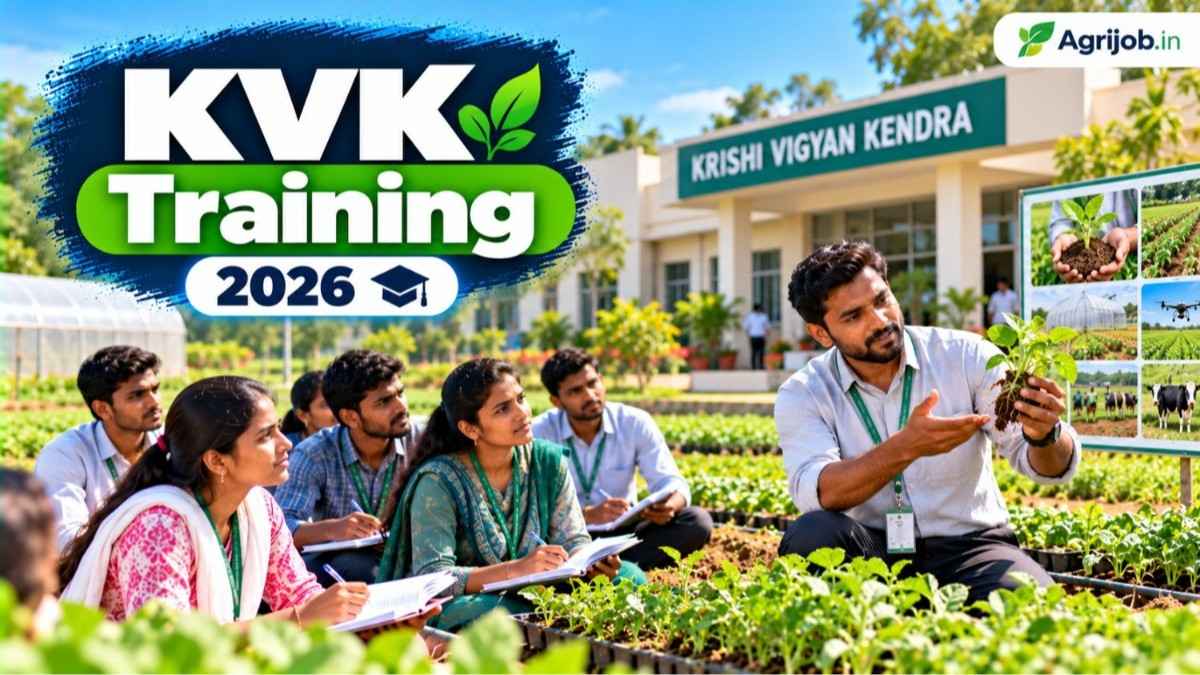
Krishi Vigyan Kendra (KVK) training refers to the short-duration, medium-duration, and long-duration capacity-development programmes conducted by India’s district-level agricultural extension centres funded by ICAR. A KVK is literally translated as “Agricultural Science Centre,” and its core mandate — as defined by ICAR — is to develop the competence of farmers, farm women, rural youth, and extension workers through practical, location-specific skills in agriculture and allied fields.
KVKs were first conceptualised by the Mehta Committee in 1973, with the first centre established in Pondicherry. Today, more than 700 KVKs operate across India under host institutions that include State Agricultural Universities, ICAR institutes, NGOs, and state government departments. Each KVK is mandated to cover a specific district and to reach farmers within a 10 km radius of its operations. According to a NILERD impact study cited by ICAR, each KVK covers approximately 43 villages and around 4,300 farmers directly.
In 2026, KVK training is more relevant than ever because the Government of India is pushing convergence between KVK programmes and flagship schemes like PM-KISAN, Pradhan Mantri Fasal Bima Yojana, PM KUSUM, and the Farmer Producer Organisation (FPO) mission. Farmers who complete KVK training are better positioned to access subsidies, credit, and technology support under these schemes.
Who Should Apply for KVK Training in 2026?
KVK training is open to a wide range of people connected to agriculture and rural livelihoods. Here are the specific audience profiles who benefit most from enrolling:
- 🌾 Small and marginal farmers (below 2 hectares) looking to adopt improved crop varieties, soil health management, or low-cost irrigation techniques
- 👩🌾 Farm women and self-help group (SHG) members seeking vocational training in food processing, mushroom cultivation, vermicomposting, or tailoring for income generation
- 🧑🎓 Agriculture and veterinary students looking for hands-on internship or summer training with an ICAR-affiliated certificate
- 🐄 Dairy and animal husbandry practitioners wanting skill upgradation in animal nutrition, artificial insemination, or poultry management
- 🌿 Rural youth aged 18–35 who are school/college dropouts seeking self-employment through trades like beekeeping, nursery management, or farm machinery repair
- 🏛️ Extension workers and government officials (block-level, gram panchayat) who need in-service training on latest agricultural technologies
- 📦 Agripreneurs and FPO members who want knowledge on agro-processing, value addition, cold storage, and market linkage
- 🌱 Organic farmers and natural farming adopters seeking certification-ready training on zero-budget natural farming (ZBNF), compost making, and bio-inputs
Types of KVK Training Programmes in 2026
KVK training is not a single programme — it is a structured system of multiple programme types, each designed for a different audience and duration. Understanding which type suits you is the first step before applying.
| Training Type | Duration | Target Group | Mode | Fee (Approx.) |
|---|---|---|---|---|
| Short Duration Farmer Training | 1–3 days | Farmers, Farm Women | On/Off Campus | Free |
| Vocational / Skill Development | 15 days – 6 months | Rural Youth, Farm Women | On Campus | Free / Nominal |
| In-Service Training | 3–10 days | Extension workers, Govt. officials | On Campus | Departmental |
| Exposure Visits / Study Tours | 1–5 days | Farmers, Students | Off Campus | Nominal |
| Front-Line Demonstrations (FLD) | Season-long | Practising Farmers | Field-based | Free |
| Technology Assessment Trials | Season-long | Progressive Farmers | On-farm | Free |
| Internship / Research Training | 1–6 months | Agri Students | On Campus | Free / Nominal |
On-Campus training takes place at the KVK facility itself and covers laboratory exercises, hands-on demonstrations, farm plot visits, and classroom sessions. Off-Campus training is conducted directly at the village level — KVK scientists and extension workers travel to farmers’ fields and conduct training in situ, which is especially useful for topics like soil testing, vermicomposting, and crop protection demonstrations.
Vocational training programmes of longer duration (1.5 months, 3 months, and 6 months) are specifically designed to make rural youth self-reliant by enabling them to set up micro-enterprises in trades like agri-machinery repair, nursery management, food processing, and dairy enterprise management.
Eligibility Criteria for KVK Training 2026
One of the biggest advantages of KVK training is the minimal eligibility barrier. Unlike competitive government recruitment exams, there is no written test, no age limit for most farmer programmes, and no mandatory educational qualification for short-duration courses. The criteria vary only by programme type:
- Short-Duration Farmer Courses (1–5 days): No minimum education required — open to any practising farmer, farm woman, or rural resident. Age: No restriction.
- Vocational / Skill Development Courses (15 days–6 months): Minimum 8th or 10th class pass preferred; rural youth and SHG members with farming background eligible. Age: Generally 18–45 years.
- In-Service Training: Must be a serving government or public sector extension employee nominated by department. Requires departmental permission / NOC.
- Student Internship / Research Training: Must be enrolled in a recognised B.Sc. Agriculture, M.Sc., or equivalent programme with a bonafide certificate from the institution.
- SC/ST Candidates: Priority consideration in most KVK programmes; many SCSP (Scheduled Caste Sub-Plan) funded programmes are reserved exclusively for SC/ST beneficiaries at zero fee.
| Programme Category | Minimum Education | Age | Fee | Priority |
|---|---|---|---|---|
| Farmer Short Courses | None | No limit | Free | All farmers |
| Farm Women / SHG | None | 18+ | Free | Women-led households |
| Rural Youth Vocational | 8th / 10th pass | 18–45 | Free/Nominal | Unemployed rural youth |
| In-Service (Govt. Official) | As per job role | As per service | Departmental | Extension workers |
| Student Internship | Pursuing B.Sc./M.Sc. Agri | 18–30 | Free/Nominal | Agri students |
| SCSP Special Programmes | None | 18+ | 100% Free | SC/ST beneficiaries only |
How to Apply for KVK Training Near You — Step-by-Step Process 2026
Applying for KVK training is intentionally simple — there is no competitive exam, no complex online portal, and no application fee for most farmer-targeted programmes. Follow this exact process in 2026:
- Visit kvk.icar.gov.in — Go to the official KVK dashboard on the ICAR website. This portal lists all 700+ KVKs in India with state and district-wise filtering.
- Find your district KVK — Use the map or district search to identify the KVK operating in your district. Note down the full address, contact phone number, and email ID of the Programme Coordinator or KVK Head.
- Check the annual training calendar — Most KVKs publish a training schedule for the year (April–March). Look for programmes relevant to your crop, trade, or interest. Training announcements are also posted on the KVK’s own website and WhatsApp groups.
- Contact the KVK directly — Call or email the Programme Coordinator. Introduce yourself, state your farming background (crop grown, landholding, district), and ask about the next available training programme in your area of interest.
- Register your name and details — The KVK staff will ask for your name, mobile number, Aadhaar number (for record purposes), village/block name, and the topic of interest. Most registrations happen verbally over phone or via a simple form available at the KVK office.
- Receive confirmation and reporting date — The KVK will confirm your slot and send the training date, venue, and reporting time via SMS or phone call. On-campus trainings require you to report at the KVK centre; off-campus trainings are held at your village.
- Attend and complete the training — Report on time, attend all sessions, and actively participate in field demonstrations and practical exercises. Attendance is mandatory for certificate issuance.
- Collect your KVK/ICAR certificate — On completion, the KVK issues a participation/training certificate in the name of the trainee. This certificate is useful for NABARD loan applications, agripreneurship schemes, and further education.
Do not wait for a formal advertisement. Most KVK farmer training programmes run on a rolling basis throughout the year. Simply calling your district KVK and expressing interest is enough to get registered for the next available batch. The best time to call for Kharif season topics is April–June 2026, and for Rabi season topics, September–November 2026.
How to Find Your Nearest KVK in 2026
Finding the KVK serving your district is straightforward using ICAR’s official digital tools:
- KVK Portal Map: Visit kvk.icar.gov.in/dashboard.aspx — an interactive map allows you to click on any state and district to view the KVK name, address, contact, and host institution.
- State-wise KVK List: ICAR maintains a downloadable PDF list of all KVKs with postal addresses and Programme Coordinator names, updated annually.
- ATARIs (Zonal Technology Managers): India is divided into 11 ATARI (Agricultural Technology Application Research Institute) zones. If you cannot reach your district KVK directly, contact your ATARI zone office — they coordinate all KVKs in the region.
- Krishi Melas and Kisan Gosthi: Local agricultural fairs and gram panchayat farmer meetings often feature KVK scientist visits — these are excellent opportunities to directly register your interest in training.
- Block-Level Agriculture Officer: Your district or block-level agriculture officer (ADO/BAO) maintains direct contact with the KVK — they can facilitate fast-track registration for government-sponsored beneficiary categories.
KVK Training vs Other Agricultural Training Programmes — Comparison 2026
Farmers and rural youth often wonder how KVK training compares with other agricultural training options available in India. Here is a direct comparison to help you choose the right programme:
| Parameter | KVK Training | MANAGE Training | NABARD Skill Dev. | SAU / College Prog. |
|---|---|---|---|---|
| Governing Body | ICAR / Ministry of Agri | MANAGE, Hyderabad | NABARD / SHG Banks | State Agri Universities |
| Fee | Free / Nominal | Subsidised / Free | Free (RSETI/RUDSETI) | Paid courses |
| Target Group | All farmers, youth, women | Extension officers | Rural youth (BPL/SC/ST) | Students / graduates |
| Duration | 1 day – 6 months | 3–21 days | 2 weeks – 6 months | Semester-based |
| Location | District level (700+ centres) | State / regional level | RSETI branches | Campus only |
| Certificate | KVK/ICAR certificate | MANAGE certificate | NABARD / Bank certificate | University certificate |
| NABARD Loan Link | Yes — KVK certificate accepted | Partial | Direct linkage | No direct link |
| Best For | Practising farmers seeking free, practical, local training | Extension officers seeking management skills | Youth seeking enterprise + loan | Students seeking formal degree |
For any Indian farmer, rural youth, or farm woman seeking practical agricultural skill-building in 2026, KVK training is the single best starting point — it is free, located in your own district, requires no exam, and results in an ICAR-affiliated certificate. NABARD’s RSETI / RUDSETI programmes are better suited for youth who need direct bank linkage for enterprise loans. Both are complementary, not competing.
Benefits and Value of KVK Training Certificate in 2026
Completing a KVK training programme gives the beneficiary tangible outcomes beyond just knowledge. Here is what the certificate and training practically deliver in 2026:
- NABARD Loan Eligibility: Banks and NABARD-affiliated institutions often require an agricultural training certificate as supporting documentation for agri-enterprise loans — a KVK certificate is widely accepted.
- FPO and SHG Membership: Trained farmers are given priority membership and leadership roles in Farmer Producer Organisations (FPOs) being promoted under the Government of India’s 10,000 FPO Mission.
- Scheme Subsidy Priority: Government departments in several states give priority to KVK-trained applicants under schemes like Rashtriya Krishi Vikas Yojana (RKVY), horticulture mission grants, and PM KUSUM solar pump subsidies.
- Higher Education / PG Admissions: Some State Agricultural Universities give additional weightage or waive entrance exam requirements for students who have completed recognised KVK internship or training programmes.
- Employment and Enterprise: Rural youth who complete 3–6 month vocational KVK courses report significantly higher rates of self-employment — in nurseries, agro-processing units, dairy enterprises, and farm machinery service centres.
- Knowledge Upgrade: Access to improved seed varieties, ICAR-recommended pest management practices, climate-smart agriculture technologies, and digital agri tools — free of cost.
Pros and Cons of KVK Training 2026
KVK training is genuinely valuable, but it is important to understand both its strengths and limitations before enrolling:
Advantages of KVK Training
- ✅ Completely free or near-free for farmers and rural youth — no financial barrier to entry
- ✅ Locally relevant — training is designed for the specific agro-climatic zone, soil type, and cropping pattern of your district
- ✅ No entrance exam — registration is based on interest and farming background, not competitive selection
- ✅ ICAR-backed certificate — nationally recognised and accepted by banks, government departments, and universities
- ✅ Covers 50+ subjects — from soil health to drones to agri-tourism, making it useful across all farming types
Limitations / Disadvantages of KVK Training
- ❌ Limited seats per batch — most programmes accommodate only 15–30 participants; late registration may mean waiting for the next batch
- ❌ No online training option yet — most KVK programmes require physical presence; remote or online delivery is limited in 2026
- ❌ Uneven quality across KVKs — the quality of training, infrastructure, and faculty expertise varies widely between well-resourced KVKs (e.g., under IARIs) and those under smaller NGOs
- ❌ Not degree-granting — KVK certificates do not replace formal academic qualifications for competitive exam purposes
Important Terms Related to KVK Training You Should Know
These high-value terms are directly relevant to the KVK training ecosystem and appear frequently in scheme documents, application forms, and ICAR publications:
- ICAR (Indian Council of Agricultural Research): The apex body under the Ministry of Agriculture and Farmers Welfare that funds, coordinates, and monitors all 700+ KVKs across India.
- ATARI (Agricultural Technology Application Research Institute): Eight zonal institutes under ICAR that supervise and coordinate KVK activities at regional level. Each ATARI covers several states.
- FLD (Front-Line Demonstration): A KVK-executed field trial where improved seed varieties or new technologies are demonstrated on a farmer’s actual land to assess performance under local conditions.
- RKVY (Rashtriya Krishi Vikas Yojana): A Government of India scheme that funds KVK infrastructure upgradation, training materials, and programme expansion — the primary channel through which special training grants flow to KVKs.
- OFT (On-Farm Trial): Location-specific technology testing conducted on farmers’ fields through KVK to evaluate suitability before wider promotion.
- SCSP Programme: Special training batches funded under the Scheduled Caste Sub-Plan — exclusively targeting SC farmers and rural youth with 100% free training and input support.
- FPO (Farmer Producer Organisation): Collective enterprises by farmers promoted with KVK support — trained KVK beneficiaries are given priority positions in FPOs, which attract Government of India equity grants of up to Rs.15 lakh per FPO.
- NICRA (National Initiative on Climate Resilient Agriculture): An ICAR programme under which KVKs run special training on climate-smart farming practices — free of cost for farmers in identified vulnerable districts.
- Kisan Gosthi: Group discussions or awareness camps organised by KVKs at village level — often the first informal step before a farmer registers for formal training.
- Agripreneurship: The promotion of farming as a business enterprise — KVKs run dedicated agripreneurship orientation programmes, especially for youth, linking training with bank credit and market access.
Important Links for KVK Training 2026
| Link Name | URL |
|---|---|
| Official KVK Portal (ICAR) | kvk.icar.gov.in |
| ICAR Official Website | icar.org.in |
| Ministry of Agriculture & Farmers Welfare | agricoop.nic.in |
| NABARD (for Agri Loans Post-Training) | nabard.org |
| KVK Dashboard (State/District Map) | kvk.icar.gov.in/dashboard.aspx |
| Agrijob.in – NDRI Karnal Free Training Guide | NDRI Karnal Dairy Training 2026 |
Conclusion — Final Thoughts on KVK Training 2026
KVK training in 2026 remains the most accessible, practical, and free pathway for any Indian farmer, rural youth, or farm woman to upgrade agricultural skills and access government scheme benefits — no exam, no fee, and no minimum education barrier for most programmes. With 700+ KVKs operating across every district and a training calendar spanning 50+ agricultural subjects, there is almost certainly a programme running near you right now. The single most important step is to contact your district KVK directly — call or email the Programme Coordinator, express your interest, and confirm your slot before the batch fills up.
Bookmark this guide — it is updated whenever ICAR releases new KVK programme notifications and policy changes for the 2026–27 agricultural year.
- India has 700+ KVKs operating at district level under ICAR — at least one covers your district right now.
- Most KVK farmer and rural youth training programmes are completely free, with no entrance exam required.
- To apply, simply visit kvk.icar.gov.in, find your district KVK, and call or email the Programme Coordinator directly.
- KVK training certificates are accepted by NABARD, banks, and state government departments for agri-enterprise loan and subsidy applications.
- Vocational programmes of 15 days to 6 months are available for rural youth seeking self-employment in dairy, food processing, nursery management, and agri-machinery trades.
- Register early — most KVK batches are limited to 15–30 participants; the best Kharif season programmes fill up between April and June 2026.
Frequently Asked Questions About KVK Training 2026
What is KVK training and who conducts it?
KVK training refers to agricultural skill-development programmes run by Krishi Vigyan Kendras — district-level extension centres funded by the Indian Council of Agricultural Research (ICAR) under the Ministry of Agriculture and Farmers Welfare. Over 700 KVKs across India conduct training for farmers, farm women, rural youth, and extension workers on topics ranging from crop production to food processing to agripreneurship.
Is KVK training free of cost in 2026?
Yes — the majority of KVK training programmes targeted at practising farmers, farm women, and rural youth carry zero fee or only a nominal registration charge (typically under Rs.200–Rs.500). SCSP-funded programmes for SC/ST beneficiaries are 100% free including training materials. In-service training for government employees may involve departmental cost recovery, but the trainee bears no direct expense.
Do I need any educational qualification to apply for KVK training?
No minimum educational qualification is required for short-duration farmer training programmes (1–5 days). Vocational and skill-development courses of longer duration (15 days to 6 months) generally prefer candidates who are at least 8th or 10th class pass. Student internships require a bonafide letter from a recognised agricultural university confirming current enrolment in a B.Sc. or M.Sc. Agriculture programme.
How do I find the KVK in my district?
Visit the official ICAR KVK portal at kvk.icar.gov.in/dashboard.aspx and use the state and district filter or interactive map to locate the KVK serving your area. The portal displays the full address, phone number, and email ID of each KVK. You can also ask your block-level Agriculture Development Officer (ADO) — they maintain direct contact with the district KVK.
What certificate is issued after completing KVK training?
On successful completion of a KVK training programme, participants receive a participation or training completion certificate issued by the Krishi Vigyan Kendra, signed by the KVK Head or Programme Coordinator. This certificate carries the ICAR affiliation and is recognised by NABARD, commercial banks, and state government departments for agri-enterprise loan applications, FPO membership, and scheme subsidy applications.
What topics are covered in KVK training programmes in 2026?
KVK training covers more than 50 subjects across agriculture and allied sectors. Major training topics in 2026 include: improved variety cultivation, organic farming and ZBNF, integrated pest and nutrient management, soil testing and health card interpretation, dairy and animal husbandry, poultry management, beekeeping, mushroom cultivation, vermicompost production, agro-processing and value addition, farm machinery operation and repair, horticulture and floriculture, fishery and aquaculture, water conservation and micro-irrigation, and FPO/agripreneurship management.
How long does a typical KVK training programme last?
Duration varies by programme type. Awareness camps and Kisan Goshthi typically last 1 day. Short-duration crop technology trainings run for 1–5 days. Skill-development training programmes for rural youth range from 15 days to 3 months. Long-duration vocational courses with enterprise development can extend to 6 months. Most farmer-targeted programmes fall in the 1–3 day range and take place at the village level.
Can agriculture students apply for KVK internship training in 2026?
Yes — many KVKs across India accept students pursuing B.Sc. Agriculture, M.Sc., or allied programmes for summer internships and research training, typically from May to July or November to December. To apply, choose a KVK from kvk.icar.gov.in, email the Programme Coordinator with your resume, a short statement of purpose, and a bonafide certificate from your college confirming enrolment. Most KVK internship placements are confirmed on a rolling basis with no formal exam.
Will completing KVK training help me get a government agriculture loan?
Yes — a KVK training certificate strengthens your agri-loan application significantly. NABARD and its partner banks (including SBI, PNB, and regional rural banks) accept KVK training certificates as supporting evidence of technical capability when processing loans under the Agriculture Infrastructure Fund (AIF), Kisan Credit Card (KCC), and NABARD’s Dairy Entrepreneurship Development Scheme (DEDS). The certificate demonstrates that the applicant has received structured training and is less likely to face technology-adoption failure.
Is there an online application form for KVK training?
Unlike formal government recruitment, KVK training does not have a single centralised online application form. Registration is largely informal — a phone call or email to your district KVK’s Programme Coordinator is sufficient for most farmer and rural youth programmes. Some larger KVKs run by ICAR institutes or well-resourced universities do maintain online registration forms on their individual KVK websites, but this is not universal across all 700+ centres in 2026.
Disclaimer: This article is for informational purposes only. Training programme availability, dates, and eligibility criteria are subject to change by individual KVKs. Always confirm details directly with the official KVK office in your district before travelling.