

Japan Agriculture 5.0 Policy 2026 – AI, Robotics and Global Investment Guide
Japan Agriculture 5.0 Policy 2026 is the world’s most ambitious national program to rebuild farming through AI, robotics, and autonomous systems — and it is creating a USD 2.0 billion agritech market that global investors can no longer ignore. Japan’s agricultural workforce has collapsed from 12 million farmers in 1960 to under 2 million today, with the average farmer now over 68 years old. This guide is for global institutional investors, venture capital firms, and agritech entrepreneurs seeking to understand where Japan’s policy dollars flow, which sectors offer the strongest returns, and how to enter the market in 2026.

This article covers: the policy architecture behind Agriculture 5.0, key technology sectors, investment entry routes, market size data, risk factors, a comparison with competing markets, and a complete FAQ for first-time investors.
Japan’s Agriculture 5.0 Policy 2026 channels ¥1.23 trillion (approx. USD 8 billion) in government AI and technology spending, of which significant allocations target autonomous farm robotics, smart agriculture subsidies of up to 50% on qualifying equipment, and a national smart agriculture demonstration network spanning 217 districts. The agritech market is valued at USD 2.0 billion in 2026 and projected to reach USD 5.1 billion by 2035, growing at a 10.8% CAGR — making Japan one of Asia’s highest-priority agritech investment destinations.
- Policy Framework: Society 5.0 + MAFF Smart Agriculture Strategy + 7th Basic Plan (FY2026–FY2030)
- Government AI Budget (FY2026): ¥1.23 trillion (approx. USD 8 billion) — METI allocation
- Smart Agriculture Subsidy Rate: Up to 50% on AI, IoT, robotics and satellite monitoring equipment
- Agritech Market Size (2026): USD 2.0 billion — projected USD 5.1 billion by 2035
- AI in Agriculture CAGR: 26.20% through 2032 (MarketsandMarkets)
- Smart Agriculture CAGR: 13.87% through 2034 (IMARC Group)
- Demonstration Districts: 217 MAFF smart agriculture zones across Japan
- Farm Labor Deficit: Core workforce fell from 2.4 million (2000) to 1.16 million (2023)
- Average Farmer Age: Over 68 years — 80%+ of farmers are over 70
- Japan’s AgFoodTech Share (Asia): 13.0% in 2025 — up from 6.1% in 2024
- What Is Japan Agriculture 5.0 Policy 2026 and Why Does It Matter?
- Who Should Read This Investment Guide?
- Market Size, Investment Value, and Return Potential
- Key Technology Sectors Driving Agriculture 5.0
- How to Enter the Japan Agritech Market — 6 Proven Routes
- Japan Agriculture 5.0 vs Global Agritech Markets — Comparison
- Pros and Cons of Investing in Japan Agriculture 5.0
- Important Terms and Concepts for Agritech Investors
- Important Policy Dates and Investment Milestones 2026
- Important Links and Official Resources
- Conclusion
- Key Takeaways
- Frequently Asked Questions About Japan Agriculture 5.0 Policy 2026
What Is Japan Agriculture 5.0 Policy 2026 and Why Does It Matter?
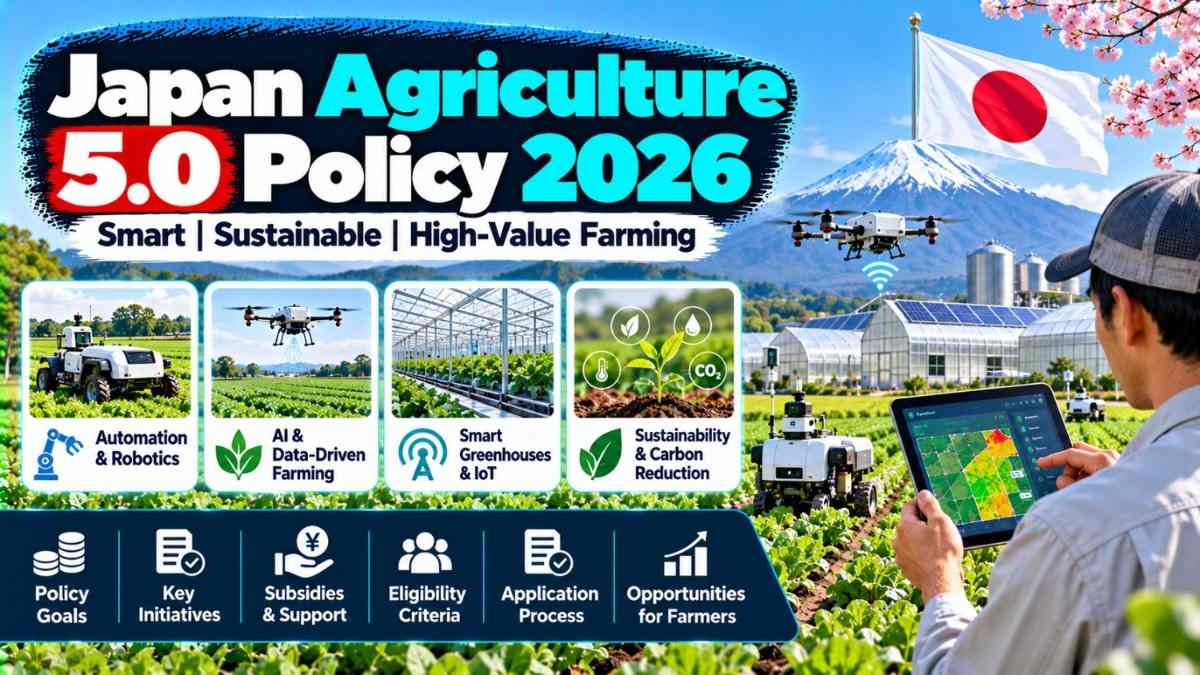
Japan Agriculture 5.0 Policy 2026 is the agricultural pillar of Japan’s broader Society 5.0 national vision — a government-led framework that integrates AI, robotics, IoT, drones, and big data into everyday farming operations to address a catastrophic labor shortage and ensure national food security. The policy framework is jointly driven by the Ministry of Agriculture, Forestry and Fisheries (MAFF) and the Ministry of Economy, Trade and Industry (METI), with support from the Cabinet Office Council for Science, Technology and Innovation.

Society 5.0 is Japan’s fifth stage of societal evolution — following hunter-gatherer, agrarian, industrial, and information societies — and agriculture is treated as one of its most urgent application fields. For investors, this matters because the policy is not aspirational: it is backed by the largest government AI budget outside the United States and China, with ¥1.23 trillion committed for FY2026 alone.
Japan’s structural problem is stark. The core agricultural workforce fell from approximately 2.4 million in 2000 to 1.16 million by 2023. Over 80% of current farmers are above 70 years of age. The country already imports more than 60% of its food. Without aggressive automation, domestic food production faces structural collapse within a decade. Agriculture 5.0 is Japan’s survival strategy — which means government funding will not slow down regardless of fiscal cycles.
The 7th Basic Plan for Science and Technology (FY2026–FY2030) identifies AI, robotics, semiconductors, and biotechnology as strategic technology areas requiring end-to-end support — from basic research through to social implementation. Agriculture is a named priority application domain. MAFF’s Smart Agriculture Demonstration Project has already deployed across 217 districts nationwide, moving the technology from pilot phase into commercial field deployment.
Who Should Read This Investment Guide?
- 🏦 Institutional investors seeking exposure to Asia’s fastest-growing deep-tech agriculture market
- 🤖 Robotics and automation companies looking to expand into food production and farm machinery sectors
- 🌾 Agritech entrepreneurs evaluating Japan as a market-entry destination with government subsidy support
- 📊 Venture capital funds building Asia-Pacific agrifoodtech portfolios with a 5–10 year horizon
- 🏗️ Equipment manufacturers (tractors, drones, sensors) seeking public procurement and subsidy-linked contracts
- 🎓 Academic and research institutions pursuing Japan–international R&D collaboration under METI programs
- 📱 Farm management software companies targeting a market where digital adoption is government-mandated
- 🌏 International agribusinesses from India, the EU, US, and Australia evaluating Japan as an innovation partner
Market Size, Investment Value, and Return Potential
Japan’s agritech market is valued at USD 2.0 billion in 2026 and projected to reach USD 5.1 billion by 2035, growing at a 10.8% CAGR, according to Dimension Market Research. Within this, the AI-in-Agriculture sub-segment grows at a faster 26.20% CAGR through 2032, and the broader smart agriculture market expands at 13.87% CAGR through 2034. Hardware — autonomous tractors, drones, and sensors — leads with approximately 46% of total market revenue.
| Market Segment | 2026 Value | Projected Value | CAGR | Key Driver |
|---|---|---|---|---|
| Total Japan Agritech Market | USD 2.0 billion | USD 5.1 billion (2035) | 10.8% | Labor shortage + policy subsidies |
| AI in Agriculture | Growing rapidly | 2032 projection | 26.20% | ML, computer vision, yield AI |
| Smart Agriculture Market | USD 1.39 billion (2025) | USD 4.46 billion (2034) | 13.87% | MAFF subsidies, IoT adoption |
| Farm Robotics Market | Growing | USD 1.36 billion (2033) | High double-digit | Autonomous tractors, harvesters |
| Agrifoodtech VC Share (Asia) | 13.0% of Asia | Expanding | Doubled YoY | Government co-investment signals |
Japan’s share of Asian agrifoodtech investment doubled in one year — jumping from 6.1% in 2024 to 13.0% in 2025 — making Japan the third-largest agrifoodtech funder in Asia, behind India and China. Global agrifoodtech VC funding reached USD 16.2 billion in 2025, with upstream farm technologies — including farm robotics — capturing a growing proportion. Japan’s government co-investment model, through METI’s FY2026 AI budget and MAFF’s smart farming subsidies, effectively de-risks private capital entry.
Japan’s government subsidy programs cover up to 50% of qualifying agritech equipment costs, including AI systems, IoT sensors, robotic platforms, and satellite monitoring. For foreign companies entering via joint venture or licensing, this subsidy structure effectively halves the customer acquisition cost — a powerful lever for market penetration that few competing markets offer at this scale.
Key Technology Sectors Driving Agriculture 5.0
Six technology sectors form the operational backbone of Japan’s Agriculture 5.0 framework, each backed by direct MAFF and METI policy support and offering distinct investor entry points.
Autonomous Tractors and Field Robotics
In August 2026, Kubota Corporation launched the Agri Robo Tractor MR Series — Japan’s first domestically manufactured tractors capable of fully unmanned autonomous operation under remote monitoring. The system uses GPS-RTK positioning for centimeter-level accuracy and autonomous field-mapping on first use. Kubota, Yanmar, and ISEKI are the three dominant players; all are expanding autonomous fleets for rice, wheat, and soybean farming, particularly in Hokkaido, which accounts for approximately 31% of Japan’s smart agriculture market revenue.
Agricultural Drones and UAV Systems
MAFF actively promotes drone-based growth monitoring, crop scouting, precision spraying, and yield estimation across Japan’s paddy and orchard farms. Japan’s 217 smart agriculture demonstration districts deploy drones as a standard component. In June 2026, Japan expanded national-level smart farming robotics integration programs, combining drones, autonomous harvesters, and sensor networks into designated smart agriculture zones. The Japan Agriculture Drones and IoT Sensors Market is growing driven by structural labor shortages and direct policy mandates.
AI-Powered Farm Management Software
Japan’s national data platform WAGRI, operational since April 2019, provides the central data infrastructure layer for the Agriculture 5.0 ecosystem. Farm management software — including AI crop diagnostics, yield prediction, irrigation automation, and supply-chain traceability — is the fastest-growing software segment. Crop Production and Farm Operations is the dominant agritech segment with a 34.5% market share in 2026, driven by high penetration across rice, wheat, soybean, vegetable, and fruit farming.
IoT Sensors and Smart Greenhouse Automation
Paddy water automation, greenhouse climate control, livestock monitoring, and soil health sensors are the fastest-diffusing IoT categories. In May 2026, Japanese dairy farms — particularly in Hokkaido — expanded automated milking robot adoption and livestock monitoring systems significantly. Smart greenhouse automation for vegetables and specialty crops is a high-growth niche that is accessible to foreign technology providers through METI’s Digitalization and AI Introduction Subsidy 2026.
AI Foundation Models for Physical Robotics
In June 2026, METI launched a multimodal foundation-model development program for AI robots and physical AI — covering manufacturing, agriculture, and logistics. METI’s ¥387 billion allocation within its FY2026 AI budget specifically targets physical AI applications. This program funds the software layer that controls autonomous agricultural robots: crop recognition, path planning, obstacle avoidance, and harvest-quality sorting. Startups and international companies that can contribute foundation model capabilities for physical AI hold a compelling value proposition for Japanese agritech partnerships.
Robotics-as-a-Service (RaaS) for Small Farms
Japan’s average farm plot is only 2.5 hectares — too small to individually justify full robot ownership. MAFF’s policy explicitly promotes shared ownership models, contract services, and Robotics-as-a-Service (RaaS) as the primary adoption pathway for small and fragmented farms. This is a structurally underserved business model in Japan’s market and represents a direct investment opportunity for companies experienced in subscription-based equipment leasing, agri-cooperatives, or service-based automation platforms.
How to Enter the Japan Agritech Market — 6 Proven Routes
- Joint Venture with Japanese Agritech Company: Partner with established firms like Kubota, Yanmar, or listed agritech startups. JETRO facilitates business matching between international firms and Japanese agricultural cooperatives, providing structured onboarding into subsidy programs.
- Technology Licensing to MAFF Smart Agriculture Zones: License your AI platform, sensor stack, or software to one of the 217 designated smart agriculture demonstration districts. MAFF-approved solutions gain preferential access to government subsidies covering 40–50% of adoption costs, reducing your customer’s price barrier.
- Apply via METI Digitalization and AI Introduction Subsidy 2026: This flexible subsidy route, launched in 2026, supports bespoke equipment, system integration, and custom automation investments including AI systems. Foreign companies can apply through a Japanese business entity or joint venture partner.
- Venture Capital Route via Japanese AgriFood Funds: Target active VCs in Japan’s agritech ecosystem, including Global Brain Corporation, Real Tech Japan, UntroD Capital, and Mitsubishi UFJ Capital. Round sizes range from Seed ($316K–$6M) to Series B ($3.4M–$48M). SVG Ventures has launched a USD 50 million agritech fund with Kagome targeting a ten-year investment horizon.
- Establish a Demonstration Pilot in Hokkaido: Hokkaido’s scale (large farms by Japanese standards, strong cooperative infrastructure) makes it the optimal first-deployment market. A successful Hokkaido pilot creates a replicable model for national rollout under MAFF’s demonstration framework.
- Academic and R&D Collaboration via KAKENHI Grants: Japan’s 7th Basic Plan increases KAKENHI grants for AI, robotics, and agricultural research. International universities and research institutions can partner with Japanese universities (Hokkaido University, Tokyo University of Agriculture and Technology) as a low-cost first step to establishing market presence and commercial relationships.
Japan Agriculture 5.0 vs Global Agritech Markets — Comparison
| Dimension | Japan Agriculture 5.0 | United States | India | EU / Germany |
|---|---|---|---|---|
| Government AI Budget (2026) | ¥1.23T (~USD 8B) | USD ~10B+ | USD ~500M | EUR 1B+ (Horizon) |
| Farm Robotics CAGR | High double-digit | 14–18% | 20–25% | 12–16% |
| Government Subsidy on Equipment | Up to 50% | Up to 50% (USDA) | Up to 90% (select schemes) | Up to 40% |
| Average Farm Size | 2.5 ha (small/fragmented) | 180+ ha (large) | 1.1 ha (very small) | 16 ha (medium) |
| Labor Shortage Urgency | Critical (80%+ farmers over 70) | Moderate-High | Low (labor surplus) | Moderate |
| Market Entry Complexity | High (language, culture) | Low | Medium | Medium-Low |
| Regulatory Environment | Structured, slow-moving | Fragmented by state | Evolving | Strict (GDPR, safety regs) |
| Global Agrifoodtech VC Share | 13% of Asia (rapidly rising) | 38% global | Largest in Asia | ~20% global |
| Technology Transfer Openness | High via JETRO/METI programs | High | High | High (EU-Japan EPA) |
| Best For | Robotics, AI, precision tech | Large-scale automation | Affordable sensors, software | Sustainability tech, biotech |
Japan offers the most policy-de-risked entry into Asian agritech for precision robotics and AI companies. The combination of critical labor shortage, 50% government equipment subsidies, a structured demonstration zone network, and a government AI budget of USD 8 billion creates conditions unlike any other market. The key constraint is market-entry complexity — foreign companies that succeed partner early with Japanese agricultural cooperatives or listed agritech firms rather than attempting direct market entry alone.
Pros and Cons of Investing in Japan Agriculture 5.0
Advantages
- ✅ Structural, non-cyclical demand: Labor shortage is demographic — it will intensify regardless of economic cycles, guaranteeing automation demand for 20+ years
- ✅ Massive government co-investment: ¥1.23 trillion AI budget for FY2026 de-risks private capital across the entire tech stack
- ✅ Up to 50% equipment subsidies: Government subsidy programs directly reduce the customer’s total cost of ownership, accelerating adoption timelines
- ✅ Policy certainty through FY2030: The 7th Basic Plan locks in strategic technology priorities for 5 years — investors face minimal policy reversal risk
- ✅ World-class manufacturing partners: Kubota, Yanmar, Fanuc, and other global robotics leaders are ready co-development partners with established distribution channels
- ✅ Technology export potential: Precision technologies developed for Japan’s small, fragmented plots are directly applicable to similar farm structures across Southeast Asia
Disadvantages and Risks
- ⚠️ High market-entry complexity: Language barriers, hierarchical business culture, and slow regulatory processes create real friction for foreign companies operating independently
- ⚠️ Small average farm size: At 2.5 hectares average, Japan’s farms cannot individually absorb high-capital robotics systems — RaaS and cooperative models are required, adding business model complexity
- ⚠️ Currency risk: Yen volatility (¥/USD fluctuations) directly impacts repatriation of returns for USD- or INR-denominated funds
- ⚠️ Conservative adoption culture: Only 8% of Japan’s workforce had used AI tools as of April 2026 — actual technology diffusion lags significantly behind policy ambition
Important Terms and Concepts for Agritech Investors
- Society 5.0: Japan’s national vision for a human-centered digital society, formally adopted by the Cabinet Office in 2016. Agriculture is one of its five priority implementation domains. Society 5.0 drives all MAFF technology policy through 2030.
- MAFF (Ministry of Agriculture, Forestry and Fisheries): Japan’s lead agricultural policymaking body. MAFF administers smart agriculture subsidies, the 217-district demonstration network, and the WAGRI data platform. All agritech investment decisions require understanding MAFF’s annual budget cycle.
- METI (Ministry of Economy, Trade and Industry): Japan’s industrial policy ministry. METI’s FY2026 AI budget of ¥1.23 trillion includes ¥387 billion specifically for physical AI — the software and systems controlling robots and industrial machinery, including farm robots.
- WAGRI Platform: Japan’s national agricultural data infrastructure, operational since April 2019. WAGRI enables interoperability between farm management software, sensor data, weather APIs, and government databases — the foundation for all AI-driven farm decision systems.
- GPS-RTK (Real-Time Kinematic): The centimeter-level GPS positioning technology used in Japan’s autonomous tractors, including Kubota’s Agri Robo Tractor MR Series. GPS-RTK is the standard precision positioning layer for autonomous farm equipment in Japan.
- RaaS (Robotics-as-a-Service): The subscription-based robot leasing model promoted by MAFF for small farm adoption. Given Japan’s 2.5-hectare average farm size, RaaS is the primary commercial model for scaling autonomous equipment deployment across fragmented land holdings.
- KAKENHI: Japan’s primary academic research grant program, administered by JSPS. The 7th Basic Plan increases KAKENHI allocations for AI, robotics, and agri-biotech — the primary funding source for university-based technology that later attracts VC investment.
- INCJ (Innovation Network Corporation of Japan): A government-backed fund with investment capability of approximately ¥2,000 billion. INCJ is a key co-investor for large-scale agritech infrastructure and semiconductor supply chain projects aligned with Agriculture 5.0.
- Aigamo Robot: Japan’s AI-powered paddy-weeding robot modeled on traditional duck-based weed control. The Aigamo robot exemplifies Japan’s approach to precision technology for highly specific farming challenges — a design philosophy that creates niche IP with global applicability.
- AgFunder: The leading global agrifoodtech investment intelligence platform. AgFunder’s annual report confirms Japan’s share of Asian agrifoodtech investment doubled from 6.1% (2024) to 13.0% (2025) — the most widely cited benchmark for Japan’s investment momentum.
Important Policy Dates and Investment Milestones 2026
| Date | Milestone / Event |
|---|---|
| April 1, 2026 | Japan FY2026 officially begins — ¥1.23 trillion METI AI budget activated |
| April 2026 | Autonomous rice farming and UAV monitoring systems scaling nationally; Kubota-Agtonomy deal announced |
| May 2026 | Hokkaido dairy farms expand automated milking and livestock monitoring adoption |
| June 2026 | METI launches multimodal foundation-model development program for physical AI robotics |
| June 2026 | Japan expands smart farming robotics integration into national smart agriculture zones |
| August 6, 2026 | Kubota launches Agri Robo Tractor MR Series — first unmanned autonomous tractor for Japan market |
| FY2026–FY2030 | 7th Basic Plan for Science and Technology — 5-year policy certainty for AI, robotics, and biotech |
| 2026–2034 | Smart Agriculture Market grows from USD 1.39B to USD 4.46B at 13.87% CAGR |
| 2035 | Japan Agritech Market projected to reach USD 5.1 billion from USD 2.0 billion in 2026 |
Important Links and Official Resources
| Resource | Link |
|---|---|
| MAFF Official Smart Agriculture Portal | maff.go.jp |
| METI Japan AI Investment Policy 2026 | meti.go.jp |
| JETRO — Invest in Japan (Agriculture & Agritech) | jetro.go.jp |
| OECD Japan Agricultural Policy Overview 2025 | oecd.ai |
| AgFunder Global AgriFoodTech Investment Report 2026 | agfundernews.com |
| Agrijob.in — Smart Agriculture Japan 2026 Guide | agrijob.in |
Conclusion — Final Thoughts on Japan Agriculture 5.0 Policy 2026
Japan Agriculture 5.0 Policy 2026 is not a future vision — it is an active, fully funded national transformation program backed by ¥1.23 trillion in government AI spending, 50% equipment subsidies, a 217-district demonstration network, and a structural labor crisis that makes automation non-optional. For global investors, the opportunity is real: a USD 2.0 billion market in 2026 growing to USD 5.1 billion by 2035, with Japan already accounting for 13% of all Asian agrifoodtech investment — up from just 6.1% the year before. The next step is identifying your entry route — joint venture, technology licensing, or VC participation — and moving before the consolidation phase begins.
Bookmark this page for the latest data — we update it as MAFF and METI release new policy documents and subsidy guidelines throughout FY2026–FY2027.
- Japan Agriculture 5.0 is backed by ¥1.23 trillion (USD 8B) in FY2026 government AI spending — making it the largest policy-backed agritech program in Asia
- The Japan agritech market is valued at USD 2.0 billion in 2026 and projected to reach USD 5.1 billion by 2035 at 10.8% CAGR
- Japan’s AI in Agriculture segment grows at 26.20% CAGR — the fastest among all major agritech economies in Asia
- Up to 50% government subsidies are available on qualifying robotics, AI, IoT, and drone equipment through MAFF and METI programs
- Japan’s share of Asian agrifoodtech investment doubled from 6.1% (2024) to 13.0% (2025) — momentum is accelerating, not slowing
- Successful market entry requires a Japanese corporate or cooperative partner; JETRO provides structured business matching for international agritech companies
Frequently Asked Questions About Japan Agriculture 5.0 Policy 2026
What is Japan Agriculture 5.0 Policy 2026?
Japan Agriculture 5.0 Policy 2026 is the agricultural implementation arm of Japan’s Society 5.0 national strategy — a comprehensive government-backed framework that deploys AI, autonomous robotics, IoT sensors, drones, and big data analytics across Japanese farming to address a critical labor shortage. Jointly administered by MAFF and METI, the policy is supported by ¥1.23 trillion in FY2026 AI spending and spans 217 designated smart agriculture demonstration districts nationwide.
How large is Japan’s agritech market in 2026?
Japan’s agritech market is valued at USD 2.0 billion in 2026, according to Dimension Market Research. It is projected to reach USD 5.1 billion by 2035 at a 10.8% CAGR. The AI in Agriculture sub-segment grows at a faster 26.20% CAGR, and the smart agriculture market is separately projected at USD 4.46 billion by 2034 at 13.87% CAGR. Hardware — autonomous tractors, drones, and sensors — is the leading segment at approximately 46% of total market revenue.
What subsidies does Japan offer for agricultural AI and robotics?
Japan’s MAFF Smart Farming Subsidy Program offers up to 50% subsidies on AI, IoT, robotics, and satellite monitoring equipment for qualifying farms and agritech deployments. The Advanced Agri-Technology Integration Policy covers AI analytics, IoT sensors, and drone systems up to 50%. METI’s Digitalization and AI Introduction Subsidy 2026 supports bespoke AI system integration including custom automation investments. Individual prefecture programs — such as Fukushima Prefecture’s JPY 50 million Smart Agriculture Fund for 2026 — provide additional co-funding on top of national programs.
Why is Japan’s farm labor shortage so severe?
Japan’s agricultural workforce fell from approximately 12 million farmers in 1960 to fewer than 2 million today, with the average farmer age now exceeding 68 years. More than 80% of current farmers are over 70 years old. Japan’s overall population is declining and aging faster than any other major economy, and rural areas face compounded depopulation pressure. Japan already imports over 60% of its food. Without large-scale automation, domestic food production faces structural collapse — which is why Agriculture 5.0 is a national security priority, not merely a technology initiative.
Which Japanese companies lead in agricultural robotics?
Kubota Corporation, Yanmar Holdings, and ISEKI are Japan’s three dominant agricultural robotics manufacturers. Kubota launched the Agri Robo Tractor MR Series in August 2026 — Japan’s first fully unmanned autonomous tractor under remote monitoring — and also invested in US agritech startup Agtonomy in April 2026. Yanmar’s SMARTPILOT autonomous tractor system and Kubota’s AGRIROBO lineup are the two most deployed autonomous farm equipment platforms in Japan. In the drone segment, DJI and Japanese startups compete alongside NTT Data and SoftBank Robotics in precision spraying.
How can foreign investors enter Japan’s agritech market?
Foreign investors have six primary routes: joint venture with a Japanese agritech company, technology licensing to MAFF smart agriculture zones, applying through METI’s Digitalization and AI Introduction Subsidy 2026 via a Japanese entity, partnering with active VCs such as Global Brain Corporation or Real Tech Japan, establishing a demonstration pilot in Hokkaido, or pursuing R&D collaboration through KAKENHI grants with Japanese universities. JETRO provides free business matching and market entry support for international companies across all these routes. Japan’s EU-Japan EPA also provides favorable conditions for European agritech companies entering via EU-headquartered subsidiaries.
Is Japan Agriculture 5.0 a good investment for Indian agritech companies?
Yes — Indian agritech companies specializing in affordable AI diagnostics, farm management software, and IoT sensor platforms have a strong value proposition for Japan’s market. Japan’s small average farm size (2.5 hectares) is closer to India’s farm structure than to the US or Australia, meaning technologies optimized for India’s fragmented land holdings are often more immediately applicable in Japan than large-farm US solutions. India is currently the largest agrifoodtech funder in Asia, and Japan-India agritech partnerships are actively encouraged under bilateral innovation agreements. Indian companies should enter via JETRO’s Invest Japan program or through Indian chambers of commerce in Tokyo.
What is WAGRI and why does it matter for investors?
WAGRI is Japan’s national agricultural data platform, operational since April 2019. It aggregates weather data, soil sensor readings, market price data, government agricultural statistics, and farm management records into a single interoperable API infrastructure. For agritech investors, WAGRI is critical because any farm AI or IoT product that integrates with WAGRI gains immediate access to Japan’s national farm data ecosystem and becomes eligible for MAFF smart farming subsidy programs. WAGRI integration is effectively a market access key for software companies entering Japan’s agriculture sector.
What are the main risks of investing in Japan agritech?
The four principal risks are: (1) market-entry complexity driven by language barriers and hierarchical business culture — foreign companies without Japanese partners consistently underperform; (2) small average farm size requiring RaaS and cooperative business models rather than direct equipment sales; (3) yen-dollar currency volatility affecting returns for foreign-currency investors; and (4) a gap between policy ambition and actual adoption speed, with only 8% of Japanese workers having used AI tools as of April 2026. Patient capital with a 5–10 year horizon consistently outperforms short-term agritech plays in Japan.
What is the role of physical AI in Japan’s Agriculture 5.0?
Physical AI refers to software that controls robots and industrial machinery in real-world environments — as opposed to digital AI that operates purely in software systems. In June 2026, METI launched a dedicated multimodal foundation-model development program for physical AI, with ¥387 billion of its FY2026 AI budget earmarked for physical AI applications across manufacturing and agriculture. For Japan’s Agriculture 5.0, physical AI is the enabling layer for fully autonomous tractors, robotic harvesters, drone navigation, and greenhouse automation systems — making it the highest-priority technology investment category within the policy framework.
Last Updated: October 2026 | Author: NITISH SINGH | Website: Agrijob.in | This guide is reviewed and updated regularly for accuracy. Bookmark this page for the latest information on Japan Agriculture 5.0 Policy.
Disclaimer: This article is for informational purposes only and does not constitute financial or investment advice. Market projections are sourced from third-party research firms and are subject to change. Readers should conduct independent due diligence and consult qualified investment advisors before making any investment decisions. Data figures reflect published estimates as of October 2026.