
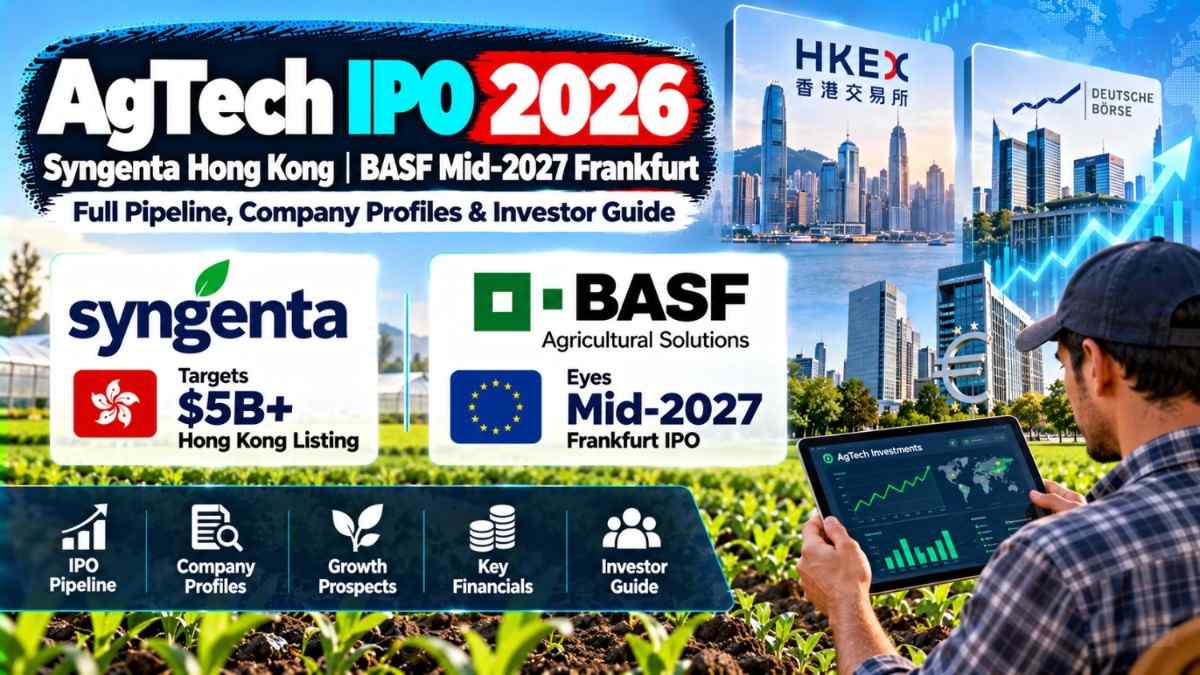
AgTech IPO 2026 is one of the most closely watched themes in global capital markets this year — and for good reason. Syngenta Group has confidentially filed for a Hong Kong IPO targeting at least $5 billion, BASF is racing toward a Frankfurt listing of its Agricultural Solutions division by mid-2027, and a new wave of precision agriculture and drone companies are positioning for public markets. This guide is for investors, agriculture professionals, and anyone tracking where smart money is flowing in the global food and farming technology sector.
In this post, we cover every major AgTech company in the IPO pipeline for 2026–2027, examine what each business does, why it matters, and what public market conditions look like for agriculture technology listings right now.
The largest AgTech IPOs in the 2026–2027 pipeline are Syngenta Group (targeting $5B+ on Hong Kong Stock Exchange), BASF Agricultural Solutions (targeting mid-2027 Frankfurt IPO with $9.6B in 2025 sales), and Quantum Systems (drone technology, early 2027 IPO possible). The broader IPO window for venture-backed AgTech startups remains largely closed as of Q3 2026, with M&A serving as the primary exit route.
- Largest pending IPO: Syngenta Group — targeting $5B–$10B on Hong Kong Stock Exchange
- BASF Agricultural Solutions IPO target: Mid-2027 on Frankfurt Stock Exchange (€9.6B in 2025 sales)
- Saturn Agtech: Malaysian vertical farming company targeting Nasdaq listing in 2026
- Quantum Systems: German agri-drone maker targeting early 2027 IPO; raised $1.2B+ total
- AgTech VC deal value Q3 2026: $2.2 billion — highest since Q3 2023 (PitchBook)
- H1 2026 total AgTech funding: $4.6 billion across 378 deals (year-to-date through Q3)
- IPO window status: Closed for most venture-backed startups; mega-cap listings advancing
- Global precision agriculture market: ~$9.5B in 2025, projected to exceed $17B by 2031
📋 Table of Contents
- What Is an AgTech IPO and Why It Matters in 2026
- Who Should Read This Guide
- Syngenta Group — The $5B+ Hong Kong IPO
- BASF Agricultural Solutions — Frankfurt’s Biggest Agri Listing
- Quantum Systems — Agri-Drone Pioneer Eyes 2027 IPO
- Saturn Agtech — Malaysian CEA Firm Targets Nasdaq
- Venture-Backed AgTech Startups in the IPO Watchlist
- AgTech IPO Market Conditions in 2026
- AgTech IPO Pipeline Comparison Table
- Pros and Cons of Investing in AgTech IPOs
- Important Terms for AgTech IPO Investors
- Important Links and Resources
- Conclusion
- Key Takeaways
- Frequently Asked Questions
What Is an AgTech IPO and Why It Matters in 2026
An AgTech IPO (Initial Public Offering in the agriculture technology sector) occurs when a company that develops technology for farming, food production, crop sciences, or agricultural logistics sells shares to the public for the first time on a stock exchange. For agriculture technology companies, going public creates access to significantly larger pools of capital for R&D, global expansion, and debt repayment — while also establishing a transparent market valuation.
In 2026, the AgTech IPO landscape is bifurcated. On one side, large established players like Syngenta Group and BASF Agricultural Solutions are actively pursuing multi-billion-dollar public listings on major global exchanges. On the other, the IPO window for venture-backed startups remains effectively closed — a trend that has persisted since the 2021 investment peak. PitchBook data confirms that agtech exits slowed to just four in Q3 2026, the fewest since 2017, with strategic acquisitions (M&A) serving as the dominant exit route for investors.
This divergence matters for investors because it signals a sector in transition: corporate giants are unlocking value through spin-offs and public listings, while the startup ecosystem consolidates around fewer, larger, and more commercially proven companies.
Who Should Read This AgTech IPO Guide?
- 💼 Retail investors researching agriculture stocks and upcoming IPOs for their portfolio
- 🌱 Agriculture professionals wanting to understand the technology companies transforming their industry
- 📊 Institutional fund managers tracking the AgTech equity pipeline for 2026–2027
- 🤖 AgTech startup founders benchmarking public market readiness against sector leaders
- 🌏 International investors monitoring Hong Kong and Frankfurt for major 2026–2027 agriculture listings
- 🎓 Agriculture students and researchers following capital flows in food and farming innovation
- 📰 Business journalists covering agrifood technology and capital markets
- 📋 Corporate development teams at food and agriculture companies evaluating strategic moves
Syngenta Group — The $5B+ Hong Kong IPO
Syngenta Group is the single most important AgTech IPO in the current pipeline. The Swiss-based seeds and agrochemicals giant — owned by Chinese state-owned group Sinochem — confidentially filed for a Hong Kong Stock Exchange listing in September 2026, targeting a raise of at least $5 billion, according to three sources with direct knowledge of the matter cited by Reuters. Earlier in 2026, reports suggested the offering could reach as high as $10 billion.
The Hong Kong listing follows Syngenta’s withdrawal of a planned Shanghai IPO in March 2024, when the company cited “industry environment and development strategy” as reasons for pulling out. At the time, the Shanghai listing had been valued at up to $9.1 billion — which would have made it one of the world’s largest IPOs of 2023. The Hong Kong filing marks the company’s return to public market ambitions after a two-year gap.
Syngenta plans to use a significant portion of IPO proceeds to pay down debt accumulated from its $43 billion acquisition by Sinochem in 2017. Investors should assess debt-to-equity ratios carefully when the prospectus is filed. A successful $5B+ listing would represent one of Hong Kong’s marquee deals of 2026.
Syngenta sells seeds, crop-protection products (herbicides, insecticides, fungicides), biological farming solutions, and digital farming tools globally. The company reported a decline in second-quarter 2026 sales and profit, partly following its exit from a low-margin business in China. Banks reportedly involved in the IPO process include Goldman Sachs, UBS, and CICC.
BASF Agricultural Solutions — Frankfurt’s Biggest Agri Listing
BASF Agricultural Solutions is targeting IPO readiness by mid-2027 on the Frankfurt Stock Exchange, with a potential listing that could become one of the largest pure-play agriculture IPOs in European history. In September 2026, BASF mandated Citi, Deutsche Bank, Goldman Sachs, and J.P. Morgan as global coordinators for the deal — a critical milestone on the path to a public listing.
The Agricultural Solutions division generated €9.6 billion in sales in 2025. BASF plans to list it as a Societas Europaea (SE) — a European public company structure — and intends to remain the majority shareholder after the IPO. This makes it a partial spin-off rather than a full sale, meaning BASF will continue to benefit from the agricultural business’s growth and cash flows.
The business covers crop protection (herbicides, fungicides, insecticides), seeds and traits, and digital farming tools. Its ERP system rollout — already complete in North America — is being extended to remaining regions by early 2027 as the company builds governance structures appropriate for a publicly listed entity. BASF’s Capital Markets Day on November 24, 2026 is expected to provide a strategic and operational overview of Agricultural Solutions ahead of the listing.
Importantly, BASF has stated that no final decision has been made regarding timing or execution of the IPO — conditions in capital markets remain a key variable. This means the listing could be delayed if equity market conditions deteriorate before mid-2027.
Quantum Systems — Agri-Drone Pioneer Eyes 2027 IPO
Germany’s Quantum Systems is one of the most closely watched AgTech-adjacent companies in the IPO pipeline for 2027. The Munich-area company builds AI-powered eVTOL reconnaissance drones for military, government, and commercial (including agriculture) customers. In Q3 2026, Quantum Systems raised $1.2 billion in a landmark round, pushing its total funding well past the billion-euro mark and cementing its status as one of Europe’s most valuable dual-use technology companies.
Reports from German publication Manager Magazin, cited by Reuters, indicate the company is preparing for an early 2027 IPO, with Morgan Stanley engaged for a fresh financing round worth 400–600 million euros in the lead-up. Quantum’s agricultural relevance comes from its precision drone systems used for crop monitoring, thermal analysis, and remote sensing across large-scale commercial farms. In Q3 2026, the company’s $1.2 billion Series D round accounted for the majority of the $1.2 billion that PitchBook attributed to farm automation and equipment in that quarter.
Saturn Agtech — Malaysian CEA Firm Targets Nasdaq
Saturn Agtech Berhad is a Malaysian agricultural technology company specializing in controlled environment agriculture (CEA). Founded in 2018, it operates indoor vertical farms in Southeast Asia and has engaged V Capital Consulting Group (VCCG) to lead a targeted Nasdaq listing in 2026. Saturn’s proprietary Model 3 vertical farming system reportedly yields over 2,300 tons per hectare annually — significantly higher than traditional methods — and operates without pesticides or herbicides.
If successful, the Saturn Agtech Nasdaq listing would give international investors direct exposure to Southeast Asia’s controlled environment agriculture market, which is scaling rapidly in response to food security concerns across the region. The company aims to use listing proceeds to expand into international markets beyond Malaysia.
Venture-Backed AgTech Startups in the IPO Watchlist
Several well-funded AgTech startups are publicly named as potential IPO candidates — though none has set a firm date. Industry analysts at PitchBook, Fertilizer Daily, and AgTech Navigator consistently cite the following companies when discussing the eventual return of the AgTech IPO window:
- Farmers Business Network (FBN) — US-based full-stack agri platform for inputs, data, and crop marketing; viewed as a long-term IPO candidate but no timeline confirmed as of 2026.
- Indigo Ag — Soil carbon and microbiome-based agriculture company; valuation fell from $3.5B peak to roughly $200M following market challenges; IPO prospects remain uncertain.
- Monarch Tractor — California-based fully electric, AI-powered tractor maker; cited as an IPO candidate in industry reports but public market timing is unspecified.
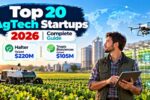
- Halter — New Zealand livestock management platform raised a $220M Series E in March 2026 at a $2B valuation (Founders Fund-led); no IPO timeline stated, but double-unicorn status and 1 million+ collars sold make it a prime future candidate.
- DeHaat — India’s full-stack agritech platform with Rs 3,000 crore+ FY25 revenue and more than 14 lakh registered farmers; company has stated IPO is “a few years away” as of 2025–26.
- Pixxel — Bengaluru-based hyperspectral satellite imaging startup; raised $168M across 7 rounds including a Series C in July 2026 at an estimated $500M valuation; no IPO date set.
- Oishii — US vertical farming company raised a $151.6M Series C in Q2 2026 for facility automation; remains private.
AgTech IPO Market Conditions in 2026 — What the Data Says
The overall AgTech IPO market in 2026 can be characterized as selectively recovering at the large-cap end while remaining effectively closed for startups. PitchBook data shows that agtech VC deal value reached $2.2 billion in Q3 2026 — more than double Q2’s $974.3 million and the highest quarterly total since Q3 2023. However, deal count fell to 101, the lowest quarterly figure since 2016, confirming the “barbell” dynamic: a handful of very large rounds dominate while the number of new deals contracts sharply.
Agtech exits numbered just four in Q3 2026, the fewest since 2017. The Global AgTech Initiative noted that “the IPO window remained shut” through the first quarter of 2026, with continued M&A activity from established agricultural players — including Bayer, Syngenta, John Deere, and BASF — substituting for public market exits. As of H1 2026, agtech startups had raised $4.6 billion across 378 deals year-to-date, versus a peak of over $50 billion in 2021.
The Q2 2026 PitchBook AgTech report describes embedded AI as the primary value driver attracting capital, with precision agriculture leading all segments at $338.6 million in Q2 alone. Farm automation and equipment, animal health, and biological inputs round out the investment map. The report notes that “no meaningful IPO activity materialized” through H1 2026, keeping the exit channel constrained to acquisitions.
For context, the global precision agriculture market stood at roughly $9.5 billion in 2025, with projections to surpass $17 billion by 2031 — a compound growth rate that makes the sector highly attractive to long-term investors despite the short-term IPO drought.
AgTech IPO Pipeline 2026–2027 — Comparison Table
| Company | Headquarters | Target Exchange | IPO Size Est. | Target Timeline | Business Focus | Status (Oct 2026) |
|---|---|---|---|---|---|---|
| Syngenta Group | Basel, Switzerland | Hong Kong Stock Exchange | $5B–$10B | 2026–2027 | Seeds, Crop Protection, Digital Farming | Confidential filing submitted (Sep 2026) |
| BASF Agricultural Solutions | Ludwigshafen, Germany | Frankfurt Stock Exchange | Not disclosed | Mid-2027 | Crop Protection, Seeds, Digital Ag | Banks mandated; IPO readiness underway |
| Quantum Systems | Munich, Germany | TBD (European exchange) | Not disclosed | Early 2027 | AI Drones (Agri + Defense) | Preparation reported; IPO unconfirmed |
| Saturn Agtech | Pasir Gudang, Malaysia | Nasdaq | Not disclosed | 2026 | Vertical Farming / CEA | Advisory mandate secured |
| Agriventure (Egypt) | Egypt | Egyptian Exchange (EGX) | Not disclosed | Q1 2027 | Berry Export / Commercial Farming | Board approved; banker appointed |
| Halter | Auckland, New Zealand | ASX / NZX (speculative) | $2B valuation | 3–5 years (est.) | Livestock Virtual Fencing / Precision Ag | $220M Series E; no IPO timeline set |
| DeHaat | Patna / Gurugram, India | BSE / NSE | Not disclosed | 2–3 years (est.) | Full-Stack Agri Platform | Profitable; IPO “a few years away” |
Among all companies in the pipeline, Syngenta’s Hong Kong IPO carries the highest near-term probability of execution given its confidential filing, bank engagements, and the improved Hong Kong IPO environment in 2026. BASF Agricultural Solutions is the most strategically significant listing globally, given €9.6B in annual sales. Both represent rare opportunities for public market investors to access pure-play, large-scale agriculture technology businesses — a category that has been largely absent from equity markets since Corteva Agriscience’s 2019 listing.
Pros and Cons of Investing in AgTech IPOs
Before investing in any AgTech IPO, understanding both the upside potential and the structural risks is essential. The sector’s history since 2021 is filled with cautionary tales — vertical farming giants that burned through billions before shutting down, and soil-carbon companies whose valuations cratered by over 90%. Here is a balanced assessment:
Advantages of AgTech IPOs
- ✅ Large addressable market: Global food technology represents a multi-trillion-dollar opportunity driven by population growth, climate change, and food security demands.
- ✅ Policy tailwinds: Governments globally — including India’s National Smart Agriculture Action Plan 2024–2028 and the EU’s Farm to Fork strategy — are subsidizing agricultural technology adoption.
- ✅ AI integration: Embedded AI is dramatically improving ROI for farmers using precision agriculture tools, creating defensible, recurring-revenue business models.
- ✅ Mega-cap listings offer stability: Syngenta and BASF Agricultural Solutions are mature businesses with billions in revenue — significantly less risky than early-stage startup IPOs.
- ✅ Precision ag market growth: The sector is projected to grow from $9.5B (2025) to over $17B by 2031, offering investors a long-term growth runway.
Disadvantages and Risks
- ❌ IPO window uncertainty: Capital market conditions can delay or cancel listings — BASF itself has explicitly stated that no final decision has been made.
- ❌ Venture-backed AgTech failures: High-profile shutdowns (Bowery Farming, valued at $2.3B in 2021; Infarm, a former unicorn) illustrate sector-specific execution risk.
- ❌ Long payback periods: Agriculture operates on seasonal cycles and multi-year technology adoption curves, making it harder to achieve the fast returns that tech-centric investors expect.
- ❌ Debt risk in large listings: Syngenta carries significant debt from its $43B 2017 acquisition — a portion of IPO proceeds will go to debt repayment, not growth.
Important Terms for AgTech IPO Investors
Understanding the terminology used in AgTech IPO coverage will help investors and readers accurately assess the pipeline:
- Controlled Environment Agriculture (CEA): Indoor farming using technology to precisely control temperature, light, humidity, and nutrients — key technology in companies like Saturn Agtech and Oishii.
- Pure-play agriculture company: A publicly listed business whose primary activity is agriculture — as opposed to a conglomerate like BASF where agriculture is one of several divisions. BASF’s spin-off strategy aims to create a pure-play listed entity.
- Precision Agriculture: The use of GPS, satellite imagery, AI, drones, and sensors to manage farm inputs more efficiently. The market is valued at $9.5B globally (2025) and is the dominant investment category in AgTech VC.
- Societas Europaea (SE): A European public company structure (used by BASF for its Agricultural Solutions listing) that allows pan-European governance and listing flexibility.
- Hyperspectral Imaging: Satellite technology that captures data across hundreds of wavelengths, used for crop health monitoring, soil analysis, and environmental management — Pixxel’s core technology.
- Dual-use technology: Technology with both commercial (agriculture, logistics) and defense (surveillance, reconnaissance) applications — relevant to Quantum Systems’ drone business.
- Lock-up period: The period (typically 90–180 days) after an IPO during which major shareholders cannot sell their shares. This is critical for evaluating post-IPO price stability.
- Confidential filing: A regulatory mechanism (used by Syngenta in its Hong Kong IPO) allowing companies to file IPO documents with regulators before making them public, preserving flexibility.
- Agtech VC deal value: The total capital invested by venture capital firms into agriculture technology companies per quarter or year — the primary benchmark for sector health.
- Barbell investment dynamic: A market condition where capital concentrates at two extremes — a few very large late-stage rounds and very small early-stage investments — while mid-stage companies struggle. This accurately describes AgTech in 2026.
Important Links and Resources
| Resource | Link |
|---|---|
| BASF Agricultural Solutions IPO Readiness (Official) | agriculture.basf.com |
| Syngenta Group Official Website | syngenta.com |
| PitchBook AgTech Industry Data | pitchbook.com/agtech |
| Global AgTech Initiative — VC Roundups | globalagtechinitiative.com |
| AgFunder News — AgTech IPO Coverage | agfundernews.com |
Conclusion — What the AgTech IPO Pipeline Tells Us About 2026
The AgTech IPO pipeline for 2026–2027 is smaller in quantity but larger in scale than at any point since the sector’s peak. Two of the most significant potential public listings in global agriculture history — Syngenta’s $5B+ Hong Kong IPO and BASF Agricultural Solutions’ Frankfurt listing — are both advancing through concrete preparation stages in late 2026. At the same time, the venture-backed startup IPO window remains shut, forcing most mid-stage companies to pursue strategic acquisitions, additional private rounds, or simply wait for improved conditions.
For investors, this creates a rare window to position ahead of what could be transformative listings in the global agricultural technology sector. Bookmark this page — we update it every time new IPO filings, bank mandates, or listing timelines are confirmed.
- Syngenta Group confidentially filed for a Hong Kong IPO in September 2026, targeting at least $5 billion in proceeds.
- BASF Agricultural Solutions is targeting mid-2027 IPO readiness on the Frankfurt Stock Exchange; the division generated €9.6B in 2025 sales.
- AgTech VC deal value hit $2.2 billion in Q3 2026 — highest since Q3 2023 — but deal count hit a multi-year low, reflecting capital concentration at late-stage companies.
- The global precision agriculture market is valued at $9.5B (2025) and is projected to exceed $17B by 2031, underpinning long-term investor interest.
- Venture-backed startups like DeHaat, Halter, and Pixxel are building toward public markets but have no confirmed IPO timelines as of October 2026.
- Investors should monitor BASF’s Capital Markets Day (November 24, 2026) and Syngenta’s Hong Kong prospectus filing for the next major milestones.
Frequently Asked Questions About AgTech IPO 2026
What is the biggest AgTech IPO expected in 2026?
The largest AgTech IPO expected to materialize from the 2026–2027 pipeline is Syngenta Group’s Hong Kong Stock Exchange listing, which could raise between $5 billion and $10 billion. The company confidentially filed for the listing in September 2026. If executed, it would rank among the world’s top five IPOs of the decade.
Is BASF Agricultural Solutions going public in 2026?
No. BASF Agricultural Solutions is targeting IPO readiness by mid-2027 on the Frankfurt Stock Exchange. As of October 2026, the company has mandated Citi, Deutsche Bank, Goldman Sachs, and J.P. Morgan as global coordinators for the deal, and a Capital Markets Day is scheduled for November 24, 2026. The final IPO decision depends on capital market conditions.
Why is the AgTech IPO window closed for startups in 2026?
The AgTech startup IPO window has been largely closed since 2022 due to a combination of factors: rising interest rates that compressed growth valuations, high-profile failures among heavily funded vertical farming companies, and a broader investor “flight to quality” that concentrated VC funding in late-stage, revenue-generating businesses. PitchBook data shows agtech exits fell to their lowest quarterly count since 2017 in Q3 2026, with strategic M&A remaining the primary exit route.
Which Indian AgTech company could IPO first?
DeHaat is the most frequently cited Indian AgTech IPO candidate, with over Rs 3,000 crore in FY25 revenue and a network of 8,000+ centers serving 14 lakh farmers. However, company founders have stated that an IPO is “a few years away” as of 2025–26. DeHaat turned EBITDA-profitable in Q1 FY26, which strengthens its eventual case for a public listing on BSE or NSE.
What is Syngenta’s valuation ahead of the Hong Kong IPO?
Sinochem paid $43 billion to acquire Syngenta in 2017, though the company’s current market valuation ahead of the Hong Kong IPO is lower given changes in the agrochemical industry. The $5B–$10B IPO fundraising target implies a valuation well below the 2017 acquisition price, partly reflecting the intent to use IPO proceeds for debt repayment rather than establishing a peak valuation.
What does “pure-play agriculture company” mean for investors?
A pure-play agriculture company is a publicly listed business whose primary — or only — business activity is in agriculture, allowing investors to gain precise exposure to the sector without the diversification of a conglomerate. BASF’s spin-off strategy for Agricultural Solutions is explicitly designed to create a “pure-play” listing, similar to how Corteva Agriscience was spun off from DowDuPont in 2019 and now trades on NYSE with a market cap exceeding $59 billion.
How much did AgTech raise globally in 2026?
Through the first three quarters of 2026, AgTech companies raised approximately $4.6 billion across 378 deals globally, according to PitchBook. Q3 2026 alone accounted for $2.2 billion — the highest quarterly total since Q3 2023 — largely driven by a $1.2 billion Series D round for Quantum Systems. However, the annual total remains well below the 2021 peak of over $50 billion.
What sectors within AgTech are attracting the most investment in 2026?
Precision agriculture, farm automation and equipment, and animal health are the three categories attracting the most capital in 2026. PitchBook’s Q2 2026 AgTech Report identifies AI-integrated precision agriculture tools — specifically AI sensing, imagery, and farm data platforms — as the single hottest investment category, followed by farm robotics and biological crop inputs. Vertical farming, by contrast, has seen dramatic investment contraction following the sector’s high-profile failures between 2022 and 2024.
Is Halter planning an IPO?
Halter has not announced any IPO plans as of October 2026. The New Zealand-based virtual fencing and livestock management company raised a $220 million Series E in March 2026 at a $2 billion valuation, led by Founders Fund (Peter Thiel’s firm). With over 1 million collars sold and operations across New Zealand, Australia, and 22 US states, Halter is widely regarded as a future IPO candidate, but the company is currently focused on expansion into Ireland and the UK rather than a near-term listing.
Last Updated: October 2026 | This guide is reviewed and updated regularly for accuracy. Bookmark this page for the latest information on the AgTech IPO pipeline.
Disclaimer: This article is for informational purposes only and does not constitute investment advice. IPO timelines and valuations are subject to change based on market conditions. Always consult a SEBI-registered investment advisor or qualified financial professional before making investment decisions.