

Seed Business in India 2026 – How to Start, Certify & Sell Through NSCS/State Agency
| Business Type | Seed Production / Seed Dealership |
| Governing Law | Seeds Act, 1966 & Seeds Rules, 1968 |
| License Authority | State Department of Agriculture |
| Certification Agency | State Seed Certification Agency (SSCA) |
| Nodal Govt. Agency | National Seeds Corporation (NSC / NSCS) – indiaseeds.com |
| Min. Investment | Rs.50,000 (retail dealer) | Rs.1–3 lakh (seed production) |
| Profit Potential | Rs.3–8 lakh/year (production) | Rs.1–3 lakh/year (dealer) |
| Age Limit (Dealer License) | 18–45 years (65 years for retired Govt. employees) |
| Min. Qualification | Class X pass + 15-day Agri Training |
| Certification Validity | 9 months (extendable on re-testing) |
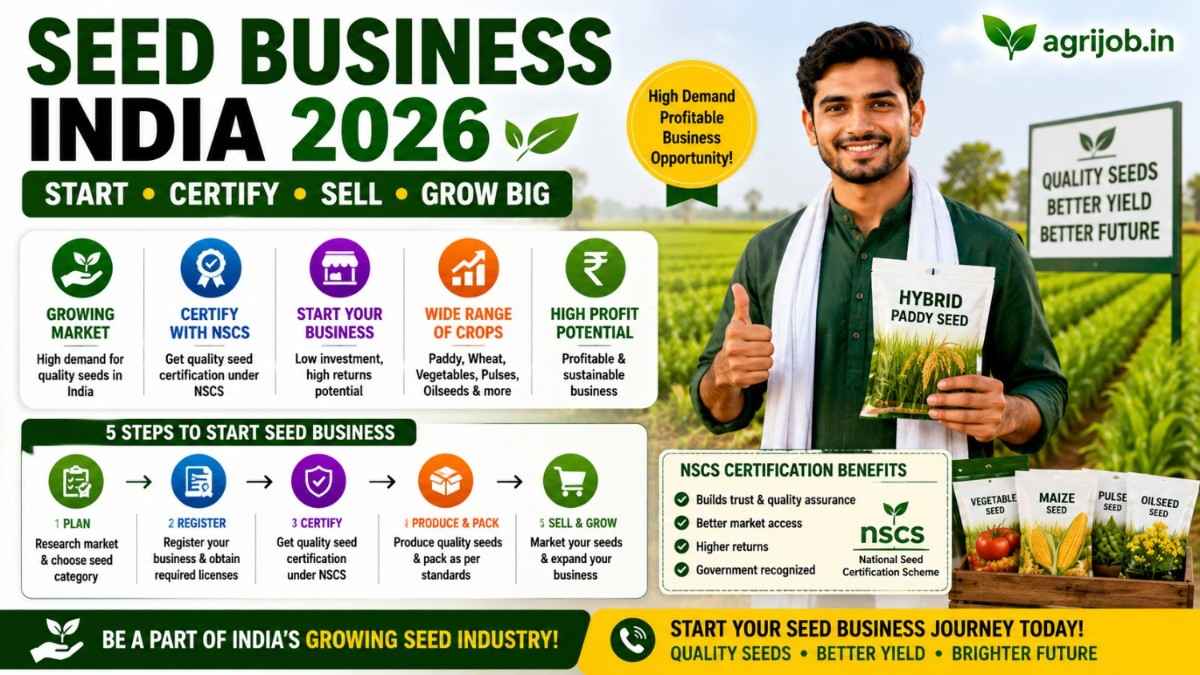
Seed business in India 2026 is one of the most profitable and government-supported agri-enterprises available to farmers, graduates, and rural entrepreneurs today. India’s agriculture sector contributes significantly to the national economy, and quality seeds are the single most important input that determines farm productivity. Whether you want to produce seeds on your farm, open a seed dealership shop, or sell directly to NSC and state seed corporations, this guide covers every step — from the legal framework and license requirements to the certification process, grower registration, and profit breakdown.

- What Is a Seed Business in India?
- 3 Types of Seed Business You Can Start
- Legal Framework – Seeds Act 1966 & Draft Bill 2025
- Eligibility & Documents for Seed Dealer License
- How to Apply for Seed Dealer License – Step by Step
- Seed Certification Process in India
- How to Register as NSC/State Agency Seed Grower
- Investment, Income & Profit Breakdown 2026
- Who Should Start a Seed Business?
- Seed Business vs Regular Farming – Comparison
- High-Value Seed Industry Terms You Must Know
- Frequently Asked Questions (FAQ)
What Is a Seed Business in India?
A seed business in India involves the production, processing, certification, storage, and sale of quality planting material to farmers and government procurement agencies. The industry is regulated under the Seeds Act, 1966 — operative since October 2, 1969 — which mandates compulsory truthful labelling and provides a framework for voluntary certification of notified crop varieties. The Act covers seeds of food crops, oil crops, cotton, fodder, and vegetative propagating materials across all states.
India’s seed market is valued at part of a global seed market that stood at USD 46.70 billion in 2025, projected to reach USD 53.20 billion by 2034. Domestically, the National Seeds Corporation (NSC) — a Miniratna Category-I Central PSU under the Ministry of Agriculture — produces 1.5 lakh tonnes of certified seed per year through its own 8 farms and over 12,500 registered seed growers across the country. NSC covers 621 varieties of 80 crops including cereals, pulses, oilseeds, fibre, and vegetables.

3 Types of Seed Business You Can Start in 2026
Before investing money or applying for any license, you need to decide which category of seed business suits your land, capital, and skills. There are 3 main entry points:
- 🌱 Seed Producer / Grower: You grow certified seeds on your farm under contract with NSC, a State Seed Corporation (SSC), or a private seed company. You receive foundation seed from the agency, grow the crop with their technical supervision, and sell the harvested seed lot back at a pre-agreed price. Income: Rs.15,000–Rs.40,000 per acre depending on crop (hybrid vegetables and maize yield highest returns).
- 🏪 Seed Dealer / Retailer: You open a licensed shop to buy seeds from certified producers or government agencies and sell them directly to farmers. This requires a Seed Dealer License from the State Agriculture Department. Low-investment, steady income model suited for rural entrepreneurs.
- 🏭 Seed Processing & Packaging Company: You set up a seed processing plant to clean, grade, treat, and pack seeds before selling them under your own brand or under contract with government agencies. This requires higher capital (Rs.10–50 lakh) but earns gross margins of 20–30% with net margins of 8–12%.
Legal Framework – Seeds Act 1966 & Draft Seeds Bill 2025
The backbone of India’s seed industry regulation is the Seeds Act, 1966, backed by Seed Rules, 1968. This Act established the Central Seed Committee, State Seed Certification Agencies (SSCAs), and State Seed Testing Laboratories. Under it, all seeds of notified varieties sold commercially must carry truthful labels confirming germination percentage and purity. The Act has 25 clauses covering variety notification, certification agencies, minimum germination and purity limits, and sale regulations.
In 2025, the Government circulated a Draft Seeds Bill 2025 to modernise the regulatory framework. Key changes proposed include: mandatory registration of all varieties (except farmers’ varieties), compulsory dealer/distributor registration with the State Government before any seed-related business activity, and stricter penalties — up to Rs.30 lakh fine and 3 years imprisonment — for major offences such as selling non-registered varieties or operating without a license. Minor offences are to be decriminalised to support Ease of Doing Business. Entrepreneurs starting a seed business in 2026 must track this Bill as it is expected to become law soon.
Eligibility & Documents for Seed Dealer License 2026
The Seed Dealer License is issued by the State Department of Agriculture and is mandatory for any individual or entity buying, storing, selling, or distributing seeds for agricultural purposes. Below is the general eligibility applicable across most Indian states:
| Criteria | Requirement |
|---|---|
| Age (General) | 18 to 45 years |
| Age (Retired Govt. Employees) | Up to 65 years |
| Minimum Education | Class X (10th pass) |
| Preferred Education | 1-year Diploma in Agriculture / B.Sc. Agriculture |
| Alternative to Diploma | 15-day training from Agriculture Department (for those without diploma) |
| Nationality | Indian Citizen |
| Premises | Own or rented shop/godown with adequate storage |
| SC/ST/OBC Relaxation | As per state government policy |
Documents Required for Seed Dealer License:
- 📄 Form A (application form from State Agriculture Department)
- 🪪 Aadhaar Card (mandatory, linked to DBT portal in many states)
- 📋 PAN Card
- 🎓 Educational Qualification Certificate or Agriculture Training Certificate (15-day course)
- 🏠 Shop/premises ownership document or rent agreement
- 📸 2 passport-size photographs
- 💰 Prescribed fee payment challan (fee varies by state, typically Rs.200–Rs.2,000)
- 📜 Affidavit / Agreement Bond (some states require Rs.100 stamp paper notarised)
How to Apply for Seed Dealer License – Step-by-Step Process
Most states now offer online seed dealer license applications through their state e-licensing portals or through the DBT Agriculture portal. The general step-by-step process is as follows:
- Register on DBT/e-Licensing Portal: Visit your state agriculture department’s e-licensing portal (e.g., odishaagrilicense.nic.in for Odisha, upagriculture.com for Uttar Pradesh). Register using your Aadhaar-linked mobile number and email ID.
- Fill Application Form (Form A): Enter all required personal details, business name, premises address, qualification, and seed categories you wish to deal in.
- Upload Documents: Scan and upload Aadhaar, PAN, qualification certificate, premises proof, and photographs in the specified format.
- Pay License Fee Online: Pay the prescribed fee through the portal using UPI, net banking, or debit card. Download the payment receipt.
- Print and Submit Hard Copy: Take a printout of the completed application and submit it to the concerned District Agriculture Office within the specified time (usually 7 days of online submission).
- Site Inspection: The licensing authority conducts a physical site visit to verify your storage infrastructure and compliance before approval.
- Receive License: If all documents are in order, the license is issued within 30–45 days of hard-copy submission. It can be downloaded from the portal.
Seed Certification Process in India – 3 Mandatory Stages
Seed certification under Section 8 of the Seeds Act, 1966 is conducted by the State Seed Certification Agency (SSCA) of your state. Currently, 22 states have their own SSCAs. Certification is voluntary for most varieties but mandatory if you want to sell seeds to government agencies or label them as “Certified Seeds.” The certification validity period is 9 months, extendable upon re-testing. The process has 3 stages:
- 🔍 Stage 1 – Source Seed Verification: You must obtain foundation or breeder seed from an approved source (NSC, State Seed Corporation, ICAR institute). Submit an application with a seed source certificate to your District Seed Certification Officer along with an agreement bond on a Rs.100 stamp paper (notarised/registered). The SSCA verifies the seed is from an approved class before allowing the plot to be registered for certification.
- 🌾 Stage 2 – Field Inspection: Trained inspectors from the SSCA visit your seed plot at critical crop stages to assess varietal purity, isolation distance from other crops (to prevent cross-pollination), presence of objectionable weeds, and disease status. Seed plots must maintain specific isolation distances — for example, 200–400 metres for cross-pollinated crops like maize and sorghum.
- 🧪 Stage 3 – Seed Testing (Laboratory Analysis): After harvest, threshing, and initial drying, you seal the raw seed bag in the presence of a certification officer. The seed lot is divided into 3 samples: one for the seed testing laboratory, one for the producer, and one kept by the agency. After a positive lab report confirming minimum germination and purity standards, the SSCA issues official tags. Only tagged lots may be sold as certified seeds.
Seeds must meet the Indian Minimum Seed Certification Standards (IMSCS), which specify minimum limits of germination, genetic purity, physical purity, and seed health for each crop and variety class.
How to Register as NSC / State Seed Agency Grower & Sell Seeds to Government
Selling seeds to the National Seeds Corporation (NSC) or your State Seed Corporation is the most secure and profitable route for seed producers, because you get a guaranteed buyback at a pre-agreed price. NSC operates through 11 Regional Offices, 65+ Area Offices, and sub-units across India, making it accessible even in remote districts.
Step-by-step process to become an NSC empanelled seed grower:
- Identify the NSC Area Office: Locate the nearest NSC Area Office or Regional Office at indiaseeds.com. NSC has offices covering all major crop-growing states.
- Submit Registration Application: Apply with land ownership documents (7/12 extract or patta), Aadhaar card, bank account details (for payment), soil test report, and a brief statement of the crops you want to produce.
- Field Inspection by NSC Agronomist: An NSC field officer visits your farm to assess soil quality, irrigation facility, isolation feasibility, and overall suitability for seed production of the requested crop variety.
- Sign the Seed Grower Agreement: On approval, you sign a formal seed production agreement specifying the variety, area to be covered, technical requirements, quality standards, and the buyback price per quintal.
- Receive Foundation / Breeder Seed: NSC provides the source seed (foundation or certified class as per the contract) along with a crop production guide, recommended input schedule, and field visit support throughout the season.
- Grow Under NSC Supervision: Follow isolation requirements, maintain records of inputs used, and allow periodic field inspections by the SSCA and NSC field staff.
- Harvest, Process & Submit: After harvest, process the seed lot through cleaning, grading, and drying. Seal the bag in the presence of the certification officer. Submit the lot to the designated NSC processing unit.
- Receive Payment: After lab testing and official tagging, NSC pays the buyback price directly to your registered bank account, typically within 30–60 days of acceptance.
For State Seed Corporations (SSCs) the process is similar. Each state has its own agency — for example, Bihar State Seed Corporation (BSSC), Maharashtra State Seeds Corporation (Mahabeej), UP Seeds Development Corporation (UPBVN), and so on. You can approach the state SSC office or apply through the State Agriculture Department portal. NSC also sells seeds online via the ONDC (Open Network for Digital Commerce) platform, opening a new digital supply channel for registered dealers.
Investment, Income & Profit Breakdown – Seed Business 2026
| Business Model | Starting Investment | Monthly Income | Annual Income | Net Profit Margin |
|---|---|---|---|---|
| Seed Retail Dealer Shop | Rs.50,000–1.5 lakh | Rs.10,000–20,000 | Rs.1.2–2.4 lakh | 15–25% |
| Seed Grower (5 acres, field crops) | Rs.1–2 lakh/season | Seasonal payout | Rs.3–5 lakh | 35–50% |
| Seed Grower (hybrid vegetables, 2–3 acres) | Rs.1.5–3 lakh/season | Seasonal payout | Rs.4–8 lakh | 40–60% |
| Seed Processing Unit (20,000 MT/year) | Rs.25–50 lakh | Rs.2–4 lakh | Rs.25–50 lakh | 8–12% net |
| Seed Dealer + Grower (combined) | Rs.3–5 lakh | Rs.25,000–50,000 | Rs.3–6 lakh | 25–35% |
Cost components to budget for seed production: Quality foundation seed (from NSC or SSCA-approved source), land preparation and irrigation, crop protection inputs, isolation plot maintenance, SSCA certification fees (field inspection + lab testing), processing/cleaning charges, and packaging material. The certification agency charges field inspection and lab testing fees that typically total Rs.1,500–5,000 per crop per season depending on area and state.
Who Should Start a Seed Business in India?
- 🌾 Farmers with 2+ acres of irrigated land who want to earn 3–5× more from the same land by shifting from food-grain farming to certified seed production under NSC/SSC contract.
- 🎓 B.Sc. / M.Sc. Agriculture graduates looking for a self-employment opportunity in rural areas rather than waiting for government jobs.
- 👨👩👧 Rural entrepreneurs and SHG members wanting to open a seed dealership shop with minimal capital — a Class X pass + 15-day training is sufficient in most states.
- 🏢 FPOs (Farmer Producer Organisations) and cooperatives that can scale up seed production collectively, access institutional buyers, and negotiate better buyback prices from NSC and state agencies.
- 👩🌾 Women farmers and SHG groups in states like Bihar, UP, MP, and Maharashtra where state governments offer additional subsidies and priority registration for women in the seed sector.
- 🧑💼 Retired government employees (up to age 65) with agricultural background who want a second income by setting up a licensed seed dealership.
- 🌿 Horticulture entrepreneurs interested in vegetable seed production, which offers the highest per-acre profit margins in the seed business (40–60% net).
- 📦 Existing agri-input dealers (fertilizer/pesticide shops) who want to add seed dealership to their existing business and expand revenue without major additional investment.
Seed Business vs Regular Farming – Detailed Comparison 2026
| Parameter | Certified Seed Production | Regular Crop Farming |
|---|---|---|
| Income per Acre | Rs.30,000–80,000+ | Rs.10,000–25,000 |
| Price Guarantee | Yes – pre-agreed buyback by NSC/SSC | No – dependent on mandi prices |
| Technical Support | Yes – NSC/SSCA field visits | Minimal (KVK/extension) |
| Certification Needed | Yes – SSCA field inspection + lab test | No |
| Market Risk | Low (guaranteed buyer) | High (price fluctuation) |
| Input Cost | Moderate (strict protocols) | Low to moderate |
| License Required | Seed Producer Registration (SSCA) | None |
| Skill Requirement | Moderate (isolation, purity maintenance) | Basic |
| Best For | Irrigated land, educated farmers, FPOs | All farmers, rain-fed areas |
High-Value Seed Industry Terms You Must Know
Understanding these terms will help you navigate the seed business, deal confidently with NSC/SSCA officials, and correctly fill out applications and agreements:
- 🌱 Breeder Seed: The purest class of seed produced under direct supervision of the plant breeder. It is the origin source for all subsequent seed multiplication classes. Used to produce Foundation Seed.
- 🔬 Foundation Seed: Produced from Breeder Seed under strict supervision. Used by registered seed growers to produce Certified Seed. NSC supplies Foundation Seed to its empanelled growers.
- ✅ Certified Seed: Produced from Foundation Seed through a certified and inspected process. This is the seed that farmers buy for crop production. Certified Seed carries the official SSCA tag (blue tag for certified, white for foundation, golden yellow for breeder).
- 📊 Seed Replacement Rate (SRR): The proportion of area sown with certified/improved seeds versus farm-saved seeds. Recommended SRR is 33% for self-pollinated crops, 50% for cross-pollinated, and 100% for hybrids. Higher SRR means more demand for certified seed.
- 📏 IMSCS (Indian Minimum Seed Certification Standards): The minimum limits of germination, genetic purity, and physical purity that seeds must meet to receive certification. Set crop-wise by the Central Seed Committee.
- 🏛️ SSCA (State Seed Certification Agency): The official government body in each state responsible for conducting field inspections and laboratory testing for seed certification under the Seeds Act, 1966.
- 🌾 Isolation Distance: The minimum spatial separation required between a seed crop and other crops of the same species to prevent genetic contamination through cross-pollination. Ranges from 50 metres (self-pollinated crops) to 400+ metres (cross-pollinated crops like maize).
- 🏷️ Truthful Labelling: Compulsory under the Seeds Act — every seed packet must carry a label stating the variety name, lot number, germination percentage, purity percentage, and date of testing, even if not certified.
- 🌐 ONDC Seed Distribution: NSC has started selling seeds through the Open Network for Digital Commerce (ONDC) platform, enabling registered dealers to procure and sell NSC certified seeds digitally.
- 📜 PPV&FR Act (Protection of Plant Varieties and Farmers’ Rights Act, 2001): Governs registration of new plant varieties. Registration fees range from Rs.2,000 (notified extant varieties) to Rs.50,000 (new commercial varieties). Relevant for seed companies launching their own branded varieties.
Frequently Asked Questions – Seed Business in India 2026
What is a seed business in India and how profitable is it?
A seed business in India involves producing, certifying, and selling quality seeds to farmers or government agencies. A well-run seed production operation on 5–10 acres can earn Rs.3–8 lakh net profit annually, while hybrid vegetable seed plots can yield even higher margins of 40–60%. It is one of the most government-supported agribusiness opportunities in 2026.
What license is required to start a seed business in India?
You need a Seed Dealer License issued by the State Department of Agriculture under the Seeds Act, 1966. If you are growing seeds for sale as a producer, you also need to register your seed plot with the District Seed Certification Officer before sowing. The Draft Seeds Bill 2025 proposes mandatory dealer/distributor registration with the State Government before any seed-related activity.
What is the eligibility to get a seed dealer license?
General eligibility is age 18–45 years, minimum Class X pass, and either a 1-year agriculture diploma or a 15-day Agriculture Department training certificate. Retired government employees can apply up to age 65. SC/ST/OBC candidates receive age and other relaxations as per state policy. Some states prefer applicants with B.Sc. Agriculture for retail fertilizer + seed combined licenses.
How do I register as a seed grower with NSC?
Contact the nearest NSC Area Office (find locations at indiaseeds.com) and submit an application with land documents, Aadhaar, and bank details. NSC has over 12,500 registered growers producing seeds of 621 varieties across 80 crops. Approved growers receive foundation seed, technical support, and a guaranteed buyback price per quintal after SSCA certification.
What is seed certification and who does it in India?
Seed certification is a quality-control system under Section 8 of the Seeds Act, 1966 ensuring seeds meet IMSCS standards for germination, genetic purity, and physical purity. It is conducted by State Seed Certification Agencies (SSCAs). Currently 22 states have their own SSCAs. The process involves 3 stages: source verification, field inspection, and laboratory testing. Certification validity is 9 months.
What documents are required for a seed dealer license?
Required documents include: Form A (application), Aadhaar card, PAN card, educational qualification certificate or agriculture training certificate, shop premises document or rent agreement, 2 passport photos, and the prescribed license fee challan. In some states, a notarised agreement bond on a Rs.100 stamp paper is also needed at the time of seed plot registration for producers.
Can small farmers start a seed business with low investment?
Yes. A seed retail dealership can be started for as little as Rs.50,000–Rs.1.5 lakh covering license fees, initial seed stock, and storage setup. Seed production on a contract basis with NSC or SSC is also accessible to small farmers — you need minimum 1–2 acres of irrigated land and basic literacy. The agency provides source seed, inputs guidance, and guarantees buyback, making the financial risk minimal.
What is the penalty for selling seeds without a license?
Under the Seeds Act, 1966 and the proposed Draft Seeds Bill 2025, selling seeds without a license is a punishable offence. Penalties include product seizure, fines up to Rs.30 lakh, and imprisonment up to 3 years for major violations such as selling non-registered varieties or operating without registration. Even minor violations attract warnings and product confiscation.
🔗 Useful Links: National Seeds Corporation (NSC) – indiaseeds.com | PPV&FR Authority – plantauthority.gov.in | Seed Sale License – India.gov.in
Last Updated: June 2026. This guide is regularly reviewed and updated for accuracy. Bookmark this page for the latest notifications on seed business regulations, NSC grower empanelment, and state seed agency schemes in India 2026.