

NRI Investment in Indian Farmland 2026 – Legal Guide
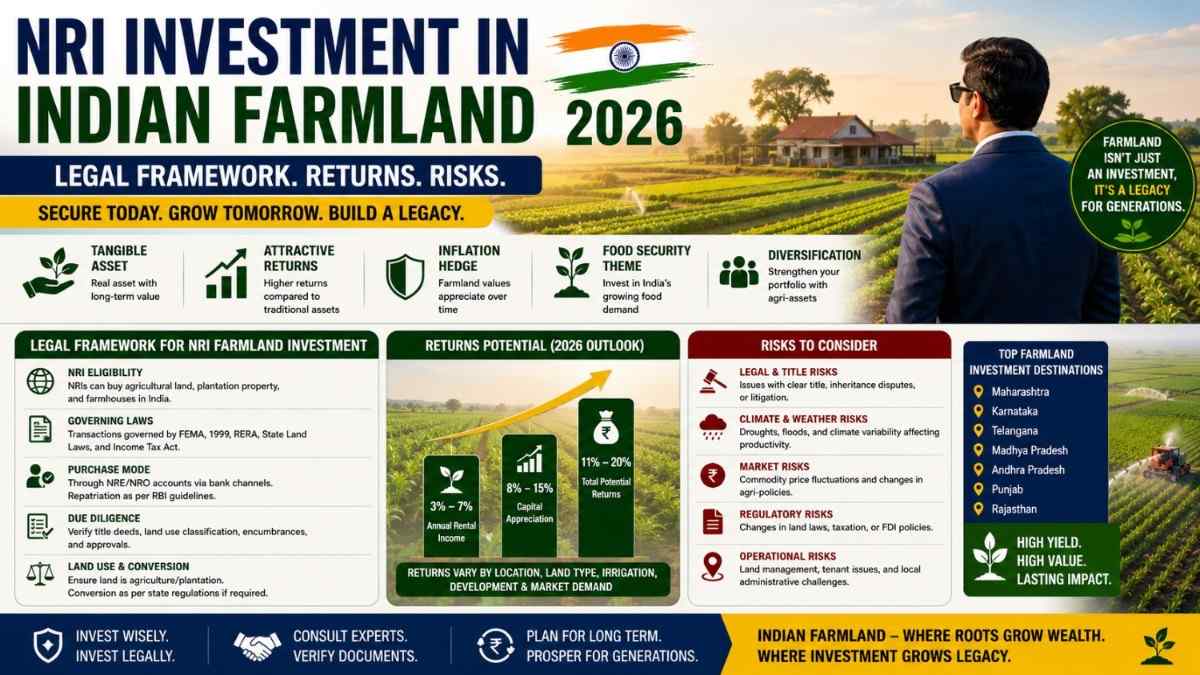
NRI investment in Indian farmland 2026 is one of the most searched — and most misunderstood — topics for the 32 million-strong Indian diaspora. Millions of NRIs dream of owning a piece of Indian farmland for financial returns, emotional connection to roots, or long-term wealth building. But before you transfer a single rupee, you need to know the hard truth: FEMA regulations strictly prohibit direct purchase of agricultural land by NRIs under the Foreign Exchange Management Act, with penalties reaching 3 times the transaction value for violations. This complete 2026 guide covers everything — FEMA legal framework, the 3 permitted ownership routes, realistic return expectations of 8–12% per annum, capital gains tax, repatriation rules, and 5 smart legal alternatives so you never have to risk your capital or legal status.

- FEMA Rules for NRI Farmland Investment 2026
- Key Facts at a Glance
- 3 Legal Routes to Own Agricultural Land as NRI
- NRI Farmland Returns – What to Expect in 2026
- Who Can Legally Hold Agricultural Land as NRI?
- Step-by-Step: How to Handle Inherited Farmland as NRI
- Who Should Consider NRI Farmland Investment?
- 5 Legal Alternatives to Direct Farmland Ownership
- NRI Farmland vs NRI Residential Property – Comparison
- Key NRI Investment Terms You Must Know in 2026
- Top Risks of NRI Farmland Investment in India
- Frequently Asked Questions
FEMA Rules for NRI Investment in Indian Farmland 2026
The legal framework governing NRI investment in Indian farmland is controlled by 2 primary laws: the Foreign Exchange Management Act (FEMA) 1999 and the FEMA (Non-debt Instruments) Rules, 2019 — specifically Rule 24. Administered by the Reserve Bank of India (RBI), these rules create a clear and strict boundary for NRI property transactions in India.
Under Rule 24 of the FEMA (Non-debt Instruments) Rules, 2019, an NRI or OCI (Overseas Citizen of India) cardholder is explicitly prohibited from purchasing agricultural land, plantation property, or farmhouses in India. This is not a procedural hurdle — it is a policy-level prohibition designed to prevent speculative foreign capital from entering Indian farmland markets and to ensure agricultural resources remain with active farmers.

- 🏛️ Governing Law: FEMA 1999 + FEMA Notification 21(R)/2018-RB + Non-debt Instruments Rules 2019
- 🏦 Regulatory Authority: Reserve Bank of India (RBI), Ministry of External Affairs
- 🚫 Prohibited: Direct purchase of agricultural land, plantation property, farmhouses
- ✅ Permitted: Residential property, commercial property (without RBI approval)
- ⚠️ Penalty for Violation: Up to 3 times (3x) the transaction value + forced sale of property
- 📅 2026 Status: National FEMA framework remains unchanged; Punjab and Kerala state proposals not yet enacted into law
The Reserve Bank of India (rbi.org.in) administers these regulations and has consistently upheld 3x compounding penalties even in cases where NRIs cooperated fully and sold the land. In a 2024 Delhi High Court case, an OCI cardholder who bought agricultural land in Tamil Nadu in 2005 for Rs.13.68 lakh was ordered to pay a penalty of Rs.41.04 lakh — even after selling the property voluntarily.
| Direct Purchase Allowed? | ❌ No – Prohibited under FEMA |
| Governing Law | FEMA 1999, Non-debt Instruments Rules 2019 |
| Legal Routes to Ownership | Inheritance, Gift from resident relative, Special RBI Approval |
| Agricultural Income Tax | ✅ Exempt under Section 10(1) |
| Capital Gains on Sale | Taxable (LTCG/STCG applies) |
| Repatriation Limit | USD 1 million per financial year (via NRO account) |
| Violation Penalty | Up to 3x the transaction value |
| Expected Returns (Legal Routes) | 8–12% per annum (land appreciation + lease income) |
| OCI Cardholder Rules | Identical restrictions to NRI |
| 2026 State Amendments | Punjab & Kerala proposals pending — not yet law |
3 Legal Routes to Own Agricultural Land as NRI in 2026
While direct purchase is prohibited, the FEMA Act (indiacode.nic.in) does provide 3 defined pathways through which an NRI can legally hold agricultural land in India. Each route has its own compliance requirements and limitations.
Route 1: Inheritance from a Resident Indian
This is the most common and legally robust route for NRI farmland ownership. If a parent, grandparent, or Indian resident relative passes away and bequeaths agricultural land to an NRI, the NRI can legally hold that land under Indian succession laws. The inheritance must be supported by a valid will or succession certificate, and state-specific inheritance laws apply. Agricultural income earned from the land post-inheritance is fully exempt from central income tax under Section 10(1) of the Income Tax Act.
Route 2: Gift from a Resident Indian Relative
An NRI can receive agricultural land as a genuine gift from a resident Indian relative (as defined under Section 2(77) of the Companies Act 2013 — parents, siblings, spouse, children qualify). The gift deed must be properly executed with stamp duty paid, and the transfer must be genuine and not a disguised purchase. Authorities scrutinise such transactions carefully. This route is permitted under FEMA but gifts from non-relatives or involving commercial consideration are not compliant.
Route 3: Special RBI Approval (Extremely Rare)
In theory, an NRI can apply for special permission to purchase agricultural land by writing to the Chief General Manager, Reserve Bank of India, Central Office, Exchange Control Department, Foreign Investment Division, Mumbai – 400 001. In practice, the RBI grants this only in exceptional cases serving significant public interest or agricultural development goals. The vast majority of applications are rejected. This should not be treated as a viable investment strategy.
NRI Farmland Investment Returns – What to Expect in 2026
For NRIs who hold farmland through legal routes, the financial returns from NRI investment in Indian farmland can be attractive when structured correctly. Returns come from 2 primary sources: agricultural income (lease rent or crop revenue sharing) and land value appreciation.
| Return Type | Expected Rate | Annual Income (Rs.50L land) | Tax Status |
|---|---|---|---|
| Agricultural Lease Rent | 2–4% per annum | Rs.1,00,000 – Rs.2,00,000 | Exempt (Section 10(1)) |
| Crop Revenue Share | 3–6% per annum | Rs.1,50,000 – Rs.3,00,000 | Exempt (Section 10(1)) |
| Land Value Appreciation | 6–10% per annum | Rs.3,00,000 – Rs.5,00,000 | Capital Gains Tax on Sale |
| Managed Farmland (Total) | 8–12% per annum | Rs.4,00,000 – Rs.6,00,000 | Partially Exempt |
- 🌾 Vegetable/intercrop farms: Revenue starts within 12–18 months of planting
- 🍋 Fruit/timber farms: Meaningful income typically after 2–4 years
- 📈 Peri-urban agricultural land: Capital appreciation averaging 8–15% per annum in high-demand states like Karnataka, Maharashtra, Tamil Nadu
- 💰 Management fee GST: 18% GST applies on fees paid to managed farmland operators
- 🏦 Repatriation: Up to USD 1 million (~Rs.8.3 crore) per year via NRO account after tax compliance
Who Can Legally Hold Agricultural Land as NRI? – Eligibility Rules
Understanding eligibility for NRI investment in Indian farmland requires clarity on legal definitions. Not every person of Indian origin has the same rights under FEMA.
| Category | FEMA Definition | Can Own Agri Land? | Route |
|---|---|---|---|
| NRI (Indian Citizen abroad 182+ days/year) | FEMA Section 2(w) | Via inheritance/gift only | Routes 1 & 2 above |
| OCI Cardholder | Citizenship Act 1955 | Via inheritance only | Route 1 only |
| PIO (now merged into OCI) | PIO cards expired Dec 2025 | Must convert to OCI | Route 1 only |
| Foreign National of Indian Origin | Non-Indian citizen | ❌ Not permitted | None |
| Resident Indian (returned NRI) | 182+ days in India/year | ✅ Full purchase rights | Direct purchase |
Important 2026 Note: All PIO (Person of Indian Origin) cards expired on December 31, 2025. Former PIO cardholders must convert to OCI status to retain any property-related rights in India. Visit the OCI Services Portal (ociservices.gov.in) for the conversion process.
Step-by-Step: How NRIs Should Handle Inherited Farmland in India
If you inherit agricultural land as an NRI, following the correct legal process protects your rights and ensures FEMA compliance. Here is the 8-step process recommended by legal experts for 2026:
- ✅ Obtain Succession Certificate / Probate: Get a valid succession certificate or probate from the competent civil court confirming your inheritance rights under applicable succession law.
- ✅ Verify Land Title and Classification: Commission a legal title search going back at least 30 years. Confirm the land is classified as agricultural (not “converted”) under state revenue records.
- ✅ Mutation of Records: Apply for mutation (name transfer) in the state revenue / tehsil office to update the land record (7/12 extract in Maharashtra, ROR in other states) in your name.
- ✅ Encumbrance Certificate: Obtain an encumbrance certificate for the past 30 years to confirm no mortgages, liens, or disputes exist on the property.
- ✅ Inform Your AD Bank: Inform your Authorised Dealer (AD) bank about the inherited agricultural property for FEMA record-keeping purposes. Proper account routing (NRO account) is essential.
- ✅ File Income Tax Return (ITR-2): NRIs holding agricultural land must disclose it in Schedule AL (Assets & Liabilities) in their Indian ITR. Agricultural income is exempt from central tax but must still be reported.
- ✅ Plan Agricultural Use or Lease: Either use the land for farming or enter a FEMA-compliant lease agreement with a resident Indian farmer. Ensure lease income flows into your NRO account.
- ✅ Consult a FEMA Expert Before Sale: If you plan to sell, capital gains tax (LTCG at 12.5% with indexation removed for post-July 2024 transactions), TDS deduction, and NRO-to-NRE repatriation rules all apply. Engage a CA with FEMA expertise before proceeding.
Who Should Consider NRI Farmland Investment in India?
Despite the restrictions, NRI investment in Indian farmland through legal routes offers genuine value for specific investor profiles. Here is who should seriously consider it in 2026:
- 🏡 NRIs inheriting ancestral farmland: If you have already inherited agricultural land, optimising its returns through managed farming or FEMA-compliant leasing is both legal and financially rewarding.
- 💼 High-net-worth NRIs seeking tax-exempt income: Agricultural income is one of the few completely tax-exempt income streams under Indian law (Section 10(1)), making it uniquely valuable for NRIs in high-tax countries.
- 🌱 NRIs planning to return to India: NRIs who plan to return within 5 years can strategically time their residential status change to become a Resident Indian, enabling direct farmland purchase without FEMA restrictions.
- 👨👩👧 NRIs with resident Indian relatives owning farmland: Those who can receive agricultural land as a valid gift from parents or siblings through proper legal channels.
- 📊 NRI investors interested in agribusiness FDI: Those seeking agricultural sector exposure through India-registered agricultural companies or fractional farmland investment platforms.
- 🇮🇳 NRIs emotionally connected to rural India: Those who want to preserve ancestral agricultural heritage while generating sustainable returns for 10–20 years.
- 🏦 NRIs diversifying from residential real estate: Agricultural land in peri-urban areas offers a different risk-return profile from urban apartments, with lower entry prices and strong 10-year appreciation trends.
- 🌾 NRIs interested in organic farming ventures: Those willing to invest in India-registered organic farming companies or agri-tech startups as an FDI-compliant route to the Indian agricultural sector.
5 Legal Alternatives to Direct Farmland Ownership for NRIs
For NRIs who cannot or do not wish to wait for inheritance or gifts, these 5 FEMA-compliant routes provide legitimate exposure to NRI investment in Indian farmland returns without direct land ownership:
- 🏢 Invest in Agricultural SPV / Company (FDI Route): NRIs can invest in India-registered agricultural companies, Special Purpose Vehicles (SPVs), or agribusiness startups. FDI is permitted in many agricultural categories including food processing, organic farming, and agri-tech. Returns are in the form of dividends or capital appreciation.
- 🤝 Farm Management Agreement: NRI provides capital; a resident Indian manages and farms the land; profits are shared. This must be carefully structured by a FEMA lawyer to ensure the NRI’s role is that of a lender/investor, not a hidden owner.
- 🌿 Fractional Farmland Investment Platforms: Several SEBI-registered and legally structured platforms in 2026 offer fractional farmland investment where NRIs invest in agricultural ventures without holding land title directly. Always verify FEMA compliance and SEBI registration before investing.
- 📦 Organic Produce Export Business: NRI-controlled trading companies can buy certified Indian organic produce for export — generating agricultural sector profits without land ownership. This is a high-growth opportunity given India’s Rs.15,000 crore+ organic food export market.
- 🏘️ Agri-Adjacent Real Estate: NRIs can freely purchase converted residential plots or approved farmhouse plots (non-agricultural classification) in rural or semi-rural areas. These are governed by standard FEMA residential property rules — no special permissions needed.
NRI Farmland vs NRI Residential Property – 2026 Comparison
| Parameter | Agricultural Farmland | Residential Property |
|---|---|---|
| Direct NRI Purchase | ❌ Prohibited under FEMA | ✅ Permitted (no RBI approval needed) |
| Income Tax on Revenue | ✅ Exempt (Section 10(1)) | Taxable at applicable slab rate |
| Capital Gains Tax | Taxable (LTCG/STCG) | Taxable (LTCG at 12.5% post-2024) |
| Annual Return Potential | 8–12% (lease + appreciation) | 4–8% (rent + appreciation) |
| Entry Price (Tier-2 city) | Rs.15 lakh–Rs.1 crore/acre | Rs.25 lakh–Rs.5 crore/flat |
| Liquidity | Low (resident buyers only) | Medium (NRI/resident buyers) |
| Repatriation Limit | USD 1 million/year | USD 1 million/year (2 properties) |
| Regulation Complexity | High (FEMA + state laws) | Moderate (FEMA + RERA) |
| Best For | Inherited land optimisation; indirect FDI | Primary NRI real estate investment |
Key NRI Investment Terms You Must Know in 2026
Understanding these high-value terms will help NRIs navigate the full landscape of NRI investment in Indian farmland and related financial decisions:
- 🏛️ FEMA (Foreign Exchange Management Act) 1999: The primary Indian law governing all cross-border financial transactions for NRIs, including property purchase, repatriation, and investment. Non-compliance carries penalties of up to 3x the transaction value.
- 🏦 NRO Account (Non-Resident Ordinary): The mandatory Indian bank account for receiving India-sourced income (rent, agricultural income, sale proceeds). All Indian-source income for NRIs must flow through the NRO account before repatriation.
- 💱 NRE Account (Non-Resident External): The account for parking foreign income in India — fully repatriable and interest income is tax-free in India. NRI investments funded from abroad should originate from the NRE account.
- 📜 FEMA Non-debt Instruments Rules 2019 (Rule 24): The specific rule that defines NRI property rights in India, including the prohibition on agricultural land purchase. This is the legal bedrock of every NRI farmland restriction.
- 🌿 Section 10(1) — Agricultural Income Exemption: Under the Income Tax Act, income from genuine agricultural operations is fully exempt from central income tax for all individuals, including NRIs who legally hold farmland through inheritance or gifts.
- 🏢 FDI in Agriculture: Foreign Direct Investment is permitted in many Indian agricultural categories — food processing, organic farming, horticulture, agri-tech — allowing NRIs to gain sector exposure through company structures. Potential returns: 15–25% per annum in high-growth agri-tech ventures.
- 🔄 Compounding (FEMA): A formal RBI process for voluntarily admitting FEMA violations and paying a penalty to settle them. In farmland violation cases, the compounding amount is typically the full 3x transaction value.
- 📊 Section 54B Capital Gains Exemption: NRIs selling urban agricultural land can claim capital gains exemption under Section 54B if the land was used for agriculture for the required period and proceeds are reinvested in another agricultural land within the stipulated timeline.
- 🌾 Managed Farmland Investment: A structure where a professional operator manages the farm; investors (including NRIs through legal routes) earn a share of crop revenue plus land appreciation — currently a Rs.500 crore+ growing market in India.
- 💰 USD 1 Million Repatriation Limit: The maximum amount NRIs can transfer out of India per financial year from their NRO account, applicable to proceeds from sale of inherited property, agricultural land, and other India-source assets.
Top Risks of NRI Investment in Indian Farmland – 2026 Warning
Before committing capital to any farmland-related structure, NRIs must understand these 6 critical risks that most property consultants do not disclose:
- ⚠️ FEMA Penalty Risk (3x Transaction Value): Even well-intentioned NRIs have faced compounding penalties equal to 3 times their purchase price. Courts have upheld these penalties for violations that occurred decades ago. The risk does not diminish with time.
- 📋 Benami Transaction Risk: Buying farmland in a resident Indian’s name while funding it from abroad is a “benami” transaction — illegal under both FEMA and the Benami Transactions (Prohibition) Act 2016. Penalties include confiscation of property and criminal prosecution.
- 🗺️ Title and Encumbrance Disputes: Agricultural land in India frequently has disputed titles, PTCL (Prevention of Transfer of Certain Lands) restrictions, eco-sensitive zone classifications, or boundary disputes. A full 30-year title search by a qualified local lawyer is non-negotiable.
- 💧 Water Scarcity and Climate Risk: Farmland returns are directly linked to water availability. Many agricultural zones in Maharashtra, Karnataka, and Rajasthan face increasing water stress due to groundwater depletion and erratic monsoons — directly impacting crop yields and lease income.
- 🏗️ Land Conversion Complexity: Converting agricultural land to residential or commercial use (for long-term capital appreciation) is a state-government process that can take years and is increasingly restricted in many states to protect farmland. Recent amendments in Maharashtra have further tightened conversion norms.
- 🔐 Managed Farmland Operator Risk: The managed farmland sector in India includes both reputable operators and marketing-heavy, unregulated schemes. Before investing in any managed farmland platform, verify: who holds legal title, what your investor security structure is, what the minimum maintenance standards are, and what the exit clause provides.
For the most current FEMA guidelines and RBI circulars affecting NRI property transactions, refer to the official RBI FEMA Notifications page (rbi.org.in) and the Ministry of Finance (finmin.nic.in).
Frequently Asked Questions – NRI Farmland Investment 2026
Can NRI buy agricultural land in India in 2026?
No. Under FEMA regulations enforced by the RBI, NRI investment in Indian farmland through direct purchase is prohibited in 2026. The FEMA (Non-debt Instruments) Rules 2019 explicitly bar NRIs and OCI cardholders from purchasing agricultural land, plantation properties, or farmhouses. The only legal routes to ownership are through inheritance from a resident Indian or as a genuine gift from a qualifying resident Indian relative. Punjab and Kerala proposed state-level amendments in 2024, but neither has enacted final legislation as of May 2026.
What is the penalty for NRI illegally buying agricultural land in India?
The penalty for violating FEMA farmland rules can reach 3 times (3x) the full transaction value. In a landmark 2024 Delhi High Court case, an OCI cardholder who purchased agricultural land in Tamil Nadu for Rs.13.68 lakh in 2005 was ordered to pay Rs.41.04 lakh in compounding penalties — even after cooperating with the RBI and selling the property. Courts have consistently upheld such penalties regardless of when the violation occurred.
How can an NRI legally inherit agricultural land in India?
An NRI can legally inherit agricultural land if a person resident in India bequeaths it through a valid will or if the NRI inherits as a legal heir under applicable succession law. To activate the inheritance, the NRI must obtain a succession certificate or probate from the competent court, apply for mutation in the state revenue records, obtain an encumbrance certificate, and inform their AD bank. Agricultural income earned post-inheritance is exempt from central income tax under Section 10(1).
What returns can NRIs expect from legal farmland investment in India?
NRIs holding farmland through legal routes can expect total returns of 8–12% per annum combining agricultural lease income (2–4%) and land value appreciation (6–10%). Peri-urban agricultural land in high-demand states like Karnataka, Maharashtra, and Tamil Nadu has seen capital appreciation of 8–15% annually over the past decade. Vegetable intercrops can generate lease income within 12–18 months; fruit or timber farms take 2–4 years to produce meaningful crop revenue.
Is agricultural income from inherited farmland tax-free for NRIs?
Yes. Income from genuine agricultural operations — crop sales, cultivation income, and land revenue — is completely exempt from central income tax under Section 10(1) of the Income Tax Act for NRIs holding land through inheritance or gift. However, capital gains on selling agricultural land are fully taxable. Management fees paid to farmland operators attract 18% GST. NRIs must still disclose agricultural assets in Schedule AL of their Indian ITR filing.
Can NRIs invest in farmland through a company structure in India?
Yes. NRIs can invest in India-registered agricultural companies, SPVs (Special Purpose Vehicles), or agribusiness startups through the FDI route. FDI is permitted in many agricultural categories including food processing, organic farming, agri-tech, and horticulture. This is a fully FEMA-compliant route to gaining Indian farmland exposure without direct ownership, with potential returns of 15–25% per annum in high-growth agri-tech ventures.
Can NRI receive agricultural land as a gift from parents in 2026?
Yes. Under the FEMA framework, NRIs can receive agricultural land as a genuine gift from a resident Indian relative — parents qualify under Section 2(77) of the Companies Act 2013. However, the gift deed must be legally executed with appropriate stamp duty paid, and the transfer must be a genuine gift with no commercial consideration. FEMA authorities scrutinise such transfers carefully to ensure they are not disguised purchases. OCI cardholders, however, cannot receive agricultural land as a gift — only through inheritance.
How much can NRIs repatriate from sale of inherited agricultural land in 2026?
NRIs can repatriate up to USD 1 million (approximately Rs.8.3 crore) per financial year from the sale proceeds of inherited agricultural land. The sale proceeds must first be credited to an NRO (Non-Resident Ordinary) account. Capital gains tax and TDS deductions apply before repatriation. A CA certification in the prescribed FEMA format is required for the repatriation process. Sale must be made to a person resident in India — not to another NRI or OCI cardholder.
This guide is regularly reviewed and updated for accuracy as of May 2026. Bookmark this page for the latest FEMA notifications and NRI farmland rules. For personalised legal advice on NRI investment in Indian farmland, always consult a FEMA-qualified advocate or chartered accountant.
Last Updated: May 2026