

Kisan Drone Soil Testing 2026 – ISRO+ICAR Multispectral Drones: Subsidy & Accuracy
Kisan Drone soil testing 2026 is transforming how Indian farmers understand their land — and the Government of India is funding it with subsidies of up to Rs.10 lakh per drone. Backed by ICAR’s precision agriculture research and ISRO’s satellite remote sensing data, multispectral drones now deliver soil health reports in hours rather than weeks, with less than 10% relative error compared to lab-based sampling. Whether you are an agriculture graduate planning a Custom Hiring Centre, a woman SHG member, a Farmer Producer Organisation, or a progressive farmer tired of blanket fertiliser application, this guide covers everything — from how these drones work and what accuracy they achieve, to every subsidy scheme available, eligibility criteria, a step-by-step application process, and a comparison of drone soil testing vs the traditional Soil Health Card programme.

- What Is Kisan Drone Soil Testing 2026?
- ISRO + ICAR Multispectral Drone Technology Explained
- Accuracy Report: What the Data Shows in 2026
- Subsidy Guide: Who Gets How Much in 2026
- Eligibility Criteria for Kisan Drone Subsidy
- How to Apply for Kisan Drone Soil Testing Subsidy
- Namo Drone Didi Scheme 2026 for Women SHGs
- Who Should Apply for Kisan Drone Scheme?
- Drone Soil Testing vs Traditional Soil Health Card
- Key Precision Agriculture Terms You Must Know
- Frequently Asked Questions
| Scheme Name | Kisan Drone Scheme / SMAM / Namo Drone Didi |
| Governing Bodies | ICAR, ISRO SAC, Ministry of Agriculture & Farmers Welfare |
| Maximum Subsidy | Rs.10 lakh (100%) for ICAR/KVK/SAU institutions |
| FPO Subsidy | 75% of drone cost, up to Rs.3.75 lakh |
| Namo Drone Didi | 80% subsidy up to Rs.8 lakh for Women SHGs |
| Total Funds Released | Rs.129.19 crore for Kisan Drone promotion |
| Drones Deployed (ICAR) | 300+ Kisan Drones via 100 KVKs, 75 ICAR institutions, 25 SAUs |
| Area Covered | 41,010 hectares; 4,52,291 farmers benefited |
| Apply Via | agrimachinery.nic.in | DAY-NRLM Portal |
What Is Kisan Drone Soil Testing 2026?
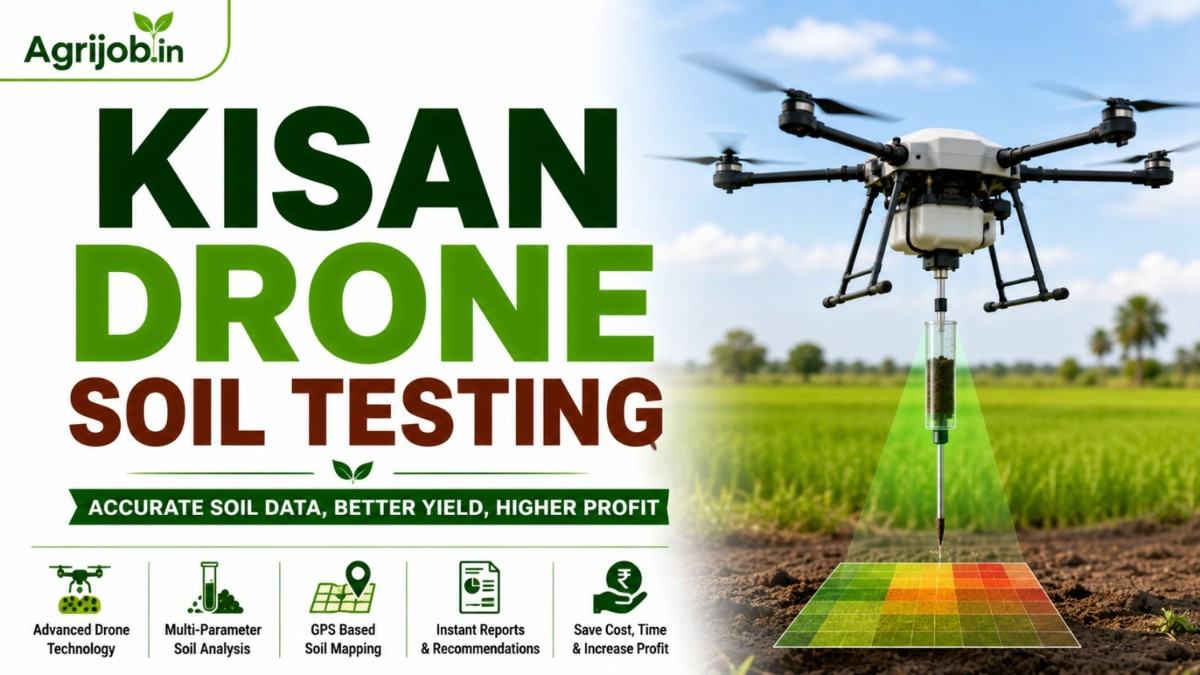
Kisan Drone soil testing is the use of DGCA-approved Unmanned Aerial Vehicles (UAVs) fitted with multispectral cameras to generate digital, georeferenced soil and crop health maps across farm fields. Unlike conventional soil testing — which requires physical collection of soil samples from multiple points and dispatch to a laboratory — drone-based testing surveys the entire field from the air, captures thousands of spectral data points per acre, and returns NDVI (Normalised Difference Vegetation Index) and NDRE (Normalised Difference Red Edge) maps within hours of the flight.
The ICAR (Indian Council of Agricultural Research) and IARI (Indian Agricultural Research Institute) initiated this drone-based system in 2016, integrating UAV technology with satellite remote sensing data. PM Narendra Modi officially launched the Kisan Drone initiative on 19 February 2022 at 100 locations simultaneously, emphasising its role in crop assessment, land record digitisation, and soil health monitoring under the Pradhan Mantri Fasal Bima Yojana (PMFBY) framework.

By 2026, ICAR through various institutions, State Agricultural Universities (SAUs), and Krishi Vigyan Kendras (KVKs) has conducted drone demonstrations across 41,010 hectares, directly benefiting over 4,52,291 farmers — figures that underscore the massive operational scale of this programme today.
ISRO + ICAR Multispectral Drone Technology Explained
Multispectral drones approved under the Kisan Drone programme capture reflected light across five key spectral bands: Blue, Green, Red, Red Edge, and Near-Infrared (NIR). Cameras such as the MicaSense RedEdge-MX and integrated RGB-plus-multispectral systems on drones like the DJI Mavic 3 Multispectral or India-made Garuda Aerospace Kisan Drone capture these bands simultaneously in each flight pass.
- 🛰️ ISRO Integration: ISRO’s Space Applications Centre (SAC) and Indian Institute of Remote Sensing (IIRS) provide satellite-based soil and land-use data through programmes like the NISAR earth observation mission. Fusing ISRO’s large-scale remote sensing outputs with drone NDVI maps at centimetre resolution creates a multi-scale precision agriculture data stack that was not available to Indian farmers even 5 years ago.
- 🌿 NDVI Mapping: NDVI measures the difference between near-infrared and red light reflectance. Healthy crops with dense chlorophyll reflect high NIR and low red light; stressed or degraded soil zones show lower NDVI values. A colour-coded NDVI map instantly shows high-health (green), moderate-stress (yellow), and critical-intervention (red) zones across a field.
- 💧 Soil Moisture Detection: Thermal sensors integrated with multispectral cameras identify soil moisture variability across the field at sub-acre resolution, enabling precise irrigation scheduling and reducing water wastage — critical for water-stressed states like Rajasthan, Gujarat, and Telangana.
- 🔬 Nutrient Deficiency Mapping: The Red Edge band is particularly sensitive to chlorophyll concentration and nitrogen content. NDRE maps generated by Kisan Drones identify nitrogen-deficient zones 7–10 days before visible yellowing appears, allowing targeted fertiliser application before yield loss occurs.
- 📐 Coverage Speed: A single Kisan Drone flight can cover 50–100 acres per hour, completing a 500-acre farm survey in under 2 hours — work that would take a ground survey team several days.
Accuracy Report: What the 2026 Data Shows for Kisan Drone Soil Testing
The scientific evidence for Kisan Drone soil testing accuracy in India is now substantial. Research conducted at ICAR-Indian Institute of Wheat and Barley Research (IIWBR), Karnal, Haryana, using UAVs with the MicaSense RedEdge-MX multispectral sensor flying at 30 metres altitude found the following:
| Parameter Measured | Flowering Stage Accuracy (R²) | Grain-Filling Stage Accuracy (R²) | Relative Error |
|---|---|---|---|
| Leaf Area Index (LAI) via NDVI | 0.78–0.86 | 0.87–0.91 | <10% |
| Leaf Nitrogen Content (LNC) via NDVI | 0.78–0.86 | 0.87–0.91 | <10% |
| Soil Moisture (Maize) via NDVI inversion | — | NSE: 0.4–0.8 | <10% |
| Soil Moisture (Millet) via NDVI inversion | — | NSE: 0.28–0.69 | <10% |
| Stress Detection (Pre-Visible) | 7–10 days earlier than manual scouting | High confidence | |
| Spatial Resolution vs Satellite | Millimetre-level vs metre-level (satellite) | 400% improvement vs 2019 | |
These figures — from peer-reviewed research at actual ICAR institutions — confirm that Kisan Drone soil testing in 2026 is not an experimental technology. It is a field-proven, high-accuracy system that outperforms traditional manual sampling on speed, coverage, and cost-per-acre when operated at scale. Drone imagery resolution has improved by 400% from 2019 to 2025, now reaching sub-centimetre accuracy — a milestone that fundamentally changes the economics of precision farming for Indian agriculture graduates and agri-entrepreneurs.
Subsidy Guide: Who Gets How Much Under Kisan Drone Scheme 2026
The Government of India has released Rs.129.19 crore for Kisan Drone promotion — including Rs.52.50 crore directly to ICAR for 300 Kisan Drones across 75,000 hectares. Below is the complete subsidy table for 2026:
| Beneficiary Category | Subsidy % | Maximum Amount | Applicable Scheme | Annual Income Potential |
|---|---|---|---|---|
| ICAR Institutes, KVKs, SAUs, FMTTI | 100% | Rs.10 lakh | SMAM / Kisan Drone Scheme | Research & demonstration |
| Farmer Producer Organisations (FPOs) | 75% | Rs.3.75 lakh | SMAM / Kisan Drone Scheme | Rs.1–3 lakh/year (services) |
| Agriculture Graduates (CHC Setup) | 50% | Rs.5 lakh | SMAM Custom Hiring Centre | Rs.3–6 lakh/year |
| SC/ST Farmers (Individual) | 50% | Rs.5 lakh | SMAM Priority Category | On-farm use |
| Women SHGs (DAY-NRLM) | 80% | Rs.8 lakh | Namo Drone Didi (Rs.1,261 cr) | Rs.1 lakh/year (rental) |
| Drone Hiring (Farmers from CHC) | N/A | Rs.6,000/hectare | Contingency Fund via CHC | Pay-per-use model |
Additionally, state governments like Maharashtra offer an additional 25% state subsidy on top of central schemes, making total subsidy up to 100% for FPOs in certain states. Karnataka, Tamil Nadu, and Rajasthan also operate state-level drone support programmes through their respective agriculture departments.
Eligibility Criteria for Kisan Drone Soil Testing Subsidy in 2026
- 🎓 Agriculture Graduates (CHC Category): Must hold a B.Sc. Agriculture or equivalent degree from a UGC-recognised university. Must register a Custom Hiring Centre in the district and operate the drone commercially for soil testing and crop monitoring services.
- 🌾 Farmer Producer Organisations (FPOs): Must be a legally registered FPO under the Companies Act or Cooperative Societies Act. FPOs qualify for 75% subsidy on certified drone models from empanelled manufacturers only.
- 👩 Women SHGs (Namo Drone Didi): Must be a registered Self-Help Group under DAY-NRLM. Women members aged 18–65 with minimum 10th-pass qualification. Drone must be used exclusively for agricultural rental services.
- 🏛️ ICAR/KVK/SAU Institutions: Any accredited ICAR institute, Krishi Vigyan Kendra, State Agriculture University, or Farm Machinery Training and Testing Institute is eligible for 100% grant on drone purchase for demonstration purposes.
- 📋 SC/ST and Marginal Farmers (Individual): Must belong to SC/ST or EWS/OBC category with land records in their name. Aadhaar-linked bank account required. Age relaxation applicable as per state norms.
- ✅ Drone Must Be DGCA-Approved: Only DGCA-certified, empanelled drone models qualify for subsidy. Non-approved drones are not eligible for any financial assistance under any category. Operators must obtain a Remote Pilot Certificate (RPC) through a DGCA-approved RPTO.
- 🔖 Registration Requirement: All drones must be registered on the Digital Sky platform (Ministry of Civil Aviation) before subsidy release.
How to Apply for Kisan Drone Soil Testing Subsidy — Step-by-Step 2026
- Visit the DBT Agriculture Portal — Go to agrimachinery.nic.in (Sub-Mission on Agricultural Mechanization portal). For Namo Drone Didi, use the DAY-NRLM official portal.
- Register with Aadhaar — Create your farmer/organisation profile using your Aadhaar number and link your bank account (DBT-enabled). FPOs must register the FPO’s PAN and registration certificate.
- Select Your Subsidy Category — Choose from individual farmer (SC/ST/marginal), FPO, agriculture graduate CHC, institution, or women SHG depending on your eligibility tier.
- Choose an Empanelled Drone Manufacturer — Select only from the Ministry of Agriculture’s approved empanelled list. Approved Indian manufacturers include Garuda Aerospace, IoTechWorld Avigation, Marut Drones, General Aeronautics (Krishak series), and others.
- Upload Required Documents — Land ownership records (khata/jamabandi), caste certificate (if SC/ST/OBC), Aadhaar, PAN card, educational qualification certificate (for CHC applicants), FPO registration certificate, SHG registration under DAY-NRLM (for women SHGs).
- Obtain DGCA Registration for Your Drone — Register the drone on the Digital Sky platform after purchase. The UIN (Unique Identification Number) is mandatory before flying.
- Complete Pilot Training — Enrol in a DGCA-approved Remote Pilot Training Organisation (RPTO) for the Remote Pilot Certificate. For Namo Drone Didi, a 15-day government-funded training programme including drone repair and data analysis is provided free.
- Await State Agriculture Department Approval — After submission, the state agriculture department verifies your application. Upon approval, subsidy is released directly into your bank account via DBT after drone purchase and invoice submission.
Namo Drone Didi Scheme 2026 — Complete Guide for Women SHGs
The Namo Drone Didi scheme is a Central Sector initiative approved with an outlay of Rs.1,261 crore for the period 2023-24 to 2025-26. It aims to provide drones to 15,000 selected Women Self-Help Groups (SHGs) under the DAY-NRLM to empower rural women as agri-tech entrepreneurs and democratise access to Kisan Drone soil testing services at the village level.
| Feature | Details |
|---|---|
| Total Budget | Rs.1,261 crore (2023-24 to 2025-26) |
| Target SHGs | 15,000 Women Self-Help Groups across India |
| Subsidy | 80% of drone cost, maximum Rs.8 lakh per SHG |
| Loan for Balance | AIF loan at 3% interest subvention |
| Training Duration | 15 days (pilot training + drone repair + data analysis) |
| Monthly Income | Rs.15,000/month for trained drone operators |
| Annual Additional Income | Up to Rs.1 lakh per year (drone rental services) |
| Age Eligibility | 18–65 years |
| Education | Minimum 10th pass |
| Drone Use | Crop spraying, soil testing, NDVI mapping for local farmers |
| Apply Via | Nearest Gram Panchayat / Pradhan Mantri Kisan Samriddhi Kendra |
Who Should Apply for Kisan Drone Soil Testing Scheme in 2026?
- 🎓 Agriculture Graduates seeking self-employment — B.Sc. or M.Sc. Agriculture graduates can set up a Custom Hiring Centre (CHC) with 50% subsidy on a multispectral drone and offer precision soil testing services to farmers across their block or district, earning Rs.3–6 lakh annually.
- 👩🌾 Women SHG members under DAY-NRLM — Women’s Self-Help Groups registered under DAY-NRLM in any state are directly eligible for the Namo Drone Didi scheme with 80% subsidy and free training, creating a sustainable rural women entrepreneurship model.
- 🌾 Farmer Producer Organisations (FPOs) — FPOs managing large aggregated farmland across multiple villages should apply for the 75% subsidy to build in-house drone soil testing capacity, reduce per-acre input costs, and improve collective bargaining through data-driven yield projections.
- 🔬 ICAR/KVK/SAU researchers and extension workers — Institutions receive 100% grant coverage up to Rs.10 lakh. KVK field officers and ICAR scientists can leverage this for large-scale demonstration, farmer training, and multi-crop NDVI research without any capital cost.
- 🏘️ SC/ST and marginal farmers — Farmers from SC/ST communities and those owning less than 2 hectares get priority allocation under SMAM with up to Rs.5 lakh support, making precision soil testing affordable for India’s most economically vulnerable cultivators.
- 🚜 Progressive large farmers (above 10 acres) — Large farmers who have faced persistent nutrient imbalance issues, waterlogging problems, or uneven yields across their holding can recover Rs.5,000–15,000 per acre in wasted fertiliser and pesticide costs through drone-guided variable-rate application.
- 💼 Agri-tech entrepreneurs and drone startups — Entrepreneurs registering drone-as-a-service models (DaaS) for soil testing and crop monitoring can access state-level drone policy support and the Agriculture Infrastructure Fund (AIF) for low-interest capital alongside PLI scheme benefits for drone manufacturing.
- 🌱 Organic and natural farming practitioners — Farmers transitioning to natural or zero-budget farming need precise soil baseline data for carbon content, organic matter, and micronutrient mapping. Multispectral Kisan Drones provide this without repeated costly lab tests.
Drone Soil Testing vs Traditional Soil Health Card Programme
| Parameter | Kisan Drone Soil Testing (2026) | Traditional Soil Health Card Scheme |
|---|---|---|
| Coverage Speed | 50–100 acres per hour | Manual grid sampling: 1–2 acres/day |
| Cost per Acre | Rs.200–600 (via CHC rental) | Rs.100–200 (lab cost, subsidised) |
| Result Turnaround | Same day (hours) | 2–4 weeks (lab processing) |
| Spatial Resolution | Centimetre-level (sub-5 cm in 2026) | Point-based (1 sample per 2.5 ha) |
| Parameters Covered | NDVI, NDRE, moisture, temp, crop stress | N, P, K, pH, organic carbon, micro-nutrients |
| Real-Time Monitoring | Yes — repeat flights at any crop stage | No — seasonal, once per cycle |
| Government Subsidy | Up to Rs.10 lakh (100% for institutions) | Fully government-funded for farmers |
| Technology Barrier | DGCA certification, RPC required | None — any farmer can participate |
| Data Integration | ISRO satellite + AI analytics platform | Standalone report, manual advisory |
Key Precision Agriculture & Drone Technology Terms You Must Know in 2026
- 🛸 Kisan Drone Scheme — The flagship Government of India initiative launched in February 2022 that provides subsidised multispectral drones to farmers, FPOs, institutions, and women SHGs for crop assessment, soil testing, and agri-input application across India.
- 🌿 NDVI (Normalised Difference Vegetation Index) — The most widely used vegetation index in precision agriculture. NDVI values between 0.6 and 0.9 indicate healthy, dense crop canopy; values below 0.3 signal severe stress, bare soil, or crop failure — triggering immediate field intervention.
- 📡 Multispectral Drone — A UAV equipped with cameras that capture 4–10 spectral bands beyond visible light (typically Blue, Green, Red, Red Edge, NIR). Multispectral drones generate NDVI, NDRE, and GNDVI maps used for soil testing, nutrient mapping, and disease detection in precision farming.
- 🗺️ SMAM (Sub-Mission on Agricultural Mechanization) — The central government scheme under the Ministry of Agriculture that funds farm machinery subsidies including Kisan Drones for individual farmers, FPOs, and Custom Hiring Centres across all 28 states and 8 union territories.
- 🏭 Custom Hiring Centre (CHC) — A farm machinery rental hub set up by agriculture graduates or entrepreneurs to provide drone services, tractor hours, and mechanisation support to small farmers who cannot afford individual equipment ownership. CHC operators receive 50% subsidy on drones under SMAM.
- 🛰️ ISRO SAC Remote Sensing — ISRO’s Space Applications Centre (SAC) in Ahmedabad and Indian Institute of Remote Sensing (IIRS) in Dehradun provide satellite-based agriculture monitoring data fused with drone NDVI outputs for comprehensive precision farming analytics in India.
- ✈️ DGCA Remote Pilot Certificate (RPC) — The mandatory certification issued by India’s Directorate General of Civil Aviation for commercial drone operators. RPC is required before any agricultural drone can be operated commercially for Kisan Drone soil testing or spraying services.
- 💰 Namo Drone Didi Scheme — A Central Sector scheme with Rs.1,261 crore outlay providing 80% subsidy (up to Rs.8 lakh) and free 15-day training to 15,000 Women SHGs for drone-as-a-service agricultural businesses in rural India (2023-24 to 2025-26).
- 🌾 Precision Agriculture — A data-driven farming approach that uses GPS, multispectral drones, soil sensors, and AI analytics to apply inputs (water, fertilisers, pesticides) at variable rates across different field zones rather than uniform blanket application — potentially saving Rs.5,000–15,000 per acre per season in input costs.
- 📊 Variable Rate Application (VRA) — A precision farming technique enabled by Kisan Drone soil testing maps, where fertilisers and agrochemicals are applied at different rates in different field zones based on NDVI and nutrient deficiency data, reducing wastage and input costs by 15–25%.
Frequently Asked Questions on Kisan Drone Soil Testing 2026
What is Kisan Drone soil testing?
Kisan Drone soil testing uses DGCA-approved UAVs fitted with multispectral cameras to generate NDVI, NDRE, and soil moisture maps across farm fields from the air. Initiated by ICAR and IARI in 2016 and integrated with ISRO satellite data, these drones replace periodic physical soil sampling with near-real-time digital soil health assessments. The output is a colour-coded field map showing nutrient-deficient, moisture-stressed, or pest-affected zones with sub-centimetre resolution, enabling precise input application.
How much subsidy is available for Kisan Drone soil testing in 2026?
The Government of India offers subsidy tiers ranging from 50% to 100% in 2026. ICAR institutes, KVKs, and State Agriculture Universities receive 100% grant up to Rs.10 lakh per drone. FPOs get 75% subsidy up to Rs.3.75 lakh. Agriculture graduates setting up CHCs receive 50% up to Rs.5 lakh. Women SHGs under Namo Drone Didi receive 80% subsidy up to Rs.8 lakh. SC/ST and marginal individual farmers receive up to Rs.5 lakh support under SMAM.
What accuracy do ICAR-approved multispectral drones achieve for soil testing?
ICAR research at the Indian Institute of Wheat and Barley Research, Karnal, confirms NDVI correlations with key crop parameters of R² = 0.87–0.91 at grain-filling stage, with an average Relative Error of less than 10% for soil moisture inversion. Crop stress is detected 7–10 days before visible symptoms appear. Drone imagery resolution has improved 400% since 2019, reaching sub-centimetre accuracy — making Kisan Drone soil testing data significantly more precise than traditional metre-level satellite imaging.
Who is eligible to apply for the Kisan Drone soil testing subsidy?
Eligibility for Kisan Drone soil testing subsidy in 2026 covers: ICAR institutes, KVKs, SAUs, and Farm Machinery Training Institutes (100% grant); Farmer Producer Organisations or FPOs (75% subsidy); Agriculture graduates starting Custom Hiring Centres (50% subsidy); Women SHGs under DAY-NRLM via Namo Drone Didi (80% subsidy); and SC/ST, EWS, or small/marginal individual farmers (up to Rs.5 lakh under SMAM). Only DGCA-approved drone models from empanelled manufacturers qualify for financial assistance.
What is the role of ISRO in Kisan Drone soil testing?
ISRO’s Space Applications Centre (SAC) and Indian Institute of Remote Sensing (IIRS) supply satellite-based large-scale soil and land cover data that is fused with ground-level Kisan Drone multispectral imagery. ISRO’s NISAR and earth observation satellites provide complementary regional data, while ISRO researchers describe multispectral imaging as “the backbone of smart agriculture monitoring” in India. This ISRO-ICAR data integration creates a multi-scale precision farming stack unavailable through either source alone.
What is the price of a multispectral agriculture drone in India in 2026?
In 2026, basic Kisan Drone sprayer models start at Rs.1.5 lakh while advanced multispectral precision agriculture drones — equipped with RGB plus 4-channel multispectral sensor systems for NDVI and soil analysis — range from Rs.6–12 lakh. Adding a dedicated multispectral sensor module to a standard sprayer drone adds Rs.3–8 lakh to the base cost. After applying government subsidies under SMAM or Namo Drone Didi, the effective out-of-pocket cost for eligible farmers and institutions can be reduced to near zero.
How do I apply for the Kisan Drone subsidy under SMAM in 2026?
To apply for Kisan Drone soil testing subsidy under SMAM: visit agrimachinery.nic.in and register with Aadhaar; select your eligibility category (individual, FPO, CHC, institution); choose an empanelled drone manufacturer from the Ministry-approved list; upload land records, caste certificate if applicable, and educational qualification (for CHC); complete DGCA drone registration on Digital Sky platform; obtain Remote Pilot Certificate from an approved RPTO; and submit for state agriculture department approval and DBT fund release.
What is the Namo Drone Didi scheme and how does it help with soil testing?
The Namo Drone Didi scheme is a Central Sector initiative with Rs.1,261 crore outlay providing 80% subsidy (up to Rs.8 lakh per drone) to 15,000 Women SHGs between 2023-24 and 2025-26. Trained women SHG members earn Rs.15,000/month and up to Rs.1 lakh additional annual income by providing Kisan Drone soil testing, NDVI mapping, and crop spraying services to local farmers for a rental fee. Apply through your nearest Gram Panchayat office or Pradhan Mantri Kisan Samriddhi Kendra.
For more on agriculture career opportunities and government schemes for agriculture graduates, read our guide on ICAR Recruitment 2026 and Agriculture Government Jobs in India.
• ICAR Official Website – icar.org.in
• SMAM DBT Agriculture Portal – agrimachinery.nic.in
• DGCA Digital Sky Platform – digitalsky.dgca.gov.in
• Namo Drone Didi Official Portal – lakhpatididi.gov.in
Last Updated: June 2026. This guide is regularly reviewed and updated for accuracy. Bookmark this page for the latest Kisan Drone soil testing 2026 notifications, subsidy updates, and scheme amendments.