
The HPRCA Pharmacist Syllabus 2026 covers 10 core pharmacy subjects (Pharmaceutics, Pharmacology, Pharmaceutical Chemistry, Pharmacognosy, Biochemistry, Human Anatomy & Physiology, Pharmacotherapeutics, Social & Hospital Pharmacy, Pharmaceutical Jurisprudence, and Drug Store Management) along with HP GK, Current Affairs, Everyday Science, Logical Reasoning, and General English & Hindi — all in a 120-mark CBT of 90 minutes with no negative marking, and a salary of Rs.18,000/month.
- Conducting Body: Himachal Pradesh Rajya Chayan Aayog (HPRCA), Hamirpur
- Advertisement No.: 11/2026
- Post Name: Pharmacy Officer (Allopathy) – Job Trainee
- Total Vacancies: 41 Posts
- Monthly Salary: Rs.18,000 (Consolidated – Job Trainee Scheme-2025)
- Application Fee: Rs.800 (All Categories)
- Age Limit: 18 – 45 Years (as on 01 January 2026)
- Exam Mode: Computer Based Test (CBT) / OMR Written Test
- Total Marks: 120 Questions × 1 Mark = 120 Marks
- Duration: 1½ Hours (90 Minutes)
- Qualifying Marks: 45% (General) | 40% (SC/ST/OBC/WFF)
- Official Website: hprca.hp.gov.in
The HPRCA Pharmacist Syllabus 2026 has been officially released by the Himachal Pradesh Rajya Chayan Aayog for the Pharmacy Officer (Allopathy) recruitment under Advertisement No. 11/2026. This guide is for D.Pharm and B.Pharm graduates from Himachal Pradesh who want to secure a government pharmacy job at Rs.18,000/month by cracking the 120-mark CBT. This page covers the complete subject-wise syllabus, updated exam pattern, category-wise qualifying marks, previous cut-off analysis, and a proven strategy to crack the exam in 2026.

- What Is the HPRCA Pharmacist Syllabus 2026?
- Who Should Read This Guide?
- HPRCA Pharmacist Exam Pattern 2026
- HPRCA Pharmacist Subject-Wise Syllabus (Part 1 — Pharmacy)
- General Knowledge & HP GK Syllabus (Part 2)
- HPRCA Pharmacist Salary & Benefits
- HPRCA Pharmacist Eligibility & Application Fee
- How to Download HPRCA Pharmacist Syllabus PDF
- HPRCA Pharmacist Cut-Off Analysis & Category-Wise Qualifying Marks
- HPRCA vs Old HPSSC Pattern — Comparison
- Pros and Cons of HPRCA Pharmacy Officer Job
- Strategy to Crack HPRCA Pharmacist CBT 2026
- Important Links
- Conclusion
- Key Takeaways
- Frequently Asked Questions
What Is the HPRCA Pharmacist Syllabus 2026?
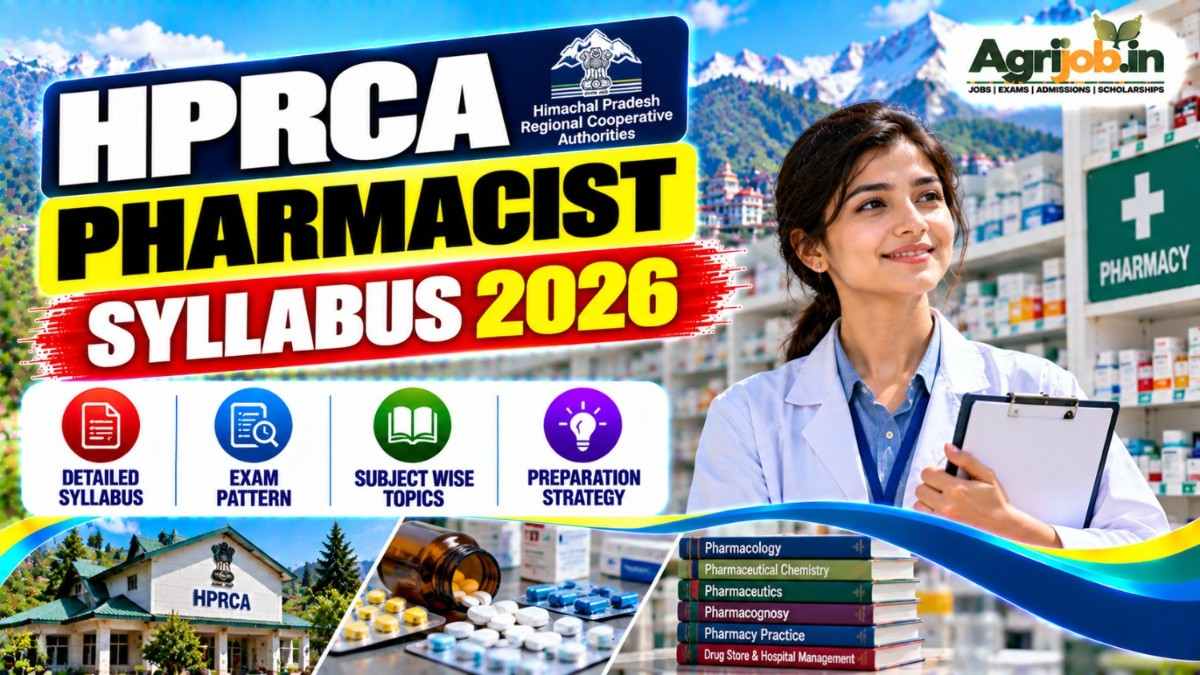
The HPRCA Pharmacist Syllabus 2026 is the official topic framework released by the Himachal Pradesh Rajya Chayan Aayog for the Pharmacy Officer (Allopathy) Computer Based Test. It is divided into two parts: Part 1 covers 10 core pharmacy subjects up to D.Pharm/B.Pharm level, and Part 2 covers General Knowledge of Himachal Pradesh, Current Affairs, Everyday Science, Logical Reasoning, Social Science, and General English & Hindi at Matric standard.
Unlike the old HPSSC pattern (170 questions, 2 hours, 0.5 marks each), the new HPRCA CBT format uses 120 questions × 1 mark, runs for 90 minutes, and has no negative marking — making it more candidate-friendly and rewarding for thorough pharmacy preparation.

Who Should Read This Guide?
This complete syllabus guide is specifically written for the following candidates:
- 🎓 D.Pharm graduates from Himachal Pradesh seeking their first government pharmacy job
- 🎓 B.Pharm holders wanting a state government posting at Rs.18,000/month with job security
- 🔄 Candidates who applied under Advt. 04/2026 (26010) or Advt. 11/2026 (26043) for Pharmacy Officer posts
- 📅 Fresh applicants appearing in the HPRCA CBT for the first time with no prior HP exam experience
- 🔁 Repeat aspirants who gave the old HPSSC Pharmacist exam and want to understand what changed in the HPRCA pattern
- 📚 Self-study candidates who want a free, complete, and verified subject-wise breakdown without buying coaching material
- 🏥 Working pharmacists in private hospitals who want to switch to a government role in HP
- 📍 Bonafide Himachalis residing outside HP who meet the HP education condition and want to apply under relaxed rules
HPRCA Pharmacist Exam Pattern 2026
The HPRCA Pharmacist exam is conducted as a Computer Based Test (CBT) or OMR Written Screening Test. There is no negative marking, which is a crucial advantage — attempt all 120 questions.
| Parameter | Details |
|---|---|
| Mode of Exam | CBT (Computer Based Test) / OMR Written |
| Type of Questions | Objective Type (MCQs) |
| Total Questions | 120 |
| Total Marks | 120 |
| Marks Per Question | 1 Mark |
| Negative Marking | None |
| Exam Duration | 1½ Hours (90 Minutes) |
| Qualifying Marks (General) | 45% — 54 marks out of 120 |
| Qualifying Marks (SC/ST/OBC/WFF) | 40% — 48 marks out of 120 |
| Language | English / Hindi |
| Selection Basis | Merit in CBT + Document Verification |
Syllabus split at a glance: The 120 questions are divided between Part 1 (pharmacy subjects — the major chunk) and Part 2 (HP GK, Current Affairs, Everyday Science, Reasoning, and English & Hindi). The official notification does not fix a rigid split between the two parts, so candidates should prepare both comprehensively.
HPRCA Pharmacist Subject-Wise Syllabus 2026 — Part 1: Pharmacy Subjects
The HPRCA Pharmacist syllabus Part 1 covers the following 10 core pharmacy subjects. These questions are set up to the level of the essential qualification (D.Pharm / B.Pharm). Focus more time here — pharmacy questions form the majority of the paper.
A. Pharmaceutics
- History and development of Pharmacy; Pharmacopoeias and Formularies (IP, BP, USP)
- Prescription reading, Posology, Pharmaceutical calculations, Weights & Measures
- Dosage forms: Powders, Tablets, Capsules, Syrups, Suspensions, Emulsions, Ointments, Creams, Suppositories, Aerosols
- Sterilization methods: Physical, Chemical, Radiation techniques
- Parenteral preparations: IV fluids, Large & Small volume parenterals
- Ophthalmic preparations: Eye drops, Eye ointments
- Unit operations: Size reduction, Mixing, Drying, Filtration, Distillation, Extraction
- Packaging materials: Glass, Plastics, Rubber — types, labelling regulations
- Storage and preservation of pharmaceutical products
B. Pharmaceutical Chemistry
- Acids, bases, buffers, antioxidants, Gastrointestinal agents
- Topical agents, Dental products, Medicinal gases, Expectorants
- Limit tests, Volumetric analysis, Impurities in pharmaceutical substances
- Antibiotics: Penicillin, Cephalosporins, Tetracyclines, Streptomycin
- Sulphonamides, Antimalarial drugs, Antitubercular drugs
- Adrenergic drugs, Cholinergic drugs, Cardiovascular drugs
- NSAIDs, Anticonvulsants, Steroidal drugs, Antihistamines
- Radiopharmaceuticals and contrast media
C. Pharmacognosy
- Definition, history, scope, and classification of crude drugs
- Cultivation, collection, processing, storage, and adulteration of crude drugs
- Chemical classes: Alkaloids, Glycosides, Tannins, Resins, Volatile oils, Lipids
- Key drugs: Senna, Digitalis, Rauwolfia, Cinchona, Belladonna, Opium, Clove, Cinnamon, Nux vomica
- Biological sources and therapeutic uses of major crude drugs
- Herbal formulations, Ayurvedic formulations, Herbal cosmetics
- Plant fibres used as surgical dressings: Cotton, Silk, Wool, Regenerated fibres
D. Pharmacology & Toxicology
- General Pharmacology: Pharmacokinetics, Pharmacodynamics, Drug receptor interaction
- Routes of administration, Drug absorption, Distribution, Metabolism, Excretion
- Autonomic Nervous System: Adrenergic, Cholinergic, Adrenolytic, Cholinolytic drugs
- CNS drugs: Sedative-Hypnotics, Analgesics, Antipyretics, Antiepileptics, Antipsychotics
- Cardiovascular drugs: Antihypertensives, Antiarrhythmics, Antianginals, Diuretics
- Chemotherapeutic agents: Antibiotics, Antifungals, Antivirals, Anthelmintics
- Drugs used in Diabetes, Thyroid disorders, Respiratory diseases, GI disorders
- Toxicology: General principles of toxicology, Antidotes, Heavy metal poisoning
E. Biochemistry & Clinical Pathology
- Carbohydrates, Proteins, Lipids, Nucleic acids — structure and metabolism
- Enzymes: Classification, Mechanism, Enzyme inhibition
- Normal and abnormal blood and urine constituents
- Clinical significance of biochemical tests: LFT, RFT, Blood glucose, Lipid profile
- Acid-base balance and electrolyte disorders
F. Human Anatomy & Physiology
- Structure and function of major organ systems: Cardiovascular, Respiratory, Digestive, Nervous, Endocrine, Renal, Reproductive
- Blood composition, coagulation, blood groups
- Nerve impulse transmission, reflex actions
- Hormones and their functions (Insulin, Thyroxine, Cortisol, etc.)
G. Pharmacotherapeutics
- Clinical use of drugs in common diseases: Hypertension, Diabetes, Asthma, Infections, Epilepsy
- Drug interactions: Pharmacokinetic and Pharmacodynamic
- Adverse drug reactions and monitoring
- Rational use of medicines and evidence-based prescribing
H. Social & Hospital Pharmacy / Community Pharmacy
- Health Education: Concepts of health, disease, and prevention
- National Health Programmes: NHM, Ayushman Bharat, Janaushadhi scheme
- Hospital Pharmacy: Layout, functions, drug distribution systems
- Community pharmacy services: Drug information, counselling, patient communication
- Inventory management: FIFO, ABC analysis, VED analysis
I. Pharmaceutical Jurisprudence (Pharmacy Law & Ethics)
- Drugs & Cosmetics Act, 1940 and Rules 1945: Schedules H, H1, X, G
- Pharmacy Act, 1948: Registration of pharmacists, powers of Pharmacy Council
- Narcotic Drugs and Psychotropic Substances (NDPS) Act, 1985
- Drugs and Magic Remedies (Objectionable Advertisements) Act, 1954
- Consumer Protection Act (pharmacy-relevant provisions)
- Good Pharmacy Practice (GPP) guidelines
J. Drug Store & Business Management
- Store management: Procurement, storage, issue, and disposal of medicines
- Record maintenance: Issue register, stock register, expiry register
- Drug formulary, Essential Medicine List (EML)
- Cold chain management for vaccines and biologicals
- Quality assurance concepts in drug stores
Pharmaceutics, Pharmacology, and Pharmaceutical Chemistry are historically the three highest-scoring subjects in HP pharmacy exams. Aim to master at least 80% of topics in these three subjects before moving to the remaining seven. Pharmaceutical Jurisprudence questions are almost always direct (Act name, Schedule, Year) — a quick 5-day focused revision can secure 8–12 marks here.
General Knowledge & HP GK Syllabus 2026 — Part 2
Part 2 of the HPRCA Pharmacist syllabus covers general subjects and must not be ignored — candidates who neglect HP GK often fall short of the cut-off even with strong pharmacy scores.
| Subject | Key Topics to Cover |
|---|---|
| Himachal Pradesh GK | History (Statehood 1971, Rulers, Districts), Geography (Rivers, Passes, Wildlife Sanctuaries), Economy (Apple belt, Hydroelectric projects), Culture (Fairs: Kullu Dussehra, Minjar; Folk dances, Temples), Important Personalities, Current HP State Schemes |
| Current Affairs (National & HP) | Last 6–12 months: HP Government appointments, National events, Science & Technology, Government schemes (Ayushman Bharat, PM Jan Arogya) |
| Everyday Science | Basic Physics (Force, Motion, Electricity), Chemistry (Elements, Acids-Bases, Chemical reactions), Biology (Cell biology, Human body, Disease & Immunity) |
| Logical Reasoning | Series completion, Coding-Decoding, Blood relations, Analogies, Direction sense, Seating arrangements, Syllogisms |
| Social Science | Indian History (Freedom Struggle), Indian Polity (Constitution, Parliament, Fundamental Rights), Geography (Physical features of India) |
| General English (Matric Level) | Grammar (Tenses, Articles, Prepositions, Subject-Verb Agreement), Vocabulary, Reading Comprehension, Sentence correction |
| General Hindi (Matric Level) | Vyakaran (Grammar), Samaas, Sandhi, Paryayvachi, Muhavare, Fill in the blanks |
HPRCA Pharmacist Salary & Benefits 2026
Selected candidates receive a consolidated monthly salary of Rs.18,000 under the HP Job Trainee Scheme-2025. This is a fixed, non-negotiable amount during the trainee period. After completing the trainee period, candidates may be absorbed into the regular pay scale of Class-III Technical posts as per HP Government rules.
| Component | Details |
|---|---|
| Post Name | Pharmacy Officer (Allopathy) – Job Trainee |
| Monthly Fixed Pay | Rs.18,000 (Consolidated) |
| Pay Type | Fixed under Job Trainee Scheme-2025 |
| Department | Health & Family Welfare, Himachal Pradesh |
| Job Location | Himachal Pradesh (State Cadre) |
| Post Category | Class-III Technical Post |
| NDPS & Schedule X Handling | Authorized (adds professional value) |
HPRCA Pharmacist Eligibility Criteria & Application Fee 2026
Candidates must fulfil all eligibility conditions before applying. The key requirements are:
- ✅ Education: 10+2 in Science from a recognized Board
- ✅ Professional Qualification: Degree (B.Pharm) or Diploma (D.Pharm) from a recognized University/Institution
- ✅ Registration: Valid registration with the State/Central Pharmacy Council is mandatory
- ✅ HP Education Condition: Matriculation and 10+2 must be from a school/institution situated in Himachal Pradesh (not applicable to Bonafide Himachalis)
- ✅ Age Limit: 18–45 years as on 01 January 2026
- ✅ Age Relaxation: 5 years for SC/ST/OBC/PwD/Ex-Servicemen of HP (maximum 45 years in any case)
| Category | Examination Fee | Processing Fee | Total Fee |
|---|---|---|---|
| All Categories | Rs.100 | Rs.700 | Rs.800 |
| Correction Fee (ORA changes) | — | — | Rs.100 |
| Payment Mode | Credit Card / Debit Card / Net Banking | ||
How to Download HPRCA Pharmacist Syllabus PDF from hprca.hp.gov.in
The official HPRCA Pharmacist Syllabus PDF can be downloaded directly from the HPRCA portal. Follow these steps:
- Visit the official website — go to hprca.hp.gov.in on your browser
- Click on “Recruitment / Notifications” — look for Advertisement No. 11/2026 (Pharmacy Officer)
- Open the notification PDF — the detailed syllabus is appended at the end of the official notification document
- Locate the Syllabus section — search for “Pharmacy Officer (Allopathy)” or post code 26043 in the document
- Download and save — save the PDF to your device for offline reference during preparation
- Cross-check with this guide — use this article alongside the official PDF to ensure no topic is missed
HPRCA Pharmacist Cut-Off Analysis & Category-Wise Qualifying Marks
The HPRCA has published minimum qualifying marks, but the actual selection cut-off will depend on the number of vacancies (41 posts), total appearing candidates, and exam difficulty. Here is the official qualifying mark structure for 2026:
| Category | Minimum Qualifying % Marks | Marks out of 120 |
|---|---|---|
| General (UR) | 45% | 54 marks |
| SC / ST / OBC / WFF | 40% | 48 marks |
| PwD / Ex-Servicemen (HP) | 40% | 48 marks |
Expected selection cut-off range (based on similar HP government exams): General — 72–90 marks | OBC — 65–80 marks | SC/ST — 55–70 marks. Actual cut-offs for HPRCA Pharmacist 2026 will be published after the exam along with the merit list at hprca.hp.gov.in. Bookmark this page for updates.
Note: Official category-wise selection cut-off data for the HPRCA Pharmacist post is not yet published. The ranges above are based on analogous HPRCA paramedical exam patterns and should be treated as indicative only. Check hprca.hp.gov.in for the latest official cut-off once declared.
HPRCA vs Old HPSSC Pharmacist Exam Pattern — Comparison
Many candidates who prepared for the old HPSSC pharmacist exam often ask what changed. The new HPRCA exam pattern is significantly different — here is a direct comparison:
| Feature | Old HPSSC Pattern | New HPRCA Pattern (2026) |
|---|---|---|
| Conducting Body | HP Staff Selection Commission | HP Rajya Chayan Aayog (HPRCA) |
| Total Questions | 170 MCQs | 120 MCQs |
| Total Marks | 85 Marks (½ mark per Q) | 120 Marks (1 mark per Q) |
| Duration | 2 Hours | 1½ Hours (90 minutes) |
| Mode of Exam | Offline OMR (Historically) | CBT / OMR Written |
| Negative Marking | Yes (historically) | No (2026 notification) |
| Syllabus Structure | 120 Professional + 50 General Qs | Part A (Professional) + Part B (General) |
| Qualifying Marks (UR) | Varied by post | 45% (54 marks) |
| Best For | High scorers in pharmacy subjects | All-round candidates (pharmacy + GK) |
The new HPRCA pattern is better for candidates with strong pharmacy knowledge because: (1) no negative marking means you should attempt all 120 questions; (2) 1 mark per question rewards accuracy more directly than the 0.5-mark system; and (3) 90 minutes for 120 questions gives you exactly 45 seconds per question — fast but manageable with proper mock test practice. Candidates who have previously prepared for GPAT or any state pharmacist exam have a structural advantage in Part 1.
Pros and Cons of HPRCA Pharmacy Officer Job
Before preparing, it helps to understand what you are working toward — a balanced view helps you make an informed decision.
Advantages
- ✅ Government job security — state cadre post with stable employment under HP Health Department
- ✅ No negative marking in CBT — attempt all 120 questions without penalty
- ✅ CBT mode — faster result processing compared to OMR exams of the past
- ✅ Limited competition — only 41 vacancies for a state-level post, reducing pressure compared to national-level exams
- ✅ Path to regularization — Job Trainee posts often lead to regular government employment under HP Government rules
Disadvantages
- ❌ Salary of only Rs.18,000/month during the trainee period — lower than private sector B.Pharm roles in cities
- ❌ HP-specific eligibility barrier — Matriculation and 10+2 must be from HP institutions (non-Bonafide Himachalis may not qualify)
- ❌ No confirmed exam date yet — candidates must wait for HPRCA to announce the CBT schedule
Strategy to Crack HPRCA Pharmacist CBT 2026 — Subject-Wise
A focused 60–90 day preparation plan will be sufficient to crack the HPRCA Pharmacist CBT 2026 for most D.Pharm/B.Pharm graduates. Follow this step-by-step strategy:
- Download the official syllabus PDF from hprca.hp.gov.in and mark every topic subject-wise. Do not rely on memory — printed syllabus checked against this guide ensures 100% coverage.
- Prioritize Part 1 subjects by weightage: Spend 65% of your study time on Pharmaceutics, Pharmacology, and Pharmaceutical Chemistry — these three subjects likely account for 40–50 questions in the 120-mark paper.
- Complete Pharmaceutical Jurisprudence in 5 days: All questions from this section are direct recall (Act name, Schedule, Year, Section). Make a one-page cheat sheet of all Schedules under D&C Act and revise daily.
- HP GK daily habit — 30 minutes every day: Read Himachal Pradesh-specific news, current appointments, and HP government schemes. HPRCA exams consistently draw 10–15 questions from HP-specific GK. “Himachal Darpan” or “HP GK by Balokhra” is the standard reference.
- Solve at least 500 pharmacy MCQs from GPAT/state pharmacist exam question banks before attempting full mock tests. This builds speed and identifies weak topics.
- Attempt 2–3 full mock tests per week in the final 30 days, strictly within 90 minutes. Since there is no negative marking, train yourself to never leave a question blank.
- Revise Everyday Science and Reasoning: These are scoring and short-to-prepare. 10 days of focused study can fetch 15–20 marks from these sections with minimal effort.
Important Links — HPRCA Pharmacist 2026
| Link Name | URL / Reference |
|---|---|
| Official Website | hprca.hp.gov.in |
| HPRCA Pharmacist Official Notification (Advt. 11/2026) | Download from hprca.hp.gov.in |
| HP Health & Family Welfare Department | hphealth.nic.in |
| Pharmacy Council of India (PCI) | pci.nic.in |
| RRB Pharmacist Syllabus 2026 (Related Guide) | RRB Pharmacist Syllabus 2026 – Exam Pattern, Cut Off & Strategy |
| UPSSSC Veterinary Pharmacist Syllabus 2026 | UPSSSC Veterinary Pharmacist Syllabus – Exam Pattern & Cut Off |
| HPRCA Final Result 2026 (Radiographer, Teacher) | HPRCA Final Result 2026 – Check Radiographer, Teacher PDF |
Conclusion
The HPRCA Pharmacist Syllabus 2026 is well-structured, covering 10 core pharmacy subjects alongside HP GK and general aptitude in a 120-mark CBT of 90 minutes with no negative marking. With 41 vacancies and a Rs.18,000/month salary, this is one of the most accessible government pharmacy positions available in Himachal Pradesh for 2026. Start your preparation today, download the official syllabus PDF from hprca.hp.gov.in, and bookmark this page — we update it every time HPRCA releases exam dates or cut-off information.
- HPRCA Pharmacist 2026 has 41 vacancies with a salary of Rs.18,000/month under the Job Trainee Scheme-2025
- The CBT consists of 120 objective questions × 1 mark each, to be completed in 90 minutes — with NO negative marking
- Minimum qualifying marks: 45% (54/120) for General; 40% (48/120) for SC/ST/OBC/WFF
- Part 1 covers 10 pharmacy subjects; Part 2 covers HP GK, Current Affairs, Science, Reasoning, English & Hindi
- Prioritize Pharmaceutics, Pharmacology, and Pharmaceutical Chemistry for maximum marks in Part 1
- Download the official syllabus PDF from hprca.hp.gov.in and check RRB Pharmacist Syllabus 2026 on Agrijob.in for a comparative preparation strategy
Frequently Asked Questions About HPRCA Pharmacist Syllabus 2026
What is the HPRCA Pharmacist Syllabus 2026?
The HPRCA Pharmacist Syllabus 2026 covers two parts: Part 1 includes 10 core pharmacy subjects (Pharmaceutics, Pharmaceutical Chemistry, Pharmacognosy, Pharmacology & Toxicology, Biochemistry & Clinical Pathology, Human Anatomy & Physiology, Pharmacotherapeutics, Social & Hospital Pharmacy, Pharmaceutical Jurisprudence, and Drug Store Management), and Part 2 covers HP GK, Current Affairs, Everyday Science, Logical Reasoning, Social Science, and General English & Hindi of Matric standard.
How many questions are in the HPRCA Pharmacist exam 2026?
The HPRCA Pharmacist CBT 2026 consists of 120 objective-type (MCQ) questions, each carrying 1 mark, for a total of 120 marks. The exam duration is 90 minutes (1½ hours) with no negative marking. Candidates must score at least 45% (54 marks) for General category or 40% (48 marks) for SC/ST/OBC/WFF to qualify.
Is there negative marking in HPRCA Pharmacist Exam 2026?
No, there is no negative marking in the HPRCA Pharmacist CBT 2026 as per the official notification under Advt. 11/2026. Candidates should attempt all 120 questions to maximize their score. Leaving questions blank is a wasted opportunity under this pattern.
What is the salary of HPRCA Pharmacy Officer 2026?
Selected candidates will receive a consolidated fixed salary of Rs.18,000 per month under the HP Job Trainee Scheme-2025. This is the remuneration during the Job Trainee period under the Department of Health & Family Welfare, Himachal Pradesh. After the trainee period, regularization may happen as per HP Government policy.
Where can I download the HPRCA Pharmacist Syllabus PDF?
The official HPRCA Pharmacist Syllabus PDF for the Pharmacy Officer (Allopathy) post can be downloaded from the official HPRCA website at hprca.hp.gov.in. Look for Advertisement No. 11/2026 in the notifications section and open the full notification PDF — the syllabus is included at the end of the document.
What are the eligibility criteria for HPRCA Pharmacist 2026?
Candidates must have 10+2 in Science from a recognized board, plus a Degree (B.Pharm) or Diploma (D.Pharm) in Pharmacy from a recognized institution, and valid registration with the State/Central Pharmacy Council. Age limit is 18–45 years as on 01 January 2026, with a 5-year relaxation for SC/ST/OBC/PwD/Ex-Servicemen of Himachal Pradesh.
How many vacancies are available in HPRCA Pharmacist Recruitment 2026?
A total of 41 vacancies have been released for the Pharmacy Officer (Allopathy) – Job Trainee post under HPRCA Advertisement No. 11/2026. The vacancies are distributed category-wise: General (UR) — 6, General (WEXM) — 13, General (WFF) — 1, EWS — 3, SC (UR) — 4, SC (WEXM) — 4, OBC (UR) — 4, OBC (WEXM) — 3, ST (UR) — 1, ST (WEXM) — 2.
What is the difference between HPRCA and HPSSC Pharmacist exam?
The old HPSSC Pharmacist exam used 170 MCQs worth 85 marks over 2 hours (0.5 mark per question). The new HPRCA Pharmacist CBT 2026 uses 120 MCQs worth 120 marks in 90 minutes (1 mark per question) with no negative marking and a CBT mode. HPRCA (Himachal Pradesh Rajya Chayan Aayog) replaced HPSSC as the recruiting body and the exam pattern changed accordingly.
How much time should I give to HP GK in HPRCA Pharmacist preparation?
Allocate 30 minutes daily to HP GK and Current Affairs throughout your preparation period. HP GK questions — covering HP history, geography, government schemes, districts, fairs, and current appointments — typically account for 10–15 marks in HPRCA exams. Ignoring HP GK while scoring well in pharmacy subjects is a common mistake that causes otherwise strong candidates to miss the final cut-off.
What is the application fee for HPRCA Pharmacist 2026?
The total application fee for HPRCA Pharmacist (Pharmacy Officer) Recruitment 2026 is Rs.800 for all categories — comprising Rs.100 as Examination Fee and Rs.700 as Processing Fee. Payment is accepted via Debit Card, Credit Card, or Net Banking through the HPRCA online portal. No fee waiver is available for any category as per Advt. 11/2026.
📅 Last Updated: October 2026 | Source: HPRCA Official Notification Advt. 11/2026 | Check hprca.hp.gov.in for the latest exam date, admit card, and result.
⚠️ Disclaimer: This article is for informational purposes only and is based on the official HPRCA notification and cross-verified public sources. Candidates must check the official HPRCA website (hprca.hp.gov.in) and official notification for the most accurate and legally binding information before applying. Agrijob.in is not affiliated with HPRCA or the Himachal Pradesh Government.