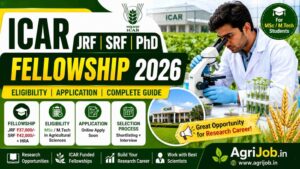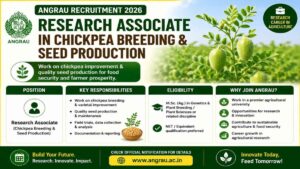

ICAR research jobs 2026 offer agriculture and life science graduates one of the most rewarding government-funded career paths in India, with monthly stipends ranging from Rs.25,000 to Rs.67,000 across positions like JRF, SRF, Young Professional, and Research Associate. Whether you are a fresh BSc Agriculture graduate or a PhD scholar looking for a funded post, the Indian Council of Agricultural Research (ICAR) and its network of 100+ institutes recruit thousands of research staff every year. This complete guide covers every ICAR research post category in 2026 — eligibility, stipend, age limit, selection process, and step-by-step application instructions — so you can apply with confidence and never miss a notification.

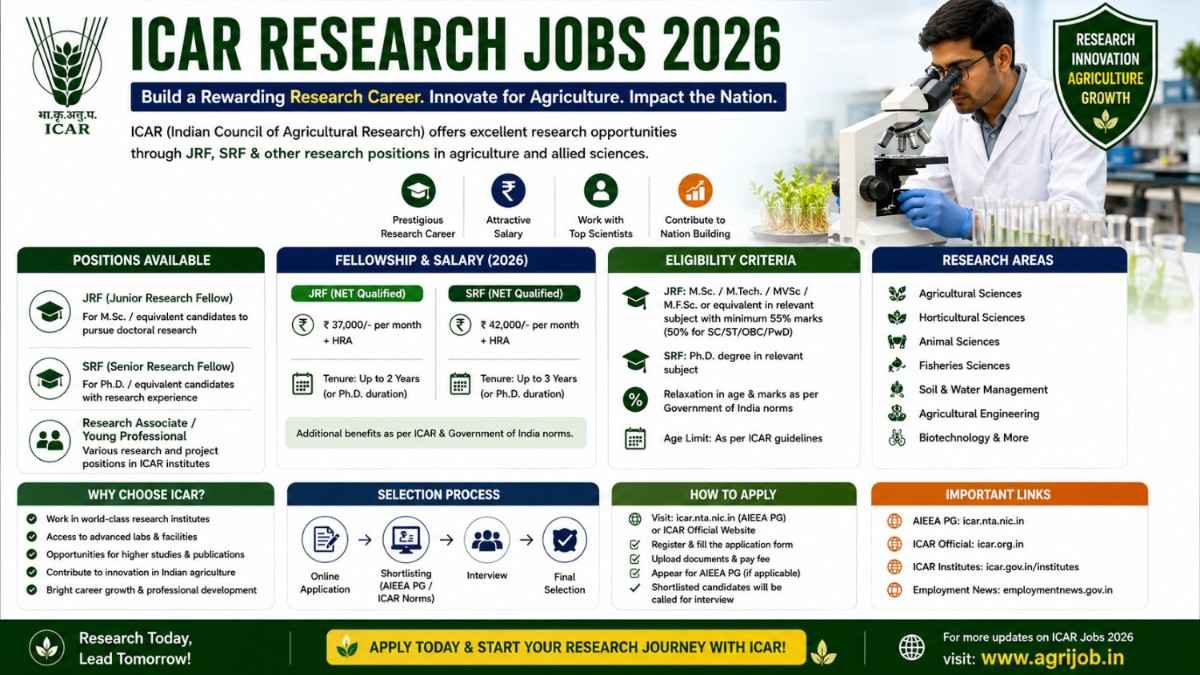
🏛️ Organisation: Indian Council of Agricultural Research (ICAR), Govt. of India
📌 Post Categories: JRF, SRF, Young Professional I & II, Research Associate, Project Assistant
💰 Stipend Range: Rs.18,000 – Rs.67,000 per month
📅 Recruitment Mode: Walk-in Interview / Online Application (Institute-wise)
🎓 Qualification: 10th Pass to PhD (post-wise)
📆 Age Limit: 30–35 years (relaxation for SC/ST/OBC/PwBD)
📜 Certificate: Research Experience Certificate / ICAR Completion Letter
🌐 Official Website: icar.org.in
📋 Table of Contents
- ICAR Research Post Categories & Stipend 2026
- ICAR Stipend Table – All Posts Compared
- Eligibility Criteria – Qualification, Age & Category
- Who Should Apply for ICAR Research Jobs?
- Top ICAR Institutes in Bihar – NRC Makhana & RPCAU Pusa
- National Research Fellowships – DST, SERB, NABARD & More
- How to Apply for ICAR Research Jobs 2026 – Step by Step
- Selection Process for ICAR Research Positions
- ICAR Research Job vs Permanent Govt Job – Full Comparison
- High-Value Agriculture Research Career Terms You Must Know
- Frequently Asked Questions (FAQ)
ICAR Research Post Categories & Stipend 2026
ICAR research jobs 2026 are available across five broad contractual categories. Each category has a defined qualification requirement, stipend level, and typical project duration. Understanding the differences helps you target the right post at the right time.
- 🔬 Junior Research Fellow (JRF): The most common entry point for fresh postgraduates in Agriculture, Life Sciences, Environmental Science, Soil Science, and allied disciplines. Requires a first-class Master’s degree. Stipend: Rs.31,000/month for the first 2 years.
- 🧪 Senior Research Fellow (SRF): Upgraded from JRF after satisfactory performance assessment at the 2-year mark, or recruited directly for positions requiring prior research experience. Stipend: Rs.35,000/month. Often includes GC/HPLC instrument operation experience.
- 👩🔬 Research Associate (RA): The highest-stipend contractual research post under ICAR. Requires a PhD degree or equivalent research publications. Stipend: Rs.54,000–Rs.67,000/month depending on the funding agency (ICAR, DST, DBT, UKRI, etc.).
- 🌱 Young Professional-II (YP-II): Designed for fresh postgraduates aged below 30. Provides hands-on research exposure without needing prior experience. Stipend: Rs.35,000/month. A highly competitive role with large applicant pools.
- 🌾 Young Professional-I (YP-I): Entry-level research support role for graduates (BSc Agriculture, BSc Life Sciences). Stipend: Rs.25,000/month. Typically involves field data collection, sample preparation, and lab support tasks.
- 🛠️ Project Assistant / Field Staff: Supports research operations at field level. Minimum qualification: 10th/12th pass with agriculture field experience. Stipend: Rs.18,000/month. Suitable for diploma holders and rural candidates.
ICAR Stipend Table – All Posts Compared 2026
| Post | Qualification | Monthly Stipend | Annual Earning | Age Limit |
|---|---|---|---|---|
| Research Associate (RA) | PhD / Equivalent | Rs.54,000–Rs.67,000 | Rs.6.48L–Rs.8.04L | 40 years |
| Senior Research Fellow (SRF) | M.Sc. + 2 yrs experience | Rs.35,000 | Rs.4.20 Lakh | 35 years |
| Young Professional-II (YP-II) | Post-Graduation | Rs.35,000 | Rs.4.20 Lakh | 30 years |
| Junior Research Fellow (JRF) | M.Sc. (First Class) | Rs.31,000 | Rs.3.72 Lakh | 35 years |
| Young Professional-I (YP-I) | Graduation | Rs.25,000 | Rs.3.00 Lakh | 30 years |
| Project Assistant-I / Field Staff | 10th / 12th Pass | Rs.18,000 | Rs.2.16 Lakh | 28 years |
Note: HRA (House Rent Allowance) is additional and depends on the city category (X, Y, Z) of the institute location. Candidates at ICAR institutes in Delhi (IARI, NIPB, NAARM) typically receive higher effective take-home than those at rural campuses.

Eligibility Criteria – Qualification, Age & Category 2026
Every ICAR research job 2026 has post-specific eligibility. Here is a consolidated overview of the key criteria across all major categories:
Educational Qualification
- 📗 JRF/SRF: First-class Master’s degree (60% or equivalent CGPA) in Agriculture, Soil Science & Agricultural Chemistry, Environmental Sciences, Biotechnology, Seed Science, Life Sciences, or allied fields from a UGC-recognised university.
- 📘 YP-II: Post-graduation (M.Sc./M.Tech.) in relevant discipline. First-class marks preferred; NET/GATE qualification is a strong advantage for selection.
- 📙 YP-I: Graduation (B.Sc. Agriculture / B.Sc. Life Sciences / B.Sc. Horticulture) from a recognised university. Good academic record required.
- 📕 Research Associate: PhD in Agriculture or allied sciences. Candidates who have submitted their thesis and are awaiting award are also eligible.
- 📓 Project Assistant/Field Staff: 10th/12th pass with experience working in agricultural fields, animal husbandry, or soil/GHG sampling tasks.
Age Limit & Relaxation Table
| Category | JRF/SRF Age Limit | YP-I / YP-II Age Limit | RA Age Limit |
|---|---|---|---|
| General / EWS | 35 years | 30 years | 40 years |
| OBC (Non-Creamy Layer) | 38 years (+3) | 33 years (+3) | 43 years (+3) |
| SC / ST | 40 years (+5) | 35 years (+5) | 45 years (+5) |
| PwBD (Persons with Disability) | 45 years (+10) | 40 years (+10) | 50 years (+10) |
| Women candidates | As per Govt. norms | As per Govt. norms | As per Govt. norms |
Application Fee
| Category | Application Fee |
|---|---|
| General / OBC / EWS | Nil (most ICAR positions) |
| SC / ST / PwBD | Nil |
| Women Candidates | Nil |
Most ICAR research positions do not charge any application fee, making them especially accessible for candidates from economically weaker sections and rural areas.
Who Should Apply for ICAR Research Jobs 2026?
- 🎓 Fresh MSc Agriculture graduates who want hands-on research experience before appearing for ASRB NET, IBPS AFO, or NABARD Grade A exams — ICAR JRF is the ideal launchpad.
- 🌿 BSc Agriculture freshers (20–30 years) looking for their first government-funded research exposure through Young Professional-I posts with Rs.25,000/month stipend.
- 👩🔬 Women candidates in science — ICAR institutes actively encourage applications from women researchers, and several projects under DST-WOS (Women Scientist Scheme) are specifically for women with breaks in career.
- 🧑🏫 PhD scholars and NET-qualified candidates targeting Research Associate (RA) posts at Rs.54,000–Rs.67,000/month, the highest-paying contractual science role in India’s public research system.
- 🌾 Candidates from Bihar, Jharkhand, and eastern UP — ICAR institutes like RPCAU Pusa and NRC Makhana (Darbhanga) recruit heavily from Mithila and North Bihar regions and sometimes give preference to local language proficiency.
- 🔬 Environmental Science and Soil Science postgraduates — ICAR projects under international funding bodies like UKRI (UK Research and Innovation) and GCRF (Global Challenges Research Fund) frequently recruit specialists in GHG measurement, nitrogen cycle research, and water quality analysis.
- 🌱 SC/ST/OBC aspirants — With up to 5 years age relaxation and no application fee, ICAR research jobs are among the most inclusive contractual science roles in India. The experience gained also adds reservation-benefit points in future permanent job applications.
- 📊 Candidates with GIS/data science skills — Modern ICAR projects require proficiency in GIS mapping, R/Python for data analysis, and reference management tools like Zotero. Applicants with these skills have a strong competitive edge for selection.
Top ICAR Institutes in Bihar – NRC Makhana & RPCAU Pusa 2026
Bihar is home to two of ICAR’s most strategically important research institutes, both offering regular research jobs 2026 for agriculture graduates from North India:
Dr. Rajendra Prasad Central Agricultural University (RPCAU), Pusa
RPCAU Pusa, established on the historic Pusa campus in Samastipur district of Bihar, is one of India’s premier central agricultural universities and a major hub for ICAR research jobs. The university’s Directorate of Research manages over 40 active research projects across crop improvement, soil health, water management, and post-harvest technology. In 2026, RPCAU Pusa has advertised multiple JRF, SRF, and YP-II positions under various ICAR and Government of India funded schemes. Research completions here are recognised by the Dr. Rajendra Prasad Central Agricultural University and carry significant weight in ASRB and state PSC selections.
ICAR National Research Centre for Makhana (NRC Makhana), Darbhanga
The ICAR-NRC Makhana at Darbhanga is the world’s only dedicated research centre for Makhana (fox nut / Euryale ferox), a crop that has seen explosive commercial growth in North Bihar’s Mithila region. The centre focuses on genetic improvement (including the landmark variety “Swarna Vaidehi”), post-harvest mechanization, and value-chain development for Makhana growers. Research staff here contribute directly to a crop that generates livelihoods for over 25,000 farming families in Darbhanga, Madhubani, Sitamarhi, and Supaul districts. For candidates from Bihar, this ICAR institute offers research roles with deep local relevance and strong publication opportunities in international agronomy journals. For more, visit the official ICAR portal.
National Research Fellowships – DST, SERB, NABARD & More 2026
Beyond ICAR’s own recruitment, agriculture and life science graduates can access a rich ecosystem of national and international research fellowships in 2026. These are especially relevant for candidates aiming at longer-term academic careers or high-value NABARD and ASRB NET positions.
| Fellowship Programme | Eligibility | Stipend / Grant | Focus Area |
|---|---|---|---|
| PM Early Career Research Grant (PMECRG) | Young scientists in national research labs/universities | Multi-year institutional funding + equipment grants | Frontier science, quantum computing, engineering |
| National Postdoctoral Fellowship (NPDF) | PhD holders in basic & applied sciences | Monthly fellowship stipend + contingency + travel | Biology, physical sciences, mathematics, chemistry |
| Ramanujan Fellowship | PhD researchers returning to India from abroad | Rs.1,35,000/month + Rs.7 lakh research grant/year | Frontier science, advanced research leadership |
| DST-WOS (Women Scientist Scheme) | Women with career break (post-PhD preferred) | Rs.55,000/month fellowship + research contingency | All major science streams including agriculture |
| Cognitive Science Research Initiative (CSRI-PDF) | PhD holders below 40 in cognitive sciences | Long-term postdoctoral fellowship + lab support | Neurophysiology, human-computer interaction |
| DST Bilateral & Joint Research Projects | Academic faculty with international collaborators | Shared international project funding + travel | AI, green hydrogen, climate science |
| SCAI Early Career Research Grants (ECRG) | Interventional researchers within 10 years post-fellowship | Direct grants for data, staff salaries, travel | Clinical and translational research |
| Future Earth Early Career Fellowship 2026 | Early-career researchers in sustainability science | International collaboration support | Climate, ecology, and sustainable agriculture |
For candidates preparing for NABARD Grade A 2026, familiarity with these funding structures is directly tested in the Development and Social Banking (DSB) and Agriculture paper. Understanding how DST, SERB, and DBT fellowships work also signals research aptitude to interview panels — a crucial differentiator at the Rs.44,500–Rs.89,000/month NABARD officer salary level.
How to Apply for ICAR Research Jobs 2026 – Step by Step
ICAR research jobs 2026 are filled either through online application portals or walk-in interviews. Follow these steps carefully based on the recruitment mode specified in the notification:
- Find the Official Notification: Visit icar.org.in → “Recruitments” section, or check the specific institute website (e.g., rpcau.ac.in, iari.res.in). Also bookmark Agrijob.in for instant alerts on new ICAR research job postings.
- Read the Notification Carefully: Note the post name, number of vacancies, last date, eligibility, stipend, and whether it is a walk-in or online application mode. Pay attention to the specific specialisation required (e.g., “Soil Science & AC with GC instrument experience”).
- Prepare Your Documents: Arrange self-attested copies of: 10th marksheet, graduation marksheet, post-graduation marksheet, NET/GATE certificate (if available), experience certificate, caste certificate (if applicable), age proof (Aadhaar/Birth Certificate), and 2 passport-size photographs.
- Fill the Application Form: Download the prescribed Performa from the official notification PDF. Fill it neatly in English with correct details. For online applications, complete the form on the institute’s recruitment portal and upload scanned documents.
- Send Application: For walk-in interviews — email your completed application with self-attested documents to the designated email address (e.g., SANH.IARI@gmail.com for UKRI-funded projects at IARI) before the last date. For online mode — submit on the portal and note your application number.
- Attend Screening / Interview: Shortlisted candidates are notified by email with the interview date and time. For walk-in posts, attend at the designated venue (usually the institute’s conference room) with all original documents for verification before the interview panel.
- Document Verification: On the day of the interview, present all original certificates along with 2 sets of self-attested copies. Original documents are returned after verification.
- Merit List & Selection: ICAR institutes publish the final merit list / selected candidate list on the official website or noticeboard within 7–15 days of the interview. Joining formalities are completed once the merit list is declared.
Selection Process for ICAR Research Positions 2026
- 📄 Stage 1 – Application Screening: Applications are screened based on eligibility — educational qualification, specialisation match, and academic scores. Only candidates meeting the minimum criteria are shortlisted for interview.
- 📧 Stage 2 – Interview Call Letter: Shortlisted candidates receive an email / SMS with the date, time, and mode (online/offline) of the interview. No physical call letter / admit card is issued for most ICAR research posts.
- 🎤 Stage 3 – Technical Interview: A panel of 3–5 scientists from the institute evaluates candidates on subject knowledge, research methodology, laboratory skills (GC, spectrophotometer, GIS, data analysis), and alignment with the project’s objectives.
- 📋 Stage 4 – Document Verification: Originals of all certificates are verified on the day of interview. Any mismatch with application data results in immediate disqualification.
- 🏆 Stage 5 – Merit List: Final selection is purely merit-based. A merit list is prepared based on interview performance, academic record, and NET/GATE scores. Category-wise merit lists are prepared where reservation applies.
- 📜 Stage 6 – Joining & Agreement: Selected candidates sign a contractual agreement specifying project duration (typically 1–3 years), stipend, reporting responsibilities, and IP/publication rights.
ICAR Research Job vs Permanent Govt Agriculture Job – Comparison
| Parameter | ICAR Research Job (JRF/SRF/RA) | Permanent Govt Agriculture Job (NABARD/IBPS AFO) |
|---|---|---|
| Monthly Pay | Rs.31,000–Rs.67,000 (stipend) | Rs.44,500–Rs.2,25,000 (salary + DA + HRA) |
| Job Security | Contractual (1–3 years) | Permanent (till retirement) |
| Pension / Gratuity | Not applicable | Yes (NPS/Old Pension Scheme) |
| Eligibility Required | M.Sc. / B.Sc. + specialisation | Graduate + competitive exam (ASRB, IBPS, UPSC) |
| Selection Competition | Moderate (interview-based) | Very high (lakhs of applicants) |
| Time to Join | 2–6 weeks after interview | 6–18 months (exam → result → joining) |
| Research Experience | Yes – highly valuable | Not always required |
| Certificate / Credential | ICAR Research Experience Letter | Government Officer ID + service record |
| Best For | Fresh postgraduates, PhD aspirants, researchers | Candidates seeking long-term financial stability |
High-Value Agriculture Research Career Terms You Must Know
Understanding these key terms will help you write better applications, crack ICAR interviews, and succeed in high-CPC competitive exams like NABARD Grade A, ASRB NET, and IBPS AFO 2026:
- 🔬 ICAR JRF (Junior Research Fellow): A government-funded research position paying Rs.31,000/month for MSc Agriculture holders. The most common first research job in India’s public science ecosystem.
- 🧬 ASRB NET (National Eligibility Test): The Agriculture Scientists Recruitment Board exam that qualifies candidates for permanent scientist posts (Rs.78,800–Rs.2,09,200/month) at ICAR institutes across India.
- 🌾 NABARD Grade A Officer: A prestigious Rs.44,500–Rs.89,000/month permanent role at the National Bank for Agriculture and Rural Development, where ICAR research experience gives strong interview advantage.
- 📊 Zotero / Reference Management: Free, open-source reference management software increasingly used in ICAR-funded research. Proficiency here is a practical skill valued in 2026 research job interviews.
- 🌡️ GHG Sampling (Greenhouse Gas): A specialized laboratory skill involving measurement of CO₂, N₂O, and CH₄ emissions from soil and water. ICAR projects under UKRI/GCRF funding frequently require this specialisation at Rs.35,000/month SRF level.
- 🗺️ GIS (Geographic Information System): Spatial data mapping tool essential for district-wise research on crop distribution, soil health mapping, and nitrogen cycles. A high-demand skill for ICAR research jobs 2026.
- 🌱 Swarna Vaidehi (Makhana Variety): ICAR-NRC Makhana’s landmark improved variety of fox nut developed at Darbhanga, now commercially cultivated across North Bihar. A frequently asked topic in ASRB NET agriculture paper.
- 🔬 DST SERB (Science and Engineering Research Board): India’s primary funding body for scientific research, offering CRG (Core Research Grant), NPDF, Ramanujan Fellowship, and WOS fellowships to eligible researchers at stipends of Rs.55,000–Rs.1,35,000/month.
- 📜 UKRI / GCRF Projects: UK Research and Innovation and Global Challenges Research Fund support international collaborative research in India. ICAR-IARI’s Division of Environment Science is a leading recipient, recruiting JRFs and SRFs at Rs.35,000/month for nitrogen and soil science research.
- 🏛️ RPCAU Pusa (Rajendra Prasad Central Agricultural University): Bihar’s only central agricultural university, located in Samastipur. One of the top 5 agricultural research institutions in India for post-harvest, crop science, and soil health research jobs.
Frequently Asked Questions – ICAR Research Jobs 2026
What is the stipend for ICAR JRF research jobs in 2026?
The ICAR JRF stipend for research jobs in 2026 is Rs.31,000 per month for the first 2 years, increasing to Rs.35,000 per month upon upgradation to SRF. Additional HRA and contingency grants are provided depending on the project and institute location.
What is the eligibility for ICAR research jobs 2026?
For ICAR JRF and Young Professional positions, the minimum eligibility is a first-class Bachelor’s or Master’s degree in Agriculture, Life Sciences, Soil Science, Environmental Science, or related disciplines from a UGC-recognised university. Age limit is typically 35 years for JRF/SRF and 30 years for Young Professional posts, with relaxation for SC/ST/OBC/PwBD candidates as per Govt. of India norms.
What is the salary for ICAR Senior Research Fellow (SRF) 2026?
The ICAR SRF salary in 2026 is Rs.35,000 per month as fixed stipend, plus HRA as applicable. Research Associates (RA) under ICAR-funded projects earn between Rs.54,000 and Rs.67,000 per month, making it one of the highest-paying contract research roles in government agriculture institutions.
How to apply for ICAR research jobs 2026?
Candidates can apply in two ways: (1) For walk-in interviews, send a self-attested application with educational certificates to the designated email by the last date. (2) For online recruitment, visit icar.org.in or the specific institute’s website, fill the form, and upload documents before the closing date.
What is the difference between ICAR JRF, SRF, YP-I and YP-II?
ICAR JRF (Rs.31,000/month) is for MSc holders; SRF (Rs.35,000/month) is upgraded from JRF or requires prior experience; YP-I (Rs.25,000/month) is for graduates; YP-II (Rs.35,000/month) is for postgraduates below 30 years; Research Associates (Rs.54,000–Rs.67,000/month) require a PhD. Each has a different age limit and project role.
Is ICAR JRF a permanent government job?
No, ICAR JRF and SRF are contractual, project-based roles typically lasting 2–3 years. However, they provide a competitive stipend, genuine research exposure, and a research certificate that is highly valued for ASRB NET, NABARD Grade A, and other permanent recruitment exams.
Which ICAR institutes offer the most research jobs in Bihar?
In Bihar, the most active ICAR institutes for research jobs include RPCAU Pusa (Samastipur), ICAR-NRC Makhana (Darbhanga), and ICAR-IIFSR (Modipuram, UP). RPCAU Pusa and NRC Makhana are especially relevant for candidates from Mithila and North Bihar. Check rpcau.ac.in for current notifications.
Can freshers apply for ICAR research jobs 2026?
Yes, freshers with a first-class Master’s degree in Agriculture or related sciences can directly apply for ICAR JRF and Young Professional-II positions. ICAR YP-I posts also accept fresh graduates. No prior research experience is mandatory for entry-level positions, though GIS, GC instrument, or data analysis skills are a strong advantage.
For the latest ICAR research job notifications 2026, check the official ICAR recruitment portal, the National Apprenticeship Portal, and the Ministry of Labour & Employment for related research trainee schemes. Bookmark Agrijob.in for instant alerts on every new ICAR JRF, SRF, YP, and RA notification — updated daily.