
IBPS RRB Agriculture Officer Syllabus 2026 has been officially released as part of the CRP RRBs-XV notification published on August 31, 2026, opening 50 Agriculture Officer (Scale II) vacancies across Regional Rural Banks in India. With a starting basic pay of Rs.64,820 per month — the highest among all agriculture banking exams — this is a premium opportunity for agriculture graduates with 2+ years of banking experience. This guide covers the complete section-wise syllabus, official exam pattern, eligibility criteria, salary structure, and a proven strategy to crack the exam in 2026.

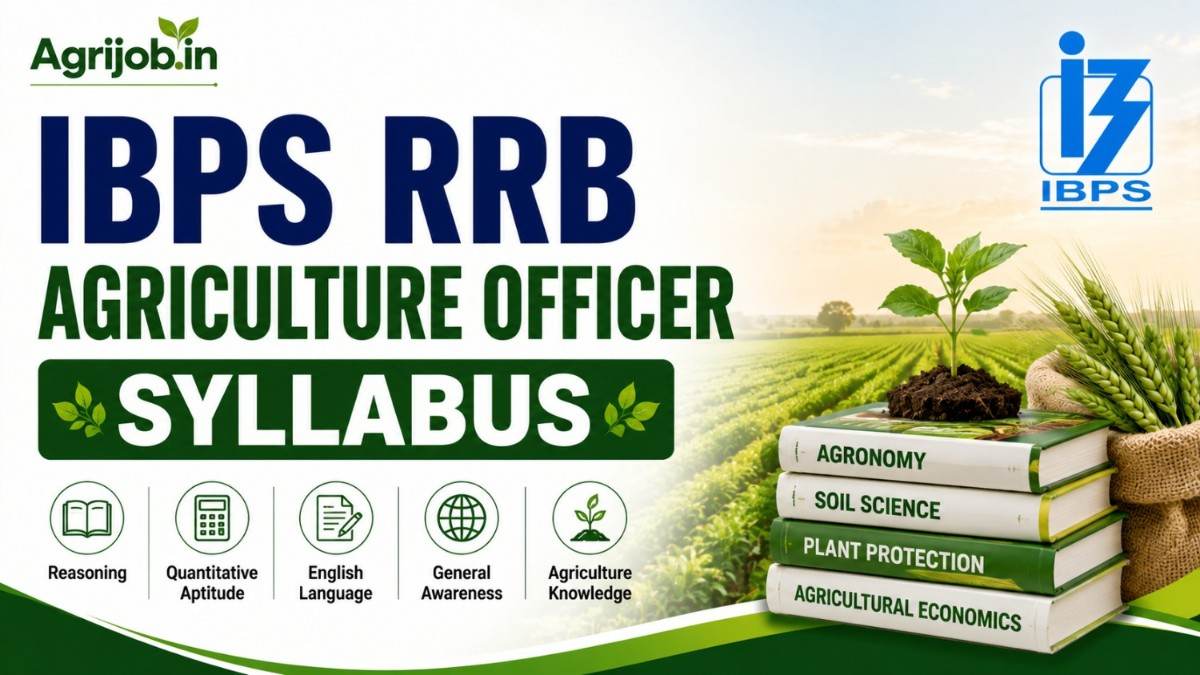
IBPS RRB Agriculture Officer Syllabus 2026 covers 6 sections — Reasoning, Quantitative Aptitude & Data Interpretation, Financial Awareness, English/Hindi Language, Computer Knowledge, and Professional Knowledge (Agriculture) — totalling 240 questions for 200 marks in 150 minutes. There are 50 Agriculture Officer (Scale II) vacancies this year. Apply online from September 1 to September 21, 2026 at ibps.in.
- Conducting Body: Institute of Banking Personnel Selection (IBPS)
- Post Name: Agriculture Officer (Officer Scale II — Specialist)
- Total Vacancies: 50 (indicative, as per official CRP RRBs-XV notification)
- Application Window: September 1 – September 21, 2026
- Exam Mode: Single Online Examination + Interview
- Total Questions: 240 questions across 6 sections
- Total Marks: 200 marks (composite)
- Exam Duration: 150 minutes (2 hours 30 minutes)
- Negative Marking: 0.25 marks per wrong answer
- Basic Pay (Scale II): Rs.64,820 per month
- Gross In-Hand: Approximately Rs.80,000–90,000 per month
- Experience Required: Minimum 2 years as an officer in a bank or financial institution
- Age Limit: 21–32 years (as on September 1, 2026)
- Official Website: ibps.in
📋 Table of Contents
- What Is IBPS RRB Agriculture Officer 2026?
- Who Should Apply for This Post?
- Salary and Pay Scale (Scale II)
- Eligibility Criteria and Age Limit
- IBPS RRB Agriculture Officer Exam Pattern 2026
- Complete Section-Wise Syllabus 2026
- How to Apply Online (Step-by-Step)
- IBPS RRB Agriculture Officer vs IBPS AFO
- Pros and Cons of IBPS RRB Agriculture Officer
- Important Terms Related to This Exam
- Important Dates and Timeline 2026
- Important Links
- Conclusion
- Key Takeaways
- Frequently Asked Questions
What Is IBPS RRB Agriculture Officer 2026?
IBPS RRB Agriculture Officer is a Specialist Officer (Scale II) position in Regional Rural Banks, selected through the Common Recruitment Process (CRP RRBs-XV) conducted by the Institute of Banking Personnel Selection. Agriculture Officers work on agriculture and allied-sector credit — evaluating farm loan applications, advising borrowers on agri-finance schemes, and supporting rural banking operations in their region.
Unlike the IBPS Agriculture Field Officer (AFO) post, which is for commercial banks and requires no experience, the RRB Agriculture Officer is a Scale II position requiring a minimum of 2 years of post-qualification banking experience. This experience filter significantly reduces competition and offers one of the highest starting basic pay packages — Rs.64,820 per month — among all agriculture-related banking exams in 2026.

The selection process consists of a single online examination followed by a personal interview. There is no separate prelims stage, unlike IBPS AFO. Candidates appearing in this exam are tested across 6 sections, with the Professional Knowledge (Agriculture) section carrying the highest practical significance for final merit.
Who Should Apply for IBPS RRB Agriculture Officer 2026?
- 🎓 Agriculture graduates with 2+ years of banking experience who currently work as Agriculture Field Officers, rural bank officers, or in agri-finance roles
- 🏦 IBPS AFO officers who completed 2 years of service and want to upgrade to Scale II salary — the syllabus is identical, so no extra preparation is required
- 🌾 Candidates with BSc/MSc Agriculture, Horticulture, Animal Husbandry, Veterinary Science, Dairy Science, Fishery Science, or Agricultural Engineering who meet the experience criterion
- 💰 Agriculture professionals targeting the highest-paying agriculture banking role with a gross monthly take-home of Rs.80,000–90,000
- 📍 Candidates open to rural or semi-urban postings across various states in India’s RRB network of 43 banks
- 🎯 Experienced professionals who want a single-exam selection process without the separate prelims stage that AFO requires
- 🔄 NABARD or cooperative bank officers looking to transition into Regional Rural Bank service at a senior officer level
- 📚 Agriculture postgraduates or PhD holders whose combined education and banking/field experience satisfies the 2-year requirement
IBPS RRB Agriculture Officer Salary 2026 – Scale II Pay Structure
The IBPS RRB Agriculture Officer Scale II offers the highest entry-level basic pay among all agriculture banking examinations in India. Under the 11th Bipartite Settlement, the starting basic pay for Scale II is Rs.64,820 per month — significantly higher than IBPS AFO Scale I (starting at Rs.36,000–48,480/month).
| Salary Component | Indicative Amount |
|---|---|
| Basic Pay (Scale II) | Rs.64,820/month |
| Dearness Allowance (DA) | Revised quarterly by IBA |
| House Rent Allowance (HRA) | Depends on posting city (7%–9% of Basic) |
| Special Allowance | As per RRB rules |
| Gross Monthly Emoluments | Approx. Rs.80,000–90,000 |
| In-Hand Take-Home (after deductions) | Approx. Rs.65,000–75,000 |
| Annual CTC (approx.) | Rs.9–9.2 lakh per annum |
| PF Contribution | As per applicable RRB rules |
Apart from salary, Agriculture Officers at Scale II are entitled to medical benefits, leave travel concession, staff housing loans at concessional rates, and other perquisites as per the RRB’s service regulations. Actual figures vary by posting RRB, city classification, and applicable allowances — candidates should verify from the allotted bank’s official offer letter.
IBPS RRB Agriculture Officer Eligibility Criteria 2026
Candidates must meet both the educational qualification and experience requirements prescribed in the official CRP RRBs-XV notification. Age is calculated as on September 1, 2026.
Educational Qualification
Candidates must hold a Bachelor’s degree in one of the following disciplines from a recognized university or equivalent, with a minimum of 50% marks in aggregate:
- Agriculture
- Horticulture
- Animal Husbandry
- Veterinary Science
- Dairy Science / Dairy Technology
- Fishery Science / Pisciculture
- Agricultural Engineering
- Forestry
- Agricultural Marketing and Cooperation
Work Experience Requirement
A minimum of 2 years of post-qualification experience as an officer in a bank or financial institution is mandatory. Fresh graduates, no matter how strong their academic background, cannot apply for this post. The experience requirement is what separates this Scale II post from the IBPS AFO Scale I position.
Age Limit (as on September 1, 2026)
| Category | Age Limit | Date of Birth Range |
|---|---|---|
| General / EWS | 21–32 years | September 2, 1993 – September 1, 2004 (both inclusive) |
| SC / ST | 21–37 years (5 years relaxation) | September 2, 1988 – September 1, 2004 |
| OBC (Non-Creamy Layer) | 21–35 years (3 years relaxation) | September 2, 1990 – September 1, 2004 |
| PwBD | 21–42 years (10 years relaxation) | September 2, 1983 – September 1, 2004 |
| Ex-Servicemen | As per government norms | Per official notification |
Application Fee
| Category | Application Fee |
|---|---|
| General / OBC / EWS | Rs.850 |
| SC / ST / PwBD | Rs.175 |
IBPS RRB Agriculture Officer Exam Pattern 2026
The IBPS RRB Agriculture Officer 2026 exam is a single-stage online examination (no separate prelims) consisting of 240 questions for 200 marks, to be completed in 150 minutes. Each section carries separate timing, and candidates must clear the minimum sectional cutoff in all 6 sections to be considered for interview shortlisting. A negative marking of 0.25 marks applies for every incorrect answer.
| Section | Number of Questions | Maximum Marks | Time |
|---|---|---|---|
| Reasoning | 40 | 40 | Sectional timing (composite 150 min) |
| Quantitative Aptitude & Data Interpretation | 40 | 40 | Sectional timing |
| Financial Awareness | 40 | 40 | Sectional timing |
| English Language / Hindi Language | 40 | 40 | Sectional timing |
| Computer Knowledge | 40 | 40 | Sectional timing |
| Professional Knowledge (Agriculture) | 40 | 40 | Sectional timing |
| Total | 240 | 200 | 150 minutes |
Interview: Candidates who clear the written exam cutoff (up to 3x the declared vacancies are called) appear for an interview worth 100 marks. The minimum qualifying score in the interview is 40% for General/OBC/EWS candidates and 35% for SC/ST/PwBD candidates. The final merit list is based on written exam score and interview combined.
IBPS RRB Agriculture Officer Syllabus 2026 – Section-Wise Topics
1. Professional Knowledge (Agriculture) – Most Critical Section
This is the most strategically important section of the IBPS RRB Agriculture Officer exam. While all sections carry 40 marks each, your relative advantage over other candidates comes from your depth in Professional Knowledge. Cover each sub-discipline systematically:
- Agronomy: Crop production practices, tillage, sowing methods, irrigation, cropping systems, multiple cropping, intercropping, kharif and rabi crop varieties, seed rate, spacing, major field crops (wheat, rice, maize, cotton, sugarcane, pulses, oilseeds)
- Soil Science: Soil formation, soil profile, soil classification, soil pH, essential plant nutrients (macro and micro), soil fertility and productivity, soil erosion, conservation methods, waterlogging, soil health cards
- Horticulture: Fruit crops, vegetable crops, floriculture, post-harvest management, protected cultivation (greenhouses, polyhouses), crop-specific production technology
- Plant Pathology: Major crop diseases, causal organisms (fungi, bacteria, viruses, nematodes), disease management strategies, integrated disease management, important pesticides and fungicides
- Entomology: Major crop pests, pest life cycles, integrated pest management (IPM), insecticides and their mode of action, biological control agents
- Genetics and Plant Breeding: Mendel’s laws, types of plant breeding (selection, hybridization, mutation breeding), hybrid seeds, biotechnology basics, GM crops (Bt cotton, etc.)
- Plant Physiology: Photosynthesis, transpiration, seed germination, growth regulators (auxins, gibberellins, cytokinins, ethylene), vernalization, photoperiodism
- Agricultural Economics and Farm Management: Agricultural finance, types of credit (short/medium/long term), cooperative credit, NABARD, KCC (Kisan Credit Card), MSP, PM-KISAN, agricultural marketing, FPOs
- Animal Husbandry and Dairy Science: Cattle breeds, poultry farming, fodder crops, milk production, common livestock diseases, government schemes for animal husbandry
- Agricultural Engineering: Farm machinery and implements, irrigation equipment, drip and sprinkler irrigation, soil and water conservation structures, post-harvest equipment
- Extension Education: Agricultural extension, training and visit system, KVKs (Krishi Vigyan Kendras), FPOs, role of ICAR institutions
- Fishery Sciences: Freshwater and marine fisheries, aquaculture, fish breeding, common fish diseases, MPEDA, NFDB
- Agroforestry and Agro-Ecology: Social forestry, agro-forestry systems, ecological balance, carbon sequestration in agriculture
- Agriculture Current Affairs: Latest government schemes (PM-KMY, PM-KUSUM, PMFBY, RKVY, e-NAM), budget allocations for agriculture, MSP announcements, agricultural census data, ICAR research updates
2. Reasoning Ability Syllabus
- Puzzles and Seating Arrangements (linear, circular, parallel row)
- Syllogism (statement and conclusion)
- Blood Relations
- Coding and Decoding
- Direction Sense Test
- Inequalities (mathematical and coded)
- Alphanumeric Series
- Statement and Assumptions / Courses of Action
- Decision Making
- Ranking and Order
- Analogy and Odd One Out
- Input-Output
- Assertion and Reason
- Word Formation and Alphabet Tests
3. Quantitative Aptitude and Data Interpretation Syllabus
- Data Interpretation (bar charts, line graphs, pie charts, tables, mixed DI)
- Number Series
- Simplification and Approximation
- Percentage and Ratio-Proportion
- Profit, Loss and Discount
- Simple Interest and Compound Interest
- Time and Work / Pipes and Cisterns
- Time, Speed and Distance
- Average, Mixture and Alligation
- Probability
- Permutation and Combination
- Quadratic Equations
- Age Problems
- Partnership
- LCM and HCF
4. Financial Awareness Syllabus
- Overview of banking system in India — RBI, scheduled banks, cooperative banks, RRBs
- RBI Monetary Policy (repo rate, reverse repo rate, CRR, SLR, OMO)
- Union Budget and Economic Survey
- Types of bank accounts and banking products
- Non-Performing Assets (NPAs), BASEL I, II, III accords
- Asset Reconstruction Companies, SARFAESI Act
- Risk management in banking
- Loan restructuring, bad loans, bank recapitalization
- Banking reforms: Jan Dhan Yojana, PMMY, MUDRA Loans
- Deposits, credits, and banking regulations
- NABARD — role in rural finance, RIDF, refinance
- Latest financial news, mergers/acquisitions in banking sector
5. English / Hindi Language Syllabus
Candidates can choose between English and Hindi language sections. The topics covered are:
| English Language Topics | Hindi Language Topics |
|---|---|
| Reading Comprehension | Reading Comprehension (Gadyansh) |
| Cloze Test | Fill in the Blanks |
| Error Detection | Error Spotting (Shuddh Vartani) |
| Phrase Substitution | Synonyms and Antonyms (Paryayvachi/Vilom) |
| Rearrangement of Sentences | Para Jumbles |
| Fill in the Blanks | Grammar (Vyakaran) |
| Synonyms and Antonyms | One Word Substitution |
| Idioms and Phrases | Idioms (Muhavare) |
| One Word Substitution | Sentence Correction |
| Jumbled Words | Paragraph Questions |
6. Computer Knowledge Syllabus
- Computer Fundamentals (hardware, software, types of computers)
- History of computers and generations
- Input and Output Devices
- Operating Systems basics
- MS Office (Word, Excel, PowerPoint)
- Internet and browsers, email, networking
- Database basics (DBMS concepts)
- Computer languages (high-level, low-level, assembly)
- Number systems and conversions (binary, decimal, octal, hexadecimal)
- Security tools, antivirus, firewall concepts
- Shortcut keys commonly used in banking
- Computer abbreviations (RAM, ROM, CPU, ALU, etc.)
How to Apply for IBPS RRB Agriculture Officer 2026 – Step-by-Step
The online application for IBPS RRB CRP RRBs-XV (which includes the Agriculture Officer Scale II post) is live from September 1, 2026. The last date to apply is September 21, 2026. Follow these steps carefully:
- Visit the official IBPS website at ibps.in. Click on the CRP RRBs-XV section visible on the homepage.
- Click “Apply Online” for Officer Scale-I/II/III (Agriculture Officer is under Scale II Specialist Officers). Do not click the Office Assistant link by mistake.
- Click “New Registration” and enter your name, date of birth, mobile number, and email ID. Note down the provisional registration number and password sent to your email.
- Fill in the complete application form with personal details, educational qualifications, work experience details, post preference, and state/language preference.
- Upload mandatory documents — recent passport-size photograph (4.5cm x 3.5cm), signature, left thumb impression, and a handwritten declaration as per the prescribed format.
- Pay the application fee online — Rs.850 for General/OBC/EWS candidates and Rs.175 for SC/ST/PwBD candidates — via net banking, NEFT, debit/credit card, or UPI.
- Submit the application and download the confirmation page. Keep a printout or PDF for your records — you will need it during document verification.
Do not wait until September 21 to apply — IBPS servers experience heavy traffic near the deadline. Apply by September 15, 2026 to avoid last-minute technical issues. Also, candidates can apply for both the Officer Scale-I/II/III post AND the Office Assistant post simultaneously (with separate registrations and fees), but can only apply for one post among Officer Scale-I, II, and III.
IBPS RRB Agriculture Officer vs IBPS AFO – Which Should You Target?
Agriculture graduates often compare these two flagship banking exams. Here is a detailed side-by-side comparison to help you choose the right target:
| Parameter | IBPS RRB Agriculture Officer (Scale II) | IBPS AFO (Scale I) |
|---|---|---|
| Conducting Bank Type | Regional Rural Banks (43 RRBs) | Public Sector Commercial Banks |
| Officer Scale | Scale II (Manager level) | Scale I (Officer level) |
| Experience Required | Minimum 2 years | No experience required |
| Basic Pay | Rs.64,820/month | Rs.36,000–48,480/month |
| Gross Monthly Salary | Rs.80,000–90,000 | Rs.57,000–68,000 |
| Exam Stages | Single exam + Interview | Prelims + Mains + Interview |
| Total Vacancies (2026) | ~50 (highly competitive) | ~700–1,000+ (higher) |
| Agriculture Syllabus | Identical — same topics | Identical — same topics |
| Sections in Exam | 6 sections including Financial Awareness and Computer | Prelims: 3 sections; Mains: Agriculture only |
| Best For | Experienced banking professionals seeking higher pay | Fresh BSc Agriculture graduates |
The recommended career path for agriculture graduates is: clear IBPS AFO first (no experience barrier, higher vacancies) → gain 2 years of banking experience as an Agriculture Field Officer → apply for IBPS RRB Agriculture Officer Scale II. The agriculture syllabus is identical for both exams, so no additional preparation is needed for the Scale II jump. This path delivers a salary upgrade of approximately Rs.16,000–20,000 per month within 2–3 years.
Advantages and Disadvantages of IBPS RRB Agriculture Officer Post
Advantages (Pros)
- ✅ Highest basic pay (Rs.64,820/month) among all entry-level agriculture banking posts in India
- ✅ Single-stage exam — no separate prelims, which saves preparation time compared to IBPS AFO
- ✅ Lower competition — the 2-year experience requirement filters out fresh graduates, reducing applicant pool significantly
- ✅ Clear career progression — Scale II officers can advance to Scale III and beyond within the RRB system through internal promotions
- ✅ Identical agriculture syllabus to IBPS AFO — experienced AFO candidates need zero additional subject preparation
- ✅ Job security and government employee benefits — pension, medical coverage, subsidized loans, LTC, and housing benefits
Disadvantages (Cons)
- ❌ Only 50 vacancies per year — extremely limited openings make competition intense despite the experience filter
- ❌ 2-year experience is a hard barrier — fresh graduates cannot apply regardless of their academic performance
- ❌ Rural/semi-urban postings — RRBs are located in rural areas, which may not suit candidates who prefer city postings
- ❌ Six sections in one exam — more preparation effort required compared to IBPS AFO Mains, which tests only Professional Knowledge
Important Terms Related to IBPS RRB Agriculture Officer Exam
- CRP RRBs-XV: Common Recruitment Process for Regional Rural Banks — 15th cycle (2026). This is the official notification under which Agriculture Officer Scale II recruitment is conducted.
- Officer Scale II: Manager-level officer post in Regional Rural Banks. Agriculture Officer falls under the Specialist Officer (SO) category at Scale II.
- Professional Knowledge (Agriculture): The core subject section of the exam covering agronomy, soil science, horticulture, plant pathology, entomology, genetics, animal husbandry, agricultural economics, and allied subjects.
- Negative Marking: 0.25 marks deducted for every incorrect answer. This means attempting 4 wrong answers costs you 1 correct answer’s marks.
- Sectional Cutoff: Each of the 6 sections has a minimum qualifying marks threshold. Failing even one section disqualifies the candidate regardless of total score.
- KCC (Kisan Credit Card): A key agri-finance scheme often tested in both Financial Awareness and Professional Knowledge sections — short-term credit facility for farmers.
- NABARD: National Bank for Agriculture and Rural Development — India’s apex development finance institution for agriculture, often cited in both Financial Awareness and Professional Knowledge questions.
- MSP (Minimum Support Price): Government-declared price for agricultural produce, ensuring farmers receive fair compensation. Frequently tested in agriculture current affairs.
- 11th Bipartite Settlement: The wage revision agreement between IBA and bank employee unions under which Scale II basic pay of Rs.64,820 is applicable.
- IBA (Indian Banks’ Association): Revises DA quarterly and oversees salary structure for bank employees including RRB officers.
IBPS RRB Agriculture Officer 2026 – Important Dates and Timeline
| Event | Date (Tentative / Official) |
|---|---|
| CRP RRBs-XV Notification Release | August 31, 2026 |
| Online Application Starts | September 1, 2026 |
| Last Date to Apply Online | September 21, 2026 |
| Application Fee Payment Deadline | September 21, 2026 |
| Single Online Examination (Scale II) | December 20, 2026 (tentative) |
| Interview Round | January–February 2027 (tentative) |
| Provisional Allotment | April 2027 (tentative) |
Note: Dates marked tentative are based on the IBPS exam calendar published with CRP RRBs-XV. Always verify from the official IBPS website (ibps.in) for any revisions.
Important Links – IBPS RRB Agriculture Officer 2026
| Link Name | URL |
|---|---|
| Official IBPS Website | ibps.in |
| IBPS RRB CRP-XV Notification PDF | Download from ibps.in → CRP RRBs-XV |
| Apply Online (Officer Scale I/II/III) | Active from September 1, 2026 at ibps.in |
| NABARD Official Website (for agri-finance reference) | nabard.org |
| India Agriculture Portal (for schemes and data) | agricoop.nic.in |
| ICAR Official Website (for agriculture research reference) | icar.org.in |
| IBPS AFO 2026 Complete Syllabus Guide (Agrijob.in) | IBPS AFO 2026 New Syllabus & 90-Day Plan |
| Agriculture Officer Salary Comparison (Agrijob.in) | Agriculture Field Officer Salary 2026 |
| IBPS AFO Eligibility & Preparation (Agrijob.in) | IBPS AFO 2026 Eligibility & Exam Pattern |
| Best Agriculture Govt Jobs 2026 (Agrijob.in) | Top 10 Agriculture Government Jobs 2026 |
Expert Strategy to Crack IBPS RRB Agriculture Officer 2026
Cracking the IBPS RRB Agriculture Officer exam requires a disciplined 90-day preparation strategy that balances all 6 sections while maximising your Professional Knowledge score. Here is a proven, phase-wise plan:
Phase 1: Foundation (Days 1–30) – Agriculture and Aptitude Base
- Dedicate 50–60% of daily study time to Professional Knowledge (Agriculture) — cover Agronomy, Soil Science, and Horticulture in depth first, as these 3 subjects cover nearly 50% of agriculture questions
- Spend 20–25% of time on Quantitative Aptitude — focus on Data Interpretation, Simplification, and Percentage/Ratio problems daily
- Allocate 15–20% to Reasoning — practise puzzles (linear and circular seating) and syllogisms, which consistently appear in banking exams
- Start following agriculture current affairs — MSP updates, government schemes, ICAR announcements, and agri-budget news. Read one agri-news source daily for 15 minutes
Phase 2: Consolidation (Days 31–60) – All Sections Simultaneously
- Complete remaining Professional Knowledge subjects: Plant Pathology, Entomology, Genetics, Animal Husbandry, Agricultural Engineering, Extension Education, and Fishery Sciences
- Begin intensive Financial Awareness preparation — Basel norms, RBI monetary policy, NABARD functions, NPA classification, and latest banking reforms are high-probability topics
- Revise Computer Knowledge — focus on MS Office shortcuts, networking basics, security tools, and number system conversions; this section can be cleared in 2–3 weeks of focused effort
- Attempt section-wise mock tests to identify weak areas
Phase 3: Revision and Full Mocks (Days 61–90) – Speed and Accuracy
- Take at least 2 full-length mock tests every week in the actual 150-minute format
- Analyse every mock test — identify sections where you are losing marks due to wrong answers (negative marking can reduce your score by 5–10 marks if unmanaged)
- Revise all government schemes relevant to agriculture — PM-KISAN, PMFBY, PM-KUSUM, RKVY, NMSA — these appear in both Professional Knowledge and Financial Awareness sections
- Practice previous year question papers (2018–2025 IBPS RRB SO and IBPS AFO papers) — 30–40% of questions repeat topics with varied framing
- For the interview: prepare your professional experience narrative, be ready to explain your 2-year banking role, and revise key agriculture finance topics (Kisan Credit Card, crop insurance, priority sector lending norms)
Conclusion
IBPS RRB Agriculture Officer Syllabus 2026 covers 6 well-defined sections that test both agriculture domain expertise and general banking aptitude, making it one of the most rewarding specialist officer roles in India’s rural banking sector. With only 50 vacancies and a Rs.64,820 basic pay, competition is intense but manageable — especially for candidates who already have 2 years of IBPS AFO or banking experience, since the agriculture syllabus is identical. Apply online before September 21, 2026 at ibps.in, and follow the 3-phase preparation plan above to maximise your chances of clearing both the written exam and interview.
Bookmark this page — we update it whenever IBPS releases new dates, exam schedules, or notification revisions. For deeper preparation on the agriculture syllabus topics, see our complete IBPS AFO 2026 Syllabus and 90-Day Plan.
- IBPS RRB Agriculture Officer 2026 has 50 vacancies with a starting basic pay of Rs.64,820/month under Officer Scale II
- The exam has 240 questions across 6 sections for 200 marks in 150 minutes — no separate prelims stage
- Minimum 2 years of post-qualification banking experience is mandatory; fresh graduates cannot apply
- Professional Knowledge (Agriculture) and Financial Awareness are the two most differentiating sections — prioritise these in preparation
- Apply online from September 1 to September 21, 2026 at ibps.in — fee is Rs.850 (General/OBC) and Rs.175 (SC/ST/PwBD)
- Recommended path: clear IBPS AFO first, gain 2 years experience, then attempt RRB SO Agriculture for the salary upgrade with zero extra syllabus effort
Frequently Asked Questions About IBPS RRB Agriculture Officer Syllabus 2026
What is the IBPS RRB Agriculture Officer Syllabus 2026?
The IBPS RRB Agriculture Officer Syllabus 2026 covers 6 sections: Reasoning (40 questions), Quantitative Aptitude and Data Interpretation (40 questions), Financial Awareness (40 questions), English or Hindi Language (40 questions), Computer Knowledge (40 questions), and Professional Knowledge — Agriculture (40 questions). The Professional Knowledge section covers Agronomy, Soil Science, Horticulture, Plant Pathology, Entomology, Genetics, Animal Husbandry, Agricultural Economics, Extension Education, Fishery Sciences, and Agriculture Current Affairs.
How many vacancies are available for IBPS RRB Agriculture Officer 2026?
IBPS has announced 50 Agriculture Officer (Officer Scale II) vacancies under the CRP RRBs-XV notification for 2026. These are indicative figures distributed across 43 participating Regional Rural Banks in India. The exact state-wise vacancy distribution is mentioned in the official notification PDF available at ibps.in.
What is the salary of IBPS RRB Agriculture Officer in 2026?
The IBPS RRB Agriculture Officer Scale II starting basic pay is Rs.64,820 per month under the 11th Bipartite Settlement. With Dearness Allowance, House Rent Allowance, Special Allowance, and other perquisites, the gross monthly emoluments reach approximately Rs.80,000–90,000. The in-hand take-home after deductions is approximately Rs.65,000–75,000 per month. This is the highest starting salary among all agriculture banking examinations in India.
Is work experience mandatory for IBPS RRB Agriculture Officer?
Yes, a minimum of 2 years of post-qualification experience as an officer in a bank or financial institution is mandatory for the IBPS RRB Agriculture Officer (Scale II) post. Fresh agriculture graduates without banking experience are not eligible and must first appear for IBPS AFO (Scale I), which has no experience requirement.
What is the exam pattern for IBPS RRB Agriculture Officer 2026?
The IBPS RRB Agriculture Officer 2026 exam is a single online examination (no separate prelims) with 240 questions totalling 200 marks, to be completed in 150 minutes. Each of the 6 sections has 40 questions for 40 marks with separate sectional timing. Negative marking of 0.25 marks applies per wrong answer. Candidates who clear the written exam are called for an interview worth 100 marks, with a minimum qualifying score of 40% (35% for reserved categories).
What is the age limit for IBPS RRB Agriculture Officer 2026?
The age limit for IBPS RRB Agriculture Officer (Scale II) is 21 to 32 years as on September 1, 2026, for General/EWS category candidates. Age relaxation applies: 5 years for SC/ST candidates (up to 37 years), 3 years for OBC-NCL candidates (up to 35 years), and 10 years for PwBD candidates (up to 42 years).
What educational qualification is required for IBPS RRB Agriculture Officer?
Candidates must hold a Bachelor’s degree with minimum 50% marks in Agriculture, Horticulture, Animal Husbandry, Veterinary Science, Dairy Science, Fishery Science, Agricultural Engineering, Forestry, or Agricultural Marketing and Cooperation from a recognized university or its equivalent. The degree result must be declared on or before the eligibility cut-off date mentioned in the official notification.
How is IBPS RRB Agriculture Officer different from IBPS AFO?
IBPS RRB Agriculture Officer (Scale II) is for Regional Rural Banks and requires 2 years of banking experience, while IBPS AFO (Agriculture Field Officer, Scale I) is for commercial public sector banks and has no experience requirement. RRB SO Agriculture offers a higher basic pay of Rs.64,820 versus AFO’s Rs.36,000–48,480. The agriculture (Professional Knowledge) syllabus is identical for both exams. The recommended strategy is to clear IBPS AFO first, build 2 years of experience, then appear for RRB SO Agriculture for the salary upgrade.
What strategy should I follow to crack the Professional Knowledge section?
For the Professional Knowledge (Agriculture) section, prioritise Agronomy, Soil Science, and Horticulture first as they cover the highest number of questions. Then cover Plant Pathology, Entomology, Genetics, Agricultural Economics, and Animal Husbandry. Daily revision of agriculture current affairs — including government schemes like PM-KISAN, PMFBY, PM-KUSUM, and MSP announcements — is essential for the 5–8 current affairs questions that appear in this section. Practise previous year IBPS AFO and RRB SO question papers for recurring topic patterns.
What is the last date to apply for IBPS RRB Agriculture Officer 2026?
The last date to apply for IBPS RRB Agriculture Officer 2026 is September 21, 2026. The online application window opened on September 1, 2026. Candidates must complete registration, fill the application form, upload documents, and pay the fee (Rs.850 for General/OBC; Rs.175 for SC/ST/PwBD) before the deadline. Applications are accepted only at ibps.in — no other mode is accepted.
Can a candidate choose Hindi instead of English in the exam?
Yes. The IBPS RRB Agriculture Officer exam gives candidates a choice between the English Language section and the Hindi Language section. Candidates opt for their preferred language at the time of application. Both sections carry equal marks (40 questions for 40 marks). Candidates more comfortable in Hindi can benefit significantly from choosing the Hindi Language section to save time and score better in this part of the exam.
Last Updated: September 2026 | This guide is reviewed and updated regularly for accuracy. Bookmark this page for the latest information on IBPS RRB Agriculture Officer recruitment, admit card, result, and cut-off updates.
Disclaimer: All salary figures, vacancy counts, and dates mentioned in this article are based on the official IBPS CRP RRBs-XV notification and publicly available IBPS data as of September 2026. Candidates are advised to verify all details from the official IBPS website (ibps.in) before applying. Agrijob.in is not affiliated with IBPS.