

Japan food import labeling requirements 2026 make one thing non-negotiable: every packaged food label sold in Japan must appear in Japanese, list all mandatory allergens, and clear an MHLW import notification before customs will release the shipment. This guide is for Indian agri-exporters, FPOs, spice and tea processors, and food manufacturers preparing their first — or fifth — shipment to Japan. It covers the governing laws, the exact label elements Japanese authorities check, the step-by-step import notification process, real compliance costs, and the 8-mandatory/21-recommended allergen list that changed on April 1, 2026. Japan remains one of the strictest food-safety markets in Asia, but with the right documentation, export-ready producers can access a market where India’s agricultural exports are increasingly welcome under the India-Japan CEPA.

Japan food import labeling requirements 2026 mandate Japanese-language labels covering product name, ingredients, additives, net weight, expiry date, storage method, nutrition facts, and the Japan-based importer’s name and address. Since the April 1, 2026 amendment, allergen labeling covers 29 total items (8 mandatory, 21 recommended, including new mandatory cashew and recommended pistachio). Every shipment also needs a separate MHLW import notification under Article 27 of the Food Sanitation Act before it can clear Japanese customs.
- Core laws: Food Sanitation Act (safety), Food Labeling Act (label content), Plant Protection Act (phytosanitary)
- Regulators: MHLW (safety/import notification), Consumer Affairs Agency (label rules), MAFF (plant/animal quarantine)
- Allergens: 29 total from April 1, 2026 — 8 mandatory, 21 recommended
- Label language: Japanese only — English-only labels are rejected at customs
- Import notification: filed via FAINS, up to 7 days before the shipment’s arrival
- Quarantine stations: 32 across Japan’s ports and airports
- Pesticide residue default: 0.01 ppm uniform limit under the Positive List System if no specific MRL exists
- Non-compliance outcome: enhanced monitoring of up to 30% of future shipments from the same exporter
- Key transition deadlines: cashew allergen labeling — March 31, 2028; individual food-item labeling overhaul — March 31, 2030
- What Are Japan’s Food Import Labeling Requirements?
- Who Should Use This Guide?
- Compliance Cost — What Japan Market Entry Really Costs
- Eligibility & Documents Required
- How the Japan Food Import Process Works — Step by Step
- Japan vs EU Food Labeling — Comparison
- Pros and Cons of Exporting Food to Japan
- Important Terms Related to Japan Food Labeling
- Important Dates & Timeline
- Important Links
- Conclusion
- Frequently Asked Questions
What Are Japan’s Food Import Labeling Requirements?
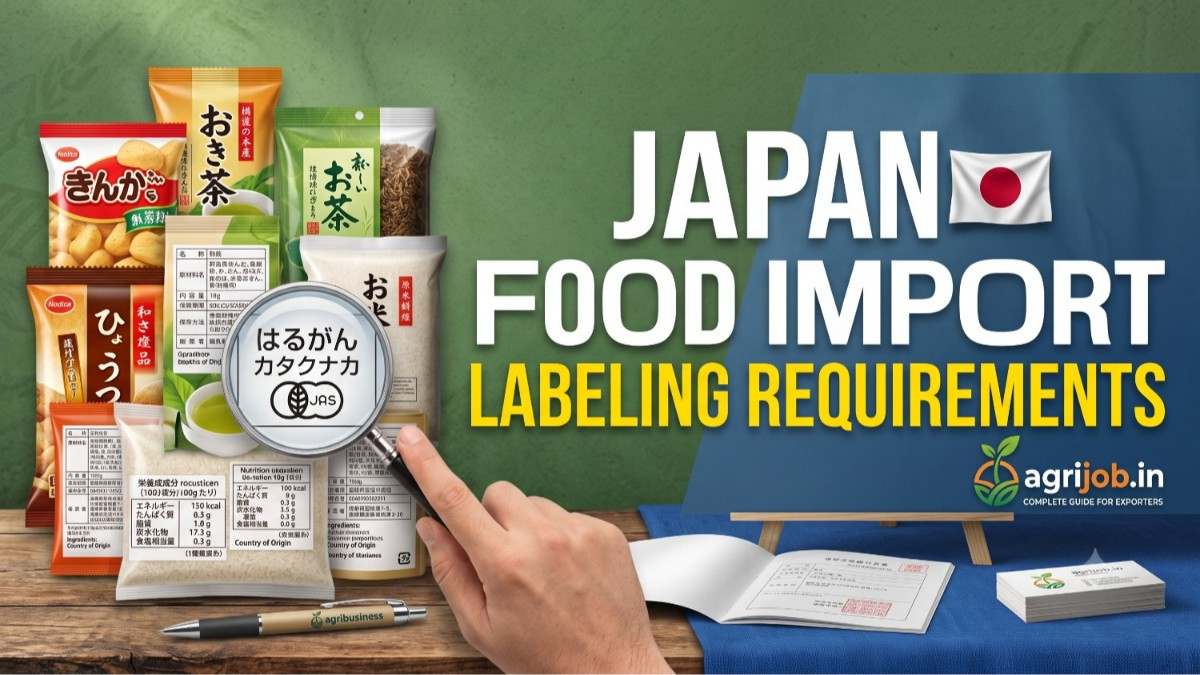
Japan food import labeling requirements 2026 are the combined rules of three laws that every packaged food product must satisfy before it reaches a Japanese shelf. The Food Sanitation Act (administered by the Ministry of Health, Labour and Welfare, or MHLW) sets safety standards and requires an import notification for every consignment. The Food Labeling Act (administered by the Consumer Affairs Agency, or CAA) governs what must physically appear on the package. The Plant Protection Act, enforced by the Ministry of Agriculture, Forestry and Fisheries (MAFF), adds phytosanitary requirements for plant-origin goods like spices, grains, and fresh produce.
These three laws work together, not separately. A shipment of Indian spices, for example, needs a Food Sanitation Act import notification confirming pesticide-residue compliance, a Food Labeling Act-compliant Japanese label, and — for whole or unprocessed plant material — a phytosanitary certificate satisfying MAFF. Missing any one of the three stops the shipment at the quarantine station.

| Law | Regulator | What It Covers |
|---|---|---|
| Food Sanitation Act | MHLW | Safety standards, additive positive list, pesticide MRLs, import notification |
| Food Labeling Act | Consumer Affairs Agency (CAA) | Mandatory label content, allergens, nutrition facts, country of origin |
| Plant Protection Act | MAFF | Phytosanitary certificates for plant-based imports |
| Health Promotion Act | MHLW/CAA | Nutrition Labelling Standards (energy, protein, fat, carbs, salt) |
| JAS Act | MAFF | Organic certification and Japanese Agricultural Standards labeling |
Who Should Use This Guide?
This guide is built for producers and businesses actively preparing food shipments for the Japanese market in 2026:
- 🌶️ Spice and seed-spice exporters who need to clear Japan’s pesticide-residue Positive List System
- 🍵 Tea processors and estates preparing their first Japanese buyer contract
- 🌰 Makhana, snack, and dry-fruit processors targeting Japan’s health-food retail segment
- 🐟 Marine product exporters needing MHLW and MAFF dual clearance
- 🏭 FPOs and APEDA-registered exporters shipping to Japan for the first time
- 🏷️ Private-label food brands that need Japanese-language packaging designed correctly the first time
- 📋 Compliance and quality managers auditing existing Japan-bound SKUs against the April 2026 allergen amendment
- 🤝 Trading houses and freight forwarders advising Indian clients on Japan market entry
Compliance Cost — What Japan Market Entry Really Costs
Japan labeling compliance is a fixed, budgetable cost per SKU — not a recurring tariff. The biggest line items are Japanese-language label translation and design, laboratory testing against Japan’s Positive List pesticide and additive standards, and the appointment of a Japan-based importer of record who files the MHLW notification on your behalf.
| Compliance Item | Typical Market Cost (Indicative) |
|---|---|
| Japanese label translation & design per SKU | Rs.15,000 – Rs.50,000 |
| Pesticide residue + microbiology lab panel per batch | Rs.25,000 – Rs.80,000 |
| APEDA RCMC registration (5-year validity) | As per current APEDA fee schedule — check official portal |
| HACCP / ISO 22000 certification (recommended, not always mandatory) | Rs.1,00,000 – Rs.3,50,000 (one-time, scale-dependent) |
| Japan-based importer-of-record / customs broker fee | Consultant-quoted, varies by product category |
| Cost of a rejected/returned shipment | Full freight + destruction/re-export cost, borne by exporter |
These figures are indicative industry ranges, not official government fees — confirm exact quotes with your translation agency, testing lab, and compliance consultant before budgeting a shipment. The real financial risk isn’t the compliance spend itself; it’s what happens when a shipment fails MHLW inspection. A single violation can trigger enhanced monitoring — inspection rates on your product jump from a routine sample check to as much as 30% of every future consignment until a clean track record is rebuilt.
Eligibility & Documents Required
Any registered Indian exporter can ship food products to Japan, but the paperwork must be complete before the container leaves port. Japan’s Food Sanitation Act also requires the import notification itself to be filed by a Japan-based legal entity — overseas exporters cannot file it directly and need a Japanese importer, agent, or customs broker on the receiving end.
- Import Export Code (IEC) issued by India’s DGFT
- APEDA Registration-cum-Membership Certificate (RCMC)
- FSSAI license confirming Indian food-safety compliance
- GST registration certificate
- Certificate of Origin for the consignment
- Phytosanitary Certificate (mandatory for plant-origin products under MAFF’s Plant Protection Act)
- Certificate of Analysis (CoA) — pesticide residue, moisture, microbiology as applicable
- Japanese-language label file, pre-approved by your Japan-based importer
- MHLW Import Notification Form, filed by your Japan-based importer via FAINS
Category-specific documentation applies on top of this base list. Marine products typically need additional MHLW health certificates, alcoholic beverages need alcohol-content and age-restriction labeling, and organic-claim products need JAS-equivalent certification recognized under Japan’s organic framework.
How the Japan Food Import Process Works — Step by Step
Understanding the sequence prevents the single most common and costly mistake: shipping before the label and notification are both cleared.
- Finalise product formulation and additives against Japan’s Positive List — confirm every additive used is on MHLW’s approved list before manufacturing the export batch.
- Commission pesticide-residue and microbiology testing to verify compliance with Japan’s MRLs or the 0.01 ppm default limit.
- Design the Japanese-language label covering name, ingredients, allergens, additives, net weight, expiry date, storage method, nutrition facts, and country of origin.
- Appoint a Japan-based importer of record who will legally file the import notification and receive the shipment.
- File the Import Notification via FAINS up to 7 days before the vessel or flight’s estimated arrival.
- MHLW conducts document examination at the relevant quarantine station — this is mandatory for every notification.
- Inspection order (if triggered) — high-risk products or first-time exporters may face physical sampling at a bonded warehouse.
- Certificate of Notification issued once the cargo passes — customs clearance can then proceed.
Request pre-shipment sample testing before your first commercial container leaves India. Products verified by an MHLW-recognised or accredited laboratory before export clear Japanese quarantine faster and avoid the cost of a returned shipment on your very first order.
Japan vs EU Food Labeling — Comparison
Exporters who already comply with EU food labeling rules often assume the work transfers directly to Japan. It doesn’t — the allergen count, additive rules, and language requirements diverge in ways that require a separate label build, not just a translation.
| Factor | Japan | European Union |
|---|---|---|
| Mandatory allergens | 8 (incl. cashew from Apr 2026) | 14 |
| Recommended allergens | 21 (total 29 items) | Not applicable — EU list is binding, not tiered |
| Label language | Japanese only | Official language(s) of the member state |
| Additive system | Positive list (MHLW-approved substances only) | Positive list (EU-approved substances only) |
| Pesticide residue default | 0.01 ppm if no MRL set | 0.01 mg/kg if no MRL set |
| Nutrition facts | 5 mandatory items | 7 mandatory items |
| Import filing authority | Japan-based importer only | EU-based importer/responsible business operator |
| Best For | Exporters with a committed Japan-based distributor | Exporters targeting multiple EU member states at once |
Treat Japan as a standalone compliance project, not an EU label with a translation layer. The two markets differ enough on allergens, additives, and filing authority that a Japan-specific label review — ideally by a translator familiar with Food Labeling Act formatting — is the safer, faster route to first clearance.
Pros and Cons of Exporting Food to Japan
Japan’s strict standards are also what make it a durable, high-value market once an exporter clears them.
- Pro: India-Japan CEPA phases out tariffs on roughly 94% of traded goods, improving margins once cleared
- Pro: Japanese buyers reward consistent quality with long-term repeat contracts rather than one-off orders
- Pro: Japan’s health-food and superfood retail segment (makhana, millets, spices) is expanding demand for Indian origin products
- Pro: Compliance investment (label, testing, HACCP) also strengthens readiness for other strict markets like the EU and South Korea
- Con: Japanese-only labeling means every SKU redesign or recipe change triggers a re-translation cost
- Con: First-time exporters face a steeper learning curve than in less regulated markets
- Con: A single non-compliant shipment can trigger enhanced monitoring that slows every subsequent consignment for months
Important Terms Related to Japan Food Labeling
MHLW (Ministry of Health, Labour and Welfare): Japan’s food-safety regulator; receives every import notification under the Food Sanitation Act.
Consumer Affairs Agency (CAA): Administers the Food Labeling Act and publishes Japan’s official labeling standards.
MAFF (Ministry of Agriculture, Forestry and Fisheries): Handles plant and animal quarantine, including phytosanitary certification.
FAINS: The Food Automated Import Notification and Inspection Network System used to file import notifications electronically.
Positive List System: Japan’s rule that only agricultural chemicals with an established Maximum Residue Limit — or below the 0.01 ppm default — may remain in imported food.
RCMC (Registration-cum-Membership Certificate): The APEDA certificate required for Indian exporters of scheduled agricultural products.
Phytosanitary Certificate: A plant-quarantine document confirming a shipment is free of regulated pests, required by MAFF for plant-origin goods.
Country of Origin Labeling (COOL): Japan’s rule requiring the country of manufacture on imported finished products, and — for foods processed in Japan — the origin of the top-weight raw ingredient.
Certificate of Analysis (CoA): A lab report verifying pesticide residue, moisture, and microbiological parameters ahead of export.
Import Notification (Yunyu Todoke-de): The mandatory Article 27 filing without which no food may legally be sold or used commercially in Japan.
Important Dates & Timeline
| Date | What Changes |
|---|---|
| April 1, 2026 | Cabinet Office Ordinance No. 34 takes effect — allergen labeling expands to 29 items; nutritional-fortification additives lose their labeling exemption |
| Up to 7 days before arrival | Window in which the Japan-based importer must file the MHLW Import Notification via FAINS |
| March 31, 2028 | Transition period ends for mandatory cashew allergen labeling |
| March 31, 2030 | Transition period ends for the overhauled individual food-item labeling rules |
Important Links
| Resource | Link |
|---|---|
| MHLW — Import Procedure under the Food Sanitation Act | Official MHLW page |
| Consumer Affairs Agency — Food Labelling | Official CAA page |
| Food Labeling Act — official English translation | Japanese Law Translation portal |
| MHLW — Positive List System introduction | Official MHLW page |
| FAO GLOBEFISH — Japan import notification overview | FAO official page |
| APEDA — official export registration authority (India) | APEDA official portal |
| Agrijob.in — APEDA Registration 2026 Complete Guide | Read the APEDA registration guide |
| Agrijob.in — Makhana Export from India 2026 | Read the Makhana export guide |
| Agrijob.in — Organic Farming Export from India 2026 | Read the organic export guide |
Conclusion
Japan food import labeling requirements 2026 reward exporters who treat compliance as a one-time build, not a recurring scramble: a correctly translated Japanese label, verified additive and pesticide compliance, and a reliable Japan-based importer of record together prevent almost every common rejection. Start the label and lab-testing work before your first commercial order is confirmed, not after. Bookmark this page — we update it whenever MHLW or the Consumer Affairs Agency issues new labeling amendments.
- Every Japan-bound food label must be entirely in Japanese — English-only labels are rejected at customs.
- Allergen labeling expanded to 29 total items on April 1, 2026, including mandatory cashew declaration.
- An MHLW Import Notification under Article 27 of the Food Sanitation Act is mandatory for every commercial shipment.
- A Japan-based importer of record must file the notification — exporters cannot file it directly from India.
- One non-compliant shipment can trigger enhanced monitoring on up to 30% of future consignments.
- Confirm pesticide residues against Japan’s Positive List — or the 0.01 ppm default — before your batch is finalised.
Frequently Asked Questions About Japan Food Import Labeling Requirements 2026
What are Japan’s food import labeling requirements in 2026?
Japan food import labeling requirements 2026 mandate a fully Japanese-language label showing product name, ingredients, additives, allergens, net weight, expiry date, storage method, nutrition facts, country of origin, and the Japan-based importer’s name and address, alongside a separate MHLW import notification before customs clearance.
Is an English-only label enough to export food to Japan?
No. The Food Labeling Act requires all mandatory information to appear in Japanese before the product reaches any consumer. English-only labels are not accepted, even if the product already carries a compliant US or EU label.
How many allergens must be declared on Japanese food labels?
As of the April 1, 2026 amendment, Japan requires declaration of 29 total allergenic items — 8 that are strictly mandatory (including the newly added cashew nut) and 21 that are recommended, including the newly added pistachio.
What documents are needed to import food into Japan from India?
Exporters typically need an IEC code, APEDA RCMC, FSSAI license, GST registration, Certificate of Origin, Phytosanitary Certificate for plant-origin goods, a Certificate of Analysis, a Japanese-language label, and an MHLW import notification filed by a Japan-based importer.
What happens if a food shipment fails Japan’s import inspection?
Non-compliant cargo is denied entry and either returned to the exporter or destroyed, at the importer’s cost. The exporter’s product is also placed under enhanced monitoring, raising the inspection rate on future shipments to as much as 30% until a clean compliance record is re-established.
Which government body regulates food labels in Japan?
The Consumer Affairs Agency (CAA) administers the Food Labeling Act and sets label-content rules, while the Ministry of Health, Labour and Welfare (MHLW) enforces food safety and the mandatory import notification under the Food Sanitation Act.
Do Indian spices need special certification to export to Japan?
Yes. Spices are closely scrutinised under Japan’s Positive List System for pesticide residues, so exporters need a Certificate of Analysis confirming compliance, plus a Phytosanitary Certificate for unprocessed or whole spices under MAFF’s Plant Protection Act.
What is the Positive List System in Japan?
The Positive List System, effective since May 29, 2006, prohibits the sale of food containing pesticide, veterinary drug, or feed-additive residues above their established Maximum Residue Limit — or above a uniform default of 0.01 ppm where no specific limit has been set.
How long does Japan’s food import notification process take?
The MHLW Import Notification can be filed up to 7 days before a shipment’s estimated arrival. Document review is typically completed within a few days, though first-time products or those flagged for an inspection order can take longer while samples are laboratory tested.
Can an Indian exporter file the MHLW import notification directly?
No. The import notification must be filed by a Japan-based legal entity — typically your importer, distributor, or a licensed customs broker — because MHLW requires an in-country party who can be held responsible for the shipment’s compliance.
Last Updated: August 2026. This guide is reviewed and updated regularly as MHLW, the Consumer Affairs Agency, and MAFF issue new labeling and import amendments. Bookmark this page for the latest information.
Disclaimer: This article is for general informational purposes only and does not constitute legal, regulatory, or trade-compliance advice. Food labeling and import rules can change; always verify current requirements with MHLW, the Consumer Affairs Agency, MAFF, APEDA, or a licensed compliance consultant before shipping.