
UPPSC PCS Mains syllabus 2026 covers six General Studies papers, one Essay paper, and one General Hindi paper — a total of 1,500 marks in the written stage. This guide is for UP graduates aged 21–40 who are preparing for the Combined State/Upper Subordinate Services Examination and want a complete, topic-by-topic breakdown of every GS paper. Below you will find the full paper-wise syllabus, the latest exam pattern update (optional subjects now removed), salary details, eligibility criteria, the step-by-step application process, and 10 FAQs — everything needed to plan your preparation without switching tabs.

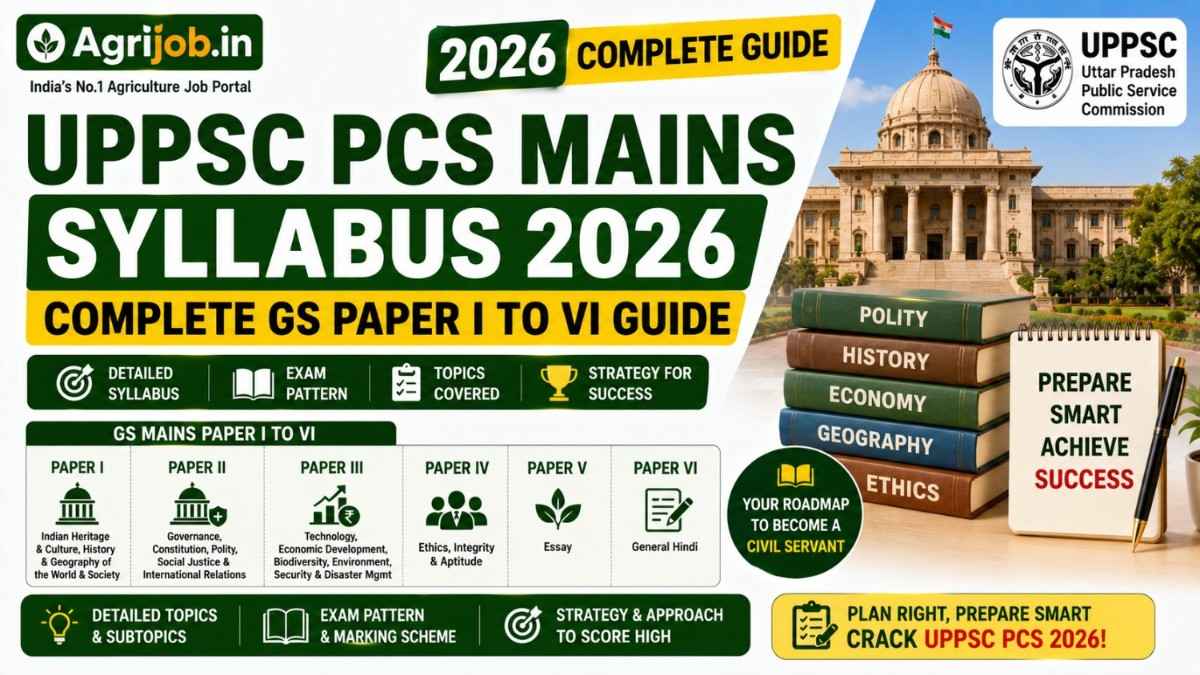
The UPPSC PCS Mains syllabus 2026 comprises 8 compulsory papers: General Hindi (150 marks), Essay (150 marks), and General Studies Papers I through VI (200 marks each), totalling 1,500 marks. Optional subjects have been fully removed since 2023 and replaced by two UP-specific GS papers (V and VI), covering Uttar Pradesh history, governance, economy, and geography.
- Conducting Body: Uttar Pradesh Public Service Commission (UPPSC)
- Exam Name: Combined State/Upper Subordinate Services (PCS) Exam 2026
- Total Mains Papers: 8 (2 qualifying + 6 merit papers)
- Total Mains Marks: 1,500
- Interview Marks: 100
- Final Merit: 1,600 marks (Mains 1,500 + Interview 100)
- Optional Subjects: Completely removed; replaced by GS Paper V & VI
- UPPSC PCS 2026 Vacancies: Approx. 500 posts (Group A & B)
- Apply Online: 25 June – 27 July 2026 at uppsc.up.nic.in
- Prelims 2026 Date: December 6, 2026 (tentative)
- Starting Salary (SDM/DSP): Rs.56,100/month basic + allowances
- In-Hand Monthly Salary: Rs.50,000 – Rs.95,000+ (post-wise)
- Official Website: uppsc.up.nic.in
📋 Table of Contents
- What is UPPSC PCS Mains Exam 2026?
- Who Should Read This Guide?
- UPPSC PCS Salary and Pay Scale 2026
- Eligibility Criteria and Application Fee
- UPPSC PCS Mains Exam Pattern 2026
- GS Paper I – History, Geography and Culture
- GS Paper II – Governance and Polity
- GS Paper III – Economy, Science and Environment
- GS Paper IV – Ethics and Integrity
- GS Paper V – Uttar Pradesh: History, Culture and Governance
- GS Paper VI – UP Economy, Geography and Development
- UPPSC PCS vs UPSC CSE – Key Differences
- Pros and Cons of UPPSC PCS Exam
- Important Terms Related to UPPSC PCS
- How to Apply for UPPSC PCS 2026 – Step-by-Step
- Important Links
- Conclusion
- Key Takeaways
- Frequently Asked Questions
What is UPPSC PCS Mains Exam 2026?
The UPPSC PCS Mains Exam is the second and most decisive stage of the Uttar Pradesh Provincial Civil Services Examination conducted by the Uttar Pradesh Public Service Commission (UPPSC). It is a descriptive (written) examination that determines whether a candidate qualifies for the final Personality Test (Interview) and, ultimately, appointment to Group A and Group B administrative posts in the Uttar Pradesh government — posts like Sub-Divisional Magistrate (SDM), Deputy Superintendent of Police (DSP), and Block Development Officer (BDO).
The Mains exam in 2026 follows an updated 8-paper structure. The biggest structural change, introduced from the 2023 cycle and continuing in 2026, is the complete removal of optional subjects. In their place, two compulsory Uttar Pradesh-specific General Studies papers (GS Paper V and GS Paper VI) have been added. This means all 1,500 Mains marks now come from common compulsory papers, levelling the competition across candidates from different academic streams.

The three-stage selection process is: Prelims (screening) → Mains (1,500 marks) → Interview (100 marks). Only Mains and Interview marks count for the final merit list — Prelims marks are not added to your score.
Who Should Read This Guide?
This complete syllabus guide is specifically designed for the following aspirants:
- 🎓 Fresh Graduates — who have just completed a Bachelor’s degree and are planning to appear in UPPSC PCS 2026 for the first time.
- 🔄 Repeat Aspirants — who appeared in earlier UPPSC cycles and want clarity on the updated 2026 syllabus (especially the removed optional subjects).
- 📚 UPSC Aspirants — who are simultaneously targeting UPSC CSE and want to understand how UPPSC Mains differs in structure and UP-specific content.
- 🏡 Rural UP Candidates — who aim for posts like BDO or District Panchayat Raj Officer and want syllabus clarity for GS Paper V and VI on Uttar Pradesh.
- 👮 Police/Admin Service Aspirants — targeting DSP or Deputy Collector posts and need to map the syllabus to exam-day performance.
- 📅 Working Professionals — currently employed but preparing part-time and need a focused topic list without information overload.
- 🎯 Final-Year Students — who want to start preparing before official notification so they can hit the ground running when the application window opens.
- 📱 Online Coaching Students — who want an offline reference guide complementing their coaching modules for UPPSC.
UPPSC PCS Salary and Pay Scale 2026
The UPPSC PCS salary in 2026 is governed by the 7th Pay Commission. The most sought-after posts — Sub-Divisional Magistrate (SDM) and Deputy Superintendent of Police (DSP) — fall under Pay Level 10 with a starting basic pay of Rs.56,100 per month. Including Dearness Allowance (DA at 50% of basic = Rs.28,050), House Rent Allowance (9–27% depending on city), and Transport Allowance, the gross monthly salary for these top posts ranges from Rs.80,000 to Rs.1,00,000+.
| Post | Pay Level | Basic Pay (Rs./month) | Estimated In-Hand (Rs./month) |
|---|---|---|---|
| Deputy Collector / SDM | Level 10 | Rs.56,100 | Rs.75,000 – Rs.1,00,000 |
| Deputy Superintendent of Police (DSP) | Level 10 | Rs.56,100 | Rs.75,000 – Rs.95,000 |
| Block Development Officer (BDO) | Level 10 | Rs.56,100 | Rs.65,000 – Rs.85,000 |
| Assistant Regional Transport Officer (ARTO) | Level 10 | Rs.56,100 | Rs.65,000 – Rs.80,000 |
| Commercial Tax Officer (CTO) | Level 10 | Rs.56,100 | Rs.65,000 – Rs.80,000 |
| Naib Tehsildar | Level 8 | Rs.47,600 | Rs.55,000 – Rs.70,000 |
| District Basic Education Officer | Level 10 | Rs.56,100 | Rs.65,000 – Rs.80,000 |
| Food Safety Officer | Level 10 | Rs.56,100 | Rs.60,000 – Rs.75,000 |
In addition to basic pay and allowances, UPPSC officers receive NPS pension, official accommodation or HRA, medical benefits, study leave, and — for posts like SDM and DSP — official vehicles, security personnel, and bungalow facilities. Career growth leads from Deputy Collector to Additional District Magistrate (ADM), District Magistrate (DM), and ultimately Commissioner-level posts.
Eligibility Criteria and Application Fee
Candidates must fulfil all eligibility conditions as specified in the official UPPSC PCS 2026 notification available at uppsc.up.nic.in:
- Nationality: Indian citizen
- Educational Qualification: Bachelor’s degree from a recognized university (final-year students may apply; proof required later)
- Age Limit (as of July 1, 2026): Minimum 21 years, Maximum 40 years for General category
- OBC (UP Domicile): Age relaxation of 3 years → upper limit 43 years
- SC/ST (UP Domicile): Age relaxation of 5 years → upper limit 45 years
- PwD Candidates: Additional relaxation as per UP government norms
- UP Domicile: Required for reserved category age relaxation and horizontal reservations
- Number of Attempts: No fixed limit specified; age limit is the effective constraint
| Category | Application Fee (Rs.) |
|---|---|
| General / OBC (from outside UP) | Rs.125 |
| OBC (UP domicile) | Rs.125 |
| SC / ST (UP domicile) | Rs.65 |
| PwD (UP domicile) | Rs.25 |
| Ex-Servicemen (UP domicile) | Rs.25 |
UPPSC PCS Mains Exam Pattern 2026
The UPPSC PCS Mains Exam 2026 is a descriptive examination with 8 papers spread over multiple days. Each paper is 3 hours long. Answers may be written in Hindi or English.
| Paper | Subject | Marks | Nature |
|---|---|---|---|
| Paper I | General Hindi | 150 | Qualifying |
| Paper II | Essay | 150 | Qualifying |
| Paper III | General Studies I (History, Society, Geography) | 200 | Merit |
| Paper IV | General Studies II (Governance, Polity, IR) | 200 | Merit |
| Paper V | General Studies III (Economy, Science, Environment) | 200 | Merit |
| Paper VI | General Studies IV (Ethics and Integrity) | 200 | Merit |
| Paper VII | General Studies V (UP History, Culture, Governance) | 200 | Merit |
| Paper VIII | General Studies VI (UP Economy, Geography, Development) | 200 | Merit |
| Interview | Personality Test | 100 | Merit |
| Total Merit | — | 1,600 | — |
Key Point: General Hindi and Essay are qualifying papers — you must pass them, but their marks are not added to your final merit score. The 6 GS papers (1,200 marks) plus the Interview (100 marks) determine your rank on the final merit list. There is no negative marking in the Mains exam.
GS Paper I – History, Indian Society and Geography (200 Marks)
GS Paper I tests a candidate’s understanding of Indian and world history, social issues, and physical as well as human geography. It covers events from ancient Indian civilization through post-independence consolidation, alongside the physical geography of India and the world, making it one of the broadest papers in the UPPSC Mains syllabus.
- History of Indian Culture: Salient aspects of art forms, literature, and architecture from ancient to modern times
- Modern Indian History (1757–1947): Significant events, personalities, and issues of the colonial period
- The Freedom Struggle: Various stages and important contributors/contributions from all parts of India
- Post-Independence Consolidation (till 1965): Reorganization of states, integration of princely states, key political and social developments
- World History (18th century to mid-20th century): French Revolution 1789, Industrial Revolution, World Wars I and II, redrawing of national boundaries, rise of Socialism, Nazism, and Fascism
- Indian Society and Culture: Salient features, diversity, and social structure of Indian society
- Role of Women: Women in society, women’s organizations, population issues, poverty, urbanization
- Liberalization, Privatization, Globalization (LPG): Their effects on economy, polity, and social structure
- Social Empowerment: Communalism, regionalism, secularism
- World Natural Resources: Distribution of water, soils, forests — South and South-East Asia focus with special reference to India
- Physical Geography: Earthquakes, tsunamis, volcanic activity, cyclones, ocean currents, winds, and glaciers
- Oceanic Resources of India: Exclusive Economic Zone, seabed resources, and their potential
- Human Migration: Refugee problem of the world with focus on India
- Frontiers and Boundaries: Indian sub-continent — geopolitical boundaries and disputes
- Population and Settlements: Types and patterns of settlements, urbanization, Smart Cities and Smart Villages mission
GS Paper II – Governance, Polity and International Relations (200 Marks)
GS Paper II is the Governance and Polity paper — arguably the most scoring paper in UPPSC Mains for aspirants with a good grasp of M. Laxmikanth’s Indian Polity and current affairs. It covers India’s constitutional framework, governance mechanisms, welfare schemes, and international relations.
- Indian Constitution: Historical underpinnings, evolution, features, amendments, significant provisions, basic structure doctrine, Supreme Court’s role in evolving constitutional basics
- Union-State Relations: Federal structure, devolution of powers and finances to local levels, Centre-State challenges
- Finance Commission: Role in Centre-State financial relations
- Separation of Powers: Dispute redressal mechanisms, institutions, and alternative dispute resolution (ADR)
- Comparative Constitutional Analysis: Indian constitutional scheme compared with major democratic countries (USA, UK, France, etc.)
- Parliament and State Legislatures: Structure, functioning, conduct of business, powers, privileges
- Executive and Judiciary: Structure, organization and functioning; ministries and departments; pressure groups and associations; PIL
- Representation of People’s Act: Salient features; appointment to constitutional posts; powers and responsibilities
- Statutory and Regulatory Bodies: NITI Aayog, quasi-judicial bodies — features and functioning
- Government Policies and ICT: Policies for development across sectors; design and implementation challenges; role of ICT
- Development Processes: NGOs, Self Help Groups (SHGs), various groups, donors, charities, institutional stakeholders
- Welfare Schemes: Central and state schemes for vulnerable sections; mechanisms, laws, institutions for protection
- Social Sector: Health, education, and human resource development issues
- Poverty and Hunger: Implications on body politic
- Governance: Transparency, accountability, e-governance applications, citizens charters
- Civil Services: Role in democracy in the context of emerging trends
- India and Neighbours: Bilateral relations with neighbouring countries
- International Groupings: Regional and global groupings affecting India’s interests
- Effect of Developed Country Policies: Impact on India; Indian diaspora issues
- International Institutions: UN agencies, IMF, World Bank, WTO — structure, mandate, functioning
- Current Affairs: Regional, national, and international importance
GS Paper III – Economy, Science, Environment and Security (200 Marks)
GS Paper III is a wide-ranging paper linking India’s economy and agriculture with science, technology, environment, and internal security. Candidates often find this paper demanding because it requires both conceptual clarity (economic planning, NITI Aayog, SDGs) and factual awareness (new technology developments, security challenges).
- Economic Planning: Objectives and achievements of Indian economic planning; role of NITI Aayog; Sustainable Development Goals (SDGs)
- Poverty and Unemployment: Social justice and inclusive growth strategies
- Government Budget: Components of government budgets and the financial system
- Major Crops and Agriculture: Types of crops, irrigation systems, storage, transport, marketing of agricultural produce, e-technology for farmers
- Farm Subsidies and MSP: Direct and indirect farm subsidies, Minimum Support Price (MSP), Public Distribution System (PDS), buffer stocks, food security, technology missions
- Food Processing: Food processing industries — scope, location, upstream/downstream requirements, supply chain management
- Land Reforms: Land reforms in India since independence
- Liberalization and Globalization: Effects on economy, industrial policy changes, and industrial growth
- Infrastructure: Energy, ports, roads, airports, railways
- Science and Technology: Developments and applications in daily life and national security; India’s S&T policy
- Indian S&T Achievements: Indigenization of technology; new technologies; technology transfer; dual-use and critical technologies
- ICT and Space Technology: Computers, energy resources, nano-technology, microbiology, bio-technology; IPR and digital rights
- Environment and Ecosystems: Environmental security, wildlife conservation, biodiversity, pollution and degradation, environmental impact assessment (EIA)
- Disaster Management: Disaster as non-traditional security challenge; mitigation and management
- International Security: Nuclear proliferation, extremism, media and social networking, cyber security basics, money laundering, human trafficking
- Internal Security: Terrorism, corruption, insurgency, organized crime
- Security Forces: Role, kind, and mandate of security forces; higher defence organizations in India
- Agriculture, Horticulture, Forestry, Animal Husbandry: Issues and current challenges
GS Paper IV – Ethics, Integrity and Aptitude (200 Marks)
GS Paper IV on Ethics is one of the most unique papers in UPPSC Mains and is directly relevant to the job profile of a civil servant. It tests a candidate’s ethical values, decision-making capacity, and integrity — not just theoretical knowledge. Case studies form a critical part of this paper, requiring candidates to apply ethical principles to real administrative scenarios.
- Ethics and Human Interface: Essence, determinants, and consequences of ethics in human action; dimensions of ethics; ethics in private and public relationships; human values from lives of great leaders and reformers
- Attitude: Content, structure, function; influence on thought and behaviour; moral and political attitudes; social influence and persuasion
- Aptitude for Civil Service: Integrity, impartiality, non-partisanship, objectivity, dedication to public service, empathy, tolerance, compassion towards the weaker sections
- Emotional Intelligence: Concept and dimensions; utility and application in administration and governance
- Moral Thinkers and Philosophers: Contributions from India (Gandhi, Ambedkar, Vivekananda) and the world (Aristotle, Kant, John Stuart Mill)
- Public/Civil Service Values: Ethical concerns and dilemmas in government and private institutions; laws, rules, and conscience as sources of ethical guidance; accountability and ethical governance
- Probity in Governance: Public service philosophy; information sharing and transparency; Right to Information (RTI); codes of ethics and conduct; citizens charters; work culture; utilization of public funds; corruption challenges
- Case Studies: Practical scenarios testing application of the above principles to administrative dilemmas
GS Paper V – Uttar Pradesh: History, Culture and Governance (200 Marks)
GS Paper V is one of the two UP-specific papers introduced after the removal of optional subjects. This paper alone carries 200 marks — the same as any other GS paper — and focuses entirely on Uttar Pradesh’s history, art, culture, governance, law and order, welfare, and innovation. Many candidates underestimate this paper; strong preparation here gives a significant rank advantage because few dedicated textbooks exist.
- History, Civilization and Culture of UP: Ancient cities (Varanasi, Mathura, Ayodhya, Prayagraj), UP’s historical timeline, civilizational contributions
- Architecture and Heritage of UP: Significance and maintainability; museums, archives, and archaeology in UP
- Freedom Struggle Contributions: UP’s role in pre- and post-1857 freedom struggles; eminent freedom fighters (Mangal Pandey, Chandra Shekhar Azad, Ram Prasad Bismil) and personalities
- Rural, Urban, and Tribal Issues: Social structure, festivals (Kumbh Mela, Diwali), folk dances (Kathak), literature, languages/dialects (Awadhi, Braj, Bhojpuri), social customs
- Political System of UP: Governance, Governor, Chief Minister, Council of Ministers, State Legislative Assembly and Council; Centre-State relations
- Public Services: UP Public Service Commission, Auditing, Advocate General, Allahabad High Court and its jurisdiction
- State Selection Criteria: Official language (Hindi); Consolidated Fund and Contingency Fund; political parties; State Election Commission
- Local Self Government: Urban local bodies; Panchayati Raj institutions; public policy and rights issues in UP
- Good Governance: Eradication of corruption, Lokayukta, Citizens Charters, e-Governance, RTI, Redressal Policy in UP
- Land Reforms in UP: Implementation and impact since independence
- Security Issues in UP: Development-extremism linkage; role of external/state actors in internal security challenges; cyber security; money laundering; security forces and mandate; border area security; organized crime-terrorism links
- Law and Order in UP: Civil Defence mechanisms
- Medical and Health Issues in UP: Healthcare delivery, schemes, and challenges
- State Education System: Structure and challenges of UP’s education system
- UP’s Contribution to India: Economic, cultural, and political significance
- Current Affairs of UP: Ongoing developments, government initiatives, recent news from Uttar Pradesh
- Jal Shakti Mission: Implementation and progress in UP; other central welfare scheme implementation in UP
- NGOs in UP: Issues, contributions, and social impact
- Tourism in UP: Religious tourism (Varanasi, Mathura), heritage tourism, prospects and challenges
- Innovation in UP: Emphasis on innovation; impact on employment and socio-economic development
- Habitat and Ecosystem: Structure, function, flora and fauna with reference to UP
- Science and Technology in UP: Advancements and government efforts
- Agriculture-based Industries in UP: Aquaculture, viticulture, sericulture (silk production), floriculture, horticulture, arboriculture and their development impact
- Public-Private Partnership (PPP): Evolution and role in UP’s development
GS Paper VI – UP Economy, Geography and Development (200 Marks)
GS Paper VI is the second UP-specific paper and covers the state’s economy, geography, development indices, agriculture, natural resources, and environmental issues. Together with GS Paper V, these two papers account for 400 of the 1,500 Mains merit marks — approximately 27% of the total written score — making them the single biggest differentiator in UPPSC Mains rankings.
- Overview of UP Economy: Main features, State Budget highlights, infrastructure and physical resources
- Trade, Commerce and Industries: Key industries, MSME sector, industrial corridors in UP
- UP Government Schemes: Welfare projects, human resource and skill development programmes; One District One Product (ODOP) Policy
- Investment in UP: UP Investors Summit, FDI/investment issues and economic impact
- Public Finance and Fiscal Policy: Tax and economic reforms in UP; ODOP Policy details
- Energy Resources: Planning and management of renewable and non-renewable energy in UP; solar energy, ethanol blending
- Demography of UP: Population trends, Census data, demographic dividend
- Commercialization of Agriculture: Major agricultural crops, cash crop production in UP (sugarcane, wheat, paddy, potato)
- UP Forest Policy: New UP Forest Policy — conservation and commercial forestry
- Agro and Social Forestry: Agroforestry systems in UP; social forestry schemes
- Agricultural Diversity: Problems of UP agriculture and policy solutions
- Developmental Indices of UP: HDI, literacy, per capita income, GSDP, health indicators
- Geography of UP: Geographical location, relief and structure, climate zones, irrigation systems, minerals, drainage (Ganga-Yamuna belt), vegetation
- National Parks and Wildlife Sanctuaries in UP: Dudhwa National Park, Pilibhit Tiger Reserve, Suhelwa Wildlife Sanctuary
- Transport Network of UP: Road, rail, air connectivity; National Highways; Purvanchal Expressway
- Power Resources and Industrial Development: Power sector infrastructure; industrial growth in UP
- Pollution and Environmental Issues: UP Pollution Control Board; Ganga pollution; stubble burning; air quality in major cities
- Natural Resources of UP: Soil (Indo-Gangetic plains alluvial soil), water (rivers, groundwater), air, forests, grasslands, wetlands
- Climate Change Issues in UP: Climate vulnerability, weather forecasting, disaster preparedness
GS Papers V and VI are where most aspirants lose their rank advantage. Since no dedicated textbook covers UP comprehensively, use three sources daily: (1) UP Ek Drishti (published by UP government), (2) Dainik Jagran/Amar Ujala for current affairs specific to UP, and (3) the official UP government portal (up.gov.in) for schemes, projects, and budgets. Candidates who dedicate 1–1.5 hours daily to UP-specific content during their preparation tend to score 20–30 marks higher in these two papers than candidates preparing UP content only in the final month.
UPPSC PCS vs UPSC CSE – Key Differences
Many aspirants prepare simultaneously for UPSC CSE and UPPSC PCS. While the two exams share significant content overlap in GS I–IV, there are critical structural and content differences that every aspirant must understand before making a preparation strategy.
| Dimension | UPPSC PCS Mains 2026 | UPSC CSE Mains 2026 |
|---|---|---|
| Total Merit Papers | 6 GS + 1 Essay = 1,350 marks | 4 GS + 1 Essay + 2 Optional = 1,750 marks |
| Optional Subjects | Completely removed from 2023 | Still present (2 papers × 250 marks each) |
| UP-Specific Papers | 2 papers (GS V and GS VI) = 400 marks | None |
| General Hindi Paper | Compulsory (qualifying) | Not present (Indian language paper instead) |
| Ethics Paper | GS Paper IV = 200 marks | GS Paper IV = 250 marks |
| Interview Marks | 100 marks | 275 marks |
| Posting | Uttar Pradesh state services only | All-India services (IAS, IPS, IFS) |
| Difficulty Level | High (2nd toughest state PSC after TNPSC) | Highest (national level) |
| Best Differentiator | UP-specific content (GS V and VI) | Optional subject + Essay quality |
If you are simultaneously targeting both UPSC and UPPSC, focus 70% of your study time on UPSC-pattern content (GS I–IV) since this content serves both exams. Use the remaining 30% exclusively for GS Papers V and VI — UP-specific topics that only UPPSC demands. The removal of optional subjects from UPPSC makes simultaneous preparation far more practical than it was before 2023. Aspirants with strong UP knowledge and good Hindi essay-writing skills have a significant edge in UPPSC over UPSC-only candidates.
Pros and Cons of UPPSC PCS Exam
Understanding both the advantages and limitations of the UPPSC PCS exam helps candidates make informed decisions about whether to pursue it alongside or instead of UPSC CSE.
Advantages of UPPSC PCS
- ✅ High Salary and Job Security: Starting basic pay of Rs.56,100/month with 7th Pay Commission benefits; NPS pension; complete job security
- ✅ Prestigious Posts: SDM, DSP, BDO, ARTO — real administrative power at the district level from Day 1
- ✅ UPSC Overlap: GS Papers I–IV are almost identical to UPSC CSE, making simultaneous preparation efficient
- ✅ Level Playing Field: Removal of optional subjects eliminates stream advantage; all candidates tested on identical papers
- ✅ State-Level Posting: Service in one’s home state, familiar language, better social connections
- ✅ Additional Perks: Official accommodation, vehicle, government medical facilities, study leave
Disadvantages of UPPSC PCS
- ❌ High Competition: Lakhs of candidates compete for approximately 200–500 vacancies annually
- ❌ No Dedicated Textbooks for GS V and VI: UP-specific papers require self-compiled resources; no single authoritative book covers all topics
- ❌ Slow Notification Cycle: UPPSC PCS notification delays are common; aspirants must plan for multi-year timelines
Important Terms Related to UPPSC PCS Syllabus
- UPPSC (Uttar Pradesh Public Service Commission): The constitutional body under Article 315 of the Indian Constitution that conducts the PCS examination and recommends candidates for Group A and B state services.
- PCS (Provincial Civil Services): The state-level civil service examination that recruits officers for posts like SDM, DSP, BDO, ARTO, and CTO in the UP government.
- CSAT (Civil Services Aptitude Test): GS Paper II in Prelims — a qualifying paper testing reasoning, comprehension, and numeracy. Candidates must score at least 33% (66 marks out of 200) to qualify.
- GS Paper V and VI: The two UP-specific General Studies papers introduced from 2023, replacing optional subjects — together worth 400 of 1,500 Mains merit marks.
- 7th Pay Commission: The latest Central Pay Commission whose recommendations determine the salary structure for UPPSC officers. Basic pay for Grade Pay 5,400 posts (like SDM) is Rs.56,100/month.
- OTR (One Time Registration): The mandatory one-time registration on the UPPSC portal; every aspirant must complete OTR before applying for any UPPSC examination.
- SDM (Sub-Divisional Magistrate): One of the most prestigious entry-level posts in UPPSC PCS; handles revenue administration, law and order, and land record matters at sub-division level.
- DSP (Deputy Superintendent of Police): A gazetted police officer who oversees police circles, crime control, and public order; one of the top-ranked posts in UPPSC PCS.
- BDO (Block Development Officer): Responsible for implementation of central and state government development schemes at the block/tehsil level in rural UP.
- ODOP (One District One Product): UP government’s flagship scheme to promote each district’s unique agricultural or artisanal product — a key topic in GS Paper VI.
How to Apply for UPPSC PCS 2026 – Step-by-Step
The UPPSC PCS 2026 application window is open from 25 June to 27 July 2026 at uppsc.up.nic.in. Follow these steps carefully:
- Complete OTR (One Time Registration): Visit uppsc.up.nic.in and click on “New OTR Registration.” Enter your name, date of birth, mobile number, and email. This OTR number is your permanent UPPSC login ID for all future exams.
- Log in and Select the Examination: Use your OTR credentials to log in. Select “Combined State/Upper Subordinate Services (PCS) Examination 2026” from the available exam list.
- Fill the Application Form: Enter all personal, educational, and contact details accurately. Upload a recent passport-size photograph (JPEG, under 50 KB) and your signature (JPEG, under 30 KB).
- Pay the Application Fee: Pay the prescribed fee online through the portal (Rs.125 for General/OBC; Rs.65 for SC/ST UP; Rs.25 for PwD/Ex-Servicemen). Keep the payment receipt.
- Submit and Print: Review all entered details before final submission. Once submitted, download and print the application confirmation page. Retain it for future reference.
- Prepare the Detailed Application Form (DAF): Before the Mains exam, candidates must fill the DAF — a detailed form about background, preferences, and optional information. Mains interview questions are often based on your DAF, so fill it carefully and honestly.
Important Links
| Link Name | URL |
|---|---|
| UPPSC Official Website | uppsc.up.nic.in |
| UPPSC PCS 2026 Notification PDF | uppsc.up.nic.in (Notifications section) |
| UP Government Official Portal | up.gov.in |
| National Career Service Portal | ncs.gov.in |
| NITI Aayog Official Website | niti.gov.in |
| India.gov.in (Government of India) | india.gov.in |
| UPPSC PCS Salary Details (Agrijob.in) | agrijob.in |
| UPPSC PCS Exam Pattern Guide (Agrijob.in) | agrijob.in |
Conclusion
The UPPSC PCS Mains syllabus 2026 is comprehensive but highly structured — 6 GS papers covering history, governance, economy, ethics, and UP-specific topics, totalling 1,500 marks. The removal of optional subjects from 2023 onwards has made the exam more equitable, and the addition of GS Papers V and VI has made UP-specific preparation non-negotiable. Aspirants who begin early, build a strong NCERT and standard book foundation for GS I–IV, and dedicate consistent daily time to UP content for GS V and VI are best positioned to clear the UPPSC PCS Mains and secure a salary starting at Rs.56,100/month with full government benefits. Bookmark this page — we update it every time UPPSC releases official changes to the syllabus or exam pattern.
- UPPSC PCS Mains 2026 has 8 compulsory papers; 6 GS papers carry merit marks totalling 1,200 marks out of 1,500.
- Optional subjects are completely removed since 2023; GS Papers V and VI (UP-specific) carry 400 marks combined — about 27% of total Mains marks.
- Starting salary for top posts (SDM, DSP) is Rs.56,100/month basic pay under 7th Pay Commission, with in-hand salary reaching Rs.75,000–Rs.1,00,000.
- Age limit is 21–40 years (General); relaxation of 3 years for OBC and 5 years for SC/ST domicile of UP as on July 1, 2026.
- Apply online between 25 June and 27 July 2026 at uppsc.up.nic.in; complete OTR registration before applying.
- UPPSC PCS 2026 notification covers approximately 500 vacancies across Group A and B posts including Deputy Collector, DSP, BDO, and Naib Tehsildar.
Frequently Asked Questions About UPPSC PCS Mains Syllabus 2026
What is the UPPSC PCS Mains syllabus 2026?
The UPPSC PCS Mains syllabus 2026 covers 8 compulsory papers: General Hindi (qualifying, 150 marks), Essay (qualifying, 150 marks), and six General Studies papers (GS I through GS VI, each 200 marks). The 6 GS papers cover history and geography, governance and polity, economy and science, ethics, UP history and culture (GS V), and UP economy and development (GS VI). Optional subjects have been removed since 2023 and replaced by GS Papers V and VI focused exclusively on Uttar Pradesh.
Are optional subjects removed from UPPSC PCS Mains 2026?
Yes, optional subjects are completely removed from the UPPSC PCS Mains examination effective from the 2023 exam cycle, and this continues in 2026. The two optional subject papers (previously 300 marks each) have been replaced by two compulsory UP-specific General Studies papers — GS Paper V (UP History, Art, Culture, Governance) and GS Paper VI (UP Economy, Geography, Development) — each carrying 200 marks. This change was approved by the UP State Cabinet.
How many total marks are there in UPPSC PCS Mains 2026?
The UPPSC PCS Mains 2026 has a total of 1,500 marks across 8 papers. However, the two qualifying papers — General Hindi (150 marks) and Essay (150 marks) — are not counted for the final merit list. The 6 GS papers (6 × 200 = 1,200 marks) are merit papers. Adding the Interview or Personality Test (100 marks), the total final merit score is 1,600 marks, on which the final rank is determined.
What is the salary for UPPSC PCS officer in 2026?
The UPPSC PCS salary in 2026 is based on the 7th Pay Commission. For the most prestigious posts — Sub-Divisional Magistrate (SDM) and Deputy Superintendent of Police (DSP) — the basic pay is Rs.56,100 per month at Pay Level 10. With Dearness Allowance (50%), House Rent Allowance, and Transport Allowance, the estimated monthly in-hand salary ranges from Rs.75,000 to Rs.1,00,000. Additional benefits include NPS pension, official accommodation or HRA, medical facilities, and official vehicle for field postings.
What is the age limit for UPPSC PCS 2026?
The age limit for UPPSC PCS 2026 is a minimum of 21 years and a maximum of 40 years as on July 1, 2026, for General category candidates. OBC candidates with UP domicile get a 3-year relaxation (upper limit 43 years). SC and ST candidates with UP domicile get a 5-year relaxation (upper limit 45 years). PwD candidates receive additional relaxation as per UP government norms. The age limit is counted as of July 1, 2026.
What are GS Paper V and VI in UPPSC PCS Mains?
GS Paper V and GS Paper VI are the two UP-specific compulsory papers introduced in UPPSC PCS Mains from 2023, replacing optional subjects. GS Paper V (200 marks) covers Uttar Pradesh’s history, civilization, culture, architecture, freedom struggle contributions, political system, governance, local self-government, law and order, health, education, NGOs, tourism, and innovation. GS Paper VI (200 marks) covers UP’s economy, geography, demography, agriculture, energy, trade, industrial development, forest policy, natural resources, environment, and climate change. Together they carry 400 marks — 27% of total Mains merit marks.
How many vacancies are there in UPPSC PCS 2026?
The UPPSC PCS 2026 notification released on June 25, 2026 announces approximately 500 vacancies across various Group A and Group B administrative posts in the Uttar Pradesh government, including Deputy Collector (SDM), Deputy Superintendent of Police (DSP), Block Development Officer (BDO), Assistant Regional Transport Officer (ARTO), Commercial Tax Officer, District Basic Education Officer, Food Safety Officer, and Naib Tehsildar. The UPPSC PCS 2025 cycle had 200 vacancies for comparison. Category-wise breakdown will be updated in the official notification PDF at uppsc.up.nic.in.
What is the UPPSC PCS 2026 Prelims exam date?
The UPPSC PCS 2026 Preliminary Examination is tentatively scheduled for December 6, 2026, as per the official UPPSC Exam Calendar 2026 released on January 30, 2026. The Mains exam for the PCS 2025 cycle (previous cycle) was conducted from March 29 to April 1, 2026. Candidates should regularly check the official website uppsc.up.nic.in for any changes to exam dates. The application window for 2026 is open from June 25 to July 27, 2026.
What books should I study for UPPSC PCS Mains 2026?
For UPPSC PCS Mains 2026, the standard book list includes: NCERT books (Class 6–12) for History, Geography, Economics, and Political Science as the foundation; M. Laxmikanth’s Indian Polity for GS Paper II; Ramesh Singh’s Indian Economy for GS Paper III; Nitin Singhania’s Indian Art and Culture for GS Paper I; and Ethics, Integrity and Aptitude by Lexicon or G. Subba Rao for GS Paper IV. For GS Papers V and VI (UP-specific), candidates should use UP Ek Drishti, UP Budget summaries, UP Economic Survey, and daily newspapers like Dainik Jagran and Amar Ujala for current UP developments.
Is UPPSC PCS exam harder than UPSC CSE?
The UPSC CSE is considered harder overall due to its national-level competition (approximately 5 lakh applicants for under 1,000 posts) and the inclusion of an optional subject requiring deep specialization. However, the UPPSC PCS is the second toughest state PSC exam in India with lakhs of aspirants competing for 200–500 posts. The UPPSC Mains is actually longer in total papers (8 papers vs 7 for UPSC merit papers) when you count both UP-specific papers, and the addition of GS Papers V and VI requires significant additional preparation unique to UPPSC — making it genuinely challenging even for well-prepared UPSC aspirants who neglect UP content.
Last Updated: July 2026 | Source: Official UPPSC Notification 2026 (uppsc.up.nic.in) | This guide is reviewed and updated regularly for accuracy. Bookmark this page for the latest UPPSC PCS Mains syllabus and exam pattern changes.
Disclaimer: This article is for informational purposes only. Candidates are advised to verify all details — including vacancy count, exam dates, eligibility, and fee — from the official UPPSC notification at uppsc.up.nic.in before applying. Agrijob.in is not affiliated with UPPSC or the Uttar Pradesh government.