
UPPSC Food Safety Officer Syllabus 2026 has been officially released by the Uttar Pradesh Public Service Commission under the Combined State/Upper Subordinate Services (PCS) Examination 2026. The Preliminary Examination comprises two papers — Paper 1: General Studies (200 marks, 150 questions) and Paper 2: CSAT (200 marks, qualifying at 33%) — and candidates must appear in both to be evaluated. With an online application window open from 25 June to 27 July 2026 and a pay scale of Rs.44,900–Rs.1,42,400 per month (Pay Level-7, 7th CPC), this is one of the most sought-after government job opportunities for science graduates in Uttar Pradesh this year.

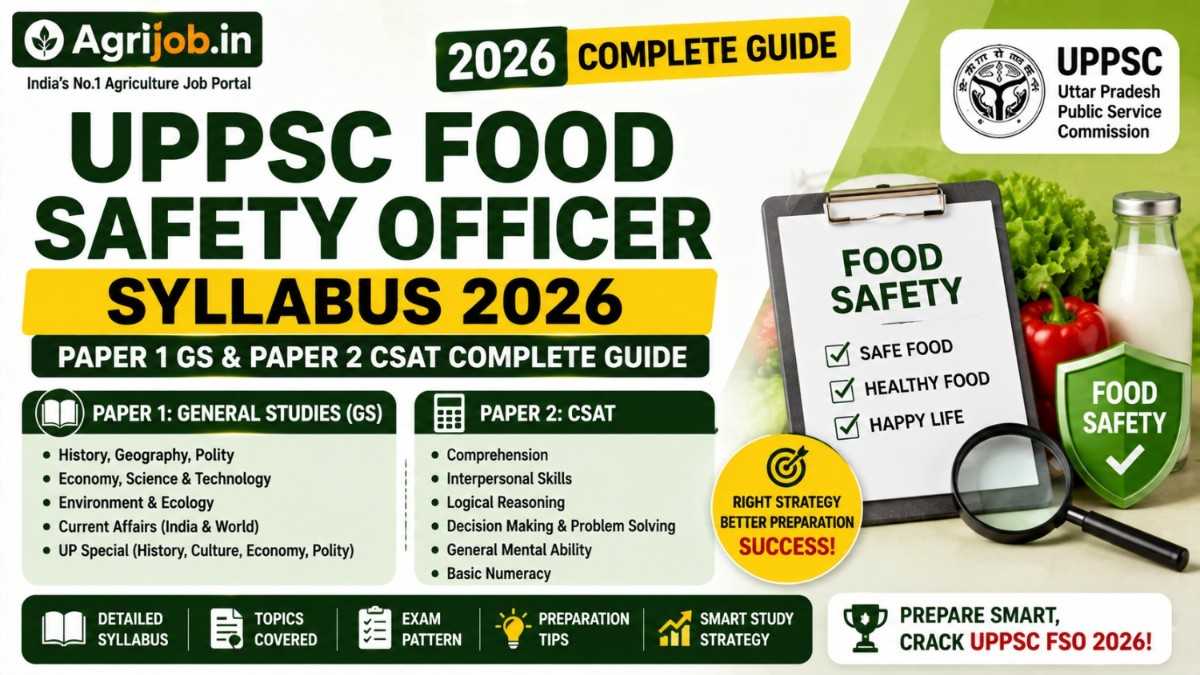
The UPPSC Food Safety Officer Syllabus 2026 covers Paper 1 (General Studies — History, Geography, Polity, Economy, Environment, and Science for 200 marks across 150 questions) and Paper 2 (CSAT — Reasoning, Aptitude, Comprehension, Hindi, English, and Maths for 200 marks, qualifying at 33%). Only Paper 1 marks count in the Prelims merit list.
- Conducting Body: Uttar Pradesh Public Service Commission (UPPSC)
- Post Name: Food Safety Officer (FSO)
- Advertisement No.: A-1/E-1/2026
- Application Dates: 25 June – 27 July 2026
- Correction Window: Up to 3 August 2026
- Paper 1 (GS): 200 marks | 150 questions | 2 hours | Merit-determining
- Paper 2 (CSAT): 200 marks | 100 questions | 2 hours | Qualifying (33% required)
- Negative Marking: -0.33 marks per wrong answer (both papers)
- Pay Scale: Rs.44,900 – Rs.1,42,400/month (Pay Level-7, 7th CPC)
- In-Hand Salary: Approx. Rs.60,000 – Rs.70,000/month
- Age Limit: 21–40 years (as on 1 July 2026)
- Application Fee: Rs.125 (General/OBC/EWS) | Rs.65 (SC/ST) | Rs.25 (PwD)
- Official Website: uppsc.up.nic.in
- What Is UPPSC FSO Syllabus 2026?
- Who Should Read This Guide?
- UPPSC FSO Salary and Pay Scale 2026
- Eligibility Criteria and Application Fee
- UPPSC FSO Exam Pattern 2026 — Step by Step
- Paper 1 Syllabus — General Studies (GS)
- Paper 2 Syllabus — CSAT (Qualifying)
- Main Exam: Food Science Technical Syllabus
- Paper 1 GS vs Paper 2 CSAT — Key Differences
- Pros and Cons of UPPSC FSO as a Career
- Important Terms Related to UPPSC FSO 2026
- Important Dates and Timeline
- Important Links
- Conclusion
- Key Takeaways
- Frequently Asked Questions
What Is the UPPSC Food Safety Officer Syllabus 2026?
The UPPSC Food Safety Officer Syllabus 2026 is the official topic list prescribed by the Uttar Pradesh Public Service Commission for selecting candidates for the post of Food Safety Officer under the Food Safety and Drug Administration Department, Government of Uttar Pradesh. The preliminary examination is divided into two papers — General Studies (Paper 1) and CSAT (Paper 2) — both objective-type OMR-based, each carrying 200 marks over two hours. Paper 1 determines the Prelims merit rank, while Paper 2 is purely qualifying with a minimum threshold of 33% (66 marks out of 200). Candidates must appear in both papers without exception.
The Mains examination tests deep technical knowledge of Food Science and Technology across 11 subject areas including Food Chemistry, Food Microbiology, Dairy Technology, and Food Laws. Understanding both stages of the UPPSC FSO Syllabus 2026 is essential before beginning preparation, as the content, difficulty, and strategy for each stage are completely different.

Who Should Read This UPPSC FSO Syllabus Guide?
- 🎓 Agriculture, Food Technology, and Biotechnology graduates planning to apply for the UPPSC FSO 2026 recruitment before 27 July 2026
- 🔬 Microbiology, Biochemistry, and Dairy Technology graduates checking whether their degree qualifies them for this post
- 🏛️ PCS aspirants and government job seekers in Uttar Pradesh targeting Group A and Group B posts under UPPSC PCS 2026
- 📚 UPPSC FSO first-time exam takers who need a clear, topic-wise syllabus breakdown before beginning their study plan
- 🔄 Candidates who appeared in previous UPPSC FSO cycles and want to check what has changed in the 2026 syllabus and exam pattern
- 👩⚕️ MBBS graduates and Chemistry postgraduates verifying their eligibility and preparing the GS component of the exam
- 📝 CSAT beginners who want to understand the qualifying paper structure, difficulty level, and scoring strategy
- 💼 Working professionals in food safety, FSSAI, and food processing industries looking to transition into a permanent government role
UPPSC Food Safety Officer Salary and Pay Scale 2026
The UPPSC FSO 2026 salary is governed by Pay Level-7 of the 7th Central Pay Commission (7th CPC), offering one of the most competitive entry-level pay scales available in Uttar Pradesh state government services. The starting basic pay of Rs.44,900 per month, combined with allowances, results in an attractive monthly take-home package for selected candidates.
| Salary Component | Amount (Approx.) |
|---|---|
| Pay Level | Level-7 (7th CPC) |
| Pay Scale | Rs.44,900 – Rs.1,42,400 per month |
| Starting Basic Pay | Rs.44,900 per month |
| Dearness Allowance (DA) | Approx. 46–50% of Basic Pay |
| House Rent Allowance (HRA) | City-based (X/Y/Z classification) |
| Transport Allowance (TA) | As per UP Govt. rules |
| Estimated In-Hand Salary | Rs.60,000 – Rs.75,878 per month |
| Approximate Annual CTC | Rs.9–10 lakh per year |
| Pension | NPS (National Pension System) |
| Medical Benefits | Covered under UP Govt. scheme |
Beyond the monthly salary, selected FSOs receive annual increments and are eligible for departmental promotions to senior officer positions within the Food Safety and Drug Administration Department, Uttar Pradesh. The FSO role also comes with job security, pension, and medical coverage — benefits rarely matched by private-sector food safety roles.
UPPSC FSO 2026 Eligibility Criteria and Application Fee
Candidates must hold a Bachelor’s degree in one of the qualifying disciplines from a recognised university to apply for UPPSC Food Safety Officer Recruitment 2026. Age must be between 21 and 40 years as on 1 July 2026. The qualifying educational disciplines include:
- Bachelor’s Degree in Food Technology (including Food Engineering, Food Processing, Food Safety and Quality Management, etc.)
- Bachelor’s Degree in Dairy Technology
- Bachelor’s Degree in Biotechnology
- Bachelor’s Degree in Oil Technology
- Bachelor’s Degree in Agricultural Science (including Agriculture, Horticulture, Fisheries, Food Nutrition and Dietetics)
- Bachelor’s Degree in Veterinary Sciences
- Bachelor’s Degree in Biochemistry
- Bachelor’s Degree in Microbiology
- Post Graduate Degree in Chemistry
- Degree in Medicine (MBBS or equivalent)
- Any equivalent qualification recognised by the Central Government
Important Note: A person having any financial interest in the manufacture, import, or sale of any food article shall not be appointed as a Food Safety Officer as per the relevant FSSAI regulations.
| Category | Age Relaxation | Application Fee |
|---|---|---|
| General / OBC / EWS | No relaxation | Rs.125 |
| SC / ST (UP) | 5 years (up to 45 years) | Rs.65 |
| OBC (UP) | 5 years (up to 45 years) | Rs.125 |
| Persons with Disabilities (PwD) | 15 years | Rs.25 |
| Ex-Servicemen | 3 years + service period | Rs.65 |
| Skilled Players (UP) | 5 years | As per category |
| CM Fellowship Research Scholars | Up to 3 years | As per category |
UPPSC FSO 2026 Exam Pattern — Step-by-Step Selection Process
The UPPSC Food Safety Officer 2026 selection follows a five-stage process. Understanding the complete exam pattern before starting preparation ensures that candidates allocate time correctly across Prelims, Mains, and the Interview stage.
- Preliminary Examination (Objective-Type, OMR): Two papers on the same day — Paper 1 (General Studies, merit-based) and Paper 2 (CSAT, qualifying). Candidates must appear in both. Only Paper 1 marks count in the Prelims merit list.
- Main Written Examination (Conventional): Eight compulsory subjects including General Hindi, Essay, and six General Studies papers. Total marks: 1,500. Technical subjects in Food Science feature prominently here.
- Interview / Viva-Voce (Personality Test): 100 marks. Tests general awareness, personality, communication, and suitability for government service.
- Document Verification: Original certificates for age, category, educational qualification, and domicile are verified after the interview.
- Medical Examination: Final fitness check before issuance of appointment order.
| Paper | Subject | Questions | Marks | Duration | Nature |
|---|---|---|---|---|---|
| Paper 1 | General Studies (GS) | 150 | 200 | 2 hours (9:30–11:30 AM) | Merit-determining |
| Paper 2 | CSAT (Aptitude) | 100 | 200 | 2 hours (2:30–4:30 PM) | Qualifying (min. 33%) |
Never ignore Paper 2 (CSAT) thinking it is “just qualifying.” Every year, a significant number of well-prepared GS aspirants fail to clear the 33% threshold (66 marks out of 200) in CSAT and are disqualified despite scoring high in Paper 1. Devote at least 30–45 minutes of daily practice to Reasoning and Class X Maths from Day 1 of your preparation.
UPPSC FSO Paper 1 Syllabus 2026 — General Studies (GS)
Paper 1 of the UPPSC FSO Prelims is the merit-determining paper. All 150 questions carry equal marks within a 200-mark total, and there is a negative marking of -0.33 marks per wrong answer. Candidates are expected to have general awareness of all topics with special reference to Uttar Pradesh. The seven major subject areas are:
| Subject Area | Key Topics | Approx. Weightage |
|---|---|---|
| Current Events (National and International) | Government schemes, international summits, appointments, awards, sports, economic policy announcements, UP-specific current affairs | 15–20% |
| History of India and Indian National Movement | Ancient, Medieval, and Modern Indian History; social, economic, and political aspects; nature and character of the freedom movement; growth of nationalism; attainment of Independence | 12–15% |
| India and World Geography | Physical, Social, and Economic Geography of India and the World; UP geography (rivers, agriculture, districts, climate); world physical features | 12–15% |
| Indian Polity and Governance | Indian Constitution; political system; Panchayati Raj; community development; public policy; rights issues; UP political structure and governance | 10–12% |
| Economic and Social Development | Sustainable development; poverty and inclusion; demographics; social sector initiatives; problems of population, environment, and urbanisation in India and UP | 10–12% |
| Environmental Ecology, Biodiversity, and Climate Change | General awareness of environmental issues; biodiversity hotspots; climate change conventions and agreements; national parks and wildlife sanctuaries in UP | 8–10% |
| General Science | Physics, Chemistry, Biology, and Science in everyday life (Class X to XII standard); questions based on observation and experience of a well-educated person | 15–20% |
Special Note on Uttar Pradesh Focus: The official syllabus explicitly states that candidates are expected to have general awareness about all the above subjects with special reference to Uttar Pradesh. UP-specific questions on agriculture, history, rivers (Ganga, Yamuna, Ghaghra), culture, political structure, and government schemes regularly appear in the UPPSC Prelims Paper 1.
UPPSC FSO Paper 2 Syllabus 2026 — CSAT (Qualifying Paper)
Paper 2 (CSAT) is a 200-mark qualifying paper with 100 objective-type questions over two hours. Candidates must score at least 33% (66 marks) to have their Paper 1 evaluated. CSAT marks are NOT added to the Prelims merit list — but failing CSAT means automatic disqualification regardless of Paper 1 performance. The detailed topic-wise syllabus is as follows:
| Section | Topics Covered | Approx. Questions |
|---|---|---|
| Comprehension | Reading passages in Hindi and English; inference, vocabulary, and analytical understanding | 10–15 |
| Interpersonal Skills and Communication | Decision-making in interpersonal situations; ethical dilemmas; team and communication scenarios | 7–10 |
| Logical Reasoning and Analytical Ability | Series (number, letter, word); analogies; coding-decoding; blood relations; directions; Venn diagrams; syllogisms; puzzles; seating arrangements | 25–35 |
| Decision Making and Problem Solving | Administrative decision-making; problem-solving scenarios; data-based conclusions | 5–8 |
| General Mental Ability | Pattern recognition; classification; odd-one-out; spatial reasoning | 8–12 |
| Elementary Mathematics (Up to Class X) | Number Systems; Average; Ratio and Proportion; Percentage; Profit and Loss; Simple and Compound Interest; Work and Time; Speed, Time and Distance; Algebra (Polynomials, LCM/HCF, Quadratic Equations, Set Theory); Geometry (Triangles, Circles, Perimeter, Area, Volume); Statistics (Mean, Median, Mode; Bar Diagram, Pie Chart, Histogram) | 15–20 |
| General English (Up to Class X) | Comprehension; Active/Passive Voice; Parts of Speech; Sentence Transformation; Direct/Indirect Speech; Punctuation; Spellings; Vocabulary; Idioms and Phrases; Fill in the Blanks | 10–13 |
| General Hindi (Up to Class X / Highschool Level) | Hindi Varnmala; Viram Chinh; Shabd Rachna; Vakya Rachna; Sandhi and Samaas; Anekarthi Shabd; Vilom Shabd; Paryayvachi Shabd; Muhavare and Lokoktiyan; Tatsam-Tadbhav; Vartani; UP ki Pramukh Boliyan | 13–15 |
Qualifying Target Strategy: To comfortably cross the 33% barrier (66 marks out of 200), focus on Reasoning (the highest-weightage section with 25–35 questions), General Hindi Grammar (13–15 questions), and English Grammar (10–13 questions). These three sections together carry 50–63 questions and are significantly more predictable than Maths. With 43–50 correct answers across these sections alone, qualifying becomes straightforward.
Main Examination: Food Science Technical Syllabus 2026
Candidates who clear the Prelims are called for the UPPSC FSO Main Examination, which tests advanced technical knowledge in Food Science and Technology across eight conventional papers (General Hindi, Essay, and six GS papers). The technical subject coverage in the Mains includes:
| Technical Subject | Key Topics in UPPSC FSO Mains |
|---|---|
| Food Chemistry | Water, Carbohydrates, Proteins, Lipids, Vitamins, Minerals; Enzyme Kinetics; Metabolic Pathways; Digestion and Absorption; Single Cell Protein (SCP) |
| Food Microbiology | Classification of Microorganisms; Growth and Nutrition; Food Poisoning; Foodborne Diseases; Food Toxins; Food Fermentation; Food Plant Sanitation |
| Food Nutrition | Balanced Diet; Recommended Dietary Allowances (RDA); Energy Value of Foods; Basal Metabolism; Protein Quality |
| Fruits and Vegetable Technology | Juices, Puree, Ketchup, Sauce, Soup; Jams, Jellies, Preserves; Candies; Beverages |
| Oils and Fats Technology | Oil Milling; Solvent Extraction; Vegetable Oil Refining; Hydrogenation; Adulteration; Rancidity; Quality Parameters |
| Dairy Technology | Milk Processing; Pasteurisation; Milk Products — Cheese, Butter, Ghee, Ice Cream, Milk Powders |
| Meat, Fish and Egg Technology | Meat Processing; Fish and Poultry Processing; Egg Products; Slaughtering and Preservation |
| Food Preservation | Drying; Dehydration; Radiation; Chemical Preservation; High-Pressure Processing; Hurdle Technology |
| Cereals and Bakery Technology | Rice Processing; Wheat Milling; Flour Quality; Bread, Biscuits, Cakes; Breakfast Cereals |
| Beverages and Plantation Products | Tea Processing; Coffee Processing; Cocoa; Chocolate and Confectionery |
| Food Laws and Regulations | FSSAI Act 2006; Food Safety and Standards Act; Food Adulteration Laws; CODEX Alimentarius; General Knowledge of Indian Polity, Economy, and Science |
UPPSC FSO Paper 1 (GS) vs Paper 2 (CSAT) — Key Differences
| Parameter | Paper 1 — General Studies | Paper 2 — CSAT |
|---|---|---|
| Total Marks | 200 | 200 |
| Number of Questions | 150 | 100 |
| Marks Per Question | 1.33 marks | 2 marks |
| Duration | 2 hours (Morning shift) | 2 hours (Afternoon shift) |
| Nature | Merit-determining | Qualifying only |
| Minimum Required Marks | 40% (General) / 35% (SC/ST) | 33% (All categories) |
| Counts in Merit List? | Yes — only this paper determines Prelims rank | No — marks not added to merit list |
| Subject Focus | GK, History, Geography, Polity, Economy, Science, Environment | Reasoning, Aptitude, Maths, Comprehension, Hindi, English |
| Difficulty Level | Moderate to High | Class X to XII standard (Moderate) |
| Special Reference | Uttar Pradesh-specific questions expected | No UP-specific focus; general aptitude |
| Preparation Time Required | 8–12 months (extensive) | 2–3 months (strategic) |
For most science graduates appearing for UPPSC FSO 2026, Paper 1 (General Studies) demands the majority of preparation time — particularly UP History, UP Geography, and Current Affairs. Paper 2 (CSAT) requires consistent practice for Reasoning and Class X Maths but is very manageable within 2–3 months of focused effort. We recommend a 70:30 time split between GS (Paper 1) and CSAT (Paper 2) during the Prelims preparation phase. Technical Food Science topics should be reserved for Mains preparation after Prelims results.
Pros and Cons of Appearing for UPPSC FSO 2026
Here is an honest evaluation of the UPPSC Food Safety Officer 2026 opportunity to help you make an informed decision before investing 6–12 months of preparation time.
| ✅ Advantages | ❌ Disadvantages |
|---|---|
| Pay Level-7 salary of Rs.44,900–Rs.1,42,400/month — among the highest in state-level food safety recruitment | Extremely competitive — lakhs of applicants for limited FSO vacancies under UPPSC PCS 2026 |
| Permanent government job with strong job security and NPS pension benefits | Long selection timeline — Prelims, Mains, Interview, Document Verification, Medical can take 12–24 months |
| Wide eligibility — 11 different degree streams qualify, including Agriculture, Microbiology, MBBS, and Chemistry PG | Technical Mains syllabus is vast — Food Chemistry, Microbiology, Dairy Technology, and Food Laws all require deep preparation |
| CSAT Paper 2 is qualifying only (33%), making it accessible to non-STEM candidates | Negative marking (-0.33 per wrong answer) in both papers penalises guessing |
| Career growth path leads to senior officer positions in FSSAI and UP Food Safety Department | Age limit of 40 years (21–40) restricts mid-career professionals from applying |
| Socially impactful role — FSOs directly protect public health by enforcing FSSAI food standards across UP | Posting in remote districts of Uttar Pradesh is possible, which may not suit all candidates |
Important Terms Related to UPPSC Food Safety Officer 2026
Understanding these high-value terms will help both in your exam preparation and in performing well in the Viva-Voce stage:
- FSSAI (Food Safety and Standards Authority of India): The apex regulatory body under the Ministry of Health and Family Welfare that governs food standards, licensing, and enforcement in India under the Food Safety and Standards Act, 2006.
- CSAT (Civil Services Aptitude Test): The qualifying Paper 2 of the UPPSC Prelims that tests reasoning, aptitude, and language comprehension; minimum qualifying score is 33% (66/200).
- 7th CPC Pay Level-7: The pay matrix level applicable to the UPPSC FSO post, with a starting basic pay of Rs.44,900 and maximum of Rs.1,42,400 per month.
- Negative Marking (-0.33): One-third of a mark is deducted for every wrong answer in the Prelims; a wrong answer on a 1.33-mark question loses 0.33 marks.
- OTR (One-Time Registration): The mandatory pre-registration process on the UPPSC portal that every candidate must complete before filling the online application form.
- HurTechnology: A food preservation technique that combines multiple mild preservation methods simultaneously to create safe, minimally processed food products — a key topic in the FSO technical syllabus.
- CODEX Alimentarius: The international food standards body established by FAO and WHO that sets global standards for food safety, quality, and trade — referenced in UPPSC FSO Mains Food Laws syllabus.
- RDA (Recommended Dietary Allowances): Nutritional intake standards set by the Indian Council of Medical Research (ICMR) for different age groups and genders — a core Food Nutrition topic in the Mains.
- Combined State/Upper Subordinate Services (PCS): The umbrella UPPSC examination that covers multiple Group A and Group B posts including Deputy Collector, DSP, BDO, and Food Safety Officer.
- Pasteurisation: A heat treatment process for milk and beverages that destroys harmful pathogens without significantly altering flavour or nutritional quality — a fundamental Dairy Technology topic for the Mains.
UPPSC FSO 2026 Important Dates and Timeline
| Event | Date |
|---|---|
| Notification Release Date | 25 June 2026 |
| Online Application Start Date | 25 June 2026 |
| Last Date to Submit Application | 27 July 2026 |
| Last Date for Application Fee Payment | 27 July 2026 |
| Correction / Modification Window Closes | 3 August 2026 |
| Admit Card Release | To be Announced |
| Preliminary Examination Date | To be Announced |
| Prelims Result and Mains Shortlist | To be Announced |
| Main Written Examination | To be Announced |
| Interview / Viva-Voce | To be Announced |
Important Links — UPPSC FSO 2026
| Link Name | URL |
|---|---|
| UPPSC Official Website | uppsc.up.nic.in |
| UPPSC FSO 2026 Apply Online | UPPSC Online Application Portal |
| FSSAI Official Website (Food Laws Reference) | fssai.gov.in |
| UP Government Official Portal | up.gov.in |
| UPPSC FSO Recruitment 2026 — Agrijob.in | UPPSC FSO Recruitment 2026 Complete Guide |
| Government Jobs in UP — Agrijob.in | Latest Govt Jobs in Agriculture and Food Sector |
Conclusion — Final Thoughts on UPPSC FSO Syllabus 2026
The UPPSC Food Safety Officer Syllabus 2026 is structured across two clearly defined Prelims papers: Paper 1 (General Studies — merit-based, 150 questions for 200 marks) and Paper 2 (CSAT — qualifying only, 100 questions for 200 marks at 33% minimum). Candidates with a science or agriculture background who prepare systematically across both stages can realistically crack the Prelims and progress to the Main Examination, which then tests deep technical knowledge in Food Science and Technology. With an in-hand salary of approximately Rs.60,000–Rs.75,000 per month and strong government job security, the UPPSC FSO 2026 is one of the best career opportunities available in Uttar Pradesh this year. Apply online before 27 July 2026 on the official UPPSC portal and bookmark this page — we update it every time official dates or syllabus changes are announced.
- UPPSC FSO 2026 Prelims has 2 papers — Paper 1 (GS, 150 Qs, 200 marks) determines merit; Paper 2 (CSAT, 100 Qs, 200 marks) is qualifying at 33% (66 marks minimum).
- Pay Level-7 salary starts at Rs.44,900/month; estimated in-hand salary is Rs.60,000–Rs.75,878/month after allowances.
- 11 degree streams are eligible — including Food Technology, Agriculture, Biotechnology, Microbiology, Biochemistry, Veterinary Sciences, Medicine, and Chemistry PG.
- Negative marking of -0.33 per wrong answer applies in both papers — avoid random guessing in Paper 1 especially, as each question carries 1.33 marks.
- Apply online at uppsc.up.nic.in before the last date of 27 July 2026; complete OTR registration first before submitting the application form.
Frequently Asked Questions About UPPSC Food Safety Officer Syllabus 2026
What is the UPPSC Food Safety Officer Syllabus 2026 for Paper 1?
The UPPSC FSO Paper 1 (General Studies) syllabus for 2026 covers seven major areas: Current Events of National and International Importance, History of India and Indian National Movement, India and World Geography, Indian Polity and Governance, Economic and Social Development, Environmental Ecology and Biodiversity, and General Science. The paper carries 200 marks for 150 objective-type questions and has a special focus on Uttar Pradesh in each topic area. Only Paper 1 marks count in the Prelims merit list.
Is Paper 2 CSAT qualifying or merit-based in UPPSC FSO 2026?
Paper 2 (CSAT) in the UPPSC FSO 2026 Prelims is purely qualifying in nature. Candidates must score a minimum of 33% marks — that is, 66 marks out of 200 — to have their Paper 1 evaluated. CSAT marks are not added to the merit list at any stage. However, failing to score 66 marks in CSAT results in automatic disqualification, regardless of how well a candidate scores in Paper 1.
What is the negative marking scheme in UPPSC FSO 2026 Prelims?
There is a negative marking of one-third (0.33) marks for every incorrect answer in both papers of the UPPSC FSO 2026 Preliminary Examination. In Paper 1, since each question carries approximately 1.33 marks (200 marks ÷ 150 questions), an incorrect answer results in a deduction of 0.33 marks from the total score. Candidates should attempt questions only when they have reasonable confidence in the answer, and avoid random guessing to protect their Paper 1 score.
What is the salary of a UPPSC Food Safety Officer in 2026?
The UPPSC Food Safety Officer salary in 2026 is governed by Pay Level-7 of the 7th Central Pay Commission. The official pay scale is Rs.44,900–Rs.1,42,400 per month, with a starting basic pay of Rs.44,900. After adding Dearness Allowance (DA), House Rent Allowance (HRA), and Transport Allowance (TA), the estimated in-hand salary ranges from Rs.60,000 to Rs.75,878 per month, translating to approximately Rs.9–10 lakh per year.
Which degree is required for UPPSC FSO 2026?
Candidates must hold a Bachelor’s degree in Food Technology, Dairy Technology, Biotechnology, Oil Technology, Agricultural Science, Veterinary Sciences, Biochemistry, or Microbiology, or a Post Graduate degree in Chemistry, or a Degree in Medicine (MBBS) from a recognised university. Any equivalent qualification recognised by the Central Government also qualifies. Candidates with interests in the manufacture, import, or sale of food articles are ineligible for appointment as FSO under FSSAI rules.
What is the age limit for UPPSC Food Safety Officer 2026?
The age limit for UPPSC FSO 2026 is 21 to 40 years as on 1 July 2026. This means candidates must have been born not earlier than 2 July 1986 and not later than 1 July 2005. SC/ST and OBC candidates from Uttar Pradesh receive a relaxation of 5 years (maximum age up to 45 years). Persons with Disabilities (PwD) receive a relaxation of 15 years. Ex-servicemen are entitled to 3 years plus the actual service period rendered.
What is the application fee for UPPSC FSO Recruitment 2026?
The application fee for UPPSC Food Safety Officer Recruitment 2026 is Rs.125 for General, OBC, and EWS category candidates. SC/ST candidates pay Rs.65, while Persons with Disabilities (PwD) candidates pay Rs.25. Ex-servicemen are charged Rs.65. The fee can be paid online via Debit Card, Credit Card, Net Banking, IMPS, or Mobile Wallet. The last date for fee payment is 27 July 2026.
How many papers are there in the UPPSC FSO Mains 2026?
The UPPSC FSO Mains 2026 consists of 8 compulsory papers, all of conventional (descriptive) type with a duration of 3 hours each. These are: General Hindi (150 marks), Essay (150 marks), and six General Studies papers (200 marks each), covering technical food science subjects. The total marks for the Mains are 1,500. Candidates must obtain the minimum qualifying marks in General Hindi as determined by the UP Government or the Commission.
How should I prepare for UPPSC FSO CSAT Paper 2 in 2026?
To clear the UPPSC FSO CSAT 2026 comfortably, focus your preparation on three high-weightage sections: Logical Reasoning (25–35 questions), General Hindi Grammar (13–15 questions), and General English Grammar (10–13 questions). Together, these three sections offer 50–63 questions and are more predictable and formulaic than the Mathematics section. Aim to score 43–50 correct answers across these sections to safely surpass the 66-mark qualifying threshold. Dedicate 30–45 minutes of daily practice to Reasoning and devote 2–3 months overall to CSAT preparation alongside your GS study plan.
What are the topics in the UPPSC FSO technical syllabus for Mains?
The UPPSC FSO Mains technical syllabus covers 11 food science subject areas: Food Chemistry (carbohydrates, proteins, lipids, vitamins, enzymes), Food Microbiology (foodborne diseases, fermentation, sanitation), Food Nutrition (RDA, balanced diet, basal metabolism), Fruits and Vegetable Technology (jams, jellies, beverages), Oils and Fats Technology (refining, hydrogenation, adulteration), Dairy Technology (pasteurisation, milk products), Meat, Fish and Egg Technology, Food Preservation (dehydration, radiation, hurdle technology), Cereals and Bakery Technology, Beverages and Plantation Products (tea, coffee, cocoa), and Food Laws and Regulations (FSSAI Act 2006, CODEX Alimentarius).
Last Updated: July 2026. This guide is reviewed and updated regularly for accuracy. Bookmark this page for the latest information on UPPSC FSO Syllabus 2026, exam dates, admit card, and results.
Disclaimer: This article is for informational purposes only. Candidates are advised to refer to the official UPPSC notification and the official website uppsc.up.nic.in for the most authoritative and legally binding information on eligibility, syllabus, dates, and selection process. Agrijob.in is not affiliated with UPPSC or the Government of Uttar Pradesh.