

Tractor Buying Guide 2026: Inspect, Finance & Save Lakhs
The Tractor Buying Guide 2026 is designed for every Indian farmer, contractor, and first-time buyer who wants to invest wisely in a tractor without falling into costly traps. Whether you are eyeing a new mini tractor priced from Rs.2.44 lakh or a second-hand mid-size model to save nearly half the cost, this guide walks you through everything: how to inspect the engine, transmission, and hydraulics; how to secure a bank loan at rates as low as 8.5%; how to claim up to 50% subsidy under the SMAM scheme; and the most common mistakes that cost buyers lakhs of rupees. This guide covers everything you need: budget planning, HP selection by land size, new vs used comparison, financing options, subsidy eligibility, step-by-step inspection checklist, documentation, and frequently asked questions.

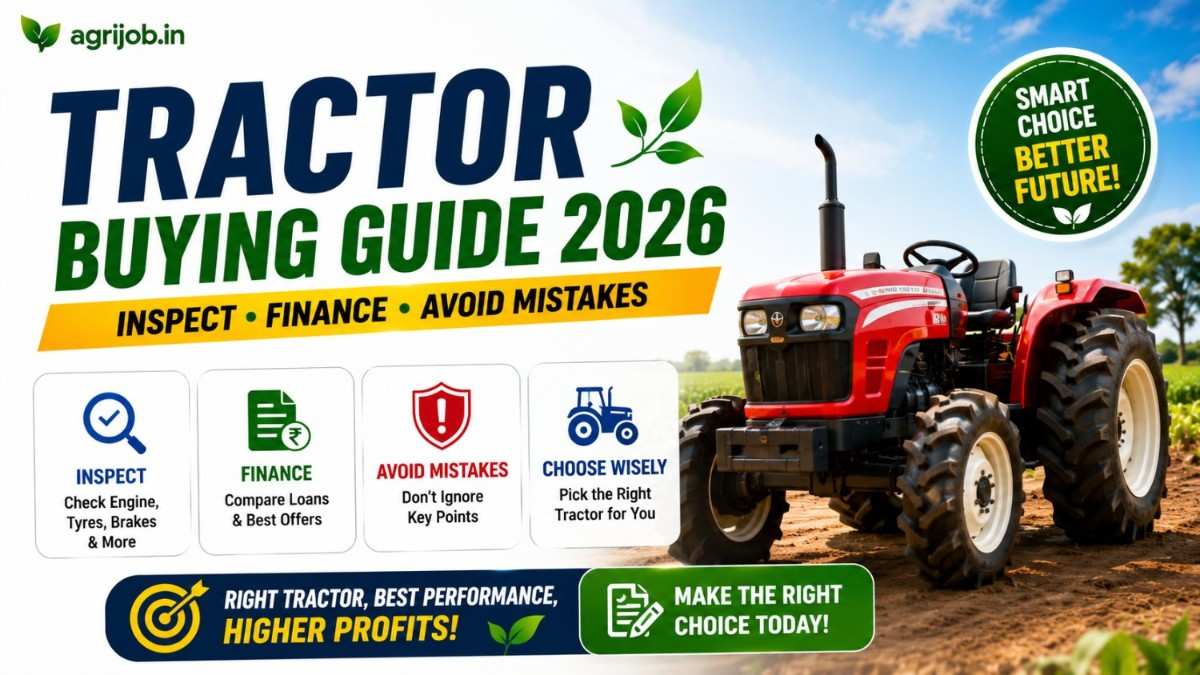
Mini Tractor Price Range: Rs.2.44 – 10.81 Lakh (Ex-Showroom)
Mid/Heavy Tractor (40+ HP): Rs.7.2 Lakh and above
SMAM Subsidy: 40% (General) to 50% (SC/ST/Women/Small & Marginal Farmers)
Loan Interest Rate: 8.5% – 18.5% per annum (public sector banks lowest)
Loan Funding: Up to 90% of tractor price, tenure 3-7 years
Safe Engine Hours (Used, Diesel): 6,000 – 10,000+ hours if well maintained
Ideal HP for 3-5 Acres: 18-26 HP
Application Mode: agrimachinery.nic.in or state DBT portal (subsidy); bank/NBFC portal (loan)
1. Tractor Buying Guide 2026: Overview
2. Money: Tractor Price List & Budget Planning
3. Choosing the Right HP: Eligibility by Land Size
4. Step-by-Step Buying Process & Inspection Checklist
5. Tractor Loan: Banks, Interest Rates & Documents
6. SMAM Subsidy: Eligibility & How to Apply
7. Who Should Use This Guide?
8. New Tractor vs Used Tractor: Detailed Comparison
9. High-Value Tractor Buying Terms You Must Know
10. Costly Mistakes to Avoid on Any Budget
11. Frequently Asked Questions
Tractor Buying Guide 2026: Overview
A tractor is often the single largest equipment investment a farming household makes, so following a structured Tractor Buying Guide 2026 approach protects both your money and your productivity. India’s tractor market in 2026 offers more choice than ever: over 100 mini tractor models between 11 HP and 36 HP, mid-range 40-50 HP workhorses, and a fast-growing used tractor marketplace where farmers can save 40-50% compared to new prices. At the same time, government mechanisation support through SMAM and easy institutional credit through public sector banks have made tractor ownership more accessible to small and marginal farmers, who represent the vast majority of India’s farming community.
| Particular | Details |
|---|---|
| Mini Tractor HP Range | 11 – 36 HP |
| Mini Tractor Price | Rs.2.44 – 10.81 Lakh (Ex-Showroom) |
| Mid/Heavy Tractor HP Range | 40 – 90+ HP |
| Top Brands | Mahindra, Swaraj, Sonalika, Massey Ferguson, John Deere, VST Shakti, Kubota |
| Loan Funding Available | 75% – 90% of tractor price |
| Subsidy Scheme | Sub-Mission on Agricultural Mechanisation (SMAM) |
| Official Subsidy Portal | agrimachinery.nic.in |
Money: Tractor Price List & Budget Planning for 2026
Budgeting correctly is the foundation of this Tractor Buying Guide 2026. Tractor prices in India vary sharply by horsepower, brand, drive type (2WD/4WD), and region, and the on-road price always includes RTO registration, insurance, and applicable state taxes on top of the ex-showroom figure. Rural buyers typically pay lower RTO and insurance charges than urban/metro buyers, while 4WD variants cost 15-25% more than equivalent 2WD models due to added traction hardware.

| Category | HP Range | Ex-Showroom Price (Rs.) | Approx. Annual Running Cost (Rs.) |
|---|---|---|---|
| Entry Mini Tractor | 11-18 HP | 2.44 – 3.55 Lakh | 35,000 – 50,000 |
| Mid Mini Tractor | 18-26 HP | 3.55 – 5.92 Lakh | 50,000 – 75,000 |
| Large Mini Tractor | 27-36 HP | 5.92 – 8.45 Lakh | 75,000 – 1,00,000 |
| Utility Tractor | 40-50 HP | 7.23 – 10.81 Lakh | 1,00,000 – 1,40,000 |
| Used Tractor (5-8 yrs) | Any HP | 40-50% below new price | Add Rs.15,000-30,000 for reconditioning |
Rural postings for farm equipment usage generally involve lower fuel and transport costs than metro-adjacent commercial use, but insurance premiums and RTO fees remain fairly consistent nationally, with only minor state-to-state variation in road tax percentage. Always add Rs.15,000-40,000 to your budget for a starter implement (rotavator, cultivator, or trailer), since a tractor without an implement cannot perform most farm operations.
Choosing the Right HP: Eligibility by Land Size
Before comparing brands, the Tractor Buying Guide 2026 approach starts with matching horsepower to your actual land size and soil type, since an over-powered or under-powered tractor wastes money either through excess fuel burn or through inadequate pulling capacity.
- 🌱 1-3 acres, orchard/vineyard: 12-15 HP compact/narrow-track tractor
- 🌾 3-5 acres, mixed cropping: 18-26 HP mini tractor
- 🚜 5-10 acres, standard farming: 27-40 HP utility tractor
- 🏞️ 10+ acres or heavy tillage: 40-50+ HP tractor, preferably 4WD
- ⛰️ Hilly or wet terrain: Add 4WD regardless of land size for traction
- 🌳 Orchard/inter-row spacing under 4 ft: Narrow-track mini tractor mandatory
| Buyer Category | Typical Discount/Benefit | Notes |
|---|---|---|
| General Category | 40% SMAM subsidy | Subject to state budget quota |
| SC/ST Farmers | 50% SMAM subsidy (up to 90% in some states) | Karnataka offers highest state top-up |
| Women Farmers | 50% SMAM subsidy + priority processing | Faster document verification |
| Small/Marginal Farmers (under 2 hectares) | 50% SMAM subsidy | Priority category under SMAM guidelines |
| FPOs/SHGs (Custom Hiring Centres) | Up to 80% subsidy | For shared-use equipment banks |
Step-by-Step Buying Process & Inspection Checklist
Whether buying new or used, this Tractor Buying Guide 2026 process reduces the risk of an expensive mistake. Follow these steps in order.
- Assess your land size, soil type, and primary operations (ploughing, sowing, haulage, orchard work)
- Shortlist 2-3 tractor models within your HP range and budget, comparing lifting capacity and fuel efficiency
- Visit an authorised dealer or verified used-tractor seller and request a physical demonstration
- For used tractors: check the hour-meter reading and cross-verify against service records
- Inspect engine oil level and colour before starting; golden-honey oil is healthy, dark black indicates neglect
- Start the engine cold and observe smoke colour: black means fuel combustion issues, blue means oil burning, white may mean coolant leakage
- Shift through all gears during a test drive, checking for grinding noise or gear slippage under load
- Engage the PTO (Power Take-Off) and hydraulic lift; look for jerky movement, leaks, or unusual vibration
- Test brakes and steering; the tractor should stop straight without pulling to one side
- Verify RC, insurance, Form 29/30 (for used tractors), and confirm engine/chassis numbers match the documents
- Negotiate price based on inspection findings, then complete payment and RTO ownership transfer
Never skip the RTO ownership transfer on a used tractor, even if the seller offers a “quick informal deal.” An untransferred RC can block your SMAM subsidy application, cause insurance claim rejection, and create legal disputes if the tractor was under an active loan (check for hypothecation clearance in the RC before paying).
Tractor Loan: Banks, Interest Rates & Documents
Financing is often the deciding factor in this Tractor Buying Guide 2026, since most farmers do not pay the full tractor price upfront. Tractor loans fall under priority sector lending in India, which means banks offer comparatively lower rates than standard vehicle loans, and the tractor itself typically serves as collateral, so no separate security is usually required.
| Lender Type | Interest Rate (per annum) | Funding Share | Tenure |
|---|---|---|---|
| Public Sector Banks (SBI, PNB) | 8.5% – 11.5% | Up to 90% | 3 – 7 years |
| Private Banks | 10% – 16% | 75% – 85% | 3 – 6 years |
| NBFCs (Faster Approval) | 12% – 18.5% | 75% – 90% | 3 – 6 years |
| Used Tractor Loans | 10% – 15% | 60% – 75% | 2 – 5 years |
| KCC-Linked Farm Equipment Loans | Subsidised, often below 9% | Varies by cooperative bank | As per KCC terms |
- 🧾 Aadhaar Card, PAN Card, and proof of address
- 📄 Land ownership or cultivation proof (7/12 extract, khatauni, or equivalent state land record)
- 🏦 Bank account statements for the last 6 months
- 💳 CIBIL score above 650 or CRIF Highmark score above 600 (or no credit history, which many schemes still accept)
- 🚜 Dealer quotation or proforma invoice for the selected tractor model
SMAM Subsidy: Eligibility & How to Apply
The Sub-Mission on Agricultural Mechanisation (SMAM) is the central government’s flagship scheme for making tractors and farm machinery affordable, and it remains a core part of this Tractor Buying Guide 2026. It is jointly funded by central and state governments, and eligibility, subsidy percentage, and application windows can vary by state, so always confirm current details with your state’s agriculture department before applying.
- Visit agrimachinery.nic.in or your state’s DBT agriculture portal (e.g., MahaDBT, I-Khedut)
- Complete Aadhaar-based registration and build your farmer profile
- Navigate to the “Agricultural Mechanisation” or “SMAM” section and select “Tractor”
- Enter land details, category (General/SC/ST/Women/Small-Marginal), and bank account information
- Upload land records, caste certificate (if applicable), Aadhaar, and bank passbook
- Submit the application and note your unique Application ID for tracking
- After approval/pre-sanction, purchase the tractor from an authorised dealer listed under SMAM
- An agriculture officer conducts physical verification and geo-tagged photography before subsidy disbursal via DBT
Many states switched from a lottery-based selection to a first-come-first-served model in recent cycles, so early application matters once the window opens. Keep in mind that subsidies are capped by annual state budget quotas, and once a district’s quota is exhausted, the portal typically stops accepting new applications for that cycle.
Who Should Use This Tractor Buying Guide 2026?
- 🌾 First-time tractor buyers unsure of the right HP for their land size
- 👩🌾 Women farmers eligible for enhanced SMAM subsidy and priority processing
- ♿ SC/ST/OBC/EWS farmers seeking maximum subsidy benefit
- 💰 Budget-conscious buyers weighing new vs used tractor options
- 🚜 Farmers upgrading from a mini tractor to a mid-size utility tractor
- 🏢 FPOs and Custom Hiring Centres planning shared-equipment investment
- 🍇 Orchard and vineyard owners needing narrow-track compact tractors
- 🔧 Buyers considering a second-hand tractor who want a reliable inspection checklist
New Tractor vs Used Tractor: Detailed Comparison
One of the biggest decisions in this Tractor Buying Guide 2026 is choosing between a brand-new tractor and a well-maintained used one. Both paths can be smart depending on your budget, urgency, and risk tolerance.
| Parameter | New Tractor | Used Tractor |
|---|---|---|
| Upfront Cost | Full ex-showroom price | 40-50% lower than new |
| SMAM Subsidy Eligible | Yes, up to 50% | Generally not eligible |
| Warranty | 2-5 years manufacturer warranty | None or limited dealer warranty |
| Loan Interest Rate | 8.5% – 16% | 10% – 15% (slightly higher) |
| Repair Risk | Low in first 3-5 years | Depends heavily on maintenance history |
| Depreciation Hit | Steepest in year 1-2 | Already absorbed by previous owner |
| Best For | First-time buyers wanting subsidy + warranty | Budget buyers, contractors, second tractor for the farm |
High-Value Tractor Buying Terms You Must Know
- Ex-Showroom Price: The dealer-listed tractor price before RTO registration, insurance, and taxes; mini tractors start at Rs.2.44 lakh
- SMAM (Sub-Mission on Agricultural Mechanisation): The central subsidy scheme offering 40-50% support on tractor purchase
- Hypothecation: A legal claim a lender holds over a financed tractor until the loan is fully repaid; must be cleared before resale
- PTO (Power Take-Off): The rotating shaft that powers attached implements like rotavators and threshers
- Lifting Capacity: The maximum weight a tractor’s hydraulic system can raise, ranging from 220 kg to over 1,650 kg in mini tractors
- DBT (Direct Benefit Transfer): The mechanism through which subsidy amounts are credited directly to a farmer’s bank account
- Form 29 & Form 30: The mandatory RTO forms for transferring ownership of a used tractor to the buyer’s name
- Custom Hiring Centre (CHC): A shared-equipment facility, often subsidised up to 80%, letting small farmers rent tractors instead of buying
- 4WD (Four-Wheel Drive): A drivetrain offering better traction on wet, hilly, or uneven terrain, typically 15-25% costlier than 2WD
- Priority Sector Lending: An RBI classification that requires banks to offer agricultural loans, including tractor loans, at comparatively lower interest rates
Costly Mistakes to Avoid on Any Budget
Even experienced farmers make avoidable errors when buying a tractor. This section of the Tractor Buying Guide 2026 highlights the mistakes that cost buyers the most money.
- ⚠️ Buying higher HP than your land needs, leading to unnecessary fuel and maintenance costs
- ⚠️ Skipping the RTO ownership transfer on a used tractor purchase
- ⚠️ Not cross-checking the hour-meter reading against actual service records
- ⚠️ Ignoring hydraulic and PTO tests during inspection, since these repairs are expensive
- ⚠️ Forgetting to check for hypothecation or an unresolved loan on the tractor’s RC
- ⚠️ Applying for a bank loan without comparing rates across at least 2-3 lenders
- ⚠️ Missing the SMAM application window and losing out on subsidy for that cycle
- ⚠️ Not budgeting separately for an implement like a rotavator or cultivator
For authoritative and updated information, always cross-check details on the official DBT Agriculture Mechanisation portal before applying for subsidy. For loan-related guidance, the SBI Tractor Loan page provides current eligibility and interest rate details. Buyers can also refer to the Department of Agriculture and Farmers Welfare, Government of India for national mechanisation policy, the National Bank for Agriculture and Rural Development (NABARD) for cooperative financing options, and the Parivahan (VAHAN) portal to verify RC and ownership details before completing a used tractor purchase.
Frequently Asked Questions: Tractor Buying Guide 2026
What is the price range for tractors in India in 2026?
Under the Tractor Buying Guide 2026, mini tractors (11-36 HP) start from Rs.2.44 lakh and go up to Rs.10.81 lakh ex-showroom, while mid and heavy tractors above 40 HP cost Rs.7.2 lakh and above depending on brand and features.
How much subsidy can I get on a new tractor purchase?
Under the SMAM scheme covered in this Tractor Buying Guide 2026, general category farmers get 40% subsidy while SC/ST, women, and small/marginal farmers get up to 50% subsidy on tractor purchase, subject to state-wise caps and budget availability.
What is the lowest tractor loan interest rate available in 2026?
As explained in this Tractor Buying Guide 2026, SBI offers tractor loan interest rates starting around 8.5% to 11.5% per annum for eligible farmers, while other public sector banks and NBFCs range between 9% and 18.5% depending on profile and collateral.
How many engine hours are safe for a used tractor?
A well-maintained diesel tractor engine typically performs reliably between 6,000 and 10,000 hours, and this Tractor Buying Guide 2026 notes some models can exceed 12,000 hours if serviced regularly with genuine parts and timely oil changes.
What documents are required to buy a used tractor in India?
You need the original Registration Certificate (RC), valid insurance, Form 29 and Form 30 for ownership transfer, service history records, and an NOC from the financer if the tractor was under loan, as detailed in this Tractor Buying Guide 2026.
Is a used tractor a better investment than a new tractor?
A used tractor can offer 40-50% savings over a new one and suits farmers with tight budgets or smaller landholdings, but this Tractor Buying Guide 2026 notes that new tractors carry manufacturer warranty, SMAM subsidy eligibility, and lower long-term repair risk.
How do I apply for the SMAM tractor subsidy online?
Farmers register on the agrimachinery.nic.in portal or their state DBT portal (like MahaDBT), fill land and bank details, upload Aadhaar and land records, select the tractor from an authorised dealer, and submit the application as outlined in this Tractor Buying Guide 2026.
What HP tractor is right for a 3-acre farm?
For 3-5 acres of land, this Tractor Buying Guide 2026 recommends an 18-26 HP mini tractor, which balances fuel efficiency, manoeuvrability, and enough power for ploughing, sowing, and inter-cultivation without excess running cost.
What is the difference between 2WD and 4WD tractors?
2WD tractors are more fuel-efficient and cost less, suited to flat, dry fields, while 4WD tractors offer better traction and stability for wet, hilly, or uneven terrain, a key decision point covered in this Tractor Buying Guide 2026.
Can I get a tractor loan without collateral?
Yes, most banks do not mandate collateral for tractor loans since the tractor itself is hypothecated as security, though this Tractor Buying Guide 2026 notes that offering collateral or a strong credit score can help secure a lower interest rate.
This guide is regularly reviewed and updated for accuracy. Bookmark this page for the latest Tractor Buying Guide 2026 pricing, subsidy, and loan updates.
Last Updated: July 2026