

Soil Health Card 2026 – How to Apply Online, Download & Use Your SHC Report
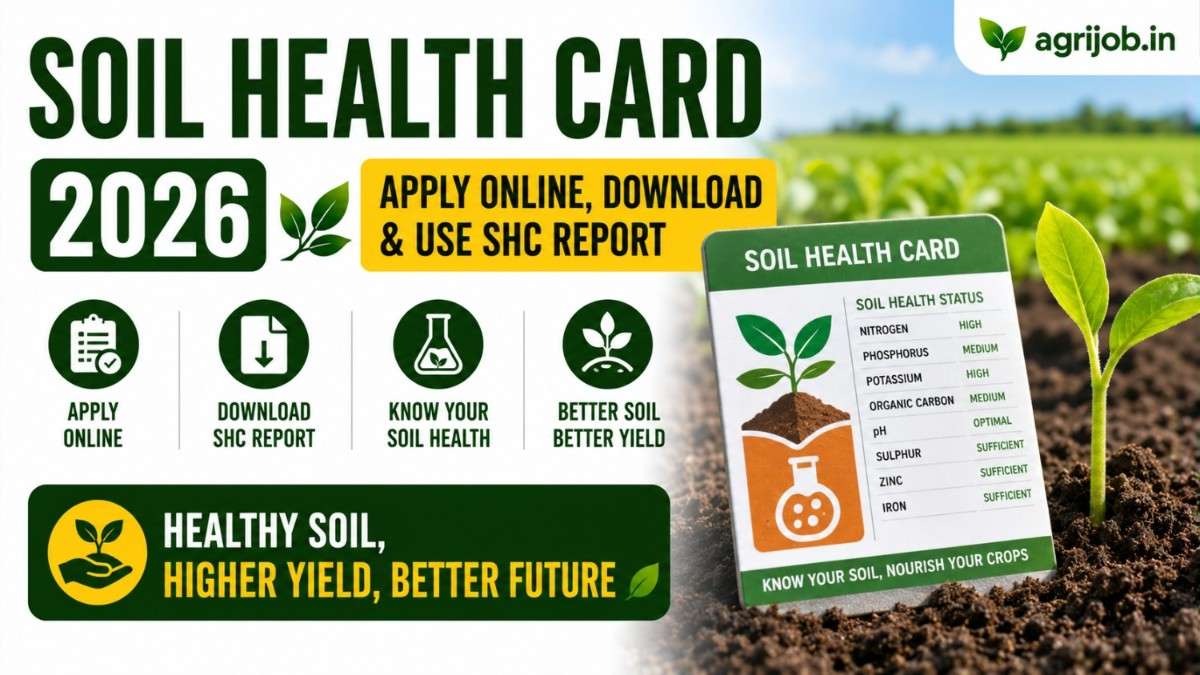
The Soil Health Card 2026 is a free government scheme that every Indian farmer with cultivable land can use to get a scientific report on their soil’s nutrient status — and precise crop-wise fertilizer recommendations. Available at soilhealth.dac.gov.in, the Soil Health Card (SHC) tests 12 critical soil parameters and tells you exactly how much nitrogen, phosphorus, potassium, and 9 other nutrients your farm needs — so you stop wasting money on excess fertilizers. This complete 2026 guide covers how to apply online and offline, track your status, download your SHC PDF, decode every parameter in your report, and use the recommendations to increase crop yield by up to 5–6% while cutting fertilizer costs by 8–10%.

| Scheme Name | Soil Health Card Scheme (under RKVY – Soil Health & Fertility) |
| Launched By | Govt. of India, Ministry of Agriculture & Farmers Welfare |
| Launch Date | 19 February 2015 (10 years running) |
| Official Portal | soilhealth.dac.gov.in |
| Cost to Farmer | Completely FREE |
| Parameters Tested | 12 (N, P, K, S, Zn, Fe, Cu, Mn, B, pH, EC, OC) |
| Card Issued Every | 2 Years (biennial cycle) |
| Cards Issued (Total) | Over 25 crore (as of July 2025) |
| Total Govt. Funding | Rs. 1,706.18 crore released to states (by Feb 2025) |
| Helpline | 1800-180-1551 (toll-free) |
| Languages Available | 22 languages + 5 dialects |
| Application Mode | Online (portal/app) + Offline (KVK/CSC) |
- What is the Soil Health Card Scheme 2026?
- Who Is Eligible for Soil Health Card?
- Documents Required to Apply
- How to Apply for Soil Health Card Online 2026
- How to Apply Offline via KVK / CSC
- How to Track Soil Health Card Status
- How to Download Soil Health Card PDF 2026
- How to Read and Use Your SHC Report
- 12 Soil Parameters Explained
- Who Should Apply for Soil Health Card?
- Soil Health Card vs No Soil Testing – Comparison
- High-Value Agriculture Terms You Must Know
- Frequently Asked Questions (FAQ)
What is the Soil Health Card Scheme 2026?
The Soil Health Card scheme is a flagship initiative of the Government of India launched on 19 February 2015 by Prime Minister Narendra Modi at Suratgarh, Rajasthan. Implemented under the Ministry of Agriculture & Farmers Welfare through the Department of Agriculture, Cooperation & Farmers Welfare, the scheme gives every farmer a printed or digital report card for each of their land holdings — completely free of charge.
From 2022–23, the Soil Health Card Scheme was merged into the Rashtriya Krishi Vikas Yojana (RKVY) under a dedicated component called “Soil Health & Fertility”, ensuring continuous and sustainable funding from both Central and State Governments. As of July 2025, over 25 crore Soil Health Cards have been distributed to Indian farmers, and Rs. 1,706.18 crore has been released to states for scheme implementation.

The SHC is not just a document — it is a field-specific, crop-wise advisory that tells each farmer exactly which fertilizers to use, in what quantity, and for which crop. Farmers who follow SHC recommendations have reported an 8–10% reduction in chemical fertilizer consumption and a 5–6% increase in overall crop productivity, directly improving their net income.
Who Is Eligible for Soil Health Card 2026?
The Soil Health Card scheme is designed for all farmers across India who own or cultivate agricultural land. There is no income criterion, no age barrier, and no category restriction. Key eligibility conditions are:
- 🌾 Land ownership or cultivation: Must be an active farmer with cultivable land (owned, leased, or sharecropped)
- 📋 Valid land records: Khata/Khasra number or survey number of the agricultural holding
- 📱 Aadhaar card: Required for identity verification on the online portal
- 🏡 Residence: Any state or Union Territory in India — scheme covers all 28 states and UTs
- 👨🌾 Farming type: Rain-fed, irrigated, small, marginal, or large holdings — all are eligible
- 🆓 Cost barrier: None — scheme is completely free; government pays Rs. 190 per sample
- 🔁 Repeat applicants: Every farmer can apply in each new 2-year cycle for an updated SHC
Priority categories: Small and marginal farmers, women farmers, SC/ST farmers, and farmers in aspirational districts receive priority attention at soil collection camps and KVK centres.
Documents Required to Apply for Soil Health Card
Keep these documents ready before starting your Soil Health Card application — both online and offline modes require the same core documents:
| Document | Purpose | Mandatory? |
|---|---|---|
| Aadhaar Card | Identity verification & OTP-based login | Yes |
| Mobile Number (Aadhaar-linked) | OTP verification & SMS updates | Yes |
| Land Records (Khata/Khasra No.) | Survey number of agricultural holding | Yes |
| PM Kisan Registration ID | Speeds up verification; links SHC to PM Kisan | Optional |
| Farmer ID (Farmer Registry) | State-specific digital farmer identity | Optional |
| Crop Details | Rabi/Kharif crop type grown on the land | Yes |
| Passport Photo | Offline applications at KVK/CSC | For offline only |
How to Apply for Soil Health Card Online 2026 – Step by Step
Applying for a Soil Health Card online in 2026 is straightforward using the official government portal. Follow these steps carefully:
- Visit the official portal: Open your browser and go to soilhealth.dac.gov.in or download the Soil Health Card (SHC) mobile app from the link on the portal homepage.
- Go to Farmer’s Corner: On the homepage, click on the “Farmer’s Corner” section. This is the dedicated module for farmers to submit soil testing requests.
- Select your State: Choose your state from the dropdown menu and click “Continue” to be directed to the state-specific farmer registration page.
- Register or Login: If you are a new user, click “Register New User” and fill in your name, Aadhaar number, mobile number, and login credentials. Existing users log in directly.
- Enter land & crop details: Provide your survey number / Khata-Khasra number, village name, tehsil, district, the crop you currently grow (Rabi or Kharif), and the approximate area of the holding in hectares.
- Upload documents: Upload a scanned copy or photograph of your Aadhaar and land records. Ensure file size is under 1 MB for smooth upload.
- OTP verification: Enter the OTP sent to your Aadhaar-linked mobile number to complete identity verification and submit your application.
- Schedule sample collection: After submission, the state agriculture department or field staff will contact you to schedule a soil sample collection from your field. Alternatively, you may be directed to the nearest soil testing lab.
- Track your status: Use your Aadhaar number or application ID at soilhealth.dac.gov.in to monitor sample collection, testing progress, and card generation status.
- Receive your SHC: Within 15–30 days of sample testing, your Soil Health Card will be available for download on the portal and as a PDF. You will also receive an SMS notification on your registered mobile.
How to Apply for Soil Health Card Offline via KVK / CSC
Farmers without internet access or smartphones can apply for the Soil Health Card 2026 through offline channels — Krishi Vigyan Kendras (KVKs), Common Service Centres (CSCs), and local agriculture offices spread across every district in India.
- 🏢 Visit the nearest KVK or agriculture office: Locate your block-level Krishi Vigyan Kendra or district agriculture office. Over 1,000 KVKs operate across India under the ICAR network.
- 📝 Fill the SHC application form: Collect and fill the printed form with your Aadhaar number, land details (Khasra/Khata), crop type, and contact number.
- 📁 Submit documents: Attach photocopies of Aadhaar card and land records. No fee is charged by the government — beware of touts charging for the service.
- 🧪 Soil sample collection: Trained agriculture staff will visit your field or ask you to bring a soil sample in a provided kit. Samples are taken from a depth of 15–20 cm using the Zig-Zag method across the field.
- 📬 Collect your card: The SHC is ready within 15–30 days and can be collected from the same office or accessed digitally. Over 10,000 CSC centres in UP and 5,000+ in Bihar assist with card collection and printing.
- 📞 Helpline support: For any difficulty, call the national toll-free helpline 1800-180-1551 or email helpdesk-soilhealth@gov.in.
How to Track Soil Health Card Status 2026
Once you have applied, you can check your Soil Health Card application status at any time using the official portal:
- Go to soilhealth.dac.gov.in or open the SHC mobile app.
- Click on “Farmer’s Corner” and select “Soil Health Card Status”.
- Enter your Aadhaar number or Application ID received at the time of submission.
- Verify your identity via the OTP sent to your registered mobile number.
- View the current stage: sample collected → sample under analysis → card generated → card available for download.
- If your status has not updated in more than 30 days, call the helpline 1800-180-1551.
How to Download Soil Health Card PDF 2026
Once your Soil Health Card is generated, downloading it in PDF format takes less than 2 minutes. The portal supports download in 22 languages including Hindi, Marathi, Tamil, Telugu, Bengali, Punjabi, and more:
- Visit soilhealth.dac.gov.in and go to Farmer’s Corner → Print Your Soil Health Card.
- Select your State, District, Sub-District (Tehsil), and Village from the dropdown menus.
- Search by your farmer name or Farmer ID / Aadhaar number.
- Your SHC record will appear on screen. You can view it in the old format (Cycle I/II) or new format (current cycle).
- Click “Print / Download PDF” to save your Soil Health Card. The PDF contains your full 12-parameter report along with crop-wise fertilizer recommendations.
- If you want the card in a regional language, select your preferred language from the language dropdown before downloading.
How to Read and Use Your SHC Report to Increase Crop Yield
Getting the Soil Health Card is only half the job — knowing how to read and act on it is what actually increases your farm income. Your SHC report has three main sections: nutrient status, rating (Low/Medium/High), and fertilizer recommendation. Here is how to use each section:
- 🟢 Check the colour-coded rating: Each of the 12 parameters is rated Low (Red), Medium (Yellow/Orange), or High (Green). Focus on all Red-rated nutrients first — these are the ones deficient in your soil.
- 🌱 Follow crop-specific recommendations: The SHC gives separate fertilizer dosage guidance for each crop you declared. Do not use generic recommendations — use the crop-specific column for your Rabi or Kharif crop.
- 💊 Address micronutrient deficiencies: Most Indian soils show Zinc (Zn) and Boron (B) deficiency. Your SHC will specify whether to apply zinc sulphate or borax, and in what quantity per hectare.
- 🧪 pH correction first: If your pH is below 6.0 (acidic), apply agricultural lime as recommended before any fertilizer. If pH is above 8.5 (alkaline), apply gypsum. Fertilizers do not work effectively in extreme pH soils.
- 🌿 Increase Organic Carbon: Low OC (below 0.5%) means degraded soil. Follow the SHC advice to add FYM (Farm Yard Manure), compost, or bio-fertilizers to restore organic matter over 2–3 seasons.
- 📉 Reduce nitrogen over-application: Most Indian farmers over-apply urea. Your SHC will give the precise N dose needed — follow it to save money and prevent soil acidification.
- 📅 Re-test every 2 years: Schedule your next SHC application as soon as your current card is 18 months old, so results are ready before the next sowing season.
12 Soil Parameters Explained – Your SHC Report Decoded
Understanding what each of the 12 parameters on your Soil Health Card means is essential to making the right farming decisions. Here is a complete reference table:
| Parameter | Type | What It Means | If Low – Action |
|---|---|---|---|
| Nitrogen (N) | Macronutrient | Essential for leaf & stem growth | Apply urea/DAP as recommended |
| Phosphorus (P) | Macronutrient | Root development & flowering | Apply Single Superphosphate (SSP) |
| Potassium (K) | Macronutrient | Fruit quality & disease resistance | Apply Muriate of Potash (MOP) |
| Sulphur (S) | Secondary nutrient | Protein synthesis, oilseed quality | Apply gypsum or ammonium sulphate |
| Zinc (Zn) | Micronutrient | Enzyme activation, grain fill | Apply zinc sulphate @ 25 kg/ha |
| Iron (Fe) | Micronutrient | Chlorophyll formation | Apply ferrous sulphate foliar spray |
| Copper (Cu) | Micronutrient | Root metabolism, lignin formation | Apply copper sulphate @ 5 kg/ha |
| Manganese (Mn) | Micronutrient | Photosynthesis & enzyme function | Apply manganese sulphate as foliar |
| Boron (B) | Micronutrient | Cell wall formation, pollen viability | Apply borax @ 2–3 kg/ha |
| pH | Physical parameter | Soil acidity/alkalinity (ideal: 6.0–7.5) | Lime for acidic; gypsum for alkaline |
| Electrical Conductivity (EC) | Physical parameter | Salt concentration (ideal: below 1 dS/m) | Leaching + gypsum for saline soil |
| Organic Carbon (OC) | Physical parameter | Soil biological activity (ideal: above 0.75%) | Add FYM, compost, green manure |
Who Should Apply for Soil Health Card 2026?
The Soil Health Card scheme benefits virtually every category of farmer in India. Here are the 8 farmer profiles who stand to gain the most from applying in 2026:
- 🌾 Small and Marginal Farmers (under 2 hectares): Every rupee saved on fertilizer matters. SHC recommendations cut input costs by an average of 8–10%, directly improving slim profit margins.
- 👩🌾 Women Farmers and SHG Members: CSC camps and KVK training programmes specifically target women farmers — SHC gives them scientific data to negotiate better at input shops and FPOs.
- 🌻 Oilseed and Pulse Growers: Sulphur and zinc deficiencies are extremely common in oilseed crops like mustard, groundnut, and soybean. SHC directly identifies these deficiencies and recommends corrective inputs.
- 🍚 Rice and Wheat Belt Farmers (UP, Punjab, Bihar, Haryana): Decades of NPK monoculture have depleted secondary and micronutrients. SHC is the only way to identify silent deficiencies before they cause yield losses.
- 🏡 SC/ST and Tribal Farmers: Government priority under the scheme — special SHC camps and subsidised input access through KVKs for tribal and forest fringe farming communities.
- 🌊 Flood-Prone Area Farmers (Bihar, Assam, Odisha): Flooding leaches nutrients rapidly. An updated SHC after every flood season helps farmers recalibrate their fertilizer plan for recovery crops.
- 🌵 Dryland and Rain-fed Farmers (Rajasthan, Maharashtra, Karnataka): Soil organic carbon is critically low in dryland soils. SHC identifies this and guides low-cost organic interventions like mulching and green manure.
- 🚜 PM Kisan Beneficiaries: The Rs. 6,000 annual PM Kisan instalment is best spent on SHC-recommended inputs — not generic fertilizers. Linking your PM Kisan ID to your SHC application integrates both schemes.
Soil Health Card vs No Soil Testing – Which Is Better?
| Factor | With Soil Health Card (SHC) | Without Soil Testing |
|---|---|---|
| Fertilizer Use | Precise, crop-specific dose | Guesswork, often excess |
| Input Cost | 8–10% lower on average | Unnecessarily high |
| Crop Yield | 5–6% higher on average | Yield stagnation or decline |
| Soil Health Over Time | Improving; organic carbon tracked | Degrading due to nutrient imbalance |
| Micronutrient Deficiency | Detected and corrected early | Often missed until crop failure |
| pH Management | Precise liming/gypsum recommendation | Ignored; fertilizers less effective |
| Govt. Scheme Linkage | Integrates with PM Kisan, PMFBY | No linkage benefit |
| Cost to Farmer | Zero (government-funded) | Rs. 500–2,000 if done privately |
| Language Support | 22 languages + 5 dialects | Lab reports often in English only |
High-Value Agriculture Scheme Terms You Must Know
Understanding the broader ecosystem of schemes connected to the Soil Health Card will help Indian farmers maximise benefits from multiple government programmes simultaneously:
- 🌾 RKVY (Rashtriya Krishi Vikas Yojana): The umbrella scheme under which SHC now operates since 2022–23. Provides Rs. 10,000+ crore annually to states for agriculture development including soil health labs and farmer training.
- 💰 PM Kisan Samman Nidhi: Rs. 6,000 per year (in 3 installments) to over 9 crore farmers — SHC recommends where to spend this money most effectively on soil-specific inputs.
- 🧪 Integrated Nutrient Management (INM): The scientific framework under which SHC recommendations are made — balancing chemical fertilizers with bio-fertilizers and organic inputs for sustainable soil health.
- 🏡 KVK (Krishi Vigyan Kendra): Over 1,000 farm science centres managed by ICAR across India — your nearest offline point for SHC application, soil testing, and agricultural training programmes.
- 🌍 National Apprenticeship Certificate (NAC): Rural youth can earn a government certificate by working as Soil Testing Lab technicians under Village-Level Soil Testing Labs (VLSTLs) — combining SHC with employment.
- 📊 GIS-Integrated Soil Mapping: The SHC portal now integrates with GIS mapping — 1,987 village-level soil fertility maps created for 21 states help cluster-level fertilizer planning for FPOs and Panchayats.
- 🌱 PMFBY (Pradhan Mantri Fasal Bima Yojana): Soil Health Card data improves crop insurance claim accuracy — insurers use SHC baseline data to assess whether yield loss was due to soil issues or climate events.
- 🧬 Bio-Fertilizer: SHC recommendations often include Rhizobium, PSB (Phosphate Solubilising Bacteria), or Azospirillum bio-fertilizers as low-cost alternatives to chemical inputs — especially for pulses and oilseeds.
Frequently Asked Questions – Soil Health Card 2026
What is the Soil Health Card 2026?
The Soil Health Card 2026 is a free, government-issued soil test report available to every Indian farmer at soilhealth.dac.gov.in. It analyses 12 parameters of your farm’s soil — including nitrogen, phosphorus, potassium, pH, and organic carbon — and gives crop-specific fertilizer recommendations so you can improve yield and reduce input costs. Over 25 crore such cards have been issued since the scheme’s launch in 2015.
How do I apply for a Soil Health Card online in 2026?
Visit soilhealth.dac.gov.in and go to Farmer’s Corner. Select your state, register with your Aadhaar number and mobile, enter your land details (Khata/Khasra number) and crop type, then submit. Verify via OTP and schedule a soil sample collection. Your card will be ready within 15–30 days of lab testing. You can also apply offline at your nearest KVK, CSC, or district agriculture office.
Is the Soil Health Card completely free of cost?
Yes, the Soil Health Card is 100% free for every farmer in India. The Government of India reimburses Rs. 190 per soil sample to states, covering collection, testing, card generation, and distribution. The Central Government funds 60% and the state government covers 40%. Farmers should not pay anyone claiming to charge a fee — report such cases to the helpline 1800-180-1551.
What are the 12 parameters tested in a Soil Health Card?
The Soil Health Card tests 12 parameters: macronutrients N (Nitrogen), P (Phosphorus), K (Potassium); secondary nutrient S (Sulphur); micronutrients Zn (Zinc), Fe (Iron), Cu (Copper), Mn (Manganese), B (Boron); and physical parameters pH (acidity/alkalinity), EC (Electrical Conductivity), and OC (Organic Carbon). Each is rated Low, Medium, or High, with corrective recommendations provided.
How do I download my Soil Health Card PDF?
Go to soilhealth.dac.gov.in → Farmer’s Corner → Print Your Soil Health Card. Select your state, district, and village. Search by your name or farmer ID and click Print/Download. The SHC is available in 22 languages. You can also ask your nearest CSC operator to print it for you if you do not have a printer at home.
How often does the Soil Health Card get updated?
The Soil Health Card is issued once every 2 years (biennial cycle). Soil samples are collected after the Rabi or Kharif harvest. Each new card reflects the current nutrient status of your soil, so you can track whether your soil health is improving after following previous recommendations. Always apply for your SHC renewal at the start of each new cycle.
What documents are needed for Soil Health Card application?
The key documents required are: Aadhaar card, Aadhaar-linked mobile number, land records (Khata/Khasra number or survey number), and details of the crop grown. PM Kisan registration ID is optional but recommended as it links both schemes and speeds up verification. No fee or additional paperwork is required for the online application.
How does the Soil Health Card reduce fertilizer costs?
Before SHC, over 90% of Indian farmers had never tested their soil and were applying fertilizers based on habit or dealer advice. SHC gives precise, field-specific recommendations. Following them eliminates over-application of nitrogen (urea) and identifies cheaper micronutrient alternatives. Studies show an average 8–10% reduction in chemical fertilizer use and 5–6% yield improvement — both directly boosting farm income.
Last Updated: June 2026 | This guide is regularly reviewed and updated for accuracy. Bookmark this page for the latest Soil Health Card 2026 notifications and portal updates. For official information, always refer to soilhealth.dac.gov.in, agricoop.nic.in, and rkvy.nic.in.