

India Green Revolution 2.0 – Technology Feeding 1.4 Billion in 2026
India’s Green Revolution 2.0 is the most ambitious agricultural transformation the country has undertaken since the original Green Revolution of the 1960s — and in 2026, it is happening at a scale, speed, and depth that would have been unimaginable even a decade ago. While the first revolution saved India from famine by introducing high-yielding varieties and chemical inputs, the second revolution is deploying AI, drones, satellite monitoring, digital farmer IDs, and a Rs.2,817 crore Digital Agriculture Mission to sustainably feed 1.4 billion people while healing the soil, empowering small farmers, and creating a new generation of agritech careers. From the Kisan e-Mitra AI chatbot answering 8,000 farmer queries daily to drone demonstrations covering 41,010 hectares, India’s agricultural technology story in 2026 is both a national food security triumph and a global model. This complete guide covers every pillar — key government schemes, core technologies, major investments, career opportunities, real numbers, and the critical challenges still to be solved.

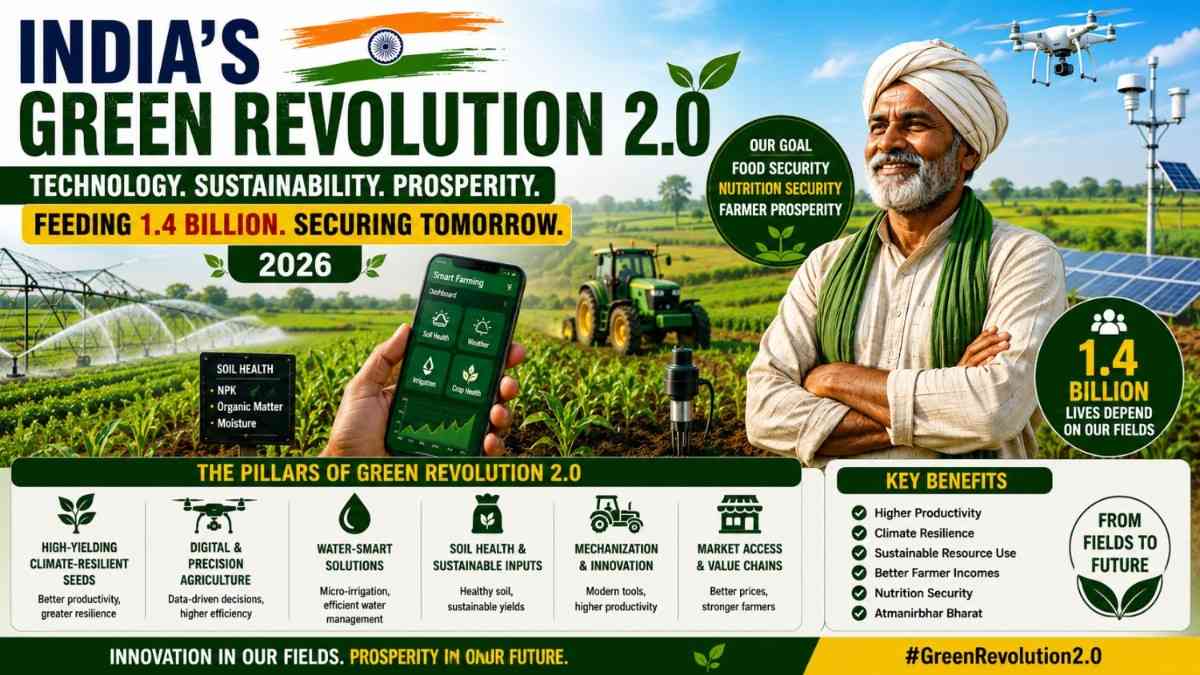
- What Is India’s Green Revolution 2.0?
- Key Facts at a Glance – India Agriculture 2026
- Digital Agriculture Mission 2026 – Rs.2,817 Crore Plan
- AI in Indian Farming – Rs.32,000 Cr Market by 2026
- Drone Revolution – 41,000 Hectares and Counting
- Top 6 Government Schemes Powering Green Revolution 2.0
- Millets, Natural Farming & the Nutrition Shift
- Who Should Follow India’s Green Revolution 2.0?
- Agritech Farming vs Traditional Farming – 2026 Comparison
- Key Agritech & Food Security Terms You Must Know in 2026
- 5 Critical Challenges India Must Still Solve
- Frequently Asked Questions
What Is India’s Green Revolution 2.0 in 2026?
India’s Green Revolution 2.0 is not a single government programme — it is the convergence of 5 major forces reshaping how food is grown, distributed, and consumed for 1.4 billion people. The original Green Revolution (1965–1985) transformed India from a famine-threatened nation into a wheat and rice surplus economy through high-yielding seeds, chemical fertilisers, and mechanisation. It worked — but at a cost: soil degradation, groundwater depletion, biodiversity loss, and regional inequality in who benefited.
Green Revolution 2.0 in 2026 directly addresses those failures. According to the Press Information Bureau (pib.gov.in), India’s 2025-26 agricultural strategy is built on 5 pillars: digital infrastructure for farmers, precision technology adoption, nutrition-crop diversification, natural and climate-smart farming, and institutional strengthening through Farmer Producer Organisations (FPOs). In March 2026, Union Minister Nitin Gadkari confirmed India is entering a new phase of technology-driven organic agriculture, emphasising AI, satellite monitoring, and eco-friendly practices to boost productivity while reducing costs.

- 🌾 Green Revolution 1.0 (1960s–80s): High-Yielding Variety seeds + chemical fertilisers + canal irrigation = food surplus in wheat and rice. Saved millions from famine.
- ⚠️ Legacy Problems by 2000s: Soil carbon depletion, groundwater overextraction in Punjab/Haryana, loss of 50,000+ traditional crop varieties, protein and micronutrient deficiencies at scale.
- 🤖 Green Revolution 2.0 (2020s–2026): AI advisory systems + agricultural drones + satellite crop monitoring + digital farmer IDs + climate-resilient millets + 10,000 FPOs = sustainable food security for 1.4 billion.
- 🏆 Global Recognition: In May 2026, PM Modi received the FAO Agricola Medal — the UN Food and Agriculture Organization’s highest honour — for India’s efforts in food security, millets promotion, and digital agriculture, making India the first country to receive this recognition in this context.
| India’s Population (2026) | 1.44 billion (world’s largest) |
| Agricultural Land | 150+ million hectares (world’s most arable land) |
| Horticulture Output (2024-25) | 362.08 MT (surpassed foodgrains) |
| PM-KISAN Disbursement (to March 2026) | Rs.4.27 lakh crore to 11 crore farmers |
| Digital Agriculture Mission Budget | Rs.2,817 crore (Cabinet approved) |
| Farmer IDs to be Created | 11 crore by FY 2026-27 |
| ICAR Drone Demo Coverage | 41,010 hectares; 4,52,291 farmers (2023-26) |
| AI in Agriculture Market (India, 2026) | USD 4 billion projected (CAGR 25.5%) |
| Agritech Companies in India | 4,990+ (Maharashtra leads with 1,363) |
| PMFBY Insured Farmers (2024-25) | 4.19 crore farmers; 6.2 crore hectares |
| FPOs Registered (by Feb 2026) | 10,000 (under 2020–2026 scheme) |
| Climate-Resilient Crop Varieties | 1,900 new varieties in last 10 years |
Digital Agriculture Mission 2026 – India’s Rs.2,817 Crore Digital Backbone
The centrepiece of India’s Green Revolution 2.0 is the Digital Agriculture Mission, approved by the Union Cabinet with a total outlay of Rs.2,817 crore. Modelled on India’s Aadhaar-based Digital Public Infrastructure (DPI) framework — the same approach that powered UPI payments and Jan Dhan banking inclusion — the Digital Agriculture Mission aims to give every Indian farmer a digital identity, real-time data access, and AI-powered decision support. The Ministry of Agriculture and Farmers Welfare (pib.gov.in) describes it as building “AgriStack” — an open, interoperable data layer for the entire farm economy.
4 Core Components of the Digital Agriculture Mission
- 🪪 Farmer ID (Digital Identity for 11 Crore Farmers): Every farmer receives a unique digital identity — similar to Aadhaar for citizens — linked dynamically to land records, crops sown, livestock ownership, family details, and all schemes and benefits availed. The target is 6 crore Farmer IDs in FY 2024-25, 3 crore in FY 2025-26, and 2 crore in FY 2026-27. Pilot projects have already been conducted in 6 states including UP (Farrukhabad), Gujarat, Maharashtra, Haryana, Punjab, and Tamil Nadu.
- 🗺️ Crop Sown Registry (Digital Crop Survey): A mobile-based ground survey system recording exactly which crops are planted where — across all 400+ districts nationwide — providing the government and agritech platforms with the most accurate crop data India has ever had. Scaling to all districts in FY 2025-26.
- 🛰️ Krishi Decision Support System (DSS): A comprehensive geospatial system integrating remote sensing satellite data on crops, soil health, weather patterns, and water resources. Enables real-time crop monitoring, early warning for pest and disease outbreaks, and evidence-based policy decisions. Soil profile maps at 1:10,000 scale are being created for 142 million hectares, with 29 million hectares already mapped.
- 🌐 Geo-Referenced Village Maps: Digital maps connecting geographic information with physical land records, enabling precise land management, boundary dispute resolution, and targeted scheme delivery to individual farm plots across India’s 6.4 lakh villages.
AI in Indian Farming 2026 – A Rs.32,000 Crore Market in the Making
Artificial Intelligence is the most transformative technology in India’s Green Revolution 2.0, with the AI in agriculture market projected to reach USD 4 billion (approximately Rs.33,000 crore) by 2026 at a CAGR of 25.5%. A 2023 NITI Aayog report projects that AI in agriculture could increase India’s farm productivity by 20–25% and significantly reduce input costs — a combination that could add hundreds of thousands of crores to farm income annually.
Here are the 6 most impactful AI applications reshaping Indian farms in 2026:
- 🤖 Kisan e-Mitra (Voice AI Chatbot): Developed by the Department of Agriculture and Farmers Welfare, this voice-based AI chatbot supports 11 regional languages and handles over 8,000 farmer queries daily on PM-KISAN, PM Fasal Bima Yojana, Kisan Credit Card, and other schemes. Over 93 lakh queries have been resolved so far — making it arguably the world’s largest agricultural AI helpline.
- 🌿 CropIn Technology: Uses Big Data Analytics, Machine Learning, AI, and remote sensing to deliver actionable crop insights to farmers and agribusinesses. Covers crop health monitoring, yield prediction, market linkages, and supply-demand gap analysis across the entire value chain.
- 🐛 Fasl (Disease & Pest AI): Collects real-time data through solar-powered IoT devices to predict disease outbreaks and pest infestations, providing prevention recommendations to farmers in local languages before damage can occur — potentially saving hundreds of crores in crop losses annually.
- 📡 Satellite + AI Crop Monitoring: Multiple platforms combine Landsat, Sentinel, and ISRO satellite imagery with weather and ground-sensor data for continuous monitoring of crop health, soil moisture, and climate stress — providing inputs to both individual farmers and national food security planning.
- 💳 AI-Powered Agri-Fintech: AI credit-scoring models from agritech startups like DeHaat, Ninjacart, and AgroStar are extending institutional credit to farmers who were previously excluded from formal banking — with AgroStar alone serving 5 million+ active farmers. AgroStar raised Rs.250 crore (USD 30 million) in November 2025 from climate investment firm Just Climate.
- 🏭 PLI Scheme for Food Processing (PLISFI): AI-driven quality assessment tools are being deployed in food processing units under India’s Production-Linked Incentive Scheme for Food Processing, which has approved 169 applications and mobilised investments of Rs.9,207 crore with incentives of Rs.2,162.55 crore disbursed by December 2025.
India’s Agricultural Drone Revolution 2026 – 41,000 Hectares and Counting
If there is one technology that visually symbolises India’s Green Revolution 2.0, it is the agricultural drone. Drive through the farmlands of Punjab, Andhra Pradesh, or Maharashtra in 2026 and you will see UAVs flying in precise lines — spraying in minutes what would take farm workers an entire day. India has over 150 million hectares of cultivated land; crop losses from pest infestation, improper irrigation, and delayed action run into tens of thousands of crores every year. Agricultural drones are beginning to change that equation at scale.
| Drone Application | Technology Used | Impact/Result |
|---|---|---|
| Precision Pesticide Spraying | RTK GPS + AI obstacle avoidance | 8–10x faster than manual spraying; 30% less chemical use |
| Crop Health Monitoring | Multispectral cameras + NDVI analysis | Early disease detection; 25–35% yield increase (Fuselage Innovations data) |
| Soil Mapping | LiDAR + AI terrain analysis | Centimetre-level field mapping for variable-rate input application |
| Fertiliser Application | Variable-rate dispensing systems | 75% reduction in fertiliser use reported by Kerala-based Fuselage Innovations |
| Flood/Drought Assessment | Aerial imagery + AI damage scoring | Faster insurance claim processing under PMFBY |
| Seed Sowing (Emerging) | Precision seed delivery pods | Reduces sowing time and labour cost in paddy fields |
The Indian drone market is projected to grow from USD 1.2 billion in 2023 to USD 4.87 billion by 2030 (CAGR: 22.15%), with agriculture remaining the dominant growth sector. The government’s Drone Didi Scheme is training women SHG (Self Help Group) members to own and operate agricultural drones — with 1,094 drones already distributed to SHGs by Lead Fertilizer Companies. ICAR has demonstrated drone technology across 41,010 hectares benefiting 4,52,291 farmers through its network of State Agricultural Universities and Krishi Vigyan Kendras in 2023-26.
Top 6 Government Schemes Powering India’s Green Revolution 2.0
India’s Green Revolution 2.0 is not driven by technology alone — it is the combination of technology + institutional support + direct farmer welfare that makes it transformative. Here are the 6 flagship government schemes with the most impact in 2026:
- 💰 PM-KISAN (Pradhan Mantri Kisan Samman Nidhi): Rs.6,000/year direct income support to small and marginal farmers. As of 17 March 2026, Rs.4.27 lakh crore has been disbursed in 22 instalments to 11 crore farmers — one of the world’s largest direct benefit transfer programmes. Funds are transferred directly to farmers’ bank accounts via DBT, eliminating middlemen.
- 🛡️ PMFBY (Pradhan Mantri Fasal Bima Yojana): India’s flagship crop insurance scheme, which insured 4.19 crore farmers covering 6.2 crore hectares in 2024-25. Since 2016-17, over 86 crore applications have been processed with claims exceeding Rs.1.90 lakh crore paid out — protecting farm families from the financial devastation of climate shocks and crop failure.
- 🏢 10,000 FPOs Scheme (Formation & Promotion): By February 2026, 10,000 Farmer Producer Organisations (FPOs) have been registered under this scheme — giving small farmers collective bargaining power, shared equipment access, better market linkages, and institutional credit. FPOs are the backbone of India’s agricultural supply chain modernisation.
- 📱 Digital Agriculture Mission (Rs.2,817 Crore): Creating digital IDs for 11 crore farmers, deploying the Krishi DSS, launching the Digital Crop Survey, and building India’s AgriStack DPI. The mission targets full nationwide coverage by FY 2026-27. (Detailed in Section 3 above.)
- 🚁 Drone Shakti Scheme + Drone Didi Scheme: Rapid adoption of drone technology for precision agriculture, with the Drone Didi Scheme specifically targeting women SHG members as drone operators and entrepreneurs — creating a new category of rural agritech jobs while improving farm efficiency.
- 🌾 MSP for 22 Crops (2025-26 & 2026-27): Minimum Support Price has been fixed at least 1.5 times the cost of production for 22 mandated crops, with upward revisions for Kharif Marketing Season 2025-26 and Rabi Marketing Season 2026-27 — providing farmers with a price floor that incentivises investment in new technology and higher-quality inputs.
Millets, Natural Farming & India’s Nutrition Revolution in 2026
Perhaps the most profound dimension of India’s Green Revolution 2.0 is the shift from a calorie-focused model (rice and wheat dominance) to a nutrition-focused one. India’s horticulture output of 362.08 MT in 2024-25 surpassed foodgrain production for the first time — a historic inflection point signalling that India’s farm economy is genuinely diversifying.
Millets (Shree Anna) are at the centre of this shift. These ancient, drought-tolerant, protein-rich crops were championed by India at the International Year of Millets 2023 — an initiative that catalysed global demand, state-level millet missions, and integration of millets into ICDS (Anganwadi) meals, public distribution systems, and PM POSHAN school meals. The Ministry of AYUSH (ayush.gov.in) and the Ministry of Agriculture jointly promote millets as both nutritional security crops and climate adaptation tools, since they require a fraction of the water used by rice cultivation.
- 💧 Water efficiency: Pearl millet (bajra) requires 350–400 mm of rainfall vs. 1,200–1,500 mm for paddy — critical as groundwater tables fall across North India
- 🥗 Nutritional density: Finger millet (ragi) contains 3.5x more calcium than rice and 3x more iron than wheat — directly addressing India’s micronutrient deficiency crisis
- 🌡️ Climate resilience: Most millets tolerate temperatures up to 46°C and can grow in poor soils — uniquely suited to India’s changing climate
- 📈 Organic market growth: India’s organic product market has grown to USD 1.5 billion, with natural farming programmes gaining significant momentum in states like Andhra Pradesh, Himachal Pradesh, and Gujarat
- 🌱 1,900 climate-resilient varieties: ICAR has developed and released 1,900 new climate-resilient crop varieties in the last 10 years, providing farmers with seeds suited to heat stress, drought, and erratic monsoon conditions
Who Should Follow India’s Green Revolution 2.0 in 2026?
India’s Green Revolution 2.0 is not just a story for farmers — it creates opportunities and implications for a wide range of people. Here are 8 specific groups who should closely follow this revolution:
- 🎓 Agriculture Science Graduates (BSc/MSc Ag): The Digital Agriculture Mission, ICAR expansion, and 700+ KVKs are generating thousands of government jobs for agriculture graduates — from Krishi Vigyan Kendra scientists to Digital Crop Survey field supervisors earning Rs.35,000–Rs.1,20,000/month.
- 🚁 Engineering Graduates Targeting Agritech: Drone manufacturing, IoT sensor development, AI crop advisory platforms, and agri-fintech are among the fastest-growing employment sectors in India — with agritech companies collectively employing tens of thousands of engineers and data scientists.
- 👩🌾 Women in Rural India (Drone Didi Opportunity): The Drone Didi Scheme is creating a new class of rural women entrepreneurs who own and operate agricultural drones — generating incomes of Rs.15,000–Rs.40,000/month in areas where such earning opportunities were previously non-existent.
- 💼 NRIs Seeking Agricultural Investment: India’s Green Revolution 2.0 is generating legitimate, FEMA-compliant investment opportunities in agritech companies, agricultural FPOs, food processing PLI beneficiaries, and managed farmland platforms — all growing at double-digit rates.
- 🏦 Banking and Finance Aspirants: NABARD’s expanded agritech loan portfolio, agri-fintech lending to FPOs, and the Rs.9,207 crore PLI food processing investment cycle are creating significant rural banking career opportunities with salaries of Rs.44,500–Rs.89,000/month.
- 📊 Policy Researchers and IAS Aspirants: Green Revolution 2.0 intersects food security, climate policy, digital governance, and rural development — 4 of the most frequently tested domains in UPSC Civil Services mains examinations in 2025-26.
- 🌾 Small and Marginal Farmers (2–5 acre holdings): The 11 crore farmers receiving PM-KISAN support and the FPO movement are specifically designed for India’s 86% of farmers who hold less than 2 hectares — giving them access to credit, technology, and markets that were previously available only to large landowners.
- 🏥 Nutritionists and Public Health Professionals: The millets revolution and shift from monoculture to dietary diversification directly addresses India’s dual burden of malnutrition — stunting and micronutrient deficiency — making this a critical domain for public health career professionals.
Agritech-Enabled Farming vs Traditional Farming – 2026 Comparison
| Parameter | Traditional Farming (Pre-2020) | Agritech-Enabled Farming (2026) |
|---|---|---|
| Crop Advisory | Word-of-mouth, extension worker (rare) | AI chatbot in local language (8,000+ queries/day) |
| Pest/Disease Response | Reactive — after crop damage visible | Proactive — IoT + AI predicts 7–14 days ahead |
| Input Application | Uniform broadcasting (wasteful) | Variable-rate precision application via drone |
| Fertiliser Use | 100% of recommended dose or more | Up to 75% reduction via precision application |
| Crop Yield | Baseline yield | 25–35% higher (drone + AI managed farms) |
| Weather Risk | High (no insurance or limited) | Covered: 4.19 crore farmers under PMFBY (2024-25) |
| Market Access | Dependent on local mandi, middlemen | eNAM + FPO + supply chain platforms (Ninjacart, DeHaat) |
| Credit Access | Informal moneylender at 24–36% interest | Kisan Credit Card + AI-scored agri-fintech loans at 7–12% |
| Government Scheme Access | Paper-based, slow, leakage-prone | Direct DBT via Farmer ID linked to Aadhaar |
| Annual Farm Income Growth | 1–3% per annum historically | Potential 20–25% boost via AI (NITI Aayog projection) |
Key Agritech & Food Security Terms You Must Know in 2026
Understanding these 10 terms is essential for anyone following India’s Green Revolution 2.0 — whether you are a student, job seeker, investor, or farmer:
- 🛰️ AgriStack: India’s Agricultural Digital Public Infrastructure — an open, interoperable data layer linking Farmer IDs, land records, crop sown registries, and scheme databases. Analogous to the Aadhaar-UPI-DBT stack for financial inclusion. Potential to unlock Rs.10,000+ crore in annual efficiency gains across the agri-value chain.
- 🤖 Precision Farming: Using GPS, IoT sensors, satellite data, and AI to apply exactly the right inputs (water, fertiliser, pesticide) at exactly the right time and location — eliminating waste and maximising yield. India’s precision farming sector is growing at 18–25% CAGR, the highest in the global agritech market.
- 🌾 FPO (Farmer Producer Organisation): A collective business entity formed by farmers that gives them aggregated bargaining power, shared equipment access, institutional credit, and direct market linkage. India registered 10,000 FPOs by February 2026 — the largest FPO programme in the world by number of organisations.
- 📱 eNAM (National Agriculture Market): India’s unified online trading platform for agricultural commodities, connecting farmers, traders, and buyers across 1,000+ mandis in 23 states. Enables farmers to receive competitive, transparent prices for their produce without depending on local intermediaries.
- 💧 Micro-Irrigation: Drip and sprinkler irrigation systems that deliver water directly to crop roots — using 40–60% less water than traditional flood irrigation. Under PM Krishi Sinchayee Yojana, 90 lakh hectares were brought under micro-irrigation in the last 10 years.
- 🌱 Shree Anna (Millets): India’s term for the superfood grain category including sorghum, pearl millet, finger millet, foxtail millet, and others — climate-resilient, nutritionally rich, and central to India’s food diversification strategy. India is the world’s largest millet producer at 41 MT annually.
- 📜 Krishi Decision Support System (DSS): A satellite + AI integrated geospatial platform under the Digital Agriculture Mission that provides real-time data on crop health, soil profiles, water availability, and weather for all of India’s 142 million hectares of agricultural land.
- 🚁 Drone Didi Scheme: A government programme training women members of Self-Help Groups (SHGs) to own and operate agricultural drones for pesticide spraying and crop monitoring — creating rural women entrepreneurs while improving farm efficiency. Part of India’s broader gender-inclusive technology adoption strategy.
- 🏦 Kisan Credit Card (KCC): A revolving credit instrument giving farmers institutional credit at subsidised interest rates (currently 4–7% with interest subvention) for crop production inputs, post-harvest expenses, and maintenance of farm assets. KCC benefits have now been extended to 4.39 lakh fishers under the fisheries sector programme.
- 🌍 PMFBY (Pradhan Mantri Fasal Bima Yojana): India’s comprehensive crop insurance scheme, providing financial protection against natural disasters, pests, and diseases. In 2024-25, it insured 4.19 crore farmers covering 6.2 crore hectares, with total claims exceeding Rs.1.90 lakh crore since inception in 2016-17.
5 Critical Challenges India Must Still Solve in Green Revolution 2.0
India’s Green Revolution 2.0 is impressive — but honest assessment demands acknowledging 5 structural challenges that must be solved for this revolution to truly reach every one of India’s 1.4 billion people:
- 🌐 Digital Connectivity Gap in Rural India: AI advisory tools, the Kisan e-Mitra chatbot, and digital crop surveys all depend on reliable internet connectivity — something missing in hundreds of thousands of India’s most remote villages. BharatNet’s rural broadband rollout is progressing, but the last-mile gap remains a critical barrier to equal technology access.
- 💧 Groundwater Depletion Crisis (Punjab/Haryana): The original Green Revolution’s legacy of paddy cultivation in water-stressed Punjab and Haryana has depleted groundwater tables by 1–2 metres per year in many districts. Green Revolution 2.0 must accelerate the shift away from paddy in these regions — a politically complex task given MSP economics and farmer entitlement.
- 🌡️ Climate Change Acceleration: Unseasonal rains, extreme heat events during flowering stages, and erratic monsoons are increasingly disrupting crop calendars. The 1,900 climate-resilient crop varieties are a step forward, but adaptation at scale requires massive investment in on-farm water storage, shade nets, and crop diversification incentives.
- 📊 Regional Agritech Inequality: Maharashtra leads India with 1,363 agritech startups while Assam has only 124, and most North-Eastern states have minimal coverage. This concentration means India’s most food-insecure regions — the Eastern states of Bihar, Jharkhand, Odisha, and the North-East — remain largely untouched by Green Revolution 2.0’s technology benefits.
- 👨🌾 Small Farmer Technology Adoption: 86% of India’s farmers hold less than 2 hectares. Most agritech innovations are demonstrated on larger, well-connected farms. The unit economics of drone services, precision soil testing, and AI advisory must come down dramatically — through government subsidies, FPO aggregation, or pay-per-use models — to reach the farmer who most needs them.
For the latest government circulars, ICAR notifications, and agritech recruitment opportunities related to India’s Green Revolution 2.0, regularly check the ICAR official website (icar.org.in) and the Press Information Bureau (pib.gov.in). For agri-job alerts, bookmark Agrijob.in — India’s dedicated agriculture career portal.
Frequently Asked Questions – India’s Green Revolution 2.0 in 2026
What is India’s Green Revolution 2.0?
India’s Green Revolution 2.0 is the second wave of agricultural transformation, built on AI, drone technology, precision farming, satellite monitoring, millets diversification, and the Rs.2,817 crore Digital Agriculture Mission. Unlike the 1960s revolution which focused on caloric yield through chemical inputs, Green Revolution 2.0 aims for sustainable food security, nutritional diversity, soil health restoration, and farmer income growth for India’s 1.4 billion people — while creating thousands of new agritech jobs in the process.
What is India’s Digital Agriculture Mission 2026?
The Digital Agriculture Mission, approved by the Union Cabinet with a Rs.2,817 crore outlay, aims to create digital Farmer IDs for 11 crore farmers by FY 2026-27, deploy the Krishi Decision Support System integrating satellite and AI data for 142 million hectares, and build India’s AgriStack DPI. It is modelled on India’s Aadhaar-UPI Digital Public Infrastructure framework and targets full nationwide coverage in 3 years, covering 400+ districts under the Digital Crop Survey programme.
How are drones transforming Indian agriculture in 2026?
Agricultural drones in India in 2026 are being used for precision pesticide spraying, multispectral crop health monitoring, soil mapping, and flood or drought damage surveys. ICAR has conducted drone demonstrations covering 41,010 hectares, benefiting 4,52,291 farmers across India by 2025-26. The Drone Didi Scheme trains women SHG members as drone operators, and India’s drone market is projected to reach USD 4.87 billion by 2030 at a CAGR of 22.15%. Kerala startup Fuselage Innovations has demonstrated 25–35% yield increases and 75% fertiliser reduction using their precision drones across 4,100 hectares.
How much has India invested in agritech in 2025-2026?
India’s agritech ecosystem of nearly 5,000 companies has collectively raised USD 6.44 billion in total venture and private equity funding. In 2025, companies raised USD 241 million across 60 rounds. The Indian agritech market was valued at USD 974 million in 2025 and is projected to reach USD 2.52 billion by 2034 (CAGR: 10.59%). Government budget allocations under the Digital Agriculture Mission (Rs.2,817 crore), PLI Food Processing (Rs.9,207 crore investments mobilised), and Crop Science for Food Security (Rs.3,979 crore) add billions more to the overall investment picture.
What is PM-KISAN and how much has been disbursed in 2026?
PM-KISAN (Pradhan Mantri Kisan Samman Nidhi) provides Rs.6,000 per year in direct income support to small and marginal farmers in 3 instalments of Rs.2,000 each, transferred directly to their bank accounts via DBT. As of 17 March 2026, over Rs.4.27 lakh crore has been disbursed in 22 instalments to 11 crore farmers — making PM-KISAN one of the world’s largest direct benefit transfer programmes for agriculture and a foundational pillar of India’s Green Revolution 2.0 farmer welfare strategy.
What role do millets play in India’s Green Revolution 2.0?
Millets (Shree Anna) are central to India’s Green Revolution 2.0 as climate-resilient, nutrition-rich crops requiring a fraction of the water needed by rice. India’s promotion of millets during the International Year of Millets 2023 catalysed state-level millet missions, integration into ICDS and PM POSHAN school meals, and MSP support. In 2024-25, India’s horticulture output of 362.08 MT surpassed foodgrain production for the first time — reflecting the successful diversification from rice-wheat monoculture toward a more nutritious, climate-resilient crop mix.
What agritech career opportunities exist in India in 2026?
India’s Green Revolution 2.0 is generating career opportunities across drone operation (Rs.20,000–Rs.40,000/month), precision agriculture consulting, farm data analytics, AI agri-advisory development, agri-fintech, cold chain logistics, and organic certification. Government posts include ICAR scientists (Rs.56,100–Rs.1,77,500/month), Digital Agriculture Mission field officers, KVK extension scientists, NABARD development officers (Rs.44,500–Rs.89,000/month), and State Agriculture Department Homoeopathic and AYUSH Medical Officers. Visit Agrijob.in for instant alerts on all agriculture and agritech government job notifications.
How is AI being used in Indian agriculture in 2026?
AI in Indian agriculture in 2026 spans the Kisan e-Mitra chatbot handling 8,000+ farmer queries daily in 11 languages; CropIn’s Big Data and ML crop insights platform; Fasl’s IoT-powered pest and disease prediction system; satellite + AI crop monitoring under the Krishi DSS; and AI credit scoring enabling agri-fintech loans for previously unbanked farmers. NITI Aayog projects AI could boost India’s agricultural productivity by 20–25%, and the AI in agriculture market is projected to reach USD 4 billion by 2026 at a CAGR of 25.5%.
This guide is regularly reviewed and updated for accuracy. Bookmark this page for the latest developments in India’s Green Revolution 2.0, agritech news, and government agriculture job notifications in 2026. For agriculture career opportunities across India, visit Agrijob.in — India’s dedicated agriculture job portal.
Last Updated: May 2026