

Organic Farming Export from India 2026 – APEDA, Certification & Markets
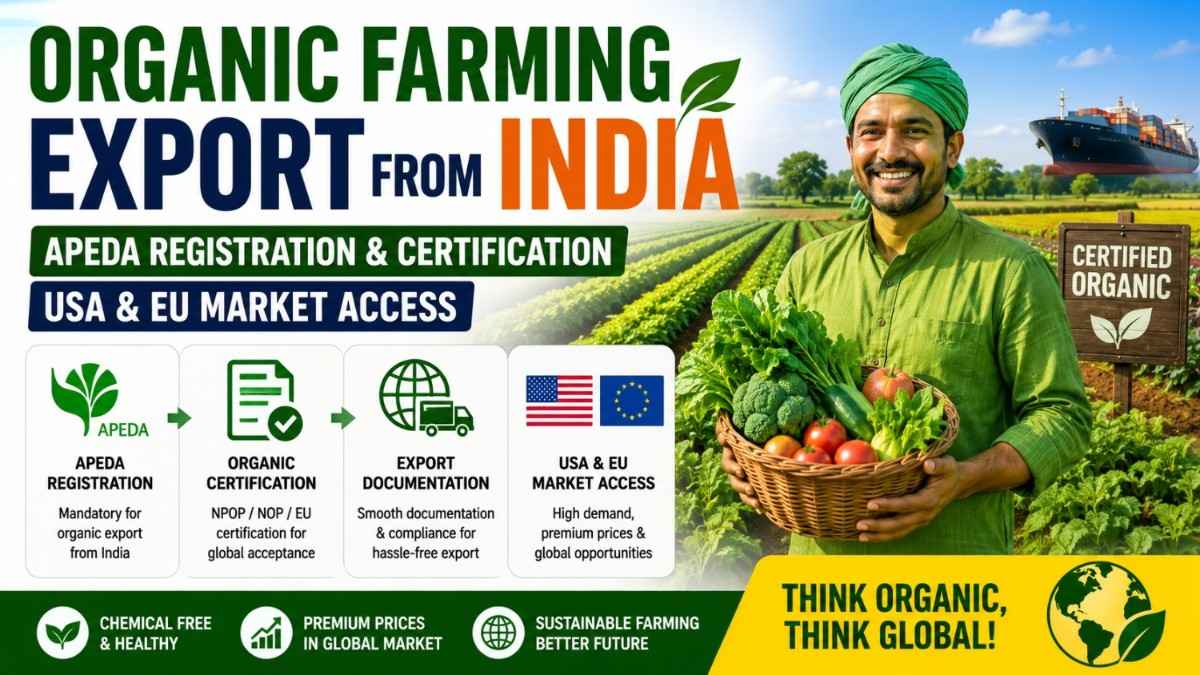
Organic farming export from India is one of the highest-margin, fastest-growing agri-business opportunities available to Indian farmers, FPOs, and agri-entrepreneurs in 2026. India is the world’s 2nd largest country by organic agricultural land and #1 in total number of organic producers globally — yet organic exports totalled only USD 665.97 million in FY 2024-25, representing a fraction of the potential in booming USA and EU markets. This complete, updated guide covers everything: APEDA registration steps, NPOP/NOP/EU certification process, costs and timelines, top export products and their premium pricing, income potential, and a step-by-step roadmap for farmers, FPOs, and exporters to successfully ship certified organic produce to global markets.

| India’s Organic Export Value (FY25) | USD 665.97 million (3.68 lakh MT) |
| India’s Rank (Organic Producers) | #1 in world by number of producers |
| Organic Agricultural Land | 59.12 lakh hectares (7.3 mha certified under NPOP) |
| Organic Sector CAGR | 25.25% (certified organic products, through 2027) |
| NPOP Certification Cost | Rs. 30,000–Rs. 50,000/year |
| USDA NOP Certification Cost | USD 750–USD 3,000+/year |
| EU Equivalency | NPOP ≡ EU Organic (no re-certification needed) |
| Top Regulatory Body | APEDA, Ministry of Commerce & Industry, Govt. of India |
- Organic Farming Export from India: Market Size & Opportunity 2026
- APEDA Registration: What It Is, Who Needs It & How to Apply
- NPOP Certification: Complete Step-by-Step Process for Organic Export
- Exporting Organic Products from India to USA: NOP Certification Guide
- Exporting Organic Products from India to EU: Standards & Process
- Top 8 Organic Products to Export from India in 2026 (With Prices)
- Income & Premium Pricing: How Much Can Organic Farmers Earn?
- Who Should Start Organic Farming Export from India?
- NPOP vs NOP vs EU Organic: Certification Comparison Table
- High-Value Organic Export Terms Every Farmer-Exporter Must Know
- Challenges & How to Overcome Them
- Frequently Asked Questions
Organic Farming Export from India: Market Size & Opportunity 2026
The global demand for certified organic food is surging, and organic farming export from India stands at the cusp of a massive expansion cycle. India’s organic food exports reached 3.68 lakh metric tonnes worth USD 665.97 million in FY 2024-25, as per NPOP TraceNet certification data. While this represents a recovery phase, the long-term trajectory is strongly upward — the global organic spice market alone is growing at over 12% annually, and India supplies over 75 varieties of spices to 150+ countries. Certified organic versions command a 20–100% price premium over conventional produce in USA and EU retail markets.
India holds a structurally advantageous position for organic farming export in 2026. It ranks #1 in the world by total number of organic producers and #2 by organic agricultural land. With 59.12 lakh hectares under organic farming and diverse agro-climatic zones producing everything from Himalayan cardamom to coastal black pepper, India can supply premium organic products across all major categories demanded by USA and EU buyers. The Govt. of India, through APEDA, has launched its 8th Edition of NPOP in 2026 and is actively negotiating organic equivalency with Australia, South Korea, Taiwan, Canada, and Japan — opening further export corridors.

| Year | Organic Export Volume (Lakh MT) | Organic Export Value (USD Million) | Key Trend |
|---|---|---|---|
| FY 2020-21 | 8.88 | $1,040.95 | Peak year; strong USA/EU demand |
| FY 2021-22 | 4.60 | $771.96 | Decline due to certification issues |
| FY 2022-23 | 3.13 | $708.33 | Quality standardisation challenges |
| FY 2023-24 | 2.61 | $494.80 | Regulatory tightening; lower volumes |
| FY 2024-25 | 3.68 | $665.97 | Recovery; NPOP 8th Ed. implementation |
| FY 2025-26 (est.) | 4.50+ | $800+ million | India-EU trade pact; BIOFACH 2026 boost |
APEDA Registration: What It Is, Who Needs It & How to Apply in 2026
APEDA — the Agricultural & Processed Food Products Export Development Authority — operates under the Ministry of Commerce & Industry, Govt. of India, and is the apex body for all agricultural export promotion activities, including organic farming export from India. An RCMC (Registration-cum-Membership Certificate) from APEDA is mandatory for any individual, FPO, or company exporting scheduled agri-products. APEDA-scheduled products include: fruits and vegetables, meat and poultry, dairy, cereals, processed foods, organic products, and floriculture. Without APEDA registration, exporters cannot access export promotion schemes, financial assistance, or TraceNet organic certification.
As per the latest data, APEDA-scheduled products alone contributed over USD 28 billion to India’s total agricultural exports of $51 billion in FY 2024-25. Small exporters, startups, and Farmer Producer Organisations (FPOs) are fully eligible to apply for APEDA registration — there is no minimum turnover requirement for initial registration.
Documents Required for APEDA Registration (2026)
- 📄 IEC Code Certificate — Import Export Code issued by DGFT (Directorate General of Foreign Trade); apply at dgft.gov.in; fee: Rs. 500
- 📄 PAN Card of the business entity (individual/firm/company/FPO)
- 📄 Bank Certificate or Cancelled Cheque — from the exporter’s current account
- 📄 GST Registration Certificate — mandatory for all export transactions
- 📄 Constitutive Document — MOA & AOA (for companies), Partnership Deed (for firms), or self-declaration (for proprietorships)
- 📄 Passport-size Photographs of the authorised signatory
- 📄 Proof of Business Address — rent agreement or utility bill
APEDA Registration: Step-by-Step Application Process
- Obtain IEC Code from DGFT portal (dgft.gov.in) — processing time: 2–3 working days; fee: Rs. 500
- Register on APEDA portal at apeda.gov.in — create an account with company PAN and IEC details
- Fill the RCMC application form online — enter product categories, business details, bank account information
- Upload all required documents in prescribed format (PDF, under 2MB each)
- Pay APEDA registration fee — Rs. 10,000 + GST (one-time; valid for 5 years)
- Application review by APEDA officer — processing time: 7–15 working days after document verification
- Receive RCMC certificate — download digitally from APEDA portal; valid for 5 years from date of issue
NPOP Certification: Complete Step-by-Step Process for Organic Farming Export from India
The National Programme for Organic Production (NPOP) is India’s official organic certification framework, implemented by APEDA since 2000. NPOP certification is mandatory for all organic farming export from India — no exporter can label products as “organic” in international markets without it. The programme’s standards are recognised as equivalent by the European Commission and Switzerland for unprocessed plant products, allowing Indian NPOP-certified organic products to be sold in EU markets without re-certification. The 8th Edition of NPOP was launched in 2026, with updated standards under active public consultation as of May 2026.
- Start the Conversion Period (3 Years) — Stop all synthetic pesticides, herbicides, chemical fertilisers, and GMO inputs. The land must be chemical-free for 3 years before the first certified organic harvest. Document all farm activities meticulously from Day 1 of conversion.
- Choose an APEDA-Accredited Certification Body (CB) — Select a CB accredited by APEDA under NPOP. Leading APEDA-accredited CBs include: ECOCERT India, Control Union Certifications, OneCert Asia, IMO Control, and LACON Quality Certification. For USA exports, ensure the CB is also USDA-NOP accredited.
- Prepare the Organic System Plan (OSP) — This is the core document describing your farm layout, crop rotation, input sources, pest management methods, record-keeping systems, harvest and post-harvest handling, and traceability procedures. The OSP must be updated annually.
- Submit Application to the Chosen CB — Submit the OSP, land records, farm maps, input purchase invoices, and conversion evidence. The CB will conduct a preliminary desk review.
- Undergo On-Site Inspection — The CB sends a trained inspector to physically verify that farm practices match the OSP. The inspector checks soil, inputs, storage facilities, records, and interviews farm workers. Inspection frequency: at least once per year (additional surprise inspections may occur).
- Receive NPOP Organic Certificate — If inspection is satisfactory, the CB issues the NPOP certificate within 30–60 days of inspection. The certificate specifies: certified operator name, certified products, farm area, and validity period (1 year, renewable annually).
- List on TraceNet Portal — All NPOP-certified operators are listed on APEDA’s TraceNet portal (organic.apeda.gov.in) — a public, traceable database that international buyers use to verify Indian organic certification before placing orders.
| Step | Activity | Approx. Time | Cost |
|---|---|---|---|
| 1 | Conversion period (chemical-free farming) | 36 months | Nil (operational cost only) |
| 2 | Choose accredited CB | 1–2 weeks | Nil |
| 3 | Prepare Organic System Plan | 2–4 weeks | Nil (self-prepared) or Rs. 5,000–15,000 (consultant) |
| 4 | Apply to CB & document review | 2–4 weeks | Included in CB fee |
| 5 | On-site inspection | 1 day | Included in CB fee |
| 6 | NPOP certificate issued | 30–60 days post-inspection | Rs. 30,000–Rs. 50,000/year (total CB fee) |
| 7 | TraceNet listing & annual renewal | Ongoing (annual) | Rs. 30,000–Rs. 50,000/year |
Exporting Organic Products from India to USA: NOP Certification Guide 2026
The USA is one of the largest and highest-value destinations for organic farming export from India, particularly for organic spices, Basmati rice, pulses, Ashwagandha, Tulsi, and Moringa. However, unlike the EU, India and the USA do not have a full NPOP-NOP organic equivalency agreement. This means Indian exporters face an additional certification requirement to legally use the USDA Organic seal in the American market.
Indian exporters have 2 compliant routes for the USA market:
- ✅ Route 1 (Preferred): Get certified by a USDA-NOP accredited Certification Body in India — Several Indian CBs hold dual NPOP + USDA-NOP accreditation: Control Union, OneCert Asia, IMO Control, and ECOCERT. This allows exporters to use the full USDA Organic seal on products shipped to US buyers. NOP certification cost: USD 750–USD 3,000+ per year, depending on farm size and product categories.
- ✅ Route 2 (Limited): Sell as “Indian Certified Organic” without the USDA seal — NPOP-certified products can be sold in US health food stores and specialty channels with an “Indian certified organic” label but cannot carry the official green USDA Organic circle logo. This route suits smaller volumes and niche importers.
APEDA is actively seeking NOP equivalency recognition with the USDA, with public consultations ongoing in May 2026 on procedures for import of NOP-certified organic ingredients for value-addition and re-export to USA — a sign of deepening India-USA organic trade cooperation. Monitor updates at APEDA official website.
Top Indian Organic Products in High Demand in the USA
- 🌾 Organic Basmati Rice — Whole Foods, Trader Joe’s, Costco; exported from Punjab, Haryana, Uttarakhand
- 🌿 Organic Ashwagandha & Tulsi — Sold by Organic India in 35+ countries via Whole Foods and iHerb; USD 8–15/kg at retail
- 🫙 Organic Turmeric Powder — #1 superfood in US health food retail; 51.01% export growth recorded recently
- 🌱 Organic Moringa Powder — Fast-growing superfood export from Tamil Nadu and Andhra Pradesh
- 🫘 Organic Pulses & Lentils — Growing with plant-based protein trend; red lentils, chickpeas, moong dal
- 🌶️ Organic Black Pepper & Cardamom — Kerala black pepper (“black gold”); Sikkim cardamom at premium prices
Exporting Organic Products from India to EU: Standards & Process 2026
The EU is India’s single most accessible major destination for organic farming export due to the formal NPOP-EU equivalency agreement. The European Commission has recognised NPOP standards as equivalent to EU Organic Regulation 2018/848 for unprocessed plant products. This means NPOP-certified Indian organic exporters can ship directly to EU buyers without paying for separate EU organic re-certification — a significant cost and time advantage.
India was named “Country of the Year” at BIOFACH 2026 — the world’s leading organic food trade fair held in Nuremberg, Germany — with over 100 Indian companies exhibiting. APEDA organised India’s pavilion, and the India-EU trade pact currently under negotiation is expected to further reduce tariff and non-tariff barriers for organic farming export from India into EU markets. The APEDA chairman confirmed in February 2026 that the organic sector has “huge opportunities for both sides” following meetings with EU Trade Commissioner Maros Sefcovic.
Key EU Export Compliance Requirements for Indian Organic Exporters
- 🇪🇺 NPOP Certificate — Valid NPOP certificate from an APEDA-accredited CB is the primary document; accepted at all EU ports of entry for unprocessed plant products
- 🇪🇺 TRACES NT Documentation — All organic shipments entering the EU must be registered in the TRACES (Trade Control and Expert System) database. Without correct TRACES documentation, shipments can be held or blocked at EU ports. The EU importer typically handles this with your certificate.
- 🇪🇺 Certificate of Inspection (COI) — For each shipment, the CB issues a COI confirming the product’s organic status. This is submitted to the EU customs authorities.
- 🇪🇺 Phytosanitary Certificate — Issued by the Plant Protection Organisation of India; required for all plant-based exports regardless of organic status
- 🇪🇺 MRL (Maximum Residue Limit) Compliance — EU has strict MRL standards. Organic products must undergo residue testing before shipment. APEDA-empanelled laboratories can issue compliant test reports.
Top 8 Organic Products to Export from India in 2026 – With Prices & Markets
Selecting the right product is the most critical decision in building an organic farming export from India business. Here are the 8 highest-value, highest-demand organic export categories in 2026:
| Product | Key States | Top Markets | Conventional Price | Organic Premium Price | Price Premium |
|---|---|---|---|---|---|
| Organic Basmati Rice | Punjab, Haryana, Uttarakhand | USA, EU, UAE, Saudi Arabia | Rs. 40–60/kg FOB | Rs. 80–120/kg FOB | +80–100% |
| Organic Black Pepper | Kerala | USA, Germany, Netherlands | Rs. 400–600/kg | Rs. 800–1,200/kg | +80–100% |
| Organic Turmeric | Andhra Pradesh, Telangana, Odisha | USA, UK, Germany, Japan | Rs. 80–120/kg | Rs. 160–280/kg | +80–130% |
| Organic Cardamom | Sikkim, Kerala | EU, Japan, Middle East | Rs. 1,200–1,800/kg | Rs. 2,200–3,500/kg | +70–90% |
| Organic Ashwagandha | Rajasthan, MP, Gujarat | USA, Germany, UK | Rs. 200–350/kg | Rs. 500–900/kg (USD 8–15/kg) | +100–150% |
| Organic Pulses & Lentils | MP, Rajasthan, Maharashtra | USA, UK, Canada, Germany | Rs. 60–100/kg | Rs. 120–200/kg | +80–100% |
| Organic Moringa Powder | Tamil Nadu, Andhra Pradesh | USA, EU, Japan, Australia | Rs. 100–150/kg | Rs. 300–600/kg | +150–300% |
| Organic Cotton | MP, Maharashtra, Rajasthan | USA, Germany, Netherlands | Rs. 60–80/kg lint | Rs. 90–130/kg lint | +30–60% |
Income & Premium Pricing: How Much Can Organic Farmers Earn from Export?
One of the most frequently asked questions about organic farming export from India is: what is the actual income potential? The answer depends on the crop, certification status, and export market — but the numbers are compelling for certified exporters:
- 🌾 Organic Basmati Rice Farmer (5 acres, Punjab) — Annual certified organic yield: ~15 MT. FOB price: Rs. 80–120/kg. Gross FOB revenue: Rs. 12–18 lakh/year. After logistics/certification costs (Rs. 1.5–2.5 lakh), net income: Rs. 10–15 lakh/year vs Rs. 4–6 lakh/year for conventional — a 2.5x income improvement
- 🌿 Organic Turmeric Farmer-Exporter (FPO, 50 acres) — Collective yield: ~150 MT. Processed turmeric powder export (EU): Rs. 200–280/kg. Gross revenue: Rs. 3–4.2 crore/year. FPO certification and processing costs: Rs. 15–25 lakh. Net income per member (50 farmers): Rs. 4–7 lakh/year each
- 🌱 Organic Moringa Powder Exporter (Tamil Nadu, 20 acres) — Moringa leaf powder exported to USA at USD 6–12/kg. Annual export volume: 15–20 MT. Revenue: Rs. 75 lakh–Rs. 1.5 crore/year. Highest-margin organic export category in 2026 with 150–300% premium over conventional.
Who Should Start Organic Farming Export from India in 2026?
Organic farming export from India in 2026 is not limited to large agribusinesses. Here are 8 specific profiles for whom this opportunity is ideal:
- 👨🌾 Progressive Farmers with 3+ Acres — Farmers who have already been practising low-chemical or traditional farming and can fast-track the 3-year conversion period. Ideal crops: spices, pulses, rice, oilseeds.
- 🤝 Farmer Producer Organisations (FPOs) — FPOs can pool resources to share certification costs (Rs. 30,000–50,000/year spread across 100+ members = Rs. 300–500/farmer/year) and achieve export lot sizes required by international buyers (minimum 5–20 MT per shipment).
- 🌾 Farmers in Certified Organic States — Sikkim (100% organic), Uttarakhand, Meghalaya, Himachal Pradesh — where conversion infrastructure and CB networks already exist, reducing time-to-market.
- 🏭 Agricultural Entrepreneurs & Startups — Those who want to build branded organic product businesses (powders, extracts, tea blends) for USA and EU online retail channels (Amazon USA, iHerb, Thrive Market).
- 👩🌾 Women Self-Help Groups (SHGs) in Rural Areas — SHGs in spice-growing regions can access APEDA financial assistance and Agri Infra Fund for basic processing units, creating Rs. 3,000–8,000/month additional income per member.
- 📦 Existing Conventional Exporters Seeking Upgrade — Spice, pulse, or grain exporters already holding IEC and APEDA RCMC who want to add an organic product line to access premium-price market segments.
- 🏦 Agribusiness Investors — Those looking to set up contract organic farming networks, aggregation centres, and processing units with 25.25% CAGR sector growth and direct supply agreements with EU/USA organic buyers.
- 🎓 Agriculture Graduates & Rural Entrepreneurs (Age 22–35) — Young agri-graduates who can build organic export trading businesses using APEDA’s BHARATI Startup support and government export promotion subsidies available in 2026.
NPOP vs NOP vs EU Organic: Certification Comparison for Indian Exporters 2026
Understanding the differences between the 3 major certification standards is essential for any organic farming export from India business plan. Here is a comprehensive 9-row comparison:
| Parameter | NPOP (India) | USDA NOP (USA) | EU Organic (EU Reg. 2018/848) |
|---|---|---|---|
| Governing Body | APEDA, Govt. of India | USDA, US Federal Govt. | European Commission |
| Mandatory For | All Indian organic exporters | Selling as “USDA Organic” in USA | Selling as “EU Organic” in EU |
| Annual Cost | Rs. 30,000–50,000 | USD 750–3,000+ | €500–2,000+ (via NPOP for India) |
| Conversion Period | 3 years chemical-free | 3 years chemical-free | 2–3 years (crop-dependent) |
| India-EU Equivalency | ✅ Yes (unprocessed plants) | ❌ No separate needed | ✅ NPOP = EU Organic accepted |
| India-USA Equivalency | ❌ No full equivalency | Needs USDA-accredited CB | Not applicable |
| Accrediting Body for CBs | APEDA | USDA Agricultural Marketing Service | DAkkS / national accreditation bodies |
| Market Access | India + EU + Switzerland (direct) | USA market (USDA seal use) | All 27 EU countries + UK (partial) |
| Best For Indian Exporters | Starting point; mandatory | Add-on for USA market access | Covered under NPOP equivalency |
High-Value Organic Export Terms Every Farmer-Exporter Must Know in 2026
Building a successful organic farming export from India business requires mastering these 10 essential terms used by international buyers, certification bodies, and regulatory authorities:
- 💡 NPOP (National Programme for Organic Production) — India’s official organic standard under APEDA. EU-equivalent for unprocessed plant products. Foundation of all organic farming export from India.
- 💡 TraceNet — APEDA’s online organic certification database (organic.apeda.gov.in) where all NPOP-certified operators are listed. International buyers verify Indian organic suppliers here before placing orders.
- 💡 Organic System Plan (OSP) — The master document every NPOP applicant must submit to their Certification Body, detailing farm layout, input management, pest control methods, and traceability systems.
- 💡 Certification Body (CB) — APEDA-accredited third-party organisation that inspects farms, reviews OSPs, and issues NPOP certificates. Examples: ECOCERT India, Control Union, OneCert, IMO Control.
- 💡 RCMC (Registration-cum-Membership Certificate) — APEDA’s registration credential for exporters; mandatory prerequisite for accessing NPOP certification and APEDA financial assistance schemes.
- 💡 IEC (Import Export Code) — 10-digit code issued by DGFT; the foundational licence required before any export activity from India. Apply at dgft.gov.in; fee: Rs. 500.
- 💡 TRACES NT (EU) — EU’s digital system for tracking all organic product shipments entering the bloc. COI (Certificate of Inspection) must be registered in TRACES for every EU-bound organic shipment from India.
- 💡 MRL (Maximum Residue Limit) — EU and USA standards for pesticide residue levels in food products. Organic products must test below MRL thresholds; APEDA-empanelled labs provide compliant testing.
- 💡 FOB (Free on Board) Price — The export price benchmark at the Indian port of loading, excluding freight and insurance. Organic products are typically priced FOB for international trade negotiations.
- 💡 PGS-India (Participatory Guarantee System) — Government-recognised organic certification for domestic markets only, at near-zero cost. NOT accepted for organic farming export from India; NPOP is required for all exports.
Challenges in Organic Farming Export from India & How to Overcome Them in 2026
India’s organic export data reveals significant challenges — volumes fell from 8.88 lakh MT (FY21) to 2.61 lakh MT (FY24) before recovering. Understanding and mitigating these challenges is essential for sustainable organic farming export from India:
- ⚠️ Certification Lapses & Documentation Gaps — The leading cause of India’s organic export decline was certification-related non-compliance with EU and USA traceability requirements. Solution: maintain meticulous daily farm records, use APEDA’s digital TraceNet portal, and never miss annual CB inspection deadlines.
- ⚠️ Minimum Lot Size Requirements — International buyers typically require 5–20 MT minimum per shipment of organic products. Individual farmers cannot meet this alone. Solution: form or join an FPO or cooperative to aggregate production and meet buyer requirements collectively.
- ⚠️ MRL Failures at Destination Ports — Cross-contamination from adjacent conventional farms can cause residue failures, destroying entire shipments. Solution: maintain 10–15 metre buffer zones, use physical barriers, test products at APEDA-approved labs before shipping, and select NPOP CBs that offer pre-shipment testing guidance.
- ⚠️ 3-Year Conversion Income Gap — Farmers lose premium pricing for 3 years during the conversion period. Solution: apply for the Govt. of India’s organic farming conversion support under PM-KISAN supplementary schemes; sell as “in-conversion organic” to niche buyers at 10–20% above conventional prices during this phase.
- ⚠️ USA NOP Certification Cost Barrier — USD 750–3,000/year is a significant barrier for small farmers. Solution: apply through FPOs to share NOP certification costs; target the EU market first (NPOP sufficient) and add NOP only after establishing EU revenue streams.
Frequently Asked Questions – Organic Farming Export from India 2026
What is APEDA registration and is it mandatory for organic farming export from India?
APEDA (Agricultural & Processed Food Products Export Development Authority) registration is mandatory for all exporters of scheduled agricultural products, including organic foods. You obtain an RCMC (Registration-cum-Membership Certificate) from APEDA at apeda.gov.in, which is required to access export promotion benefits and is a prerequisite for NPOP organic certification. Small exporters, FPOs, and startups are all eligible to apply. Fee: Rs. 10,000 + GST (valid 5 years).
What is NPOP certification and who needs it for organic farming export from India?
NPOP — National Programme for Organic Production — is India’s official organic certification standard, implemented by APEDA since 2000. NPOP certification is mandatory for any Indian exporter who wishes to label products as “organic” internationally. NPOP standards are recognised as equivalent by the EU and Switzerland, allowing direct export to EU markets without re-certification. Certification costs Rs. 30,000–Rs. 50,000 per year through an APEDA-accredited Certification Body.
Is NPOP certification accepted in the USA for organic farming exports?
India and the USA do not have a full organic equivalency agreement. For organic farming export from India to the USA, exporters must get certified by a USDA-NOP accredited CB (many Indian CBs like Control Union, OneCert, and IMO Control hold dual accreditation) to use the USDA Organic seal. Alternatively, products can be sold in USA specialty markets as “Indian certified organic” without the USDA seal. NOP certification costs USD 750–USD 3,000+ per year. APEDA is actively negotiating NOP equivalency.
What is the value of organic food exports from India in 2024-25?
India’s organic food exports reached 3.68 lakh metric tonnes worth USD 665.97 million in FY 2024-25, per NPOP TraceNet data. This represents a recovery from FY 2023-24’s low of USD 494.80 million. Total agricultural exports from India exceeded $50 billion in FY 2025-26. With demand for certified organic spices growing over 12% annually globally and India positioned as the world’s #1 organic producer nation by number of farms, the trajectory for organic farming export from India is strongly upward.
What are the top organic products exported from India to USA and EU?
The top organic products for export from India include: organic Basmati rice (largest by value; USA, EU, UAE), organic spices (turmeric, black pepper, cardamom, ginger; 12%+ annual demand growth in USA/EU), organic pulses and lentils (USA, UK, Canada, Germany), organic herbs and superfoods (Ashwagandha, Tulsi, Moringa sold via Whole Foods, Holland & Barrett), and organic cotton (USA, Germany, Netherlands). Sikkim cardamom and Kerala black pepper command the highest per-kg premiums in EU specialty retail.
How many steps are there in the APEDA NPOP certification process?
The NPOP certification process for organic farming export from India involves 7 key steps: (1) obtain IEC code from DGFT, (2) register with APEDA and get RCMC, (3) complete the 3-year chemical-free conversion period, (4) choose an APEDA-accredited Certification Body, (5) submit the Organic System Plan (OSP), (6) undergo on-site inspection by the CB, and (7) receive NPOP certificate (valid 1 year, renewable annually) and list on TraceNet. Total elapsed time after conversion: 3–6 months for the certification itself.
What documents are required for APEDA registration for organic export?
Documents required for APEDA registration include: IEC code certificate (from DGFT), PAN card, bank certificate or cancelled cheque, GST registration certificate, constitutive document (MOA/Partnership Deed/self-declaration), and passport-size photographs of the authorised signatory. After APEDA registration, additional documents for NPOP certification include: land ownership/lease records, farm maps, input purchase records, conversion plan, and the Organic System Plan (OSP). All documents must be self-attested and uploaded to the APEDA portal in PDF format.
What is the income potential from organic farming export in India?
Organic farming export from India offers price premiums of 20–300% above conventional produce, depending on the crop. Certified organic Basmati rice fetches Rs. 80–120/kg FOB vs Rs. 40–60/kg conventional. Organic black pepper commands Rs. 800–1,200/kg vs Rs. 400–600/kg. Organic Moringa powder earns USD 6–15/kg in USA/EU retail. A 5-acre organic Basmati rice farm in Punjab can generate Rs. 10–15 lakh/year net income after NPOP certification costs — 2.5x the conventional income. With India’s organic sector growing at 25.25% CAGR through 2027, the income potential for certified exporters is among the highest in Indian agriculture.
Which states in India are best for starting an organic farming export business?
The top states for organic farming export from India in 2026 are: Sikkim (world’s first 100% organic state; premium cardamom and ginger), Madhya Pradesh (largest organic acreage; soybeans, pulses, sesame), Rajasthan (cumin, isabgol, sesame), Kerala (black pepper, coconut, cardamom), Uttarakhand and Himachal Pradesh (organic Basmati, herbs), and Meghalaya (organic ginger and turmeric). These states have APEDA-accredited CBs operating locally and established export logistics corridors to JNPT, Chennai, and Kolkata ports.
This guide on organic farming export from India is regularly reviewed and updated for accuracy. Bookmark this page for the latest NPOP notifications, certification updates, and market opportunities. For agriculture career opportunities in India’s booming organic export sector, visit Agrijob.in — India’s #1 Agriculture Job & Career Portal.
Last Updated: May 2026 | Sources: APEDA (apeda.gov.in), NPOP 8th Edition 2026, IMARC Group, Global Agriculture, Organic Mandya, Radiance Overseas, Decentro Agritech Report 2026, Vision IAS Current Affairs