
Japan’s plant factory industry is at an inflection point in 2026: the country now operates approximately 440 plant factories — 1.4 times the total from a decade ago — while its government has pledged a staggering JPY 4.6 trillion (roughly USD 28.3 billion) in combined public and private investment by fiscal 2040. This guide is for investors, agri-tech entrepreneurs, food industry executives, and policy researchers who want a factual, current picture of Japan’s indoor farming sector. It covers market size, key players, government policy, technology trends, investment outlook, and the real challenges operators face today.

Japan’s plant factory industry in 2026 operates around 440 facilities nationwide, backed by a government target of JPY 4.6 trillion in investment by fiscal 2040. Key players include Spread Co., MIRAI Co., Oishii Farm, Panasonic, and Mitsubishi Chemical, with the Japan indoor farming market growing at a CAGR of approximately 10.23% and projected to reach USD 3.3 billion by 2033.
- Number of Plant Factories in Japan: ~440 (as of 2026, up 1.4x from a decade ago)
- Government Investment Target (by FY2040): JPY 4.6 trillion (~USD 28.3 billion)
- Japan Indoor Farming Market Size (2025): USD 1.47 billion
- Projected Market Size (2034): USD 3.34 billion
- Market CAGR (2025–2034): ~9.6–10.23%
- Global Plant Factory Market (2026): USD 4.14 billion (growing at 10.2% CAGR to 2035)
- Asia-Pacific Market Share: ~42% of global plant factory market
- Farmers in Japan (2026): ~980,000 (down from 2.05 million in 2010)
- Key Policy Body: Ministry of Agriculture, Forestry and Fisheries (MAFF)
- Latest Oishii Farm Funding Round (May 2026): JPY 24 billion (~USD 157 million)
- Primary Crops Produced: Leafy greens, lettuce, strawberries, herbs
- Leading Technology: Hydroponics, AI-driven environment control, LED lighting
📋 Table of Contents
- What Is a Plant Factory and Why Is Japan Leading the Sector?
- Who Should Read This Guide?
- Japan Plant Factory Market Size and Growth Forecast 2026
- Key Players in Japan’s Plant Factory Industry 2026
- Japan Government Policy and MAFF Investment Roadmap
- How a Japanese Plant Factory Works — Step-by-Step Process
- Plant Factory vs Traditional Greenhouse Farming in Japan
- Pros and Cons of Plant Factories in Japan
- Investment Outlook — Where the Money Is Going in 2026
- Important Terms and Concepts in Japan’s Plant Factory Sector
- Important Links and Resources
- Conclusion
- Key Takeaways
- Frequently Asked Questions
What Is a Plant Factory and Why Is Japan Leading the Sector?
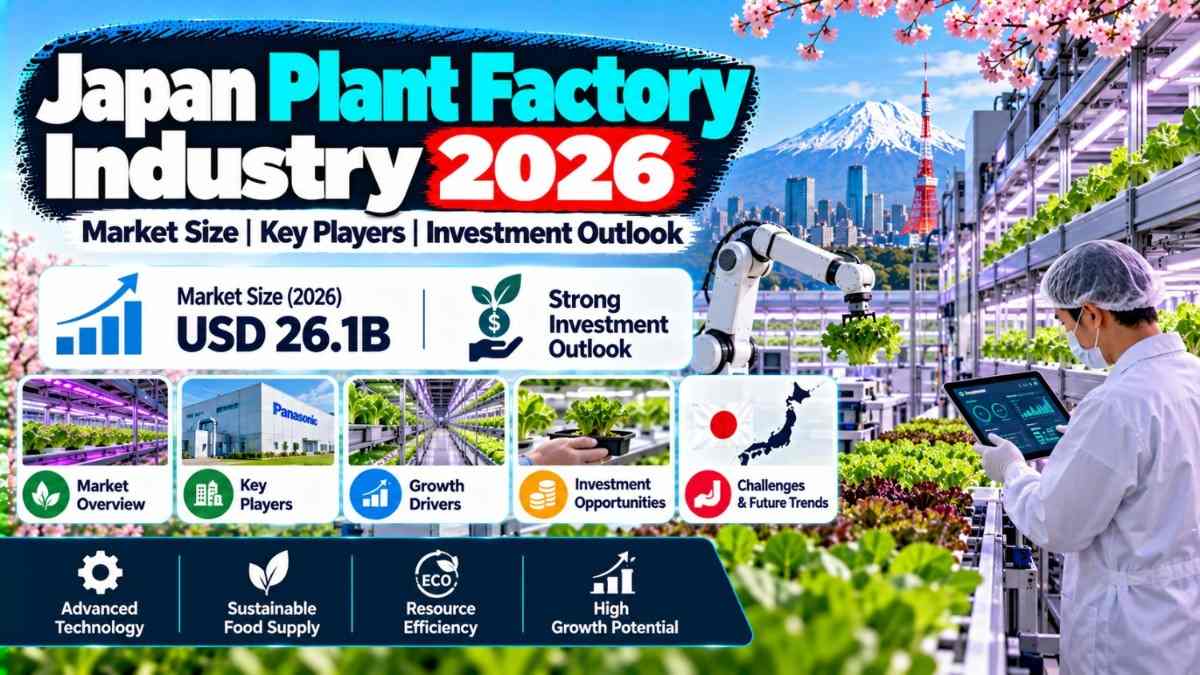
A plant factory (植物工場, shokubutsu kojo) is a fully or partially enclosed agricultural facility that uses artificial lighting, climate control, hydroponics or aeroponics, and sensor-driven automation to grow crops year-round — completely independent of outdoor weather conditions. Japan defines plant factories as production systems capable of delivering crops at fixed times, fixed quantities, fixed prices, and fixed quality levels — a framework known in Japanese agri-tech circles as the “4-Tei” principle (定時・定量・定価格・定品質).

Japan is widely recognized as one of the world’s pioneers in commercial plant factory development. Electronics companies including Toshiba, Panasonic, and Fujitsu entered the indoor farming space beginning around 2008, converting idle manufacturing facilities into controlled-environment farms. Today, Japan hosts around 440 plant factories, a ratio that gives it one of the highest per-capita densities of plant factory operations globally. The country’s aging farmer population — down to roughly 980,000 primary-income farmers in 2026 from 2.05 million in 2010 — is a structural driver making plant factories essential rather than optional for national food security.
The Japanese government formally classified plant factories as a strategic national industry in November 2025 under the Japan Growth Strategy Council, positioning them alongside semiconductors and AI as priority sectors for public-private co-investment. The Ministry of Agriculture, Forestry and Fisheries (MAFF) published its Agricultural Research and Innovation Strategy 2026 in July 2026, explicitly naming automated harvesting in plant factories with AI environmental management as a core development target.
Who Should Read This Guide?
- 🌱 Agricultural investors looking at Japan’s indoor farming sector for portfolio diversification
- 🏭 Food manufacturers and retailers evaluating domestic sourcing partnerships with plant factory operators
- 📊 Agri-tech startup founders seeking a competitive landscape overview before entering Japan
- 🏛️ Policy researchers and government advisors tracking Japan’s MAFF investment roadmap
- 🎓 Agricultural university students and researchers studying controlled environment agriculture (CEA)
- 🧑💼 Corporate strategy teams at electronics, construction, and real estate firms exploring plant factory partnerships
- 🌍 International farming businesses considering Japan as a market entry or technology licensing destination
- 📰 Journalists and analysts covering Japan’s food technology and agri-investment sector in 2026
Japan Plant Factory Market Size and Growth Forecast 2026
The Japan indoor farming market was valued at approximately USD 1.47 billion in 2025 and is projected to reach USD 3.34 billion by 2034, growing at a compound annual growth rate (CAGR) of 9.6% over the forecast period. Within the broader global context, the international plant factory market is estimated at USD 4.14 billion in 2026, expected to reach USD 10.01 billion by 2035 at a 10.2% CAGR — and Japan accounts for a significant share of the Asia-Pacific region’s 42% global dominance.
| Market Metric | Value / Figure |
|---|---|
| Japan Indoor Farming Market (2025) | USD 1.47 billion |
| Japan Indoor Farming Market (2034 projected) | USD 3.34 billion |
| Japan Market CAGR (2025–2034) | ~9.6% |
| Japan Greenhouse Horticulture Market (2026) | USD 4.8 billion |
| Global Plant Factory Market (2026) | USD 4.14 billion |
| Global Plant Factory Market (2035 projected) | USD 10.01 billion |
| Asia-Pacific Share of Global Market | ~42% |
| Japan Government Investment Target (by FY2040) | JPY 4.6 trillion (~USD 28.3 billion) |
| Active Plant Factories in Japan (2026) | ~440 |
| Japan Plant Factory Growth vs. 10 Years Ago | 1.4x increase |
The hydroponics segment dominates Japan’s indoor farming market by growing mechanism, while leafy vegetables — particularly lettuce varieties — account for the largest share of production. The market is now expanding beyond lettuce into strawberries, tomatoes, herbs, and high-value functional foods. Japan’s Japan Plant Factory Association (JPFA) held its 3rd International Symposium on Plant Factory in Chiba in August–September 2026, reflecting the global academic and commercial interest in Japan’s sector leadership.
Key Players in Japan’s Plant Factory Industry 2026
Japan’s plant factory competitive landscape combines specialist indoor farming companies, electronics manufacturers that pivoted into agri-tech, and well-funded startups attracting international capital. Here are the most significant operators and investors shaping the sector in 2026.
Spread Co., Ltd. (Kyoto) — Largest Automated Vertical Farm Operator
Spread Co. operates Techno Farm Keihanna near Kyoto, widely cited as one of the world’s largest automated vertical farms, producing 30,000 heads of lettuce daily under its Vegetus brand. The company raised approximately USD 30 million (JPY 4 billion) in a Series A round, claiming the largest single fund-raising in the Japanese food tech sector at the time. Spread’s Techno Farm model is designed to be replicated across 100+ locations through franchise-style partnerships. Spread also focuses on R&D into strawberries and alternative protein sources, with automation cutting labour costs by 50% and energy costs by 30% compared to earlier facilities.
MIRAI Co., Ltd. (Tokyo) — Hydroponic Systems and Vertical Farm Operator
MIRAI (formerly Mirai Co., Ltd.) operates automated hydroponic vertical farms and also supplies complete cultivation systems to third-party buyers. Based in Tokyo and founded in 2004, MIRAI is one of Japan’s original specialist plant factory operators. The company showcased its produce and technology at the JPFA International Symposium in 2026, emphasizing advances in AI-driven environmental control, LED optimization, and crop phenotyping. MIRAI’s business model spans both direct farming operations and equipment supply — a dual revenue structure that distinguishes it from pure-play operators.
Oishii Farm Corporation — Japan-Origin Global Strawberry Plant Factory Leader
Oishii Farm is arguably the highest-profile plant factory investment story in Japan in 2026. Founded in 2016 and headquartered in New Jersey, USA, with its technology roots in Japan, Oishii Farm raised approximately JPY 24 billion (USD 157 million) in its Series C first close in May 2026, bringing its cumulative total funding to approximately JPY 52.5 billion. Investors in this round included Sparx Group (lead investor), NTT (IoT and infrastructure), Yasukawa Electric, Misumi Group, Nomura Real Estate, Asahi Kogyosha, Mizuho Bank, Ebara Corporation, and Daiwa House Industry. The company opened a large-scale R&D base, the Open Innovation Centre, in Hamura, western Tokyo, in August 2026. Agriculture Minister Norikazu Suzuki personally visited the facility in January 2026, underscoring its national strategic importance. CEO Hiroki Koga has described the plant factory sector as a potential JPY 100 trillion global industry, with Japan positioned to capture a 30% domestic and international market share by 2040.
Panasonic Corporation — Technology Supplier and Indoor Farm Operator
Panasonic is one of Japan’s major electronics companies that entered the plant factory space as both an operator and technology provider. The company leverages its expertise in LED lighting, environment control systems, and IoT to power indoor cultivation facilities. Panasonic’s involvement reflects a broader pattern in Japan where consumer electronics giants have repositioned themselves as agri-tech infrastructure providers.
Mitsubishi Chemical Group — Hydroponic System Developer
Mitsubishi Chemical Group develops and markets plant factory systems through its subsidiary Mitsubishi Chemical Aqua Solutions (MCAS). The company’s flagship product, the “Napper Land” thin-film hydroponic system for leafy vegetables, is deployed across multiple facilities. Mitsubishi Chemical also supplies NFT (Nutrient Film Technique) plant factory systems for tomatoes and cucumbers. The group’s involvement signals that Japan’s major chemical and materials companies view plant factory infrastructure as a growth market.
Other Notable Players
Additional companies active in Japan’s plant factory sector include 808 Factory (Shizuoka — known for its traceability systems and solar-powered operations), NTT Agri Innovation, Tsubakimoto Chain Co. (automated systems for plant factories, including its Fukui Mihama facility producing 2.2 tonnes of lettuce per day), Chubu Electric Power Co., ES-CON Japan Ltd., and Leaf Factory Tokyo Co., Ltd. The Japan Plant Factory Association (JPFA), presided over by Eri Hayashi, coordinates industry research, standards, and international academic collaboration.
Japan Government Policy and MAFF Investment Roadmap
Japan’s government commitment to plant factories moved from supportive to structurally strategic between 2025 and 2026. Under Prime Minister Sanae Takaichi’s administration, plant factories were formally designated as one of 17 strategic sectors at the Japan Growth Strategy Council in November 2025. The follow-up public-private investment roadmap published in draft form in June 2026 allocated JPY 4.6 trillion specifically to plant factories — the single largest allocation within the JPY 9.7 trillion food technology sector envelope targeting cumulative investment through to 2040.
MAFF published its Agricultural Research and Innovation Strategy 2026 on July 21, 2026. Key priorities for plant factories include: automated harvesting with AI environmental management, AI-driven quality control systems, new market acquisition through functional food production (including crops containing pharmaceutical precursor compounds), and international standards leadership. Japan explicitly aims to achieve a 30% domestic and international market share in plant factory exports by 2040. The MAFF’s FY2026 budget also includes provisions for smart farming subsidies covering up to 40% of automated equipment costs, and the Cropland Act establishes a dedicated “Advanced Agricultural Production Facility” legal category to streamline plant factory construction approvals.
Under Japan’s Investment Facilitation Act, corporations and limited liability partnerships (LPS) can obtain MAFF approval for their agricultural business plans, unlocking special tax measures and simplified cropland conversion permissions. If you are structuring a plant factory investment vehicle in Japan, securing MAFF approval as an “Advanced Agricultural Production Facility” significantly reduces regulatory friction and may qualify you for government co-investment incentives.
How a Japanese Plant Factory Works — Step-by-Step Process
- Facility Design and Construction: A fully enclosed or semi-enclosed structure is built, typically converting existing industrial space (former factories or warehouses). Walls, floors, and ceilings are insulated and sealed to maintain controlled internal conditions. Investment at this stage typically ranges from JPY 500 million to several billion yen for commercial-scale operations.
- Climate Control System Installation: HVAC systems, CO2 enrichment units, humidity controllers, and precision temperature regulators are installed. AI-driven sensors monitor and adjust conditions in real time, maintaining optimal growing parameters for each crop type.
- Hydroponic or Aeroponic System Setup: Nutrient-enriched water is circulated through growing trays (deep flow technique, NFT, or thin-film systems). Water recycling systems recover 90%+ of water used, a significant efficiency advantage over open-field farming.
- LED Lighting Configuration: Specialized LED arrays tuned to specific wavelength spectrums (typically red and blue light for photosynthesis optimization) are positioned above crop rows. LED energy consumption represents 75–80% of total electricity usage in fully enclosed plant factories, making this the primary cost management target.
- Seed Germination and Transplanting: Seeds are germinated in controlled nursery trays. Automated transplanting robots (or semi-automated systems) move seedlings to cultivation racks at the correct growth stage. Spread’s Techno Farm model automates this from seeding through to packaging.
- Growth Monitoring and AI Management: IoT sensors track plant height, leaf colour, weight gain, and photosynthesis rates. AI systems compare real-time data against optimal growth models and auto-adjust lighting intensity, nutrient concentrations, and CO2 levels. Oishii Farm uses AI specifically to manage its bee pollination environments for strawberry production.
- Harvest and Packaging: Crops are harvested by automated robotic arms or trained staff. Produce goes directly into food-safe packaging within the controlled environment, minimising contamination risk. Produce is pesticide-free by design — a premium selling point in Japan’s retail market.
- Quality Control and Traceability: Each batch is logged with full environmental data from seed to harvest. 808 Factory, for example, offers per-product, per-second, per-worker traceability — a level of supply chain transparency unavailable in conventional farming.
- Distribution to Retail and Foodservice: Products are shipped under cold chain to supermarkets, convenience stores, food manufacturers, and foodservice operators. Spread’s Vegetus brand is sold at major Japanese supermarkets and retailers nationwide.
Plant Factory vs Traditional Greenhouse Farming in Japan
Understanding how plant factories compare to Japan’s established greenhouse horticulture sector is essential for both investors and operators. Japan’s greenhouse horticulture market is valued at approximately USD 4.8 billion in 2026 — comparable in size to the indoor farming market — but serves different quality and consistency objectives.
| Dimension | Plant Factory (Fully Enclosed) | Greenhouse Horticulture |
|---|---|---|
| Weather Dependency | Zero — fully controlled environment | Partial — natural light used; weather affects yields |
| Crop Consistency | 4-Tei: fixed time, quantity, price, quality | Variable by season and climate conditions |
| Pesticide Use | None required (closed system) | Often required for pest management |
| Water Efficiency | 90%+ water recycling typical | High water use; less recycling |
| Initial Capital Cost | Very high (JPY 500M–several billion) | Lower (JPY 50M–500M typical) |
| Electricity Cost | Very high (lighting = 75–80% of electricity) | Lower (natural light reduces LED cost) |
| Land Requirement | Minimal — vertical stacking possible | Significant horizontal land required |
| Crop Variety Range | Currently mainly leafy greens, expanding | Wide range: vegetables, fruits, flowers |
| Labour Cost | Reducing rapidly with automation | Labor-intensive, rising costs a challenge |
| Profitability | Challenging; improving with scale and AI | Established but squeezed by energy costs |
| Government Support 2026 | Strategic priority — JPY 4.6T target | Smart greenhouse subsidy programs ongoing |
| Best Suited For | Urban areas, food security, premium produce | Broader crop variety, rural production |
For investors evaluating Japan’s controlled agriculture sector in 2026, plant factories offer superior food security and quality consistency but require significantly higher upfront capital and carry higher operating costs due to electricity. Greenhouse horticulture remains more profitable on a per-facility basis today. However, for the next 5–10 years, government policy, demographic pressure, and technology cost curves strongly favour plant factories as the strategic growth bet — particularly for investors willing to participate in the JPY 4.6 trillion investment programme backed by MAFF.
Pros and Cons of Plant Factories in Japan
Advantages of Japan’s Plant Factory Model
- ✅ Year-round production completely independent of seasons, typhoons, and temperature extremes
- ✅ Pesticide-free produce in a closed environment, commanding premium retail prices and consumer trust
- ✅ Water recycling efficiency of 90%+, critical as Japan addresses resource sustainability targets
- ✅ Urban proximity — facilities can be built near consumption centres, cutting logistics costs and carbon footprint
- ✅ AI-accelerated crop development — Oishii Farm states its AI breeding program achieves “hundreds of years” of traditional breeding progress in a single year
- ✅ Full traceability from seed to shelf, meeting the highest retail and regulatory standards in Japan and export markets
- ✅ Strategic government backing through MAFF’s JPY 4.6 trillion investment roadmap and Innovation Strategy 2026
Disadvantages and Challenges
- ❌ Very high initial capital expenditure — commercial-scale facilities require hundreds of millions to billions of yen upfront
- ❌ High electricity costs — lighting alone consumes 75–80% of total electricity, making profitability difficult when energy prices rise
- ❌ Crop variety limitations — most commercial facilities still focus on leafy greens; fruits and root vegetables remain in R&D phase
- ❌ Bankruptcy risk — some operators in Japan have failed to recover initial costs despite growing demand, highlighting the sector’s economic fragility at sub-scale operations
- ❌ Labour dependence despite automation — most Japanese farms remain partially dependent on manual labour, and a 5%+ annual rise in labour costs is squeezing margins across the sector
Investment Outlook — Where the Money Is Going in 2026
Japan’s plant factory investment landscape in 2026 reflects both public commitment and growing private confidence, despite the sector’s well-known profitability challenges. The most significant investment signals this year include:
- Oishii Farm’s JPY 24 billion Series C (May 2026) brought cumulative funding to JPY 52.5 billion. The round attracted NTT, Yasukawa Electric, Nomura Real Estate, Daiwa House Industry, and Mizuho Bank — representing a cross-sector coalition of telecoms, robotics, real estate, construction, and finance.
- Tsubakimoto Chain’s Fukui Mihama Plant Factory — a JPY 2.8 billion fully operational artificial-light plant factory producing 2.2 tonnes of lettuce per day, launched in May 2025. This demonstrates large industrial manufacturers diversifying into agri-production.
- MAFF’s FY2026 food-tech investment roadmap positions plant factories as a JPY 4.6 trillion national investment priority, creating a structural policy backstop for private capital entering the sector.
- Mitsui Bussan (Mitsui & Co.) invested in Italian plant factory startup Zero and is pursuing a plant factory development project in Saudi Arabia — showing Japanese trading houses are exporting the model internationally.
- NTT’s strategic role as IoT and infrastructure partner to Oishii Farm positions Japan’s largest telecom as a key enabler of next-generation plant factory connectivity and data analytics platforms.
Investors entering the sector in 2026 should focus on three sub-themes: (1) technology suppliers — LED manufacturers, AI environmental control system developers, and robotic automation companies serving plant factories; (2) operators with scale — companies like Spread and Oishii Farm that are achieving production volumes large enough to improve unit economics; and (3) real estate enablers — developers like Nomura Real Estate and Daiwa House Industry that are creating the physical infrastructure to support large-scale facilities.
Important Terms and Concepts in Japan’s Plant Factory Sector
- PFAL (Plant Factory with Artificial Lighting): The fully enclosed plant factory model using only artificial LED lighting — the dominant form in Japan’s indoor farming sector. Electricity costs for PFALs are the primary profitability challenge.
- CEA (Controlled Environment Agriculture): The broad category encompassing all forms of indoor and greenhouse farming where environmental variables (temperature, humidity, CO2, light) are actively managed.
- 4-Tei Principle (4定): Japan’s unique plant factory quality framework — fixed delivery time, fixed quantity, fixed price, and fixed quality. This differentiates plant factory produce from weather-dependent conventional farming.
- Hydroponics: A soil-less growing system where plant roots are submerged or misted with nutrient-enriched water solutions. The dominant growing mechanism in Japan’s plant factories, particularly for leafy vegetables.
- NFT (Nutrient Film Technique): A hydroponic method where a thin stream of nutrient solution flows over plant roots in shallow channels — used by Mitsubishi Chemical for tomato and cucumber plant factory systems.
- MAFF (Ministry of Agriculture, Forestry and Fisheries): Japan’s primary government body overseeing agriculture policy, plant factory regulation, subsidy programs, and investment roadmaps.
- JPFA (Japan Plant Factory Association): The industry body coordinating research standards, practitioner networking, and international collaboration for Japan’s plant factory sector. Led by President Eri Hayashi.
- Vegetus: Spread Co.’s consumer brand for vertically farmed pesticide-free lettuce, available in major Japanese supermarkets — one of the best-known plant factory retail brands in Japan.
- Aquaponics: A hybrid system combining fish cultivation (aquaculture) with plant growing — increasingly referenced in Japan’s 2026 investment roadmap alongside plant factories as a food technology investment target.
- Advanced Agricultural Production Facility: The legal classification under Japan’s Cropland Act that grants plant factories special construction and land-use permissions, simplifying the regulatory pathway for new facility development.
Important Links and Resources
| Resource | Link |
|---|---|
| Japan Ministry of Agriculture, Forestry and Fisheries (MAFF) — Official Portal | www.maff.go.jp/e/ |
| Japan Plant Factory Association (JPFA) — Official Site | www.npoplantfactory.org/ |
| MAFF Agricultural Research and Innovation Strategy 2026 | MAFF Official Publications (maff.go.jp) |
| National Agriculture and Food Research Organization (NARO) | www.naro.go.jp/english/ |
| Japan Food and Agriculture Organization (FAO Japan Office) | www.fao.org/japan/en/ |
| Spread Co., Ltd. — Official Site | www.spread.co.jp/en/ |
| Oishii Farm — Official Site | www.oishii.com |
Conclusion — Japan’s Plant Factory Sector in 2026 and Beyond
Japan’s plant factory industry in 2026 sits at a strategic crossroads: backed by unprecedented government commitment (JPY 4.6 trillion through 2040), driven by an acute demographic crisis that has cut the farmer population nearly in half since 2010, and validated by landmark private investments including Oishii Farm’s JPY 52.5 billion in cumulative funding. The sector is no longer a niche experiment — it is national food infrastructure. However, the economics remain demanding: electricity costs, high capex, and limited crop diversity mean that only well-capitalized operators with strong technology and automation partnerships are positioned to achieve sustainable profitability. For investors, agri-tech developers, and policy researchers, 2026 marks the beginning of the plant factory sector’s transition from pioneering technology to mainstream food production system in Japan. Bookmark this page — we update it regularly as official data and investment announcements are released.
- Japan operates approximately 440 plant factories in 2026 — 1.4 times the count from a decade ago, with the government targeting JPY 4.6 trillion in investment by fiscal year 2040.
- The Japan indoor farming market is valued at USD 1.47 billion in 2025 and is forecast to reach USD 3.34 billion by 2034 at a CAGR of approximately 9.6%.
- Key players include Spread Co. (30,000 lettuce heads/day at Techno Farm Keihanna), MIRAI Co. (hydroponic systems and farming operations), and Oishii Farm (JPY 52.5 billion cumulative funding, open innovation center in Tokyo).
- MAFF’s Agricultural Research and Innovation Strategy 2026 designates AI-automated plant factory harvesting and quality control as national R&D priorities, with Japan targeting 30% global market share by 2040.
- The largest challenge remains electricity costs — lighting accounts for 75–80% of total electricity consumption — making profitability difficult at smaller scales despite labour-saving automation.
- For investors, the optimal entry points in 2026 are LED and AI technology suppliers, large-scale operators like Spread and Oishii Farm, and real estate/construction partners enabling large facility development.
Frequently Asked Questions About Japan Plant Factory Industry 2026
How many plant factories are currently operating in Japan in 2026?
As of 2026, Japan has approximately 440 plant factories operating across the country. This represents 1.4 times the total number from a decade ago, according to Japan’s Ministry of Agriculture, Forestry and Fisheries (MAFF). The facilities range from small-scale commercial operators to large automated vertical farms like Spread Co.’s Techno Farm Keihanna, which produces 30,000 heads of lettuce daily.
What is the Japanese government’s investment target for plant factories?
Japan’s government has set a target of JPY 4.6 trillion (approximately USD 28.3 billion) in combined public and private investment in plant factories by fiscal year 2040. This target was formally established under Prime Minister Sanae Takaichi’s administration and is part of a broader JPY 9.7 trillion national food technology investment roadmap covering plant factories, land-based aquaculture, food machinery, and novel foods.
What crops do Japan’s plant factories mainly produce?
The majority of Japan’s plant factories currently specialize in leafy vegetables — particularly lettuce varieties — which are well-suited to hydroponic systems and artificial LED lighting. Spread’s Vegetus brand and MIRAI’s produce are both predominantly lettuce-based. However, the sector is actively expanding: Oishii Farm focuses on high-value strawberries, and MAFF’s 2026 innovation strategy targets fruits, herbs, and functional food crops with pharmaceutical applications as the next expansion frontier.
Why is Japan’s farmer population declining so rapidly?
Japan’s agricultural workforce has undergone a dramatic demographic shift. The number of farmers whose primary income comes from farming fell from approximately 2.05 million in 2010 to roughly 980,000 in 2026 — a decline of more than 50% in 16 years. This reflects Japan’s broader aging population crisis, rural-to-urban migration, and the physical demands of outdoor farming that deter younger workers. Plant factories are positioned as the structural solution to sustain food production with a vastly reduced agricultural labour force.
Who are the biggest investors in Japan’s plant factory sector in 2026?
The most significant investors in Japan’s plant factory sector in 2026 include Sparx Group (lead investor in Oishii Farm’s Series C), NTT, Yasukawa Electric, Nomura Real Estate, Daiwa House Industry, Mizuho Bank, and Misumi Group. On the corporate strategic side, Mitsubishi Chemical develops plant factory systems independently. The Japanese government through MAFF channels also functions as a co-investor via subsidies, low-interest financing, and regulatory support structures.
What is the main profitability challenge for Japanese plant factories?
The primary profitability challenge in Japan’s plant factory sector is electricity cost. Lighting in fully enclosed plant factories accounts for 75–80% of total electricity consumption, and energy price increases directly compress margins. Combined with very high initial capital expenditure — often hundreds of millions to billions of yen per facility — and rising labour costs (up approximately 5% annually), achieving breakeven and sustained profitability requires significant scale, automation investment, and operational efficiency. Some operators in Japan have already gone bankrupt after failing to recover their initial costs.
What makes Japan’s plant factory model internationally competitive?
Japan’s competitive advantage in plant factories rests on three pillars: precision engineering expertise from its electronics and manufacturing industries, advanced AI and IoT integration (particularly for real-time crop environment management), and world-class seed and cultivation technology — particularly for high-value varieties like premium strawberries that command strong export premiums. Oishii Farm CEO Hiroki Koga has noted that Japan possesses the best combination of delicious crop varieties, skilled cultivation farmers, and advanced systems engineers — a unique triad that gives Japanese plant factory technology a global competitive edge.
How does the Japan Plant Factory Association (JPFA) support the industry?
The Japan Plant Factory Association (JPFA), led by President Eri Hayashi, serves as the primary industry coordination body for Japan’s plant factory sector. The JPFA organizes bi-weekly practitioner meetings for operators to share challenges and strategies, conducts and publishes technical research on cultivation efficiency and resource management, runs educational certification programs (808 Factory’s founder completed all JPFA courses before launching his facility), and hosts international symposiums — including the 3rd JPFA International Symposium on Plant Factory held in Chiba in August–September 2026.
What is the global plant factory market size in 2026?
The global plant factory market is estimated at approximately USD 4.14 billion in 2026, with projections to reach USD 10.01 billion by 2035 at a CAGR of 10.2%. The Asia-Pacific region accounts for approximately 42% of the global market, with Japan and China the two dominant markets within that region. Japan’s per-capita plant factory density is among the highest globally, and the country’s combination of technology leadership and government policy support makes it the world’s benchmark market for the sector.
Last Updated: October 2026. This guide is reviewed and updated regularly for accuracy. Bookmark this page for the latest information on Japan’s plant factory industry, investment targets, and key player developments.
Disclaimer: This article is for informational purposes only and does not constitute investment advice. All investment decisions should be made with independent financial and legal counsel. Market size figures are sourced from third-party research reports and should be verified against primary official sources including MAFF and JPFA publications before use in investment decision-making.