
Smart agriculture in Japan 2026 is no longer optional for farmers facing a workforce crisis — over 65% of Japan’s farming population is now aged 65 or older, and the rural labor pool continues to shrink each year. Japan’s Ministry of Agriculture, Forestry, and Fisheries (MAFF) responded by enacting the Act on the Promotion of Smart Agricultural Technology Utilization in October 2024, backed by a JPY 4,500 million (approx. USD 29.72 million) dedicated fund, with subsidy programs covering 50–70% of certified IoT and automation equipment costs. This guide is for Japanese farmers, agricultural cooperatives, and agribusiness owners who want to access government subsidies for IoT sensors, autonomous tractors, drones, and precision farming systems in 2026.

This article covers: what smart agriculture subsidies are available, who qualifies, how much you can claim, the step-by-step application process, approved technology categories, and a comparison of major government programs.
Japan’s MAFF offers smart agriculture IoT farming subsidies in 2026 covering up to 50% of equipment costs (capped at JPY 15–50 million depending on prefecture and project category) under the Smart Agricultural Technology Utilization Promotion Act. Eligible technologies include autonomous tractors, IoT soil sensors, drone sprayers, and AI farm management platforms. Applications are submitted to your local Agriculture and Forestry Office or prefectural authority.
- Governing Body: Ministry of Agriculture, Forestry and Fisheries (MAFF), Japan
- Key Legislation: Act on Promotion of Smart Agricultural Technology Utilization (enacted Oct 2024)
- Total MAFF Budget (2024): JPY 4,500 million (approx. USD 29.72 million) for smart tech promotion
- Subsidy Rate: Up to 1/2 (50%) of eligible costs; up to 70% for certified operators
- Subsidy Cap: JPY 15–30 million (national); up to JPY 50 million (Fukushima Prefecture 2026 example)
- Market Size (2025): USD 1,385.6 million; projected USD 4.46 billion by 2034 (CAGR 13.87%)
- Demonstration Districts: 217 districts across Japan (Hokkaido to Okinawa)
- Eligible Applicants: Individual farmers, agricultural cooperatives, agribusiness entities, tech providers
- Key Technologies Covered: IoT sensors, autonomous tractors, drones, AI analytics, smart greenhouses
- Application Route: Prefectural Agriculture and Forestry Office / National MAFF (multi-prefecture projects)
- What Is Smart Agriculture in Japan?
- Who Should Apply for Japan IoT Farming Subsidies?
- Japan Government Smart Agriculture Subsidy Programs 2026
- Eligibility Requirements and Certification Process
- How to Apply — Step-by-Step Process
- Smart Agriculture Subsidy Programs vs Self-Financing
- Pros and Cons of Japan’s Smart Agriculture Subsidy System
- Important IoT Farming Terms and Concepts
- Important Links
- Conclusion
- Frequently Asked Questions
What Is Smart Agriculture in Japan?
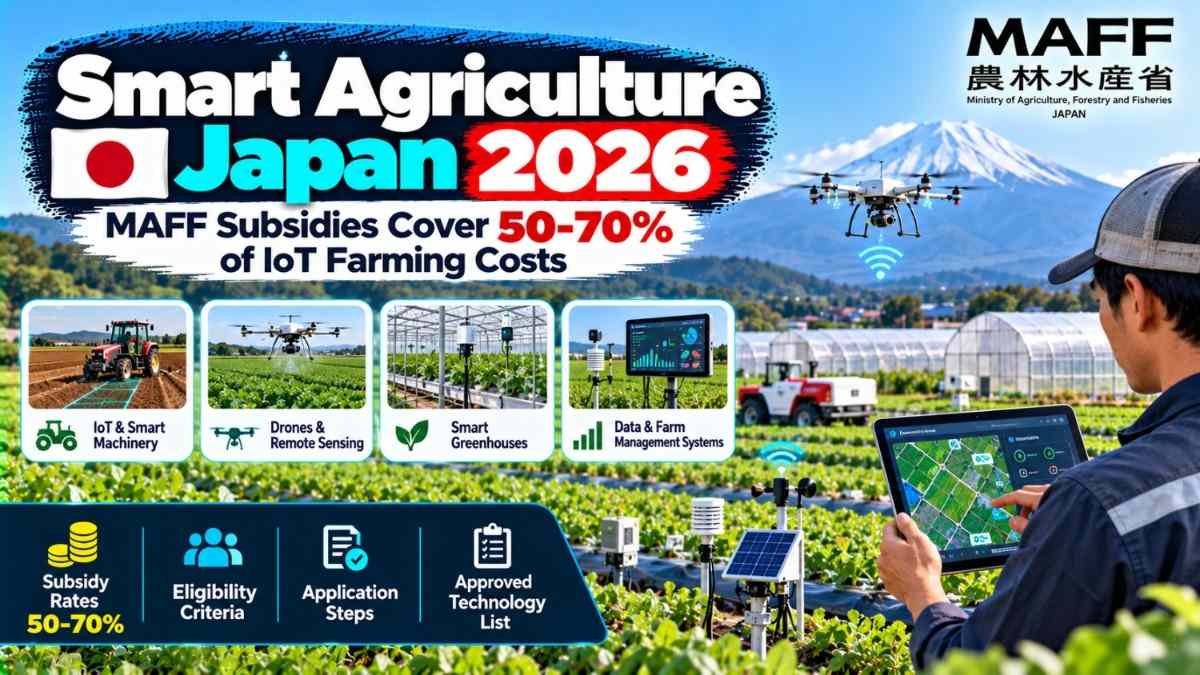
Smart agriculture in Japan refers to the systematic integration of robots, artificial intelligence (AI), the Internet of Things (IoT), and precision data systems into everyday farming operations. It is the cornerstone of Japan’s national strategy to address its two most urgent agricultural crises: a rapidly aging farming workforce (average age now above 67) and a shrinking rural labor pool that threatens national food security.

Japan’s smart agriculture journey began formally in 2013 with the establishment of the Research Group for the Realization of Smart Agriculture, followed by the Smart Agriculture Demonstration Project from 2019, and finally culminating in the landmark Act on the Promotion of Smart Agricultural Technology Utilization, which was enforced in October 2024. This legislation created legal frameworks for certification, financial incentives, and the Innovation Promotion Conference for Smart Agriculture (IPCSA) — a multi-stakeholder body connecting technology providers, researchers, and farmers.
In practical terms, smart agriculture covers a wide spectrum. For Japan’s paddy rice farmers, it means automatic water management systems and drone-based growth monitoring. For vegetable growers, it means IoT-connected smart greenhouses with automated climate control. For livestock operations, it means AI-powered health monitoring sensors. The common denominator is technology replacing or augmenting manual labor, while simultaneously improving yield, reducing input costs, and generating actionable farm data.
| Technology Category | Application in Japan | Typical Labor Savings |
|---|---|---|
| Autonomous Tractors | Paddy plowing, field leveling | Up to 40% reduction |
| Pesticide-Spraying Drones | Citrus, rice, vegetable fields | 61% working time cut |
| IoT Soil & Water Sensors | Automated paddy water management | 9–15% labor hours saved |
| AI Farm Management Platforms | Crop forecasting, resource allocation | 12–18% input cost reduction |
| Smart Greenhouses | Tomatoes, strawberries, leafy greens | 25–35% productivity gain |
| Robot Harvesters | Delicate fruit picking, grain combining | 10%+ yield data quality improvement |
Who Should Apply for Japan IoT Farming Subsidies?
The 2026 smart agriculture subsidies are designed for a broad range of applicants, but some categories are better positioned to qualify and benefit than others. Here are the 8 primary audience profiles:
- 🌾 Rice paddy farmers with 5+ hectares looking to automate water management, planting, and harvesting operations to reduce seasonal labor dependency.
- 🚁 Vegetable and horticulture growers who want to install IoT climate sensors and drone-based crop monitoring to cut input costs by 12–18%.
- 🏢 Agricultural cooperatives (JA groups) seeking shared smart machinery services such as drone spraying contracts or autonomous tractor leasing pools.
- 🌿 Fruit and citrus farm operators in regions like Shikoku and Kyushu exploring AI-powered pest management and variable-rate fertilization systems.
- 🔬 Agritech companies and technology providers that supply certified smart agricultural machinery and services and want to access MAFF R&D support programs.
- 🏔️ Mountain and hilly region farmers in areas such as Hokkaido and Tohoku where remote sensing and autonomous machinery significantly reduce physical strain.
- 👩🌾 Young and next-generation farmers (under 45) taking over family operations who want to build digitally integrated farm management from the ground up.
- 🏭 Corporate agricultural enterprises managing multiple production sites who want to certify a Production Method Innovation Implementation Plan and unlock higher subsidy tiers.
Japan Government Smart Agriculture Subsidy Programs 2026
Japan currently operates multiple layered subsidy programs for smart agriculture, administered at both national (MAFF) and prefectural levels. Understanding which program applies to your operation is the critical first step before applying.
| Program Name | Period | Technologies Covered | Subsidy Rate | Max Cap |
|---|---|---|---|---|
| Smart Farming Subsidy Program | 2025–2026 | AI, IoT, robotics, satellite monitoring | Up to 50% | JPY 15–30 million |
| Advanced Agri-Technology Integration Policy | 2025–2026 | AI analytics, IoT sensors, drones | Up to 50% | JPY 15 million |
| Sustainable Climate-Smart Agriculture Program | 2025–2027 | Bio-sensors, renewables, carbon tracking | Up to 50% | JPY 30 million |
| Smart Agriculture Acceleration Demonstration | Ongoing | Robots, AI, IoT at production sites | Varies | JPY 30 million |
| Green Mechanization Fund | Ongoing | Low-emission, electric/hybrid machinery | Up to 50% | JPY 15 million |
| Fukushima Prefecture Smart Ag Fund 2026 | 2026 | Full IoT/smart machinery suite | Check guidelines | JPY 50 million |
| MAFF Innovation Fund (Startups) | Ongoing | R&D for new agritech solutions | Fixed amount | JPY 46.72 billion total pool |
The most powerful national-level program remains the Smart Agriculture Acceleration Demonstration Project, which has already been deployed across 217 districts nationwide — covering paddy rice, vegetables, horticulture, tea, and livestock. This project’s results portal provides verified data on which technologies have demonstrated productivity improvements at actual farm sites, forming the backbone of eligibility lists for newer subsidy cycles.
For prefectural programs, subsidy conditions vary. Fukushima Prefecture’s 2026 offering, for example, supports caps up to JPY 50 million for applicants with verified “promotion operator” status and a certified plan aligned with the Production Method Innovation Implementation Plan framework.
Eligibility Requirements and Certification Process
Eligibility for Japan’s smart agriculture IoT subsidies in 2026 depends on meeting both entity-level criteria (who you are) and technology-level criteria (what equipment you’re purchasing). The Act on the Promotion of Smart Agricultural Technology Utilization introduced a formal certification system that unlocks additional subsidy tiers and a reported 7-point scoring bonus in prefectural selection processes.
Entity Eligibility — Who Can Apply:
- Individual farmers and farming households registered with the local agriculture authority
- Agricultural cooperatives (JA groups and independent cooperatives)
- Agricultural production corporations and joint enterprises
- Companies engaged in the development AND supply of smart agricultural services (in an integrated manner)
- Institutions and companies engaged in R&D for precision farming and data-driven agriculture
- Entities certified as “promotion operators” under the 2024 Act
Technology Eligibility — What Equipment Qualifies:
- Autonomous and GPS-guided tractors (JIS-certified models)
- Pesticide-spraying drones certified under Japan’s drone regulations
- IoT soil moisture, temperature, and nutrient monitoring sensors
- AI-powered farm management software platforms
- Remote-controlled paddy water management systems
- Robot harvesters and autonomous combine systems with yield/quality data capture
- Smart greenhouse automation systems (climate control, irrigation, lighting)
- Satellite and remote sensing crop monitoring platforms
Application Fee Table (Entity Category):
| Applicant Category | Application Fee | Certification Required |
|---|---|---|
| Individual Farmer | No fee (government program) | Prefectural registration |
| Agricultural Cooperative | No fee | JA or cooperative certification |
| Agricultural Corporation | No fee | Corporate registration + plan submission |
| Technology/Service Provider | No fee (R&D fund applications vary) | Innovation plan certification under 2024 Act |
| Multi-Prefecture Applicant | No fee | National MAFF guidelines apply |
The Production Method Innovation Implementation Plan is the key certification document under the 2024 Act. This plan must outline both new production methods AND the deployment of smart agricultural technologies. Once certified, applicants qualify for the highest tier of subsidies and gain access to special exception schemes — including fast-tracked equipment approvals and low-interest long-term loans from the Japan Finance Corporation.
How to Apply — Step-by-Step Process
The application process for Japan’s 2026 smart agriculture IoT subsidies follows a structured pathway with mandatory pre-checks and formal submission windows. Follow these steps in order to maximize your chances of selection.
- Identify your applicable program and category. Cross-reference the national MAFF guidelines and your prefecture’s 2026 public offering. Determine whether you apply under national (multi-prefecture), prefectural, or city-level authority. Check the target machinery list specific to your project menu.
- Confirm the subsidy rate and cap for your category. National MAFF offerings cap at JPY 15–30 million for most categories. Some prefectures (e.g., Fukushima 2026) allow up to JPY 50 million for promotion operators. Do not assume the cap — check your specific prefecture’s guidelines.
- Prepare your Production Method Innovation Implementation Plan. This is the core certification document. It must describe your current production methods, the smart technologies you will adopt, projected productivity improvements, and timeline. For certification under the 2024 Act, this plan is mandatory for higher subsidy tiers.
- Submit a preliminary document check (where required). Some prefectures and national programs require a preliminary submission to a verification body before formal application. In 2026, this involves sending check documents to the Japan Agricultural Aviation and Agricultural Support Service Association via email or uploader.
- Submit your formal application to the correct authority. Single-prefecture applicants: submit to your local Agriculture and Forestry Office (Fukushima), Agricultural Affairs Office (Yamanashi), or relevant city department (Kobe City 2026 example). Multi-prefecture applicants: submit directly to the national government via MAFF.
- Undergo selection screening. Applications are scored. Certified operators with an approved Production Method Innovation Implementation Plan receive a 7-point scoring bonus in the 2026 prefectural selection process (based on Fukushima Prefecture guidelines). Ensure your plan is certified before the formal application window opens.
- Receive approval and commence procurement. Upon approval, begin procurement of certified smart agricultural equipment from MAFF-approved suppliers. Retain all invoices and delivery records — these are required for subsidy disbursement and post-project reporting.
Get your Production Method Innovation Implementation Plan certified before the application window opens — not during it. Certification can take 4–8 weeks through prefectural offices, and uncertified applicants miss the 7-point scoring bonus that can determine whether your application is selected in competitive rounds. Contact your local Agriculture and Forestry Office at least 3 months before the application deadline.
Smart Agriculture Subsidies vs Self-Financing in Japan
Farmers considering smart agriculture upgrades face a fundamental question: is it better to access government subsidies or to self-finance IoT equipment purchases? The comparison below covers the critical dimensions that affect a typical Japanese farm operation.
| Dimension | Government Subsidy Route | Self-Financing Route |
|---|---|---|
| Upfront Cost | 50–70% covered; farmer pays 30–50% | 100% out-of-pocket |
| Equipment Selection | Must choose from MAFF-certified list | Full freedom of choice |
| Application Time | 3–6 months including certification | Immediate purchase possible |
| Reporting Burden | Post-project reports required | No reporting obligations |
| Max Benefit (JPY) | JPY 15–50 million depending on program | N/A (no benefit) |
| Access to Loans | Low-interest Japan Finance Corporation loans available | Standard commercial interest rates |
| Technology Currency | MAFF list updated annually | Any technology including emerging models |
| Best For | Farms with 5+ hectares, cooperatives, corporate operations | Small farms with urgent, specific technology needs |
For farms of 5 hectares or larger, cooperatives, and corporate agricultural entities, the government subsidy route is strongly preferable. The 50–70% cost coverage, combined with low-interest Japan Finance Corporation loans for the remaining balance, dramatically reduces payback periods on IoT investments. Self-financing should only be considered for smaller operations with urgent technology needs that cannot wait for a 3–6 month application cycle, or for equipment categories not yet on the MAFF certified list.
Pros and Cons of Japan’s Smart Agriculture Subsidy System
Japan’s smart agriculture subsidy framework is one of the most comprehensive in Asia, but it comes with structural limitations that applicants should understand before committing.
Advantages:
- ✅ Substantial cost coverage — 50–70% subsidy rates make high-cost IoT and robotic systems financially accessible for farms that could not otherwise invest.
- ✅ Legislative backing — The 2024 Act provides long-term legal certainty for subsidy programs, unlike ad hoc grants that may not be renewed.
- ✅ Stacked benefits — Certified applicants can combine subsidies with Japan Finance Corporation low-interest loans and tax incentives, reducing total investment cost by 65–80%.
- ✅ 217 proven demonstration districts — MAFF’s demonstration program provides verified data on yield improvements, labor savings, and ROI specific to Japanese farm conditions before farmers commit.
- ✅ Labor crisis solution — Smart machinery subsidized by MAFF directly addresses the aging workforce problem, with autonomous systems reducing total labor hours by an average of 9% and drone spraying cutting work time by 61%.
Disadvantages:
- ❌ Scale requirement — Small farms below 5 hectares often cannot economically justify smart machinery even with subsidies; MAFF’s own researchers note mid-sized farms (10–20 ha) lack dedicated support schemes.
- ❌ Complex application process — The certification + preliminary check + formal application sequence takes 3–6 months and requires significant documentation, disadvantaging individual farmers without administrative support.
- ❌ Restricted equipment list — Only MAFF-certified technologies qualify, which can exclude the newest models or emerging agritech solutions not yet on the approved list.
- ❌ Post-project reporting burden — Subsidy recipients must submit detailed productivity and management effect reports after completion, adding administrative overhead for small operations.
Important IoT Farming Terms and Concepts for Japan Subsidies
Understanding these key terms will help you navigate the application documentation and MAFF guidelines more effectively in 2026.
- Smart Agricultural Technology Utilization Promotion Act (2024) — The primary legislation governing smart farming subsidies, certifications, and the IPCSA framework. Enacted October 2024. All 2026 subsidy programs operate under this framework.
- Production Method Innovation Implementation Plan — The mandatory certification document applicants must prepare and have certified to access premium subsidy tiers and the 7-point selection bonus.
- MAFF (Ministry of Agriculture, Forestry and Fisheries) — Japan’s central government authority for agriculture, responsible for all national smart farming subsidy programs, demonstration projects, and the JPY 4,500 million promotion fund.
- IPCSA (Innovation Promotion Conference for Smart Agriculture) — Established under the 2024 Act to connect technology providers, researchers, and agricultural producers to accelerate smart technology adoption.
- Precision Agriculture — Data-driven farming that uses GPS, IoT sensors, and AI analytics to optimize inputs (water, fertilizer, pesticides) at field-zone level, reducing waste by 12–18% and improving yields.
- IoT Soil Sensors — Connected devices placed in fields that monitor soil moisture, temperature, pH, and nutrient levels in real time, transmitting data to farm management platforms and automated irrigation systems.
- Autonomous Tractor — GPS-guided agricultural machinery capable of operating without a driver for tasks including plowing, planting, and spraying; one of the core technologies covered under MAFF’s smart machinery subsidy.
- JA Cooperative — Japan Agricultural Cooperatives, the primary farming cooperative network in Japan; JA groups can apply for subsidies on behalf of member farmers and operate shared smart machinery services.
- Promotion Operator — An entity that has received certification under the 2024 Act as a designated implementer of smart agricultural technologies; promotion operator status grants access to the highest subsidy caps and scoring bonuses.
- eMAFF Map — MAFF’s digital information system for agriculture, currently in development, which will integrate smart farm data with government records for streamlined subsidy administration and farm management.
Important Links
| Resource | Link |
|---|---|
| MAFF Official Smart Agriculture Portal | maff.go.jp — Smart Agriculture |
| MAFF Smart Agriculture Promotion PDF (Oct 2025) | Promotion of Smart Agriculture (PDF) |
| OECD Japan Agricultural Policy 2025 Report | OECD Agricultural Policy Japan 2025 |
| 2026 Subsidy Eligibility & Application Guide | Smart Agriculture Subsidy 2026 Guide |
| Japan Finance Corporation (Agricultural Loans) | Japan Finance Corporation |
| Agrijob.in — Agricultural Career Resources | Agrijob.in Home |
Conclusion
Smart agriculture in Japan 2026 represents a once-in-a-generation opportunity for farmers and agribusinesses to modernize operations with direct government financial support. With MAFF subsidies covering 50–70% of certified IoT and automation equipment costs, and the 2024 Act creating durable legal and financial frameworks, the barriers to adopting autonomous tractors, drone systems, and precision farming platforms have never been lower. The smart agriculture market in Japan is projected to grow from USD 1.39 billion in 2025 to USD 4.46 billion by 2034 — and those who get certified and apply early in the 2026 window will have first-mover advantage in a rapidly transforming sector.
Your next step: Contact your local Agriculture and Forestry Office or visit the MAFF smart agriculture portal (maff.go.jp) to request the 2026 prefectural public offering guidelines and begin preparing your Production Method Innovation Implementation Plan at least 3 months before the application deadline. Bookmark this page — we update it whenever MAFF releases new subsidy cycles and approved technology lists.
- Japan’s MAFF allocated JPY 4,500 million (USD 29.72 million) to promote smart agricultural technologies in 2024, with 2026 programs continuing under the Smart Agricultural Technology Utilization Promotion Act.
- Government subsidies cover 50–70% of certified IoT farming costs, capped at JPY 15–50 million depending on the program and prefecture.
- Getting your Production Method Innovation Implementation Plan certified before applying gives a 7-point scoring bonus in prefectural selection rounds.
- Demonstration projects across 217 districts have confirmed real-world outcomes: 61% work time reduction for drone spraying, 9% average labor hour savings, and 10%+ yield improvements in select categories.
- Applications go to your local Agriculture and Forestry Office (single-prefecture) or directly to MAFF (multi-prefecture projects) — never to the same body for both.
Frequently Asked Questions About Smart Agriculture Japan 2026
What is smart agriculture in Japan?
Smart agriculture in Japan refers to the use of robots, AI, IoT sensors, autonomous machinery, and precision data systems in farming operations to improve productivity and reduce labor dependency. Japan’s Smart Agricultural Technology Utilization Promotion Act, enacted in October 2024, provides the legal and financial framework for government-backed adoption of these technologies across all major crop types.
How much subsidy does the Japanese government offer for IoT farming equipment?
The standard MAFF subsidy rate for smart agriculture IoT farming equipment is up to 50% (1/2) of eligible costs, with caps of JPY 15–30 million for most national programs. Certified “promotion operators” under the 2024 Act may access up to 70% coverage in some categories, and prefectural programs (such as Fukushima’s 2026 offering) can reach caps of JPY 50 million for plan-aligned projects.
Who is eligible to apply for Japan’s smart agriculture subsidies in 2026?
Eligible applicants include individual farmers, agricultural cooperatives (JA groups), agricultural production corporations, and companies engaged in the integrated development and supply of smart agricultural services. Entities certified as “promotion operators” under the 2024 Act receive priority in selection and access to higher subsidy tiers.
What IoT farming technologies are covered by MAFF subsidies?
MAFF-covered technologies include autonomous tractors, pesticide-spraying drones, IoT soil and water sensors, AI farm management platforms, remote-controlled paddy water management systems, robot harvesters, smart greenhouses, and satellite-based crop monitoring systems. Equipment must appear on the MAFF-certified technology list for the relevant program year to qualify.
Where do I submit my smart agriculture subsidy application in Japan?
For single-prefecture projects, submit your application to your local Agriculture and Forestry Office (e.g., Fukushima), Agricultural Affairs Office (e.g., Yamanashi), or the relevant city department (e.g., Kobe City). For multi-prefecture or wide-area projects, applications go directly to the national government via MAFF. Check your prefecture’s 2026 public offering guidelines to confirm the exact submission address.
What is the Production Method Innovation Implementation Plan?
The Production Method Innovation Implementation Plan is the core certification document required under the 2024 Smart Agricultural Technology Utilization Promotion Act. It describes the applicant’s current production methods, the smart technologies to be adopted, projected productivity improvements, and implementation timeline. Obtaining certification for this plan before applying unlocks higher subsidy rates and a 7-point selection scoring bonus in prefectural rounds.
How long does the smart agriculture subsidy application process take in Japan?
The full process — from preparing your Production Method Innovation Implementation Plan through certification, preliminary document check, formal submission, and selection — typically takes 3–6 months. Applicants who begin preparation at least 3 months before the formal application window have the best chance of having all certification documents in order by the submission deadline.
Can small farms apply for Japan’s smart agriculture subsidies?
Yes, small farms can apply, but the economic viability of smart machinery adoption remains a challenge for operations below 5 hectares. MAFF’s own research indicates that most commercial farms need sufficient scale for smart machines to be economically practical. Smaller farms may benefit more from cooperative-level applications, shared machinery services through JA groups, or the lower-cost IoT sensor and monitoring categories that do not require large-scale machinery investment.
What is IPCSA and how does it support smart agriculture adoption?
IPCSA stands for the Innovation Promotion Conference for Smart Agriculture, established under the 2024 Act. It facilitates collaboration among technology providers, researchers, and agricultural producers to accelerate smart technology adoption across Japan. IPCSA coordinates demonstration projects, supports certification processes, and provides a forum for resolving technical and regulatory barriers that slow adoption at the farm level.
What results have Japan’s smart agriculture demonstration projects shown?
Across 217 demonstration districts nationwide, MAFF’s smart agriculture projects have produced measurable outcomes: total labor hours reduced by an average of 9%, crop yields increased by a similar margin in many districts, pesticide-spraying drone adoption cut working time by 61%, and AI-integrated farm management systems reduced water and fertilizer use by 12–18%. Some high-performing districts have exceeded 10% labor reductions, validating the practical case for wider adoption.
Last Updated: October 2026 | This guide is reviewed and updated regularly for accuracy. Bookmark this page for the latest smart agriculture Japan subsidy information.
Disclaimer: This article is for informational purposes only. Subsidy rates, caps, and eligibility criteria are subject to change with each program cycle. Always verify the latest conditions with your local Agriculture and Forestry Office or the MAFF official portal at maff.go.jp before submitting an application. This article does not constitute legal, financial, or professional agricultural advice.