
Biodiversity Net Gain (BNG) is now the most significant new income opportunity for UK farmers since the introduction of the Basic Payment Scheme — and unlike BPS, it is growing, not being phased out. Under the Environment Act 2021, mandatory BNG has applied to most English developments since 12 February 2024, legally requiring every developer to deliver a minimum 10% uplift in biodiversity. When developers cannot achieve that gain on-site, they must buy biodiversity units from landowners like you. This guide is for UK farmers, landowners, and rural estate managers who want to understand exactly how to earn long-term income from habitat creation on their land in 2026.

UK farmers can earn income from Biodiversity Net Gain by creating or enhancing habitats on their land, calculating biodiversity units using Defra’s Statutory Biodiversity Metric, registering as a habitat bank on Natural England’s Biodiversity Gain Site Register, and selling those units to developers. In 2026, biodiversity units trade at approximately GBP20,000–GBP200,000+ per unit depending on habitat type — making BNG a potentially transformational income stream for farms with marginal or lower-productivity land.
- Mandatory since: 12 February 2024 (major sites); 2 April 2024 (small sites); 2 November 2026 (NSIPs)
- Minimum gain required: 10% biodiversity uplift on all applicable developments in England
- BNG market size (2026): GBP93 million — tripled in 12 months
- Registered gain sites: 312 in England as of mid-2026
- Typical unit price range: GBP20,000–GBP200,000+ per biodiversity unit (habitat-dependent)
- Income example (grassland, 10 ha): 20–40 units x GBP26,000–GBP28,500 = GBP520,000–GBP1,140,000 over 30 years
- Minimum commitment: 30 years, legally binding via conservation covenant or Section 106 agreement
- Register fee: GBP639 per gain site (SI 2024/46)
- HMRC guidance (May 2026): BNG receipts generally treated as income tax rather than capital gains
- VAT: Sale of biodiversity units is a standard-rated taxable supply at 20%
📋 Table of Contents
- What Is Biodiversity Net Gain and Why Does It Matter for Farmers?
- Who Should Consider BNG Income on Their Farm?
- How Much Income Can UK Farmers Earn from Biodiversity Net Gain?
- Which Habitat Types Generate the Most Biodiversity Units?
- Eligibility and Land Requirements for Selling BNG Units
- How to Register as a Habitat Bank — 6 Step-by-Step Process
- BNG vs Environmental Land Management (ELM) Schemes — Which Pays More?
- Pros and Cons of Biodiversity Net Gain for Farmers
- Tax Treatment of BNG Income for UK Farmers in 2026
- Important BNG Terms Every Farmer Must Know
- Important BNG Dates and Timeline for 2026
- Important Links for UK Farmers Exploring BNG
- Conclusion
- Key Takeaways
- Frequently Asked Questions About Biodiversity Net Gain UK Farmers 2026
What Is Biodiversity Net Gain and Why Does It Matter for Farmers?
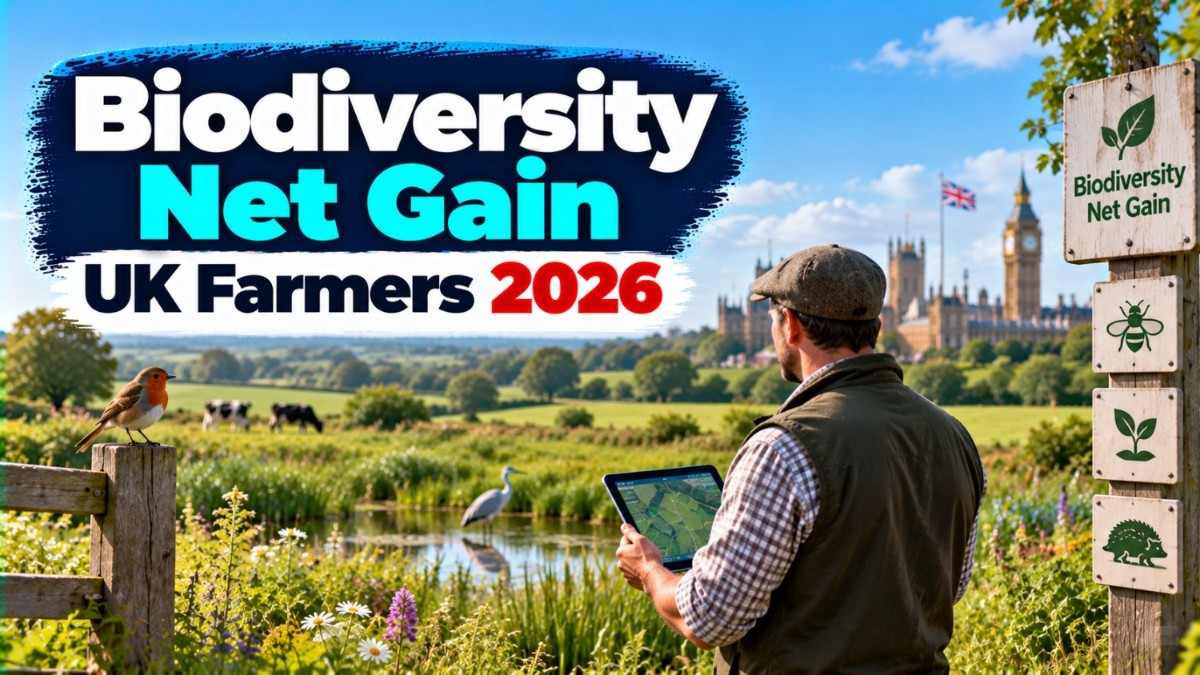
Biodiversity Net Gain (BNG) is a mandatory planning requirement under the Environment Act 2021 that compels developers in England to leave biodiversity in a measurably better state than before their development began. The policy requires a minimum 10% net gain in biodiversity units, calculated using Defra’s Statutory Biodiversity Metric. When developers cannot achieve that gain within their own site boundary, they must purchase units from registered off-site habitat banks — and that is exactly where UK farmers come in.
For the farming community, BNG represents a structural market shift. The Basic Payment Scheme is being phased out under the Agricultural Transition Plan, removing direct income support from thousands of farms. Environmental Land Management schemes are still evolving and in many areas oversubscribed. BNG fills that gap with a market-driven income stream: developers need units, and farms with lower-productivity or marginal land can supply them. The BNG market in England was worth an estimated GBP93 million in 2026 — triple its 2025 value — and demand is set to intensify further as the requirement extends to Nationally Significant Infrastructure Projects (NSIPs) from 2 November 2026.

BNG operates via a standardised unit system. A biodiversity unit measures the ecological value of a habitat, factoring in its size, type, condition, and location. Your existing land is assessed to establish a baseline unit count. You then commit to creating or improving a habitat — wildflower meadow, native woodland, wetland — and the increased unit count above baseline is what you sell. The habitat must be maintained for at least 30 years, secured by a legally binding conservation covenant or Section 106 agreement and recorded on Natural England’s Biodiversity Gain Site Register.
Who Should Consider BNG Income on Their Farm?
BNG is not suitable for every farm or every farmer. The opportunity is clearest for those whose land profile and circumstances align with what the market values most:
- 🌿 Farmers with Grade 4 or Grade 5 Agricultural Land Classification (ALC) land — low-productivity parcels where the opportunity cost of taking land out of food production is minimal, and the habitat improvement uplift from baseline is highest.
- 💧 Landowners with floodplain, drained wetland, or land adjacent to watercourses — wetland creation commands the highest unit prices in the BNG market, with priority river habitat units trading above GBP140,000 per unit in 2026.
- 🌳 Estates or farms with field corners, steep slopes, or woodland edges — marginal land that produces little agricultural income but can generate significant biodiversity units under woodland buffer or mixed habitat strategies.
- 💼 Farmers actively seeking to replace lost BPS income — with BPS phased out in England, BNG can realistically replace or exceed former direct payment income on less productive land.
- 🔍 Landowners near planned development corridors — proximity to development increases unit demand and may reduce the spatial risk multiplier applied to your units, improving prices.
- 📅 Farmers already in ELM schemes who want to stack income streams — BNG can be stacked alongside Sustainable Farming Incentive (SFI), Countryside Stewardship, and Local Nature Recovery payments provided the habitat enhancement meets additionality requirements.
- 💰 Farmers looking for long-term, index-linked income certainty — a 30-year legally secured BNG agreement provides predictable income over a generation, often with upfront or staged payments from habitat bank operators.
- 🌍 Tenant farmers and long-term leaseholders — you can sell biodiversity units with the landowner’s consent, provided your lease covers at least the full length of the BNG legal agreement.
How Much Income Can UK Farmers Earn from Biodiversity Net Gain?
BNG income varies enormously by habitat type, land condition, and location. The most important variable is the biodiversity unit price, which is set by the private market — not by government — and negotiated on a case-by-case basis between landowners (or their habitat bank operators) and developers. The table below gives indicative 2026 figures sourced from Biodiversity Units UK’s October 2025 pricing report (95 habitat banks) and the February 2026 edition (165 registered sites):
| Habitat Type | Units / Hectare (approx.) | Unit Price Range (2026) | Indicative Income / Hectare |
|---|---|---|---|
| Wetland Creation (non-priority) | ~8.0 | GBP50,000–GBP80,000 | GBP400,000–GBP640,000 |
| Priority Wetland / Fen / Floodplain | ~8.0 | GBP100,000–GBP200,000+ | GBP800,000–GBP1,600,000+ |
| Woodland Creation / Expansion | ~6.0 | GBP34,000–GBP50,000 | GBP204,000–GBP300,000 |
| Lowland Meadow / Species-Rich Grassland | ~5.5 | GBP26,000–GBP37,000 | GBP143,000–GBP203,500 |
| Other Neutral Grassland | ~5.5 | GBP26,000–GBP28,500 | GBP143,000–GBP156,750 |
| Heathland and Scrub | ~4.5 | GBP29,000–GBP35,000 | GBP130,500–GBP157,500 |
| Mixed Habitat Mosaic | ~4.0 | GBP17,000–GBP30,000 | GBP68,000–GBP120,000 |
| Hedgerow (per 100m) | Linear (per 100m) | GBP23,000–GBP29,000 | Per 100m of hedgerow |
Sources: Biodiversity Units UK Pricing Report (October 2025, February 2026); LandBNG planning assumptions 2026. Prices are indicative market ranges — actual prices are negotiated privately. Always obtain independent valuation advice before signing agreements.
To put these figures in a real-world context: a 10-hectare block of improved grassland converted to species-rich neutral grassland might generate 20–40 biodiversity units over the 30-year agreement. At GBP26,000–GBP28,500 per unit, that represents a total income of GBP520,000–GBP1,140,000, often paid in a combination of an upfront premium, annual management payments, and a revenue share when units are sold. Working through a habitat bank operator such as Environment Bank or Ecosulis, farmers have reported guaranteed grassland income of approximately GBP80,000–GBP85,000 per hectare over a 31-year agreement, including management payments.
If your farm has land adjacent to a river, stream, or ditch, prioritise an ecological assessment there first. Watercourse and floodplain wetland units are the scarcest and highest-priced units in the market. The February 2026 Biodiversity Units UK report puts the national average for watercourse units at approximately GBP140,000 per unit, with Southern England at GBP144,866 and Northern England at GBP125,013. Even 2–3 units from a single watercourse restoration project can generate six-figure returns. Supply in this habitat type is classified as “Very Rare” nationally, meaning demand consistently outstrips supply.
Which Habitat Types Generate the Most Biodiversity Units on Farm Land?
Not all farm habitats are equal in the BNG market. The Defra Statutory Biodiversity Metric weights habitats by distinctiveness (ecological rarity and value) and condition. Higher distinctiveness habitats generate more units per hectare, and units from them command higher prices. The key habitat strategies available to most UK farms are:
- Species-rich neutral grassland (lowland meadow): One of the most sought-after habitat types. Created through reduced fertiliser input, targeted wildflower seeding, and appropriate grazing management. Generates approximately 5.5 units/ha. Well-suited to most lowland farms with existing grassland parcels.
- Wetland creation: The highest unit yield (~8 units/ha) and highest unit price of any mainstream farm habitat. Requires land adjacent to watercourses or seasonally wet soils. Can involve bunded scrapes, shallow lakes, fen carr, or floodplain restoration. Also eligible for Countryside Stewardship Higher Tier payments if properly structured.
- Native woodland creation: Generates approximately 6 units/ha. Suited to steep slopes, field boundaries, and land adjacent to existing woodland. Can also attract woodland carbon credits, provided additionality rules are met. Woodland creation units are more common in supply, leading to softening prices in some regions.
- Heathland and scrub restoration: Relevant for farms on sandy or acidic soils. Well-established through livestock management withdrawal and targeted scrub control. Approximately 4.5 units/ha at GBP29,000–GBP35,000 per unit.
- Hedgerow enhancement: A linear habitat priced per 100 metres rather than per hectare. Ideal for farms with long hedgerow networks in poor condition. Can complement other BNG habitats without taking large areas out of production.
- Mixed habitat mosaic: The most flexible approach for farms with diverse land types. Combines grassland, scrub, and bare ground in a single block. Lower unit yield (~4 units/ha) but more compatible with continued low-intensity grazing.
Eligibility and Land Requirements for Selling BNG Units in England
Any person or organisation that can meet the additionality and eligibility criteria set by Natural England can sell biodiversity units in England. The eligibility rules are designed to ensure that habitat improvements represent a genuine, measurable gain above what would have happened anyway. Key requirements include:
- Land must be in England: BNG mandatory requirements currently apply in England only. Wales, Scotland, and Northern Ireland operate under separate policies.
- Seller must be the landowner, a long-term leaseholder, or a farming tenant with the landowner’s written consent and a lease covering at least the full length of the legal agreement.
- Land must be suitable for the proposed habitat type — assessed by a CIEEM-qualified ecologist using the Defra Statutory Biodiversity Metric.
- Additionality must be demonstrated: The habitat improvement must go beyond what is already legally required of the landowner (e.g. you cannot sell units from land where you are already required to create habitat as part of a planning condition or environmental damage remediation).
- Habitat cannot already count towards a separate BNG requirement: A unit cannot be sold twice to two different developments — the Biodiversity Gain Site Register prevents double-counting.
- Legal agreement required for 30 years minimum: Secured either through a conservation covenant (a new legal mechanism introduced by the Environment Act 2021) or a Section 106 planning obligation.
- Stacking is permitted: You can receive payments from ELM schemes (SFI, Countryside Stewardship, Local Nature Recovery) on the same land as your BNG habitat, provided the habitat meets additionality requirements. You can also stack nutrient credits on the same land.
- Agricultural Property Relief (APR): From 6 April 2025, land under qualifying environmental management including BNG agreements became eligible for APR — a significant change for inheritance tax planning on family farms.
| Eligibility Factor | Requirement |
|---|---|
| Geography | England only (not Wales, Scotland, or Northern Ireland) |
| Who can sell | Landowner, leaseholder (with consent), tenant farmer (with consent) |
| Minimum commitment | 30 years, legally binding |
| Legal mechanism | Conservation covenant or Section 106 agreement |
| Additionality check | Enhancement must go beyond existing legal obligation |
| Register fee | GBP639 per gain site (SI 2024/46) |
| Ecological assessment | CIEEM-qualified ecologist required; Defra Statutory Metric used |
| ELM compatibility | Stacking permitted with SFI, CS, Local Nature Recovery |
How to Register as a BNG Habitat Bank — 6-Step Process for UK Farmers
Becoming a registered BNG habitat bank involves six main stages, from initial feasibility through to ongoing monitoring. The process typically takes 3–6 months to complete before your first units can be sold. Here is the step-by-step process as defined by Natural England’s guidance:
- Commission an Ecological Baseline Assessment (Phase 1 Habitat Survey): Engage a CIEEM-qualified ecologist to survey your land and calculate your existing biodiversity unit score using the Defra Statutory Biodiversity Metric. This establishes your baseline — the starting point from which your unit gain is measured. The assessment identifies which parcels have the greatest uplift potential and what habitat types are most appropriate.
- Develop a Habitat Enhancement and Management Plan: Based on the baseline assessment, your ecologist creates a detailed habitat enhancement plan showing what habitats you will create or improve, the target condition for each habitat, and the timeline for reaching that condition. This forms the basis of your Habitat Management and Monitoring Plan (HMMP), which must cover the full 30-year period.
- Secure Legal Agreement: Your habitat bank must be secured in law before it can be registered. You have two options: a conservation covenant (a private, voluntary legal agreement between a landowner and a responsible body such as a conservation organisation or local authority, introduced by the Environment Act 2021) or a Section 106 planning obligation tied to an approved planning permission. Both are equally valid and both run for a minimum of 30 years, binding your successors in title.
- Apply to Register on Natural England’s Biodiversity Gain Site Register: Submit your application to Natural England to register your gain site. The application requires evidence of your baseline habitat assessment, the legal agreement securing the habitat, your HMMP, and payment of the registration fee of GBP639 per gain site. Natural England reviews the application and, if approved, lists your site on the public register, making your units available for allocation by developers.
- Market and Sell Your Biodiversity Units: Once registered, units can be sold through three routes — directly to developers, through a specialist habitat bank broker or operator (such as Environment Bank, Ecosulis, or Wilder Carbon), or through an emerging secondary market. Units are allocated to specific developments by recording the allocation on the Biodiversity Gain Site Register. Prices and payment structures are negotiated privately; income may come as a lump sum upfront, annual management payments, or revenue share when units are allocated.
- Ongoing Monitoring and Annual Reporting: You are required to submit annual monitoring reports throughout the 30-year agreement period, demonstrating that habitat condition targets are being met. If you work through a habitat bank operator, they typically take responsibility for this reporting. If you sell directly, you must engage an ecologist for annual condition assessments and report to the relevant body (local authority or conservation covenant responsible body).
BNG vs Environmental Land Management (ELM) Schemes — Which Pays More?
Many farmers ask whether they should pursue BNG income or focus on ELM scheme payments. The honest answer is: for most farms, the best strategy combines both. However, the income potential differs significantly by land type, area, and commitment level. The comparison below covers the key dimensions:
| Factor | Biodiversity Net Gain (BNG) | ELM Schemes (SFI / Countryside Stewardship) |
|---|---|---|
| Income per hectare | GBP5,000–GBP50,000+/ha (one-off or staged over 30 years) | GBP200–GBP1,500/ha/year (ongoing annual payments) |
| Payment structure | Lump sum + management payments + unit revenue share | Annual payments for agreed management actions |
| Commitment length | 30 years minimum — legally binding, cannot be reversed | 3–10 years (renewable but not permanent) |
| Flexibility | Very low — land use locked in for 30 years | Higher — agreements have end dates |
| Application competition | Market-driven — no application cap | Oversubscribed in many areas |
| Compatible with food production | Partial — low-intensity grazing sometimes permitted | Yes — specifically designed alongside farming |
| Can be combined? | Yes — stacking with ELM payments is permitted | Yes — stacking with BNG units is permitted |
| Best for | Marginal / low-productivity land, long-term income certainty | Active productive farmland, shorter commitments |
| Impact on APR (inheritance tax) | Eligible for APR since 6 April 2025 | Generally eligible for APR |
For farms with at least 5 hectares of Grade 4 or 5 land, marginal grassland, or floodplain, the optimal strategy in 2026 is to pursue BNG registration for those parcels while keeping productive land in SFI or Countryside Stewardship. The income ceiling for BNG on the right land significantly exceeds what ELM schemes pay per hectare. The 30-year commitment is the key trade-off — BNG is most appropriate where the land has limited long-term alternative income potential. Always take independent land agent and tax advice before signing.
Pros and Cons of Biodiversity Net Gain for UK Farmers
BNG is a genuine income opportunity, but it is not without risk. Farmers should weigh these advantages and disadvantages carefully before committing land:
Advantages of BNG for Farmers
- ✅ Significant income potential: Unit prices of GBP20,000–GBP200,000+ per unit represent income levels that can rival or exceed food production on lower-grade land.
- ✅ Long-term income certainty: A 30-year legally secured agreement provides a predictable revenue stream that is not subject to commodity price volatility or policy changes that affect farming subsidies.
- ✅ BPS replacement income: For farms losing direct payments under the Agricultural Transition Plan, BNG can replace significant portions of lost subsidy income, particularly on lower-quality agricultural land.
- ✅ Stackable with ELM schemes: BNG income can be added on top of SFI, Countryside Stewardship, and Local Nature Recovery payments, maximising the environmental land management income from each parcel.
- ✅ APR eligibility: Since 6 April 2025, qualifying BNG agreements can attract Agricultural Property Relief for inheritance tax purposes, protecting farm succession planning.
- ✅ Growing market demand: The extension of mandatory BNG to NSIPs from November 2026 will materially increase developer demand for off-site units, supporting prices across all habitat types.
Disadvantages and Risks of BNG for Farmers
- ⚠️ Irreversible 30-year commitment: Once land is registered on the Biodiversity Gain Site Register and units are allocated to a development, that commitment is binding on all future owners. It can affect financing, tenancy arrangements, and resale values.
- ⚠️ Unit prices may soften for common habitat types: Neutral grassland unit prices fell approximately 3–6% nationally between October 2025 and February 2026, reflecting increasing supply from habitat banks. Early movers secure better prices.
- ⚠️ Complex tax treatment: HMRC’s May 2026 technical note confirms receipts will generally be treated as income rather than capital, increasing the tax liability for many farmers. VAT at 20% applies to unit sales. Professional tax advice is essential before signing.
- ⚠️ Upfront costs before income: Ecological surveys, legal agreements, HMMP preparation, and registration fees (GBP639/site) must be paid before any income is received unless a habitat bank operator funds these costs.
Tax Treatment of BNG Income for UK Farmers in 2026
The tax treatment of BNG income is one of the most complex and consequential aspects of entering the BNG market. HMRC published an updated technical note on the taxation of ecosystem service payments on 14 May 2026, providing greater clarity on the four main payment scenarios. The key points for farmers are:
- Income tax: HMRC states that ecosystem service payments — including BNG unit income — will normally be treated as income rather than capital, taxed as income of a trade (if the BNG is a trading activity) or as miscellaneous income. This has significant implications for higher-rate taxpayers.
- Capital Gains Tax: If HMRC treats the activity as investment rather than trade, CGT may apply to lump-sum receipts. The correct treatment depends on how the agreement is structured — advice is essential.
- VAT: The sale of biodiversity units is a standard-rated taxable supply attracting VAT at 20%. VAT-registered farmers must account for VAT on unit sales.
- Woodland exception: Income from BNG woodland units created through the commercial occupation of woodland may fall outside income tax under the woodland income exemption — a significant planning opportunity for farms creating native woodland.
- Agricultural Property Relief (APR): Land under qualifying BNG agreements became eligible for APR from 6 April 2025 under provisions introduced by the Finance Act 2025, protecting farm succession and inheritance tax positions.
- Inheritance Tax: The potential interaction with IHT reliefs (APR and BPR) for land designated for BNG remains an area where specialist advice is critical. From 6 April 2025, the new APR eligibility provides more certainty, but agreement structuring still affects eligibility.
Disclaimer: This section provides a general summary of current HMRC guidance for information only. It does not constitute tax advice. The tax treatment of your BNG income will depend on the specific terms of your agreement and your individual circumstances. Always obtain independent advice from a qualified agricultural tax adviser before signing any BNG agreement. Source: HMRC Technical Note on Ecosystem Service Payments, May 2026.
Important BNG Terms Every UK Farmer Must Know
Understanding the BNG market means mastering its vocabulary. These are the eight most important terms you will encounter when exploring biodiversity net gain income:
- Biodiversity Unit: The standardised measure of biodiversity value produced by Defra’s Statutory Biodiversity Metric. One unit reflects the ecological value of a defined area of habitat, factoring in type, condition, and location. Units are what farmers sell to developers — the higher the condition and distinctiveness, the more units a hectare generates and the higher the price per unit.
- Defra Statutory Biodiversity Metric: The official calculation tool created by Defra and Natural England to calculate biodiversity unit scores. Its use is mandatory for all BNG calculations submitted to local planning authorities in England. Updated versions are released periodically; your ecologist must use the current version.
- Biodiversity Gain Site Register: Natural England’s public digital register of all off-site habitat banks in England. Every gain site must be registered here before its units can be legally allocated to a development. The register is publicly searchable and records each site’s baseline and enhanced habitat values.
- Habitat Management and Monitoring Plan (HMMP): The legally required document setting out how your BNG habitat will be created, managed, and monitored across the full 30-year agreement period. It forms the backbone of your legal agreement and must be approved by the relevant responsible body before registration.
- Conservation Covenant: A new legal mechanism introduced by the Environment Act 2021 allowing a landowner to voluntarily enter a legally binding agreement with a ‘responsible body’ (conservation organisation, local authority, or government body) to manage land in a specified way for at least 30 years. One of the two valid mechanisms for securing BNG habitats.
- Habitat Bank Operator: A specialist company (such as Environment Bank or Ecosulis) that brokers BNG agreements between farmers and developers, typically funding upfront ecological assessment and legal costs in exchange for a share of unit revenue. Working through an operator reduces financial risk but reduces total income per unit.
- Spatial Risk Multiplier: A factor applied in the Statutory Biodiversity Metric that adjusts unit values based on the distance and ecological connectivity between your habitat bank and the development site requiring BNG. Higher-risk locations (further from the development) may require more units to meet BNG requirements, affecting pricing.
- Additionality: The principle that BNG habitat improvements must represent a genuine gain beyond what would have occurred anyway — or what the landowner is legally required to do. Habitats already committed under planning conditions, remediation orders, or other environmental obligations cannot be counted towards BNG and sold as units.
Important BNG Dates and Timeline for UK Farmers in 2026
| Date | BNG Event / Change |
|---|---|
| 12 February 2024 | BNG mandatory for major developments under Town and Country Planning Act 1990 |
| 2 April 2024 | BNG extended to small sites (householder development and some exemptions excluded) |
| 6 April 2025 | Land under qualifying BNG agreements became eligible for Agricultural Property Relief (APR) under Finance Act 2025 |
| 14 May 2026 | HMRC published technical note on taxation of ecosystem service payments including BNG |
| 6 August 2026 | BNG exemption extended — does not apply to planning applications for developments of 0.2 hectares or below |
| 2 November 2026 | BNG becomes mandatory for Nationally Significant Infrastructure Projects (NSIPs) — major expansion of developer demand |
Important Links for UK Farmers Exploring Biodiversity Net Gain
| Resource | Link |
|---|---|
| GOV.UK — Understanding Biodiversity Net Gain (official guidance, updated 14 July 2026) | gov.uk/guidance/understanding-biodiversity-net-gain |
| Natural England — Biodiversity Gain Site Register | naturalengland.blog.gov.uk — BNG Register |
| Defra — Statutory Biodiversity Metric Tool and Guides | gov.uk — Biodiversity Metric Tool |
| HMRC — Tax Treatment of Ecosystem Service Payments (May 2026) | gov.uk — Ecosystem Service Payments Tax |
| NFU Online — BNG Guidance for Farmers | nfuonline.com — BNG for Farmers |
Conclusion — Is Biodiversity Net Gain Worth It for Your Farm?
Biodiversity Net Gain is one of the most significant income opportunities available to UK farmers in 2026. With the BNG market having tripled to GBP93 million and mandatory requirements now extending to infrastructure projects from November 2026, developer demand for off-site biodiversity units will only increase. For farms with marginal land, watercourses, or existing habitats that can be enhanced, BNG offers income that significantly exceeds what food production generates from those parcels — with the added benefit of long-term certainty and APR eligibility. The 30-year commitment is the key consideration: once registered, the land use decision cannot be reversed. Commission an ecological assessment, take independent tax advice, and explore whether a habitat bank operator can reduce your upfront financial risk before deciding.
Next step: Contact a CIEEM-qualified ecologist for a Phase 1 Habitat Survey of your lower-productivity parcels — this is the only way to know exactly how many biodiversity units your land could generate and what income you could realistically achieve. Bookmark this page for ongoing updates as the BNG market develops through 2026 and beyond.
- BNG has been mandatory in England since 12 February 2024, requiring developers to deliver a minimum 10% biodiversity uplift — creating paid demand for habitat creation on farms.
- Biodiversity units traded at GBP20,000–GBP200,000+ per unit in 2026, with wetland and watercourse habitats commanding the highest prices and scarcest supply.
- A 10-hectare grassland conversion to species-rich meadow can generate GBP520,000–GBP1,140,000 over a 30-year agreement at 2026 unit prices.
- BNG income can be stacked on top of SFI, Countryside Stewardship, and Local Nature Recovery scheme payments on the same land, subject to additionality rules.
- HMRC’s May 2026 guidance confirms BNG receipts are generally taxable as income — specialist tax advice is essential before signing any agreement.
- The BNG market is set to expand significantly from November 2026 when NSIPs become subject to mandatory BNG — early registration of habitat banks secures better unit prices and terms.
Frequently Asked Questions About Biodiversity Net Gain UK Farmers 2026
What is Biodiversity Net Gain and how does it create income for UK farmers?
Biodiversity Net Gain is a mandatory planning requirement under the Environment Act 2021 that compels developers to deliver a minimum 10% improvement in biodiversity on all applicable projects in England. When developers cannot achieve that gain within their development boundary, they must purchase biodiversity units from registered habitat banks — including farms. Farmers create or enhance habitats, register their land on Natural England’s Biodiversity Gain Site Register, and sell the resulting biodiversity units to developers for income.
How much can a UK farmer earn from selling biodiversity units in 2026?
Income depends on habitat type, location, and land condition. In 2026, biodiversity units for neutral grassland trade at approximately GBP26,000–GBP28,500 per unit, woodland units at GBP34,000–GBP50,000, and wetland or watercourse units at GBP50,000–GBP200,000+. A 10-hectare grassland conversion generating 20–40 units could yield GBP520,000–GBP1,140,000 over a 30-year agreement, paid as a combination of upfront payments, annual management fees, and unit revenue share.
Which habitat types are most valuable for biodiversity net gain income?
Wetland creation and restoration delivers the highest income — approximately 8 units per hectare at prices of GBP50,000–GBP200,000+ per unit for floodplain and priority river habitats. Watercourse units are classified as “Very Rare” in supply nationally and command the highest market prices. Species-rich grassland (lowland meadow) is the most commonly traded type. Native woodland generates approximately 6 units per hectare but prices are softening in areas with increasing supply.
Can tenant farmers sell biodiversity units on their rented land?
Yes. Tenant farmers can sell biodiversity units on rented land provided they have the written consent of the landowner and hold a lease that covers at least the full length of the BNG legal agreement (minimum 30 years). Both landowners and long-term leaseholders are eligible sellers under the BNG framework established by Natural England and Defra.
Can I combine BNG income with ELM scheme payments on the same land?
Yes — stacking is permitted. Defra has confirmed that land in the Sustainable Farming Incentive, Countryside Stewardship, and Local Nature Recovery can also be used to sell biodiversity units, provided the BNG habitat enhancement meets additionality requirements and goes beyond what the ELM payment is funding. Stacking is also permitted with nutrient credits. Each income stream must be verified separately for eligibility.
How long is the BNG commitment and can it be reversed?
BNG agreements require a minimum commitment of 30 years, secured in law through a conservation covenant or Section 106 planning obligation. Once registered on the Biodiversity Gain Site Register and units are allocated to a development, the commitment is legally binding on all future owners of the land — it cannot be reversed. This is the most important factor for farmers to consider when deciding which parcels to register.
How is BNG income taxed for UK farmers in 2026?
HMRC’s technical note published on 14 May 2026 confirms that BNG payments will generally be treated as income rather than capital gains. If structured as a trading activity, income tax applies; if treated as investment income, capital gains tax rules may apply. VAT at 20% applies to the sale of biodiversity units. A key exception is woodland — BNG income from commercially occupied woodland may fall outside income tax under the woodland exemption. Specialist tax advice is essential before entering any BNG agreement, as treatment varies by agreement structure.
What is Natural England’s Biodiversity Gain Site Register?
Natural England’s Biodiversity Gain Site Register is the official public database of all off-site habitat banks in England. Every landowner wishing to sell biodiversity units for off-site BNG must register their gain site here before units can be legally allocated to a development. The register records each site’s baseline and enhanced habitat values, ensuring no unit is double-counted across multiple developments. Registration costs GBP639 per gain site under SI 2024/46.
Does BNG apply to farms in Wales, Scotland, and Northern Ireland?
No. Mandatory Biodiversity Net Gain under the Environment Act 2021 currently applies in England only. Wales, Scotland, and Northern Ireland have separate biodiversity and planning frameworks and are not subject to the mandatory 10% BNG requirement. Farmers in those nations cannot sell biodiversity units under the English BNG regime, though equivalent nature recovery programmes may exist locally.
What are the steps to becoming a BNG habitat bank on my farm?
The six key steps are: (1) Commission a CIEEM-qualified ecologist to carry out a Phase 1 Habitat Survey and calculate your baseline biodiversity unit score using the Defra Statutory Metric; (2) Develop a Habitat Enhancement and Management Plan (HMMP) covering the full 30-year period; (3) Secure a legally binding conservation covenant or Section 106 agreement; (4) Apply to register your gain site on Natural England’s Biodiversity Gain Site Register (fee: GBP639); (5) Market and sell your biodiversity units to developers, directly or through a habitat bank operator; (6) Submit annual monitoring reports throughout the 30-year agreement period.
Last Updated: October 2026. This guide is reviewed and updated regularly to reflect the latest government guidance, market prices, and HMRC tax treatment. Bookmark this page for current information on biodiversity net gain UK farmers. For official guidance, always refer to GOV.UK — Understanding Biodiversity Net Gain.
Disclaimer: This article is for informational purposes only and does not constitute financial, legal, or tax advice. Income figures are indicative market estimates only; actual BNG income will vary by land type, location, and agreement terms. Tax treatment depends on individual circumstances and agreement structure. Always obtain independent advice from a qualified agricultural land agent, solicitor, and tax adviser before entering any BNG agreement.