
Modified atmosphere packaging (MAP) for fresh produce is the single most bankable postharvest technology available to Indian agri-food businesses in 2026 — yet fewer than 12% of domestic food processors currently use it at scale. India loses agricultural produce worth approximately Rs. 1.53 trillion (USD 18.5 billion) every year to post-harvest spoilage, and fruits and vegetables account for 30–50% of harvest value in losses alone. MAP directly attacks that number by replacing the air inside a package with a precisely calibrated mix of oxygen (O₂), carbon dioxide (CO₂), and nitrogen (N₂) to slow respiration, inhibit microbial growth, and delay senescence. This guide is written for food processors, agri-exporters, FPO managers, cold-chain entrepreneurs, and farm business owners who want a clear ROI picture before committing capital to MAP equipment or packaging films.

You will find everything here: how MAP works at a molecular level, which produce categories benefit most, a crop-by-crop shelf-life extension table, a full cost-benefit and ROI breakdown in Indian rupees, how MAP compares with vacuum and conventional packaging, eligibility for PMKSY/MoFPI subsidies, and an 8-step implementation roadmap. Every figure in this guide is sourced from official government portals, peer-reviewed research, or primary industry sources active in India.
Modified atmosphere packaging (MAP) extends the shelf life of fresh fruits and vegetables by 3 to 21 days depending on produce type and temperature, by replacing ambient air inside the package with a controlled mix of CO₂, O₂, and N₂. India’s post-harvest losses in fruits and vegetables reach 30–50% of harvest value — MAP is proven to reduce spoilage losses by up to 40%, delivering measurable ROI within 12–18 months for most food processors and exporters.
- Technology Type: Passive or active gas-flush packaging using O₂, CO₂, and N₂
- Average Shelf-Life Gain: +3 to +21 days for vegetables; +7 to +60 days for select fruits
- India Post-Harvest Loss (F&V): 30–50% of harvest value (CIPHET / NABCONS data)
- Annual Economic Loss in India: Rs. 1.53 trillion (NABARD Consultancy Services)
- MAP Market Global Value (2025): USD 19.6 billion; growing at 7.43% CAGR to 2031
- Government Support: 35% grant under PMKSY Cold Chain Scheme (MoFPI, May 2025 guidelines)
- Subsidy Portal: sampada-mofpi.gov.in
- Key Gases Used: CO₂ (antimicrobial), N₂ (oxygen displacing), O₂ (colour/texture retention)
- Primary MAP Formats: Tray + lidding film, pouches, bulk bags, micro-perforated retail packs
- ROI Benchmark: 12–24 months payback period for mid-scale MAP line (industry data)
- What Is Modified Atmosphere Packaging and How Does It Work?
- Who Should Invest in MAP Technology in 2026?
- Shelf-Life Extension Data by Produce Category
- MAP ROI Analysis — Cost vs. Savings in Indian Rupees
- How MAP Technology Works — Step-by-Step Process
- MAP vs. Vacuum Packaging vs. Conventional Packaging
- Advantages and Disadvantages of Modified Atmosphere Packaging
- Important Terms Related to Modified Atmosphere Packaging
- Government Schemes and Subsidies for MAP in India (2026)
- Important Links
- Conclusion
- Key Takeaways
- Frequently Asked Questions
What Is Modified Atmosphere Packaging and How Does It Work?
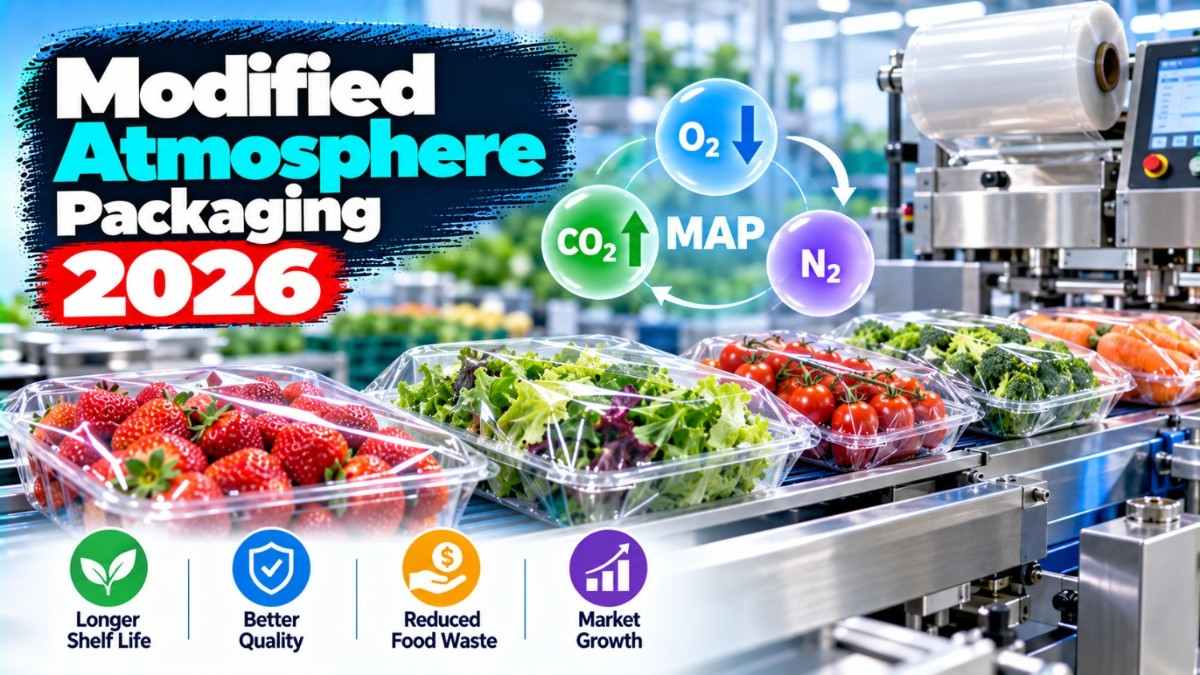
Modified atmosphere packaging (MAP) is a postharvest preservation technology in which the gas composition surrounding fresh produce inside a sealed package is intentionally altered from ambient air (approximately 21% O₂, 78% N₂, 0.04% CO₂) to a precise mixture calibrated for that specific commodity’s respiration profile. By reducing oxygen and elevating carbon dioxide inside the pack, MAP dramatically slows the biological processes — respiration, ethylene production, enzymatic browning, and microbial proliferation — that cause perishables to deteriorate.

The three primary gases used in MAP are carbon dioxide (CO₂), which inhibits aerobic bacteria and molds; nitrogen (N₂), an inert gas that displaces oxygen and prevents oxidative rancidity; and oxygen (O₂), retained at controlled low levels for commodities that require it to sustain colour (such as fresh-cut salads) or aerobic respiration. A strawberry sealed in MAP with 5–10% O₂ and 15–20% CO₂ at 2°C can achieve up to 23 days of shelf life, compared to fewer than 6 days at ambient conditions. For Indian pomegranates exported via sea to Europe, MAP has enabled 60-day transit times with consistent quality on arrival — a change that has made sea freight commercially viable where only air freight was previously feasible.
Two broad implementation modes exist: passive MAP, where the produce’s own respiration gradually establishes the desired atmosphere inside a selectively permeable film (laser-microperforated bags are the most common passive format in India), and active MAP, where the headspace is actively flushed or vacuum-modified and then back-flushed with a target gas blend before sealing. Active MAP delivers faster atmosphere establishment, is preferred for retail trays and fresh-cut categories, and is used in combination with modified humidity packaging to prevent condensation-driven decay.
Who Should Invest in MAP Technology in 2026?
MAP is not a one-size-fits-all technology — its ROI is highest for businesses with measurable spoilage losses, long supply chains, or export ambitions. Here are the eight profiles that stand to gain most:
- 🌾 Agri-exporters shipping fruits and vegetables to the Middle East, Europe, or Southeast Asia, where the shift from air freight to sea freight enabled by MAP can reduce logistics costs by 30–50%.
- 🏭 Food processors and fresh-cut produce companies supplying modern retail, quick commerce platforms (Zepto, Blinkit, Swiggy Instamart), or institutional buyers who demand 7–14 day shelf life guarantees.
- 🧺 Farmer Producer Organisations (FPOs) and agri-cooperatives handling bulk volumes of tomatoes, onions, grapes, or leafy greens where post-harvest spoilage rates exceed 15%.
- 🚛 Cold-chain logistics entrepreneurs looking to add value-added packaging services to existing reefer transport or cold storage operations under PMKSY.
- 🏪 Supermarket and organised retail chains seeking to reduce shrinkage (unsold produce), extend display life, and cut the frequency of replenishment runs.
- 🍓 Growers of high-value, highly perishable produce — strawberries, lychee, arils, fresh herbs, cherry tomatoes — where spoilage losses per kg are highest and MAP packaging cost is easiest to justify.
- 🌿 Horticulture entrepreneurs receiving NABARD or SFAC support wanting to differentiate their produce with premium retail-ready packaging and achieve price premiums of 15–25% over loose market rates.
- 📦 Packaging companies and agri-tech startups developing MAP films, lidding solutions, or gas-mixing equipment for the Indian market, where technology penetration remains under 12% of total food processing volume.
Shelf-Life Extension Data by Produce Category
The shelf-life benefit of MAP varies significantly by commodity, temperature, and the specific gas formulation used. The table below presents indicative data drawn from peer-reviewed research and commercial practice. All figures assume appropriate cold-chain temperature maintenance, which is a prerequisite for MAP to perform as designed.
| Produce | Without MAP (Days) | With MAP (Days) | Shelf-Life Gain | Optimal Temperature |
|---|---|---|---|---|
| Strawberry | 3–6 | 14–23 | +10–17 days | 2–4°C |
| Fresh-cut bell pepper | 9–14 | 17–20 | +3–6 days (20%+) | 5°C |
| Tomato (whole) | 7–10 | 21–28 | +14–18 days | 6°C |
| Spinach / leafy greens | 4–6 | 10–26 | +6–20 days | 0–2°C |
| Lettuce | 5–7 | 13–15 | +8 days | 5°C |
| Cucumber | 7–10 | 22–25 | +15 days | 2–10°C |
| Pomegranate (whole) | 9 | 12–14 | +3–5 days (+33%) | 5–7°C |
| Pomegranate arils | 5–7 | 14–15 | +7–10 days | 2–4°C |
| Banana (for export) | 3–4 (post-ripening) | 10–14 | +7–10 days | 13–15°C |
| Broccoli / cauliflower | 7–10 | 28–35 | +21–25 days | 2–4°C |
| Fresh herbs (coriander, mint) | 3–5 | 10–14 | +7–9 days | 0–2°C |
| Mango (whole) | 7–10 | 21–35 | +14–25 days | 8–12°C |
Sources: ARC-IAE Agring Bulletin (June 2025); ScienceDirect MAP Research; University of Tasmania Postharvest Research; Vista Packaging and StePac commercial data (India, 2025).
MAP ROI Analysis — Cost vs. Savings in Indian Rupees
The business case for MAP rests on a straightforward equation: the cost of the packaging solution (capital equipment, films, gas, labour) versus the value of produce saved and premium pricing unlocked. The ROI calculation below is based on a mid-scale fresh produce business handling 500 metric tonnes of mixed fruits and vegetables annually — a scale representative of an active FPO, a regional exporter, or a modern fresh-cut processing unit in India.
| Cost / Benefit Item | Without MAP | With MAP | Annual Impact (Rs.) |
|---|---|---|---|
| Produce volume handled | 500 MT/year | 500 MT/year | — |
| Average post-harvest spoilage rate (F&V) | 30–35% | 18–22% | Loss reduction of ~12–15% |
| Produce salvaged by MAP (60–75 MT extra) | — | 60–75 MT | Rs. 30–60 lakh (at Rs. 50/kg avg.) |
| Price premium for MAP-packed retail produce | 0% | 15–25% premium | Rs. 15–25 lakh additional revenue |
| Air freight savings (shift to sea for export) | High air freight cost | Sea freight viable | Rs. 20–40 lakh saving |
| MAP packaging materials cost | — | Rs. 8–15 lakh/year | (Rs. 8–15 lakh cost) |
| Gas (CO₂, N₂) cost at scale | — | Rs. 2–5 lakh/year | (Rs. 2–5 lakh cost) |
| MAP machine capital (amortised 5 years) | — | Rs. 5–12 lakh/year | (Rs. 5–12 lakh cost) |
| Net Annual Benefit (conservative) | — | — | Rs. 50–90 lakh/year |
| Estimated Payback Period | — | — | 12–20 months |
Capital investment range: A passive MAP system (laser-perforated film rolls + sealing equipment) for a small FPO can start at Rs. 8–20 lakh. A mid-scale active MAP tray-sealing line with gas-mixing units typically costs Rs. 25–80 lakh. Under the PMKSY Cold Chain Scheme, a 35% grant-in-aid reduces the net capital outlay significantly (see Government Support section below).
Before investing in MAP equipment, calculate your current annual spoilage cost. Multiply your monthly produce throughput (in kg) by your average spoilage rate (%) and your average realised price per kg. If the resulting annual spoilage loss exceeds Rs. 10–15 lakh, an entry-level MAP system will typically pay back within 18 months, even without the PMKSY subsidy. Factor in 35% MoFPI grant support to dramatically shorten that payback window. Contact the NABARD Consultancy Services or your nearest Agri Business Centre for a no-cost pre-feasibility assessment.
How MAP Technology Works — Step-by-Step Process
Implementing MAP correctly requires coordinating produce physiology, film science, and packaging engineering. Here is the standard 8-step process used by commercial operations in India and globally:
- Measure the respiration rate of your produce. Every fresh commodity respires at a unique rate (measured in mL CO₂/kg/hour), which varies by temperature. A respiration meter is used in lab conditions to identify the target gas composition. Vista Packaging (Mumbai) and other Indian MAP specialists offer this as a paid or complimentary service for prospective clients.
- Select the correct packaging film or material. The film’s Oxygen Transmission Rate (OTR) and CO₂ Transmission Rate (CTR) must be matched to the produce’s respiration rate. Micro-perforated LDPE films, multi-layer barrier laminates, and compostable alternatives (corn starch or potato starch films) are the main options available in India.
- Choose passive or active MAP format. Passive MAP (the film establishes equilibrium over time via produce respiration) suits bulk packaging and slower-moving supply chains. Active MAP (gas flush then seal, or vacuum + back-flush) is used for retail trays and fresh-cut categories requiring immediate atmosphere control.
- Set up the packaging equipment. For active MAP: a tray sealer or flow-wrap machine with integrated gas-mixing unit and headspace analyser. For passive MAP: a bag sealer or heat-seal machine with microperforated film. A single laser-perforation machine with two heads can produce 2–3 tonnes of packaging film daily.
- Pre-cool produce before packaging. MAP performs best when produce enters the pack at its target storage temperature. Field heat significantly accelerates respiration and defeats the purpose of MAP. Pre-cooling to within 2–3°C of target temperature before packaging is non-negotiable.
- Package and seal under controlled conditions. The packaging area should be maintained at low temperature (typically 4–8°C). Gas is injected or allowed to equilibrate, and the package is hermetically sealed. Seal integrity testing is carried out per batch.
- Verify headspace gas composition. A sample of sealed packages is tested using a portable gas analyser to confirm that O₂ and CO₂ levels fall within the target range for the commodity. Out-of-spec packs are rejected before dispatch.
- Maintain cold chain throughout distribution. MAP extends shelf life only within the temperature range it was designed for. A cold-chain break — even for 4–6 hours — can reset respiration rates and collapse the gas atmosphere. Reefer transport and cold display cabinets at retail are essential complements to MAP.
MAP vs. Vacuum Packaging vs. Conventional Packaging
Food businesses evaluating MAP often compare it against vacuum packaging (which removes all gas) and standard conventional packaging (LDPE bags or loose trays). The comparison table below covers the key decision dimensions:
| Parameter | Conventional Packaging | Vacuum Packaging | Modified Atmosphere Packaging |
|---|---|---|---|
| Shelf-life gain (fresh produce) | None / minimal | Moderate (+2–5 days) | High (+7–21 days or more) |
| Colour / texture retention | Poor | Poor (crushing effect) | Excellent (gas cushion protects) |
| Suitability for fresh-cut produce | Limited | Not suitable (crushing) | Ideal |
| Chemical preservative requirement | Often needed | Reduced | Minimal to none |
| Initial capital cost | Low | Low–Medium | Medium–High |
| Ongoing packaging material cost | Low | Low | Higher (specialised films) |
| Consumer appeal / premium pricing | None | Low | High (premium retail positioning) |
| Export viability (sea freight) | No | Limited | Yes — enables sea freight over air |
| Compliance with modern retail requirements | Declining acceptance | Partial | Meets all modern retail standards |
| Best suited for | Short local supply chains | Processed meats, cheese | Fresh F&V, fresh-cut, export produce |
MAP is the clear choice for any fresh produce business targeting modern retail, export markets, or quick commerce platforms. The higher upfront packaging cost (typically 2–4x conventional) is outweighed by salvage value from reduced spoilage, price premiums of 15–25% achievable in organised retail, and logistics savings from extended transit windows. For purely local, short-cycle supply chains (farm to market within 24 hours), conventional packaging with cold storage may be sufficient. But for any operation moving produce across state lines or internationally, MAP is no longer optional — it is commercially necessary.
Advantages and Disadvantages of Modified Atmosphere Packaging
A balanced assessment of MAP is essential for any capital allocation decision. Here are the key advantages and genuine limitations you need to weigh:
Advantages of MAP
- ✅ Extended shelf life without chemicals: MAP achieves 3–21 additional days of saleable shelf life with no synthetic preservatives, meeting clean-label demand from modern retail and export buyers.
- ✅ Reduces post-harvest waste: By cutting spoilage rates by 40% or more at the processing-distribution stage, MAP directly recovers value from produce that would otherwise be discarded.
- ✅ Enables sea freight for exports: Replacing air freight with sea freight can reduce export logistics costs by 30–50% — a transformative saving for mango, pomegranate, grape, and banana exporters targeting European and Middle Eastern markets.
- ✅ Premium positioning in organised retail: MAP-packaged produce commands 15–25% higher retail prices and meets mandatory supplier requirements from Reliance Retail, DMart, Big Basket, and quick commerce platforms.
- ✅ Scalable from FPO level to large processor: Passive MAP solutions (microperforated bags) can be deployed by an FPO with a capital outlay as low as Rs. 8–10 lakh, making the technology accessible at multiple farm-enterprise scales.
- ✅ Government subsidy availability: Under PMKSY’s Cold Chain and Value Addition Infrastructure Scheme, eligible businesses can access a 35% grant-in-aid on project cost, reducing net capital investment significantly.
Disadvantages of MAP
- ⚠️ Higher initial capital and packaging cost: MAP materials cost 2–7 times more than conventional packaging films. The specialised equipment (gas mixers, headspace analysers, tray sealers) requires Rs. 25–80 lakh for a mid-scale active MAP line.
- ⚠️ Cold chain dependency: MAP is not a substitute for cold chain — it only works within its designed temperature range. A cold-chain break during transport or retail display can rapidly degrade the controlled atmosphere and accelerate spoilage.
- ⚠️ Commodity-specific formulation required: There is no universal gas blend. Each produce type needs an individually measured and calibrated atmosphere. Mixing incompatible commodities in the same MAP environment will damage one or both.
- ⚠️ Once opened, shelf life advantage is lost: MAP benefits end when the package is opened. For retail consumers, this means the product must be used within a short window once the seal is broken.
- ⚠️ Skilled operator requirement: Active MAP systems require trained operators familiar with gas ratios, seal integrity testing, and cold-chain management — a skill gap that currently limits adoption in India’s smaller agri-enterprises.
Important Terms Related to Modified Atmosphere Packaging
Understanding the following key terms will help you evaluate supplier proposals, read research studies, and engage productively with MAP equipment vendors and cold-chain consultants:
- Oxygen Transmission Rate (OTR): The rate at which O₂ passes through a packaging film, measured in mL/m²/day. Matching OTR to produce respiration rate is the foundational step in MAP film selection.
- Equilibrium Modified Atmosphere (EMA): The stable gas composition reached inside a passive MAP package when film permeability and produce respiration rates are balanced. A well-designed EMA extends shelf life without triggering anaerobic fermentation.
- Controlled Atmosphere (CA) Storage: CA goes beyond MAP — it continuously monitors and adjusts the gas composition inside a storage room or vessel throughout the entire storage period. CA is more expensive and used for large-volume, long-duration storage (apples, pears, kiwi).
- Respiration Rate: The rate at which a fresh commodity consumes O₂ and releases CO₂, typically expressed in mL CO₂ per kg per hour. Higher respiration = faster spoilage = more demanding MAP formulation requirements.
- Headspace Analysis: Laboratory or in-line measurement of the actual gas composition (% O₂, CO₂, N₂) inside a sealed MAP package using a portable gas analyser. Critical for QC.
- Micro-perforated Film: A packaging film with laser-drilled microscopic holes (typically 40–200 microns in diameter) that allow controlled gas exchange between the package interior and the external environment. The primary passive MAP technology used by Indian companies like Vista Packaging.
- Active MAP: A MAP approach where the gas composition inside the package is actively controlled by flushing with a target gas blend (gas flush packaging) or by vacuum extraction followed by gas back-filling, before hermetic sealing.
- Senescence Inhibition: MAP’s role in delaying the natural ageing and cell death process (senescence) in fresh produce by suppressing ethylene signalling and reducing metabolic activity at the cellular level.
- LDPE (Low-Density Polyethylene): The most common base material for MAP films in India. Used in micro-perforated bags for bulk produce MAP applications due to its affordability and reliable sealing properties.
- Modified Humidity Packaging (MHP): Often paired with MAP — the packaging material also controls moisture vapour transmission to prevent condensation (which drives mold growth) and weight loss from dehydration. Critical for fresh-cut leafy greens.
Government Schemes and Subsidies for MAP in India (2026)
India’s Ministry of Food Processing Industries (MoFPI) actively supports MAP and cold-chain investments through the Pradhan Mantri Kisan SAMPADA Yojana (PMKSY) umbrella scheme. MAP equipment, barrier packaging infrastructure, and associated cold-chain assets are eligible for financial assistance under the Cold Chain and Value Addition Infrastructure component. As of October 2026, 395 integrated cold chain projects have been approved under this scheme since its inception. The May 2025 revised operational guidelines (the most current in force) offer a 35% grant-in-aid on eligible project costs for setting up cold chain projects inclusive of MAP packaging infrastructure.
| Scheme / Support | Details | Nodal Ministry / Body |
|---|---|---|
| PMKSY – Cold Chain Scheme | 35% grant-in-aid on eligible project costs for cold chain + MAP infrastructure | MoFPI (mofpi.gov.in) |
| PMKSY Application Portal | Submit online EoI at sampada-mofpi.gov.in | Ministry of Food Processing Industries |
| NABARD Food Processing Fund (FPF) | Concessional credit at reduced interest rates for food processing and packaging units | NABARD (nabard.org) |
| PMFME (Micro Food Processing Enterprises) | Credit-linked subsidy at 35% (max Rs. 10 lakh) for micro-enterprises upgrading packaging | MoFPI + State Nodal Agencies |
| NHB Capital Investment Subsidy | Subsidy for cold storage, pack houses, and grading/packaging for horticulture | National Horticulture Board (nhb.gov.in) |
To apply under the Cold Chain Scheme, eligible businesses (companies, LLPs, cooperatives, FPOs) must set up Farm Level Infrastructure (FLI) and processing centres as per the revised May 22, 2025 guidelines. Applications are submitted online through the SAMPADA Portal. The MoFPI regularly floats Expressions of Interest (EoI) — the most recent EoI window (August 2025) had a deadline of 5:00 PM on August 8, 2025, but new EoIs are issued periodically. Monitor the official website mofpi.gov.in for updates.
Important Links
| Resource | Link |
|---|---|
| MoFPI Official Website (Cold Chain Scheme) | www.mofpi.gov.in |
| SAMPADA Portal (Apply for Cold Chain Scheme) | www.sampada-mofpi.gov.in |
| NABARD – Food Processing Fund | www.nabard.org |
| PIB – Cold Chain Value Addition Scheme (Official) | PIB Cold Chain Document (Oct 2025) |
| WRI India – Food Forward 2026 (Post-Harvest Loss Data) | WRI India Food Forward 2026 |
| National Horticulture Board (NHB) | www.nhb.gov.in |
Conclusion — Final Thoughts on Modified Atmosphere Packaging 2026
Modified atmosphere packaging for fresh produce is no longer an advanced technology reserved for multinational exporters — in 2026, it is a commercially proven, government-subsidised investment with a documented 12–20 month payback period for Indian agri-food businesses of all sizes. India’s Rs. 1.53 trillion annual post-harvest loss cannot be solved by production alone; it requires upstream investment in technologies that protect the value already created at the farm. MAP is currently the most cost-effective tool available for that job, with no viable chemical-free alternative that matches its shelf-life extension performance across such a broad range of fresh produce.
Your next step: assess your current annual spoilage loss, visit the SAMPADA Portal (sampada-mofpi.gov.in) to check PMKSY Cold Chain Scheme eligibility, and contact a MAP film specialist operating in India (Vista Packaging or StePac distributors) for a commodity-specific respiration rate assessment. Bookmark this page — it is updated whenever official MoFPI guidelines or PMKSY EoI windows are revised.
- MAP extends fresh produce shelf life by 3–21 days depending on commodity and temperature — without synthetic preservatives.
- India loses Rs. 1.53 trillion in post-harvest value annually; fruits and vegetables account for 30–50% of harvest value in spoilage losses (NABCONS / CIPHET data).
- A mid-scale MAP operation handling 500 MT/year can achieve net annual benefits of Rs. 50–90 lakh with a 12–20 month payback period.
- MAP enables Indian exporters to shift from air freight to sea freight, cutting logistics costs by 30–50% on routes to Europe and the Middle East.
- The PMKSY Cold Chain Scheme (MoFPI, May 2025 guidelines) offers a 35% grant-in-aid for eligible MAP and cold-chain projects — apply at sampada-mofpi.gov.in.
- Read our complete guide to PMKSY Cold Chain eligibility and application process for step-by-step support.
Frequently Asked Questions About Modified Atmosphere Packaging Fresh Produce 2026
What is modified atmosphere packaging (MAP) and why is it used for fresh produce?
Modified atmosphere packaging (MAP) is a food preservation technology that replaces the air inside a sealed package with a calibrated mix of oxygen (O₂), carbon dioxide (CO₂), and nitrogen (N₂). It is used for fresh produce because it slows the natural respiration and senescence processes that cause perishables to deteriorate, extending saleable shelf life by 3–21 days without the use of chemical preservatives. This makes produce safer, fresher, and more valuable across longer supply chains.
How much does MAP equipment cost in India in 2026?
MAP equipment costs in India range from Rs. 8–20 lakh for a basic passive MAP system (microperforated film rolls with a standard bag sealer), suitable for FPOs and small processors, to Rs. 25–80 lakh for a mid-scale active MAP tray-sealing line with gas-mixing units and headspace analysers. Large-capacity MAP lines for commercial exporters can cost Rs. 1–3 crore. Under the PMKSY Cold Chain Scheme, eligible businesses can claim a 35% grant-in-aid on project costs, substantially reducing the net capital requirement.
What gas mixture is used in MAP for vegetables?
The gas mixture varies by commodity, but most fresh vegetables use combinations of 3–8% O₂ and 5–15% CO₂, with nitrogen making up the balance. High-respiration commodities like broccoli and spinach use lower O₂ levels to suppress respiration aggressively. Low-respiration produce like whole tomatoes or cucumbers can tolerate slightly higher O₂. The exact ratios must be calibrated through respiration rate testing — using a standardised blend without testing can accelerate fermentation and destroy the produce.
Is MAP the same as vacuum packaging?
No. Vacuum packaging removes all gas from the package, creating a near-zero-oxygen environment that crushes soft produce and damages texture. MAP replaces the air with a precisely calibrated gas blend that supports the produce’s biological requirements. MAP outperforms vacuum packaging for fresh-cut salads, berries, tomatoes, and any commodity where appearance and texture integrity are critical. For meats and hard cheeses, vacuum packaging remains the standard — but for fresh fruits and vegetables, MAP is the superior choice.
What is India’s post-harvest loss rate for fruits and vegetables?
According to CIPHET (Central Institute of Post Harvest Engineering and Technology) and NABARD Consultancy Services (NABCONS), India’s post-harvest loss rate for fruits and vegetables ranges from 30% to 50% of harvest value, depending on commodity and supply chain conditions. In absolute terms, India loses agricultural produce worth approximately Rs. 1.53 trillion every year across all categories. The Ministry of Food Processing Industries estimates 68.9 million metric tonnes of post-harvest food losses annually, making India one of the world’s largest food-loss nations by volume.
Can MAP be used without a cold chain?
MAP is not a substitute for cold chain and will not deliver its full shelf-life benefit at ambient temperatures. At elevated temperatures, produce respiration rates increase dramatically, the controlled atmosphere inside the package is consumed far faster, and microbial growth accelerates. Most MAP shelf-life data assumes refrigeration at 2–10°C, depending on the commodity. MAP works best as a complement to refrigerated transport and cold display — together, they achieve the full 3–21 day shelf-life extension. MAP alone at ambient temperatures may add only 1–3 days of benefit.
Which Indian produce is most suitable for MAP for export?
Pomegranates, mangoes, grapes, bananas, strawberries, lychees, and pomegranate arils are currently the most commercially active MAP export categories from India. Pomegranate arils packed in MAP have achieved 14–15 day retail shelf life, enabling competitive distribution to European supermarkets. Indian pomegranates using StePac MAP technology have demonstrated consistent quality over 60-day sea transit to Europe, replacing air freight on that route. Fresh herbs, baby vegetables, and ready-to-eat salad blends are also rapidly growing MAP export categories from India.
How do I apply for the PMKSY Cold Chain Scheme subsidy in 2026?
To apply for the PMKSY Cold Chain and Value Addition Infrastructure Scheme, visit the official SAMPADA Portal at sampada-mofpi.gov.in and submit an Expression of Interest (EoI) when the Ministry opens a new application window (EoIs are floated periodically — monitor mofpi.gov.in for announcements). The May 22, 2025 revised operational guidelines are the current reference document. Eligible applicants include companies, LLPs, cooperatives, and Farmer Producer Organisations (FPOs) meeting the scheme’s financial and project eligibility criteria. The scheme provides a 35% grant-in-aid on eligible project costs for integrated cold chain projects that include MAP and value-addition infrastructure.
What is the global MAP market size and growth rate?
The global modified atmosphere packaging market was valued at USD 19.6 billion in 2025 and is projected to reach USD 25.856 billion by 2031, growing at a compound annual growth rate (CAGR) of 7.43%, according to Research and Markets data. The market is driven by increasing consumer demand for fresh, chemical-free, longer-shelf-life produce, expansion of modern retail and e-commerce food channels, and rising awareness of food waste reduction imperatives. Asia-Pacific, including India, is one of the fastest-growing regional markets for MAP adoption.
Does MAP packaging work for all types of fresh produce?
MAP is highly effective for most horticultural produce but works better for some categories than others. It delivers the greatest shelf-life gains for high-respiration produce (broccoli, strawberries, leafy greens) and commercially important export fruits (mango, pomegranate, grapes). For very low-respiration produce like whole onions and potatoes, MAP provides minimal added benefit over regular cool storage. Some commodities, such as whole garlic or dry legumes, do not benefit from MAP at all. Commodity-specific respiration rate testing is always recommended before committing to a MAP formulation for a new produce type.
Last Updated: October 2026. This guide is reviewed and updated regularly for accuracy. Bookmark this page for the latest information on MAP technology, government scheme guidelines, and India post-harvest data updates.
Disclaimer: The ROI figures and cost estimates in this guide are indicative and based on publicly available industry and research data as of October 2026. Actual investment requirements and returns will vary by scale, location, produce mix, and market conditions. For capital investment decisions, always consult a qualified agri-business advisor and verify the latest PMKSY scheme guidelines at mofpi.gov.in before application.