

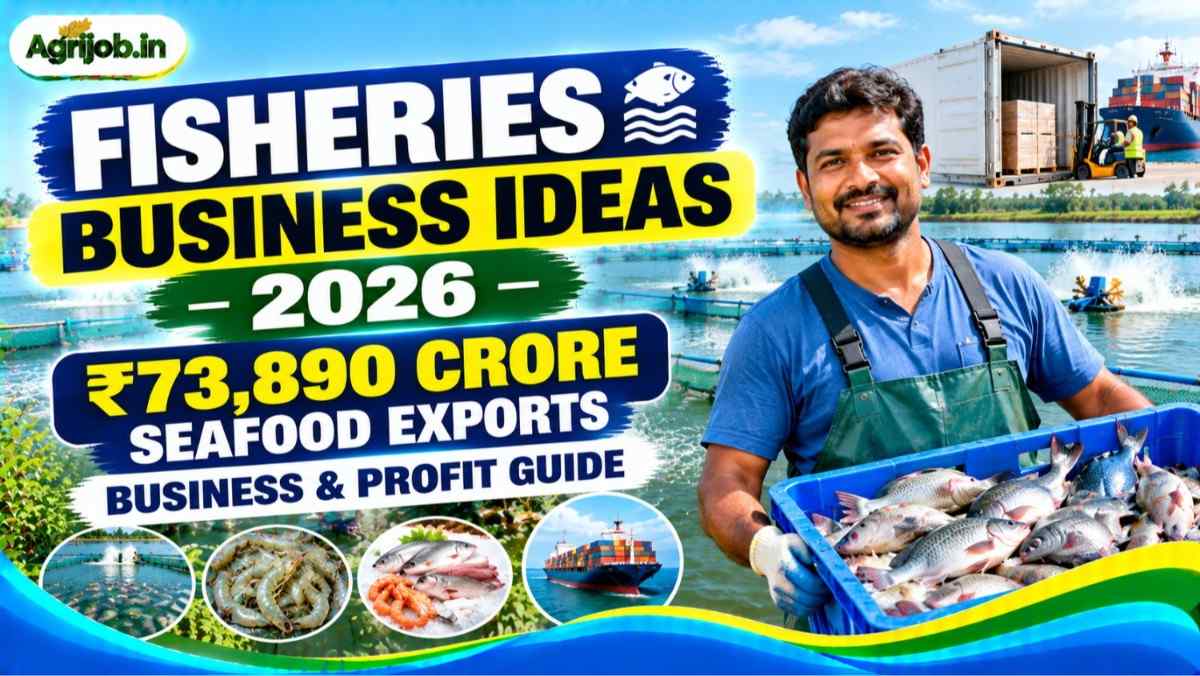
India’s fisheries sector crossed Rs.73,890 crore in export earnings in FY 2025–26 — an all-time record — and the business opportunities embedded in this blue economy are still massively underexplored by Indian entrepreneurs. Whether you are a coastal farmer, an agri-graduate, or an investor hunting for high-return sectors, the fisheries value chain in 2026 offers businesses that generate Rs.50,000 to Rs.5 lakh per month with government-backed subsidies under PMMSY. This guide is for farmers, entrepreneurs, and investors aged 20–55 who want to enter fisheries, aquaculture, or seafood export in India with clear profit data and step-by-step business models. This article covers 10 proven business ideas, profit estimates, export market data, eligibility for PMMSY subsidies, comparison of business models, and a step-by-step launch guide.

The fisheries sector in India is one of the most profitable agri-businesses in 2026. India exported Rs.73,890 crore (USD 8.46 billion) worth of seafood in FY 2025–26, creating strong demand for fish farming, processing, cold storage, and export businesses. PMMSY provides up to 60% subsidy on setup costs, making the entry barrier very low for Indian entrepreneurs.
- Total Seafood Exports (FY 2025–26): Rs.73,890 crore (USD 8.46 billion) — all-time record
- Export Volume: 19,72,018 metric tonnes
- Top Export Product: Frozen shrimp — Rs.49,037 crore (66.52% of total export value)
- Top Export Markets: USA (Rs.20,263 crore), China, EU, Southeast Asia, Japan, Middle East
- Livelihoods Supported: ~3 crore fishers and fish farmers across India
- PMMSY Total Outlay: Rs.20,750 crore (including Rs.6,000 crore PM-MKSSY sub-scheme)
- PMMSY Budget 2026–27: Record Rs.2,500 crore allocated
- India’s Global Rank: 2nd largest aquaculture producer globally
- Share of Global Fish Exports: ~10% of total global seafood exports
- Value-Added Products Growth: Share rose from 2.5% to 11% of export basket
- What Is a Fisheries Business and Why 2026 Is the Best Year to Start
- Who Should Start a Fisheries Business in India?
- Top 10 Fisheries Business Ideas with Profit Potential
- Export Earnings and Global Reach of Indian Fisheries
- PMMSY Subsidy — Eligibility and Financial Assistance
- How to Start a Fisheries Business in India — Step-by-Step
- Fish Farming vs Fish Processing vs Seafood Export — Comparison
- Pros and Cons of Entering the Fisheries Business
- Important Terms in Fisheries Business You Must Know
- Important Links — Official Portals and Resources
- Conclusion
- Key Takeaways
- Frequently Asked Questions
What Is a Fisheries Business and Why 2026 Is the Best Year to Start
A fisheries business covers every stage of the fish and seafood value chain — from rearing fish in ponds and tanks, to processing them into frozen or dried products, to exporting them to markets in the USA, EU, and China. India’s fisheries sector contributes approximately 1.27% to GDP and employs nearly 3 crore people, making it one of the largest employment generators in the agriculture economy.
2026 is the optimal entry point for three concrete reasons. First, India’s seafood exports crossed Rs.73,890 crore in FY 2025–26, the highest ever, creating sustained demand that processors and suppliers must fulfill. Second, the government has allocated a record Rs.2,500 crore under PMMSY for 2026–27, meaning subsidies and financial assistance are at a peak. Third, the EU-India Free Trade Agreement signed in February 2026 has opened a massive new export corridor for Indian seafood with reduced tariffs.

The sector’s scope goes far beyond a fishing boat. Ice plants, cold storage, fish feed mills, hatcheries, retail kiosks, and aquaculture technology startups all form part of the value chain that PMMSY actively funds. Whether you invest Rs.5 lakh or Rs.5 crore, there is a business model in this sector that fits your scale.
Who Should Start a Fisheries Business in India?
The fisheries sector is uniquely inclusive — it is profitable for micro-entrepreneurs with Rs.2 lakh capital and for large agri-businesses with crores to invest. Here are the 8 most ideal entrepreneur profiles for this sector in 2026:
- 🎣 Coastal and inland fishers who want to add processing and value-added export earnings on top of their catch income
- 🌾 Farmers with pond land (0.5 to 5 acres) who can convert idle water bodies into productive shrimp or fish farms
- 🎓 Agriculture graduates and fisheries diploma holders who want to build technology-driven aquaculture startups backed by PMMSY funding
- 🏭 Cold chain and logistics entrepreneurs who want to build ice plants, refrigerated transport fleets, or integrated cold chain facilities
- 💼 Export traders and importers already working in agriculture or food who want to pivot into the high-value seafood export market
- 👩🍳 Women self-help groups (SHGs) in coastal areas who can start dried fish, pickled fish, or ready-to-cook seafood product businesses with low capital
- 🏘️ Village-level entrepreneurs in Bihar, UP, West Bengal, Andhra Pradesh, and Odisha targeting the booming domestic fish consumption market
- 📱 Agri-tech founders who want to build digital platforms, IoT-based water quality monitoring, or fish feed management apps for the Rs.21.9 billion aquaculture market
Top 10 Fisheries Business Ideas with Profit Potential in India 2026
The following 10 business models span the entire fisheries value chain. Each includes an investment range, monthly income potential, and the specific PMMSY or government support available.

1. Freshwater Fish Farming (Rohu, Catla, Tilapia)
Freshwater aquaculture contributes over 75% of India’s total fish production. Rohu and Catla are the two most consumed freshwater fish in India, and Tilapia delivers one of the fastest growth cycles (6–8 months to harvest). A 1-acre pond can produce 3,000–5,000 kg of fish per harvest cycle, generating a gross income of Rs.3–5 lakh per year. Net profit after feed, seed, and operational costs typically ranges between Rs.1.2–2.5 lakh per acre per year.
2. Shrimp (Vannamei) Farming — The Highest-Value Aquaculture Business
Shrimp is the single biggest profit driver in Indian aquaculture. Vannamei (Whiteleg shrimp) farming is now India’s top export earner — contributing Rs.49,037 crore of the total Rs.73,890 crore seafood export value in FY 2025–26. Shrimp farmers in Andhra Pradesh, Tamil Nadu, and Gujarat earn Rs.2–5 lakh per acre per crop cycle (120–150 days). With two crops per year, annual profits can reach Rs.4–10 lakh per acre depending on stocking density and pond management. PMMSY provides financial assistance for construction of shrimp ponds and Recirculating Aquaculture Systems (RAS).
3. Ice Plant and Cold Storage Business
Post-harvest losses in fisheries can reach 20–30% without cold chain infrastructure. This is why ice plants and cold storage facilities near fish landing centres are highly profitable and actively subsidised under PMMSY. A 10-tonne cold storage facility generates Rs.40,000–80,000/month in rental and service income from local fishers. The government provides financial assistance up to Rs.100 lakh per plant under PMMSY cold chain development. An entrepreneur in West Bengal running a fish processing and drying unit with a 10-tonne cold storage recorded a profit of Rs.31 lakh in 2025 alone, according to ICAR data.
4. Fish Processing and Freezing Unit
Setting up a fish processing plant to clean, grade, freeze, and pack fish for domestic retail or export markets is one of the most scalable fisheries businesses. Processing fish adds 30–50% value over raw catch prices. A medium-scale processing unit (5–10 tonne/day capacity) can generate Rs.2–5 lakh/month net profit once export relationships are established. Frozen fish was India’s second-largest seafood export item in FY 2025–26, generating Rs.5,658 crore (USD 643.70 million), showing robust export demand.
5. Dried and Smoked Fish Products
Dried seafood emerged as India’s third-largest export category in FY 2025–26, generating Rs.5,079 crore with a sharp 78% rise in rupee terms year-on-year. A small-scale dried fish enterprise producing 2,000 kg/month — like the model replicated from West Bengal — earns Rs.31 lakh annually at current market rates. This is a low-investment business (Rs.2–10 lakh) suitable for coastal entrepreneurs, especially with FSSAI certification and modern drying racks instead of traditional open-air methods.
6. Fish Feed Manufacturing
India’s aquaculture market of USD 21.9 billion creates enormous demand for high-quality fish feed. Avanti Feeds Limited, India’s largest shrimp feed producer, illustrates the scale possible in this segment. Small and medium fish feed mills servicing local aquaculture clusters generate Rs.1–3 lakh/month. Feed quality directly affects yield and disease resistance, so certified feed manufacturers command premium pricing in markets like Andhra Pradesh and Tamil Nadu.
7. Ornamental Fish Farming and Aquarium Business
India’s ornamental fish market is growing rapidly alongside rising urban disposable incomes. Goldfish, Koi, Guppy, and exotic tropical species fetch Rs.50–Rs.5,000 per fish retail. Initial investment is low (Rs.1–5 lakh) with strong margins. This is one of the best business ideas for urban and semi-urban entrepreneurs with limited space, as it can be run from a 500–1,000 sq. ft. facility.
8. Seafood Export Business — Connecting to 130 Countries
India currently exports over 350 seafood product varieties to nearly 130 countries, according to the Ministry of Fisheries. Setting up an export unit requires an IEC (Import Export Code), EIC (Export Inspection Council) approval, and MPEDA registration. Export earnings per container of frozen shrimp average Rs.50–80 lakh, with margins of 8–15% at the exporter level. The EU-India FTA (signed February 2026) and growing Middle East demand are major tailwinds for new exporters.
9. Fish Hatchery and Seed Production
Every fish farmer needs quality fingerlings (baby fish) to stock their ponds — and hatcheries producing certified disease-free seed are in constant demand. A small hatchery producing 50–100 lakh fingerlings per season can earn Rs.5–15 lakh per season. PMMSY provides financial assistance for fish seed hatchery construction, making this a low-risk high-demand business.
10. Seaweed Cultivation and Marine Aquaculture
Seaweed farming is one of the newest and fastest-growing opportunities in India’s blue economy. Seaweed is used in food, pharmaceuticals, cosmetics, and biofuel. Tamil Nadu and Gujarat lead seaweed cultivation. PMMSY specifically supports seaweed farming and ornamental fish enterprises as new-age fisheries businesses. Early movers in this space are generating Rs.30,000–Rs.1 lakh/month from small plots (0.1 hectare) in coastal waters.
| Business Idea | Initial Investment | Monthly Income | PMMSY Support | Export Potential |
|---|---|---|---|---|
| Freshwater Fish Farming | Rs.2–5 lakh/acre | Rs.20,000–50,000 | Yes — pond construction | Medium |
| Shrimp (Vannamei) Farming | Rs.5–15 lakh/acre | Rs.40,000–1 lakh | Yes — RAS, ponds | Very High |
| Ice Plant / Cold Storage | Rs.20–100 lakh | Rs.60,000–1.5 lakh | Yes — up to Rs.100 lakh | Indirect |
| Fish Processing Unit | Rs.15–50 lakh | Rs.1–5 lakh | Yes — processing units | High |
| Dried / Smoked Fish | Rs.2–10 lakh | Rs.50,000–2 lakh | Yes — training + infra | High (Rs.5,079 Cr export) |
| Fish Feed Manufacturing | Rs.10–50 lakh | Rs.1–3 lakh | Yes — feed mills | Low |
| Ornamental Fish Farm | Rs.1–5 lakh | Rs.30,000–1 lakh | Yes — ornamental species | Medium |
| Seafood Export Business | Rs.50 lakh–5 crore | Rs.2–20 lakh | Yes — MPEDA schemes | Very High |
| Fish Hatchery | Rs.5–20 lakh | Rs.40,000–1.5 lakh | Yes — hatchery construction | Low |
| Seaweed Cultivation | Rs.50,000–2 lakh | Rs.30,000–1 lakh | Yes — new enterprise | Medium-High |
Export Earnings and Global Reach of Indian Fisheries 2026
India is now the world’s second-largest aquaculture producer and accounts for approximately 8% of global fish production. The country ships over 350 seafood product varieties to nearly 130 countries, giving any new exporter an enormous choice of destination markets. The following table shows the exact export market breakdown by destination country for FY 2025–26:
| Export Market | Shrimp Volume (MT) | Value (Rs. Crore) | Growth Trend |
|---|---|---|---|
| USA | 2,56,128 | Rs.20,263 | -10.82% (shifting to other markets) |
| China | 1,69,505 | Strong growth | +22.7% growth |
| European Union | 1,35,599 | Significant | +37.9% growth |
| Southeast Asia | 83,810 | Growing | +36.1% growth |
| Japan | 40,776 | Stable | +6.55% growth |
| Middle East | 30,478 | Emerging | Rapid growth |
| Other countries | 76,351 | Diversifying | Positive |
Beyond shrimp, India’s export diversification is accelerating. Frozen squid exports reached Rs.4,493 crore (1,02,060 MT), frozen cuttlefish grew 13.32% in volume and 16.25% in dollar value, and value-added processed seafood products now account for 11% of the export basket — up from just 2.5% a few years ago. This means entrepreneurs entering processing and value-addition today have a rising export price premium to capture.
The EU-India Free Trade Agreement signed in February 2026 is a game-changer. The EU was already India’s third-largest shrimp market with 37.9% growth in FY 2025–26. With tariff reductions under the FTA, EU demand for Indian seafood is expected to accelerate further, opening premium markets for certified, value-added, and sustainably-sourced Indian seafood.
PMMSY Subsidy — Eligibility and Financial Assistance Guide 2026
The Pradhan Mantri Matsya Sampada Yojana (PMMSY) is India’s flagship fisheries scheme with a total outlay of Rs.20,750 crore (including Rs.6,000 crore for PM-MKSSY sub-scheme), launched in 2020 by the Department of Fisheries, Ministry of Fisheries, Animal Husbandry and Dairying. As of its sixth anniversary on 10 September 2026, PMMSY has created employment for 58 lakh persons and transformed fisheries infrastructure nationally.
The scheme provides financial assistance as a percentage of the project cost across different categories of beneficiaries:
- SC/ST and Women beneficiaries: Up to 60% subsidy on eligible project cost
- General category beneficiaries: Up to 40% subsidy on eligible project cost
- State governments and their entities: 100% central assistance or 60:40 cost sharing
- Aquaculture startups and Fish Farmers Producer Organizations (FFPOs): Dedicated financial assistance window
- RAS (Recirculating Aquaculture Systems) and Bio-floc units: Technology-specific assistance available
Eligible activities under PMMSY include: pond and tank construction, hatchery and feed mill setup, ice plants and cold storages (up to Rs.100 lakh per plant), post-harvest transportation vehicles (refrigerated vans), fish kiosks and retail markets, seaweed cultivation, ornamental fish units, and fishing vessel modernisation.
| Category | PMMSY Subsidy Rate | State Share | Beneficiary Share |
|---|---|---|---|
| SC/ST and Women (all states) | 60% Central | State-funded | 10% |
| General Category (all states) | 40% Central | State-funded | 20% |
| NE/Himalayan States (general) | 60% Central | State-funded | 10% |
| State Govt. entities | 60:40 (Centre:State) | 40% | Nil |
| Central Govt. entities | 100% Central | Nil | Nil |
How to Start a Fisheries Business in India — Step-by-Step 2026
- Choose your business model: Select from the 10 business ideas listed above based on your location (coastal vs inland), capital, land availability, and target market (domestic vs export). Coastal states like Andhra Pradesh, Kerala, Tamil Nadu, and West Bengal offer the widest infrastructure access for shrimp and marine fisheries.
- Check state fisheries department eligibility: Visit your State Fisheries Department website or office to check PMMSY beneficiary eligibility. Required documents typically include Aadhaar card, land ownership proof or lease agreement, bank account details, and a brief project proposal.
- Register on the National Fisheries Digital Platform (NFDP): The NFDP, launched under PM-MKSSY, is the official digital gateway for fishers and fish farmers to access scheme benefits, insurance, and credit. Register at fisheries.gov.in.
- Prepare your Detailed Project Report (DPR): For PMMSY financial assistance, you need a DPR covering land details, activity type, estimated cost, and expected output. Your district fisheries office or NABARD branch can help prepare and validate the DPR.
- Apply through State Implementing Agency: Submit your PMMSY application to the State Fisheries Development Board or designated implementing agency in your state. Processing time is typically 30–90 days.
- Secure additional financing: NABARD provides fisheries-sector loans at concessional rates. Kisan Credit Card (KCC) has been extended to fishers since 2019. PM-MKSSY also provides formalized credit access for registered fish farmers.
- Obtain required licenses: For processing and export businesses, obtain: FSSAI license, Import Export Code (IEC) from DGFT, EIC approval from Export Inspection Council, and MPEDA registration for seafood export.
- Set up cold chain and quality systems: For any business linked to export or urban retail, food safety certification (FSSAI, HACCP) is mandatory. Invest in quality testing, temperature monitoring, and traceability systems from day one — these are required by all major export markets including the USA and EU.
Do not start an export business without first completing MPEDA registration and EIC certification. The USA (your largest market at Rs.20,263 crore) and the EU now mandate HACCP certification and traceability documentation for every consignment. Skipping these steps results in rejected shipments and significant financial loss. Start with domestic markets to build operational capacity, then layer in export capability once certifications are in place.
Fish Farming vs Fish Processing vs Seafood Export — Which Is Right for You?
Three dominant business models exist in Indian fisheries: primary production (fish farming / aquaculture), secondary value addition (processing, freezing, drying), and tertiary trade (domestic distribution or international export). Here is how they compare across 8 key dimensions:
| Parameter | Fish Farming | Fish Processing | Seafood Export |
|---|---|---|---|
| Minimum Investment | Rs.2 lakh | Rs.10 lakh | Rs.50 lakh |
| Monthly Income Potential | Rs.20,000–1 lakh | Rs.1–5 lakh | Rs.5–20 lakh |
| Land / Infrastructure | Pond/tank required | Factory space | Processing + logistics |
| PMMSY Subsidy | 40–60% | 40–60% | MPEDA schemes |
| Time to First Profit | 6–12 months | 3–6 months | 12–24 months |
| Skill Requirement | Medium (trainable) | Medium-High | High (regulatory + trade) |
| Risk Level | Medium (disease, weather) | Low-Medium | Medium-High (global prices) |
| Scalability | Medium | High | Very High |
For most Indian entrepreneurs starting in 2026 with Rs.5–20 lakh capital, shrimp farming or freshwater fish farming combined with an on-site drying or processing unit offers the best risk-adjusted return. This integrated model captures both domestic and export markets, benefits from PMMSY subsidies at the farm level, and generates cash flow within 6–12 months. Entrepreneurs with Rs.50 lakh+ should seriously evaluate fish processing units targeting EU or Middle East export, where demand is growing at 37.9% and 36.1% respectively. Pure export businesses require regulatory preparation of 12–18 months before the first shipment.
Pros and Cons of Entering the Fisheries Business in India
A balanced assessment of fisheries as a business sector is essential before committing capital and time:
Advantages of Fisheries Business
- ✅ Massive government support: PMMSY provides 40–60% subsidy, reducing capital risk significantly for new entrants
- ✅ Proven export demand: Rs.73,890 crore FY 2025–26 export record confirms real global demand, not a projected market
- ✅ Multiple entry points: Businesses from Rs.2 lakh (seaweed, ornamental fish) to Rs.5 crore+ (export processing) are viable in this sector
- ✅ EU-India FTA tailwind: The February 2026 free trade agreement reduces tariff barriers and opens premium EU seafood markets to Indian exporters
- ✅ Rising domestic consumption: 72% of India’s population eats fish; per capita consumption reached 5.7 kg in 2025 and is growing
- ✅ Technology integration opportunity: RAS, bio-floc, IoT-based monitoring, and digital traceability are being actively promoted and funded under PM-MKSSY
Disadvantages and Risks
- ❌ Disease risk in aquaculture: White spot syndrome and other shrimp diseases can wipe out an entire crop — biosecurity investment is non-negotiable
- ❌ PMMSY subsidy processing delays: State implementation quality varies widely; subsidy disbursement can take 6–18 months depending on the state
- ❌ Export regulatory complexity: FSSAI, EIC, MPEDA, and HACCP certifications require time, expertise, and upfront cost before the first export
- ❌ US tariff uncertainty: Exports to the USA declined 10.82% in rupee value in FY 2025–26 due to global market shifts and tariff pressures — over-dependence on one market is a risk
Important Terms in Fisheries Business You Must Know
Understanding these 10 key terms will help you navigate PMMSY applications, export documentation, and aquaculture technology decisions with confidence:
- PMMSY (Pradhan Mantri Matsya Sampada Yojana): India’s flagship fisheries scheme with Rs.20,750 crore outlay providing 40–60% subsidy on fisheries infrastructure, launched in 2020
- MPEDA (Marine Products Export Development Authority): The statutory body under Ministry of Commerce & Industry that regulates and promotes seafood exports — mandatory registration for all exporters
- RAS (Recirculating Aquaculture System): A technology-driven fish rearing system that filters and reuses water, enabling high-density indoor farming with minimal water consumption — PMMSY actively funds RAS units
- Bio-floc Technology: A sustainable aquaculture method using beneficial microbes in water to improve feed efficiency and reduce chemical use — growing fast in India and funded under PMMSY
- Vannamei Shrimp (L. vannamei): The dominant shrimp species in Indian aquaculture, contributing Rs.49,037 crore of exports in FY 2025–26, traded globally as Whiteleg or Pacific white shrimp
- EIC (Export Inspection Council): The government authority that certifies fish and seafood products meet quality and safety standards required by importing countries — mandatory for all seafood exporters
- IEC (Import Export Code): A 10-digit registration number from DGFT (Directorate General of Foreign Trade) required to import or export any goods from India, including seafood
- NFDP (National Fisheries Digital Platform): The official digital platform launched under PM-MKSSY for fisher registration, scheme access, insurance enrollment, and digital identity for fish farmers
- FFPO (Fish Farmers Producer Organization): A collective ownership model for fish farmers — similar to FPOs in agriculture — that PMMSY actively funds to give small farmers collective bargaining power in markets
- Blue Economy: An economic concept encompassing all activities — fishing, shipping, aquaculture, tourism, renewable energy — that sustainably use ocean and water resources for growth and livelihood generation
Important Links — Official Portals and Resources
| Link Name | URL |
|---|---|
| Official PMMSY Portal — Department of Fisheries | dof.gov.in/pmmsy |
| MPEDA — Seafood Export Registration and Guidelines | mpeda.gov.in |
| NABARD — Fisheries Finance Schemes | nabard.org |
| National Fisheries Development Board (NFDB) | nfdb.gov.in |
| ICAR-Central Institute of Fisheries Education | icar.org.in |
| Export Inspection Council — EIC Certification | eicindia.gov.in |
Conclusion — Fisheries Business Ideas India 2026
India’s fisheries sector in 2026 is not a future opportunity — it is a present and proven one, backed by Rs.73,890 crore in actual export earnings, Rs.2,500 crore in government budget support, and 130 countries actively buying Indian seafood. Whether you choose shrimp farming, fish processing, cold chain logistics, ornamental fish rearing, or dried seafood production, the fundamentals of demand, government subsidy, and global reach are all working in your favour. The EU-India FTA, the rising share of value-added products, and digital transformation via NFDP make 2026 the most well-supported year yet to enter this sector. Apply for PMMSY through your State Fisheries Department today and bookmark this page — we update it every time official data or scheme guidelines change.
- India’s fisheries exports hit an all-time high of Rs.73,890 crore (USD 8.46 billion) in FY 2025–26 — the market is real and growing
- PMMSY provides 40–60% subsidy on fisheries businesses, reducing minimum investment to as low as Rs.80,000–Rs.2 lakh for women and SC/ST entrepreneurs
- Shrimp farming in Andhra Pradesh generates Rs.4–10 lakh per acre per year; dried fish processing enterprises in West Bengal recorded Rs.31 lakh annual profit
- EU-India FTA (February 2026) and 37.9% EU market growth make European seafood export the next big opportunity for Indian processors
- 10 business ideas span every investment range from Rs.50,000 (seaweed cultivation) to Rs.5 crore+ (seafood export unit) — choose based on your capital and location
- Register on NFDP, contact your State Fisheries Department for PMMSY, and secure MPEDA registration before making any export investment
Frequently Asked Questions About Fisheries Business Ideas India 2026
What is the most profitable fisheries business in India in 2026?
Shrimp (Vannamei) farming is currently the most profitable fisheries business in India. It contributed Rs.49,037 crore — over 66% — of India’s total seafood export value of Rs.73,890 crore in FY 2025–26. Shrimp farmers in Andhra Pradesh earn Rs.2–5 lakh per acre per crop cycle, with two crops per year possible, generating Rs.4–10 lakh per acre annually. Fish processing for export (frozen fish, dried seafood) is the second most profitable segment, especially with the EU market growing at 37.9%.
How much subsidy does PMMSY give for fisheries business?
PMMSY provides up to 60% subsidy for SC/ST and women beneficiaries and up to 40% subsidy for general category entrepreneurs on the eligible project cost of approved fisheries activities. This covers pond construction, hatcheries, ice plants (up to Rs.100 lakh per plant), refrigerated transport vehicles, fish processing units, seaweed cultivation, and more. The remaining cost (10–20% for subsidised categories) is typically met through bank loans supported by NABARD or Kisan Credit Card.
Which states are best for starting a fisheries business in India?
Andhra Pradesh is India’s top state for shrimp farming and aquaculture, contributing the highest share of India’s seafood exports. Kerala and Tamil Nadu lead in marine fisheries and processing. West Bengal and Bihar are strong for freshwater fish farming (Rohu, Catla). Gujarat is emerging strongly in marine and cage culture. For entrepreneurs in landlocked states like Bihar, UP, and Madhya Pradesh, freshwater aquaculture (pond fish farming) is the recommended entry point, with PMMSY funding available in all states.
Which countries buy the most Indian seafood?
The United States is India’s largest seafood importer by value, importing Rs.20,263 crore worth of seafood in FY 2025–26, though volumes declined by 19.51% due to market conditions. China is the largest importer by quantity (1,69,505 MT of shrimp alone) and recorded 22.7% growth. The European Union showed the highest growth rate at 37.9%, while Southeast Asia grew 36.1% and Japan grew 6.55%. The Middle East is an emerging market. India now exports to over 130 countries in total.
What licenses do I need to start a seafood export business in India?
To export seafood from India, you need four key registrations: (1) IEC (Import Export Code) from DGFT — the basic export license for any goods; (2) MPEDA registration from the Marine Products Export Development Authority; (3) EIC certification from the Export Inspection Council, which approves your processing facility meets food safety standards for the importing country; and (4) FSSAI license for food processing and handling. For the USA and EU, HACCP (Hazard Analysis Critical Control Point) certification is additionally required and is mandatory for every processing facility shipping to these markets.
Can I start a fisheries business with Rs.2 lakh?
Yes, several fisheries businesses are viable starting from Rs.2 lakh or less. Seaweed cultivation requires Rs.50,000–2 lakh for a small coastal plot. Ornamental fish farming (goldfish, guppies) can begin with Rs.1–3 lakh in a 500 sq. ft. space. Small-scale freshwater fish farming (backyard pond) is possible with Rs.2–5 lakh, especially with PMMSY subsidy covering 40–60% of pond construction cost. Dried fish production with a 1–2 tonne/month capacity starts at Rs.1–3 lakh including a basic drying unit and FSSAI registration.
What is PMMSY and how is it different from PM-MKSSY?
PMMSY (Pradhan Mantri Matsya Sampada Yojana) is the flagship umbrella scheme for fisheries development with a total outlay of Rs.20,050 crore, covering infrastructure development, production enhancement, value chain modernisation, and fishers’ welfare since 2020. PM-MKSSY (Pradhan Mantri Matsya Kisan Samridhi Sah-Yojana) is a newer Central Sector sub-scheme under PMMSY with Rs.6,000 crore outlay, approved in February 2024, focused specifically on formalising the fisheries sector through digital platform (NFDP), insurance coverage, and credit access for small and micro fish farmers.
Is aquaculture technology like RAS and bio-floc profitable in India?
Yes, RAS (Recirculating Aquaculture Systems) and bio-floc technology are both profitable and actively promoted under PMMSY with dedicated financial assistance. RAS enables year-round fish production in controlled indoor environments, independent of seasons and weather, with stocking densities 10–20x higher than traditional ponds. Bio-floc reduces feed costs by 15–25% by using beneficial microbes to convert waste into fish nutrition. Both technologies reduce water usage by over 90%, making them ideal for water-scarce states. Break-even for a small RAS unit (Rs.20–50 lakh investment) is typically 3–4 years.
How do I register on the National Fisheries Digital Platform (NFDP)?
The NFDP (National Fisheries Digital Platform), launched under PM-MKSSY, is the official government platform for fish farmers to access scheme benefits, insurance, and formal credit. Registration requires Aadhaar card, bank account details, and mobile number. The platform provides a digital ID for fishers and fish farmers that enables access to PM-MKSSY benefits, PM-MFSSY insurance cover, and formal credit linkage. Visit fisheries.gov.in or your nearest State Fisheries Department office to initiate registration. Registered fish farmers are given priority in PMMSY subsidy applications.
Last Updated: October 2026 | This guide is reviewed and updated regularly for accuracy. Bookmark this page for the latest PMMSY scheme data, export figures, and fisheries business information.
Disclaimer: This article is for informational and educational purposes only. All business investment decisions should be made after consulting your State Fisheries Department, NABARD, and certified financial advisors. Subsidy rates and scheme terms are subject to change — always refer to the official PMMSY portal at dof.gov.in for the latest guidelines.