
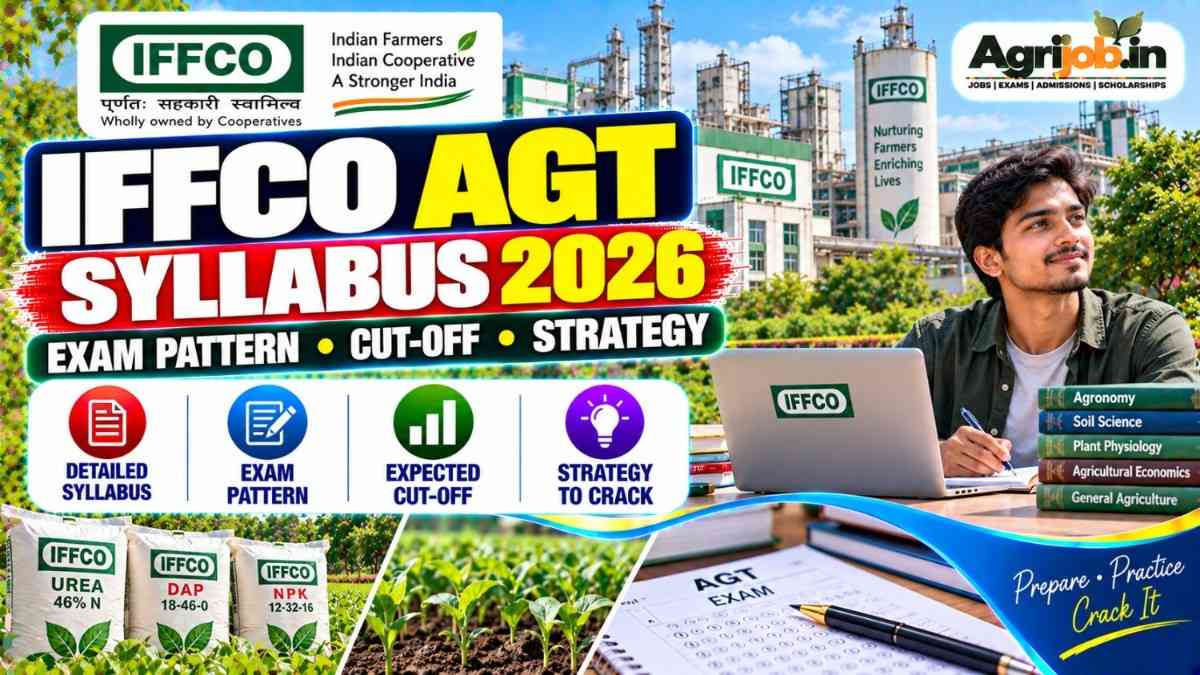
IFFCO AGT syllabus 2026 covers 6 sections across 150 marks — with Agriculture alone carrying 100 marks (67% of total). This guide is for B.Sc. Agriculture graduates appearing in the Indian Farmers Fertiliser Cooperative Limited’s Agriculture Graduate Trainee exam who want a complete, data-backed preparation resource. This article covers the full exam pattern, section-wise syllabus, previous year category-wise cut-off analysis, comparison with similar exams, and a 60-day strategy to crack the IFFCO AGT 2026 — from Prelims to Interview.

The IFFCO AGT 2026 Preliminary Exam has 150 MCQ questions for 150 marks, completed in 45–60 minutes with no negative marking. Agriculture carries 100 marks; the remaining 50 marks are split across Analytical Ability, Reasoning, Numerical Ability, General Awareness, and Communication Skills. General category candidates need approximately 85–95 marks to clear the Prelims cut-off based on 2025 expected trends.
- Conducting Body: Indian Farmers Fertiliser Cooperative Limited (IFFCO)
- Post Name: Agriculture Graduate Trainee (AGT)
- Official Website: iffco.in / careers.iffco-recruitments.in
- Application Last Date: 14 October 2026
- Prelims: 150 questions · 150 marks · 45–60 minutes · No negative marking
- Agriculture Weightage: 100 out of 150 marks (67%)
- Stipend During Training: Rs. 33,300/month (1 year)
- Pay After Absorption: Rs. 37,000–70,000/month (Basic Pay Scale)
- Eligibility: 4-Year B.Sc. Agriculture; 60% for General/OBC; 55% for SC/ST
- Age Limit: 30 years as on 01.09.2026; relaxation as per rules
- Selection Stages: Prelims → Final Online Test → Interview → Medical
- Expected General Cut-Off: 85–95 marks (out of 150)
📋 Table of Contents
- What is IFFCO AGT 2026?
- Who Should Apply for IFFCO AGT 2026?
- IFFCO AGT Exam Pattern 2026 – Prelims & Final Test
- IFFCO AGT Syllabus 2026 – Section-Wise Topics
- Agriculture Syllabus – 100 Marks Deep Dive
- IFFCO AGT Previous Year Cut-Off – Category & Post Wise
- IFFCO AGT Salary & Pay Structure 2026
- IFFCO AGT Selection Process 2026 – All 4 Stages
- IFFCO AGT vs FCI AGT vs IBPS AFO – Comparison
- Pros and Cons of IFFCO AGT 2026
- Important Terms Related to IFFCO AGT
- 60-Day Strategy to Crack IFFCO AGT 2026
- Important Links
- Conclusion
- Key Takeaways
- Frequently Asked Questions
What is IFFCO AGT 2026? – Definition, Organization & Career Significance
IFFCO AGT (Agriculture Graduate Trainee) is the flagship entry-level recruitment of the Indian Farmers Fertiliser Cooperative Limited — the world’s largest fertilizer cooperative with an annual turnover exceeding Rs. 70,000 crore. The AGT post places selected agriculture graduates at the frontline of India’s fertilizer distribution, farmer outreach, and cooperative extension network across all states.
Established in 1967 and owned by 36,000+ farmer cooperative societies serving over 5 crore farmer members, IFFCO manufactures and markets Urea, DAP, NPK, MOP, and its pioneering Nano Urea and Nano DAP — the world’s first nano-liquid fertilizers. An AGT who completes the 1-year training and gets absorbed joins IFFCO at the E-1 grade (Assistant Manager level) with a starting basic pay of Rs. 37,000/month and a full IDA pay scale.

The 2026 recruitment cycle opened on 01 October 2026 with the application window closing on 14 October 2026 at careers.iffco-recruitments.in. The exam is conducted in Computer-Based Test (CBT) mode — an open-environment online exam where candidates use their own device with internet access.
Who Should Apply for IFFCO AGT 2026?
- 🎓 Fresh B.Sc. Agriculture graduates (2022 onwards) — IFFCO specifically targets recent graduates who passed in 2022 or later; older batches are generally not eligible.
- 🌱 B.Sc. Agriculture students in their final year — Final semester result awaited candidates can apply provisionally before result declaration.
- 🏆 Candidates who cleared ICAR JRF or IBPS AFO — The syllabus overlaps heavily; concurrent preparation is highly efficient.
- 🔬 Candidates with strong Agronomy and Soil Science fundamentals — These two subjects alone cover 40% of the Agriculture section.
- 💼 Agriculture graduates seeking stable corporate careers — IFFCO offers IDA pay scale equivalent to central government PSU compensation.
- 🌍 Candidates willing to serve across India — IFFCO AGTs are posted pan-India; posting at northern states (UP, Punjab, Haryana) is most common due to high fertilizer demand.
- 📱 Graduates interested in agri-technology and innovation — IFFCO leads with Nano Urea, Nano DAP, and digital farming initiatives.
- 🤝 Candidates passionate about cooperative and farmer-centric work — IFFCO’s cooperative ownership model means AGTs work directly for farmer-owners, not private shareholders.
IFFCO AGT Exam Pattern 2026 – Prelims & Final Test
The IFFCO AGT 2026 selection consists of 4 stages. Stage 1 — the Preliminary Online Test — is the primary filter. Understanding this stage’s exam pattern is the single most important step before beginning preparation.
Stage 1 – Preliminary Online Test (CBT)
| Subject / Section | Questions | Marks | Weightage |
|---|---|---|---|
| Agriculture | 100 | 100 | 67% |
| Analytical Ability | 10 | 10 | 7% |
| Test of Reasoning | 10 | 10 | 7% |
| Numerical Ability | 10 | 10 | 7% |
| General Awareness (Agriculture Scenario, National Economy, Panchayat Raj & Cooperative) | 10 | 10 | 7% |
| Communication Skills | 10 | 10 | 7% |
| Total | 150 | 150 | 100% |
Duration: 45–60 minutes | Mode: Online CBT (open-environment — candidates use own device) | Negative Marking: None | Language: English only | Question Type: Multiple Choice Questions (1 mark each)
Stage 2 – Final Online Test
Candidates who qualify the Preliminary Test are invited to a Final Online Test conducted at designated exam centres in a controlled environment. Duration is approximately 60 minutes. The exact pattern for the Final Test is announced closer to the exam date; it covers advanced agriculture subject knowledge and aptitude. Candidates should treat the Final Test as equal in importance to Prelims — both scores contribute to the shortlist for interview.
Stage 3 – Personal Interview
A panel of 3–5 senior IFFCO officials (HR + Technical + Zonal) conducts a 20–35 minute interview focusing on agriculture subject depth, IFFCO organisational knowledge, personality assessment, and communication. Interview marks contribute directly to the final merit list.
Stage 4 – Medical Examination
All candidates who clear the interview undergo a medical examination at IFFCO-designated hospitals. Final joining is subject to passing the medical fitness test.
IFFCO AGT Prelims is conducted in “open environment” mode — meaning candidates use their own device with internet access. However, this is a time trap: the exam duration of 45–60 minutes for 150 questions leaves just 18–24 seconds per question. Candidates who try to look up answers lose time rapidly. Treat IFFCO AGT like a closed-book exam during preparation — master the concepts so deeply that you answer on memory, and use the open-book option only for genuinely doubtful questions in the final 5 minutes.
IFFCO AGT Syllabus 2026 – Complete Section-Wise Topics
1. Agriculture (100 Marks) — Primary Scoring Zone
Agriculture carries 100 out of 150 marks and is therefore the sole decisive section. Key sub-topics across all agriculture disciplines include:
| Agriculture Sub-Topic | Key Areas | Expected Questions |
|---|---|---|
| Agronomy | Crop production, cropping systems, irrigation, Kharif & Rabi crops, weed management, dryland farming, precision agriculture, organic farming | 20–25 |
| Soil Science & Plant Nutrition | Soil formation, classification, physical/chemical properties, 16 essential nutrients, fertilizer types (Urea 46%N, DAP 18:46:0, MOP 60%K₂O), Nano Urea, Nano DAP, INM, biofertilizers | 18–22 |
| Agricultural Extension & Cooperatives | Extension methods, IFFCO cooperative structure, PACS, NABARD, FPOs, digital agriculture, PM-KISAN, PMKSY, PMFBY, e-NAM | 12–15 |
| Plant Protection (Entomology & Pathology) | Major pests, IPM, ETL & EIL, insecticide groups, fungal/bacterial/viral diseases, biological control | 12–15 |
| Horticulture | Fruit & vegetable crops, protected cultivation, post-harvest management, spice crops | 8–10 |
| Agricultural Economics & Policy | Cost concepts, MSP, fertilizer subsidy, NBS, agricultural trade, food security, rural schemes | 8–10 |
| Plant Breeding & Biotechnology | Mendelian genetics, breeding methods, hybrid development, Bt crops, seed technology, important crop varieties | 5–8 |
| Farm Machinery & Post-Harvest Technology | Tractors, implements, threshers, harvesters, cold storage, processing, value addition | 3–5 |
2. Analytical Ability (10 Marks)
Topics include: Analogy, Series Completion, Statement Verification, Situation Reaction Test, Direction Sense Test, Classification, Data Sufficiency, Alpha-Numeric Sequence Puzzles, Blood Relations, Coding-Decoding, Assertion & Reasoning, Arithmetical Reasoning, Missing Characters, and Operations of Mathematics. Aim for 8–9 out of 10 here.
3. Test of Reasoning (10 Marks)
Paper Cutting, Cubes and Dice, Water Images, Dot Situation, Identical Figure Groupings, Forming Figures and Analysis, Construction of Squares and Triangles, Series, Analytical Reasoning, Paper Folding, Mirror Images, Figure Matrix, Completion of Incomplete Patterns, Spotting Embedded Figures, and Classification. This is a speed-based section — practice is mandatory.
4. Numerical Ability (10 Marks)
Averages, Mensuration, Profit and Loss, Problems on Numbers, Pipes and Cisterns, Indices and Surds, Simple Equations, Probability, Time and Distance, Quadratic Equations, Odd Man Out, Races and Games, Numbers and Ages, Permutations and Combinations, Compound Interest, Problems on Trains, Ratio and Proportion, Areas, Volumes, Percentages, Boats and Streams, Simplification and Approximation, Mixtures and Allegations, Simple Interest, LCM and HCF, and Time and Work Partnership.
5. General Awareness (10 Marks)
Agriculture Scenario (India’s fertilizer production, crop output, ICAR schemes), National Economy (GDP, inflation, Budget 2026), Panchayat Raj (3-tier system, 73rd Amendment, Gram Sabha), Cooperative sector (NABARD, NCDC, cooperative banks, IFFCO’s role), Current Affairs of last 6 months — banking terms, awards, RBI functions, and fiscal/monetary policies.
6. Communication Skills (10 Marks)
Telephone Skills, Email Etiquette, Empathy, Active Listening, Presentation Skills, Body Language, Writing Skills, Conflict Resolution, and Respectful Communication. Questions typically test understanding of professional communication scenarios and appropriate responses.
Agriculture Syllabus Deep Dive – Fertilizer-Focused Topics (IFFCO-Specific)
Because IFFCO is primarily a fertilizer cooperative, the Agriculture section has an additional emphasis on plant nutrition and fertilizer science compared to other agriculture exams. The following topics appear repeatedly across IFFCO AGT previous year patterns and must be mastered completely:
- Nano Urea (IFFCO): 4% nitrogen content (liquid), 500 ml = 1 bag (50 kg) of conventional urea, foliar spray at 2–4 ml/litre, reduces soil nitrogen loss, FCDO approved — this topic is near-guaranteed in both exam and interview
- Nano DAP (IFFCO): World’s first nano DAP, 8% N + 16% P₂O₅ content, 500 ml per acre, seed treatment + foliar spray, higher nutrient use efficiency than conventional DAP
- Fertilizer grades and content: Urea (46%N), DAP (18:46:0), SSP (16% P₂O₅), MOP (60% K₂O), complex NPK grades (10:26:26, 12:32:16, 20:20:0)
- Nutrient deficiency symptoms: Yellowing patterns, chlorosis, necrosis — N (older leaves), P (purple colouring), K (leaf margin scorch), Fe (interveinal chlorosis in young leaves)
- Fertilizer subsidy system: Nutrient-Based Subsidy (NBS) for P&K; statutory price regulation for urea; DBT (Direct Benefit Transfer) for fertilizer distribution reform
- Soil pH and nutrient availability: Optimal pH 6.5–7.0; phosphorus availability falls below pH 5.5 and above 7.5; micro-nutrient availability inversely related to pH
- Biofertilizers: Rhizobium (N-fixation in legumes), Azotobacter/Azospirillum (free-living N-fixers), PSB — Phosphate Solubilizing Bacteria, Mycorrhiza (P uptake enhancement)
IFFCO AGT Previous Year Cut-Off – Category-Wise & Trend Analysis
IFFCO does not officially publish cut-off marks publicly after every recruitment cycle. The following analysis is based on expected cut-off data from 2025 exam analysis reports, coaching institute estimates, and trend extrapolation from 2023–2024 cycles.
Prelims Cut-Off (Out of 150 Marks)
| Category | 2023 (Expected) | 2024 (Expected) | 2025 (Expected) | Trend |
|---|---|---|---|---|
| General / EWS | 82–88 | 84–90 | 85–92 | Rising gradually year-on-year as applicants increase |
| OBC (NCL) | 76–82 | 78–84 | 80–86 | Moderate increase; 3–6 marks below General |
| SC | 65–72 | 66–74 | 68–75 | Stable; benefit of reservation; interview becomes key differentiator |
| ST | 58–65 | 60–68 | 62–70 | Lowest threshold; strong agriculture knowledge compensates in Final Test |
Key Cut-Off Observations
- Agriculture Part is the differentiator: Candidates scoring 75+ in the Agriculture section (out of 100) almost always clear the Prelims cut-off, regardless of performance in other sections
- No sectional cut-off: There is no mandatory section-wise minimum — total marks determine qualification, so stronger candidates compensate weaker sections with Agriculture dominance
- Northern Zone is most competitive: UP, Punjab, and Haryana zones see the highest number of applicants and correspondingly higher effective cut-offs by 3–5 marks compared to Eastern and North-Eastern zones
- High vacancy years see lower effective cut-offs: Recruitment cycles announcing 300+ vacancies have historically seen effective merit thresholds 4–6 marks lower than cycles with 100–150 vacancies
- Accuracy matters more than attempts: Since there is no negative marking, candidates should attempt all 150 questions — but genuine knowledge-based accuracy of 80%+ on 130+ questions produces reliable scores of 100–110
- Safe target score for 2026: General/EWS candidates should target 105–115 marks to comfortably clear Prelims and secure interview call; OBC: 98–108; SC: 85–95; ST: 78–88
IFFCO AGT Salary & Pay Structure 2026
| Stage | Pay Component | Amount |
|---|---|---|
| During Training (1 Year) | Monthly Stipend | Rs. 33,300/month |
| After Absorption – E-1 Grade | Basic Pay Scale | Rs. 37,000–70,000/month |
| After Absorption – E-1 Grade | Dearness Allowance (DA) | ~45% of Basic Pay (quarterly revision) |
| After Absorption – E-1 Grade | HRA | 8–24% of Basic Pay (city-category based) |
| After Absorption – E-1 Grade | Annual Performance Bonus | 1–3 months Basic Pay |
| After Absorption – E-1 Grade | Medical Benefits | Full family coverage |
| After Absorption – E-1 Grade | Estimated Gross CTC | Rs. 8–10 LPA (starting) |
| 5–10 Years Service | Manager (E-2) CTC | Rs. 12–16 LPA |
| 10–15 Years Service | Senior Manager (E-3) CTC | Rs. 16–22 LPA |
IFFCO AGT Selection Process 2026 – All 4 Stages Explained
- Preliminary Online Test (CBT): 150 questions, 150 marks, 45–60 minutes, open-environment online mode (own device with internet). Agriculture: 100 marks; Aptitude sections: 50 marks. Shortlisted candidates move to Stage 2.
- Final Online Test: Conducted at designated centres across India in a controlled environment. Duration approximately 60 minutes. Covers advanced agriculture and aptitude. Both Prelims + Final scores together determine interview call.
- Personal Interview: 3–5 member panel; 20–35 minutes; covers agriculture depth, IFFCO knowledge, cooperative understanding, and personality assessment. Interview marks form part of final merit.
- Medical Examination: Standard fitness test at IFFCO-empanelled hospitals. Final joining subject to medical clearance.
IFFCO AGT vs FCI AGT vs IBPS AFO – Comparison Table
| Parameter | IFFCO AGT 2026 | FCI AGT (Agriculture) | IBPS AFO 2026 |
|---|---|---|---|
| Conducting Body | IFFCO (Cooperative) | Food Corporation of India | IBPS (Banking Sector) |
| Post Level | Trainee / E-1 on absorption | Junior Engineer / Grade III Technical | Agriculture Field Officer |
| Prelims Marks | 150 marks (150 Qs) | 150 marks (150 Qs) | 80 marks (80 Qs) |
| Agriculture Weightage | 100/150 (67%) | Agriculture Science paper | 60/80 (75%) |
| Negative Marking | None | 0.25 marks per wrong answer | 0.25 marks per wrong answer |
| Starting Pay | Rs. 37,000/month basic | Rs. 60,000–1,80,000/month scale | Rs. 35,000–1,05,000/month scale |
| Job Nature | Agri-extension, fertilizer marketing | Procurement, storage operations | Agricultural credit, rural banking |
| Transfer Policy | Pan-India transfers | Pan-India transfers | State-level postings primarily |
| Vacancy Volume | 200–500 (per cycle) | 4,000+ (national) | 2,000–3,000 (national) |
| Competition Level | High (national) | Very High (national) | Very High (national) |
| Best For | Candidates interested in fertilizer, extension, cooperative careers | Candidates interested in procurement, food storage | Candidates interested in rural banking and agri-finance |
If your strength is core agriculture science (Agronomy, Soil Science, Plant Protection), IFFCO AGT and IBPS AFO are your best matches — both reward subject depth over aptitude speed. FCI AGT has negative marking and a higher competition base, making accuracy more critical. For candidates appearing in 2026, preparing for IFFCO AGT simultaneously prepares you for 70%+ of IBPS AFO syllabus — pursue both concurrently. IFFCO AGT offers the unique advantage of direct exposure to India’s largest fertilizer cooperative, which has no equivalent in any other agriculture sector job.
Pros and Cons of IFFCO AGT 2026
Advantages
- ✅ World’s largest cooperative: Working for 5 crore+ Indian farmer-owners gives the role genuine social purpose beyond a typical corporate job
- ✅ Innovation exposure: IFFCO leads globally in Nano fertilizer technology — AGTs get front-row access to agricultural innovation
- ✅ No negative marking in Prelims: Allows candidates to attempt all 150 questions without risk — a strategic advantage over FCI/IBPS exams
- ✅ Competitive pay with IDA scale: Rs. 33,300/month stipend rising to Rs. 37,000+ basic on absorption, with DA revisions equivalent to government PSU levels
- ✅ Fast career progression: Strong performers move from AGT to Assistant Manager to Manager within 5–7 years
- ✅ No application fee: Zero registration fee in 2026 notification — accessible to all eligible candidates
Disadvantages
- ❌ Compulsory 1-year training period: Selected candidates must complete 1 year training (usually at IFFCO plants: Kalol, Phulpur, Aonla, Paradeep) — relocation from home state is common
- ❌ No official post-wise vacancy breakdown: IFFCO does not always disclose category-wise or zone-wise vacancy split in the recruitment notification, limiting strategic planning
- ❌ Uncertainty in Final Test pattern: The detailed pattern for the Final Online Test is not announced along with the notification, creating last-minute surprises
- ❌ Pan-India transfer liability: AGTs can be posted anywhere — candidates preferring state-level postings may find IFFCO’s transfer policy restrictive compared to state government agriculture department jobs
Important Terms Related to IFFCO AGT Syllabus 2026
- CBT (Computer-Based Test): The online examination format used for IFFCO AGT 2026 Prelims; conducted in an open-environment mode — candidates use own device with internet access at home or any location
- Nano Urea: IFFCO’s patented liquid nitrogen fertilizer with 4% N content; 500 ml bottle replaces one 50-kg bag of conventional urea; applied as foliar spray — directly relevant to interview and exam
- Nano DAP: World’s first nano liquid DAP developed by IFFCO with 8% N + 16% P₂O₅; used for seed treatment and foliar spray; significantly higher nutrient use efficiency than granular DAP
- NBS (Nutrient Based Subsidy): India’s fertilizer subsidy policy for P&K fertilizers — subsidy fixed per nutrient unit, not per bag; DAP, MOP, SSP, and complex NPKs covered under NBS; urea remains under statutory price control
- PACS (Primary Agricultural Credit Societies): The base unit of India’s cooperative credit structure; IFFCO’s 36,000+ member cooperatives include PACS and district cooperative societies; AGTs work through PACS for farmer-level distribution
- INM (Integrated Nutrient Management): Combining chemical fertilizers + organic manures + biofertilizers to meet crop nutrient requirements while maintaining soil health — a core concept in IFFCO AGT agriculture syllabus
- E-1 Grade (IDA Pay Scale): The pay grade at which IFFCO AGTs are absorbed as Assistant Managers after 1-year training; starting basic pay Rs. 37,000/month in the Rs. 37,000–70,000 scale
- Topical Authority: In the context of exam prep — focusing preparation depth on the 3 highest-weightage agriculture sub-topics (Agronomy + Soil Science + Extension) before spreading to lesser-weighted areas
- FCDO (Fertilizer Control Order): The statutory regulation governing fertilizer quality, packaging, labelling, and price in India; IFFCO Nano Urea received FCDO approval before national commercial launch
- Open-Environment Exam: IFFCO AGT Prelims is classified as an open-environment CBT — no invigilated lab; candidates appear from home using their own computer/laptop with internet; time pressure makes this effectively a closed-book test
60-Day Strategy to Crack IFFCO AGT 2026 – Phase-Wise Plan
The following strategy is designed for a candidate starting preparation 60 days before the expected exam date. Adjust the timeline proportionally if you have more or fewer days available.
Phase 1: Foundation Building (Day 1–20)
- Map the syllabus to your BSc textbooks: Print the IFFCO AGT syllabus and physically tick topics you already know vs. topics needing revision. This honest self-assessment prevents wasted time.
- Start with Soil Science & Plant Nutrition: This is the most IFFCO-specific section. Deep-study fertilizer chemistry, 16 essential nutrients (functions + deficiency symptoms), NPK grades, Nano Urea, and INM. Dedicate 45 minutes daily for the first 10 days.
- Read IFFCO’s official Nano Urea and Nano DAP product pages at iffco.in — these will prepare you for both exam questions and interview answers simultaneously.
- Agronomy foundation: Cover all major Kharif crops (paddy, maize, soybean, cotton, groundnut) and Rabi crops (wheat, barley, gram, mustard) — cultivation practices, important varieties, and yield potential. 30 minutes daily from Day 10 onwards.
- Daily current affairs: 30 minutes on agriculture-related news — IFFCO announcements, fertilizer policy, government scheme updates, crop production reports from PIB and DACFW.
Phase 2: Core MCQ Practice (Day 21–40)
- Practice 60–80 MCQs daily from Agriculture subjects — focus on Agronomy (25 Qs), Soil Science (20 Qs), and Plant Protection (15 Qs) as highest-impact areas.
- Build a Fertilizer Facts Cheat Sheet: One page listing NPK content of 15 major fertilizers, application rates for top 5 crops, Nano Urea vs conventional urea comparison, and soil pH effects on nutrient availability. Review this sheet every alternate day.
- Complete Extension & Cooperatives: Study the 3-tier cooperative credit structure, IFFCO’s member cooperative model, e-NAM, PM-KISAN scheme details, and ATMA/KVK extension methods.
- Aptitude sections practice: 20 minutes daily on Reasoning, Analytical Ability, and Numerical Ability — target 80%+ accuracy on 10-mark sections for easy guaranteed marks.
- Attempt previous year FCI AGT and IBPS AFO agriculture papers: These overlap 60–70% with IFFCO AGT agriculture content and provide excellent practice material.
Phase 3: Mock Tests & Analysis (Day 41–55)
- Attempt 3–4 full-length IFFCO AGT mock tests weekly: Time-bound practice at 45 minutes for 150 questions trains you to answer at exactly 18 seconds per question on average.
- Analyse every mock: For every wrong answer, identify the root cause — conceptual gap, careless reading, or time pressure. Fix conceptual gaps before the next mock.
- Target score tracking: Maintain a score sheet across mock tests. General/EWS candidates should be consistently scoring 105+ by Day 50; if not, intensify weak agriculture sub-topics.
- General Awareness boost: Read the most recent IFFCO Annual Report (available at iffco.in), the Agriculture Ministry’s Annual Report, and last 3 months of agriculture current affairs in the final 2 weeks.
Phase 4: GD & Interview Preparation (Day 56–60)
- Practice speaking on agriculture topics for 2–3 minutes without pause — record yourself and review for clarity, pace, and confidence. Group Discussion requires fluency under pressure.
- Prepare answers for 10 standard IFFCO interview questions: Why IFFCO?, How does Nano Urea work?, What is the cooperative model?, Role of an AGT in the field?, Fertilizer subsidy system, Climate change impact on Indian agriculture.
- Know IFFCO’s manufacturing plants: Kalol (Gujarat) — Nano Urea plant; Kandla (Gujarat); Phulpur (UP); Aonla (UP); Paradeep (Odisha). Knowing which plant makes which product demonstrates preparation depth.
Candidates who master all fertilizer-related topics (NPK grades, Nano Urea, NBS policy, deficiency symptoms, INM) can expect to answer 15–18 questions correctly from Soil Science alone — adding approximately 15–18 extra marks beyond average competitors who study only agronomy. This fertilizer knowledge gap is where IFFCO AGT toppers are made. Spend at least 30% of your Agriculture study time on plant nutrition and fertilizer science.
Important Links – IFFCO AGT 2026
| Link Name | URL |
|---|---|
| Official IFFCO Website | www.iffco.in |
| IFFCO AGT 2026 Apply Online | careers.iffco-recruitments.in |
| NABARD – Official Site (Cooperative Credit Reference) | www.nabard.org |
| Agriculture Ministry – DACFW (Policy Reference) | agricoop.nic.in |
| PIB – Agriculture Press Releases | pib.gov.in |
| IFFCO AGT Recruitment 2026 – Agrijob.in | IFFCO AGT 2026 – Full Recruitment Guide |
| IFFCO AGT Exam Pattern & Cutoff – Agrijob.in | IFFCO AGT Exam Pattern, Cutoff & Interview Tips |
| FCI AGT Agriculture 2026 – Agrijob.in | FCI Manager Agriculture 2026 – Complete Guide |
Conclusion – IFFCO AGT Syllabus 2026
The IFFCO AGT syllabus 2026 rewards genuine Agriculture subject mastery above all else — 100 marks out of 150 come from core agriculture topics, making this the most subject-intensive agriculture recruitment exam at the national level. Candidates who build real depth in Soil Science, Agronomy, and Agricultural Extension while specifically studying IFFCO’s fertilizer products and cooperative model will comfortably clear the Prelims cut-off and make a strong impression in the interview stage. Apply online before 14 October 2026 at careers.iffco-recruitments.in and bookmark this page — we update it with the latest exam date, admit card link, result, and cut-off as soon as IFFCO announces them.
- IFFCO AGT 2026 Prelims has 150 questions for 150 marks in 45–60 minutes with no negative marking — Agriculture alone contributes 100 marks (67%).
- The safe target score for General/EWS category is 105–115 marks; OBC: 98–108; SC: 85–95; ST: 78–88 — aim above these to secure interview call comfortably.
- Mastering fertilizer science (Nano Urea, NPK grades, NBS policy, deficiency symptoms) can add 15–18 extra marks vs average competitors — this is IFFCO’s unique scoring advantage.
- Application last date is 14 October 2026; stipend is Rs. 33,300/month during training and Rs. 37,000+ basic pay after absorption at E-1 grade.
- Begin a 60-day preparation plan starting with Soil Science and Agronomy, then move to mock tests, and dedicate the final week to IFFCO organizational knowledge for interview.
- Check agrijob.in for instant alerts on IFFCO AGT admit card, exam date, result, and cut-off as soon as they are released.
Frequently Asked Questions About IFFCO AGT Syllabus 2026
What subjects are included in the IFFCO AGT syllabus 2026?
The IFFCO AGT 2026 syllabus covers 6 subjects in the Preliminary Test: Agriculture (100 marks), Analytical Ability (10 marks), Test of Reasoning (10 marks), Numerical Ability (10 marks), General Awareness — covering Agriculture Scenario, National Economy, Panchayat Raj and Cooperative sector — (10 marks), and Communication Skills (10 marks). The total is 150 marks across 150 MCQ questions.
How many questions are asked in the IFFCO AGT 2026 exam?
The IFFCO AGT 2026 Preliminary Exam has exactly 150 questions for 150 marks. Each question carries 1 mark. There is no negative marking for wrong answers, so candidates should attempt all 150 questions. The exam duration is 45–60 minutes (check the official admit card for the confirmed duration).
What is the expected cut-off for IFFCO AGT 2026 for General category?
Based on expected cut-off trends from 2025 analysis (exam conducted 8 May 2025), the IFFCO AGT Prelims cut-off for General/EWS category is estimated at 85–92 marks out of 150. To comfortably secure an interview call, General category candidates should target 105–115 marks as a safe score. Actual cut-off will depend on the number of applicants, vacancy count, and exam difficulty in 2026.
Is there negative marking in IFFCO AGT 2026?
No, there is no negative marking in the IFFCO AGT 2026 Preliminary Online Test. Each correct answer gives 1 mark; incorrect or unattempted answers give 0 marks. This means candidates should attempt all 150 questions in the time available without any risk of losing marks on uncertain answers.
What is the Agriculture syllabus for IFFCO AGT 2026 in detail?
The Agriculture section (100 marks) covers: Agronomy (crop production, cropping systems, major Kharif and Rabi crops, weed management, dryland farming, precision agriculture — expected 20–25 questions); Soil Science and Plant Nutrition (fertilizers, Nano Urea, Nano DAP, 16 essential nutrients, biofertilizers, problem soils — 18–22 questions); Agricultural Extension and Cooperatives (IFFCO model, PACS, government schemes — 12–15 questions); Plant Protection (IPM, major pests, diseases — 12–15 questions); Horticulture, Agricultural Economics, Plant Breeding, and Farm Machinery for the remaining marks.
Is IFFCO AGT an open-book exam?
The IFFCO AGT Preliminary Test is conducted in “open-environment” mode — candidates appear online from home using their own device with internet access. However, with 150 questions to answer in 45–60 minutes (about 18–24 seconds per question), there is practically no time to look up answers. Candidates must prepare thoroughly and treat it as a closed-book exam in practice, using the internet access only for genuinely uncertain questions in the remaining time.
What is the salary after IFFCO AGT selection?
During the 1-year training period, IFFCO AGTs receive a stipend of Rs. 33,300 per month. After successful completion of training and absorption as a permanent employee, the basic pay scale is Rs. 37,000–70,000 per month (E-1 grade). With Dearness Allowance (~45% of basic), HRA, transport allowance, and annual performance bonus, the estimated gross CTC at absorption is Rs. 8–10 lakh per annum.
What is the best strategy to crack IFFCO AGT 2026?
The most effective IFFCO AGT strategy has 3 pillars: First, achieve subject depth — score 75+ out of 100 in Agriculture by mastering Agronomy, Soil Science (especially fertilizer science and Nano Urea/DAP), and Agricultural Extension. Second, develop IFFCO-specific knowledge — know the cooperative structure, plant locations, product range, and Nano fertilizer technology inside-out for both exam questions and interview. Third, practice for speed — attempt at least 10–15 full-length 150-question mock tests within 45 minutes each to build the speed and confidence needed on exam day.
Can MSc Agriculture candidates apply for IFFCO AGT 2026?
Yes, MSc Agriculture candidates can apply for IFFCO AGT 2026. The basic requirement is a 4-year B.Sc. Agriculture degree from a UGC-recognized university, and MSc holders possess this qualification. Having a postgraduate degree often provides an advantage during the interview round by demonstrating greater subject depth. Always verify the specific educational qualification clause in the official 2026 notification at iffco.in before applying.
What are the posting locations for IFFCO AGT?
IFFCO AGTs are posted pan-India across IFFCO manufacturing plants, state marketing offices, and district marketing offices. During the 1-year training period, posting is typically at IFFCO plants — Kalol (Gujarat), Kandla (Gujarat), Phulpur (UP), Aonla (UP), or Paradeep (Odisha) — or at state-level extension offices. After absorption, posting is based on IFFCO’s zone-wise requirements. Northern states (UP, Punjab, Haryana, Rajasthan) have the highest number of AGT positions due to India’s largest fertilizer consumption base in these regions.
How many vacancies are expected in IFFCO AGT 2026?
The exact number of IFFCO AGT 2026 vacancies had not been officially disclosed in the recruitment notification as of the date of this guide. Past IFFCO AGT recruitment cycles have announced between 200 and 500+ vacancies depending on IFFCO’s expansion plans and attrition. Candidates should monitor the official recruitment portal at careers.iffco-recruitments.in and the IFFCO website at iffco.in for official vacancy count updates.
Last Updated: October 2026 | This guide is reviewed and updated regularly for accuracy. Bookmark this page for the latest IFFCO AGT exam dates, admit card links, results, and cut-off marks as soon as IFFCO releases them.
Disclaimer: This article is for informational and preparation guidance purposes only. Cut-off marks cited are based on expected/estimated data from coaching institutes and media analysis — not official IFFCO releases. Always refer to the official IFFCO recruitment notification at iffco.in for confirmed eligibility, exam pattern, salary, and other recruitment terms. Figures may change with each recruitment cycle.