
The RRB Para-Medical Health & Malaria Inspector Grade II exam is a single-stage CBT of 100 questions, 100 marks in 90 minutes. The Professional Ability section carries 70 marks covering Food & Nutrition, Environmental Sanitation, Communicable Diseases, and Health Statistics. The in-hand salary is Rs.35,400 per month under 7th Pay Commission Level 6.
RRB paramedical syllabus 2026 for the Health and Malaria Inspector (HMI) Grade II post is one of the most searched topics among science graduates preparing for Indian Railways recruitment. The exam tests 70 marks of professional public health knowledge plus 30 marks of general aptitude — making it distinct from other paramedical posts. This guide covers the complete topic-wise syllabus, updated 2026 exam pattern, previous-year cut-off data (category and post-wise), salary structure, and a proven strategy to crack the exam.

This guide is for B.Sc (Science) graduates with a Diploma in Health/Sanitary Inspection who are targeting a government job in Indian Railways under RRB CEN 04/2024 or upcoming recruitment cycles.

- Post Name: Health and Malaria Inspector Grade II / Grade III
- Conducting Body: Railway Recruitment Board (RRB)
- Exam Mode: Computer-Based Test (CBT) — Single Stage
- Total Questions: 100 MCQs | Total Marks: 100
- Duration: 90 Minutes (1.5 Hours)
- Negative Marking: 1/3 mark deducted per wrong answer
- Professional Ability (Core): 70 Marks
- General Aptitude (Common): 30 Marks
- Salary (7th CPC Level 6): Rs.35,400/month in-hand
- Annual CTC: Approx. Rs.4.24 lakhs + allowances
- Vacancies (CEN 04/2024): 126 posts (Grade III)
- Selection Process: CBT → Document Verification → Medical Examination
- Minimum Qualifying Marks: UR/EWS: 40% | OBC/SC: 30% | ST: 25%
- Official Website: indianrailways.gov.in / respective RRB zone portals
What Is RRB Health and Malaria Inspector Post in Indian Railways?
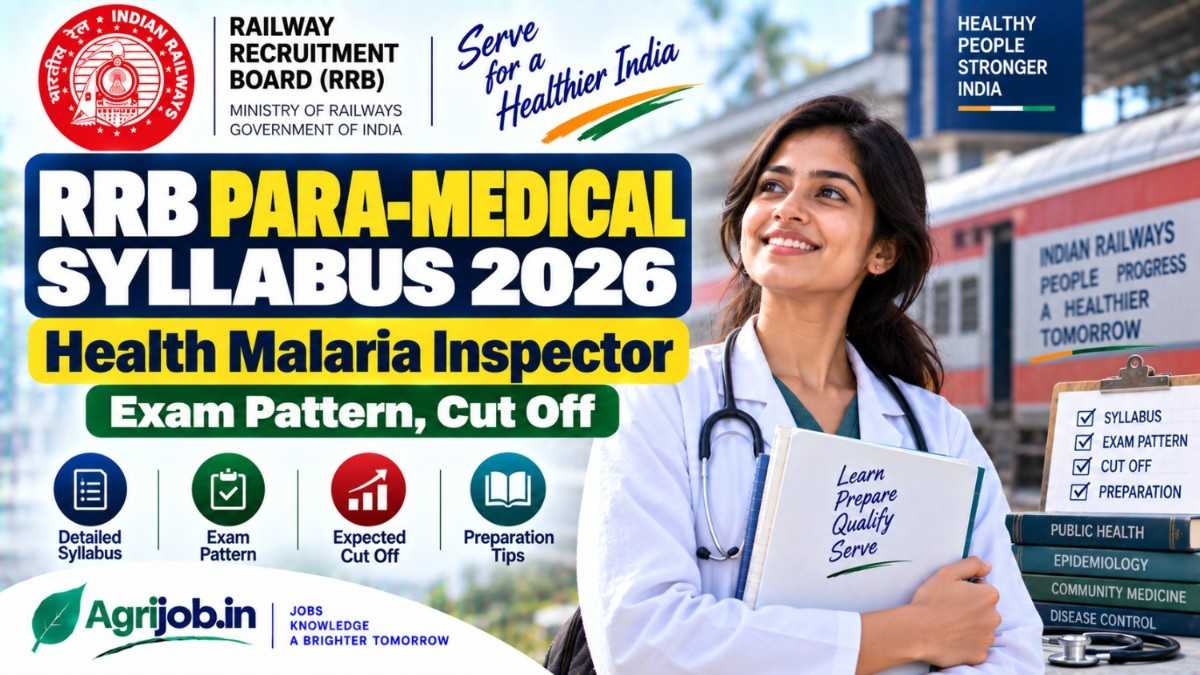
The RRB Health and Malaria Inspector (HMI) is a Group C paramedical post in Indian Railways responsible for maintaining public health standards across railway stations, colonies, and premises. The HMI conducts sanitation inspections, controls vector-borne diseases (especially malaria), monitors food and water hygiene, and implements national health programmes within the railway zone.
The post falls under RRB’s Centralized Employment Notice (CEN) for Paramedical Categories. RRB conducts the recruitment through a single-stage Computer-Based Test (CBT) followed by Document Verification (DV) and a Medical Examination. The exam is held approximately every 5–6 years — the last major cycles were in 2019 and 2024–25.
| Feature | Details |
|---|---|
| Post Grade | Grade II / Grade III (varies by CEN) |
| Pay Level (7th CPC) | Level 6 (Rs.35,400 – Rs.1,12,400) |
| Department | Indian Railways — Medical Department |
| Job Location | Railway zones across India |
| Exam Frequency | Once in ~5–6 years |
| Vacancies (2024 CEN) | 126 posts (Grade III across all zones) |
Who Should Apply for RRB Health and Malaria Inspector?
- 🎓 B.Sc (Biology/Zoology/Microbiology) graduates who also hold a Diploma in Health/Sanitary Inspector — this is the core eligibility combination.
- 🏥 Public health workers and field health supervisors who want to move into a permanent central government role with job security.
- 🌾 Rural candidates from Tier 2 and Tier 3 cities looking for a Group C railway job with good salary, allowances, and pension benefits.
- 📋 Health Sanitary Inspectors employed in state government or municipal bodies seeking a central government posting.
- 🔬 Candidates with background in Community Health, Preventive Medicine, or Public Health — the entire professional syllabus aligns with these disciplines.
- 👩⚕️ Women candidates seeking a government job with age relaxation (3 years for OBC, 5 years for SC/ST) and railway zone preferences.
- 🎯 Aspirants targeting railways over UPSC or SSC — this post has lower competition and more focused syllabus than civil services exams.
- 💼 Ex-servicemen and PwBD candidates who are eligible for additional reservations and relaxations under this recruitment.
RRB HMI Exam Pattern 2026 — Section-Wise Breakdown
The RRB Health and Malaria Inspector CBT follows a standardized pattern common to all RRB paramedical recruitment cycles. Understanding the section-wise distribution is critical for planning your preparation time.
| Section | Questions | Marks | Level |
|---|---|---|---|
| Professional Ability (Public Health / HMI Core) | 70 | 70 | Diploma/Degree Level |
| General Science | 10 | 10 | Class 10 CBSE Standard |
| General Awareness | 10 | 10 | Current Affairs + GK |
| General Arithmetic, Intelligence & Reasoning | 10 | 10 | Basic Aptitude |
| Total | 100 | 100 | 90 Minutes |
Key exam rules you must know: Each correct answer carries 1 mark. Each wrong answer attracts a penalty of 1/3 mark. Unattempted questions carry zero marks. The medium of examination is both Hindi and English. The CBT is conducted in multiple shifts; marks are normalized across shifts before the cut-off is applied.
Complete Topic-Wise Syllabus — All 4 Sections
The RRB HMI syllabus is divided into a 70-mark core professional section and a 30-mark general aptitude section. Below is the complete breakdown of all topics for each section.
Section 1: Professional Ability — Core Subject (70 Marks)
This is the most important section. All four official subject areas are covered in detail in the section below.
Section 2: General Science (10 Marks)
- Physics: Units and measurements, motion, force, energy, electricity, magnetism, optics, sound
- Chemistry: Periodic table, chemical reactions, acids/bases/salts, carbon compounds, metals and non-metals
- Life Science/Biology: Cell structure, human body systems (digestive, circulatory, respiratory, nervous), genetics, evolution, environment and ecology
Section 3: General Awareness (10 Marks)
- Current affairs — national and international events from last 6–12 months
- Indian history — ancient, medieval, modern periods and freedom struggle
- Indian geography — physical features, rivers, climate, agriculture, minerals
- Indian polity — Constitution, fundamental rights, Preamble, important amendments, Lok Sabha and Rajya Sabha
- Indian economy — GDP, budget, five-year plans, banking system, RBI
- Awards and honours — Bharat Ratna, Padma awards, Nobel Prize winners
- Sports — major tournaments, Indian achievements
- Science and technology — recent developments, space missions (ISRO)
Section 4: General Arithmetic, Intelligence & Reasoning (10 Marks)
- Arithmetic: Number system, percentages, ratio and proportion, profit and loss, simple and compound interest, time and work, averages, age problems, fractions
- Reasoning & Intelligence: Analogies, coding-decoding, number series, letter series, blood relations, directions, data interpretation, Venn diagrams, syllogisms, odd one out, puzzles
Professional Ability Syllabus in Detail — 70 Marks (4 Core Subjects)
The Professional Ability section for Health and Malaria Inspector Grade II carries 70 marks out of 100 — this single section determines your selection. It covers the four official syllabus subjects prescribed by RRB.
Subject 1: Food and Nutrition
Food and Nutrition is tested heavily because HMIs inspect food establishments, railway canteens, and water supply at railway premises.
- Nutrients and their functions: Proteins (essential and non-essential amino acids), carbohydrates (simple and complex), fats (saturated/unsaturated/trans fats), vitamins (fat-soluble: A, D, E, K; water-soluble: B-complex, C), minerals (calcium, iron, iodine, zinc), and water.
- Nutritional deficiency diseases: Kwashiorkor (protein deficiency), Marasmus (caloric deficiency), Night blindness and Xerophthalmia (Vitamin A), Rickets/Osteomalacia (Vitamin D), Scurvy (Vitamin C), Beriberi (Thiamine B1), Pellagra (Niacin B3), Anaemia (Iron/Folic acid/B12), Goitre (Iodine deficiency).
- Balanced diet and dietary requirements: ICMR recommended dietary allowances (RDA) for different age groups. Calorific values of foods — protein: 4 kcal/g, carbohydrate: 4 kcal/g, fat: 9 kcal/g. BMI calculation and interpretation.
- Food safety and adulteration: Common adulterants (starch in milk/arrowroot, metanil yellow in pulses, chalk powder in flour, argemone oil in mustard oil, ergot in grains). Food Safety and Standards Act (FSSA) 2006 and FSSAI regulations. Prevention of Food Adulteration (PFA) Act.
- Foodborne diseases: Foodborne infection (Salmonella typhi/typhimurium — incubation 12–48 hrs; Vibrio cholerae; Hepatitis A) versus food intoxication (Staphylococcal toxin — incubation 1–6 hrs; Clostridium botulinum; Bacillus cereus). HACCP (Hazard Analysis and Critical Control Points) — 7 principles.
- Food preservation methods: Physical (refrigeration, freezing, heating/pasteurisation, dehydration, irradiation), chemical (salt, sugar, vinegar, sodium benzoate, potassium metabisulphite), and biological (fermentation). Pasteurisation temperatures — HTST: 72°C for 15 seconds; LTLT: 63°C for 30 minutes.
Subject 2: Environmental Sanitation and Sanitary Engineering
Environmental Sanitation is central to the HMI’s day-to-day railway responsibilities and carries significant weight in the exam.
- Water supply and quality: Sources of water (surface water — rivers, lakes, reservoirs; groundwater — wells, tubewells, springs). Characteristics of potable water — physical (colourless, odourless, tasteless, turbidity less than 5 NTU), chemical (pH 6.5–8.5, TDS less than 500 mg/L, fluoride 1 mg/L), and bacteriological (zero coliforms in 100 mL). Water treatment steps: screening, sedimentation, coagulation (alum dose: 5–40 mg/L), flocculation, sand filtration (rapid or slow), chlorination. Residual chlorine standard: 0.5 mg/L at the point of supply. Hardness, fluorosis, arsenic contamination.
- Excreta and sewage disposal: Types of latrines — pit latrines, Ventilated Improved Pit (VIP) latrine, water-seal latrine, septic tank (capacity based on retention period of 24 hours). Sewage treatment: Imhoff tank, activated sludge process, trickling filter. Biomedical waste management — BMW Rules 2016 colour coding: Yellow bag (anatomical waste), Red bag (contaminated recyclables), White (sharp metals), Blue (glass).
- Solid waste management: Municipal solid waste (MSW) classification — organic, recyclable, inert, hazardous. Disposal methods: sanitary landfill (the standard method for MSW), incineration (high-temperature destruction of hazardous waste), composting (aerobic decomposition), vermicomposting, biogas production, and 3R strategy (Reduce, Reuse, Recycle). Swachh Bharat Mission (Urban and Gramin) mandates.
- Air quality and housing: NAAQS (National Ambient Air Quality Standards) for pollutants — PM10, PM2.5, SO2, NOx, CO, ozone, lead. AQI (Air Quality Index) — 6 categories (Good: 0–50, Satisfactory: 51–100, Moderate: 101–200, Poor: 201–300, Very Poor: 301–400, Severe: 401–500). Housing standards — window area should be at least 1/10th of floor area, minimum 14 cubic metres of air space per person (for non-industrial premises). Overcrowding coefficient.
- Disinfection and sterilisation: Physical methods (autoclaving at 121°C/15 psi for 15–20 mins; hot air oven at 160°C/60 mins; UV radiation), chemical disinfectants (bleaching powder, chloramine, glutaraldehyde, formaldehyde, iodine solutions), Levels of disinfection (high, intermediate, low). Spaulding classification of medical instruments.
- Sanitary inspection of railways: Coach sanitation, inspection of railway catering units, water supply points at stations, pest and rodent control on trains and premises.
Subject 3: Communicable and Non-Communicable Diseases — Prevention and Control
This subject covers the widest breadth of topics and is the core of the Health and Malaria Inspector’s public health role.
Vector-Borne Diseases (Critical — Highest Weightage):
- Malaria: Causative agents — Plasmodium falciparum (cerebral malaria, blackwater fever, most dangerous), P. vivax (most common in India, relapsing malaria, Schüffner’s dots), P. malariae (quartan fever, 72-hour cycle), P. ovale. Vector: female Anopheles mosquito. Life cycle: sporogony in mosquito, schizogony (liver stage exo-erythrocytic + blood stage erythrocytic) in humans. Symptoms: cold stage, hot stage, sweating stage. Diagnosis: thick and thin blood smear (Giemsa/Leishman stain), Rapid Diagnostic Test (HRP-2 antigen for P. falciparum), QBC. Treatment: Chloroquine (P. vivax); ACT — Artesunate + Sulphadoxine-Pyrimethamine (AS+SP) for P. falciparum; Primaquine for radical cure and preventing gametocyte transmission. National malaria elimination target: 2030. API (Annual Parasite Index) = positives / population × 1000.
- Dengue: Aedes aegypti mosquito (day-biting), DEN-1 to DEN-4 serotypes. Dengue Haemorrhagic Fever (DHF) — thrombocytopenia, plasma leakage. NS1 antigen (early detection), IgM/IgG antibody test. No specific antiviral — supportive management.
- Filariasis: Wuchereria bancrofti (most common in India), vector Culex quinquefasciatus. Lymphoedema, hydrocele, elephantiasis. Microfilariae in peripheral blood at night (nocturnal periodicity). Mass Drug Administration (MDA) with DEC + Albendazole under NVBDCP.
- Kala-azar (Visceral Leishmaniasis): Leishmania donovani, vector Phlebotomus argentipes (sandfly). Pancytopenia, hepatosplenomegaly. Treatment: Liposomal Amphotericin B (first line), Miltefosine. Target: elimination by 2023 (now extended) — less than 1 case per 10,000 population per block.
- Japanese Encephalitis: Flavivirus, vector Culex tritaeniorhynchus, reservoir: pigs and ardeid birds (herons). JE vaccine in National Immunisation Schedule for endemic districts.
Airborne and Respiratory Diseases:
- Tuberculosis: Mycobacterium tuberculosis, droplet nuclei transmission, incubation 4–12 weeks. NTEP (National TB Elimination Programme) — target: TB-free India by 2025 (Nikshay Poshan Yojana). Treatment categories and DOTS strategy. Mantoux test (PPD test) — positive if induration > 10 mm (5 mm in immunocompromised). BCG vaccine.
- COVID-19 and other respiratory infections: SARS-CoV-2, pandemic control measures, quarantine vs. isolation.
- Influenza, Measles, Chickenpox, Mumps, Rubella: Causative agents, incubation periods, isolation periods, vaccines.
Enteric (Faecal-Oral) Diseases:
- Cholera: Vibrio cholerae, El Tor biotype, rice-water stools, rapid dehydration. Treatment: Oral Rehydration Solution (ORS), antibiotics (Doxycycline). Notifiable disease. OCV (oral cholera vaccine) under outbreak control.
- Typhoid: Salmonella typhi, contaminated food and water, incubation 10–14 days, Widal test (rising titres), blood culture (1st week), stool culture (2nd–3rd week). Typhoid Vi conjugate vaccine.
- Hepatitis A and E: Faecal-oral route, contaminated water. Hepatitis B and C: blood-borne.
- Polio: Poliovirus (types 1, 2, 3), India certified polio-free since 2014. OPV (oral polio vaccine) and IPV in national schedule. Pulse Polio Immunisation (PPI).
Non-Communicable Diseases (NCDs):
- Cardiovascular diseases: Risk factors — hypertension (BP > 140/90 mmHg), dyslipidaemia, smoking, diabetes, obesity. Primary prevention strategies.
- Diabetes mellitus: Type 1 (insulin-dependent) vs. Type 2. Diagnostic criteria: fasting blood glucose > 126 mg/dL; random > 200 mg/dL; HbA1c > 6.5%. NPCDCS (National Programme for Prevention and Control of Cancer, Diabetes, CVD and Stroke).
- Cancer: Risk factors, cancer screening — PAP smear for cervical cancer, mammography for breast cancer, HPV vaccine (9–14-year girls under national programme).
- Mental health: NMHP (National Mental Health Programme), DMHP (District Mental Health Programme).
- Occupational diseases: Silicosis (silicon dioxide dust — miners), Asbestosis (asbestos fibres), Byssinosis (cotton dust — Monday morning tightness), Coal worker’s pneumoconiosis, Noise-induced hearing loss (NIHL — > 85 dB for 8 hours), Skin disorders, Lead poisoning.
Subject 4: Health and Death Statistics
Biostatistics and vital statistics are tested every cycle and are directly related to the HMI’s reporting duties.
- Vital statistics — definitions and formulae:
- Crude Birth Rate (CBR) = Live births / Mid-year population × 1000
- Crude Death Rate (CDR) = Deaths / Mid-year population × 1000
- Infant Mortality Rate (IMR) = Deaths under 1 year / Live births × 1000 (India IMR 2023: ~28)
- Neonatal Mortality Rate (NMR) = Deaths in first 28 days / Live births × 1000
- Maternal Mortality Ratio (MMR) = Maternal deaths / Live births × 1,00,000 (India MMR 2023: ~97)
- Total Fertility Rate (TFR) = Sum of age-specific fertility rates × 5 (India TFR 2021: 2.0)
- Life Expectancy at Birth = Average years a person is expected to live (India: ~70 years)
- Natural Growth Rate = CBR − CDR
- Epidemiological measures: Incidence rate, prevalence rate (point and period), attack rate, case fatality rate (CFR), proportional mortality rate.
- Statistical methods: Measures of central tendency (mean, median, mode), measures of dispersion (range, standard deviation, variance, coefficient of variation), normal distribution and Z-scores, chi-square test, p-value interpretation.
- Data presentation: Bar chart (comparing discrete categories), histogram (frequency distribution of continuous data), frequency polygon, pie chart, scatter plot, line graph (trends over time), ogive curve.
- Health information systems: Integrated Disease Surveillance Programme (IDSP) — P form (presumptive), L form (laboratory confirmed), C form (clinical/confirmed case). Weekly Epidemic Report (WER). Civil Registration System (CRS) for vital events. Census data usage (Census 2011; next Census 2024 likely).
- Death certification and ICD: International Classification of Diseases (ICD-11 in force from 2022), cause of death coding, verbal autopsy, perinatal death review.
Allocate 60% of your Professional Ability study time to the 4 official subjects in this order: (1) Communicable Diseases & Vector Control (25–30 questions expected), (2) Environmental Sanitation (15–18 questions), (3) Food & Nutrition (12–15 questions), (4) Health Statistics (8–10 questions). Study from K. Park’s Preventive and Social Medicine (latest edition) as the gold standard reference — every HMI topper cites this single book as their primary resource.
RRB Health and Malaria Inspector Salary 2026 — Pay Scale and Allowances
Selected candidates receive a salary governed by the 7th Central Pay Commission (7th CPC). The HMI post is classified under Pay Level 6 of the Pay Matrix.
| Salary Component | Amount (Rs.) |
|---|---|
| Basic Pay (Level 6, Entry) | Rs.35,400/month |
| Dearness Allowance (DA) | As per government revision (50%+ of basic) |
| House Rent Allowance (HRA) | 8%/16%/24% of basic (based on city category) |
| Transport Allowance (TA) | Rs.1,350 – Rs.3,600/month |
| Medical Benefits | RELHS (Railway Employee Liberal Health Scheme) |
| Annual Increment | 3% of basic pay every year |
| Gross In-Hand Salary (Estimated) | Rs.45,000 – Rs.55,000/month |
| Annual Package (Approx.) | Rs.4.24 – Rs.6.60 lakhs/year |
| Maximum Pay (Level 6 ceiling) | Rs.1,12,400/month |
Additional perks include free railway passes (self and dependants), subsidised railway quarters, railway school access for children, and pension under NPS (National Pension System). The HMI post also qualifies for promotion to Senior Inspector and Health Officer through departmental exams.
Eligibility Criteria for RRB HMI 2026
You must meet both the educational qualification and age criteria to apply for this post.
| Criterion | Requirement |
|---|---|
| Educational Qualification | B.Sc (Science) with Biology/Zoology/Botany/Microbiology/Biotechnology AND Diploma in Health/Sanitary Inspector from a recognised institution |
| Minimum Age | 18 years |
| Maximum Age (UR) | 36 years (as on the cut-off date) |
| Age Relaxation — OBC (NCL) | +3 years (max 39 years) |
| Age Relaxation — SC/ST | +5 years (max 41 years) |
| Age Relaxation — PwBD (UR) | +10 years (max 46 years) |
| Age Relaxation — Ex-Servicemen | As per government policy |
| Nationality | Indian Citizen |
| Medical Standards | Must meet visual acuity and physical fitness norms as per RRB |
Previous Year Cut-Off Marks — Category and Post Wise
Cut-off marks for RRB paramedical exams vary by zone, category, and post. The Health and Malaria Inspector post generally has lower cut-offs than Staff Nurse or Pharmacist due to fewer applicants for the specialised role.
CEN 02/2019 Cut-Off — Health and Malaria Inspector Grade III (WR Zone — Official Data)
| List Type | UR | SC | ST | OBC | EWS |
|---|---|---|---|---|---|
| Regular DV Shortlist | 61.56 | 55.10 | 55.78 | 52.72 | — |
| Extra Candidates (50% over vacancy) | 55.44 | 51.70 | 55.10 | — | — |
Comparative Cut-Off: HMI vs Other Paramedical Posts (2019 WR Zone)
| Post | UR Cut-Off | SC Cut-Off | OBC Cut-Off |
|---|---|---|---|
| Staff Nurse | 70.73 | 70.17 | 68.21 |
| Health and Malaria Inspector Gr III | 61.56 | 55.10 | 52.72 |
| Pharmacist Grade III | 58.87 | 53.19 | 57.80 |
| ECG Technician | 51.02 | — | — |
Minimum Qualifying Marks (Statutory — All Cycles)
| Category | Minimum Qualifying Marks (%) | Minimum Qualifying Marks (Out of 100) |
|---|---|---|
| UR / EWS | 40% | 40 marks |
| OBC (NCL) | 30% | 30 marks |
| SC | 30% | 30 marks |
| ST | 25% | 25 marks |
Expected Safe Score (2026 / Next Cycle)
| Category | Safe Score (Expected) | Minimum to Qualify |
|---|---|---|
| UR / EWS | 75+ marks | 40 marks |
| OBC (NCL) | 68–72 marks | 30 marks |
| SC | 60–65 marks | 30 marks |
| ST | 55–60 marks | 25 marks |
Note: The safe score estimates above are based on previous recruitment cycle trends. Actual cut-offs vary by zone and number of vacancies. Candidates targeting Prayagraj, Chandigarh, and Mumbai zones should aim 5–10 marks higher due to higher competition in these areas.
RRB HMI vs Other Paramedical Posts — Comparison
| Feature | Health Malaria Inspector | Staff Nurse | Pharmacist Grade III |
|---|---|---|---|
| Pay Level (7th CPC) | Level 6 (Rs.35,400) | Level 7 (Rs.44,900) | Level 5 (Rs.29,200) |
| Vacancies (2024 CEN) | 126 posts | 713 posts | 246 posts |
| Qualification Required | B.Sc + Diploma HMI | B.Sc Nursing / GNM | D.Pharm + B.Pharm |
| UR Cut-Off (2019) | 61.56 | 70.73 | 58.87 |
| Competition Level | Medium | Very High | High |
| Core Syllabus Focus | Public health, sanitation, malaria | Clinical nursing, pharmacology | Pharmaceutics, pharmacology |
| Career Growth | Senior Inspector → Health Officer | Senior Nurse → Nursing Supdt. | Senior Pharmacist |
| Job Nature | Field-based, inspection-heavy | Clinical, ward-based | OPD/ward dispensing |
For science graduates holding a Sanitary Inspector diploma, the Health and Malaria Inspector post offers the best combination of manageable competition, focused syllabus, and stable railway career. The lower cut-off compared to Staff Nurse (approximately 9–10 marks lower in 2019) makes it more accessible, while the Rs.35,400 base salary with railway perks provides strong long-term value. Candidates from public health, community health, or environmental science backgrounds will find this the most aligned railway government job available to them.
Advantages and Disadvantages of RRB Health Malaria Inspector Post
Advantages:
- ✅ Central government job with pension (NPS), job security, and PF benefits
- ✅ Lower competition than Staff Nurse or Pharmacist posts — more achievable for dedicated aspirants
- ✅ Railway passes (self and family) — major perk valued at Rs.30,000–Rs.50,000/year
- ✅ Railway accommodation (subsidised quarters) available at most major stations
- ✅ Career progression through departmental exams — Health Officer level reachable
- ✅ Focused syllabus aligned with B.Sc + Diploma background — no need to study new subjects from scratch
Disadvantages:
- ❌ Fewer vacancies than Staff Nurse — 126 posts nationally (CEN 04/2024), meaning zone-wise competition can still be stiff
- ❌ Field-intensive role — requires regular inspections outdoors, including in challenging environmental conditions
- ❌ Exam conducted infrequently (every 5–6 years) — no annual recruitment opportunity unlike SSC or IBPS
- ❌ Transfer liability across railway zones — family relocation may be required
Strategy to Crack RRB HMI Exam 2026 — Step-by-Step Guide
- Anchor your preparation to K. Park’s Textbook: Preventive and Social Medicine by K. Park (latest edition) is the single most important resource for the entire Professional Ability section. All four syllabus subjects — Food & Nutrition, Environmental Sanitation, Communicable Diseases, and Health Statistics — are covered in depth. Read it cover-to-cover at least once before attempting mock tests.
- Prioritise Vector-Borne Diseases, especially Malaria: Malaria questions appear in nearly every HMI exam. Master the Plasmodium species, life cycle, diagnosis methods (RDT vs. blood smear), treatment protocols (ACT for falciparum, chloroquine for vivax), API calculation, and NVBDCP guidelines. Allocate 20–25% of your total study time to this single topic.
- Tabulate national health programmes: Create a one-page master table of every national programme — target disease, year of launch, key drug/vaccine, and current targets. This pays dividends in both General Awareness and Professional Ability questions.
- Master environmental sanitation formulae and standards: Memorise water quality standards (residual chlorine 0.5 mg/L, turbidity < 5 NTU, pH 6.5–8.5), sewage treatment steps, and biomedical waste colour coding. These appear as direct MCQs every cycle.
- Practice Health Statistics formulae daily: Write out IMR, MMR, CBR, CDR, TFR, and incidence/prevalence formulae every morning until they are automatic. The statistics section is the highest-scoring area for candidates who invest time in it.
- General Aptitude (30 marks) — score full marks: The reasoning, arithmetic, GK, and science sections are at Class 10 level. Target 28–30 out of 30 in this section. Use standard SSC/Railway GK books and practise 10 reasoning questions daily. This section takes only 30–40 minutes of daily study.
- Attempt minimum 10 full-length mock tests: Mock tests build speed (you need to attempt 100 questions in 90 minutes — that is 54 seconds per question on average), improve accuracy, and reveal weak areas. After each mock test, analyse every wrong answer for root-cause correction.
- Manage negative marking strategically: With 1/3 negative marking, attempting a question you are less than 50% sure about is a losing strategy statistically. Attempt questions where you can eliminate at least 2 options confidently.
Important Terms Related to RRB HMI Syllabus
- Annual Parasite Index (API): API = (Malaria positive cases / Population examined) × 1000. Districts with API > 2 are classified as high burden under NVBDCP and receive priority intervention.
- Herd Immunity: The proportion of a population that must be immune (through vaccination or infection) to protect susceptible individuals from disease spread. For measles: 95%; for polio: 85–90%.
- IDSP (Integrated Disease Surveillance Programme): India’s national disease surveillance network. Reports using P (presumptive), L (laboratory), and C (confirmed) forms through district and state units to the national centre.
- HACCP: Hazard Analysis and Critical Control Points — a systematic preventive food safety approach identifying biological, chemical, and physical hazards in food production. Seven principles govern its implementation under FSSAI.
- FSSAI: Food Safety and Standards Authority of India — regulatory body under FSSA 2006 that sets standards for food products, licenses food businesses, and regulates food imports and exports.
- Infant Mortality Rate (IMR): Number of deaths under 1 year per 1,000 live births. India’s IMR has fallen from 44 (2011) to approximately 28 (2023) — a key metric in health development goals.
- NVBDCP: National Vector Borne Disease Control Programme — the central scheme covering Malaria, Dengue, Filariasis, Kala-azar, Japanese Encephalitis, and Chikungunya under the Ministry of Health and Family Welfare.
- DOTS (Directly Observed Treatment Short-course): WHO-recommended TB treatment strategy under NTEP ensuring drug compliance by observing each dose intake. The “H” in treatment = Isoniazid (H) + Rifampicin (R) + Pyrazinamide (Z) + Ethambutol (E).
- Mass Drug Administration (MDA): Annual distribution of preventive drugs to entire target populations — DEC + Albendazole for filariasis elimination; Primaquine for radical cure in malaria-endemic areas.
- Normalization (CBT Exams): Statistical process used by RRB to equate scores across different shifts of the same exam, ensuring fairness when difficulty levels differ. Final cut-offs are applied to normalized scores.
Important Dates and Timeline
| Event | Date / Timeline |
|---|---|
| CEN 04/2024 Notification Released | August 2024 |
| Online Application Window (CEN 04/2024) | August 17 – September 16, 2024 |
| Application Status Activation | November 22, 2024 |
| RRB Paramedical CBT (CEN 04/2024) | April 28, 2025 onwards |
| RRB Paramedical Answer Key 2025 | Released May 6, 2025 |
| RRB Paramedical Cut-Off 2025 Released | August 11, 2025 |
| Next Recruitment Cycle (Expected) | 2026–27 (check indianrailways.gov.in) |
Important Links
| Resource | Link |
|---|---|
| Official Indian Railways Portal | indianrailways.gov.in |
| RRB Official CEN Notifications | rrbcdg.gov.in |
| NVBDCP — National Vector Borne Disease Control | nvbdcp.gov.in |
| FSSAI — Food Safety and Standards Authority of India | fssai.gov.in |
| Ministry of Health — Official Portal | mohfw.gov.in |
| More RRB Recruitment Guides — Agrijob.in | agrijob.in/railway-jobs |
| Government Job Salary Guides — Agrijob.in | agrijob.in/government-job-salary |
| Public Health Career Guide — Agrijob.in | agrijob.in/public-health-jobs |
Conclusion
The RRB paramedical syllabus for Health and Malaria Inspector Grade II is one of the most focused and achievable government exam syllabi for public health science graduates. With a single-stage CBT of 100 marks in 90 minutes, a clear 70-mark professional syllabus aligned with your diploma training, and cut-offs consistently lower than other paramedical posts, this recruitment offers a genuine pathway to a Rs.35,400/month central government railway career with lifelong benefits. Start your preparation with K. Park’s textbook, master vector-borne disease control and environmental sanitation, practise mock tests daily, and aim for 75+ marks as your target score. Bookmark this page — it is updated every time an official RRB notification is released.
- RRB HMI CBT has 100 MCQs in 90 minutes — Professional Ability carries 70 marks, general aptitude 30 marks.
- The 4 core subjects are: Food & Nutrition, Environmental Sanitation, Communicable & NCDs, Health Statistics.
- In-hand salary for Health Malaria Inspector is Rs.35,400/month under 7th CPC Pay Level 6.
- Previous cut-off for HMI (UR) was 61.56 in 2019 — aim for 75+ in the next cycle for a safe score.
- Eligibility: B.Sc (Science with Biology/Zoology/Microbiology) + Diploma in Health/Sanitary Inspector.
- Study K. Park’s Preventive and Social Medicine as your primary textbook — it covers 80%+ of the Professional Ability syllabus.
Frequently Asked Questions About RRB Paramedical Syllabus Health Malaria Inspector 2026
What is the total marks and duration of the RRB Health Malaria Inspector exam?
The RRB Health and Malaria Inspector CBT is a 100-mark, 100-question exam conducted over 90 minutes (1.5 hours). It follows a single-stage selection with 70 marks for Professional Ability and 30 marks for general aptitude. There is a negative marking of 1/3 mark for each wrong answer.
What are the 4 subjects in the RRB HMI Professional Ability syllabus?
The four official subjects in the Professional Ability section (70 marks) are: (1) Food and Nutrition, (2) Environmental Sanitation and Sanitary Engineering, (3) Communicable and Non-Communicable Diseases (Prevention and Control), and (4) Health and Death Statistics. These align directly with the Diploma in Health/Sanitary Inspector curriculum.
What qualification is required for RRB Health Malaria Inspector Grade II?
Candidates must hold a B.Sc (Science) degree with subjects such as Biology, Zoology, Botany, Microbiology, or Biotechnology AND a Diploma in Health/Sanitary Inspector from a recognized institution. Both qualifications are mandatory — holding only one is not sufficient. The age limit is 18–36 years for UR candidates, with relaxations for reserved categories.
What is the salary of a Health and Malaria Inspector in Indian Railways?
The RRB Health and Malaria Inspector receives a basic pay of Rs.35,400 per month under the 7th Pay Commission’s Pay Level 6. The gross in-hand salary, including Dearness Allowance, HRA, and Transport Allowance, is estimated at Rs.45,000–Rs.55,000 per month. Additional benefits include free railway passes, subsidised accommodation, and NPS pension.
What was the cut-off marks for HMI post in the 2019 RRB Paramedical exam?
In the CEN 02/2019 exam for the Western Railway zone, the cut-off for Health and Malaria Inspector Grade III for Regular DV shortlisting was 61.56 for UR, 55.10 for SC, 55.78 for ST, and 52.72 for OBC. These figures are from the official RRB cut-off document. Cut-offs varied across other zones and were generally lower than the Staff Nurse post by 8–10 marks.
How many vacancies are available for Health Malaria Inspector in RRB paramedical 2024?
Under CEN No. 04/2024, Railway Recruitment Board announced 126 vacancies for Health and Malaria Inspector Grade III across all RRB zones combined. The total paramedical vacancies in this notification were 1,376, with the majority (713) being for Nursing Superintendent posts. Zone-wise vacancy distribution is published on each RRB’s official website.
Which book is best for RRB Health Malaria Inspector preparation?
The single most important book for RRB HMI preparation is Preventive and Social Medicine by K. Park (latest edition). It covers all four professional ability subjects comprehensively. For General Awareness, Lucent’s General Knowledge or Arihant’s GK capsule works well. For mock tests, Testbook and Adda247 offer RRB Paramedical-specific practice sets.
What is the minimum qualifying mark for the RRB HMI CBT?
The statutory minimum qualifying marks (to pass the CBT) are: 40% for UR and EWS candidates (40 marks out of 100), 30% for OBC (NCL) and SC candidates (30 marks), and 25% for ST candidates (25 marks). However, merely qualifying the minimum does not guarantee selection — the actual cut-off for DV shortlisting is much higher, typically 55–70 marks depending on zone and category, as only 1.5–2 times the number of vacancies are called for DV.
Is there any physical/medical test for RRB Health Malaria Inspector?
After clearing the CBT and Document Verification rounds, shortlisted candidates must pass a Medical Examination conducted by the Railway Medical Authority. The medical standards check vision acuity, hearing ability, and general fitness. The HMI post requires candidates to meet standards appropriate for field inspection work. Detailed medical standard criteria are specified in the official RRB notification.
How does normalization work in the RRB Paramedical CBT?
Since the RRB Paramedical CBT is conducted in multiple shifts, RRB applies statistical normalization to ensure fairness. The normalized score adjusts raw marks based on the difficulty level of each shift relative to others, using a formula prescribed in the official notification. The final cut-off is applied to these normalized scores, not raw marks. Candidates appearing in an easier shift may see their scores adjusted slightly downward, and vice versa.
Last Updated: September 2026 | This guide is reviewed and updated regularly for accuracy. Bookmark this page for the latest RRB paramedical syllabus and cut-off information.
Disclaimer: This article is for informational and educational purposes only. Candidates are advised to check official RRB notifications at indianrailways.gov.in and their respective RRB zone websites for the most current and authoritative information on eligibility, vacancies, examination dates, and cut-off marks. Agrijob.in is not affiliated with Indian Railways or any Railway Recruitment Board.