

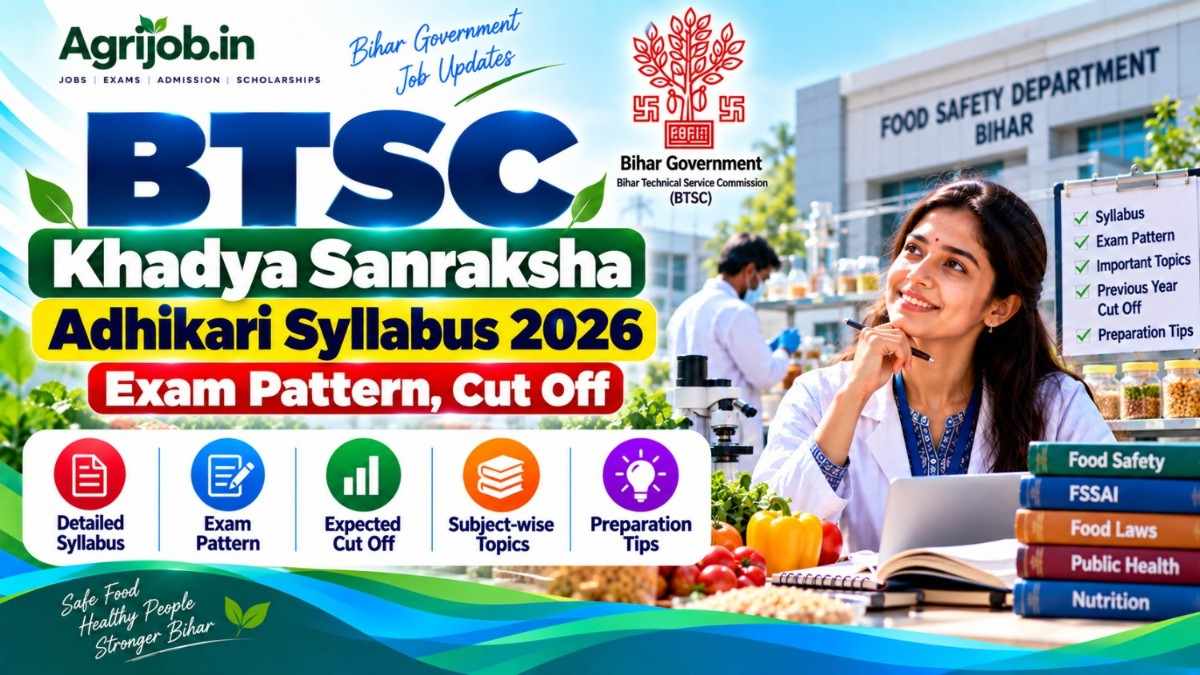
BTSC Khadya Sanraksha Adhikari Syllabus 2026 – Exam Pattern, Cut Off & 90-Day Strategy
BTSC Khadya Sanraksha Adhikari Syllabus 2026 has been officially released for the 105 Food Safety Officer posts announced under Advertisement No. 29/2026. If you hold a degree in Food Technology, Agriculture, Microbiology, Chemistry, or Medicine — and want a Level-6 Bihar government job paying Rs.35,400–Rs.1,12,400/month — this is the most important document you will read this year. This guide is for Bihar-domicile graduates aged 21–42 who have applied or plan to apply before the 24 October 2026 deadline. We cover the complete BTSC FSO syllabus subject-wise, the updated CBT exam pattern with negative marking, previous category-wise expected cut offs, and a proven 90-day strategy to crack the exam on the first attempt.

The BTSC Khadya Sanraksha Adhikari (FSO) exam 2026 is a 100-question, 100-mark Computer-Based Test (CBT) of 2 hours with 0.25 negative marking. The syllabus covers 5 sections: General Knowledge (Bihar + India), General Intelligence, General English, Computer Knowledge, and Food Safety Technical subjects (food microbiology, preservation, hygiene, processing, analysis, and chemistry). Selection is purely on written exam merit — no work experience or interview round.
- Advertisement No.: 29/2026 — Bihar Technical Service Commission (BTSC)
- Total Vacancies: 105 Food Safety Officer posts under Health Department, Bihar
- Exam Mode: Computer-Based Test (CBT) — Objective MCQs
- Total Questions / Marks: 100 Questions | 100 Marks
- Exam Duration: 2 Hours (120 Minutes)
- Negative Marking: 0.25 marks deducted per wrong answer
- Qualifying Marks: 40% for General category (as per BTSC norms)
- Pay Scale (Level 6): Rs.35,400 – Rs.1,12,400/month (7th CPC)
- Application Dates: 25 September 2026 to 24 October 2026
- Official Website: btsc.bihar.gov.in
- What Is BTSC Khadya Sanraksha Adhikari (FSO) Exam 2026?
- Who Should Apply for BTSC FSO 2026?
- BTSC Khadya Sanraksha Adhikari Salary 2026 — Pay Scale & In-Hand Details
- Eligibility Criteria — Education, Age Limit & Category
- BTSC FSO Exam Pattern 2026 — Complete Structure
- BTSC Khadya Sanraksha Adhikari Syllabus 2026 — Subject-Wise
- Category-Wise Vacancy 2026
- Previous & Expected Cut Off Marks — Category Wise
- BTSC FSO vs FSSAI FSO — Key Differences
- Pros and Cons of BTSC Food Safety Officer Job
- Important Terms Related to Food Safety Officer Exam
- 90-Day Strategy to Crack BTSC Khadya Sanraksha Adhikari 2026
- Important Links — Official & Internal
- Conclusion
- Key Takeaways
- Frequently Asked Questions
What Is BTSC Khadya Sanraksha Adhikari (Food Safety Officer) Exam 2026?
The BTSC Khadya Sanraksha Adhikari exam is a competitive recruitment test conducted by the Bihar Technical Service Commission (BTSC) to fill vacancies in the Bihar Food Safety Service under the state’s Health Department. In 2026, BTSC announced 105 posts through Advertisement No. 29/2026 — making it one of the biggest food-safety recruitment cycles Bihar has seen. Selected candidates enforce food safety laws under the Food Safety and Standards Act, 2006 (FSSAI Act), conduct food inspections, collect samples, and ensure that food sold across Bihar meets prescribed quality and safety standards.
The 2026 exam marks a significant structural change from the older merit-based system (which gave weightage to academic percentage and work experience). Under the current pattern, selection is 100% based on the written CBT exam — no marks for experience, no interview. This levels the field for all candidates with the prescribed educational qualification.
| Particular | Details |
|---|---|
| Conducting Body | Bihar Technical Service Commission (BTSC), Patna |
| Post Name | Khadya Sanraksha Adhikari / Food Safety Officer (FSO) |
| Advertisement No. | 29/2026 |
| Department | Health Department, Government of Bihar |
| Total Vacancies | 105 Posts |
| Exam Mode | Computer-Based Test (CBT) |
| Selection Basis | Written Exam Only (no experience marks, no interview) |
| Job Location | Anywhere in Bihar (state-wide posting) |
Who Should Apply for BTSC Khadya Sanraksha Adhikari 2026?
This recruitment is ideal for science graduates from Bihar seeking a stable, well-paying state government job with clear career progression. Here are the specific candidate profiles this post suits best:
- 🎓 Food Technology / Dairy Technology graduates — directly eligible with core technical advantage in the exam’s food safety section
- 🔬 Microbiology / Biochemistry / Biotechnology graduates — technical section aligns closely with graduation syllabus
- 🌾 Agriculture Science graduates — eligible; food preservation and agri-processing overlap well with syllabus
- 🐄 Veterinary Science (B.V.Sc.) graduates — food hygiene and microbiology knowledge directly applicable
- ⚗️ Chemistry (MSc) postgraduates — food analysis and testing section well within preparation scope
- 🏥 MBBS / BDS / BHMS / BAMS / BUMS graduates — medical degree holders fully eligible; food microbiology and hygiene are familiar domains
- 👩 Bihar-domicile women candidates — 35% horizontal reservation makes this a high-probability opportunity
- 🎯 Candidates who missed FSSAI Central FSO — BTSC FSO 2026 offers state-level equivalent with Bihar-specific advantages
BTSC Khadya Sanraksha Adhikari Salary 2026 — Pay Scale, In-Hand & Allowances
The BTSC Food Safety Officer post sits at Pay Level 6 under the 7th Pay Commission, with a starting basic pay of Rs.35,400 per month. This is one of the better-paying entry-level Bihar government posts available to science graduates. After including Dearness Allowance (DA at 42%), House Rent Allowance (HRA at 8–16% depending on city), and Travel Allowance, the total in-hand salary ranges between Rs.52,000 – Rs.62,000/month at the entry level.
| Salary Component | Amount (Approximate) |
|---|---|
| Basic Pay (Pay Level 6) | Rs.35,400/month (starting) |
| Maximum Basic Pay | Rs.1,12,400/month |
| Dearness Allowance (DA @ 42%) | Rs.14,868/month |
| House Rent Allowance (HRA @ 8–16%) | Rs.2,832 – Rs.5,664/month |
| Travel Allowance (TA) | As applicable by city tier |
| Estimated Gross Monthly Salary | Rs.55,000 – Rs.65,000/month |
| Estimated In-Hand Salary | Rs.52,000 – Rs.62,000/month |
| Annual CTC (Approximate) | Rs.6.5 – Rs.7.5 Lakh/year |
Additional benefits include National Pension System (NPS) contributions, medical coverage under BSGEIS (Bihar State Government Employees Insurance Scheme), earned leave, casual leave, government quarter (where available), and promotion opportunities as per Bihar Government service rules.
Eligibility Criteria — Education Qualification, Age Limit & Category Rules
Candidates must satisfy all three eligibility pillars — educational qualification, age limit, and Bihar domicile requirement — to be considered. Age is calculated as on 1 August 2026 per the official notification.
Educational Qualification
- Food Technology / Dairy Technology / Biotechnology / Oil Technology
- Agricultural Science / Veterinary Science / Biochemistry / Microbiology / Chemistry (PG)
- Food Engineering / Food Processing / Food Safety & Quality Management / Food Biotechnology
- Agricultural Engineering / Fisheries / Food Nutrition & Dietetics / Horticulture
- Medicine — MBBS / BDS / BHMS / BAMS / BUMS / B.S.R.M.S. (Sowa Rigpa)
- Any qualification notified by FSSAI from time to time with Central Government approval
Age Limit (as on 1 August 2026)
| Category | Minimum Age | Maximum Age |
|---|---|---|
| Unreserved (UR) — Male | 21 Years | 37 Years |
| Unreserved (UR) — Female | 21 Years | 40 Years |
| BC / EBC — Male & Female | 21 Years | 40 Years |
| SC / ST — Male & Female | 21 Years | 42 Years |
| Persons with Disabilities (PwD) | 21 Years | Up to 10 years extra relaxation |
| Regular Bihar Govt. Employees (3+ years) | 21 Years | Up to 5 years extra relaxation |
| Ex-Servicemen | 21 Years | Service period + 3 years (max 57 years) |
Application fee: Rs.100 for all candidates (Debit Card / Credit Card / Net Banking / UPI). Bihar-domicile candidates only are eligible for category-based reservations and age relaxations.
BTSC FSO Exam Pattern 2026 — Complete Structure with Marking Scheme
The BTSC Khadya Sanraksha Adhikari exam is conducted in Computer-Based Test (CBT) mode with 100 objective-type (MCQ) questions for 100 marks. The total time allowed is 2 hours (120 minutes). The paper is bilingual — available in both Hindi and English. Normalisation will apply if the exam is held in multiple shifts.
| Exam Component | Details |
|---|---|
| Exam Mode | Computer-Based Test (CBT) — Online |
| Question Type | Objective MCQ (Multiple Choice) |
| Total Questions | 100 |
| Total Marks | 100 |
| Marks per Correct Answer | +1 Mark |
| Negative Marking (per wrong answer) | −0.25 Marks |
| Unattempted Questions | 0 Marks (no penalty) |
| Exam Duration | 2 Hours (120 Minutes) |
| Medium of Paper | Hindi and English (Bilingual) |
| Normalisation | Applicable if exam held in multiple shifts |
| Qualifying Marks (General) | Minimum 40% (40 out of 100) |
With 0.25 negative marking, attempting 85–90 questions with 80–85% accuracy yields higher scores than attempting all 100 with guessing. Avoid marking any answer where you are less than 60% confident. In a 100-question paper, 20 wrong answers = a full 5-mark penalty, which can shift your rank significantly.
BTSC Khadya Sanraksha Adhikari Syllabus 2026 — Complete Subject-Wise Breakdown
The BTSC FSO syllabus 2026 covers 5 broad subject areas. The technical food safety section carries the highest importance for final selection since that is where candidates from relevant disciplines score their decisive advantage over competitors.
Section 1 — General Knowledge (India + Bihar)
| Topic | Key Areas to Prepare |
|---|---|
| Indian History | Freedom movement, major historical events, important dates |
| Indian Geography | Physical features, rivers, climate, natural resources |
| Indian Polity | Constitution, fundamental rights, governance structure, major amendments |
| Indian Economy | Budget basics, GDP, inflation, major economic schemes |
| Science & Technology | Latest scientific developments, space missions, national science achievements |
| Current Affairs (2025–2026) | National and international events, awards, summits, appointments |
| Bihar GK | History, geography, culture, economy, industrial development of Bihar |
| Inventions & Discoveries | Key scientific milestones; food science-related discoveries preferred |
Section 2 — General Intelligence & Reasoning
| Topic | Sub-Areas |
|---|---|
| Analogy | Verbal and non-verbal analogy — word pairs, figure pairs |
| Number Series | Missing number, odd one out in sequences |
| Classification | Group the odd item — alphabet, number, figure-based |
| Spatial Reasoning | Figures, mirror images, paper folding, dice problems |
| Relationship Concepts | Blood relations, direction sense |
| Logical Problem Solving | Syllogisms, statements and conclusions |
| Decision Making | Situational reasoning; code-decode |
| Visual Memory | Observation and pattern identification |
Section 3 — General English
| Topic | Focus Areas |
|---|---|
| Grammar Basics | Articles, adverbs, verbs, subject-verb agreement |
| Error Spotting | Identify grammatical errors in sentences |
| Fill in the Blanks | Vocabulary + grammar-based completion |
| Cloze Test | Context-based passage completion |
| Synonyms & Antonyms | Vocabulary building — 10th–12th level |
| Phrase & Sentence Improvement | Correct the underlined phrase |
| Active & Passive Voice | Voice transformation across tenses |
| Reading Comprehension | Short passage — 4–5 questions on facts and inference |
Section 4 — Computer Knowledge
| Topic | Focus Areas |
|---|---|
| Computer Fundamentals | History, types, components, input/output devices |
| Operating System | Windows OS basics, file management |
| MS Office Suite | MS Word, MS Excel, MS PowerPoint — basic features |
| Internet & Email | Browser basics, email usage, search engines, web terminology |
| Networking Basics | LAN, WAN, protocols — basic level only |
| Security Basics | Viruses, antivirus, data protection concepts |
| Database Basics | What is a database; basic query concepts (conceptual level) |
Section 5 — Food Safety Technical Syllabus (Core Section)
This is the most decisive section for candidates from relevant science backgrounds. Thorough preparation here separates rank-holders from the rest of the applicant pool.
| Sub-Section | Key Topics to Cover |
|---|---|
| Food Preservation | Principles; methods — refrigeration, canning, drying, pasteurisation, irradiation, fermentation, chemical preservatives |
| Food Processing & Packaging | Unit operations; packaging materials (PETE, HDPE, glass, tin); MAP and vacuum packaging |
| Food Microbiology | Microorganisms (bacteria, yeast, moulds); spoilage organisms; food-borne pathogens (Salmonella, E.coli, Listeria, Staphylococcus); food safety limits |
| General Principles of Food Hygiene | HACCP principles; GMP; GHP; personal hygiene; cross-contamination prevention; Codex Alimentarius guidelines |
| Food Chemistry | Carbohydrates, proteins, lipids, vitamins, minerals; food additives — colours, preservatives, antioxidants |
| Role in Human Nutrition | Macro and micro-nutrients; deficiency diseases; RDA values; nutritional labelling |
| Food Analysis & Testing | Sampling procedures; proximate analysis; physical, chemical, and microbiological testing; adulteration tests; FSSAI standards |
| Food Safety Laws (FSSAI) | Food Safety and Standards Act 2006; FSSAI regulations; licence & registration; penalty clauses; powers of Food Safety Officer |
BTSC FSO 2026 — Category-Wise Vacancy Distribution (105 Posts)
| Category | Total Posts | 35% Horizontal Reservation (Bihar Women) |
|---|---|---|
| Unreserved (UR / General) | 41 | 14 |
| Economically Weaker Section (EWS) | 11 | 04 |
| Scheduled Caste (SC) | 17 | 06 |
| Scheduled Tribe (ST) | 02 | 00 |
| Extremely Backward Class (EBC) | 18 | 06 |
| Backward Class (BC) | 12 | 04 |
| Backward Class — Women (WBC) | 04 | 00 |
| Total | 105 | 34 |
BTSC FSO Expected Cut Off 2026 — Category-Wise Analysis & Previous Cycle Trends
BTSC has not yet released an official cut off for the 2026 FSO exam. Based on the previous BTSC FSO recruitment trends, qualifying marks under the older merit system, and patterns from analogous Bihar technical service exams, the following expected cut off range for the 2026 CBT-based exam can be estimated:
| Category | Expected Cut Off (out of 100) | Remarks |
|---|---|---|
| Unreserved (UR) — General Male | 68 – 76 marks | High competition; 41 posts only |
| Unreserved (UR) — General Female | 63 – 71 marks | 35% horizontal reservation boosts selection |
| EWS — Male | 65 – 73 marks | Only 11 posts; moderate competition |
| EWS — Female | 60 – 68 marks | Horizontal reservation applicable |
| Scheduled Caste (SC) | 55 – 65 marks | 17 posts; age relaxation of 5 years helps |
| Scheduled Tribe (ST) | 50 – 60 marks | Only 2 posts; typically lower cut off |
| Extremely Backward Class (EBC) | 60 – 70 marks | 18 posts — largest reserved category |
| Backward Class (BC) | 62 – 72 marks | 12 posts; competitive among BC candidates |
| WBC (BC Women) | 55 – 65 marks | 4 dedicated posts |
Key factors shaping 2026 cut off: Expected 50,000–80,000+ applicants for 105 posts, difficulty level of CBT, normalisation across shifts, and broad eligibility from 20+ disciplines. Candidates should target at least 75+ marks (75%) for General category to be safely above the expected cut off range. Note: 2026 is BTSC FSO’s first CBT-based cycle — the 2021 merit-based data is not directly comparable.
BTSC FSO vs FSSAI FSO 2026 — Which is Better for Bihar Graduates?
| Parameter | BTSC FSO (Bihar) 2026 | FSSAI Central FSO 2026 |
|---|---|---|
| Conducting Body | Bihar Technical Service Commission | Food Safety & Standards Authority of India |
| Total Vacancies | 105 posts (2026 cycle) | Variable — national level |
| Pay Level | Level 6 (Rs.35,400–Rs.1,12,400) | Level 8 (Rs.47,600–Rs.1,51,100) approximately |
| In-Hand Salary | Rs.52,000 – Rs.62,000/month | Rs.70,000 – Rs.80,000/month (approx.) |
| Competition Level | State-level (Bihar domicile preferred) | National level (all India open) |
| Exam Mode | 100-mark CBT, 2 hours | Multi-stage — CBT-1, CBT-2 |
| Selection Process | Single CBT + Document Verification | CBT-1 → CBT-2 → Skill Test |
| Eligibility | Bachelor’s+ in 20+ eligible disciplines | Bachelor’s+ in specified disciplines |
| Posting Location | Bihar only (state-wide) | Pan-India |
| Best For | Bihar-domicile graduates seeking state govt. job | Graduates open to all-India posting & higher pay |
For fresh Bihar-domicile science graduates, BTSC FSO 2026 is the better first target — single-stage selection, state-level competition, and domicile reservation benefits all work in your favour. Simultaneously target FSSAI Central FSO for a higher pay scale. The core syllabus overlaps by approximately 70%, so dual preparation is highly efficient.
Advantages and Disadvantages of BTSC Khadya Sanraksha Adhikari Job
Pros (Advantages)
- ✅ Permanent Bihar government job with full job security and service under NPS pension
- ✅ Rs.35,400 basic pay at entry — grows to Rs.1,12,400 over service with annual increments
- ✅ Single CBT stage only — straightforward two-step process (exam → document verification)
- ✅ Broad eligibility — 20+ disciplines eligible; both UG and PG degree holders can apply
- ✅ Socially impactful role — enforcing food safety laws protecting millions of Bihar consumers
- ✅ 35% horizontal reservation for women — strong opportunity for women candidates from Bihar
Cons (Disadvantages)
- ⚠️ Pay Level 6 is lower than FSSAI Central FSO (Level 8) — salary gap of approximately Rs.15,000–20,000/month at entry
- ⚠️ Posting anywhere in Bihar — no guaranteed home-district posting; may require relocation within state
- ⚠️ No previous CBT cut-off data for BTSC FSO — 2026 is the first CBT-based cycle, making precise target-setting harder
Important Terms & Concepts Related to BTSC FSO Exam 2026
- HACCP (Hazard Analysis and Critical Control Points): A systematic preventive approach to food safety that identifies and controls hazards at all stages of food production. Mandated under FSSAI regulations for certain food businesses.
- GMP (Good Manufacturing Practice): Guidelines ensuring conditions and practices required during manufacturing maintain a defined quality standard. A key topic under food hygiene syllabus.
- Codex Alimentarius: Internationally adopted food standards created by WHO and FAO. India’s FSSAI standards are largely aligned with Codex.
- Pasteurisation: A heat treatment that kills pathogenic microorganisms in food (especially milk) without sterilising the product. HTST method: 72°C for 15 seconds.
- Food Adulteration: Adding inferior or harmful substances to food. Prevention of Food Adulteration Act (1954) was replaced by the FSSAI Act 2006.
- Water Activity (aw): A measure of water availability for microbial growth in food. Below 0.6 aw generally prevents microbial growth — critical in food preservation.
- Proximate Analysis: Laboratory tests determining moisture, ash, crude protein, crude fat, and crude fibre content of food. Core topic under food analysis syllabus.
- MAP (Modified Atmosphere Packaging): Alters the internal atmosphere of a food package (reduced O₂, increased CO₂/N₂) to extend shelf life.
- Mycotoxins: Toxic metabolites from moulds on food crops (e.g., aflatoxin from Aspergillus). Highly carcinogenic; FSSAI sets strict limits for Indian food products.
- FSSAI (Food Safety and Standards Authority of India): The apex food safety body under the Ministry of Health and Family Welfare, operating under the FSS Act 2006. FSOs work under FSSAI’s regulatory framework.
90-Day Strategy to Crack BTSC Khadya Sanraksha Adhikari Exam 2026
With the exam date expected in November–December 2026, candidates have 8–10 weeks of focused preparation from today. Here is a structured 90-day plan built specifically for the BTSC FSO 2026 CBT pattern:
Phase 1 — Foundation (Days 1–30)
- Download the official BTSC Advertisement No. 29/2026 from btsc.bihar.gov.in — read the complete syllabus notification first
- Cover Food Safety Technical sections first — Food Microbiology, HACCP, FSSAI Act, Food Preservation, Food Chemistry — minimum 2 chapters daily from graduation textbooks
- Start Bihar + India GK using Bihar Darshan books and current affairs from September–October 2026
- Build reasoning speed by solving 20 questions daily — analogies, series, coding-decoding, blood relations
- Cover all MS Office basics (Word, Excel, PowerPoint) in 2–3 focused sessions — computer section questions are direct and marks are easy to secure
Phase 2 — Practice & Speed Building (Days 31–60)
- Attempt 2 full-length mock tests per week on Toppersexam, Adda247, or EduGorilla — strictly within 2 hours
- Analyse all errors after every mock — categorise as conceptual gaps vs. silly mistakes; address each separately
- Revise food microbiology daily — one pathogen per day; note temperature growth ranges, diseases caused, and FSSAI safety limits
- Build English vocabulary with 10 new words daily; practise error-spotting and fill-in-the-blanks
- Time-box each section — 30 min for technical, 25 min for GK, 20 min for reasoning, 15 min for English, 10 min for computers
Phase 3 — Revision & Final Push (Days 61–90)
- Attempt one full mock daily in the last 3 weeks — build exam stamina and consistency
- Revise short notes for FSSAI Act key provisions, 7 HACCP steps, food spoilage organisms, and important food analysis tests
- Focus on Bihar GK current affairs for September–November 2026 — Bihar budget, schemes, key appointments
- Never attempt unfamiliar questions in the exam — 0.25 negative marking means unanswered is always safer than guessing
- Approach the exam with calm precision — read each question fully, eliminate 2 wrong options before selecting
Recommended Books & Resources for BTSC FSO 2026
| Subject | Recommended Resource |
|---|---|
| Food Technology / Microbiology | Food Science by Norman Potter; Food Microbiology by Adams & Moss |
| FSSAI Act & Regulations | Official FSSAI website — FSS Act 2006 PDF (free download at fssai.gov.in) |
| Bihar + India GK | Lucent’s General Knowledge (latest edition); Bihar Darshan by Alok Kumar |
| Reasoning | R.S. Aggarwal — A Modern Approach to Verbal & Non-Verbal Reasoning |
| English Grammar | High School English Grammar by Wren & Martin |
| Computer Knowledge | DOEACC CCC Study Material or standard computer awareness book for govt exams |
| Mock Tests | Adda247 Bihar FSO Batch, Toppersexam BTSC FSO, EduGorilla Test Series |
Important Links — BTSC Khadya Sanraksha Adhikari 2026
| Link Name | URL |
|---|---|
| Official BTSC Website | btsc.bihar.gov.in |
| BTSC FSO Apply Online Portal | btsc.pariksha.nic.in |
| FSSAI Official Website (FSS Act 2006) | fssai.gov.in |
| India Government Jobs Portal (NCS) | ncs.gov.in |
| Agrijob.in — BTSC FSO Recruitment 2026 | View Full Recruitment Guide |
| Agrijob.in — Bihar Government Jobs | Bihar Government Jobs Category |
| Agrijob.in — Food Safety Officer Jobs India | Food Safety Officer Jobs |
Conclusion — Your Path to Becoming a BTSC Khadya Sanraksha Adhikari
The BTSC Khadya Sanraksha Adhikari Syllabus 2026 is clear, structured, and heavily weighted towards your existing science knowledge — especially if you hold a degree in Food Technology, Microbiology, Agriculture, or Medicine. With 105 posts open, a single-stage CBT selection process, and a starting salary of Rs.35,400/month (in-hand Rs.52,000+), this is one of the best Bihar government job opportunities for science graduates this recruitment cycle. Start preparation today, dedicate the first 30 days entirely to the Food Safety technical section, and build GK and reasoning momentum in parallel. Apply before the 24 October 2026 deadline at btsc.bihar.gov.in — bookmark this page for the latest exam date, admit card, and result updates.
- BTSC Khadya Sanraksha Adhikari 2026 offers 105 posts with Rs.35,400/month starting salary (Pay Level 6, 7th CPC)
- The exam is a 100-question, 100-mark CBT of 2 hours with 0.25 negative marking — no interview, no experience marks
- 5 syllabus sections: General Knowledge, General Intelligence, General English, Computer Knowledge, and Food Safety Technical
- Expected General category cut off: 68–76 marks out of 100 — target 75+ marks for a safe selection margin
- 35% horizontal reservation for Bihar-domicile women candidates across all categories — a strong opportunity not to be missed
- Apply online at btsc.pariksha.nic.in before 24 October 2026 (Rs.100 fee); prepare with 2 mock tests per week and the official FSSAI Act 2006
Frequently Asked Questions About BTSC Khadya Sanraksha Adhikari Syllabus 2026
What is the BTSC Khadya Sanraksha Adhikari syllabus 2026?
The BTSC Khadya Sanraksha Adhikari syllabus 2026 covers 5 sections: General Knowledge (India and Bihar history, geography, polity, economy, current affairs), General Intelligence and Reasoning, General English (grammar, vocabulary, comprehension), Computer Knowledge (MS Office, internet, hardware basics), and Food Safety Technical subjects (food microbiology, food preservation, food processing, food hygiene, food chemistry, food analysis, and the FSSAI Act 2006). The exam has 100 questions for 100 marks in 2 hours.
How many questions are in the BTSC FSO exam 2026?
The BTSC Food Safety Officer exam 2026 has exactly 100 objective-type (MCQ) questions for 100 marks. The duration is 2 hours (120 minutes). For every correct answer, +1 mark is awarded. For every wrong answer, 0.25 mark is deducted. Unattempted questions carry no penalty.
What is the expected cut off for BTSC Khadya Sanraksha Adhikari 2026?
Based on competition level and vacancy distribution, the expected cut off for General category male candidates is 68–76 marks out of 100. EWS candidates may expect 65–73 marks, EBC candidates 60–70 marks, SC candidates 55–65 marks, and ST candidates 50–60 marks. These are estimates derived from analogous Bihar technical service exam patterns; the official cut off will be released alongside the result on btsc.bihar.gov.in.
Is there negative marking in the BTSC FSO exam?
Yes, the BTSC Khadya Sanraksha Adhikari 2026 exam carries a negative marking of 0.25 marks for every wrong answer. This means for every 4 wrong answers, you lose 1 full mark. Candidates should avoid guessing and mark an answer only when reasonably confident. Leaving a question unanswered carries no penalty.
What is the BTSC Khadya Sanraksha Adhikari salary 2026?
The BTSC Khadya Sanraksha Adhikari post is placed at Pay Level 6 under the 7th Central Pay Commission, with a starting basic pay of Rs.35,400/month and a maximum of Rs.1,12,400/month. After adding Dearness Allowance (42%), HRA, and Travel Allowance, the estimated gross monthly salary at entry level is Rs.55,000–Rs.65,000, and the in-hand salary is approximately Rs.52,000–Rs.62,000/month.
Who is eligible for BTSC Food Safety Officer recruitment 2026?
Candidates holding a Bachelor’s, Master’s, or Doctorate degree in Food Technology, Dairy Technology, Biotechnology, Agricultural Science, Veterinary Science, Biochemistry, Microbiology, Chemistry (PG), Medicine (MBBS/BDS/BHMS/BAMS/BUMS), or any qualification notified by FSSAI are eligible. The minimum age is 21 years and the maximum age is 37 years for Unreserved male candidates (as on 1 August 2026), with relaxation for reserved categories. Bihar domicile is required for category-based reservation benefits.
What is the selection process for BTSC Khadya Sanraksha Adhikari 2026?
The selection process consists of two stages: a Written Competitive Examination in Computer-Based Test (CBT) mode (100 questions, 100 marks, 2 hours), followed by Document Verification for shortlisted candidates. There is no interview and no weightage for academic percentage or work experience. Selection is entirely based on performance in the CBT exam.
How should I prepare for the food safety technical section of BTSC FSO 2026?
Focus on food microbiology (food-borne pathogens, spoilage organisms, indicator bacteria), food preservation methods (pasteurisation, canning, drying, irradiation), HACCP principles, general food hygiene and GMP, food chemistry (carbohydrates, proteins, lipids, vitamins, additives), food analysis methods (proximate analysis, adulteration testing), and the FSSAI Act 2006 key provisions. Use graduation textbooks as the primary resource and supplement with the FSS Act 2006 PDF from fssai.gov.in (free download).
What is the application fee for BTSC FSO 2026 and how to apply?
The application fee is Rs.100 for all candidates, payable online through Debit Card, Credit Card, Net Banking, or UPI. Apply at btsc.pariksha.nic.in from 25 September 2026 to 24 October 2026. Upload required documents (photograph, signature, educational certificates, category certificate), pay the fee, and save the submitted application and payment receipt for future reference.
What are the most important topics in BTSC FSO 2026 syllabus for maximum marks?
The highest-return topics are: food microbiology and food-borne pathogens, FSSAI Act 2006 key provisions and FSO powers, HACCP principles, food preservation methods, food analysis techniques, Bihar GK and current affairs (2025–2026), and MS Office basics for computer knowledge. The technical food safety section is where candidates with relevant degrees can build a decisive 10–15 mark advantage over competitors from non-food-science backgrounds.
Last Updated: September 2026 | This guide is reviewed and updated regularly. Bookmark this page for the latest BTSC FSO exam date, admit card, and result updates from btsc.bihar.gov.in.
This article is for informational and educational purposes only. Cut-off estimates are based on analogous exam trends and are not official figures. All candidates must verify eligibility, dates, and vacancy details from the official Bihar Technical Service Commission website at btsc.bihar.gov.in and the official Advertisement No. 29/2026 before applying. Agrijob.in is not responsible for any discrepancies between this content and the official notification.