
VL Dhan 160 (VL 20986) is India’s newest certified organic rice variety, developed by ICAR-Vivekananda Parvatiya Krishi Anusandhan Sansthan (VPKAS), Almora, specifically engineered to thrive under fully organic farming conditions in the hill regions of North-West India. This guide is for hill farmers, organic agriculture practitioners, and progressive cultivators in Uttarakhand, Himachal Pradesh, and Jammu & Kashmir who want to switch to high-yielding, chemical-free rice cultivation in 2026. We cover the variety’s key features, yield potential, eligibility for government support under PKVY, step-by-step cultivation process, comparison with predecessor varieties, and a complete FAQ.

VL Dhan 160 (VL 20986) is an ICAR-released organic rice variety that delivers an average yield of 2,321 kg per hectare under strictly organic conditions — outperforming most existing organic hill-rice checks. Developed by ICAR-VPKAS Almora, it is disease-resistant, suitable for Kharif season, and eligible for the PKVY organic farming subsidy of up to Rs.50,000/hectare over 3 years.
- Variety Name: VL Dhan 160 (Pedigree Code: VL 20986)
- Developed By: ICAR-Vivekananda Parvatiya Krishi Anusandhan Sansthan (VPKAS), Almora, Uttarakhand
- Suitable Conditions: Strictly organic agricultural setups (rainfed upland / organic transplanted)
- Average Yield (Organic): 2,321 kg/hectare
- Season: Kharif (June–November)
- Target States: Uttarakhand, Himachal Pradesh, Jammu & Kashmir
- Disease Resistance: Resistant to major hill-rice diseases (blast, brown spot)
- Government Subsidy: Eligible under PKVY — up to Rs.50,000/hectare over 3 years
- Certification Body: ICAR / State Varietal Release Committee (SVRC)
- Best For: Organic farmers, tribal farmers, hill cultivators switching from chemical to natural farming
- What Is VL Dhan 160 and Why It Matters for Organic Farmers in 2026
- Who Should Grow VL Dhan 160?
- Yield Potential and Income from VL Dhan 160 Organic Rice
- Eligibility & Requirements for Growing VL Dhan 160
- How to Cultivate VL Dhan 160 – Step-by-Step Organic Process
- VL Dhan 160 vs VL Dhan 159 vs Conventional Rice Varieties
- Advantages and Disadvantages of VL Dhan 160
- PKVY Organic Farming Subsidy 2026 – How VL Dhan 160 Farmers Can Apply
- Important Terms Related to Organic Rice Farming
- Important Links
- Conclusion
- Key Takeaways
- Frequently Asked Questions About VL Dhan 160 Organic Rice Variety 2026
What Is VL Dhan 160 and Why It Matters for Organic Farmers in 2026
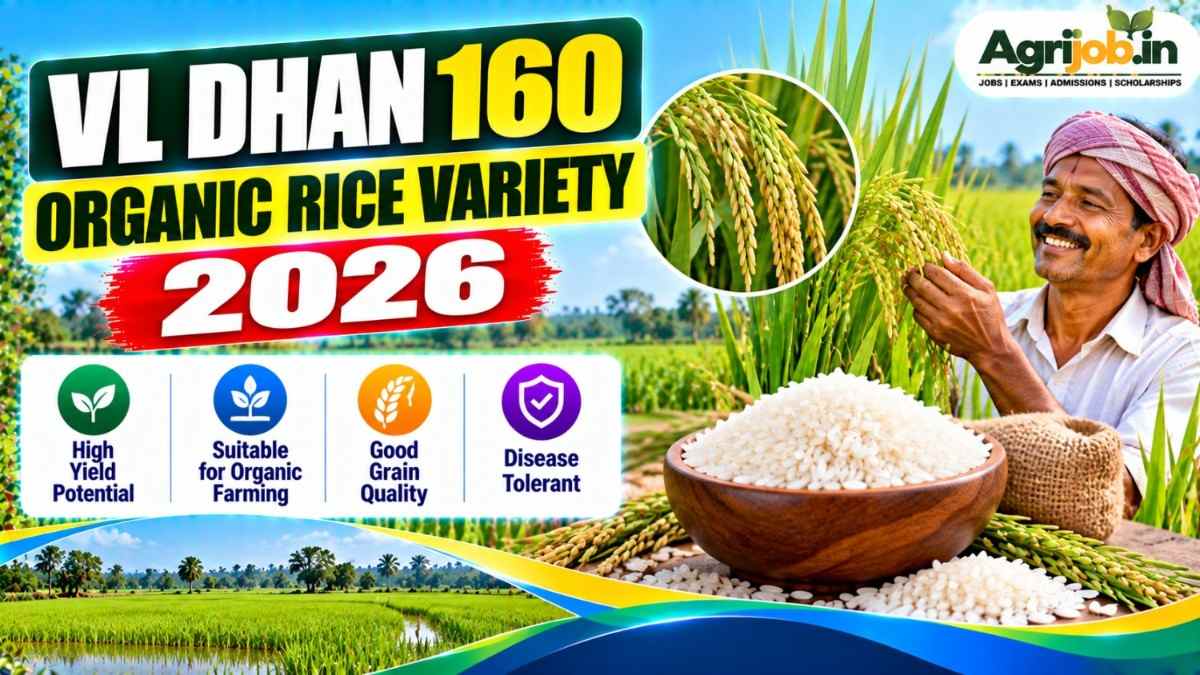
VL Dhan 160 is a specialized hill-rice variety released by the Indian Council of Agricultural Research (ICAR) through its Vivekananda Parvatiya Krishi Anusandhan Sansthan (VPKAS) in Almora, Uttarakhand. It is officially designated under the pedigree code VL 20986 and is designed exclusively for organic cultivation environments — meaning it is bred to deliver peak performance without any synthetic fertilizers, pesticides, or chemical growth regulators.
Unlike mainstream high-yielding varieties (HYVs) that depend heavily on nitrogen-rich chemical inputs, VL Dhan 160 has been bred specifically for organic soil conditions where nutrient availability comes from FYM (farm yard manure), green manures, compost, and bio-fertilizers. This makes it uniquely positioned for the growing segment of Indian farmers choosing organic farming under government schemes like Paramparagat Krishi Vikas Yojana (PKVY) and the National Mission on Natural Farming (NMNF).

The introduction of VL Dhan 160 follows a successful lineage from ICAR-VPKAS: the same institute developed VL Dhan 159 (released 2021), which recorded an organic yield of 2,054 kg/ha and outperformed check varieties by up to 42.34%. VL Dhan 160 pushes that benchmark further with an average organic yield of 2,321 kg/hectare — a meaningful improvement for small and marginal hill farmers who operate on 0.5–2 ha plots.
Key Features of VL Dhan 160 at a Glance
- 🌱 Organic Suitability: Specially bred to perform under strictly organic conditions — no synthetic inputs required
- 📈 Yield: Average 2,321 kg/hectare under organic environments
- 🛡️ Disease Resistance: Naturally resistant to key hill-rice diseases, significantly reducing the need for fungicides
- ⏱️ Duration: Early to medium duration — suitable for Kharif season in hill terrains
- 🏔️ Altitude Suitability: Performs well at altitudes typical of Uttarakhand, Himachal Pradesh, and J&K hills
- 🌾 Grain Quality: Good hulling and milling recovery consistent with ICAR-VPKAS hill-rice standards
Who Should Grow VL Dhan 160?
VL Dhan 160 is purpose-built for a specific set of farmers and agricultural contexts. Here are the profiles most likely to benefit from this variety:
- 🧑🌾 Hill Farmers in Uttarakhand: Farmers cultivating in Almora, Nainital, Chamoli, Pithoragarh, and other hill districts of Uttarakhand who already practice or plan to shift to organic cultivation.
- 🏔️ Himachal Pradesh Upland Farmers: Cultivators in HP hill areas looking for a certified organic rice variety that can outperform local checks under non-chemical conditions.
- 🌿 PKVY-Registered Organic Cluster Members: Farmers already enrolled in Paramparagat Krishi Vikas Yojana clusters who need a government-endorsed variety to maximize subsidy benefits.
- 🧪 Farmers Transitioning from Chemical to Organic: Those in the 3-year organic transition period who need a variety that performs acceptably even while soil biology is rebuilding.
- 👨👩👧 Tribal and Marginal Hill Farmers: Small landholding farmers (0.5–2 ha) for whom input cost reduction from zero-chemical cultivation makes a direct positive impact on net income.
- 📦 Organic Produce Market Sellers: Farmers who sell to organic food companies, FPOs, or premium retail channels where certified organic rice commands Rs.10–20/kg premium over non-certified rice.
- 🏫 ICAR Krishi Vigyan Kendra (KVK) Demonstration Plots: KVK scientists and staff looking for the most current ICAR-VPKAS organic rice recommendation for farmer demonstrations.
- 🌐 Organic Export-Oriented Producers: Producer groups and FPOs who want to export certified organic rice from Himalayan hill regions to premium international markets.
Yield Potential and Income from VL Dhan 160 Organic Rice
One of the strongest selling points of VL Dhan 160 is its superior yield performance in comparison to existing organic hill-rice alternatives. While conventional rice farming in Uttarakhand records a state average of approximately 2,710 kg/ha (as per Directorate of Economics & Statistics data for 2025), VL Dhan 160 achieves 2,321 kg/ha under strictly organic conditions — a remarkable benchmark considering that organic systems generally yield 10–20% less than chemically-supported systems in the same region.
| Parameter | VL Dhan 160 (Organic) |
|---|---|
| Average Yield | 2,321 kg/hectare |
| Estimated Paddy Price (General) | Rs.2,183/quintal (MSP 2025-26) |
| Estimated Paddy Price (Organic Premium) | Rs.3,000–Rs.4,500/quintal |
| Gross Income (General Market / 1 Ha) | Rs.50,687 approx. |
| Gross Income (Organic Premium / 1 Ha) | Rs.69,630–Rs.1,04,445 approx. |
| Input Cost Reduction vs Conventional | 30–45% lower (no chemical fertilizers) |
| Net Profit Advantage (Organic vs Conventional) | Organic basmati cultivation can be up to 105% more profitable (research evidence from northern India) |
| PKVY Subsidy Benefit (over 3 years) | Rs.50,000/hectare (up to) |
Research data from Uttarakhand’s Nainital district confirms that organic rice farmers using water-saving techniques like SRI (System of Rice Intensification) achieved gross margins 6.76% higher than conventional farmers while using substantially fewer external inputs. For VL Dhan 160 farmers who combine organic cultivation with SRI methods, net returns can exceed Rs.40,000–Rs.80,000 per acre per Kharif season.
Eligibility and Requirements for Growing VL Dhan 160
VL Dhan 160 is a public-domain variety released by ICAR under government notification. Any farmer in the recommended agro-climatic zone can grow it. Below are the core requirements to maximize its performance and access government support:
Agro-Climatic Requirements
- Geography: Hill regions of Uttarakhand, Himachal Pradesh, and Jammu & Kashmir — terraced fields, upland areas, and medium-altitude zones
- Soil: Loamy to clay-loam soils with good organic matter content; pH 5.5–7.0
- Water: Rainfed upland or limited-irrigation conditions; optimized for water-scarce hill farming
- Season: Kharif only (June sowing / transplanting — November harvest)
- Farming System: Strictly organic — no synthetic pesticides, herbicides, or chemical fertilizers permitted
Documents Required to Access PKVY Subsidy for VL Dhan 160 Cultivation
| Document | Purpose |
|---|---|
| Aadhaar Card | Identity verification |
| Land Records / Khatoni | Proof of farm ownership or lease |
| Bank Account (linked to Aadhaar) | DBT (Direct Benefit Transfer) of subsidy |
| Membership in PKVY Cluster (50 farmers / 50 ha min.) | Cluster-based certification under PGS-India |
| Soil Health Card | Baseline soil status for organic certification |
| State Agriculture Department Registration | Enrollment in organic scheme |
How to Cultivate VL Dhan 160 – Step-by-Step Organic Process
Growing VL Dhan 160 successfully under organic conditions requires following a disciplined agronomic sequence. Below is the recommended cultivation protocol based on ICAR-VPKAS guidelines for hill organic rice:
- Seed Procurement: Obtain certified VL Dhan 160 seeds from ICAR-VPKAS Almora, State Seed Corporation, or KVK seed banks. Seed rate: 40–50 kg/hectare for direct seeding, 20–25 kg/ha for transplanted conditions.
- Nursery Preparation (Mid-May to June): Prepare raised nursery beds (1 m × 5 m per 0.1 ha field requirement). Apply 4 tonnes of well-rotten farm yard manure (FYM) + 50 kg neem cake per acre as base organic input. Avoid any synthetic fertilizer at this stage.
- Soil Preparation: Deep ploughing followed by 2–3 harrowing passes. Incorporate 8–10 tonnes/ha of FYM or compost at least 3 weeks before transplanting to allow microbial decomposition. Apply Trichoderma-enriched compost for disease suppression.
- Transplanting (June – July): Transplant 20–25-day-old seedlings. Under SRI (System of Rice Intensification) method: plant 1 seedling per hill at 25 cm × 25 cm spacing for better tillering and panicle development. Conventional transplanting: 2–3 seedlings per hill at 20 cm × 15 cm.
- Nutrient Management (Organic Only): Top-dress with 4 tonnes/ha of compost or vermicompost at active tillering stage (25–30 days after transplanting). Apply bio-fertilizers: Azospirillum + PSB (Phosphate Solubilizing Bacteria) at 2 kg/ha mixed in FYM. Jeevamrit or Panchagavya spray (500 ml/15 litre water) at panicle initiation stage boosts grain filling.
- Weed Management: Manual weeding at 20 and 40 days after transplanting is essential in organic systems — no chemical herbicides are permitted. Intercropping with Sesbania speciosa (Dhaincha) as a live mulch suppresses weeds naturally between rows.
- Disease & Pest Management (Organic IPM): VL Dhan 160’s natural resistance significantly reduces blast and brown spot pressure. Spray Pseudomonas fluorescens (0.5%) at tillering and heading stages for additional blast protection. For stem borer management, release Trichogramma japonicum egg parasitoids (50,000 eggs/acre/week for 4 weeks during tillering).
- Harvesting (October – November): Harvest when 80–85% of grains in the panicle have matured (golden-yellow color). Timely harvest prevents shattering losses in hill conditions. Expected paddy yield: 2,300–2,400 kg/hectare under optimal organic management.
Farmers growing VL Dhan 160 for the first time should apply Trichoderma harzianum seed treatment (4 g/kg seed) before nursery sowing. This single step reduces soil-borne fungal infections by up to 60% in organic systems where chemical fungicide seed dressings cannot be used — maximizing germination rates and seedling vigour without any synthetic inputs.
VL Dhan 160 vs VL Dhan 159 vs Conventional Rice Varieties – Comparison
Understanding how VL Dhan 160 compares to its predecessor (VL Dhan 159) and to conventionally bred alternatives helps farmers make an informed decision about variety selection for the 2026 Kharif season.
| Feature | VL Dhan 160 (VL 20986) | VL Dhan 159 | Conventional HYV (e.g., Vivek Dhan 154) |
|---|---|---|---|
| Suitable for Organic Farming | ✅ Yes (specifically bred) | ✅ Yes | ❌ No (requires chemical inputs) |
| Average Organic Yield | 2,321 kg/ha | 2,054 kg/ha | N/A (needs chemicals) |
| Yield Under Chemical Farming | Not recommended | Not recommended | 2,800–3,500 kg/ha |
| Disease Resistance | High | Moderate–High | Moderate (fungicide-dependent) |
| Input Cost (per ha) | Low (Rs.12,000–18,000) | Low (Rs.12,000–18,000) | High (Rs.25,000–40,000) |
| PKVY Subsidy Eligibility | ✅ Eligible | ✅ Eligible | ❌ Not eligible |
| Organic Price Premium | Rs.3,000–4,500/quintal | Rs.3,000–4,500/quintal | MSP only: Rs.2,183/quintal |
| Release Year | 2025–2026 | 2021 | Various (pre-2010) |
| Developer | ICAR-VPKAS Almora | ICAR-VPKAS Almora | Various ICAR institutes |
For hill farmers committed to organic cultivation in Uttarakhand, Himachal Pradesh, or J&K, VL Dhan 160 is the superior choice for Kharif 2026. It yields 13% more than its predecessor VL Dhan 159 under the same organic conditions, while delivering disease resistance that significantly reduces crop loss risk. Combined with PKVY subsidy of up to Rs.50,000/hectare, the total financial case for VL Dhan 160 is compelling. Conventional HYVs still yield more in absolute terms — but only under high-input chemical systems that erode soil health and increase long-term farming costs.
Advantages and Disadvantages of VL Dhan 160
Advantages of VL Dhan 160
- ✅ Highest organic yield among ICAR-VPKAS hill rice varieties: 2,321 kg/ha sets a new benchmark for organic performance in North-West Himalayan conditions
- ✅ Zero synthetic input requirement: Dramatically lowers input costs by 30–45% compared to conventional rice farming — direct benefit for small and marginal farmers
- ✅ Strong disease resistance: Reduces crop loss risk from blast and brown spot, which are major yield limiters in hill rice without fungicide use
- ✅ PKVY subsidy eligible: Government-certified variety, qualifying farmers for Rs.50,000/ha over 3 years under the Paramparagat Krishi Vikas Yojana
- ✅ Premium market access: Certified organic rice commands Rs.3,000–Rs.4,500/quintal vs Rs.2,183/quintal MSP — a 37–106% price premium potential
- ✅ Soil health improvement: Organic cultivation rebuilds soil organic carbon, reduces chemical dependency long-term, and improves water retention in terrace soils
Disadvantages of VL Dhan 160
- ⚠️ Lower absolute yield than chemical HYVs: At 2,321 kg/ha, it yields less than chemically-supported HYVs (2,800–3,500 kg/ha) — farmers must compensate through premium pricing
- ⚠️ Strict organic management required: Any accidental use of synthetic inputs voids organic certification eligibility and premium pricing rights
- ⚠️ Higher labour demand: Organic weed management and manual pest control require more farm labour than herbicide-based conventional systems — a challenge in labour-scarce hill villages
- ⚠️ Seed availability may be limited: As a newly released variety, certified seed availability through State Seed Corporations may be limited in the first 1–2 seasons; farmers should contact ICAR-VPKAS directly for early access
PKVY Organic Farming Subsidy 2026 – How VL Dhan 160 Farmers Can Apply
The Paramparagat Krishi Vikas Yojana (PKVY), launched in 2015 under the National Mission on Sustainable Agriculture (NMSA), is the Government of India’s flagship organic farming support scheme. It offers up to Rs.50,000 per hectare over 3 years to farmers who adopt certified organic cultivation — making it highly relevant for VL Dhan 160 growers.
| PKVY Component | Subsidy Amount (per Ha over 3 years) |
|---|---|
| Organic Inputs (FYM, compost, bio-fertilizers) | Rs.31,500 |
| Organic Certification (PGS-India) | Included |
| Capacity Building, Training | Rs.8,800 |
| Market Linkage Support | Rs.9,700 |
| Total (up to) | Rs.50,000/ha over 3 years |
| Funding Pattern (General States) | 60% Central : 40% State |
| Funding Pattern (NE/Himalayan States) | 90% Central : 10% State |
- Join or Form a PKVY Cluster: PKVY operates on a cluster model — minimum 50 farmers, covering 50 ha. Contact your block-level Agriculture Department office or KVK to join an existing cluster or form a new one.
- Enroll on the PKVY Portal: Registration is done through the state agriculture department. In Uttarakhand, this is managed through the Directorate of Agriculture. Ensure your Aadhaar and land records are ready.
- Get Soil Health Card: A current Soil Health Card is mandatory for organic transition documentation. Apply at your nearest Common Service Centre (CSC) or agriculture office.
- Adopt PGS-India Certification: PKVY uses the Participatory Guarantee System (PGS-India) — a farmer-group certification model. Your cluster conducts field visits and uploads compliance data to the PKVY portal; certification is issued by the Deputy Director of Agriculture.
- Cultivate VL Dhan 160 Under Organic Protocols: Follow ICAR’s organic cultivation guidelines strictly (see Step-by-Step section above). Maintain farm diary records of all inputs used — these are required for PGS audit.
- Receive Subsidy via DBT: Upon certification, subsidy components are transferred directly to your Aadhaar-linked bank account via Direct Benefit Transfer (DBT) in phased instalments over 3 years.
Important Terms Related to Organic Rice Farming and VL Dhan 160
Understanding the following terms will help farmers, extension workers, and policy advocates engage more effectively with ICAR, state agriculture departments, and organic certification bodies:
- VL Dhan Series: A line of hill-adapted rice varieties developed by ICAR-VPKAS Almora since 1978. “VL” stands for Vivekananda Lab. Each variety is numbered sequentially; higher numbers are more recent releases with improved traits.
- PGS-India (Participatory Guarantee System): The government-recognized organic certification system promoted under PKVY. Unlike third-party certification, PGS relies on peer auditing within farmer clusters — making it faster, cheaper, and community-managed.
- ICAR-VPKAS Almora: Indian Council of Agricultural Research – Vivekananda Parvatiya Krishi Anusandhan Sansthan, Almora — the premier hill-agriculture research institute responsible for developing VL Dhan 160 and over 25 other crop varieties suited to North-West Himalayan conditions.
- SVRC (State Varietal Release Committee): The committee that officially notifies a new plant variety for commercial cultivation within a state. VL Dhan 160 has been notified following ICAR-VPKAS research protocols.
- PKVY (Paramparagat Krishi Vikas Yojana): Government of India’s flagship Rs.50,000/ha organic farming subsidy scheme under NMSA, providing end-to-end support from input procurement to market linkage for certified organic farmers.
- FYM (Farm Yard Manure): Composted cattle dung, urine, and bedding material. Primary nutrient source replacing chemical NPK under organic cultivation. Apply 8–10 tonnes/ha for VL Dhan 160.
- SRI (System of Rice Intensification): A water-saving transplanting methodology that plants single young seedlings at wider spacing — increasing tillering, panicle count, and ultimately grain yield by 20–40% over conventional transplanting, even under organic conditions.
- Kharif Season: The monsoon-dependent main agricultural season in India, running June–November in the hills. VL Dhan 160 is a Kharif-season variety.
- AICRP (All India Coordinated Rice Improvement Project): ICAR’s multi-location rice testing program across 40+ centres. Varieties like VL Dhan 160 are tested under AICRP before official release to ensure performance is consistent across environments.
- Jaivikkheti Portal (jaivikkheti.in): Government of India’s dedicated online marketplace for organic farmers to sell certified organic produce directly to buyers — accessible to VL Dhan 160 growers post PKVY certification.
Important Links
| Link Name | URL |
|---|---|
| ICAR-VPKAS Official Website (Rice Varieties) | vpkas.icar.gov.in |
| ICAR Official Website | icar.org.in |
| PKVY Scheme – MyScheme.gov.in | myscheme.gov.in/schemes/pkvy |
| Jaivikkheti Organic Farmers Portal | jaivikkheti.in |
| PKVY Organic Farming Subsidy 2026 – Complete Guide | agrijob.in – PKVY Guide |
| APEDA Organic Rice Export Guide 2026 | agrijob.in – APEDA Basmati Organic |
Conclusion
VL Dhan 160 (VL 20986) represents a significant step forward for organic rice cultivation in the hills of North-West India. With its certified organic yield of 2,321 kg/hectare, strong disease resistance, and full eligibility for the PKVY subsidy of up to Rs.50,000 per hectare, this ICAR-VPKAS Almora variety gives hill farmers a scientifically validated, government-backed option to transition to chemical-free farming without sacrificing income. Combined with the organic price premium of Rs.3,000–Rs.4,500 per quintal and the digital sales access through Jaivikkheti portal, VL Dhan 160 farmers are well-positioned to earn more while farming sustainably in 2026 and beyond.
Next Step: Contact your nearest ICAR-VPKAS Krishi Vigyan Kendra or state agriculture department to register for PKVY 2026 and obtain certified VL Dhan 160 seed before the Kharif season nursery window opens in May–June 2026. Bookmark this page — we update it every time ICAR releases new data on VL Dhan 160 performance or PKVY guidelines change.
- VL Dhan 160 (VL 20986) is ICAR-VPKAS Almora’s latest organic rice variety, yielding 2,321 kg/hectare under strictly organic conditions — 13% more than predecessor VL Dhan 159 (2,054 kg/ha).
- The variety is designed for Kharif season cultivation in hill regions of Uttarakhand, Himachal Pradesh, and Jammu & Kashmir — no synthetic inputs required or recommended.
- Farmers growing VL Dhan 160 under PKVY-registered clusters are eligible for up to Rs.50,000/hectare in government subsidy over 3 years via Direct Benefit Transfer.
- Organic rice commands Rs.3,000–Rs.4,500/quintal vs Rs.2,183/quintal MSP — a potential income premium of 37–106% for certified organic producers selling through premium or export channels.
- Apply for PKVY cluster enrollment through your state agriculture department before the Kharif 2026 nursery window opens in May–June; seed is available through ICAR-VPKAS and KVK networks.
Frequently Asked Questions About VL Dhan 160 Organic Rice Variety 2026
What is VL Dhan 160 and who developed it?
VL Dhan 160 (pedigree code VL 20986) is a new organic rice variety developed by ICAR-Vivekananda Parvatiya Krishi Anusandhan Sansthan (VPKAS), Almora, Uttarakhand — an institute under the Indian Council of Agricultural Research (ICAR), Ministry of Agriculture and Farmers Welfare, Government of India. It is specifically bred to deliver high performance under strictly organic agricultural conditions in the hill regions of North-West India.
What is the yield of VL Dhan 160 under organic farming?
Under strictly organic conditions, VL Dhan 160 delivers an average yield of 2,321 kg per hectare. This places it significantly above its predecessor VL Dhan 159 (which averaged 2,054 kg/ha under organic conditions) and makes it the highest-yielding certified organic hill-rice variety currently released by ICAR-VPKAS Almora.
Which states are recommended for VL Dhan 160 cultivation?
VL Dhan 160 is recommended for the hill regions of Uttarakhand, Himachal Pradesh, and Jammu & Kashmir — states where ICAR-VPKAS has historically released and tested its VL Dhan series. The variety is optimized for Kharif season cultivation in rainfed upland and organic transplanted conditions typical of these Himalayan hill regions.
Can conventional (non-organic) farmers grow VL Dhan 160?
Technically yes, but it is not recommended. VL Dhan 160 is specifically bred and tested for organic conditions. Its genetic traits are optimized for organic soil biology — where organic matter, microbial activity, and bio-inputs provide nutrition. Using synthetic fertilizers with VL Dhan 160 may not deliver proportionally higher yields and would disqualify the farmer from PKVY organic subsidy and organic price premiums.
How does VL Dhan 160 compare to VL Dhan 159?
VL Dhan 160 yields 2,321 kg/ha vs VL Dhan 159’s 2,054 kg/ha under organic conditions — an improvement of approximately 267 kg/ha (13% more yield). Both varieties are certified organic hill-rice options from ICAR-VPKAS Almora. VL Dhan 160 is the more current release with improved disease resistance and higher organic yield performance, making it the preferred choice for new plantings in Kharif 2026.
What government subsidy is available for VL Dhan 160 farmers?
Farmers cultivating VL Dhan 160 under a registered PKVY (Paramparagat Krishi Vikas Yojana) organic cluster are eligible for up to Rs.50,000 per hectare in government financial assistance spread over 3 years. This covers organic inputs, PGS-India certification, capacity building, and market linkage support. In North-East and Himalayan states (including Uttarakhand), the Centre contributes 90% of this amount (only 10% from the state government).
Where can I get certified VL Dhan 160 seeds?
Certified seeds of VL Dhan 160 are available from ICAR-VPKAS Almora directly, State Seed Corporations in Uttarakhand and Himachal Pradesh, and through KVK (Krishi Vigyan Kendra) seed banks in the recommended states. As a recently released variety, early-season seed stocks may be limited in 2026 — farmers are advised to contact ICAR-VPKAS Almora (Phone: +91-5962-230208) or their nearest KVK before April to secure certified seed for June–July nursery preparation.
What diseases is VL Dhan 160 resistant to?
VL Dhan 160 carries natural resistance to the major diseases that affect upland hill rice in the Himalayan region, particularly rice blast (caused by Magnaporthe oryzae) and brown spot (caused by Bipolaris oryzae). These two diseases are the most economically damaging in organic hill-rice systems where fungicide application is not permitted. The variety’s built-in resistance significantly reduces crop loss risk and makes it well-suited for fully chemical-free organic cultivation.
How can I sell organic rice grown from VL Dhan 160 at a premium price?
Farmers holding a valid PGS-India or third-party organic certification can list and sell their organic rice on the Government of India’s Jaivikkheti portal (jaivikkheti.in), which is India’s official online marketplace for certified organic produce. Additionally, private organic brands, FPOs (Farmer Producer Organizations), and APEDA-registered organic exporters are active buyers of certified hill-organic rice at Rs.3,000–Rs.4,500 per quintal — substantially above the Rs.2,183/quintal MSP for conventional paddy.
This guide is reviewed and updated regularly for accuracy. All data on VL Dhan 160 yield, PKVY subsidy amounts, and government scheme details are sourced from ICAR official portals, government notifications, and verified agricultural research publications. Bookmark this page for the latest information on VL Dhan 160 organic rice cultivation and PKVY 2026 updates.
Disclaimer: This article is for informational purposes only. Yield figures are based on ICAR-VPKAS research data under specified organic trial conditions. Actual field yields may vary depending on soil quality, rainfall, altitude, management practices, and input availability. Subsidy amounts and scheme guidelines are subject to change by the Government of India — verify current details at myscheme.gov.in/schemes/pkvy before applying.