
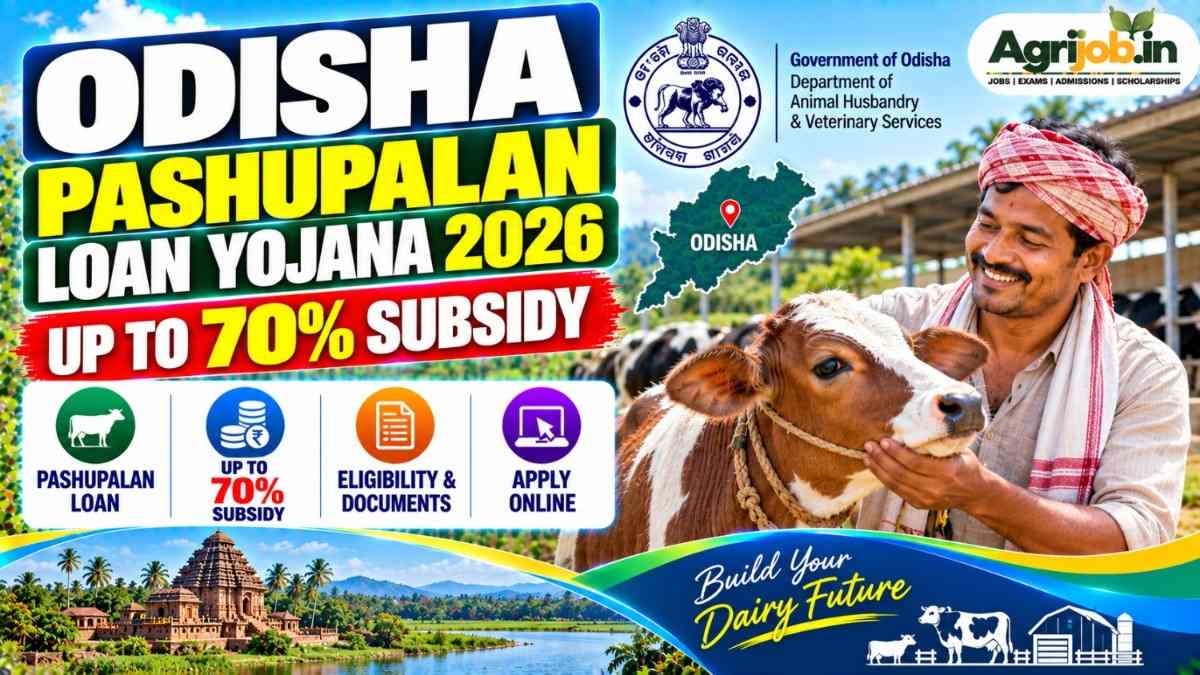
Odisha Pashupalan Loan Yojana 2026 – 70% Subsidy, Schemes & Apply Online
Odisha Pashupalan Loan Yojana 2026 offers livestock farmers, rural entrepreneurs, and self-help groups access to government-backed loans with subsidies ranging from 25% to 70% of project cost — covering dairy cows, buffaloes, goats, pigs, poultry, and ducks. The Odisha state government, under Chief Minister Mohan Charan Majhi, has allocated Rs.1,423.47 crore under the Mukhyamantri Kamdhenu Yojana alone to transform the state’s livestock sector.
This guide is for farmers, unemployed youth, SHG members, and rural entrepreneurs in Odisha aged 18–65 who want to start or expand animal husbandry businesses using government subsidy. It covers all active state government schemes, central government schemes, bank loans, and cooperative society schemes available in Odisha as of October 2026 — with eligibility criteria, loan amounts, subsidy percentages, and how to apply online.
Odisha Pashupalan Loan Yojana 2026 provides up to 70% subsidy on livestock loans under the flagship Mukhyamantri Kamdhenu Yojana (Rs.1,423.47 crore budget), plus 40–50% under MKUY and 50% under the National Livestock Mission (NLM). Eligible farmers can apply offline at the nearest FARD district office or online at apicol.co.in for MKUY.
- Flagship State Scheme: Mukhyamantri Kamdhenu Yojana (MKY)
- State Budget (5 years): Rs.1,423.47 crore (2024–25 to 2028–29)
- Max Subsidy (State): Up to 70% under MKY (dairy cows & buffaloes)
- Beneficiaries so far: Over 4.16 lakh farmers (as of June 2026)
- MKUY Subsidy: 40–50% capital subsidy, up to Rs.1 crore (agri-enterprise)
- NLM Subsidy (Central): 50% back-ended subsidy, up to Rs.50 lakh
- AHIDF Loan Coverage: Up to 90% of project cost (central)
- Implementing Dept: Fisheries & Animal Resources Development (FARD), Odisha
- Apply Online (MKUY): apicol.co.in
- Official Dept Portal: fard.odisha.gov.in
- What Is Odisha Pashupalan Loan Yojana 2026?
- Who Should Apply for Odisha Pashupalan Loan?
- State Government Schemes — Odisha 2026
- Central Government Schemes Available in Odisha
- Bank Loan & Cooperative Society Schemes
- Subsidy & Loan Amount Details — All Schemes Compared
- Eligibility Criteria & Documents Required
- How to Apply — Step-by-Step Process 2026
- State vs Central Scheme: Which Is Better for You?
- Advantages & Disadvantages
- Important Terms & High-CPC Keywords Explained
- Important Links Table
- Conclusion
- Key Takeaways
- Frequently Asked Questions
What Is Odisha Pashupalan Loan Yojana 2026 and How Does It Work?
Odisha Pashupalan Loan Yojana 2026 is an umbrella term for all government-backed livestock loan-plus-subsidy programmes available to Odisha’s farmers, rural entrepreneurs, and SHG members. It is not a single scheme — it is a convergence of multiple state government, central government, NABARD, bank, and cooperative society programmes, all working together to make animal husbandry economically accessible.
The flagship scheme is the Mukhyamantri Kamdhenu Yojana (MKY), launched by the BJP government under CM Mohan Charan Majhi with a five-year budget of Rs.1,423.47 crore. Under MKY, eligible dairy farmers receive up to 70% of the animal purchase cost directly as subsidy credited to their bank accounts via DBT. As of June 2026, over 4.16 lakh farmers have already received more than Rs.326 crore in financial assistance under this scheme alone.
The scheme ecosystem in Odisha works like this: the state government provides animal purchase subsidy and capital investment support; the central government adds further back-ended subsidy through NLM and AHIDF; and banks (including Odisha Gramya Bank, SBI, and cooperative banks) disburse the loan amounts that are then partially offset by these subsidies.
Who Should Apply for Odisha Pashupalan Loan Yojana 2026?
- 🐄 Dairy farmers in Odisha who want to buy high-yield cows or buffaloes at just 30% of the animal’s market cost (70% paid by state)
- 🐐 Small and marginal farmers seeking to start a 10+1 goat unit or 30+2 goat unit through Women SHG mode
- 🐖 Rural entrepreneurs wanting to set up semi-commercial pig farming with 25% state subsidy
- 🐔 Poultry farmers aiming to start 500-broiler or 1,000-layer units under the state’s Poultry Development scheme
- 👩 Women SHG members (WSHGs) in Odisha — special goat farming, backyard poultry, and duck farming sub-schemes are reserved for them
- 🏢 Agri-entrepreneurs and MSMEs setting up dairy processing, feed plants, or large livestock enterprises who want up to 90% loan coverage under AHIDF
- 🌾 SC/ST beneficiaries — eligible for higher subsidy rates under NLM and priority allocation under Kamdhenu Yojana
- 🎓 Educated unemployed youth (18–35 years) from Odisha who want to set up livestock-based self-employment ventures through MKUY
State Government Schemes — Odisha Pashupalan 2026
Odisha’s Fisheries & Animal Resources Development (FARD) Department runs multiple animal husbandry sub-schemes under its state plan. Here are the key active schemes for 2023–24 and onwards:
1. Mukhyamantri Kamdhenu Yojana (MKY) — Flagship Dairy Scheme
The most important state scheme for dairy pashupalan in Odisha. MKY provides up to 70% subsidy on purchase of crossbred dairy cows and buffaloes. The scheme has eight sub-schemes: Buffalo Entrepreneurship Development, Go-Palan Yojana, Go-Sampad Bima Yojana, Calf Rearing Scheme, Incentive to Dairy Farmers, Strengthening of Dairy Organisation, Support to OMFED, and Feed & Fodder Production. An additional 15% subsidy is available on cattle procured from outside Odisha. About 4,033 functional Dairy Co-operative Societies are operating under OMFED, procuring milk statewide.
2. Mukhyamantri Krushi Udyog Yojana (MKUY) — Agri-Enterprise Capital Subsidy
MKUY is Odisha’s flagship agri-enterprise scheme, implemented by APICOL (Agriculture Promotion & Investment Corporation of Odisha). It offers a 40–50% Capital Investment Subsidy (CIS) up to Rs.1 crore on fixed investment (excluding land) for commercial agri-enterprises including animal husbandry, dairy processing, feed manufacturing, and poultry units. The Odisha Cabinet approved its continuation in 2026 with a fresh outlay of Rs.2,496.40 crore for 2026–27 to 2030–31. MKUY’s innovative “mirror account mechanism” transfers 80% of subsidy upfront as bank security, cutting loan sanctioning time by nearly two-thirds. Apply online at apicol.co.in.
3. Poultry Development Umbrella Scheme (State Plan 2023–24)
Odisha runs multiple poultry sub-schemes under its State Plan, including: Broiler Farming (500 and 2,000 bird capacity), Layer Farming (1,000 bird capacity), Semi-Commercial Duck Farming, Backyard Poultry Rearing (including special allocation for PVTG households), Chick Rearing Unit setup, and Mini Poultry Feed Mill establishment. WSHG members get priority allocation and dedicated WSHG-mode sub-schemes.
4. Small Animal Development Schemes (Goat & Pig)
For goat farming, Odisha runs the Goat Rearing through Women Self Help Groups (30+2 unit), Small-Scale Goat Farming (individual mode), and Goat Development & Scientific Breeding through Artificial Insemination sub-schemes. For pig farming, the Semi-Commercial Pig Farming (individual mode) scheme provides 25% state subsidy to set up a unit of 20 sows and 2 boars. These schemes operate under the FARD Department and are applied for via the district Animal Husbandry office.
5. Mukhyamantri Prani Kalyan Yojana (MPKY) — Goshala Support
CM Majhi launched the Mukhyamantri Prani Kalyan Yojana with a Rs.186 crore budget to establish new goshalas and support existing registered goshalas. It covers roughly 22,000 stray and helpless cattle across Odisha. Not a direct pashupalan loan scheme but relevant for registered goshala operators.
Central Government Schemes Available in Odisha 2026
6. National Livestock Mission (NLM) — 50% Back-Ended Subsidy
The NLM is implemented by the Department of Animal Husbandry & Dairying (DAHD) through state implementing agencies. In Odisha, it covers: Rural Backyard Goat Development (10+1 unit), Rural Backyard Sheep Development (10+1 unit), Innovative Poultry Productivity Project (IPPP, 600-bird broiler unit), and feed/silage-related sub-schemes. NLM provides a 50% back-ended capital subsidy for eligible units. Apply online at nlm.udyamimitra.in. Odisha FARD is the State Implementing Agency (SIA).
7. Animal Husbandry Infrastructure Development Fund (AHIDF) — Up to 90% Loan
AHIDF is a central scheme with a corpus of Rs.29,610.25 crore (extended to FY 2025–26). It provides up to 90% of project cost as bank loan with 3% annual interest subvention for up to 8 years. In Odisha, Rs.106.45 crore in AHIDF loans have been sanctioned for 7 projects. Eligible projects include dairy processing plants, meat processing units, animal feed plants, breed multiplication farms, and veterinary vaccine facilities. MSME category projects qualify for credit guarantee coverage up to Rs.2 crore. Apply at udyamimitra.in.
8. Rashtriya Gokul Mission (RGM) — Indigenous Breed Development
RGM focuses on conservation and development of indigenous cattle breeds (Sahiwal, Gir, Red Sindhi) through genetic upgradation. In Odisha, Nationwide Artificial Insemination Programme (NAIP) Phases I and II are implemented under RGM, with Odisha FARD as the nodal agency. Individual farmers benefit indirectly through free AI services at government veterinary centres. Apply via the local veterinary officer.
9. PM Pashu Kisan Credit Card (PM Pashu KCC)
The PM Pashu KCC scheme provides revolving credit of Rs.1.60 lakh per animal unit (2 cows or buffaloes) at 4% effective interest rate (after 3% GoI interest subvention) for livestock working capital needs including feed, veterinary care, and day-to-day expenses. Apply at jansamarth.in, SBI YONO Kisan app, or nearest bank branch.
Bank Loan & Cooperative Society Schemes in Odisha
Beyond direct government subsidy schemes, Odisha’s banking network provides dedicated livestock loan products that can be stacked with state/central subsidies:
Odisha Gramya Bank (OGB) — Livestock Loan
Odisha Gramya Bank, sponsored by Indian Overseas Bank, is the primary regional rural bank covering tribal and remote Odisha districts. OGB provides dairy cow/buffalo loans up to Rs.5 lakh for individuals and up to Rs.20 lakh for SHG-linked units, with NABARD refinancing at concessional rates. Loan repayment is 5–7 years. OGB is a key channel for Kamdhenu Yojana subsidy disbursement in remote areas.
State Bank of India (SBI) — Kisan Credit Card & Dairy Loan
SBI provides Animal Husbandry Loans from Rs.50,000 to Rs.10 lakh at 7%–12% interest (depending on category and security). SBI is the nodal bank for PM Pashu KCC applications in Odisha via YONO Kisan or branch application. SBI also channels AHIDF-linked term loans for larger agri-enterprise units in Odisha.
OMFED Cooperative Societies — Dairy Input Credit
Odisha’s 4,033 functional Dairy Co-operative Societies under OMFED provide input credit (feed, medicines, AI services) to member dairy farmers. The state government’s Mission Shakti Loan scheme provides interest-free loans through Women SHG-bank linkage — loans to SHGs for livestock at an annual interest rate of 0% (full interest subvention by Odisha government). About 3 lakh dairy farmers currently access benefits via OMFED cooperatives. OMFED’s turnover reached Rs.1,028 crore in FY 2024–25.
NCDC (National Cooperative Development Corporation) — Cooperative Livestock Loan
NCDC provides concessional term loans to registered dairy and livestock cooperatives in Odisha for infrastructure development, working capital, and dairy processing capacity. Interest subvention of 2.5% p.a. is available under the Dairy Infrastructure Development Fund (DIDF) for eligible milk unions and federations. Applications are submitted by the cooperative to the NCDC state office in Bhubaneswar.
Subsidy & Loan Amount Details — All Schemes Compared 2026
| Scheme | Type | Max Subsidy | Max Loan | Best For |
|---|---|---|---|---|
| Mukhyamantri Kamdhenu Yojana (MKY) | State | Up to 70% | Animal cost (DBT) | Dairy cow/buffalo farmers |
| MKUY (APICOL) | State | 40–50%, max Rs.1 cr | Rs.50 lakh+ | Agri-enterprise, dairy processing |
| Poultry Development (State) | State | Varies by sub-scheme | Up to Rs.10 lakh | Broiler/layer/duck farmers |
| Semi-Commercial Pig Farming | State | 25% | Rs.2–5 lakh | Pig unit (20 sows + 2 boars) |
| Goat Farming (WSHG / Individual) | State | Varies (subsidy-linked) | Rs.1–3 lakh | Women SHGs, small farmers |
| National Livestock Mission (NLM) | Central | 50% back-ended | Up to Rs.50 lakh | Goat, sheep, poultry, pig units |
| AHIDF (Central) | Central | 3% interest subvention | Up to 90% project cost | Dairy processing, feed plants, infra |
| PM Pashu KCC | Central/Bank | 3% interest subvention | Rs.1.60 lakh/unit | Working capital for any livestock |
| OGB / SBI Livestock Loan | Bank | Nil (market rate loan) | Rs.50,000–Rs.10 lakh | Any livestock unit, stackable |
| Mission Shakti Loan (WSHG) | State Cooperative | Full interest subvention (0% effective) | As per SHG norms | Women SHG livestock ventures |
Eligibility Criteria & Documents Required
Eligibility varies by scheme, but the common requirements across most Odisha Pashupalan Loan Yojana 2026 programmes are:
- ✅ Permanent resident of Odisha — valid Aadhaar-linked domicile required
- ✅ Age 18–65 years (general); 18–40 years for MKY (special relaxation for SC/ST/PwD)
- ✅ Existing farmer or intending livestock entrepreneur — agriculture/pashupalan experience preferred
- ✅ Bank account linked to Aadhaar (subsidy via DBT)
- ✅ Not a loan defaulter with any bank or financial institution
- ✅ Land ownership or lease agreement for animal shelter / shed (required for MKUY and NLM; not mandatory for small MKY units)
- ✅ For MKUY only: Detailed Project Report (DPR) mandatory; bank loan approval required before subsidy claim
- ✅ For cooperative schemes: Membership in local OMFED Dairy Cooperative or Women SHG
Documents Required (Standard): Aadhaar Card, Residence/Domicile Certificate, Bank Passbook, Income Certificate, Caste Certificate (SC/ST), Land Records or Lease Agreement, Passport-size Photographs, Animal Husbandry/Veterinary Training Certificate (where available), and Detailed Project Report (for MKUY/AHIDF/NLM large units).
How to Apply for Odisha Pashupalan Loan Yojana 2026 — Step-by-Step
- Identify your scheme: Decide which sub-scheme matches your livestock type, scale, and category (general/SC/ST/WSHG/entrepreneur). Refer to the comparison table above.
- Visit the District FARD Office / Block Veterinary Officer: For state schemes (MKY, Poultry, Goat, Pig), collect the application form from your nearest Veterinary Officer or download from fard.odisha.gov.in. For MKY specifically, contact the district Animal Husbandry office to register your intent.
- Approach your bank: Go to your nearest SBI, Odisha Gramya Bank, or State Cooperative Bank branch. Discuss the project, obtain a loan sanction letter, and ensure the bank is registered for the scheme. For Pashu KCC, apply online at jansamarth.in or SBI YONO Kisan.
- For MKUY — apply online at apicol.co.in: Register as an entrepreneur, upload DPR, KYC documents, land records, and bank sanction letter. Track status in the same portal.
- For NLM — apply at nlm.udyamimitra.in: Select “Entrepreneur” login, upload DPR and all documents, select your bank, and submit. The State Implementing Agency (FARD Odisha) reviews and forwards to the bank.
- For AHIDF — apply at udyamimitra.in: Suitable for agri-enterprises; requires MSME registration and formal DPR. Bank appraises and sanctions.
- Loan disbursement & subsidy: Once bank sanctions the loan, the first installment is disbursed. The bank then applies to NABARD (for NLM/AHIDF) or to APICOL/FARD (for state schemes) for subsidy release. Subsidy is credited directly to your loan account via DBT/ECS, reducing outstanding principal.
- Animal insurance: Under MKY, Go-Sampad Bima Yojana covers livestock insurance — mandatory for beneficiaries to protect against loss. Ensure insurance is activated within 30 days of animal purchase.
Eligible Odisha farmers can often combine state and central subsidies on the same unit. For example, a dairy farmer can claim MKY state subsidy (up to 70% on animal cost) AND PM Pashu KCC working capital at 4% effective interest for the same farm. For larger agri-entrepreneurs, MKUY capital subsidy can complement AHIDF interest subvention. Always confirm eligibility for stacking with your FARD district officer before applying — as per official notification, check the latest circular at fard.odisha.gov.in.
State Schemes vs Central Schemes vs Bank Loans — Which Is Best?
| Feature | State Schemes (MKY / MKUY) | Central Schemes (NLM / AHIDF) | Bank / Cooperative |
|---|---|---|---|
| Subsidy Rate | Up to 70% (MKY) | 50% back-ended (NLM) | Nil subsidy; market rate |
| Loan Size | Small to mid (animal cost) | Up to Rs.50 lakh (NLM) / 90% project (AHIDF) | Rs.50,000–Rs.10 lakh |
| Application Mode | Offline (FARD) + MKUY online | Online (nlm.udyamimitra.in / udyamimitra.in) | Branch / online banking |
| Best For | Dairy farmers, SHGs, small units | Goat farms, large poultry, processing infra | Working capital, quick access |
| Processing Time | 1–3 months (MKY DBT) | 2–4 months (bank appraisal required) | 15–45 days |
| DPR Required | No (MKY small units); Yes (MKUY) | Yes (all NLM/AHIDF units) | Depends on loan size |
| Combinability | Can stack with bank loan | Can stack with state scheme in some cases | Can be used alongside subsidies |
| Best For SC/ST | MKY priority + 15% extra | 50% NLM subsidy (same as general) | RRB concessional rates |
For small and marginal dairy farmers, the Mukhyamantri Kamdhenu Yojana is the strongest option — 70% subsidy with DBT delivery, minimal paperwork, and no DPR required for small units. For rural entrepreneurs building a commercial livestock enterprise (feed plant, dairy unit, processing), MKUY + AHIDF together offer the most competitive financing. For Women SHG members, the Mission Shakti interest-free loan route plus state goat/poultry sub-schemes offers the lowest effective cost. In every case, apply through your local FARD office first — they can identify which schemes you’re eligible to stack.
Advantages & Disadvantages of Odisha Pashupalan Loan Yojana 2026
✅ Advantages:
- Highest state-level dairy subsidy in eastern India — up to 70% under Kamdhenu Yojana, benefiting over 4.16 lakh farmers as of 2026
- Multiple stackable schemes allow eligible farmers to reduce their actual out-of-pocket investment to as little as 10–30% of total project cost
- MKUY’s mirror account mechanism cuts sanctioning time by two-thirds compared to older subsidy models
- Wide animal coverage — dairy, buffalo, goat, pig, poultry, duck, and even fodder development units all covered
- Special allocations for PVTG households, Women SHGs, and SC/ST beneficiaries with higher subsidy and simplified process
❌ Disadvantages:
- NLM and AHIDF require a formal Detailed Project Report (DPR) — burdensome for first-time small farmers without technical support
- Back-ended subsidy model means the farmer pays full loan EMIs until the subsidy is credited — can take 3–6 months post-disbursement
- MKUY requires a prior bank loan sanction, which means farmers with thin credit histories may face difficulty getting the benefit
- Some state sub-schemes (Poultry, Goat) are updated annually with new guidelines — farmers must verify current-year scheme availability at their district FARD office
Important Terms Related to Odisha Pashupalan Loan Yojana 2026
- Capital Investment Subsidy (CIS): A one-time government grant on fixed capital cost (excluding land). MKUY provides CIS of 40–50%. Not a loan — does not need repayment.
- Back-Ended Subsidy: Subsidy credited to the loan account after verifying project completion. Farmer pays normal EMIs until subsidy arrives; upon credit, outstanding principal reduces proportionally.
- DBT (Direct Benefit Transfer): Subsidy credited directly to beneficiary’s Aadhaar-linked bank account. MKY uses DBT/ECS for dairy animal subsidies.
- OMFED: Odisha State Cooperative Milk Producers’ Federation Ltd — the apex dairy cooperative in Odisha. With Rs.1,028 crore turnover in FY 2024–25, OMFED is the primary milk procurement and marketing body for 3 lakh dairy farmers via 4,033 cooperative societies.
- NABARD: National Bank for Agriculture and Rural Development — the nodal bank for refinancing livestock loans and channeling DEDS, DIDF, and other central scheme subsidies through commercial and cooperative banks.
- FARD Department: Fisheries & Animal Resources Development Department, Government of Odisha — the nodal agency for state pashupalan schemes. Website: fard.odisha.gov.in
- APICOL: Agriculture Promotion & Investment Corporation of Odisha Ltd — implements MKUY and disburses capital investment subsidies to agri-entrepreneurs. Website: apicol.co.in
- NLM (National Livestock Mission): Central government scheme under DAHD providing 50% back-ended capital subsidy for goat, sheep, poultry, and pig entrepreneurship units. Apply at nlm.udyamimitra.in.
- Pashu KCC (Animal Kisan Credit Card): Revolving credit card for livestock working capital at 4% effective interest rate per annum after government interest subvention.
- WSHG (Women Self-Help Group): A group of 10–15 women organised for collective savings, credit, and livelihood activities. Several Odisha pashupalan sub-schemes have dedicated quotas for WSHG members, especially for goat, duck, and backyard poultry units.
Important Links — Odisha Pashupalan Loan Yojana 2026
| Link Name | URL |
|---|---|
| FARD Odisha — Animal Husbandry Schemes | fard.odisha.gov.in/animal-husbandry-schemes |
| MKUY Apply Online (APICOL) | apicol.co.in |
| NLM Apply Online | nlm.udyamimitra.in |
| AHIDF Apply Online | udyamimitra.in |
| PM Pashu KCC Apply | jansamarth.in |
| OMFED Official Website | omfed.com |
| DAHD Official (Central Schemes) | dahd.gov.in |
| NABARD Official | nabard.org |
| Agrijob.in — AHIDF Loan Guide | AHIDF Loan 2026 Complete Guide |
| Agrijob.in — Dairy Farm Loan Subsidy Guide | Dairy Farm Loan Subsidy 2026 — 25%, 33%, 50% Explained |
Conclusion — Is Odisha Pashupalan Loan Yojana 2026 Worth Applying For?
Odisha Pashupalan Loan Yojana 2026 is among the most well-funded livestock support ecosystems in eastern India, with the Mukhyamantri Kamdhenu Yojana alone offering 70% subsidy on dairy animals backed by a Rs.1,423.47 crore five-year budget — already benefiting over 4.16 lakh farmers and distributing more than Rs.326 crore in financial assistance. Whether you want to start with 2 cows under MKY, set up a 30+2 goat unit through your Women SHG, or build a large dairy processing unit under MKUY + AHIDF, Odisha has a structured pathway with active government support in 2026.
Apply at the nearest FARD district office for state schemes, and check fard.odisha.gov.in for current-year sub-scheme guidelines before visiting. Bookmark this page — it is updated every time official scheme data changes.
- Mukhyamantri Kamdhenu Yojana provides up to 70% subsidy on dairy cow/buffalo purchase — the highest in eastern India — with Rs.1,423.47 crore budget for 2024–29
- Over 4.16 lakh farmers have already benefited, receiving more than Rs.326 crore in financial assistance as of June 2026
- MKUY adds 40–50% Capital Investment Subsidy (up to Rs.1 crore) for larger agri-enterprises; renewed with Rs.2,496.40 crore budget through 2030–31
- Central schemes — NLM (50% back-ended), AHIDF (90% loan cover, 3% subvention), PM Pashu KCC (4% effective interest) — can be stacked with state subsidies for maximum benefit
- Women SHG members and SC/ST beneficiaries get priority allocation and reserved sub-schemes; apply at the FARD district office or online at apicol.co.in / nlm.udyamimitra.in
Frequently Asked Questions About Odisha Pashupalan Loan Yojana 2026
What is the maximum subsidy under Odisha Pashupalan Loan Yojana 2026?
The maximum subsidy available under Odisha’s state scheme is up to 70% under the Mukhyamantri Kamdhenu Yojana (MKY) for dairy cows and buffaloes. An additional 15% subsidy is available on cattle procured from outside Odisha. Under the central NLM scheme, eligible entrepreneurs get a 50% back-ended capital subsidy for goat, sheep, poultry, and pig units up to Rs.50 lakh. Combining state and central programmes, total effective subsidy can reach 60–85% of eligible project cost for some beneficiary categories.
How do I apply for Mukhyamantri Kamdhenu Yojana in Odisha?
To apply for MKY, visit your nearest district Fisheries & Animal Resources Development (FARD) office and collect the application form or download it from fard.odisha.gov.in. Submit it with Aadhaar, bank passbook, residence certificate, and income/caste certificate. For the Go-Palan Yojana sub-scheme and large dairy units, connect with your local OMFED Dairy Cooperative Society as well. The scheme operates in all 30 districts of Odisha.
Is there an online application for Odisha pashupalan loan?
Yes. MKUY applications (for commercial agri-enterprises including larger dairy and livestock units) are fully online at apicol.co.in. The NLM scheme is applied for online at nlm.udyamimitra.in. The AHIDF is applied for at udyamimitra.in. The PM Pashu KCC is applied for at jansamarth.in. However, the flagship MKY scheme for small dairy units still primarily runs through offline applications at district offices.
Can women farmers apply for Odisha pashupalan loan scheme?
Yes — and women receive priority treatment. Multiple sub-schemes are exclusively designed for Women Self Help Group (WSHG) members, including: Goat Rearing through WSHGs (30+2 unit), Backyard Poultry Rearing (WSHG mode), Semi-Commercial Duck Farming (WSHG mode), and Layer Farming (1,000 bird capacity, WSHG mode). Women SHGs also benefit from the Mission Shakti Loan which provides 0% effective interest rate loans (full interest subvention by Odisha government). Contact your nearest Mission Shakti cluster coordinator or WSHG facilitator to check eligibility.
What animals are covered under Odisha Pashupalan Loan Yojana 2026?
Odisha’s pashupalan schemes cover a wide range of livestock: Dairy Cows (crossbred HF, Jersey, and indigenous breeds), Buffaloes (including Murrah), Goats (small-scale and WSHG mode), Pigs (semi-commercial piggery), Broiler Chickens (500 and 2,000 bird units), Layer Chickens (1,000 bird units), Ducks (semi-commercial), and Fodder crops (Azolla, perennial and seasonal fodder). Fisheries, sheep, and integrated poultry-feed mill units are also separately covered under different FARD sub-schemes.
How much income can a dairy farmer earn under MKY 2026?
A 2-cow dairy unit (HF/Jersey, each producing 15–18 litres/day) can generate gross milk income of Rs.9,000–Rs.15,000/month at Rs.30–50/litre (OMFED procurement rate). Net income after feed and operational costs is approximately Rs.6,000–Rs.10,000/month per cow. A 10-cow unit under MKY can yield Rs.60,000–Rs.1,00,000/month, making it a viable primary livelihood. CM Majhi has set a target of increasing Odisha’s daily milk production from 72 lakh litres to 274 lakh litres by 2047.
What is the difference between MKUY and MKY in Odisha?
MKY (Mukhyamantri Kamdhenu Yojana) focuses on the purchase subsidy for dairy animals — it pays up to 70% of the cow/buffalo cost for individual dairy farmers and covers 8 dairy sub-schemes. MKUY (Mukhyamantri Krushi Udyog Yojana) is for setting up commercial agri-enterprises — it provides 40–50% capital investment subsidy on fixed assets (sheds, equipment, infrastructure) for larger livestock, dairy processing, and agri-business ventures. MKY is for the animal-buying dairy farmer; MKUY is for the entrepreneur building a livestock-based business.
Can I get goat farming loan from cooperative in Odisha?
Yes. Women SHG members can access goat farming finance through their WSHG-linked cooperative under the Odisha state scheme for Goat Rearing through Women Self Help Groups (30+2 unit). In addition, the NLM scheme covers individual goat farming entrepreneurs with 50% back-ended subsidy. Apply at the block-level veterinary office or through your WSHG cluster facilitator for state cooperative route, or at nlm.udyamimitra.in for the NLM route.
Is the NABARD DEDS scheme still active in Odisha 2026?
No. The Dairy Entrepreneurship Development Scheme (DEDS) under NABARD was discontinued after FY 2020–21. Dairy subsidy support in Odisha in 2026 now comes primarily from the state’s Mukhyamantri Kamdhenu Yojana (MKY) and the central NLM/AHIDF programmes. Farmers who see DEDS mentioned on older websites should note that it is no longer active; they should approach their FARD district office or apicol.co.in for currently active schemes.
Last Updated: October 2026. This guide is reviewed and updated regularly for accuracy. Bookmark this page for the latest Odisha Pashupalan Loan Yojana updates as official scheme guidelines change each financial year.
Disclaimer: This article is for general informational purposes only. Subsidy percentages, loan limits, and eligibility criteria may vary by financial year, district, and beneficiary category. Always verify current scheme guidelines directly with the FARD Department Odisha (fard.odisha.gov.in), APICOL (apicol.co.in), or your district Animal Husbandry Officer before applying. This is not legal or financial advice.