
Land Development Loan 2026 – Complete Guide to Convert Barren Land Into Profitable Farm With Bank Finance
Land Development Loan 2026 is one of the most powerful financial tools available for Indian farmers who own barren, fallow, or uncultivated land. In 2026, leading government banks including Bank of Baroda, SBI, Bank of India, Union Bank of India, and all NABARD-refinanced scheduled banks are actively offering Land Development Loans up to ₹2 Crore to eligible farmers, SHGs, JLGs, and FPOs across India. If you have a piece of wasteland that is sitting idle, this loan can help you transform it into a productive, income-generating farm — and this guide will show you exactly how. Read on for complete details and apply via agrijob.in.

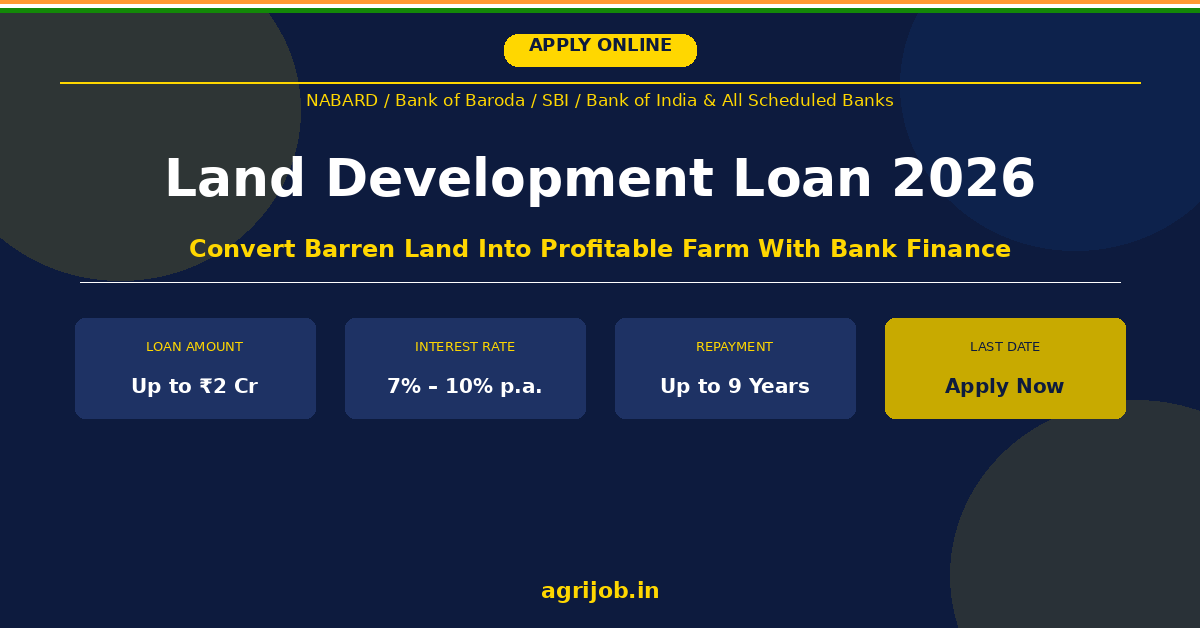
Land Development Loan 2026 – Quick Overview
| Detail | Information |
|---|---|
| Scheme Name | Land Development Loan / Agricultural Land Development Loan |
| Offered By | Bank of Baroda, SBI, Bank of India, Union Bank, Federal Bank & All NABARD-Refinanced Banks |
| Supported By | NABARD (National Bank for Agriculture and Rural Development) |
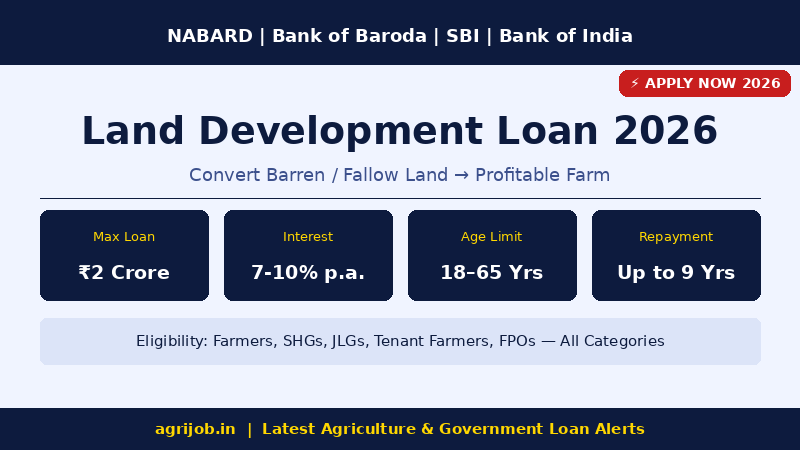
| Maximum Loan Amount | Up to ₹2,00,00,000 (₹2 Crore) |
| Interest Rate | 7% – 10% per annum (varies by bank & category) |
| Repayment Period | Up to 9 Years (Union Bank); 5–15 Years (varies by bank) |
| Eligible Applicants | Individual Farmers, SHGs, JLGs, Tenant Farmers, FPOs, Corporate Farmers |
| Application Mode | Offline – Nearest Bank Branch |
| Last Date to Apply | Rolling Basis – No Fixed Last Date |
| Official Website | nabard.org |
What is Land Development Loan 2026?
A Land Development Loan is a specialised agricultural term loan offered by banks to farmers for carrying out various farm development activities on barren, fallow, saline, alkaline, or otherwise unproductive land. The goal of the Land Development Loan 2026 scheme is to convert economically unproductive land into cultivable, income-generating farmland.

Under this scheme, banks finance activities such as land reclamation, soil development, bunding and terracing, gully plugging, drainage layout, fencing, irrigation infrastructure, soil & water conservation, and watershed management. These activities transform barren or wasteland into productive agricultural land within 1–3 crop seasons.
NABARD, India’s apex agricultural development bank, refinances these loans to scheduled commercial banks, Regional Rural Banks (RRBs), and Cooperative Banks at concessional rates — ensuring farmers get affordable credit even in remote areas.
Application Fee
| Category | Processing Fee |
|---|---|
| Aggregate Agriculture Exposure up to ₹3 Lakhs | NIL (Zero) |
| Above ₹3 Lakhs | 1% of sanctioned limit (Max ₹1 Lakh – varies by bank) |
| Women Beneficiaries / SHG / JLG | Concessional / Waived (bank-specific) |
Note: Processing fees vary across banks and promotional periods. Many banks offer fee waivers during festive seasons or for priority categories. Always confirm the latest fee structure at your nearest branch before applying.
Age Limit for Land Development Loan 2026
| Category | Age Limit |
|---|---|
| Minimum Age | 18 Years |
| Maximum Age | 65 Years (some banks up to 70 years) |
| Senior Farmers (above 60) | Co-applicant (legal heir) may be required |
| Women Farmers | Priority given; relaxed norms applicable |
Land Development Loan 2026 – Eligible Activities & Amounts
The Land Development Loan 2026 covers a comprehensive range of farm development activities. The loan amount sanctioned depends on the type of activity, cost estimate, and land area.
| Activity | Description | Typical Coverage |
|---|---|---|
| Land Levelling | Grading & levelling uneven land for irrigation | 100% of cost estimate |
| Land Reclamation | Converting saline, alkaline, ravine or waterlogged land | Up to project cost |
| Bunding & Terracing | Creating bunds to prevent soil erosion on slopes | Up to project cost |
| Gully Plugging | Stone/brick structures to stop gully erosion | Up to project cost |
| Drainage Layout | Field drainage channels for waterlogged land | Up to project cost |
| Soil & Water Conservation | Check dams, farm ponds, water harvesting structures | Up to project cost |
| Watershed Management | Integrated watershed development programs | Up to project cost |
| Fencing | Wire/stone fencing to protect cultivated area | Up to project cost |
| Irrigation Infrastructure | Borewells, farm ponds, drip/sprinkler systems | As per NABARD norms |
| Solar Pumps on Barren Land | Solar agriculture pumps & solarisation of grid pumps | As per NABARD norms |
| Maximum Loan Cap | Combined all activities | Up to ₹2 Crore |
Eligibility and Qualification for Land Development Loan 2026
- Individual Farmers: Any farmer directly engaged in agriculture or allied activities who owns or has usufructuary rights over agricultural/fallow/barren land.
- Self Help Groups (SHGs): Groups of individual farmers are eligible; banks must maintain disaggregated data.
- Joint Liability Groups (JLGs): Groups of 4–10 farmers with a common borrowing arrangement are eligible.
- Tenant Farmers / Oral Lessees / Sharecroppers: Eligible if their share of landholding is within Small and Marginal Farmer limits and the lease has been in existence for at least the last 10 years.
- Landless Agricultural Labourers: Eligible under special schemes and JLG arrangements.
- Farmer Producer Organisations (FPOs/FPCs): Companies and cooperatives of individual farmers engaged in agriculture and allied activities.
- Corporate Farmers & Partnership Firms: Eligible under non-priority sector classification.
- Women Farmers: Priority is given; widows, SHG members, and distress cases are given preferential treatment.
- NRI-Owned Agricultural Land: NRIs holding agricultural land in India can apply through authorised representatives or co-applicants as per RBI and bank-specific guidelines (see NRI section below).
Documents Required
- KYC Documents: Aadhaar Card, PAN Card, Voter ID, Driving Licence (any one photo ID + address proof)
- Land Documents: 7/12 extract, ROR (Record of Rights), land mutation records, survey map, encumbrance certificate
- Farm Development Plan: Detailed plan/estimate of work to be carried out (prepared by Agriculture Extension Officer or recognised agency)
- Cost Estimate: From approved contractor/government agency for development works
- Income Proof: Last 3 years’ crop production records / income tax returns (if applicable)
- Bank Statements: Last 6 months account statement
- Passport-size Photographs: 2 recent photographs
- SHG/JLG Documents: Group formation documents, meeting minutes, savings passbook (for group applicants)
Selection Process
- Application Submission: Farmer submits application with all documents at the nearest bank branch or through a Business Correspondent (BC).
- Field Inspection: Bank’s agriculture officer or empanelled valuer visits the land for physical verification and assessment.
- Land Valuation: Land value assessed based on the last 5-year average registration value from the Sub-Registrar’s office and bank’s internal valuation.
- Development Plan Appraisal: Bank’s technical officer reviews the farm development plan and cost estimate for feasibility.
- Credit Appraisal: CIBIL score, repayment capacity, and existing liabilities are assessed.
- Sanction & Disbursement: Upon approval (typically 15–30 working days), loan is sanctioned and disbursed directly to the farmer’s account or through Demand Draft to the contractor.
How to Apply for Land Development Loan 2026
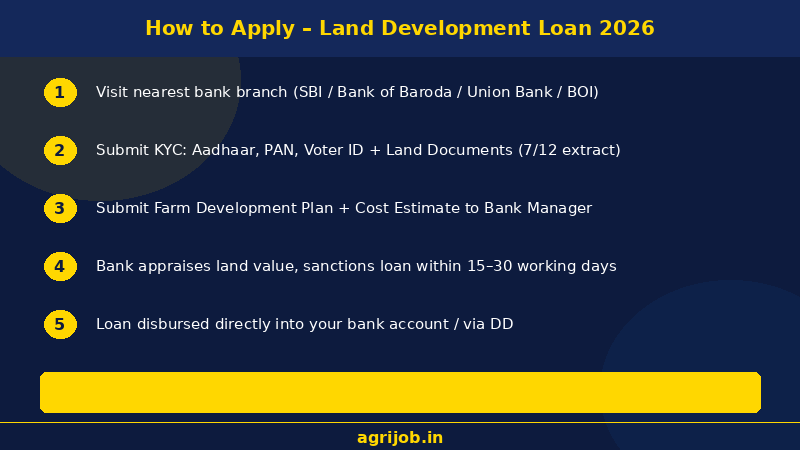
- Visit Your Nearest Bank Branch: Go to the nearest branch of SBI, Bank of Baroda, Bank of India, Union Bank of India, Federal Bank, or any NABARD-refinanced Scheduled Bank in your district.
- Collect Application Form: Ask for the “Agricultural Land Development Loan” or “Farm Development Scheme” application form. It is provided free of charge.
- Prepare Farm Development Plan: Get a detailed development plan prepared by your local Agriculture Extension Officer, Krishi Vigyan Kendra (KVK), or a NABARD-empanelled agency.
- Submit Application with Documents: Attach all required KYC, land, and development plan documents to the completed application form and submit it at the branch.
- Field Visit by Bank Officer: The bank will schedule a field inspection within 7–10 working days. Be present at the land during the visit.
- Loan Sanction: Once field inspection and appraisal are complete, the loan is sanctioned — typically within 15–30 working days for standard cases.
- Disbursement: Loan amount is credited directly to your savings account or disbursed in stages based on the development schedule.
- Start Farm Development: Begin the development activities as per the approved plan. Maintain receipts and progress records for bank monitoring visits.
Interest Rates & Repayment Details – Land Development Loan 2026
| Bank | Interest Rate (Approx.) | Max Loan Amount | Repayment Period |
|---|---|---|---|
| Bank of Baroda | ~8.5%–10% p.a. | Up to ₹2 Crore | Up to 9 Years |
| Union Bank of India | ~8%–9.5% p.a. | Based on plan | Max 9 Years |
| Bank of India (BOI) | ~7.5%–10% p.a. | Based on land value | 5–15 Years |
| Federal Bank | ~8%–10% p.a. | 75% of land value | 7–10 Years |
| State Bank of India (SBI) | ~7%–9.5% p.a. | As per project | Up to 9 Years |
| Bank of Maharashtra | ~8%–9% p.a. | Up to ₹20 Lakh | Up to 9 Years |
| NABARD Refinance Rate | Starting from 4.5% p.a. | Wholesale refinance | 18 Months – 5 Years |
Important: Interest rates are subject to RBI repo rate changes and bank-specific policies. Farmers with a good CIBIL score and clean repayment history can negotiate better rates. The repayment schedule is aligned with crop cycles — installments can be monthly, quarterly, half-yearly, or yearly depending on the borrower’s cash flow.
Is Land Development Loan 2026 a Good Opportunity for NRIs and International Agriculture Graduates?
Many NRIs (Non-Resident Indians) living in the USA, UK, Canada, Australia, and the Gulf countries own agricultural land in India that lies barren or fallow. The Land Development Loan 2026 provides an excellent avenue for NRIs returning to India, or those looking to invest in Indian farming through family members, to develop such land productively.
In the India vs USA comparison for agricultural financing, Indian government-backed farm loans are significantly more affordable. In the USA, USDA Farm Service Agency loans start at around 4–6% but require extensive documentation and are limited to US residents. In contrast, India’s NABARD-backed Land Development Loans offer comparable rates (7–10%) with far simpler processes for landowners, making them attractive for NRIs returning to India who want to leverage their ancestral land.
For international students who have completed BSc or MSc in Agriculture, Agronomy, Soil Science, Land Management, or related disciplines from overseas universities, returning to India and applying for a Land Development Loan to start a modern farm business is a viable and rapidly growing career path. The Government of India’s push for “Doubling Farmer’s Income” and the support of NABARD makes this particularly promising in 2026.
NRIs cannot directly hold agricultural land in India (as per FEMA regulations), but they can co-apply with a resident family member who holds the land. For Indian students abroad who are still Indian citizens, no such restriction applies. Explore agriculture career opportunities at agrijob.in to find allied jobs while your farm is being developed.
Government Schemes Supporting Land Development in 2026
The Land Development Loan 2026 works best when combined with central and state government schemes that provide subsidies and grants for land development:
- PM Krishi Sinchayee Yojana (PMKSY): Provides subsidy for micro-irrigation (drip & sprinkler) on developed land — “Har Khet Ko Pani, More Crop Per Drop”.
- NABARD Watershed Development Fund: Finances watershed management projects for barren & degraded land.
- Rashtriya Krishi Vikas Yojana (RKVY): State-level grants for farm infrastructure and land development.
- PM KUSUM Scheme: Covers solar pump installation on barren/fallow land — NABARD explicitly finances this under Long-Term Loans.
- Soil Health Card Scheme: Free soil testing to determine the best development approach for your specific land type.
- MNREGA Convergence: In many states, MNREGA (Mahatma Gandhi Rural Employment Guarantee Act) funds can be converged with bank loans for bunding, terracing, and water harvesting works.
Important Links
| Link | URL |
|---|---|
| NABARD Official Website | nabard.org – Official |
| Bank of Baroda Land Development Loan | Click Here |
| Union Bank Farm Development Scheme | Click Here |
| Bank of India Land Purchase Loan | Click Here |
| Federal Bank Agricultural Development Loan | Click Here |
| NABARD Long Term Loans | Click Here |
| More Agriculture Loans & Finance | Latest Agriculture Jobs & Finance at agrijob.in |
| Latest Govt Jobs 2026 | Govt Jobs 2026 at agrijob.in |
| Join Telegram | agrijob.in Telegram Channel |
Frequently Asked Questions about Land Development Loan 2026
Q1. What is Land Development Loan 2026?
The Land Development Loan 2026 is a government-backed agricultural term loan offered by NABARD-refinanced banks (Bank of Baroda, SBI, Bank of India, Union Bank, and others) to help farmers convert barren, fallow, saline, or unproductive land into cultivable farmland. Loan amounts go up to ₹2 Crore and cover activities like land reclamation, bunding, terracing, drainage, irrigation, and soil conservation.
Q2. Who is eligible for Land Development Loan 2026?
Individual farmers, SHGs, JLGs, tenant farmers, oral lessees, sharecroppers, FPOs, corporate farmers, and partnership firms are all eligible. Women farmers and distressed farmers are given priority. Even landless labourers can apply under JLG arrangements.
Q3. What is the maximum loan amount under Land Development Loan 2026?
The maximum loan amount under Bank of Baroda’s scheme is ₹2 Crore. Bank of Maharashtra limits it to ₹20 Lakh for individual applicants. Other banks sanction amounts based on land valuation and the estimated development cost. The overall financing ceiling varies by bank and project.
Q4. What is the interest rate for Land Development Loan in 2026?
Interest rates range from approximately 7% to 10% per annum depending on the bank, loan amount, category of borrower, and prevailing RBI repo rate. NABARD’s refinance rate to banks starts from 4.5% p.a. Banks add a margin for their operating costs. Farmers with clean credit histories may get rates closer to 7–8%.
Q5. Can NRIs or Indian students abroad apply for Land Development Loan 2026?
NRIs cannot directly hold agricultural land in India under FEMA, but they can co-apply with a resident family member who is the land title holder. Indian citizens studying abroad who intend to return can apply directly. This makes Land Development Loan 2026 an interesting option for NRIs investing in Indian agriculture through family. Always verify current FEMA rules with your bank.
Q6. Is there a last date for applying for Land Development Loan 2026?
No — the Land Development Loan 2026 is a banking product, not a one-time government scheme with a fixed last date. You can apply throughout the year at any participating bank branch. However, it is advisable to apply before the Kharif or Rabi sowing season to have the loan disbursed in time for land preparation.
Final Thoughts on Land Development Loan 2026
The Land Development Loan 2026 is a golden opportunity for every Indian farmer who owns barren, fallow, or unproductive land. With loans up to ₹2 Crore available at competitive interest rates of 7–10% p.a. from trusted government banks backed by NABARD, there has never been a better time to convert wasteland into a productive, income-generating farm. Whether you are a small and marginal farmer, part of an SHG or JLG, a tenant farmer, or even an NRI looking to invest in Indian agriculture through family members, this scheme has something for everyone. Apply at your nearest bank branch today and take the first step toward transforming your land and your livelihood. Visit agrijob.in for more agriculture finance updates, government schemes, and agriculture job notifications.
Disclaimer: This Agricultural jobs related information is only for the purpose of providing information to you and for Agricultural career advancement of Agricultural, Horticulture, Agronomy, Soil Science, Plant Breeding, Agriculture Marketing, Forestry, Poultry, Fisheries, Agri Business Management Graduates. We are not representing this employer or any Employment Agency nor we guarantee any employment. We do not ask candidates for any fees, Personal Information like (Bank OTP, Credit-Debit Card No, Aadhar Card OTP etc.) Please be Aware And never Share Such Information to any one or In the Name of agrijob.in. Please verify the correctness of the Agri jobs details yourself. We do not offer any guarantee on correctness of any details mentioned here. If a candidate pays any amount to anyone claiming to represent any company then it would be the responsibility of that candidate and he cannot hold us or the concerned employer responsible for such fraudulent activities.