
How to crack CA Final in the first attempt is the single most important question every CA aspirant asks — and with only 14.07% of candidates clearing both groups in May 2026, the answer demands more than just hard work. It demands a precise, phase-by-phase strategy. This guide is for CA Final students appearing in November 2026 or May 2027 who want to qualify on their very first try — not just pass, but pass with confidence.

This complete strategy covers everything: the 6-paper ICAI new scheme structure, a 3-revision framework, subject-wise time allocation, Paper 6 (IBS) open-book preparation, mock test simulation, and the exact habits that separated the 7,931 qualifiers of May 2026 from the 48,000+ who did not make it. Read this before your next study session.
To crack CA Final in the first attempt, complete 3 full syllabus revisions, solve the last 3 attempts’ ICAI RTPs and MTPs for every paper, build one-page chapter summary notes from day one, dedicate 20–25% of study time to Financial Reporting (Paper 1), and simulate at least 2 full 6-paper mock exam sets under strict timed conditions before the exam. Only 14.07% cleared both groups in May 2026 — this strategy puts you firmly in that top tier.
- Conducting Body: Institute of Chartered Accountants of India (ICAI) — icai.org
- Total Papers (New Scheme): 6 papers across 2 groups (600 marks total)
- Group I Papers: Financial Reporting (FR), Advanced Financial Management (AFM), Advanced Auditing & Professional Ethics (AAPE)
- Group II Papers: Direct Tax Laws & International Taxation (DT), Indirect Tax Laws (IDT), Integrated Business Solutions — IBS (open-book, 4 hours)
- Passing Criteria: Minimum 40% per paper + 50% aggregate per group (150/300 per group)
- May 2026 Pass % — Both Groups: 14.07% (7,931 new CAs qualified out of 56,299 appeared)
- May 2026 Pass % — Group I: 12.00% | Group II: 20.49%
- Jan 2026 Pass % — Both Groups: 10.97% (7,590 new CAs qualified)
- Nov 2026 Exam Dates: Group I: Nov 2, 4, 6 | Group II: Nov 9, 11, 13
- Ideal Preparation Time: 8–12 months (including 3 full revision cycles)
- Avg. CA Salary (ICAI 64th Campus 2026): Rs.13 LPA average; Rs.27.5 LPA highest domestic
- SPOM Requirement: All 4 Self-Paced Online Modules (Set A, B, C, D) must be cleared before appearing
- Why Cracking CA Final in First Attempt Matters — The Numbers
- Who Should Read This Complete Strategy Guide?
- CA Salary After First Attempt — What Is at Stake Financially
- CA Final Exam Structure 2026 — 6 Papers You Must Conquer
- Phase 1 — Build Your Master Study Plan (Months 1–2)
- Phase 2 — Complete Syllabus Coverage With Smart Prioritisation (Months 2–6)
- Phase 3 — Execute 3 Full Revision Cycles (The Non-Negotiable Rule)
- Phase 4 — Mock Test and RTP/MTP Practice (Final 45 Days)
- Phase 5 — Paper 6 (IBS) Open-Book Strategy
- Phase 6 — Exam-Hall Strategy and Time Management
- Subject-Wise Strategy for All 6 CA Final Papers
- First Attempt vs Multiple Attempts — What Changes
- Pros and Cons of Different CA Final Preparation Strategies
- Important Terms Every CA Final Aspirant Must Know
- CA Final Important Dates 2026
- Important Links
- Conclusion
- Key Takeaways
- Frequently Asked Questions
Why Cracking CA Final in First Attempt Matters — The Real Numbers
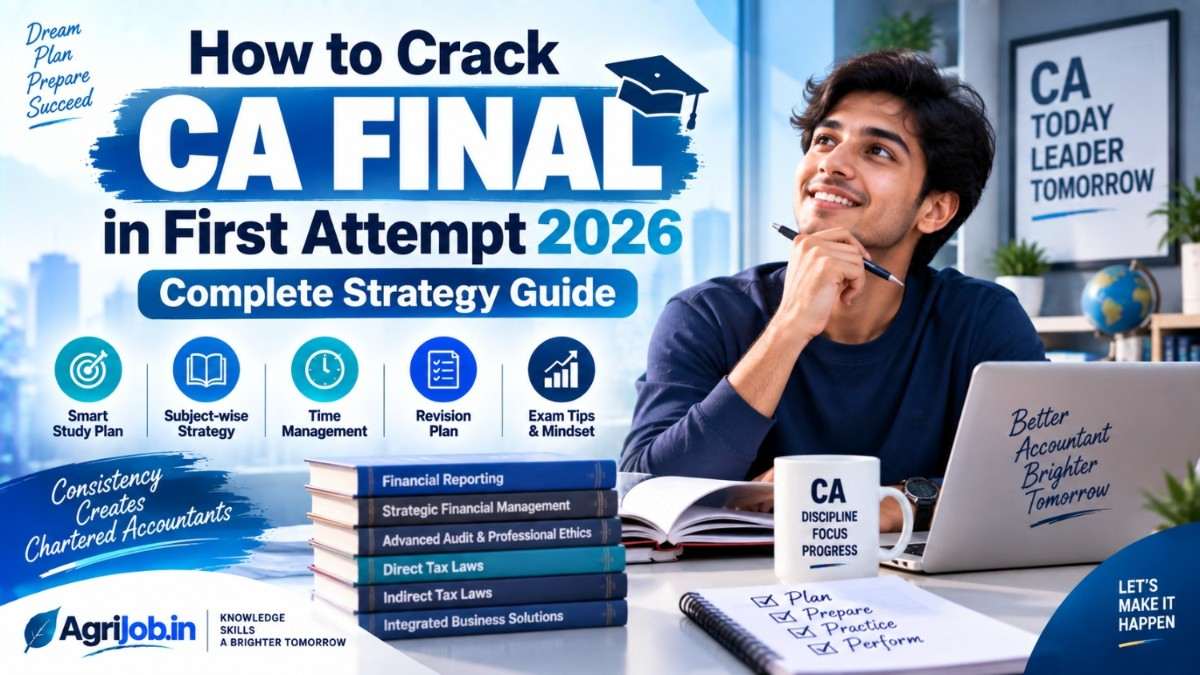
Clearing CA Final in the first attempt is not just a matter of pride — it directly impacts your salary, career trajectory, and the time you spend reaching your financial goals. Only 14.07% of candidates cleared both CA Final groups in May 2026. That means 85.93% of students who appeared — many of whom were well-prepared — did not make it. The separation between passers and repeaters is almost always strategic, not intellectual.

Every additional CA Final attempt costs you 4–6 months of delay — time in which first-attempt passers are already earning Rs.13 LPA at ICAI campus placements, building their résumé, and compounding their career experience. A first-attempt qualifier who joins at age 23–24 reaches senior finance roles 1–3 years ahead of a multi-attempt qualifier with otherwise identical skills. That gap translates to Rs.15–40 lakh in cumulative earnings over a decade, conservatively.
| Session | Group I | Group II | Both Groups | New CAs |
|---|---|---|---|---|
| May 2026 | 12.00% | 20.49% | 14.07% | 7,931 |
| January 2026 | 21.03% | 9.76% | 10.97% | 7,590 |
| September 2025 | 24.66% | 25.26% | 16.23% | 11,466 |
Source: ICAI official result data — caresults.icai.org | Published June 18, 2026 and March 1, 2026
Who Should Read This CA Final First Attempt Strategy Guide?
- 🎓 CA Final November 2026 aspirants who want a structured, phase-by-phase preparation roadmap with 6–10 weeks remaining
- 📅 Students targeting May 2027 who are just beginning their CA Final journey and want to build the right habits from day one
- 🔁 Repeaters who failed one or both groups in previous attempts and need to fundamentally restructure their approach
- 📚 Students midway through preparation who want to validate whether their current study plan is first-attempt-optimised
- ⏰ Articleship students balancing training and CA Final preparation simultaneously who need a realistic, time-aware strategy
- 🏆 Students targeting an All India Rank (AIR) who need to understand what the top 0.1% of CA Final students do differently
- 📊 CA Inter cleared students who are about to begin CA Final preparation and want to start with the correct framework
- 👨👩👧 Parents and mentors supporting a CA Final aspirant who want to understand what a verified first-attempt strategy looks like
CA Salary After Clearing in First Attempt — What Is at Stake in 2026
The financial reward of clearing CA Final — especially in the first attempt — is substantial. The ICAI 64th Campus Placement Programme (April–May 2026) placed newly qualified CAs with an average CTC of Rs.13 lakh per annum and a highest domestic offer of Rs.27.50 lakh. Research from CAPS Academy (April 2026) confirms that first-attempt passers earn Rs.1–2 LPA more at the entry level than multi-attempt qualifiers at the same company — and this gap compounds over a decade into Rs.15–40 lakh in career earnings.
| Profile | Typical Fresher CTC | 10-Year Career Advantage |
|---|---|---|
| AIR Rank Holder (Top 50) | Rs.18–27.5 LPA | Enters senior roles 2–3 years earlier |
| First-Attempt Qualifier (Big 4 articleship) | Rs.10–16 LPA | Rs.15–30 lakh extra earnings over decade |
| ICAI Campus Average (64th Edition 2026) | Rs.13 LPA avg | Benchmark for all first-attempt qualifiers |
| Multi-Attempt Qualifier (3+ attempts) | Rs.6–9 LPA | Salary gap narrows by Year 3–4 |
| Big 4 (Advisory/Deals) — First Attempt | Rs.12–18 LPA | Partner track access (10–15 years) |
Source: ICAI Campus Placement data (June 2026), CAPS Academy salary analysis (April 2026), zeroinfy.in salary report (March 2026)
CA Final Exam Structure 2026 — 6 Papers You Must Conquer
Under the ICAI new scheme of education (effective from May 2024 onwards), CA Final has 6 papers divided into two groups of 3 papers each. Papers 1–5 are 3-hour exams with a 70% descriptive + 30% MCQ format. Paper 6 (IBS) is a unique 4-hour open-book case study exam. Understanding this structure is the prerequisite for an intelligent preparation strategy.
| Group | Paper | Subject | Duration | Marks | Difficulty |
|---|---|---|---|---|---|
| Group I | Paper 1 | Financial Reporting (FR) | 3 hours | 100 | ⭐⭐⭐⭐⭐ Highest |
| Group I | Paper 2 | Advanced Financial Management (AFM) | 3 hours | 100 | ⭐⭐⭐⭐ High |
| Group I | Paper 3 | Advanced Auditing & Professional Ethics (AAPE) | 3 hours | 100 | ⭐⭐⭐ Moderate |
| Group II | Paper 4 | Direct Tax Laws & International Taxation (DT) | 3 hours | 100 | ⭐⭐⭐⭐ High |
| Group II | Paper 5 | Indirect Tax Laws (IDT — GST + Customs) | 3 hours | 100 | ⭐⭐⭐ Moderate |
| Group II | Paper 6 | Integrated Business Solutions (IBS — Open Book) | 4 hours | 100 | ⭐⭐⭐⭐ Unique |
Source: ICAI new scheme syllabus — icai.org | Papers 1–5: 70% descriptive + 30% MCQ. Paper 6: 5 case studies × 25 marks (attempt any 4). SPOM (Set A, B, C, D) must be cleared separately before appearing for written exams.
Phase 1 — Build Your Master Study Plan Before Starting (Months 1–2)
Most CA Final failures are execution failures, not knowledge failures. The first step to cracking CA Final in the first attempt is building a master plan that allocates months, not just hours, to each paper — and then following it without deviation. Students who begin studying without a written plan routinely run out of time, over-invest in familiar subjects, and arrive at the exam with 2 papers under-prepared.
Your master plan must include 3 non-negotiable milestones: (1) Syllabus completion date — at least 45 days before the exam; (2) Revision Round 1 completion date — after finishing each group; (3) Revision Round 3 start date — 30 days before exam day, using only short notes and RTPs/MTPs.
- Assess your current position honestly. For each of the 6 papers, rate your current knowledge as strong, moderate, or weak. Papers you rate as weak get 30% more study time in the plan.
- Allocate study hours by paper difficulty. Use this verified baseline: FR (Paper 1) — 20–25% of total time; DT (Paper 4) — 15–20%; AFM (Paper 2) — 15%; AAPE (Paper 3) — 12–15%; IDT (Paper 5) — 12%; IBS (Paper 6) — 10–12%.
- Plan 3 revision cycles before building the subject schedule. Work backwards from the exam date to identify when Revision Round 1, 2, and 3 must begin. Most students preparing for November 2026 should begin Revision Round 1 no later than the second week of September 2026.
- Set a weekly output target, not just daily hours. Track progress by chapters completed and problems solved per week — not hours spent sitting at a desk. Output-based tracking forces accountability and reveals when a subject is taking longer than planned.
- Reserve 2 days per week for MTP/RTP practice during the final 6 weeks before the exam. These days are revision + practice only — never new content.
Phase 2 — Complete Syllabus Coverage With Smart Prioritisation (Months 2–6)
Completing the CA Final syllabus is necessary but not sufficient. The critical skill in Phase 2 is smart prioritisation — allocating depth of study based on chapter weightage in ICAI RTPs, exam frequency, and your personal competency gaps. Students who try to give equal depth to every chapter across 6 papers invariably run out of time and have shallow coverage everywhere.
Apply the RTP-First principle throughout Phase 2: after completing any chapter, immediately solve the corresponding questions from the last 3 ICAI RTPs before moving to the next chapter. This anchors your reading to exam-level application from the very first reading — reducing the time needed for Revision Round 1 by approximately 30%.
- 🔴 Financial Reporting (Paper 1): Prioritise Ind AS 103 (Business Combinations), Ind AS 110/111 (Consolidation), Ind AS 109 (Financial Instruments), Ind AS 115 (Revenue). Solve 2 full consolidation problems per week throughout Phase 2 — concept reading without problem practice does not build FR competency.
- 🟠 Advanced Financial Management (Paper 2): Formula-heavy subject — daily 30-minute formula recall practice is mandatory. Prioritise derivatives, portfolio management, and international finance chapters. Use the AFM formula handbook from your first reading session.
- 🟡 Advanced Auditing — AAPE (Paper 3): Revise Audit consistently throughout — 4–5 hours per week from Month 2 onwards. Do not leave Audit for last-minute reading. Learn the SA sequence (SA 200 to SA 810) as a flow, not as isolated standards.
- 🔴 Direct Tax (Paper 4): Apply Finance Act 2025 provisions only for November 2026. Prioritise computation-based questions, case laws, and international taxation chapter. Solve every ICAI RTP DT question from the last 3 sessions — these directly reflect examiner priorities.
- 🟡 Indirect Tax (Paper 5): Track CBIC circulars and notifications alongside chapter study. GST (Parts I and II) and Customs + FTP are both testable. Build a running amendment log from the first day of IDT study.
- 🟠 IBS (Paper 6): Begin IBS practice from Month 3 — at least one full case study per week. Build a personal index for your reference books so you can locate key frameworks in under 60 seconds during the open-book exam.
At the end of every chapter you complete during Phase 2, write a one-page summary sheet containing: key definitions (2–3 lines each), critical section/Ind AS numbers, formula cards for numerical topics, and the top 3 ICAI RTP question types for that chapter. These summary sheets are your entire Revision Round 2 toolkit. Without them, each revision takes as long as the first reading — making 3 revisions practically impossible in the time available before the exam.
Phase 3 — Execute 3 Full Revision Cycles (The Non-Negotiable Rule)
The single biggest determinant of CA Final first-attempt success is the number of revision cycles completed before the exam. Every ICAI topper and examiner-feedback analysis confirms the same finding: a minimum of 3 complete revisions is required to build the recall speed and application accuracy needed on exam day. Students who appear in CA Final after one or two incomplete readings consistently underperform against their own preparation level.
Each revision cycle serves a different cognitive function that cannot be compressed into a single reading. Think of the 3 revisions as building three layers of exam readiness — understanding, consolidation, and execution speed.
| Revision Round | Timing | What You Use | Goal |
|---|---|---|---|
| Round 1 — Concept Consolidation | After completing each group’s chapters | Full notes + ICAI examples + RTP questions | Build conceptual clarity and application understanding |
| Round 2 — Speed Revision | 4–6 weeks before exam | Chapter summary sheets only + solved RTP answers | Lock in memory; cover the full syllabus in 2–3 weeks |
| Round 3 — Exam-Ready Execution | Final 30 days before exam | Summary notes + MTPs + PYQs only | Build exam-hall recall speed and time management under pressure |
The hard deadline rule: Complete 100% of your syllabus reading by Day 45 before the exam. From Day 45 onward, no new chapter reading is permitted — only revision, problem-solving, and MTP simulation. Students who violate this rule by reading new chapters in the final 30 days consistently find their revision of well-prepared topics deteriorates, and both subjects underperform on exam day.
Phase 4 — ICAI RTP and Mock Test Paper Practice (Final 45 Days)
ICAI’s Revision Test Papers (RTPs) and Mock Test Papers (MTPs) are the closest simulation of the actual CA Final examination available to any student. The CA Final exam is set by the same ICAI Board of Studies that designs the RTPs — meaning 30–40% of the actual paper’s question style, topic emphasis, and application format is predictable from RTP study. Students who neglect this resource are preparing blind.
The minimum RTP/MTP practice target for a first-attempt strategy is: solve the last 3 attempts’ RTPs for every one of the 6 papers, plus complete at least 2 full MTP sets (each set = all 6 papers) under timed exam conditions. This represents approximately 18 hours of timed writing across the 2 full MTP sets — the only way to build the writing stamina, time management, and answer-structuring discipline needed on the actual exam day.
- Download all materials from icai.org/bos. ICAI releases RTPs and MTPs for every paper before each exam session free of charge on the Board of Studies portal. These are not optional supplementary material — they are the primary practice standard.
- Solve RTPs paper-by-paper in chronological order. Start with the oldest of the 3 sessions and work forward to the most recent. This reveals how examiner emphasis has shifted — the most recent RTP is the closest indicator of what November 2026 will test.
- Compare every answer with ICAI Suggested Answers. After solving any RTP or MTP question, compare your answer line by line with ICAI’s official Suggested Answer — not just for correctness, but for format, keyword use, depth, and section citation structure.
- Attempt complete MTP sets under strict exam conditions. No notes, no phone, no interruptions — timed to the minute. For the 3-hour papers (Papers 1–5): start at 9 AM sharp, end at 12 PM sharp. For Paper 6 (IBS): 2 PM to 6 PM with only your reference books available.
- Post-MTP analysis is as important as the test itself. After each complete MTP set, analyse your performance paper by paper: where did you lose time, which topics produced wrong answers, and how does your answer structure compare to ICAI’s model? Each weak area identified in an MTP becomes a targeted revision task before the next MTP.
Phase 5 — Paper 6 (IBS) Open-Book Exam Strategy — The Paper Most Misunderstood
Paper 6 — Integrated Business Solutions (IBS) — is the most structurally unique paper in CA Final history. It is a 4-hour open-book examination featuring 5 case studies of 25 marks each (attempt any 4). It has no fixed syllabus in the traditional sense; instead, it demands integrated application of Financial Reporting, Auditing, Direct Tax, Indirect Tax, and Strategic Management knowledge across real business scenarios. Most students who underperform in IBS do so not because they lack knowledge but because they have never practised under actual open-book, case-study conditions.
The open-book format is frequently misunderstood as an easy paper. It is not. With 4 hours and 4 case studies of 25 marks each, there is zero time to search through books for concepts you have not already internalized. The books serve as a verification and detail-retrieval tool — not a primary learning tool during the exam. Students who show up without prior IBS practice routinely run out of time after completing 2 case studies.
- ✅ Begin IBS practice from Month 3 — minimum one full case study per week under timed conditions with books available
- ✅ Build a personal index of all reference books organized by topic — FR provisions, SA requirements, DT computation frameworks, strategic management models
- ✅ Locate key frameworks (Porter’s Five Forces, Ind AS 115 recognition criteria, CARO requirements) in under 60 seconds during practice — build this speed before exam day
- ✅ Practice articulating multi-disciplinary professional judgment in structured written answers — IBS answers must show integration across subjects, not just isolated knowledge from each
- ✅ Attempt all ICAI released IBS practice case studies from icai.org — these are the best available simulations of the actual Paper 6 format and difficulty
- ✅ In the exam, read all 5 case studies in the first 15 minutes before choosing 4 — always select the 4 where you can address the most marks confidently, not just the 4 that seem most familiar at first glance
Phase 6 — Exam-Hall Strategy and Time Management on the Day
A student who has prepared well but manages time poorly in the exam hall can fail a paper they should have passed. CA Final papers 1–5 are 3-hour, 100-mark examinations where leaving a high-mark question unattempted always scores zero — worse than a partially correct attempt. Exam-day time management is not an instinct; it is a practiced discipline built through mock tests.
Apply the 1.8-minutes-per-mark rule as your base time budget for all 3-hour papers: this gives you 108 minutes per 60 marks, with 30 minutes reserved for paper reading and final review at the start. In practice: allocate maximum 25–28 minutes to a 15-mark question and maximum 18–20 minutes to a 10-mark question. Never spend more than your allocated time on any question — move on and return if time permits.
- First 10 minutes — Read the entire paper before writing a single word. Identify which optional questions you will attempt, rank them by confidence level, and plan your answering sequence. Write your paper sequence in pencil on the front of the answer booklet as a time-management guide.
- Answer highest-confidence questions first. Early correct answers build momentum and secure marks before time pressure accumulates. Never start with your weakest question — the exam is not a school paper where you must answer questions in printed order.
- For descriptive answers — structure before you write. Spend 60–90 seconds outlining your key points in the margin before starting the paragraph. Structured answers score consistently higher than stream-of-consciousness writing, and the planning time recovers itself in writing speed.
- Use working notes in ALL numerical answers — FR, AFM, DT, and IDT. Working notes earn step marks even when the final answer is wrong. A fully correct working note section with a wrong final answer often earns 5–8 out of 15 marks. A correct final answer with no working notes earns full marks only if ICAI’s marking scheme does not award step marks — which is rare.
- For Paper 6 (IBS) — allocate 55 minutes per case study. This gives you 220 minutes for 4 case studies, with 20 minutes for initial reading and final review. Never exceed 55 minutes on any single case study — an unfinished fifth case study costs more marks than a slightly incomplete answer in one of your four chosen studies.
Subject-Wise Strategy for All 6 CA Final Papers
A uniform approach across all 6 papers is a guaranteed path to failure. Each CA Final paper demands a subject-specific strategy based on its format, difficulty, and what ICAI examiners actually reward. Here is the verified first-attempt strategy for each of the 6 papers.
| Paper | Top Priority Chapters | Key Strategy | Study Time % |
|---|---|---|---|
| FR (Paper 1) | Ind AS 103, 110, 109, 115 | 70% time on problem-solving; 2 consolidation problems/week | 20–25% |
| AFM (Paper 2) | Derivatives, Portfolio Mgmt, Int’l Finance | Daily formula recall; solve 5 problems per chapter before moving on | 15% |
| AAPE (Paper 3) | SAs 315, 330, 560, 580; Company Audit; CARO | 4–5 hrs/week throughout; learn SA sequence as flow not isolated standards | 12–15% |
| DT (Paper 4) | Computation, Case Laws, Int’l Tax, Transfer Pricing | Apply Finance Act 2025 only; cite sections in every answer | 15–20% |
| IDT (Paper 5) | GST — Place of Supply, ITC, Returns; Customs + FTP | Track CBIC circulars; maintain running amendment log | 12% |
| IBS (Paper 6) | Integrated FR + Audit + DT + IDT + Strategy | 1 full case study/week from Month 3; build book index; 55 min/case study | 10–12% |
First Attempt vs Multiple Attempts — What Actually Changes
First-attempt and multi-attempt CA Final strategies differ fundamentally — not in subject knowledge, but in preparation architecture and execution discipline. Understanding what separates a first-attempt qualifier from a repeater is itself a strategic tool.
| Dimension | First-Attempt Qualifier | Typical Repeater Pattern |
|---|---|---|
| Revision Cycles | 3 full revisions minimum | 1–2 incomplete revisions |
| ICAI Material Use | RTPs + MTPs + Study Material as primary resource | Coaching notes only; RTPs/MTPs as afterthought |
| Mock Test Practice | 2 complete 6-paper mock sets under timed conditions | Chapter-level practice only; no full-paper simulation |
| Short Notes | 1-page chapter summary built during first reading | Relies on full notes/books in all revision rounds |
| Syllabus Completion | 100% done 45 days before exam | New chapters being read 2–3 weeks before exam |
| IBS (Paper 6) Prep | 1 full case study/week from Month 3 | Relies on open-book access without prior practice |
| Answer Presentation | Structured to ICAI Suggested Answer format | Narrative/unstructured writing; misses examiner keywords |
| Starting Salary Advantage | Rs.1–2 LPA higher at same firm (first 2 years) | Lower starting; gap closes by Year 3–4 |
The data across every CA Final session is consistent: first-attempt qualifiers do not study more hours than repeaters. They study with better architecture. Three revisions instead of one, ICAI RTPs as the practice standard instead of coaching question banks, full mock test simulation instead of chapter-level practice, and short notes that enable fast revision — these four structural differences account for the majority of the separation between the 14.07% who pass and the 85.93% who do not. Fix the architecture, and the knowledge you already have becomes exam-ready.
Pros and Cons of Different CA Final Preparation Strategies
Advantages of the 6-Phase First-Attempt Strategy Outlined Above
- ✅ Directly aligned with exam setter’s standards: ICAI RTPs and MTPs are the only practice tool set by the same team that sets the actual exam — students using this material face fewer surprises in the exam hall
- ✅ 3 revisions build genuine exam-day recall: Concepts revised 3 times under retrieval conditions are retained under pressure; concepts read once are not — this is established by cognitive science, not just CA topper interviews
- ✅ Mock test simulation eliminates exam-day shocks: Writing stamina, time management discipline, and structured answer presentation can only be built by practising under real conditions — there is no shortcut
- ✅ Short notes make all 3 revisions achievable: Without chapter summary sheets, each revision round takes as long as the first reading — physically impossible to complete 3 rounds in the time available before the exam
- ✅ Financial reward is direct and measurable: First-attempt qualifiers enter the Rs.13 LPA ICAI campus placement bracket immediately and reach senior roles 1–3 years earlier than multi-attempt candidates
Risks and Disadvantages of Common Unstructured Approaches
- ❌ Coaching-notes-only preparation: Coaching notes simplify and occasionally omit topics that ICAI examiners test; students who rely only on coaching notes consistently encounter gaps in the actual paper
- ❌ Single-reading strategy: The most common predictor of CA Final failure — a single reading of 6 complex papers is orientation, not preparation; exam-day recall from one reading is insufficient under time pressure
- ❌ No mock test simulation: Students who have never sat through a timed 3-hour or 4-hour paper experience writing fatigue, time panic, and structuring errors on the actual exam day that no amount of knowledge can compensate for
- ❌ Selective chapter skipping: ICAI does not follow a predictable rotation — any chapter can appear with 15–20 marks in any session; zero coverage of a topic costs more marks than minimal coverage would have protected
Important Terms Every CA Final Student Must Know in 2026
- ICAI (Institute of Chartered Accountants of India): The statutory professional body under the Chartered Accountants Act 1949 that sets, conducts, and evaluates CA Final examinations. All official study material, RTPs, MTPs, and suggested answers are available at icai.org.
- New Scheme (2024 onwards): The revised ICAI curriculum effective from May 2024, reducing CA Final papers from 8 to 6. All CA Final students registered from 2023 onwards are on this scheme. Old scheme students are being phased out.
- SPOM (Self-Paced Online Modules): Four sets (A, B, C, D) of self-paced learning modules that must be completed and passed before a student is eligible to appear for CA Final written examinations. Accessible at lms.icai.org.
- IBS (Integrated Business Solutions): The unique 4-hour open-book Paper 6 of CA Final where students attempt any 4 out of 5 multidisciplinary case studies (25 marks each). Tests integrated application across all CA Final subjects simultaneously.
- RTP (Revision Test Papers): Session-specific official ICAI papers released before each exam that reflect current examiner priorities. Solving the last 3 attempts’ RTPs per paper is the minimum RTP standard for first-attempt preparation.
- MTP (Mock Test Papers): Full-length official simulated exams from ICAI Board of Studies. Completing 2 full MTP sets (all 6 papers) under timed conditions before the exam is the minimum MTP standard for first-attempt preparation.
- Finance Act 2025: The applicable Finance Act for CA Final November 2026 examinations. All DT and IDT provisions tested in November 2026 are from Finance Act 2025; Finance Act 2026 provisions are not applicable for this session.
- Step Marking: ICAI’s practice of awarding partial marks for correct intermediate steps in numerical problems even when the final answer is wrong. Working notes displayed clearly in the answer booklet are the only way to receive step marks.
- Exemption: A student scoring 60+ marks in any CA Final paper but failing the group overall has that paper score carried forward to the next attempt. Check current ICAI exemption policy at icai.org for the number of attempts the exemption is valid for.
- Ind AS (Indian Accounting Standards): IFRS-converged accounting standards forming the core of CA Final Paper 1 (FR). Ind AS 103 (Business Combinations), 110 (Consolidation), 109 (Financial Instruments), and 115 (Revenue) are consistently the highest-weightage chapters in every FR exam.
CA Final Important Dates — November 2026
| Event | Date |
|---|---|
| CA Final Nov 2026 — Paper 1 (Financial Reporting) | November 2, 2026 |
| CA Final Nov 2026 — Paper 2 (Advanced Financial Management) | November 4, 2026 |
| CA Final Nov 2026 — Paper 3 (Advanced Auditing & Professional Ethics) | November 6, 2026 |
| CA Final Nov 2026 — Paper 4 (Direct Tax Laws & International Taxation) | November 9, 2026 |
| CA Final Nov 2026 — Paper 5 (Indirect Tax Laws) | November 11, 2026 |
| CA Final Nov 2026 — Paper 6 (Integrated Business Solutions) | November 13, 2026 |
| Syllabus Completion Hard Deadline (for 3 revisions) | September 19, 2026 (target) |
| Revision Round 2 Start (speed revision from short notes) | October 3, 2026 (target) |
| Full Mock Test Set 1 — Complete (all 6 papers) | October 12–17, 2026 (target) |
| Full Mock Test Set 2 — Complete (all 6 papers) | October 25–30, 2026 (target) |
| CA Final Nov 2026 — Result (Expected) | January 2027 (check icai.nic.in) |
Source: ICAI official exam schedule — icai.org | Group I: 9 AM–12 PM; Group II (Papers 4–5): 2 PM–5 PM; Paper 6 (IBS): 2 PM–6 PM. Verify exact timings from ICAI admit card.
Important Links for CA Final First Attempt Strategy
| Resource | Link |
|---|---|
| ICAI Official Portal — RTPs, MTPs, Study Material | www.icai.org |
| ICAI CA Final Results Portal | caresults.icai.org |
| ICAI Self-Service Portal (Exam Form, Registration) | eservices.icai.org |
| ICAI SPOM / LMS Portal | lms.icai.org |
| Income Tax Portal — Finance Act Provisions | www.incometax.gov.in |
| GST Portal — CBIC Circulars and Notifications | www.gst.gov.in |
| Agrijob.in — CA Final Preparation Mistakes to Avoid 2026 | CA Final Mistakes to Avoid — 15 Expert Tips |
| Agrijob.in — Chartered Accountant Salary 2026 Complete Guide | CA Salary Pay Scale and Job Profile 2026 |
| Agrijob.in — CV for CA Articleship 2026 | CV for CA Articleship — Complete Guide |
| Agrijob.in — Best Time to Start CA Inter After Foundation | CA Inter Preparation After Foundation 2026 |
Conclusion — How to Crack CA Final in First Attempt Starts Today
Cracking the CA Final in the first attempt is not a matter of extraordinary talent — it is a matter of executing a verified, phase-by-phase strategy with consistency and discipline. The 7,931 candidates who qualified in May 2026 did not study more hours than the 48,000+ who did not. They planned better, revised more, practised under exam conditions, and used ICAI’s own materials as their primary standard. Every element of this 6-phase strategy is replicable by any motivated CA Final student who begins implementing it today.
Your next action is concrete: download the last 3 sessions’ RTPs for one CA Final paper, solve the questions from one chapter you have already studied, and compare your answers with ICAI’s Suggested Answers line by line. That single session will reveal more about your actual exam readiness than hours of passive re-reading. Bookmark this page — we update it every time ICAI releases new pass percentage data, RTP material, or exam schedule notifications.
- Only 14.07% of CA Final candidates cleared both groups in May 2026 — Group I pass rate was just 12% — making first-attempt strategy non-negotiable for career timing and salary advantage
- Complete 3 full revision cycles before the exam — Round 1 after group completion, Round 2 from short notes (4–6 weeks out), Round 3 from summary sheets + MTPs (final 30 days only)
- Solve the last 3 ICAI RTPs per paper and complete 2 full 6-paper MTP sets under timed exam conditions — no other practice resource is as directly aligned with what the examiner tests
- Allocate 20–25% of total study time to Financial Reporting (Paper 1) — the single biggest Group I failure driver — with 70% of FR time spent on problem-solving, not re-reading
- Begin IBS (Paper 6) open-book case study practice from Month 3 — one full case study per week under timed conditions; the open-book format rewards preparation, not improvisation
- First-attempt qualifiers earn Rs.13 LPA average through ICAI 64th Campus Placement — every additional attempt costs 4–6 months and Rs.5–10 lakh in delayed career earnings
Frequently Asked Questions About How to Crack CA Final in First Attempt
Is it possible to crack CA Final in the first attempt?
Yes — cracking CA Final in the first attempt is absolutely achievable, and thousands of students do it every session. In May 2026, 7,931 candidates qualified in their first or subsequent attempt, including many first-timers. The key is strategy and execution, not extraordinary intelligence. Students who complete 3 full revisions, solve ICAI RTPs and MTPs systematically, build short notes from day one, and simulate full exam conditions with 2 complete mock test sets consistently outperform the national average of 14.07% (both groups, May 2026). First-attempt success is a strategic outcome, not a random one.
How many months are needed to prepare for CA Final in the first attempt?
The ideal preparation time for CA Final first attempt is 8–12 months of structured preparation. This timeline allows for: 5–6 months of initial syllabus coverage with RTP-anchored learning; 6–8 weeks for Revision Round 1 from full notes; 4–6 weeks for Revision Round 2 from short notes; and 30 days for the final exam-ready phase (Revision Round 3 + full MTP simulation). Students preparing alongside articleship may need 10–12 months due to lower daily study hours. Students studying full-time (7–9 hours daily) can prepare in 8 months with disciplined execution of the 6-phase strategy.
What is the best strategy for CA Final Paper 1 (Financial Reporting)?
The best strategy for CA Final Paper 1 (Financial Reporting) allocates 70% of FR study time to problem-solving and only 30% to concept reading. Prioritise Ind AS 103 (Business Combinations), Ind AS 110/111 (Consolidation), Ind AS 109 (Financial Instruments), and Ind AS 115 (Revenue Recognition) — these chapters consistently produce the highest-weightage FR exam questions across all sessions. Solve 2 complete consolidation problems per week throughout preparation. After completing any FR chapter, immediately solve the corresponding ICAI RTP questions from the last 3 sessions. FR is the primary reason Group I’s pass rate was only 12% in May 2026 — it demands disproportionate practice, not just reading.
How should I prepare for CA Final Paper 6 (IBS) open-book exam?
CA Final Paper 6 (IBS) requires dedicated weekly practice from Month 3 of preparation — at least one full case study per week under timed open-book conditions. Build a personal index for your reference books (organized by FR provisions, SA numbers, DT computation frameworks, and strategic management models) so you can locate any specific framework in under 60 seconds during the exam. In the exam, read all 5 case studies in the first 15 minutes before selecting your 4 — always choose based on which 4 let you earn the most marks, not just which appear most familiar. Allocate 55 minutes per case study and never exceed this — an unfinished case study is more costly than a slightly incomplete answer in one of your four completed studies.
How many hours per day should I study for CA Final in first attempt?
A daily study schedule of 8–10 hours of focused preparation is the validated target for full-time CA Final first-attempt candidates. This excludes coaching hours where applicable. During the initial syllabus coverage phase, 7–8 hours per day is sufficient. In the final 30-day revision phase, most successful candidates extend to 9–11 hours. Consistency matters significantly more than peak intensity — 8 hours every day for 8 months produces dramatically better outcomes than 12 hours for 3 days followed by 5 hours for the next week. One complete rest day per week with no study sessions is strongly recommended to maintain weekly output quality and prevent the burnout that derails many well-prepared candidates in the final month.
What is the CA Final pass percentage in 2026?
The CA Final May 2026 pass percentage was 14.07% for both groups combined (7,931 new CAs qualified out of 56,299 appeared for both groups). Group I recorded a 12.00% pass rate; Group II recorded 20.49%. The previous session in January 2026 recorded 10.97% for both groups (7,590 qualifications). September 2025 recorded 16.23% for both groups (11,466 qualifications). These results are published by ICAI on caresults.icai.org and reflect the consistently application-focused, high-standard nature of the CA Final examination. Source: ICAI official results, June 18, 2026.
Should I appear for both CA Final groups together or one at a time?
If your preparation for both groups is at a comparable level — including 3 revisions, RTP practice, and MTP simulation for all 6 papers — attempting both groups together is the faster path to qualification and the stronger signal to ICAI campus placement recruiters. Both-groups pass rate in May 2026 was 14.07%, and candidates who appear for both groups are generally better-prepared overall. However, if one group is significantly under-prepared, it is better to clear the stronger group first rather than risk failing both. A decisive single-group pass in November 2026 is better than a failed both-groups attempt followed by another 4–6 months of delay.
What Finance Act applies for CA Final November 2026?
Finance Act 2025 provisions are applicable for CA Final November 2026 examinations, including Paper 4 (Direct Tax Laws and International Taxation) and Paper 5 (Indirect Tax Laws). Finance Act 2026 provisions are not applicable for the November 2026 attempt and will apply from May 2027 examinations onwards. Students must download ICAI’s official amendment summary for November 2026 from icai.org and update their Direct Tax and Indirect Tax preparation accordingly before starting revision. Using outdated amendment notes for DT and IDT is one of the most common and costly mistakes identified in CA Final repeater analysis.
What salary can I expect after cracking CA Final in first attempt?
Newly qualified CAs who clear CA Final in the first attempt earn an average CTC of Rs.13 lakh per annum through ICAI’s 64th Campus Placement Programme (April–May 2026), with the highest domestic offer at Rs.27.50 lakh. First-attempt qualifiers with strong Big 4 articleship backgrounds typically earn Rs.10–16 LPA; rank holders (AIR 1–50) start at Rs.18–27.5 LPA. Research from CAPS Academy (April 2026) confirms that first-attempt passers earn Rs.1–2 LPA more than multi-attempt qualifiers at the same firm in the first 2 years — and this advantage translates to Rs.15–40 lakh in cumulative earnings over a 10-year career. At mid-level (5–8 years), experienced CAs in Big 4 advisory or BFSI roles typically earn Rs.25–45 LPA.
Last Updated: September 2026. This guide is reviewed and updated regularly whenever ICAI releases new CA Final pass percentage data, RTP material, exam schedule notifications, or campus placement results. Bookmark this page for the most current preparation strategy for how to crack CA Final in first attempt. Always verify examination dates, fees, and eligibility criteria directly at the official ICAI portal: icai.org.
Disclaimer: All examination statistics, pass percentages, salary figures, and eligibility criteria in this article are sourced from ICAI official publications, verified industry reports, and publicly available data as of September 2026. Information is subject to change per ICAI notifications. This guide is for informational and educational purposes only and does not constitute professional advice. Agrijob.in is not affiliated with ICAI.