
Agriculture Jobs in Canada 2026 – Salary & PR Pathway Guide
Agriculture jobs in Canada for Indian graduates in 2026 are among the most sought-after international career opportunities, offering salaries of CAD 45,000–CAD 1,10,000/year (Rs.27 lakh–Rs.90 lakh) alongside one of the clearest PR pathways available to any foreign worker. Canada faces a severe agri-labour shortage across all provinces, and Indian BSc/MSc Agriculture graduates are actively being recruited through government-backed visa sponsorship programs. Whether you are a fresh agronomy graduate, a food scientist, or an experienced farm manager, this 2026 updated guide covers everything you need to know — from top agriculture roles and exact CAD salaries, to Express Entry NOC codes, PR pathways, IELTS requirements, eligibility criteria, and a step-by-step application process to secure your Canada agriculture job today.

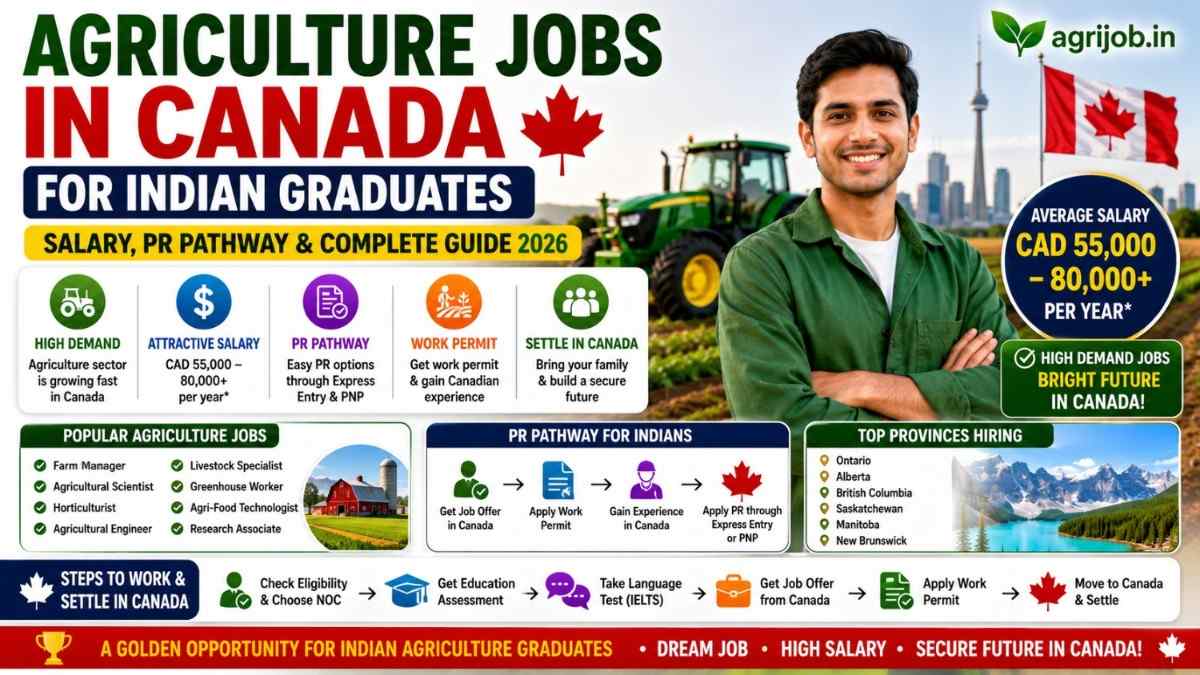
- Why Canada Agriculture Jobs Are Best for Indian Graduates 2026
- Top Agriculture Jobs in Canada – Roles, NOC Codes & Salary 2026
- Agriculture Jobs Canada Salary Table – Entry to Senior Level
- Eligibility Criteria for Indian Graduates Applying to Canada
- Canada PR Pathways for Agriculture Workers from India 2026
- Visa Sponsorship for Agriculture Jobs in Canada 2026
- Who Should Apply for Agriculture Jobs in Canada?
- Agriculture Jobs in Canada vs Australia – Which is Better?
- How to Apply for Agriculture Jobs in Canada – Step-by-Step
- High-Value Canada Agriculture Career Terms You Must Know
- Frequently Asked Questions (FAQ)
Why Canada Agriculture Jobs Are Best for Indian Graduates 2026
Canada’s agricultural sector generates over CAD 143 billion annually and employs approximately 2.1 million people, making it one of the largest employers of foreign skilled workers. For Indian graduates holding a BSc or MSc in Agriculture, Agronomy, Food Science, or Horticulture, Canada offers 3 distinct advantages that no other country can match in 2026:
- 🌾 Labour Shortage = Job Security: Canada has over 3,400 open agriculture jobs listed on Glassdoor alone as of early 2026, with demand growing 6–8% annually across all provinces.
- 💰 High Salaries in CAD: Even entry-level agriculture roles pay CAD 16–24/hour, translating to Rs.10 lakh–Rs.18 lakh per year just at hourly worker level — far above India’s average agriculture salary.
- 🛂 Clear PR Pathway: Agriculture is one of the few sectors with a dedicated federal pilot program (Agri-Food Pilot) plus PNP support across 5 provinces, making PR achievable within 2–3 years of arrival.
- 🏥 Benefits Package: Most sponsored roles include free or subsidised housing, health insurance, transportation allowance, and overtime pay under Canadian labour law.
- 🎓 PGWP Eligible: Indian graduates who complete an 8-month+ agriculture programme at a Canadian Designated Learning Institution (DLI) receive a Post-Graduation Work Permit (PGWP) valid for up to 3 years.
Top Agriculture Jobs in Canada – Roles, NOC Codes & Salary 2026
Canada’s National Occupational Classification (NOC) system categorises agriculture jobs into TEER levels 2 through 5. Indian graduates with a university degree typically qualify for TEER 2–3 roles, which are eligible for Express Entry and most PNP streams. Here are the top 8 agriculture jobs in Canada most accessible to Indian graduates in 2026:

| Job Role | NOC Code | TEER Level | Avg. Annual Salary (CAD) | Approx. in Rs. |
|---|---|---|---|---|
| Agronomist / Crop Specialist | 2123 | 2 | CAD 62,000–1,08,000 | Rs.38–67 lakh |
| Farm Manager | 8251 | 2 | CAD 60,000–90,000 | Rs.37–56 lakh |
| Agricultural Equipment Technician | 7312 | 2 | CAD 55,000–96,000 | Rs.34–59 lakh |
| Food Scientist / Technologist | 2212 | 2 | CAD 55,000–95,000 | Rs.34–59 lakh |
| Agricultural Inspector | 2222 | 2 | CAD 50,000–80,000 | Rs.31–50 lakh |
| Greenhouse / Nursery Manager | 8252 | 2 | CAD 48,000–75,000 | Rs.30–46 lakh |
| General Farm Worker (Skilled) | 8431 | 4 | CAD 33,000–50,000 | Rs.20–31 lakh |
| Seasonal Agricultural Worker (SAWP) | 8431 | 4 | CAD 16–24/hour | Rs.980–1,470/hour |
Exchange rate used: 1 CAD = Rs.61.5 (May 2026). Actual salary may vary by province, employer, and experience level.
Agriculture Jobs Canada Salary Table – Entry to Senior Level
Understanding the full salary structure is critical before you decide to apply. The table below breaks down agriculture jobs in Canada salary by experience level, province, and annual earning potential for Indian graduates in 2026:
| Experience Level | Role Example | Salary Range (CAD/year) | Annual in Rs. | Housing Provided? |
|---|---|---|---|---|
| Entry Level (0–2 years) | Farm Worker / Lab Assistant | CAD 33,000–45,000 | Rs.20–27.7 lakh | Often Yes (SAWP) |
| Mid Level (2–5 years) | Agronomist / Food Technologist | CAD 55,000–75,000 | Rs.33.8–46 lakh | Employer Dependent |
| Senior Level (5–8 years) | Senior Agronomist / Farm Manager | CAD 80,000–1,00,000 | Rs.49–61.5 lakh | No (market rental) |
| Expert Level (8+ years) | Agricultural Consultant / Director | CAD 1,00,000–1,10,000+ | Rs.61.5–67.6 lakh+ | No |
Province-wise Salary Highlights for Agriculture Jobs in Canada 2026:
- 🌿 Ontario: CAD 60,000–90,000/year — highest demand for agri-tech, food processing, greenhouse roles.
- 🌾 Saskatchewan: CAD 55,000–85,000/year — grain, canola, livestock; low competition.
- 🐄 Alberta: CAD 55,000–90,000/year — beef cattle, dairy, horticulture.
- 🍇 British Columbia: CAD 60,000–90,000/year — fruit, vegetable, viticulture agronomy.
- 🌱 Manitoba: CAD 50,000–80,000/year — seed genetics, grain processing.
Eligibility Criteria for Indian Graduates Applying to Canada Agriculture Jobs 2026
Before applying for agriculture jobs in Canada, Indian candidates must meet the following eligibility requirements. These apply across most immigration pathways including Express Entry, TFWP, and PNP streams:
| Criteria | Requirement |
|---|---|
| Educational Qualification | BSc/MSc Agriculture, Agronomy, Food Science, Horticulture, Soil Science, or related from a UGC-recognised university |
| Age Limit | 18 years minimum; Express Entry favours candidates aged 20–35 for maximum CRS points |
| Language Proficiency | IELTS Academic/General: CLB 5 (band 5.0) for TFWP; CLB 7 (band 6.0–6.5) for Express Entry and PNP |
| Work Experience | 1+ year in eligible agriculture NOC code required for most PR pathways; fresh graduates eligible for PGWP route |
| ECA (Educational Credential Assessment) | WES or ICAS assessment of Indian degree required for Express Entry |
| Settlement Funds | CAD 13,757 for a single applicant (2026 figure) — proof of funds required |
| Medical Exam | IRCC-approved physician medical examination required for all immigration pathways |
| Police Clearance | Certificate of Good Conduct from local police station; apostille may be required |
Age Relaxation Note: Unlike Indian government job age relaxation for SC/ST/OBC/EWS/PwBD categories, Canadian immigration does not use reservation-based age relaxation. However, CRS points for age are highest between ages 20–29 (110 points), dropping gradually after 30. Indian candidates aged 20–35 are in the optimum zone for Express Entry draws in 2026.
Canada PR Pathways for Agriculture Workers from India 2026
Canada offers 4 clear PR pathways specifically suited for Indian agriculture graduates in 2026. Unlike banking or IT sectors where only Express Entry is viable, the agriculture sector has dedicated federal and provincial routes that make permanent residency achievable for candidates at all skill levels:
1. Federal Agri-Food Pilot Program (Best for Meat Processing & Greenhouse Workers)
- 🌿 Targets roles in meat processing, mushroom production, greenhouse vegetable/flower production, and livestock operations.
- 📋 Requires 1 year of full-time, non-seasonal Canadian work experience in an eligible NOC code.
- 🗣️ Minimum CLB 4 language proficiency (lower bar than Express Entry).
- 🎓 No mandatory Canadian education requirement — Indian degrees accepted after ECA.
- ✅ Considered the fastest direct route to PR for workers already in Canada on TFWP or SAWP.
2. Express Entry – Canadian Experience Class (CEC)
- 🌾 Best for Indian graduates who come to Canada on PGWP and gain 1 year of skilled agriculture work experience (TEER 0–3).
- 📊 CRS score of 450–500+ typically required; agriculture category-based draws may have lower cut-offs.
- ⏱️ Processing time: 6–12 months after ITA (Invitation to Apply).
- 🏆 Agronomists (NOC 2123) are particularly competitive due to high TEER 2 classification.
3. Provincial Nominee Programs (PNP) – Agriculture Streams
- 🗺️ Saskatchewan SINP: International Graduate stream — no job offer required for agriculture graduates from Canadian universities.
- 🌻 Ontario OINP: Employer Job Offer – In-Demand Skills Stream covers food processing and farm-related roles.
- 🐂 Alberta AAIP: Rural Renewal stream targets experienced agri-workers for rural Alberta communities.
- 🍎 BC PNP: Skilled Worker and International Graduate streams accept agriculture TEER 2–3 roles.
- 🌊 Atlantic Immigration Program: Lower competition, faster timelines for all agri-food roles in Nova Scotia, New Brunswick, PEI, and Newfoundland.
4. New IRCC Sector-Specific Agriculture Stream 2026
Canada’s immigration authority (IRCC), in partnership with Employment and Social Development Canada (ESDC), has announced a new sector-specific work permit and PR stream targeting agriculture and fish processing workers. This stream — set for rollout in 2026 — will make it significantly easier for temporary foreign workers, including those from India, to transition to permanent residency without relying solely on older pathways. It will include direct employer-country partnerships, streamlining recruitment from India through official channels. Monitor IRCC’s official announcements page for the exact launch date and eligibility criteria.
Visa Sponsorship for Agriculture Jobs in Canada 2026
Visa sponsorship is available for Indian graduates applying for agriculture jobs in Canada through 3 government-regulated channels. Employers must obtain a Labour Market Impact Assessment (LMIA) before sponsoring a foreign worker, which proves that no Canadian citizen or PR holder was available for the role:
- 🏗️ TFWP (Temporary Foreign Worker Program): The primary visa sponsorship route for skilled agriculture roles — agronomists, farm managers, food technologists. Contracts typically run 1–2 years with renewal options. Employers include Nutrien Ag Solutions, Richardson Pioneer, Corteva Agriscience, BASF Canada, and provincial farm operators.
- 🌱 SAWP (Seasonal Agricultural Worker Program): Government-to-government agreement for seasonal farm work — fruit picking, greenhouse work, crop harvesting. Contracts run 6 weeks to 8 months. Free housing, transportation, and health insurance are mandatory employer obligations under Canadian labour law. Note: SAWP currently covers Mexico and 11 Caribbean countries by bilateral agreement; Indian citizens apply under the TFWP route instead.
- 🎓 PGWP Route: Indian students who complete a programme of 8 months or more at a Canadian DLI can apply for a Post-Graduation Work Permit within 180 days of graduation — valid for up to 3 years. Agriculture and food science degrees are IRCC-approved fields for PGWP under the 2026 updated guidelines.
The fastest path to Canada agriculture PR in 2026 is: Study at a Canadian DLI → Get PGWP → Work 1 year in TEER 2–3 agri-role → Apply under CEC or PNP → Get PR in 6–12 months. Total timeline: approximately 3.5–4 years from India. Alternatively, apply directly under TFWP with an LMIA-approved employer offer and transition to PR after 1 year via the Agri-Food Pilot or provincial PNP stream. Always verify your chosen NOC code eligibility on IRCC Canada official website before applying.
Who Should Apply for Agriculture Jobs in Canada 2026?
Agriculture jobs in Canada in 2026 are not limited to farm labourers. The sector has evolved into a high-tech, well-paying industry that suits a wide range of Indian graduate profiles. Here are the 8 candidate types who should seriously consider this pathway:
- 🌾 BSc/MSc Agriculture Graduates (Fresh & Experienced): Core eligibility for agronomist, crop specialist, and agricultural consultant roles under NOC 2123. TEER 2 classification makes them Express Entry-eligible.
- 🔬 Food Science & Food Technology Graduates: High demand in Ontario and Alberta’s food processing industry. Food scientists (NOC 2212) earn CAD 55,000–95,000/year with direct PR access via Agri-Food Pilot.
- 🌿 Horticulture & Floriculture Graduates: British Columbia’s fruit, vegetable, and viticulture sector actively recruits horticulture specialists — especially for greenhouse management roles paying CAD 48,000–75,000/year.
- 🐄 Animal Husbandry / Veterinary Graduates: Dairy, beef, and poultry operations in Alberta and Saskatchewan need livestock supervisors and animal health technicians under TEER 2–3 codes.
- 💻 Agri-Tech & Precision Agriculture Specialists: Graduates with GIS, drone operation, data analytics, or soil mapping skills are in extreme demand at Canada’s agri-tech startups in Ontario, offering CAD 70,000–1,00,000/year.
- 👩 Women Agriculture Graduates: Canada actively supports gender diversity in its agri-workforce. Women applying under Atlantic Immigration Program or rural PNP streams report faster processing and strong community support networks.
- 📚 ICAR/SAU Graduates Targeting Global Careers: Indian graduates from IARI, TNAU, PAU, ANGRAU, and other SAUs have internationally competitive credentials that WES and ICAS evaluate favourably for Canadian immigration.
- 🌐 Agriculture Graduates Currently Working in Gulf/Middle East: Those already working abroad with 1+ years of agriculture experience can directly apply under Express Entry’s Federal Skilled Worker Program (FSW) without needing prior Canadian experience.
Agriculture Jobs in Canada vs Australia for Indian Graduates – Which is Better?
| Factor | Canada Agriculture Jobs | Australia Agriculture Jobs |
|---|---|---|
| Average Annual Salary | CAD 65,000–1,10,000 (Rs.40–67 lakh) | AUD 55,000–95,000 (Rs.28–49 lakh) |
| PR Pathway Speed | 2–3 years via Agri-Food Pilot or PNP | 3–5 years via Skilled Migration 189/491 |
| Visa Sponsorship Availability | High — LMIA-based TFWP widely available | Medium — 482 TSS visa requires sponsor |
| IELTS Requirement (min.) | CLB 5 (band 5.0) for TFWP; CLB 7 for EE | Band 6.0 for all pathways |
| Indian Graduate Recognition | ECA (WES) — widely accepted | Skills Assessment via VETASSESS or AQF |
| Housing Support | Free housing common under SAWP/TFWP | Less common; often market rate |
| Job Diversity (Agriculture) | Very High — agri-tech, food science, livestock, grain | High — livestock, horticulture, viticulture |
| Best For | Graduates seeking PR + high salary in 2–3 years | Graduates open to longer PR timeline |
For Indian agriculture graduates prioritising salary, PR speed, and long-term settlement, Canada is the clear winner in 2026. The combination of a dedicated Agri-Food Pilot Program, higher CAD salaries, employer-sponsored housing, and new IRCC sector-specific streams makes Canada the most accessible and financially rewarding destination for Indian agri-professionals. Australia remains a strong second choice for those preferring a warmer climate or with specific livestock and viticulture specialisations.
How to Apply for Agriculture Jobs in Canada from India – Step-by-Step 2026
Follow this 9-step process to apply for agriculture jobs in Canada from India in 2026. This process covers both the job application route (TFWP) and the study-then-work route (PGWP):
- 🎓 Get Your Educational Credential Assessment (ECA): Apply to WES Canada or ICAS to evaluate your Indian BSc/MSc Agriculture degree. Processing takes 7–60 days. Cost: CAD 220–400. This is mandatory for Express Entry and most PNP streams.
- 📋 Complete Your IELTS / CELPIP Exam: Aim for an overall band of 6.0–6.5 (CLB 7) for skilled worker pathways. Register at IELTS official website. French-speaking candidates can use TEF Canada instead.
- 🔍 Identify Your Target NOC Code: Match your agriculture specialisation to the correct NOC code (e.g., NOC 2123 for agronomists, NOC 8251 for farm managers). Verify your TEER level on IRCC Canada.
- 📄 Create Your Express Entry Profile (or find an LMIA employer): Register your profile on the IRCC online portal. Include your ECA, IELTS scores, work experience, and education details to calculate your CRS score. Alternatively, search for LMIA-approved employers on the ESDC Canada job bank.
- 🌾 Apply to Canadian Agriculture Employers Directly: Target companies including Nutrien Ag Solutions, Richardson Pioneer, Agriculture and Agri-Food Canada (AAFC), Yara Canada, Corteva Agriscience, Bayer CropScience, and large Ontario/BC farm operators. Use LinkedIn, Indeed Canada, and Canada’s official Job Bank portal for listings.
- 📬 Receive LMIA-Approved Job Offer: Employer applies for a positive LMIA from ESDC. Once approved, you receive an official job offer letter — this adds 50–200 CRS points to your Express Entry profile.
- ✈️ Apply for Work Permit / PGWP: Submit your temporary work permit application online through the IRCC portal. Include job offer letter, LMIA copy, ECA, IELTS scores, passport, medical exam results, and police clearance certificate. Processing time: 2–8 weeks.
- 🏠 Arrive in Canada & Start Working: Most LMIA-approved agricultural employers provide airport pickup, housing orientation, and onboarding support. Ensure your SIN (Social Insurance Number) is obtained within your first week.
- 🛂 Apply for PR After 1 Year: After completing 1 year of full-time work in an eligible agriculture NOC code, submit your PR application through the Agri-Food Pilot, CEC, or PNP stream. Engage a Registered Canadian Immigration Consultant (RCIC) for best results.
High-Value Canada Agriculture Career Terms You Must Know
These are the most searched high-CPC keywords in the Canada agriculture immigration space. Understanding them will help you navigate the correct pathway and use the right terminology in your job applications and immigration documents:
- 🌾 Express Entry Canada Agriculture 2026: Canada’s points-based immigration system that manages skilled worker PR applications. Agriculture TEER 2–3 roles like agronomist (NOC 2123) are eligible under Federal Skilled Worker (FSW) and Canadian Experience Class (CEC) programs. Category-based draws specifically targeting agriculture workers can have lower CRS cut-offs.
- 📋 LMIA Canada Agriculture: Labour Market Impact Assessment — the government approval an employer must obtain before sponsoring a foreign agriculture worker. A positive LMIA adds 50 points (job offer NOC 0/A/B) to your CRS score, significantly boosting PR chances.
- 🎓 PGWP Agriculture Canada: Post-Graduation Work Permit available to Indian students who study at a Canadian DLI. Agriculture and food science are IRCC-approved fields. PGWP duration matches study programme length — up to 3 years for a 2-year programme.
- 🗺️ PNP Agriculture Stream: Provincial Nominee Program agriculture-specific streams in Saskatchewan (SINP), Ontario (OINP), Alberta (AAIP), and BC. PNP nomination adds 600 CRS points — virtually guaranteeing an ITA in the next draw.
- 🌱 Agri-Food Pilot Program Canada: Federal pilot providing a direct PR route for workers in meat processing, greenhouse production, and livestock. Targets long-term rural settlement. No mandatory Canadian education requirement.
- 💰 Agronomist Salary Canada 2026: Average CAD 62,000–1,08,000/year (Rs.38–66 lakh). One of the highest-paid agriculture roles in Canada, classified as TEER 2 under NOC 2123. High demand across all Prairie provinces.
- 🔬 Food Scientist Jobs Canada Salary: Average CAD 55,000–95,000/year. Food scientists work in food processing plants, research labs, and quality assurance departments. Eligible under Agri-Food Pilot and Ontario PNP.
- 🏗️ TFWP Agriculture Canada: Temporary Foreign Worker Program — the primary employer-sponsored pathway for Indian graduates without Canadian work experience. Requires LMIA, job offer, and valid work permit.
- 📊 CRS Score Agriculture Canada: Comprehensive Ranking System score used in Express Entry. With an LMIA job offer in a TEER 2 agriculture role + CLB 7 IELTS + a Canadian degree, Indian candidates can achieve CRS scores of 440–520+.
- 🌐 Rural and Northern Immigration Pilot (RNIP): Community-driven PR programme targeting small rural communities with agriculture labour shortages. Lower competition and community recommendation letters improve approval chances.
Frequently Asked Questions – Agriculture Jobs in Canada for Indian Graduates 2026
Can Indian graduates get agriculture jobs in Canada in 2026?
Yes, Indian graduates with a BSc or MSc in Agriculture, Agronomy, Food Science, or related fields can get agriculture jobs in Canada in 2026. Canada faces a significant agri-labour shortage and actively recruits skilled international candidates through the Temporary Foreign Worker Program (TFWP), Express Entry, and Provincial Nominee Programs (PNPs). Having a WES-evaluated degree and IELTS score of 6.0+ significantly improves your approval chances. Many employers such as Nutrien Ag Solutions, Agriculture and Agri-Food Canada (AAFC), and provincial farm operators provide LMIA-backed sponsorship for qualified Indian candidates.
What is the average agriculture job salary in Canada for Indian graduates?
The average salary for agriculture jobs in Canada ranges from CAD 45,000 to CAD 1,10,000 per year (approximately Rs.27 lakh to Rs.67 lakh/year at May 2026 exchange rates). Entry-level farm workers and seasonal labourers earn CAD 16–24/hour, while agronomists earn CAD 62,000–1,08,000/year and farm managers earn CAD 67,000–90,000/year. Most sponsored roles include free housing, health insurance, and transportation allowance, further increasing total compensation.
What is the Canada PR pathway for Indian agriculture workers in 2026?
Indian agriculture graduates can get Canada PR through 4 main pathways in 2026: (1) Federal Agri-Food Pilot Program for meat processing/greenhouse workers, (2) Express Entry – Canadian Experience Class (CEC) after 1 year of Canadian work experience in TEER 0–3 roles, (3) Provincial Nominee Program (PNP) streams in Ontario, Saskatchewan, Alberta, and BC, and (4) the new IRCC sector-specific agriculture stream being rolled out in 2026. PNP nomination adds 600 CRS points, making Express Entry PR virtually guaranteed.
What NOC codes are eligible for agriculture jobs in Canada for Indian graduates?
Key NOC codes for agriculture jobs in Canada include: NOC 2123 (Agronomists/Agricultural Specialists – TEER 2), NOC 8251 (Farm Managers – TEER 2), NOC 8431 (General Farm Workers – TEER 4), NOC 2212 (Agricultural Technologists and Technicians – TEER 2), and NOC 9461 (Process Control Operators, Food Processing – TEER 3). TEER 2 and 3 codes qualify for Express Entry and PNP. TEER 4 roles qualify under the Agri-Food Pilot and TFWP routes.
Is IELTS mandatory for agriculture jobs in Canada from India?
Yes, language proficiency is required for Canadian immigration pathways. A minimum CLB 5 (IELTS band 5.0) is required for TFWP work permits, while CLB 7 (IELTS 6.0–6.5) is needed for Express Entry and most PNP streams. Agronomist and food scientist roles often require CLB 7–8. French-speaking Indian candidates from Francophone universities can use TEF Canada scores instead of IELTS, and may qualify for additional CRS points under the French-language proficiency bonus.
Which Canadian provinces hire the most Indian agriculture graduates?
The top 5 provinces for agriculture jobs in Canada for Indian graduates are Ontario (agri-tech, food processing, greenhouses), Saskatchewan (grain, canola, livestock), Alberta (beef cattle, dairy), British Columbia (fruit, vegetables, viticulture), and Manitoba (seed genetics, grain processing). Each province has its own PNP agriculture stream. Ontario has the highest demand while Saskatchewan’s SINP International Graduate stream requires no job offer for Canadian university graduates.
What documents are needed to apply for Canada agriculture work permit from India?
Documents required for a Canada agriculture work permit from India include: valid passport (6+ months validity), LMIA-approved employer job offer letter, WES/ICAS ECA of your Indian agriculture degree, IELTS/CELPIP scorecard, police clearance certificate, IRCC-approved medical examination report, proof of settlement funds (CAD 13,757 minimum for a single applicant), and educational transcripts. If applying under PGWP, your graduation letter from a Canadian DLI replaces the ECA requirement.
What is the Canada Agri-Food Pilot Program and who is eligible from India?
The Canada Agri-Food Pilot Program is a federal immigration pathway providing a direct route to permanent residency for workers in meat processing, greenhouse/nursery production, and livestock operation roles. Indian candidates who obtain a Canadian TFWP work permit, work 1 full year (minimum 1,560 hours) in an eligible agri-food role, and meet CLB 4+ language requirements can apply for PR under this pilot. No Canadian education is required — your Indian BSc/MSc Agriculture after WES ECA is accepted. Eligible NOC codes include 8431, 8432, 9461, and 9462.
For the latest notifications on agriculture jobs in Canada, PR pathway updates, and visa sponsorship openings for Indian graduates, also explore related opportunities on Agrijob.in International Agriculture Jobs and Agriculture Jobs Abroad for Indian Graduates. This guide is regularly reviewed and updated for accuracy. Bookmark this page for the latest 2026 notifications.
Last Updated: May 2026 | Source References: IRCC Canada Official Website | ESDC Canada – Foreign Workers Programme | Canada Job Bank – Agriculture Listings