
RRB Pharmacist Syllabus 2026 is the most critical document every D.Pharm and B.Pharm aspirant must study before appearing for the Computer-Based Test (CBT) under CEN No. 05/2026. With 118 Pharmacist (Entry Grade) vacancies announced by the Railway Recruitment Board across various railway zones and a Pay Level-5 salary of Rs.29,200 per month, this is one of the most sought-after central government pharmacy jobs in India. This guide covers the complete RRB Pharmacist Syllabus 2026, section-wise exam pattern, 30+ Professional Ability subjects, previous year category-wise cut-off marks, and a proven 90-day strategy to score 75+ marks.

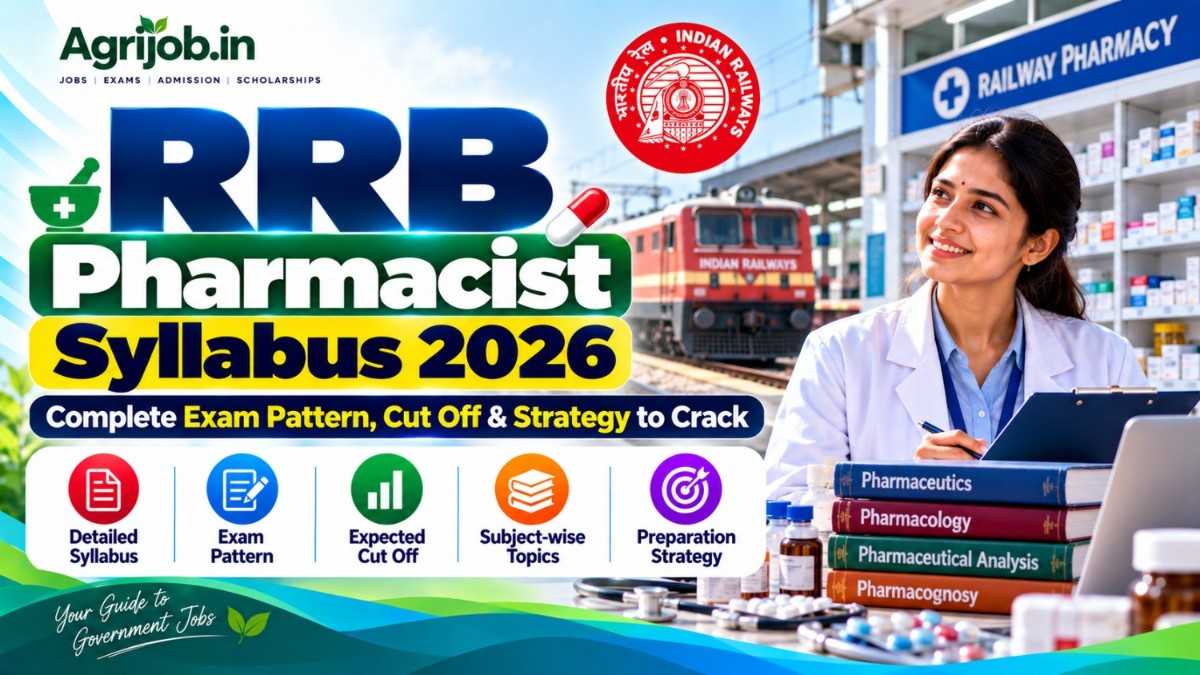
The RRB Pharmacist Syllabus 2026 (CEN 05/2026) covers 4 sections in a 100-mark CBT: Professional Ability (70 questions), General Awareness (10), General Arithmetic & Reasoning (10), and General Science (10). The exam duration is 90 minutes with 1/3 negative marking. Professional Ability carries 70% weightage and covers 30+ pharmacy subjects including Pharmacology, Pharmaceutics, Pharmaceutical Chemistry, and more.
- Notification No.: CEN 05/2026 (RRB Paramedical Categories)
- Post Name: Pharmacist (Entry Grade)
- Total Vacancies: 118 (out of 590 paramedical posts)
- Pay Scale: Level 5 — Rs.29,200 initial basic pay (7th CPC)
- Application Window: 15 September to 14 October 2026
- Selection Process: CBT → Document Verification → Medical Examination
- CBT Format: 100 Questions | 100 Marks | 90 Minutes | 1/3 Negative Marking
- Professional Ability Weightage: 70 questions (70 marks)
- Medical Standard: C2
- Official Website: rrb.indianrailways.gov.in
📋 Table of Contents
- What is RRB Pharmacist Exam 2026?
- Who Should Apply for RRB Pharmacist 2026?
- RRB Pharmacist Exam Pattern 2026
- Professional Ability Syllabus – 30+ Pharmacy Subjects
- General Awareness, Science & Reasoning Syllabus
- RRB Pharmacist Salary 2026
- Eligibility Criteria & Application Fees
- Previous Year Cut-Off Marks Category-Wise
- RRB Pharmacist vs UPSSSC Pharmacist – Which is Better?
- Pros & Cons of RRB Pharmacist Job
- 90-Day Strategy to Crack RRB Pharmacist 2026
- Key Pharmacy Terms for Professional Ability
- Important Links
- Conclusion
- Key Takeaways
- Frequently Asked Questions
What is RRB Pharmacist Exam 2026?
The RRB Pharmacist Exam 2026 is a Computer-Based Test conducted by the Railway Recruitment Board to fill 118 Pharmacist (Entry Grade) vacancies across Indian Railway zones under Centralised Employment Notice (CEN) No. 05/2026. It is one of India’s most competitive pharmacy government exams, attracting lakhs of D.Pharm and B.Pharm graduates annually.
Pharmacists selected through this exam work in Railway Hospitals and Health Units, dispensing medicines to railway employees and their families, maintaining drug inventory, ensuring proper storage of life-saving drugs, and assisting Medical Officers. The post carries permanent central government service status with pension benefits, HRA, DA, and all 7th CPC allowances.

The exam is a single-stage CBT — there is no Tier-2 or interview. Your CBT score directly determines your merit ranking for Document Verification. This makes thorough preparation of the RRB Pharmacist Syllabus 2026 the only path to selection.
| Parameter | Details |
|---|---|
| Exam Conducting Body | Railway Recruitment Board (RRB) |
| CEN Number | CEN No. 05/2026 |
| Mode of Exam | Computer-Based Test (CBT) – Online |
| Type of Questions | Multiple Choice Questions (MCQs) |
| Total Questions | 100 |
| Total Marks | 100 |
| Exam Duration | 90 minutes (120 minutes for PwBD with scribe) |
| Negative Marking | 1/3 mark per wrong answer |
| Language | English, Hindi, and regional languages |
| Stages After CBT | Document Verification + Medical Examination |
Who Should Apply for RRB Pharmacist 2026?
- 🎓 D.Pharm holders registered with the State Pharmacy Council under the Pharmacy Act, 1948
- 🎓 B.Pharm graduates looking for a stable central government job with full pension and benefits
- 🏥 Pharm.D candidates who want to work in a clinical hospital pharmacy environment in Indian Railways
- 🧑💼 Pharmacy students in final year who will complete their degree and registration before the document verification date
- 👩⚕️ Working pharmacists in private hospitals seeking the job security and salary scale of a central government post
- 📍 Candidates from rural or semi-urban areas across India who qualify age and educational criteria
- 🔄 Pharmacy Council of India (PCI) registered candidates who have not yet secured a government job
- ♿ PwBD candidates — 40 of the 590 total paramedical vacancies are reserved for persons with benchmark disabilities
RRB Pharmacist Exam Pattern 2026 – Section-Wise Breakdown
The RRB Pharmacist Exam Pattern 2026 is a single-stage CBT with 100 questions and 100 marks in 90 minutes. Professional Ability carries 70% of the total marks — making pharmacy knowledge the single most important factor in your selection. The remaining 30 marks are divided equally among three general sections of 10 marks each.
| Section | Number of Questions | Total Marks | Weightage |
|---|---|---|---|
| Professional Ability (Pharmacy) | 70 | 70 | 70% |
| General Awareness | 10 | 10 | 10% |
| General Arithmetic, Intelligence & Reasoning | 10 | 10 | 10% |
| General Science | 10 | 10 | 10% |
| Total | 100 | 100 | 100% |
Negative Marking Rule: For every wrong answer, 1/3 mark (0.33 marks) is deducted. No marks are deducted for unanswered questions. This means attempting 80–85 questions confidently is better than attempting all 100 with guesses.
RRB Pharmacist Professional Ability Syllabus 2026 – All 30+ Subjects
The Professional Ability section is the heart of the RRB Pharmacist Syllabus 2026. It covers all major subjects from D.Pharm and B.Pharm curricula as prescribed in Annexure C of CEN 05/2026. Pharmacology has the highest question frequency (~20 questions), followed by Pharmaceutics and Pharmaceutical Chemistry. Below is the complete subject-wise breakdown:
| Subject | Expected Questions | Priority Level |
|---|---|---|
| Human Anatomy and Physiology | 3–4 | High |
| Pharmaceutical Analysis | 2–3 | Medium |
| Pharmaceutics | 5–6 | Very High |
| Pharmaceutical Inorganic Chemistry | 2–3 | Medium |
| Remedial Biology / Remedial Mathematics | 2–3 | Medium |
| Pharmaceutical Organic Chemistry | 3–4 | High |
| Biochemistry | 2–3 | Medium |
| Pathophysiology | 2–3 | Medium |
| Computer Applications in Pharmacy | 1–2 | Low |
| Environmental Sciences | 1–2 | Low |
| Physical Pharmaceutics | 2–3 | Medium |
| Pharmaceutical Microbiology | 2–3 | Medium |
| Pharmaceutical Engineering | 2–3 | Medium |
| Medicinal Chemistry | 3–4 | High |
| Pharmacology | 8–10 | Very High |
| Pharmacognosy and Phytochemistry | 3–4 | High |
| Industrial Pharmacy | 3–4 | High |
| Pharmaceutical Jurisprudence | 2–3 | Medium |
| Herbal Drug Technology | 2–3 | Medium |
| Biopharmaceutics and Pharmacokinetics | 2–3 | Medium |
| Pharmaceutical Biotechnology | 1–2 | Low |
| Quality Assurance | 2–3 | Medium |
| Instrumental Methods of Analysis | 2–3 | Medium |
| Pharmacy Practice | 2–3 | Medium |
| Novel Drug Delivery System | 1–2 | Low |
| Biostatistics and Research Methodology | 1–2 | Low |
| Social and Preventive Pharmacy | 1–2 | Low |
| Pharma Marketing Management | 1–2 | Low |
| Pharmaceutical Regulatory Science | 1–2 | Low |
| Pharmacovigilance | 1–2 | Low |
| Quality Control and Standardization of Herbals | 1–2 | Low |
| Computer Aided Drug Design | 1 | Low |
| Cell and Molecular Biology | 1 | Low |
| Cosmetic Science | 1 | Low |
| Experimental Pharmacology | 1 | Low |
| Advanced Instrumentation Techniques | 1 | Low |
| Dietary Supplements and Nutraceuticals | 1 | Low |
Pharmacology (8–10 Qs), Pharmaceutics (5–6 Qs), Medicinal Chemistry (3–4 Qs), Pharmacognosy (3–4 Qs), and Industrial Pharmacy (3–4 Qs) together account for approximately 25–30 of the 70 Professional Ability marks. Master these five before touching the remaining 30+ subjects. Use D.Pharm GPAT/RRB PYQs to practice topic-wise MCQs for each.
General Awareness, Science & Reasoning Syllabus (30 Marks)
The three common sections of the RRB Pharmacist CBT — General Awareness, General Science, and General Arithmetic & Reasoning — together carry 30 marks. While pharmacy dominates the paper, scoring full marks in these sections can be the difference between selection and rejection, especially in high-competition zones like Kolkata, Chandigarh, and Patna.
| Section | Key Topics |
|---|---|
| General Science (10 Qs) | Physics, Chemistry and Life Sciences up to Class 10 CBSE level — Motion, Force, Light, Heat, Chemical Reactions, Cell Biology, Human Body Systems |
| General Awareness (10 Qs) | Current Affairs, Indian History and Freedom Struggle, Indian Geography, Indian Constitution and Polity, Indian Economy, Sports, Environmental Issues, Science and Technology News |
| General Arithmetic (5 Qs approx.) | Number Systems, Simplification, Ratio and Proportion, Percentage, Average, Time and Work, Profit and Loss, Simple and Compound Interest |
| General Intelligence & Reasoning (5 Qs approx.) | Analogy, Classification, Series Completion, Coding-Decoding, Blood Relations, Direction Sense, Logical Venn Diagrams, Statement and Conclusion |
RRB Pharmacist Salary 2026 – Complete Pay Structure
The RRB Pharmacist (Entry Grade) salary under CEN 05/2026 is governed by the 7th Pay Commission. The initial basic pay is Rs.29,200 per month at Pay Level 5. After adding HRA, DA, Transport Allowance, and other components, the gross monthly CTC ranges from Rs.38,000 to Rs.52,000 depending on the posting city and applicable DA rate.
| Pay Component | Amount (Approximate) |
|---|---|
| Basic Pay (Level 5) | Rs.29,200/month |
| Dearness Allowance (DA ~50% as of 2026) | Rs.14,600/month |
| House Rent Allowance (HRA – varies by city: X/Y/Z) | Rs.2,628 – Rs.7,008/month |
| Transport Allowance (TPTA) | Rs.1,350 – Rs.3,600/month |
| Other Allowances (Medical, Children Education, etc.) | Rs.500 – Rs.2,000/month |
| Gross Monthly Salary (Approximate) | Rs.38,000 – Rs.52,000/month |
| Annual CTC (including all allowances) | Rs.4.5 – Rs.6.2 lakh/year |
| Pay Scale Progression (Next Level – Level 6) | Rs.35,400 (after annual increments + promotion) |
In addition to the monthly salary, RRB Pharmacists receive railway passes for free travel, subsidized railway canteen food, and access to Railway Medical Services for self and family — benefits that significantly enhance the effective compensation package beyond the stated figures.
Eligibility Criteria, Age Limit & Application Fees 2026
Candidates must meet all eligibility conditions at the time of document verification. The key requirements for the Pharmacist (Entry Grade) post under CEN 05/2026 are:
- Educational Qualification: B.Pharm (Bachelor of Pharmacy) or D.Pharm (Diploma in Pharmacy) from a recognized institution — both are eligible as per CEN 05/2026
- Registration: Valid registration as a Pharmacist under the Pharmacy Act, 1948 with the Pharmacy Council of India (PCI) or any State Pharmacy Council — mandatory
- Nationality: Indian Citizen, or a subject of Nepal / Bhutan, or a Tibetan refugee who came before 1 January 1962, or a person of Indian origin from specified countries
- Age Limit (General): 18–33 years (as specified in CEN 05/2026 — verify from official notification for your category)
| Category | Age Relaxation | Minimum Qualifying Marks (CBT) |
|---|---|---|
| Unreserved (UR) | No relaxation | 40% (40/100) |
| Economically Weaker Section (EWS) | No relaxation | 40% (40/100) |
| OBC (Non-Creamy Layer) | 3 years | 30% (30/100) |
| Scheduled Caste (SC) | 5 years | 30% (30/100) |
| Scheduled Tribe (ST) | 5 years | 25% (25/100) |
| Ex-Servicemen | As per rules | As per own community % |
| PwBD Candidates | 10 years | As per own community % (relaxed by 2 marks if shortage) |
| Category | Application Fee |
|---|---|
| UR / EWS / OBC | Rs.500 (Rs.400 refunded after CBT attendance) |
| SC / ST / Ex-Servicemen / PwBD / Female / Transgender / Minorities / Economically Backward | Rs.250 (Rs.250 refunded after CBT attendance) |
RRB Pharmacist Previous Year Cut-Off Marks – Category and Zone-Wise
The RRB Pharmacist cut-off marks vary significantly by railway zone (board), category, and the number of vacancies notified for that zone. Scores from CEN 03/2025 (CBT held March 2026) and the historical CEN 02/2019 benchmark are the most reliable data points for predicting the CEN 05/2026 cut-off. The actual CEN 05/2026 cut-off will be released only after the CBT, which is yet to be scheduled.
RRB Pharmacist Cut-Off – CEN 03/2025 (2026 Result Cycle) Zone-Wise
| RRB Zone | UR | OBC | SC | ST | EWS |
|---|---|---|---|---|---|
| Secunderabad | 60.88 | 60.20 | 53.74 | — | 52.38 |
| Ajmer | 60.54 | 60.20 | 52.04 | 49.66 | 57.82 |
| Chennai | 59.18 | 58.50 | 53.06 | 49.66 | 50.34 |
| Patna | 58.16 | — | 40.48 | 28.91 | — |
| Ahmedabad | 56.38 | 55.67 | 52.13 | 40.07 | 53.55 |
| Bhopal | 54.61 | 53.55 | — | — | 41.13 |
RRB Pharmacist Cut-Off – CEN 02/2019 (Historical Benchmark)
| RRB Zone | UR | OBC | SC | ST | EWS |
|---|---|---|---|---|---|
| Allahabad | 67.41 | 63.88 | 58.12 | 48.02 | 53.06 |
| Ahmedabad | 58.87 | 57.80 | 53.19 | 41.49 | 53.90 |
Key Insight: The UR cut-off for RRB Pharmacist consistently falls between 55–65 marks in most zones. If you score 70+ in the CBT, you are almost guaranteed selection in most railway zones. Target 75+ for a safe buffer against high-competition zones like Secunderabad, Ajmer, and Chennai.
Expected Cut-Off for RRB Pharmacist CEN 05/2026
| Category | Expected Cut-Off Range (CEN 05/2026) |
|---|---|
| Unreserved (UR) | 60–70 marks |
| EWS | 55–65 marks |
| OBC (NCL) | 55–65 marks |
| SC | 48–58 marks |
| ST | 35–50 marks |
RRB Pharmacist vs UPSSSC Pharmacist – Which Government Pharmacy Job is Better?
| Comparison Parameter | RRB Pharmacist 2026 | UPSSSC Pharmacist |
|---|---|---|
| Appointing Body | Railway Recruitment Board (Central) | UPSSSC (State – Uttar Pradesh) |
| Pay Level | Level 5 – Rs.29,200 basic | Level 5 – Rs.29,200 basic (state scale) |
| Gross Monthly Salary | Rs.38,000 – Rs.52,000 | Rs.32,000 – Rs.45,000 |
| Job Location | Pan-India Railway Zones | Uttar Pradesh only |
| Exam Difficulty | Moderate – Professional Ability focused | Moderate – State syllabus based |
| Transfer Policy | Pan-India railway transfers | State-level transfers only |
| Railway Pass Benefit | Yes – free pan-India travel | No |
| Job Security | Central Government permanent job | State Government permanent job |
| Medical Facilities | Full railway medical coverage | State health schemes |
| Best For | Candidates seeking central govt job with perks | Candidates wanting to stay in UP |
RRB Pharmacist is superior for candidates who want a central government pharmacy job with pan-India placement, free railway travel passes, and 7th CPC pay without state-specific restrictions. UPSSSC Pharmacist is better only if you specifically need to remain in Uttar Pradesh. For career growth, salary, and prestige, RRB Pharmacist wins hands down.
Advantages & Disadvantages of RRB Pharmacist Job
Pros
- ✅ Permanent central government job with full pension under NPS and strong job security
- ✅ Free railway passes for yourself and family for travel across India on all express/mail trains
- ✅ Railway Medical Care — free treatment for self and dependents at Railway Hospitals
- ✅ Work-life balance — defined working hours, holidays as per Railway calendar, no night-shift mandate
- ✅ Children’s Education Allowance — Rs.2,250/child/month up to 2 children
- ✅ Career advancement — promotion to Pharmacist Grade II and above through LDCE/departmental exams
Cons
- ❌ Pan-India posting — candidates may be posted to remote railway zones far from home state
- ❌ Highly competitive exam — lakhs of D.Pharm/B.Pharm candidates compete for 118 posts; UR cut-off reaches 60–70
- ❌ Slow promotion pace — departmental promotions in Railways are time-bound and seniority-based, not merit-based
90-Day Strategy to Crack RRB Pharmacist 2026 – Step by Step
A structured 90-day preparation strategy is the most effective approach to crack the RRB Pharmacist exam, given that 70 out of 100 marks come from Professional Ability alone. Here is a proven, detailed plan designed by pharmacy exam experts:
- Week 1–2 — Syllabus Mapping & Resource Collection: Download the official CEN 05/2026 notification PDF from rrbapply.gov.in. Print the Annexure C syllabus. Collect D.Pharm and B.Pharm standard textbooks for the top 5 high-weightage subjects: Pharmacology (Rang & Dale or Tripathi), Pharmaceutics (Banker & Anderson, RM Mehta), Medicinal Chemistry (Foye’s), Pharmacognosy (Trease & Evans), and Industrial Pharmacy (Lachman).
- Days 1–30 — Phase 1: Core Pharmacy Foundation: Study the top 5 highest-weightage subjects: Pharmacology, Pharmaceutics, Medicinal Chemistry, Pharmacognosy, and Industrial Pharmacy. Solve 100–150 MCQs daily from PYQs of RRB, GPAT, and State Pharmacy Council exams. Maintain a dedicated wrong-answer notebook for revision.
- Days 31–60 — Phase 2: Remaining Professional Ability Subjects: Cover Human Anatomy & Physiology, Pharmaceutical Chemistry (Organic and Inorganic), Biochemistry, Pharmaceutical Microbiology, Biopharmaceutics, Pharmaceutical Engineering, and other medium-priority subjects. Increase MCQ target to 150–200 per day. Take one full-length mock test every Sunday.
- Days 61–75 — Phase 3: General Sections & Weak Area Revision: Complete General Awareness (read The Hindu or Jagran Josh daily), General Science (Class 10 NCERT chapters), and Arithmetic & Reasoning. Start revising all pharmacy subjects topic-by-topic. Solve 5 full-length mock tests in this phase.
- Days 76–80 — Phase 4: First Full Revision: Go through all 30+ subjects once using short notes, flow charts, and mnemonics. Focus on drug classifications, mechanisms of action, dosage forms, and pharmacokinetic parameters — these are the most tested areas in RRB Pharmacist CBT.
- Days 81–85 — Phase 5: Previous Year Papers & Mock Tests: Attempt 8–10 full mock tests simulating actual exam conditions (90-minute timer, OMR-style). Analyze each mock test immediately. Target score: 75+ per mock before the exam.
- Days 86–90 — Phase 6: Final Revision & Exam-Day Strategy: Revise only your notes — no new topics. Memorize high-probability facts: Drug of choice for diseases, Schedule classification of drugs, Official tests in Pharmacopoeia, Mechanism of action of key drugs, Important acts under Pharmaceutical Jurisprudence. On exam day: attempt Professional Ability first (most marks), then General Science, then Awareness, then Arithmetic-Reasoning.
Key Pharmacy Terms for Professional Ability Section
Mastering these high-frequency pharmacy terms will boost your Professional Ability score significantly. Each term below appears repeatedly in RRB and other competitive pharmacy exams:
- Bioavailability: The fraction of an administered drug dose that reaches systemic circulation unchanged — a key pharmacokinetic parameter tested in every RRB Pharmacist exam; oral bioavailability of morphine is 20–30%, for example
- Half-Life (t½): Time taken for the plasma drug concentration to reduce by 50%; drugs with long half-life (e.g., amiodarone, 40–55 days) need fewer doses per day
- Therapeutic Index (TI): Ratio of LD50 to ED50; drugs with narrow TI (digoxin, lithium, warfarin, phenytoin) require therapeutic drug monitoring
- Schedule H Drugs: Prescription-only drugs as per Drugs and Cosmetics Act, 1940 and Rules, 1945 — cannot be sold without a valid prescription; includes antibiotics, steroids, and psychotropics
- Pharmacopoeia: Official compendium of drug standards — Indian Pharmacopoeia (IP), British Pharmacopoeia (BP), and United States Pharmacopeia (USP) are the three most tested authorities
- First-Pass Effect: Metabolism of an orally administered drug in the gut wall and liver before reaching systemic circulation — explains why sublingual nitroglycerin is preferred over oral for angina
- pH Partition Theory: Drugs are absorbed as unionized (lipid-soluble) forms across membranes — acidic drugs absorbed in stomach; basic drugs absorbed in intestine
- GMP (Good Manufacturing Practices): Regulatory guidelines (Schedule M, CGMP, WHO-GMP) governing pharmaceutical manufacturing to ensure safety, quality, and efficacy of drug products
- Pharmacovigilance: The science of detecting, assessing, understanding, and preventing adverse drug reactions (ADRs) — India’s PvPI (Pharmacovigilance Programme of India) is the national ADR monitoring system
- Biopharmaceutics Classification System (BCS): Classifies drugs into 4 classes based on solubility and intestinal permeability — BCS Class I drugs (high solubility, high permeability) show best absorption
Important Links – RRB Pharmacist 2026
| Link Name | URL |
|---|---|
| Official RRB Application Portal (CEN 05/2026) | rrbapply.gov.in |
| Official RRB Website | rrb.indianrailways.gov.in |
| Pharmacy Council of India (PCI) | pci.nic.in |
| Indian Pharmacopoeia Commission | ipc.gov.in |
| National Health Systems Resource Centre (NHSRC) | nhsrcindia.org |
Conclusion – RRB Pharmacist Syllabus 2026
The RRB Pharmacist Syllabus 2026 under CEN 05/2026 is extensive but highly structured — 70% of the exam (70 marks) comes from pharmacy subjects you have already studied during D.Pharm or B.Pharm, which is a massive advantage. Focus your preparation on Pharmacology, Pharmaceutics, Medicinal Chemistry, Pharmacognosy, and Industrial Pharmacy to cover the bulk of Professional Ability marks, and keep your General Awareness and Science sections sharp for the remaining 30. A target score of 70–75 marks will secure selection in most railway zones across UR, OBC, SC, ST, and EWS categories.
Apply online at rrbapply.gov.in before 14 October 2026. Bookmark this page — we update it every time the official exam date, admit card, and cut-off are announced.
- RRB Pharmacist 2026 has 118 vacancies (CEN 05/2026) with a starting salary of Rs.29,200/month at Pay Level 5
- The CBT is 100 questions in 90 minutes — 70 marks from Professional Ability (pharmacy subjects)
- Pharmacology carries the highest weightage (~8–10 questions) among all Professional Ability subjects
- Previous year UR cut-off for RRB Pharmacist ranges from 54–67 marks out of 100 across zones
- Minimum qualifying marks: 40% (UR/EWS), 30% (OBC/SC), 25% (ST) — but cut-off is always higher
- Apply online between 15 September and 14 October 2026 at rrbapply.gov.in
Frequently Asked Questions About RRB Pharmacist Syllabus 2026
What is the RRB Pharmacist Syllabus 2026?
The RRB Pharmacist Syllabus 2026 (CEN 05/2026) covers four sections: Professional Ability (70 questions covering 30+ pharmacy subjects), General Awareness (10 questions), General Arithmetic & Reasoning (10 questions), and General Science (10 questions). The full syllabus is available in Annexure C of the official CEN 05/2026 notification PDF at rrbapply.gov.in. Pharmacology, Pharmaceutics, Medicinal Chemistry, and Pharmacognosy are the highest-weightage topics.
How many questions are in the RRB Pharmacist exam?
The RRB Pharmacist CBT consists of 100 questions carrying 100 marks in total. The exam duration is 90 minutes (120 minutes for PwBD candidates eligible for a scribe). Of the 100 questions, 70 are from Professional Ability (pharmacy subjects) and 30 are from General Awareness, General Science, and General Arithmetic & Reasoning (10 each). Every wrong answer results in a deduction of 1/3 mark.
What is the RRB Pharmacist salary in 2026?
The RRB Pharmacist (Entry Grade) salary in 2026 is Rs.29,200 per month at Pay Level 5 under the 7th Pay Commission. After adding Dearness Allowance (approximately 50% of basic in 2026), HRA, Transport Allowance, and other components, the gross monthly salary ranges from Rs.38,000 to Rs.52,000 depending on the posting city. Free railway travel passes, railway medical coverage, and children’s education allowance further increase the effective value of the compensation.
What is the cut-off for RRB Pharmacist in UR category?
The RRB Pharmacist cut-off for the UR (Unreserved) category in the CEN 03/2025 cycle ranged from 54.61 (Bhopal) to 60.88 (Secunderabad) out of 100 marks. The historical CEN 02/2019 UR cut-off was higher at 58.87–67.41. For CEN 05/2026, UR candidates should target a score of 70+ to ensure selection across most railway zones, with a minimum safe score of 65 marks. Cut-offs vary by RRB zone due to zone-wise vacancy distribution.
Is D.Pharm eligible for RRB Pharmacist 2026?
Yes, D.Pharm (Diploma in Pharmacy) holders are eligible for RRB Pharmacist (Entry Grade) under CEN 05/2026, provided they are registered as a Pharmacist under the Pharmacy Act, 1948 with the Pharmacy Council of India (PCI) or any State Pharmacy Council. Both D.Pharm and B.Pharm graduates are eligible. Candidates must ensure their PCI or State Pharmacy Council registration is valid and current at the time of document verification.
How many vacancies are announced under RRB Pharmacist CEN 05/2026?
A total of 118 Pharmacist (Entry Grade) vacancies have been announced under CEN 05/2026 as part of the broader RRB Paramedical Recruitment 2026, which covers 590 vacancies across 9 paramedical categories. The 590 total vacancies include 365 Nursing Superintendent posts, 118 Pharmacist posts, 43 Health and Malaria Inspector Grade II posts, 31 Lab Assistant posts, 25 Radiographer posts, and others. The number of vacancies may be revised by the Railway Recruitment Boards.
What is the best strategy to crack RRB Pharmacist 2026?
The best strategy to crack RRB Pharmacist 2026 is to prioritize Professional Ability (70 marks) above all else — especially Pharmacology, Pharmaceutics, Medicinal Chemistry, Pharmacognosy, and Industrial Pharmacy. Start with these five high-weightage subjects in the first 30 days, complete remaining pharmacy subjects in the next 30 days, and use the final 30 days for revision, full mock tests, and general section preparation. Solving 8,000–10,000 MCQs from PYQs and taking 15–20 full mock tests before the exam is the proven pathway to a 70+ score.
What is the minimum qualifying mark for RRB Pharmacist?
The minimum qualifying marks in the RRB Pharmacist CBT as per CEN 05/2026 are 40% (40 marks) for Unreserved (UR) and EWS candidates, 30% (30 marks) for OBC-NCL and SC candidates, and 25% (25 marks) for ST candidates. PwBD candidates must meet the qualifying marks of their own community, which may be relaxed by 2 marks in case of a shortage of PwBD candidates against reserved vacancies. Meeting the minimum qualifying mark does not guarantee selection — candidates are shortlisted for Document Verification strictly on merit based on CBT scores.
Which subject has the highest weightage in RRB Pharmacist Syllabus?
Pharmacology has the highest individual subject weightage in the RRB Pharmacist Professional Ability section, accounting for approximately 8–10 questions (nearly 14% of total marks). It is followed by Pharmaceutics (5–6 questions), Medicinal Chemistry (3–4 questions), Pharmacognosy and Phytochemistry (3–4 questions), and Industrial Pharmacy (3–4 questions). Together, these five subjects cover approximately 25–30 of the 70 Professional Ability questions, making them the top priority for every RRB Pharmacist aspirant.
⚠️ Disclaimer: The cut-off marks, expected scores, and syllabus details in this article are based on official CEN 05/2026 notification and previous cycle data from rrbapply.gov.in. Candidates are advised to verify all information from the official RRB website before taking any action. This content is for informational and preparation guidance purposes only.