
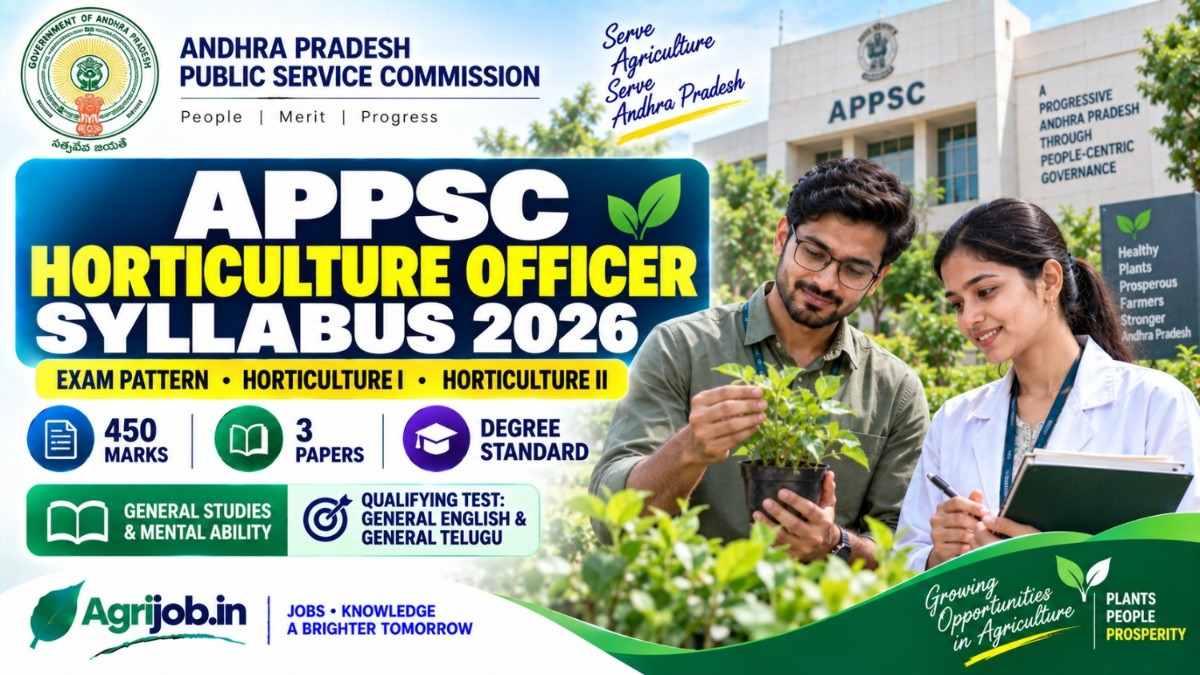
APPSC Horticulture Officer Syllabus 2026 has been officially prescribed by the Andhra Pradesh Public Service Commission (APPSC) for 37 vacancies in the A.P. Horticulture Service under Notification No. 19/2026, dated 15 September 2026. This comprehensive guide is for B.Sc. Horticulture graduates aged 18–42 years who want to crack this competitive exam and land a government job paying Rs.54,060–Rs.1,40,540 per month. This article covers the complete paper-wise syllabus, updated exam pattern, previous cut-off marks by category, and a proven strategy to score 350+ out of 450 marks.

The APPSC Horticulture Officer 2026 exam is an OMR-based objective test comprising 1 qualifying language paper (100 marks, not counted in merit) and 3 scored papers — General Studies & Mental Ability (150 marks), Horticulture-I (150 marks), and Horticulture-II (150 marks) — totalling 450 marks across 450 questions, with 1/3rd negative marking per wrong answer.
- Notification No.: 19/2026 (dated 15 September 2026)
- Total Vacancies: 37 posts in A.P. Horticulture Service
- Pay Scale: Rs.54,060 – Rs.1,40,540 per month
- Application Window: 6 October 2026 – 27 October 2026
- Exam Mode: CBRT / OMR-based, Offline
- Total Papers: 1 Qualifying + 3 Scored Papers
- Total Marks: 450 (excluding qualifying paper)
- Negative Marking: 1/3rd mark per wrong answer
- Qualification: 4-year B.Sc. / B.Sc. (Hons) in Horticulture (ICAR-recognised)
- Age Limit: 18–42 years (relaxation for SC/ST/BC/PwBD)
- Official Website: psc.ap.gov.in
📋 Table of Contents
- What Is APPSC Horticulture Officer Exam?
- Who Should Apply for This Post?
- Salary & Pay Scale Details
- Eligibility & Application Fee
- Exam Pattern 2026 – Paper-Wise Breakdown
- Qualifying Paper: General English & Telugu
- Paper I – General Studies & Mental Ability Syllabus
- Paper II – Horticulture-I Syllabus
- Paper III – Horticulture-II Syllabus
- Computer Proficiency Test (CPT)
- Previous Cut-Off Marks – Category Wise
- APPSC HO vs Other State Agriculture Officer Exams
- Strategy to Crack APPSC Horticulture Officer 2026
- Important Links
- Conclusion
- Key Takeaways
- FAQs About APPSC Horticulture Officer Syllabus 2026
What Is the APPSC Horticulture Officer Exam 2026?
The APPSC Horticulture Officer exam is a state-level competitive examination conducted by the Andhra Pradesh Public Service Commission for direct recruitment to the post of Horticulture Officer in the A.P. Horticulture Service. The 2026 cycle announced 37 vacancies under Brief Notification No. 19/2026 — a significant jump from the 2 posts notified in 2025 under Notification No. 18/2025. Selected officers serve under the Department of Horticulture, Government of Andhra Pradesh, managing field-level horticulture operations, farmer extension services, and scheme implementation.
The exam is single-stage — no screening test is conducted regardless of the number of applicants. The entire written examination is conducted in CBRT (Computer-Based Recruitment Test) / OMR mode. Performance across Paper I, Paper II, and Paper III determines the final merit list, and candidates must also clear the Computer Proficiency Test (CPT) before final appointment.

Who Should Apply for APPSC Horticulture Officer 2026?
This recruitment is specifically designed for the following candidates:
- 🎓 B.Sc. Horticulture graduates from ICAR-accredited universities who want a stable government career.
- 🌾 Agriculture students with a strong background in pomology, olericulture, and floriculture subjects.
- 📋 Candidates aged 18–42 years who meet the Andhra Pradesh domicile and educational conditions.
- 💼 SC/ST/BC/EWS/PwBD aspirants who benefit from reduced cut-off marks and age relaxation under AP government rules.
- 📚 Fresh graduates and working professionals who want to transition into a gazetted government post with Rs.54,060+ starting pay.
- 🖥️ Candidates comfortable with basic computer proficiency, since the CPT (Office Automation test) is a mandatory qualifying stage before final selection.
- 🏘️ Rural Andhra Pradesh residents who want to serve local farming communities as extension officers.
- 🔬 Candidates with post-harvest, greenhouse, or organic farming specialisation — high-weightage areas in Paper III.
APPSC Horticulture Officer Salary & Pay Scale 2026
The APPSC Horticulture Officer post carries one of the most attractive pay scales for horticulture graduates in Andhra Pradesh government service. As per Notification No. 19/2026, the revised pay structure is:
| Pay Component | Amount (Rs.) |
|---|---|
| Pay Scale (Basic) | Rs.54,060 – Rs.1,40,540 |
| Starting Basic Pay (approx.) | Rs.54,060 per month |
| Maximum Basic Pay | Rs.1,40,540 per month |
| Dearness Allowance (DA) | As per AP Government rates |
| House Rent Allowance (HRA) | 8–24% of basic (city category) |
| Medical Allowance | As per AP Government norms |
| Gross In-hand Salary (estimated) | Rs.65,000 – Rs.80,000/month |
| Probation Period | 2 years full-time service (3 years continuous) |
Note: The revised pay scale of Rs.54,060–Rs.1,40,540 represents a significant upgrade from the earlier Rs.35,120–Rs.87,130 pay band applicable to the 2021 cycle. This revision aligns with the 7th Pay Commission recommendations implemented by the Government of Andhra Pradesh.
Eligibility Criteria & Application Fee
Candidates must fulfil all of the following eligibility conditions to apply for APPSC Horticulture Officer 2026:
- Educational Qualification: Four-year B.Sc. Degree / B.Sc. (Hons) Degree in Horticulture from a recognised university in the State of Andhra Pradesh, or from any other university accredited by the Indian Council of Agricultural Research (ICAR), Ministry of Agriculture and Farmers Welfare, Government of India.
- Age Limit: Minimum 18 years; Maximum 42 years (as on the crucial date published in the Detailed Notification).
- Age Relaxation: SC/ST/BC/PwBD/Ex-Servicemen candidates are eligible for age relaxation as per AP Government rules — exact category-wise relaxation is in the Detailed Notification at psc.ap.gov.in.
- Nationality: Indian citizen with Andhra Pradesh local candidacy as applicable.
| Category | Application / Processing Fee | Exam Fee |
|---|---|---|
| OC / General | Rs.250 | Rs.120 |
| SC / ST / BC | Rs.250 | NIL |
| PwBD / Ex-Servicemen | Rs.250 | NIL |
| White Card Holders (AP) | Rs.250 | NIL |
| Unemployed Youth (AP) | Rs.250 | NIL |
Note: The fee structure above is based on the 2021/2022 cycle notification. The Detailed Notification for 2026 (expected by 6 October 2026) will confirm exact fee amounts at psc.ap.gov.in.
APPSC Horticulture Officer Exam Pattern 2026 – Complete Paper-Wise Breakdown
The APPSC Horticulture Officer exam follows a well-defined 4-paper structure. The qualifying language paper does not count toward the merit score; the remaining 3 papers carry a combined 450 marks.
| Paper | Subject | Questions | Duration | Max. Marks | Nature |
|---|---|---|---|---|---|
| Qualifying Test | General English (50) + General Telugu (50) — SSC Standard | 100 | 100 minutes | 100 | Qualifying only (not added to merit) |
| Paper I | General Studies & Mental Ability | 150 | 150 minutes | 150 | Merit-counted |
| Paper II | Horticulture-I | 150 | 150 minutes | 150 | Merit-counted |
| Paper III | Horticulture-II | 150 | 150 minutes | 150 | Merit-counted |
| Total | — | 550 (100 qualifying) | — | 450 (merit) | — |
Key rules: Each question carries 1 mark. Negative marking of 1/3rd mark is deducted for every wrong answer as per G.O. Ms. No. 235, Finance (HR-I, Plg & Policy) Dept., dated 06/12/2016. Unattempted questions carry no penalty. The exam is conducted in English medium only. If held in multiple sessions, APPSC applies marks normalisation.
Qualifying Paper – General English & General Telugu (SSC Standard)
The language qualifying paper tests SSC-level English and Telugu. Candidates must pass each section individually. This paper does not add to the merit score but failure means other papers are not evaluated.
| Section | Topics Covered |
|---|---|
| General English (50 Qs) | Comprehension; Usage and idiom; Vocabulary and punctuation; Logical re-arrangement of sentences |
| General Telugu (50 Qs) | Synonyms & Vocabulary; Grammar; Telugu to English meanings; English to Telugu meanings |
Paper I – General Studies & Mental Ability Syllabus (150 Marks)
Paper I is common to most APPSC posts and tests a candidate’s awareness of current affairs, science, history, polity, and reasoning ability. Scoring 100+ in this paper gives a decisive advantage in the final merit list.
| Topic Area | Key Subtopics |
|---|---|
| Current Affairs | International, national, and Andhra Pradesh state events; government schemes; agricultural policies |
| General Science | Applications to daily life; developments in Science, Technology, and IT relevant to 2026 |
| History of India & AP | Social, economic, cultural, political aspects; Indian National Movement; AP-specific history |
| Geography | Geography of India with focus on Andhra Pradesh — rivers, soils, agro-climatic zones |
| Indian Polity & Governance | Constitutional issues; public policy; e-Governance reforms; Panchayati Raj |
| Indian Economy & Planning | Economic planning; agricultural economy; budget basics; NABARD, RBI functions |
| Sustainable Development & Environment | Climate change; biodiversity; environmental protection acts; green practices |
| Disaster Management | Vulnerability profile; prevention & mitigation; Remote Sensing & GIS applications |
| Logical Reasoning | Analogy; classification; series; coding-decoding; blood relations; direction sense |
| Data Analysis & Mental Ability | Tabulation; visual representation; mean, median, mode, variance; data interpretation |
Preparation tip: Focus 30% of Paper I preparation on Andhra Pradesh-specific topics (AP economy, AP geography, AP government schemes), as APPSC consistently tests state-level awareness in 20–25 questions per cycle.
Paper II – Horticulture-I Syllabus (150 Marks)
Paper II covers applied horticulture science at the B.Sc. level. It is the highest-scoring opportunity for well-prepared candidates, as most questions are direct fact-based recall from standard B.Sc. Horticulture textbooks.
| Unit | Topic | Key Subtopics |
|---|---|---|
| Unit 1 | Fruit Crops (Pomology) | Mango, banana, citrus, grape, pineapple, guava, papaya, sapota — area, production, botany, varieties, rootstocks, HDP, climate, pruning, nutrition, irrigation, bahar treatment, harvesting, post-harvest, storage, physiological disorders |
| Unit 2 | Vegetable Crops (Olericulture) | Tomato, brinjal, chillies, sweet pepper, potato, okra, cucurbits, leguminous vegetables, cole crops, root crops, bulb crops, tuber crops, leafy vegetables, perennial vegetables — origin, varieties, cultivation, post-harvest |
| Unit 3 | Floriculture, Ornamental Gardening & Landscape | Rose, chrysanthemum, jasmine, carnation, gladiolus, anthurium, tuberose, marigold, crossandra, gerbera — production, post-harvest, shelf life. Garden types (Japanese, English, Mughal), lawn, topiary, rockery, indoor plants, bonsai, flower arrangement |
| Unit 4 | Medicinal, Aromatic, Spices & Plantation Crops | Aloe, amla, stevia, ashwagandha, isabgol, senna; citronella, lemon grass, palmarosa, mints, vanilla; turmeric, ginger, coriander, cardamom, pepper, cinnamon, nutmeg; coconut, cashew, oil palm, coffee, tea, rubber, arecanut |
| Unit 5 | Dryland Horticulture & Watershed Management | Dryland crops — ber, pomegranate, custard apple, phalsa, fig, aonla, jamun, tamarind. Watershed development, soil & water conservation, water harvesting, land use capability |
Paper III – Horticulture-II Syllabus (150 Marks)
Paper III covers foundational and applied science subjects that form the backbone of horticulture practice — from plant propagation and physiology to post-harvest technology, greenhouse management, and extension education.
| Unit | Topic | Key Subtopics |
|---|---|---|
| Unit 1 | Fundamentals of Horticulture | Divisions, horticultural zones, orchard planning, organic farming, nutrition management (soil and tissue analysis), irrigation methods, pruning, training, growth regulators, cropping systems, mulching, rejuvenation of old orchards |
| Unit 2 | Plant Propagation & Nursery Management | Sexual and asexual propagation — cuttage, layerage, budding, grafting; rootstock selection, mother tree maintenance, bud wood certification, micro-propagation tissue culture, Nursery Registration Act |
| Unit 3 | Plant Physiology | Seed germination, dormancy, photosynthesis (C3, C4, CAM), respiration, plant growth regulators — auxins, gibberellins, cytokinins, ethylene, inhibitors; fruit set, parthenocarpy, fruit ripening, senescence |
| Unit 4 | Entomology | Major pests in horticultural crops — life cycle, nature of damage, control measures; IPM strategies; nematode management |
| Unit 5 | Plant Pathology | Diseases of horticultural crops — bacterial, fungal, viral; IDM (Integrated Disease Management); life cycles of pathogens |
| Unit 6 | Soil Science | Soil texture, structure, pH, organic matter, C:N ratio, nutrients (primary, secondary, micronutrients), biofertilisers, INM, Fertiliser Control Order |
| Unit 7 | Introductory Agro-Forestry | Agro-forestry systems, intercropping, home gardens, MPTS, social forestry, bio-diesel trees (Jatropha, Pongamia), hortipastoral systems |
| Unit 8 | Extension Education | Teaching-learning process; audio-visual aids; technology transfer — KVK, IVLP, ATIC, NHM, APMIP; ATMA, SREP, PRA tools |
| Unit 9 | Organic Farming | Concept, relevance, organic nutrient management (vermicomposting, green manuring, compost pits), bio-fertilisers, bio-pesticides, pheromones, organic certification, labelling, accreditation, export, international and national policies |
| Unit 10 | Post-Harvest Management | Maturity indices, handling, grading, cold storage, packaging (vacuum, poly shrink, grape guard), export packing, physiological changes, quality parameters; preservation — canning, drying, dehydration, pickling, jams, jellies, ketchup; food laws |
| Unit 11 | Greenhouse Management | Types of greenhouses, cladding materials, climate control (heating, cooling, CO2, humidity), growing media, fertigation, production technology for tomato, cucumber, rose, carnation, gerbera under polyhouse |
| Unit 12 | Farm Power & Machinery | IC engines, tractors, tillage implements, grafting tools, pruning equipment, plant protection equipment, harvesting equipment, processing equipment |
Paper II and Paper III together carry 300 out of 450 marks (66.6% of total merit score). Candidates who allocate at least 60% of their study time to core horticulture subjects and achieve 120+ in each horticulture paper can comfortably clear the OC cut-off even with an average Paper I performance.
Computer Proficiency Test (CPT) – Qualifying Stage
After clearing the written examination, shortlisted candidates (in the ratio of 1:2 to total vacancies) must appear for and qualify in the Computer Proficiency Test (CPT). This is a practical, hands-on exam conducted as per G.O. Ms. No. 26, G.A. (Ser.B) Dept., dt: 24.02.2023.
| CPT Component | Duration | Max. Marks | Min. Qualifying (SC/ST/PwBD) | Min. Qualifying (BC) | Min. Qualifying (OC/EWS) |
|---|---|---|---|---|---|
| Office Automation (MS Word, Excel, PowerPoint) | 60 minutes | 100 | 30 marks | 35 marks | 40 marks |
The CPT is divided into Part A (MCQs on computer basics — 20% weightage) and Part B (hands-on practical tasks — 80% weightage). Part B covers: word processing with mail merge and formatting (25%), typing speed and document organisation (15%), Excel formulas, charts, and conditional formatting (20%), and PowerPoint presentations with animation and transitions (20%). CPT marks do not count toward the final merit list — it is purely qualifying in nature.
Previous Cut-Off Marks – Category Wise
APPSC Horticulture Officer cut-off marks are determined after the written examination based on the number of vacancies, number of applicants, and exam difficulty. The minimum qualifying marks as mandated under G.O. Ms. No. 103, G.A. (Ser.A) Dept., dt: 03.02.1967 are fixed category-wise:
| Category | Minimum Qualifying Marks (%) | Minimum Qualifying Marks (out of 450) |
|---|---|---|
| Open Competition (OC) / EWS | 40% | 180 marks |
| Backward Class (BC) | 35% | 157.5 marks |
| SC / ST / PwBD | 30% | 135 marks |
These are minimum qualifying marks — not final cut-offs for selection. Actual competitive cut-offs are invariably higher based on merit. Based on the 2022 examination cycle (39 vacancies, exam held 18–21 October 2022, result declared 16 February 2023), the estimated competitive merit cut-offs ranged as follows:
| Category | Estimated Merit Cut-Off (2022 Cycle, out of 450) | Estimated Percentage |
|---|---|---|
| OC (Open Competition) | 310 – 330 marks | 69–73% |
| BC (Backward Class) | 285 – 305 marks | 63–68% |
| SC (Scheduled Caste) | 255 – 275 marks | 57–61% |
| ST (Scheduled Tribe) | 230 – 250 marks | 51–56% |
Important note: APPSC does not officially publish a paper-wise cut-off breakdown. The estimates above are derived from candidate score reports and coaching institute analyses following the 2022 result. The 2026 cut-offs may vary based on the number of applicants for 37 vacancies and exam difficulty level. Always verify final cut-offs on psc.ap.gov.in once results are declared.
APPSC Horticulture Officer vs Other State Agriculture Officer Exams
| Comparison Factor | APPSC Horticulture Officer 2026 | TSPSC Agriculture Officer | TNPSC Agricultural Officer |
|---|---|---|---|
| Conducting Body | APPSC (Andhra Pradesh) | TSPSC (Telangana) | TNPSC (Tamil Nadu) |
| Vacancies (Latest) | 37 posts | Varies (typically 20–50) | Varies (typically 30–100) |
| Pay Scale | Rs.54,060 – Rs.1,40,540 | Rs.42,430 – Rs.1,23,310 | Rs.56,100 – Rs.1,77,500 |
| Total Exam Marks | 450 marks (3 papers) | 450 marks (3 papers) | 300 marks (2 papers) |
| Negative Marking | 1/3rd per wrong answer | 1/3rd per wrong answer | No negative marking |
| Qualifying Test | English + Telugu (100 marks) | English + Telugu (100 marks) | Not applicable |
| Computer Proficiency Test | Mandatory qualifying stage | Not required | Not required |
| Exam Mode | CBRT / OMR Offline | Computer-based (CBT) | OMR Offline |
| Best For | AP-based B.Sc. Horticulture graduates | Telangana-based candidates | Tamil Nadu candidates seeking higher pay |
APPSC Horticulture Officer 2026 offers the best opportunity for Andhra Pradesh-based B.Sc. Horticulture graduates in the current recruitment cycle. With 37 vacancies — the highest since 2022 — and a revised pay scale of Rs.54,060–Rs.1,40,540, the effort-to-reward ratio is exceptional. The 3-paper structure with a generous 150 minutes per paper favours candidates who prepare systematically rather than those who rely on last-minute revision.
Strategy to Crack APPSC Horticulture Officer 2026 – Step-by-Step
A structured 4-month preparation plan is sufficient to clear the APPSC Horticulture Officer exam if followed consistently. Here is the proven approach:
- Download the official syllabus PDF from psc.ap.gov.in — never rely on third-party summaries alone. Cross-reference with the uploaded APPSC notification annexure to identify any topic additions for the 2026 cycle.
- Allocate study hours by marks weightage — Paper II + Paper III carry 300 marks; give them 60% of total study time. Paper I (150 marks) needs 30%; remaining 10% is for the qualifying language paper and CPT practice.
- Cover fruit crops and vegetable crops first (Unit 1 & 2 of Paper II) — these two units together historically contribute 40–50 questions in Paper II. Make crop-wise revision tables covering: scientific name, family, origin, key varieties, major pests, diseases, and post-harvest methods.
- Master plant physiology and plant propagation (Units 2 & 3 of Paper III) — these are high-scoring conceptual units. Use ICAR textbooks and past question papers to identify frequently tested facts about auxins, gibberellins, budding and grafting methods, and tissue culture media.
- Practice negative marking discipline — since 1/3rd mark is deducted per wrong answer, avoid blind guessing. Attempt a question only if you are 70%+ confident. On a 150-question paper, attempting 110 correctly-answered questions scores more than attempting 140 with 30 wrong (110 vs 130).
- Revise Andhra Pradesh-specific data for Paper I — AP agro-climatic zones, AP horticulture crop production statistics, AP government schemes (APMIP, NHM in AP context), and AP geography are tested every cycle.
- Practice CPT daily for the last 30 days — Word mail merge, Excel conditional formatting, and PowerPoint transitions are the most frequently tested practical tasks. APPSC’s own website offers free mock tests in CBRT mode.
- Attempt at least 5 full-length mock tests under timed conditions — simulate the 150-minute exam pressure for each paper separately. Review every wrong answer before the next mock test.
Important Links – APPSC Horticulture Officer 2026
| Link Name | URL / Details |
|---|---|
| Official Notification No. 19/2026 PDF | psc.ap.gov.in – Notification PDF |
| Apply Online (psc.ap.gov.in) | psc.ap.gov.in |
| APPSC Exam Calendar 2026 | APPSC Recruitment Notifications Portal |
| ICAR Official Website | icar.org.in |
| Andhra Pradesh Horticulture Department | horticulture.ap.gov.in |
| Related: APPSC Agriculture Officer 2026 | See our APPSC Agriculture Officer guide on Agrijob.in |
| Related: Government Agriculture Jobs 2026 | See our Government Horticulture Jobs category on Agrijob.in |
Conclusion
APPSC Horticulture Officer 2026 is one of the most valuable government job opportunities for B.Sc. Horticulture graduates in Andhra Pradesh this year. With 37 vacancies under Notification No. 19/2026, a revised pay scale of Rs.54,060–Rs.1,40,540, and a well-structured 450-mark exam covering core horticulture science alongside General Studies, the path to selection is clear for systematic aspirants. Focus your preparation on fruit crops, vegetable crops, plant physiology, and propagation — these four areas collectively drive your score in Papers II and III. Apply online at psc.ap.gov.in between 6 and 27 October 2026, and bookmark this page for the latest updates as the Detailed Notification and exam date are confirmed.
- APPSC Horticulture Officer 2026 has 37 vacancies under Notification No. 19/2026 — the highest since the 2022 cycle’s 39 posts.
- The pay scale is Rs.54,060–Rs.1,40,540 per month, revised upward from the earlier Rs.35,120–Rs.87,130 band.
- The exam carries 450 marks across 3 merit-counted papers; 1/3rd negative marking applies per wrong answer.
- Minimum qualifying marks are 40% (OC/EWS), 35% (BC), and 30% (SC/ST/PwBD) on the combined written score.
- Papers II and III (Horticulture subjects) contribute 300 out of 450 merit marks — prioritise them in your study plan.
- Apply online at psc.ap.gov.in between 6 October and 27 October 2026 before the deadline.
Frequently Asked Questions About APPSC Horticulture Officer Syllabus 2026
How many papers are there in the APPSC Horticulture Officer 2026 exam?
There are 4 papers in total — 1 qualifying language paper (General English + General Telugu, 100 marks) and 3 merit-counted papers: Paper I (General Studies & Mental Ability, 150 marks), Paper II (Horticulture-I, 150 marks), and Paper III (Horticulture-II, 150 marks). Only Papers I, II, and III count toward the final merit list, making the total merit score 450 marks.
What is the cut-off for APPSC Horticulture Officer for OC category candidates?
The mandated minimum qualifying mark for Open Competition / EWS candidates is 40% of the total merit score, which equals 180 marks out of 450. However, the actual competitive merit cut-off (the score of the last-selected candidate) is significantly higher — estimated at 310–330 marks based on the 2022 cycle. For 2026, the cut-off will depend on candidate pool and exam difficulty.
What is the salary of an APPSC Horticulture Officer in 2026?
As per Notification No. 19/2026, the pay scale for APPSC Horticulture Officer is Rs.54,060 – Rs.1,40,540 per month. This represents a major revision from the earlier Rs.35,120–Rs.87,130 scale. After adding DA, HRA, and medical allowances, the gross in-hand salary is estimated at Rs.65,000–Rs.80,000 per month at the entry level.
Is the Computer Proficiency Test mandatory for APPSC Horticulture Officer selection?
Yes, the Computer Proficiency Test (CPT) is a mandatory qualifying stage. Shortlisted candidates in the ratio of 1:2 to total vacancies must appear and qualify in the 60-minute CPT. The minimum passing marks are 30 (SC/ST/PwBD), 35 (BC), and 40 (OC/EWS) out of 100. CPT marks are not added to the written exam merit score.
What qualification is required for APPSC Horticulture Officer?
Candidates must hold a four-year B.Sc. Degree or B.Sc. (Hons) Degree in Horticulture from a university recognised in Andhra Pradesh or from a university accredited by the Indian Council of Agricultural Research (ICAR), Ministry of Agriculture and Farmers Welfare, Government of India. The qualification must be obtained before the crucial date mentioned in the Detailed Notification.
Is there negative marking in the APPSC Horticulture Officer exam?
Yes, there is negative marking. As per G.O. Ms. No. 235, Finance (HR-I, Plg & Policy) Dept., dated 06/12/2016, each wrong answer is penalised with 1/3rd of the marks prescribed for that question. Since each question carries 1 mark, a wrong answer deducts 0.33 marks. Unattempted questions carry no penalty. This makes accuracy more important than sheer attempt count.
How many total vacancies are announced in APPSC Horticulture Officer 2026?
APPSC has announced 37 vacancies for Horticulture Officer in the A.P. Horticulture Service under Brief Notification No. 19/2026 dated 15 September 2026. The category-wise (SC/ST/BC/OC/EWS/Women/PwBD) vacancy breakup will be published in the Detailed Notification at psc.ap.gov.in on or before 6 October 2026.
Which topics should I prioritise in APPSC Horticulture Officer Paper II and Paper III?
In Paper II, fruit crops (mango, banana, citrus, grape) and vegetable crops (tomato, cucurbits, cole crops) are the highest-weightage areas and together typically contribute 60–80 questions per cycle. In Paper III, plant propagation (budding, grafting, tissue culture), plant physiology (plant growth regulators, photosynthesis), and organic farming are consistent high-scorers. Greenhouse management and post-harvest technology are increasingly tested in recent years and deserve dedicated revision.
What is the last date to apply for APPSC Horticulture Officer 2026?
The last date to submit the online application for APPSC Horticulture Officer 2026 is 27 October 2026 at 11:59 PM. Applications open on 6 October 2026. Both dates apply to all three posts in the current APPSC batch notification (Notification Nos. 08, 19, and 11 of 2026). Applications must be submitted online only at psc.ap.gov.in; offline applications are not accepted.
Last Updated: September 2026. This guide is reviewed and updated regularly for accuracy. Bookmark this page for the latest APPSC Horticulture Officer updates, admit card, exam date, and result notifications.
Disclaimer: This article is for informational purposes only. Vacancy numbers, pay scales, and dates are sourced from official APPSC notifications and may be subject to revision. Candidates are advised to verify all details from the official website psc.ap.gov.in before making any career decisions.