

Intercropping types and benefits come down to one simple idea: growing two or more crops on the same field at the same time captures more sunlight, water, and nutrients than a single crop ever can. Farmers using intercropping in India report 20% to 50% higher land productivity compared with growing one crop alone, according to ICAR field trials. This guide is for small and marginal farmers, especially in Bihar and other semi-arid regions, who want a second income from the same plot without buying extra land. Below, you will find the main types of intercropping, real crop combinations used in India, the money benefits, step-by-step methods, and a full FAQ section.

Intercropping means growing two or more compatible crops together on the same field in the same season. The main types are mixed, row, strip, relay, and parallel intercropping. In India, this practice can raise total land output by 20-50% and add Rs.15,000-Rs.40,000 extra income per acre through combinations like maize + pigeonpea or sugarcane + onion.
- Definition: Growing 2+ crops together on the same land in the same season
- Main types: Mixed, Row, Strip, Relay, Parallel intercropping
- Land productivity gain: 20-50% higher than sole cropping (LER 1.2-1.8)
- Area under practice in India: Around 1 million hectares (ICAR estimate)
- Farmers practicing it: 0.70-0.90 million, mostly small landholders
- Popular regions: Karnataka, Telangana, Tamil Nadu, Maharashtra, Gujarat, Bihar
- Extra income potential: Rs.15,000-Rs.40,000 per acre depending on crop mix
- Government support: RKVY crop diversification component, NMSA
- What Is Intercropping? Definition and Role in Indian Agriculture
- Intercropping Types and Benefits: 5 Methods Explained
- Who Should Use Intercropping in Their Fields?
- How Much Extra Income Can Intercropping Add?
- Requirements to Start Intercropping
- How Intercropping Works — Step-by-Step Process
- Intercropping vs Monocropping — Which Gives Better Returns?
- Advantages and Disadvantages of Intercropping
- Important Terms Related to Intercropping
- Best Intercropping Combinations and Sowing Season in India
- Important Links for Intercropping Farmers
- Conclusion
- Frequently Asked Questions
What Is Intercropping? Definition and Role in Indian Agriculture
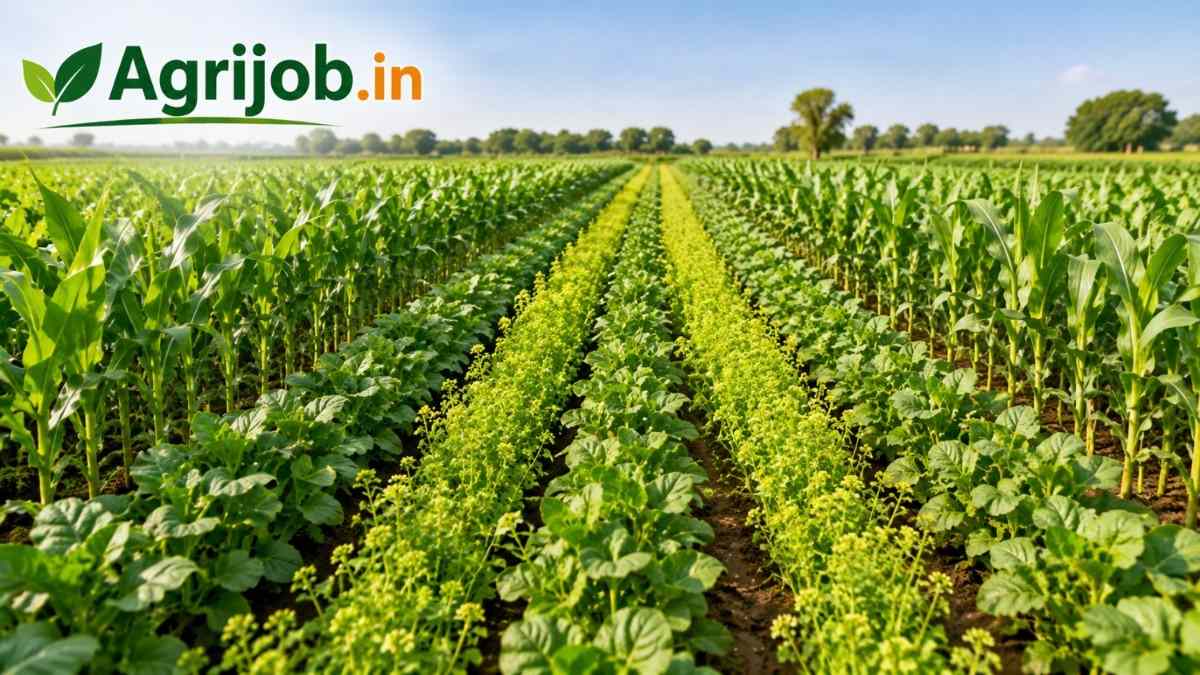
What is intercropping? Intercropping is the practice of growing two or more crops simultaneously on the same field, arranged so each crop can be managed on its own while both benefit from shared sunlight, water, and soil nutrients. It differs from mixed cropping, which has no fixed row pattern, and from crop rotation, which grows crops one after another rather than together.
Indian farmers have used this technique for generations, long before the term “intercropping” existed. ICAR-Indian Institute of Farming Systems Research, Modipuram, estimates that 0.70 to 0.90 million Indian farmers currently practice intercropping, mostly on semi-arid land in Karnataka, Telangana, Tamil Nadu, Maharashtra, Gujarat, and Madhya Pradesh. In eastern states like Bihar, research from Tirhut College of Agriculture, Dholi, has demonstrated similar success with sugarcane and legume combinations.

| Feature | Intercropping |
|---|---|
| Number of crops | 2 or more, grown together |
| Row arrangement | Definite pattern (row, strip, or relay) |
| Sowing time | Same time or staggered by weeks |
| Main goal | Higher total yield per unit area |
| Best suited for | Small and marginal farmers with limited land |
Intercropping Types and Benefits: 5 Methods Explained
There are five recognised types of intercropping, each suited to different crops, soils, and farm equipment. Choosing the right type depends on how much independent management each crop needs.
1. Mixed Intercropping
Two or more crops are sown together with no distinct row arrangement, often by broadcasting seeds. This is the oldest and simplest form, common in rainfed tribal and hill farming where labour for precise rows is limited.
2. Row Intercropping
Crops are planted in alternating rows following a fixed ratio, such as 2 rows of maize to 1 row of pigeonpea. Row intercropping is the most widely recommended type in India because it allows separate fertiliser, weeding, and harvesting schedules for each crop.
3. Strip Intercropping
Crops are grown in wider strips, wide enough that each strip can be managed with a tractor or power tiller, but narrow enough that the crops still interact agronomically. Research on strip width shows a 1-metre strip often produces the highest yield advantage, though wider 3-metre strips are easier for Indian farmers using standard machinery.
4. Relay Intercropping
The second crop is sown into the standing first crop before it is harvested, so both share part of their growing period. Wheat sown into standing rice a few weeks before rice harvest is a classic relay intercropping example used across the Indo-Gangetic plains, including Bihar.
5. Parallel Cropping
Two crops with completely different growth habits and near-zero competition are grown together so both express their full yield potential, such as green gram sown with maize. Because there is minimal competition, parallel cropping gives close to the combined yield of both sole crops.
Who Should Use Intercropping in Their Fields?
Intercropping is not equally useful for every farm. Here is who benefits most from adopting it this season.
- 🌾 Small and marginal farmers with under 2 hectares who need income from every square metre of land
- 🌱 Rainfed farmers in semi-arid districts who want a backup crop if one fails due to erratic rainfall
- 🍬 Sugarcane growers who want extra income during the crop’s slow-growing first 3-4 months
- 🥜 Pulse and oilseed farmers looking to add nitrogen back into depleted soil naturally
- 🚜 Farmers without irrigation access who need drought-tolerant legumes as insurance crops
- 👨🌾 New FPO members exploring diversified income streams to reduce market risk
- 🌍 Farmers focused on organic or low-input methods wanting natural pest control and reduced fertiliser cost
- 📈 Orchard owners with young fruit trees who want short-term crop income before trees mature
How Much Extra Income Can Intercropping Add?
The biggest reason Indian farmers adopt intercropping is money. A second crop from the same land, grown with the same water and largely the same labour, adds a direct income stream without needing extra land.
| Crop Combination | Extra Income Potential (per acre) | Key Benefit |
|---|---|---|
| Sugarcane + Onion | Rs.25,000 – Rs.40,000 | Early cash before cane matures |
| Maize + Pigeonpea | Rs.12,000 – Rs.20,000 | Extra pulse harvest, added soil nitrogen |
| Wheat + Mustard | Rs.8,000 – Rs.15,000 | Natural pest repellence for wheat |
| Cotton + Green Gram | Rs.10,000 – Rs.18,000 | Short-duration pulse before cotton canopy closes |
| Sugarcane + Pea/Lentil | Rs.20,000 – Rs.35,000 | Highest monetary advantage index in ICAR trials |
Field trials at Tirhut College of Agriculture, Dholi, Bihar, recorded a 22-38% actual yield advantage from pigeonpea-based intercropping systems compared with growing the same crops separately. Sugarcane intercropped with peas showed the highest monetary advantage among all combinations tested over six years.
Requirements to Start Intercropping
Intercropping needs planning before sowing, not expensive new equipment. Most Indian farmers can start with tools and seeds they already use for sole cropping.
- Compatible crop pair: One tall/deep-rooted crop with one short/shallow-rooted crop works best (e.g. maize with green gram)
- Different maturity periods: Pick crops that don’t compete for resources at the same growth stage
- Basic soil testing: Confirm nutrient levels so both crops get adequate fertiliser without one starving the other
- Row-marking tools or a simple rope/marker: For row and strip intercropping accuracy
- Separate seed sources: Certified seed for both the base crop and the intercrop
- Labour planning: Slightly higher labour need during sowing and harvest windows
| Requirement Category | Details |
|---|---|
| Land holding | No minimum; works on plots as small as 0.25 acre |
| Irrigation | Not mandatory; many combinations are rainfed-suitable |
| Investment (approx.) | Rs.3,000 – Rs.8,000 extra per acre for second crop’s seed and inputs |
| Technical support | Available free through local KVK (Krishi Vigyan Kendra) |
How Intercropping Works — Step-by-Step Process
Setting up a successful intercropping system in 2026 follows the same core steps regardless of the crop pair chosen.
- Test your soil to know existing nutrient levels before adding a second crop’s demand.
- Choose a base crop and a compatible intercrop with different heights, root depths, or maturity periods.
- Decide the type — row, strip, relay, mixed, or parallel — based on your available machinery and labour.
- Fix the row ratio (for example, 2:1 or 4:2) using local KVK or ICAR recommendations for your crop pair.
- Sow the base crop first, at the correct spacing for full sunlight access.
- Sow or transplant the intercrop either at the same time or a few weeks later for relay systems.
- Apply fertiliser separately for each crop’s specific nutrient needs, avoiding over-fertilising the dominant crop.
- Monitor for competition in the first 4-6 weeks and thin plants if one crop is choking the other.
- Harvest each crop at its own maturity, starting with the earlier-maturing component.
Always intercrop a legume (pigeonpea, green gram, black gram, or lentil) with a cereal or cash crop wherever possible. Legumes fix nitrogen in the soil naturally, cutting your urea requirement for the next season while giving you a second harvest to sell.
Intercropping vs Monocropping — Which Gives Better Returns?
Monocropping (sole cropping) grows a single crop across the whole field, while intercropping shares the same land between two or more crops. Each has a different risk and return profile.
| Factor | Intercropping | Monocropping |
|---|---|---|
| Land productivity | 20-50% higher (LER 1.2-1.8) | Baseline (LER = 1.0) |
| Risk if one crop fails | Low — second crop cushions loss | High — total income loss |
| Labour requirement | Higher, especially at sowing/harvest | Lower, easier to mechanise |
| Input cost | Slightly higher (two crops’ seed/inputs) | Lower, single input schedule |
| Mechanization ease | Difficult for combine harvesters | Easy, standard equipment works |
| Soil health impact | Improves fertility, reduces erosion | Can deplete specific nutrients over time |
| Pest & disease spread | Slower spread, natural barrier effect | Faster spread within uniform crop |
| Best for | Small/marginal, rainfed farmers | Large mechanised commercial farms |
For farmers with less than 2 hectares and no reliable irrigation, intercropping is usually the better choice — it spreads risk and adds a second income without extra land cost. Large mechanised farms growing a single cash crop for bulk export markets often see better returns sticking with monocropping.
Advantages and Disadvantages of Intercropping
Intercropping is not a universal fix. A balanced view helps you decide if it suits your specific field and labour situation.
Advantages
- Higher total yield per acre through better use of sunlight, water, and soil nutrients
- Reduced risk of total crop failure since two crops rarely fail from the same cause together
- Natural pest and weed control — diverse plants confuse pests and shade out weeds
- Improved soil fertility when legumes are paired with cereals, cutting fertiliser costs
- Diversified income from two harvests instead of one, reducing dependency on a single market price
Disadvantages
- Higher labour requirement for planting, weeding, and staggered harvesting
- Mechanization difficulty — most combine harvesters and seed drills are built for single crops
- Management complexity — needs planning for two sets of fertiliser, water, and pest schedules
- Possible crop competition if incompatible pairs are chosen, lowering both yields
Important Terms Related to Intercropping
These terms appear often in ICAR literature and government scheme documents on intercropping and crop diversification.
- Land Equivalent Ratio (LER): The area of land needed under sole cropping to match the yield of one unit of intercropped land. An LER above 1.0 means intercropping is more efficient — values of 1.2 to 1.8 are common in Indian trials.
- Base crop: The main crop that occupies most of the field and drives primary income, such as sugarcane or maize.
- Companion cropping: A form of intercropping where both crops reach their full sole-crop yield potential with almost no competition.
- Monetary Advantage Index (MAI): A measure of the extra profit earned from intercropping compared with growing the base crop alone.
- Crop diversification: Growing a wider range of crops on a farm to reduce market and climate risk, closely linked to intercropping.
- Row ratio: The number of rows of each crop planted together, such as 2:1 (two rows of cereal to one row of legume).
- Allelopathy: When one plant releases chemicals that affect the growth of a neighbouring plant, which must be avoided when choosing pairs.
- Sole cropping (monocropping): Growing only one crop across the entire field, used as the baseline for comparing intercropping benefits.
- Additive series intercropping: A layout where the intercrop is planted in addition to the base crop’s normal population, without reducing the base crop’s density.
Best Intercropping Combinations and Sowing Season in India
Match your crop pair to your local sowing calendar for the best results. These combinations are widely tested and recommended across Indian agricultural universities.
| Crop Combination | Best Sowing Season | Suitable Regions |
|---|---|---|
| Maize + Pigeonpea | Kharif (June-July) | Bihar, Madhya Pradesh, Maharashtra |
| Sugarcane + Onion/Coriander | Autumn/Spring planting | Uttar Pradesh, Bihar, Karnataka |
| Wheat + Mustard | Rabi (October-November) | Bihar, Punjab, Haryana, UP |
| Cotton + Green Gram | Kharif (May-June) | Maharashtra (Vidarbha), Gujarat |
| Sorghum + Pigeonpea | Kharif (June-July) | Karnataka, Telangana, Maharashtra |
The Rashtriya Krishi Vikas Yojana (RKVY) supports crop diversification, including intercropping adoption, through its state-level components covering soil health, mechanisation, and rainfed area development. Farmers can check eligibility for related support through their local Department of Agriculture office or nearest KVK.
Important Links for Intercropping Farmers
| Resource | Link |
|---|---|
| RKVY Official Portal (Crop Diversification) | rkvy.nic.in |
| ICAR Research Complex for Eastern Region, Patna | icarrcer.icar.gov.in |
| Pigeonpea Intercropping Research (ICAR-RCER study) | pmc.ncbi.nlm.nih.gov |
| Our Soil Testing Guide for Farmers 2026 | Read: Soil Testing for Farmers 2026 |
| Fixing Bihar Soil Deficiencies (Cauliflower Case Study) | Read: Cauliflower Boron Deficiency Fix |
| Agriculture Input Subsidy 2026 (Seed & Fertiliser) | Read: Input Subsidy Guide 2026 |
Conclusion
Intercropping types and benefits both point to the same conclusion for Indian farmers: growing two compatible crops together is one of the lowest-cost ways to raise income and cut risk on the same plot of land. Whether you choose row intercropping with maize and pigeonpea or relay cropping with wheat after rice, matching the right crop pair to your soil and season is what determines success.
Start small — try one intercropping combination on a portion of your field this season, track the extra harvest, and expand once you see the results. Bookmark this guide and consult your nearest KVK before finalising your row ratio and seed quantities.
- Intercropping means growing 2+ crops together; the 5 main types are mixed, row, strip, relay, and parallel
- Land productivity can rise 20-50% (LER of 1.2-1.8) compared with single-crop farming
- Popular Indian combinations include maize + pigeonpea and sugarcane + onion or pea
- Extra income potential ranges from Rs.8,000 to Rs.40,000 per acre depending on crop pair
- Legume + cereal pairs also cut fertiliser costs by fixing nitrogen naturally in the soil
- Start with one tested combination this season and consult your local KVK for the right row ratio
Frequently Asked Questions About Intercropping Types and Benefits
What is intercropping in simple words?
Intercropping is growing two or more crops together on the same field during the same season, arranged so each crop can still be managed and harvested on its own. It is different from mixing seeds randomly, since spacing and row patterns are planned in advance.
What are the main types of intercropping?
The five main types are mixed intercropping, row intercropping, strip intercropping, relay intercropping, and parallel cropping. Row intercropping is the most common in Indian farming because it allows independent fertiliser and harvest schedules for each crop.
What are the main benefits of intercropping?
The main benefits are higher total yield per acre, reduced risk from crop failure, natural pest and weed control, improved soil fertility from legume pairings, and a second income stream from the same land.
Is intercropping better than monocropping?
For small and marginal farmers with limited land and rainfed conditions, intercropping usually gives better overall returns and lower risk. Large mechanised farms growing a single export-focused crop often find monocropping easier to manage and harvest.
What is Land Equivalent Ratio (LER) in intercropping?
Land Equivalent Ratio is the land area needed under sole cropping to produce the same yield as one unit of intercropped land. An LER greater than 1.0 shows intercropping is more efficient — Indian field trials commonly report LER values between 1.2 and 1.8.
Which crops are best for intercropping in India?
Widely tested Indian combinations include maize with pigeonpea, sugarcane with onion or pea, wheat with mustard, and cotton with green gram. The best pair for your field depends on your local soil, rainfall, and existing cropping season.
Does intercropping need more labour than a single crop?
Yes, intercropping typically needs more labour for planting, weeding, and staggered harvesting since two crops mature at different times. Many farmers offset this extra labour cost with the added income from the second harvest.
Which government scheme supports intercropping in India?
The Rashtriya Krishi Vikas Yojana (RKVY) supports crop diversification and intercropping adoption through state-level project components covering soil health, mechanisation, and rainfed area development. Farmers can check current benefits through their district Department of Agriculture office.
Can intercropping be done with sugarcane?
Yes, sugarcane is one of the most common intercropping base crops in India because it takes 10-12 months to mature and has wide row spacing. Onion, coriander, peas, and lentils are commonly intercropped with sugarcane to earn early income before the cane is harvested.
How do I choose the right crop combination for intercropping?
Pick crops with different heights, root depths, and maturity periods so they don’t compete for the same resources at the same time. Pairing a tall cereal with a short-duration legume is a reliable starting formula recommended by most Indian agricultural universities.
Last Updated: August 2026. This guide is reviewed and updated regularly for accuracy. Bookmark this page for the latest information on intercropping types and benefits.
Disclaimer: Income figures in this guide are indicative estimates based on ICAR field trial data and published agricultural research. Actual returns vary by region, soil type, rainfall, and market prices. Consult your nearest Krishi Vigyan Kendra (KVK) or state agriculture department before adopting a new cropping system.