

Makhana export from India has grown nearly 4X in just four years — from 6,700 MT in 2020 to over 25,000 MT in 2024, making it one of the fastest-rising agricultural export opportunities available today. This guide is for Indian entrepreneurs, farmers, agri-business owners, and first-time exporters aged 25–50 who want to sell makhana (fox nuts) to the US, UK, EU, UAE, and other international markets. You will find the complete 7-step export process, every mandatory document, all required certifications, HS codes, shipping tips, and profit benchmarks — everything you need before dispatching your first container.

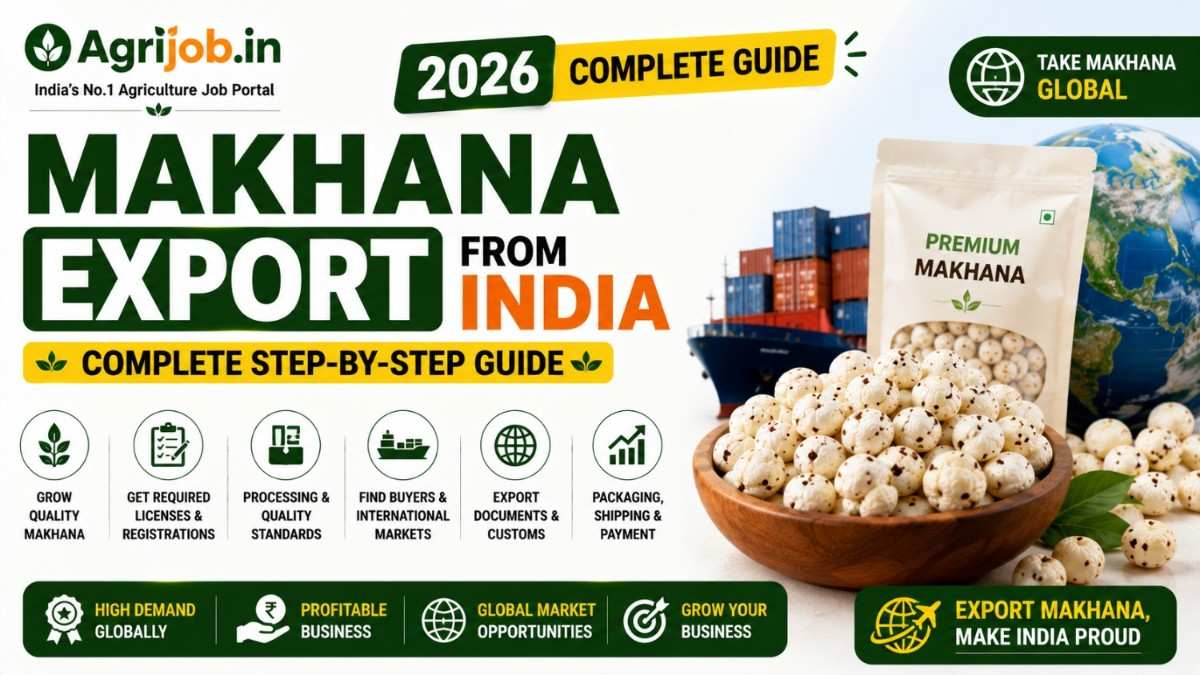
To export makhana from India in 2026, you need an IEC code from DGFT (Rs.500 fee, issued in 1–3 days), APEDA RCMC registration, an FSSAI Central License, and a Phytosanitary Certificate per shipment. For the US market, FDA Facility Registration is mandatory; for the EU, compliance with Commission Implementing Regulation (EU) 2023/652 is required. India’s makhana exports reached Rs.255 crore ($30.5 million) in 2024–25.
- India’s Global Share: ~90% of global makhana production
- Bihar Contribution: 80–85% of India’s total output
- Export Value (2024–25): Rs.255 crore ($30.5 million) — up 27% YoY
- Export Volume (2024): 25,000+ MT shipped internationally
- Export Price Range: $4–$21 per kg depending on grade and destination
- Domestic Price (2026): Rs.700–Rs.1,700 per kg by grade
- Top Export Markets: USA, UAE, UK, Germany, Canada, Singapore
- HS Codes: 08129090 (raw/dried), 19041090 (popped/roasted)
- MOQ for First Shipment: 500 kg–1 MT (trial); 14–18 MT (full 20-ft container)
- Best Export Port: Kolkata/Haldia (Bihar origin); JNPT Mumbai (USA/EU)
- Market CAGR: 17–18% annually (2021–22 to 2024–25)
📋 Table of Contents
- What Is Makhana Export and Why It Is a Profitable Business in 2026
- Who Should Start a Makhana Export Business from India
- Makhana Export Earnings — Prices, Grades, and Profit Margins
- Eligibility and Registration Requirements for Makhana Export
- How to Export Makhana from India — 7-Step Process
- Mandatory Export Documents for Every Makhana Shipment
- Certifications Required to Export Makhana to USA and Europe
- Exporting Makhana to USA vs Europe — Key Differences
- Pros and Cons of the Makhana Export Business from India
- Important Terms and Concepts for Makhana Exporters
- Important Dates and Timelines for Makhana Export Registrations
- Important Links for Makhana Exporters
- Conclusion
- Key Takeaways
- Frequently Asked Questions About Makhana Export from India 2026
What Is Makhana Export and Why It Is a Profitable Business in 2026
Makhana export from India is the process of shipping processed or raw fox nuts (Euryale ferox Salisb.) — sourced primarily from Bihar’s wetlands — to international buyers in the US, Europe, Middle East, and Southeast Asia. India controls approximately 90% of global makhana production, with Bihar alone contributing 80–85% of the total output, giving Indian exporters an unmatched competitive advantage in international markets.
Global demand for makhana is accelerating because the product is naturally gluten-free, vegan, low in fat, and high in magnesium, potassium, and phosphorus — a nutritional profile that fits the premium health-snack trend in the US and EU. India’s makhana exports grew at a 39% CAGR between 2020 and 2024, and the domestic market is projected to reach Rs.11,000–12,000 crore by 2029–30, growing at 17–18% per year. For exporters in Bihar, Jharkhand, and Assam, the 2026 window represents the best entry point in a decade.

Note: Always use the correct botanical name Euryale ferox — not “lotus seeds” (Nelumbo nucifera) — on all export documents, phytosanitary certificates, and FDA filings to prevent customs delays and regulatory rejection.
Who Should Start a Makhana Export Business from India
- 🌾 Bihar/Jharkhand makhana farmers who want to bypass middlemen and earn direct international prices of $4–$21/kg instead of local mandi rates
- 🏭 Food processing entrepreneurs looking to launch a roasted, flavoured, or private-label makhana brand in US or EU retail chains
- 📦 Agri-export startups seeking a high-growth, non-perishable commodity with low rejection rates compared to fresh produce
- 🤝 Trading houses and commission agents in Kolkata, Patna, or Mumbai who already handle dry commodity exports and want to add a premium SKU
- 🎓 Agriculture graduates and MBA professionals entering the agri-business space with government support under APEDA and Makhana Board schemes
- 💼 MSME owners with Rs.5–10 lakh initial capital to start with a 500 kg trial shipment and scale to full container loads within 6–12 months
- 🌍 NRI entrepreneurs living in the US, UK, or UAE who want to source directly from Bihar and distribute in the diaspora and mainstream health market
- 🛒 Indian e-commerce sellers on Amazon USA or UK who want to import their own brand of makhana snacks for higher margin DTC sales
Makhana Export Earnings — Prices, Grades, and Profit Margins
The profitability of makhana export from India depends heavily on the grade (Suta size) you ship. Premium grades command significantly higher international prices, and the gap between domestic procurement cost and FOB export price is the exporter’s gross margin.
| Grade (Suta) | Size | India Wholesale Price (2026) | FOB Export Price | Gross Margin |
|---|---|---|---|---|
| 4 Suta | <14 mm | Rs.700–900/kg | $4–6/kg | 25–35% |
| 5 Suta | 14–16 mm | Rs.900–1,100/kg | $7–10/kg | 30–40% |
| 6 Suta (Standard Export) | 16–18 mm | Rs.1,100–1,400/kg | $12–15/kg | 35–45% |
| 7 Suta (Premium/GI-Tagged) | >18 mm | Rs.1,400–1,700/kg | $18–21/kg | 40–50% |
A standard 20-foot container holds 14–18 MT of makhana. At 6 Suta grade with an FOB price of $13/kg, a full container generates approximately $1,82,000–$2,34,000 in export revenue. Your net profit after freight, APEDA fees, certification costs, and packaging typically ranges from 25–40% depending on your direct-farm sourcing model.
GI-Tagged Mithila Makhana from Darbhanga, Madhubani, and Purnia districts commands a 15–20% premium above standard 6 Suta in EU and US premium retail channels. Investing in GI certification as part of your export brand strategy can dramatically improve unit economics.
Eligibility and Registration Requirements for Makhana Export
Any individual, partnership, LLP, private limited company, or proprietorship registered in India can export makhana legally after obtaining these mandatory registrations. There is no minimum turnover or experience requirement to start.
- Business Entity: Any registered legal entity — sole proprietor, partnership, LLP, or Pvt. Ltd.
- PAN Card: Mandatory for IEC application (personal PAN for proprietors; company PAN for companies)
- Bank Account: Current account in the name of the business with a cancelled cheque or bank certificate
- GST Registration: Mandatory for tax documentation; exports are zero-rated under GST but registration is required
- MSME Registration: Optional but recommended — enables access to APEDA subsidies, ECGC insurance, and RoDTEP incentives
| Registration / License | Issuing Authority | Fee | Processing Time |
|---|---|---|---|
| IEC (Import Export Code) | DGFT (dgft.gov.in) | Rs.500 | 1–3 working days |
| APEDA RCMC | APEDA (apeda.gov.in) | Rs.5,000–10,000 | 7–15 working days |
| FSSAI Central License | FSSAI (fssai.gov.in) | Rs.2,000–7,500 | 30–60 days |
| GST Registration | GST Portal (gst.gov.in) | Free | 3–7 working days |
| Phytosanitary Certificate | NPPO / Plant Quarantine | Per shipment | 3–5 days per lot |
| FDA Facility Registration (USA) | US FDA (fda.gov) | Free | Immediate (online) |
| HACCP Certification | Accredited CB | Rs.50,000–1,50,000 | 30–90 days |
How to Export Makhana from India — 7-Step Process
Follow this exact sequence for your first makhana export shipment. Completing steps 1–4 before sourcing product prevents costly delays at customs.
- Obtain your IEC Code from DGFT. Apply online at dgft.gov.in using Form ANF-2A. Submit PAN card, bank certificate, and passport-size photo. Pay Rs.500 fee. IEC is issued in 1–3 working days and has lifetime validity (requires annual profile update). Without IEC, no shipment can legally clear Indian customs.
- Register with APEDA and obtain your RCMC. Go to apeda.gov.in and register as a makhana exporter under the scheduled commodities list. The Registration-cum-Membership Certificate (RCMC) is mandatory for all agricultural exports and unlocks government subsidies, market development assistance, and quality certification support.
- Get FSSAI Central License. Apply on the FoSCoS portal (foscos.fssai.gov.in). An FSSAI Central License (not a State License) is mandatory for food exporters. It certifies your product complies with Indian food safety standards — a requirement demanded by customs in the US, EU, UAE, and UK.
- Obtain quality certifications (HACCP, ISO 22000, Organic if targeting premium markets). HACCP and ISO 22000 are not always legally mandatory for every destination but are commercially essential — US and EU importers and supermarket chains routinely require them before placing purchase orders. Apply through an NABCB-accredited certification body.
- Source, grade, and pack the makhana per destination country standards. Specify grade clearly (Suta system) on packing list. Use food-grade HDPE bags or vacuum-sealed packaging for moisture protection. Label in English with full ingredient declaration, net weight, country of origin (India), botanical name (Euryale ferox), lot number, and best-before date. EU requires multilingual labeling; US requires FDA-compliant label with Nutrition Facts panel.
- Arrange export documentation and get per-shipment certificates. Before your cargo moves, obtain the Phytosanitary Certificate from the Plant Quarantine Station (issued by NPPO India) after physical inspection of your lot. Prepare: Commercial Invoice, Packing List, Bill of Lading (or Air Waybill), Certificate of Origin (from Chamber of Commerce or APEDA), and a Certificate of Analysis (COA) from an NABL-accredited lab.
- Book freight, file Shipping Bill, and complete customs clearance. For US and EU shipments, Nhava Sheva (JNPT), Mumbai is recommended for container reliability. Bihar-origin consignments can use Kolkata/Haldia Port for cost savings. File the Shipping Bill on ICEGATE portal through your Customs House Agent (CHA). For US shipments: file FDA Prior Notice at least 8 hours before vessel arrival (2 hours for air/truck). For EU: ensure your EU importer has FSVP-equivalent documentation ready for customs.
Start with a 500 kg–1 MT LCL (Less-than-Container Load) trial shipment to a known diaspora buyer or Indian-origin distributor in the US or UK. This lets you validate your documentation, labeling compliance, and buyer payment process before committing to a full 18 MT FCL container worth Rs.15–25 lakh. Most international buyers expect 1–2 trial shipments before scaling orders. Use the Kolkata Port for the trial — it is the closest sea port to Bihar and reduces inland freight costs by 30–40% compared to routing through Mumbai.
Mandatory Export Documents for Every Makhana Shipment
Every makhana export consignment requires this core document set regardless of destination. Missing or incorrect documents cause shipment holds, customs penalties, or rejection at the destination port.
| Document | Purpose | Issued By | Required For |
|---|---|---|---|
| Commercial Invoice | Declares product value, quantity, buyer-seller details | Exporter | All destinations |
| Packing List | Specifies number of packages, weights, grade, lot numbers | Exporter | All destinations |
| Bill of Lading (B/L) / Air Waybill | Shipping contract; title document for the cargo | Shipping Line / Airline | All destinations |
| Certificate of Origin (COO) | Verifies product is of Indian origin | Chamber of Commerce / APEDA | All destinations |
| Phytosanitary Certificate | Confirms cargo is free from pests and diseases | NPPO India / Plant Quarantine Station | All destinations |
| Certificate of Analysis (COA) | Lab results for pesticide residues, heavy metals, microbial count | NABL-accredited lab | US, EU, UK, UAE |
| FSSAI License Copy | Proves Indian food safety compliance | FSSAI | All destinations |
| APEDA RCMC Copy | Proves APEDA registration for agricultural exports | APEDA | All destinations |
| FDA Prior Notice (USA) | Mandatory pre-arrival notification to US FDA | Exporter / Customs Broker (online via FDA PN System) | USA only |
| IEC Code | Exporter’s unique identity for customs filing | DGFT | All destinations (on Shipping Bill) |
| Shipping Bill | Indian customs export declaration | ICEGATE / CHA | All destinations |
Certifications Required to Export Makhana to USA and Europe
Certifications for makhana export differ by destination market. The US and EU have distinct regulatory frameworks, and confusion between the two is a common reason first-time exporters face rejection. Here is what each market actually requires in 2026:
Certifications for Exporting Makhana to the USA
- FDA Facility Registration (mandatory): Your processing/packing facility must be registered with the US FDA under FSMA Section 415 at fda.gov. Registration is free and done online. It must be renewed biennially in even-numbered years.
- FDA Prior Notice (mandatory per shipment): Must be filed electronically through the FDA’s Prior Notice System Interface (PNSI) at least 8 hours before ocean freight arrival at a US port (2 hours for air/truck). Includes product description, manufacturer details, country of origin, and anticipated arrival date.
- FSVP Compliance (mandatory for US importer): Under the Food Safety Modernization Act (FSMA), your US importer must have a Foreign Supplier Verification Program (FSVP) in place for your facility. As the Indian exporter, you support this by providing batch-specific COAs, facility audit reports, and traceability documentation (farm-to-export chain of custody).
- HACCP Certification (commercially mandatory): While not always legally required for makhana (which is a low-risk commodity), US supermarket chains (Whole Foods, Costco, Walmart) and institutional buyers will not place purchase orders without a valid HACCP certificate. Obtain from an NABCB or internationally accredited certification body.
- USDA Organic Certification (optional but premium-enabling): If targeting the US organic segment, obtain NPOP (India) certification, which has equivalency recognition with USDA NOP for most categories, or directly certify under USDA NOP via an accredited agent in India.
Certifications for Exporting Makhana to Europe (EU + UK)
- EU Novel Food / Traditional Food Compliance: Commission Implementing Regulation (EU) 2023/652 authorises roasted and popped kernels of Euryale ferox as a traditional food from a third country under the EU Novel Food framework. This simplifies EU entry for popped/roasted makhana — your EU importer handles notification to EFSA, but you must provide product specifications and documentation confirming botanical identity as Euryale ferox.
- EU Organic Certification (for premium organic segment): India’s NPOP standard has partial equivalence with EU Organic Regulation. However, for full EU organic market access, direct certification under EU Regulation 2018/848 through an approved control body (ECOCERT, CERES, Kiwa BCS) operating in India is recommended.
- Pesticide Residue Testing (mandatory for EU): EU Maximum Residue Levels (MRLs) under Regulation (EC) 396/2005 apply strictly. Have a COA from an ISO 17025-accredited lab testing for pesticide residues before every shipment. EU customs regularly tests Indian agricultural imports.
- UK FSVP-Equivalent Requirements (post-Brexit): The UK now operates under the UK Food Safety Act 1990 and UK-specific import controls. Your UK importer registers the consignment with the Animal and Plant Health Agency (APHA). Phytosanitary Certificate and COA requirements mirror EU standards.
- HACCP / ISO 22000 (commercially mandatory for EU retail): EU supermarkets and distributors require HACCP or ISO 22000 as a non-negotiable supply chain entry requirement.
Exporting Makhana to USA vs Europe — Key Differences
| Parameter | USA | European Union |
|---|---|---|
| Regulatory Body | US FDA (FSMA) | EFSA / EU Commission |
| Pre-arrival Notice | FDA Prior Notice (8 hrs ocean / 2 hrs air) | Import Entry via TRACES NT system |
| Importer Obligation | FSVP mandatory for US importer | Novel Food notification by EU importer |
| Facility Registration | FDA Facility Registration (free, biennial renewal) | Not required at facility level (product-level compliance) |
| Organic Market Entry | USDA NOP or NPOP equivalency | EU Organic Reg. 2018/848 (NPOP partial equivalence) |
| Pesticide Testing | FDA residue limits (FSMA preventive controls) | EU MRL Reg. (EC) 396/2005 (stricter limits) |
| Novel Food Status | Generally recognised as safe (GRAS-adjacent; no formal novel food issue) | EU Reg. 2023/652 — authorized as traditional food |
| Labeling Language | English (Nutrition Facts panel required) | All official EU languages (min. host country language) |
| HACCP Requirement | Commercially mandatory (retail/institutional) | Legally required under EU Reg. 852/2004 |
| Best Port (India side) | JNPT Mumbai (direct USA service) | JNPT Mumbai or Nhava Sheva (Europe via transshipment) |
For first-time makhana exporters from India, the USA is the easier market to enter — FDA Prior Notice and FSVP are well-documented processes, the diaspora importer network is large, and US import duty on makhana under HS 08129090 is moderate. The EU is more lucrative (higher per-kg prices, premium organic segment) but requires stricter pesticide-residue documentation and HACCP compliance from day one. Recommendation: start with a 500 kg trial shipment to a US-based Indian distributor, use the 1–2 shipment cycle to iron out documentation, and then expand to the EU with an ISO 22000-certified facility.
Pros and Cons of the Makhana Export Business from India
Advantages of Exporting Makhana from India
- 🌟 Market dominance: India controls 90% of global supply, giving exporters unmatched sourcing advantage and pricing power
- 📈 High growth rate: 39% CAGR in exports (2020–2024) with no signs of demand slowdown in US or EU health-snack channels
- 💰 Strong margins: Premium 7 Suta grade earns $18–21/kg internationally vs. Rs.1,500/kg (~$18) domestic — meaning exporters access foreign exchange at par with domestic premium retail, but with much higher volume
- 🏛️ Government support: APEDA subsidies, Makhana Board (Rs.100 crore budget), RoDTEP incentives, and GI Tag (Mithila Makhana) all support the export value chain
- 🧊 Non-perishable product: Makhana has a 12–18 month shelf life in proper packaging, eliminating the cold-chain logistics complexity that kills margins in fresh produce exports
Disadvantages and Challenges of Makhana Export
- ⚖️ Certification cost and time: Getting HACCP, ISO 22000, and FSSAI Central License together can cost Rs.2–3 lakh and take 60–90 days, which delays first shipment significantly
- 📦 Bulky logistics: Makhana’s low density (a truck that carries 10 MT of wheat carries only 2–3 MT of makhana) makes per-kg freight costs disproportionately high
- 💱 US tariff pressure: India’s makhana exports dipped slightly in Jan–Oct 2025 due to US tariff adjustments, showing vulnerability to trade policy shifts
- 🔍 Grading inconsistency: Manual grading (Suta system) by local artisans creates batch-to-batch variation that can lead to buyer disputes if strict grade specifications are not enforced at sourcing
Important Terms and Concepts for Makhana Exporters
- IEC (Import Export Code): A mandatory 10-digit identification number issued by DGFT (dgft.gov.in) for Rs.500. No business can legally export from India without it. Lifetime validity with mandatory annual profile update on DGFT portal.
- APEDA RCMC: Registration-cum-Membership Certificate from the Agricultural and Processed Food Products Export Development Authority. Mandatory for all scheduled agricultural exports including makhana. Enables access to government subsidies and trade fair participation.
- Phytosanitary Certificate: A per-shipment document issued by India’s National Plant Protection Organisation (NPPO) after physical inspection, certifying that the makhana lot is free from regulated pests and diseases under the International Plant Protection Convention (IPPC).
- FOB (Free on Board): Shipping term where the exporter’s responsibility ends when goods cross the ship’s rail at the Indian port. Most makhana export contracts are priced FOB Kolkata or FOB JNPT.
- FSVP (Foreign Supplier Verification Program): US FDA rule under FSMA requiring every US importer to verify their Indian supplier produces food to US safety standards. Your COA, audit reports, and traceability documents feed this program.
- COA (Certificate of Analysis): Lab report from an NABL or ISO 17025-accredited laboratory confirming pesticide residues, heavy metals (lead, cadmium, arsenic), aflatoxins, and microbial counts are within destination-country limits. Required per batch by US and EU buyers.
- HS Code: Harmonized System classification code used in customs declarations. Makhana HS codes: 08129090 (raw/dried fox nuts) and 19041090 (popped/roasted makhana prepared from cereals). Correct HS code prevents customs disputes and ensures correct duty assessment.
- GI Tag — Mithila Makhana: Geographical Indication tag granted to makhana from the Mithila region of Bihar (Darbhanga, Madhubani, Sitamarhi, Purnia districts). GI-Tagged Mithila Makhana commands 15–20% price premium in premium international markets.
- RoDTEP (Remission of Duties and Taxes on Exported Products): Government of India scheme that refunds embedded taxes and levies on exported goods. Makhana exporters can claim RoDTEP benefits, which effectively reduce the effective export cost by 1–4% of FOB value.
- NPOP (National Programme for Organic Production): India’s national organic certification program administered by APEDA. NPOP has equivalence recognition with EU Organic and Swiss Organic standards, allowing NPOP-certified Indian makhana to enter these markets with simplified procedures.
Important Dates and Timelines for Makhana Export Registrations
| Milestone / Deadline | Date / Timeline |
|---|---|
| IEC Annual Profile Update (DGFT) | April 1 – June 30 every year (mandatory; non-updated IEC gets deactivated) |
| FSSAI Central License Renewal | Annual or 2/3/5-year validity; renew 30 days before expiry |
| FDA Facility Registration Renewal | October 1 – December 31 in even-numbered years (next: Oct–Dec 2026) |
| APEDA RCMC Renewal | Annually (before March 31 each year) |
| Makhana Harvest Season (Bihar) | August–October (plan first shipments for November–January peak supply) |
| EU HACCP Audit Cycle | Annual surveillance audit; initial certification 30–90 days |
| USDA Organic Annual Inspection | Annual field inspection by accredited certifier |
Important Links for Makhana Exporters
| Link Name | URL |
|---|---|
| DGFT — Apply for IEC Code Online | www.dgft.gov.in |
| APEDA — Register as Makhana Exporter | apeda.gov.in |
| FSSAI — Apply for Central License (FoSCoS) | foscos.fssai.gov.in |
| US FDA — Register Food Facility | fda.gov — Importing Food Products |
| APEDA Makhana Export Strategy Report (Official PDF) | apeda.gov.in — Makhana Monthly Dashboard |
| ICEGATE — File Shipping Bill Online | www.icegate.gov.in |
| Plant Quarantine — Phytosanitary Certificate (NSWS) | www.nsws.gov.in |
Conclusion — Your Makhana Export Journey Starts with One IEC
Makhana export from India in 2026 is one of the most accessible, high-margin agricultural export businesses available to Indian entrepreneurs — the product is non-perishable, India holds 90% of global supply, and international demand is growing at 17–18% annually. The paperwork is sequential and manageable: IEC, APEDA RCMC, and FSSAI come first, followed by HACCP for buyer credibility and a Phytosanitary Certificate per shipment. With an initial investment of Rs.5–10 lakh and a 500 kg trial shipment, you can validate the entire export chain before committing to full container loads.
Your immediate next step: visit dgft.gov.in and apply for your IEC code today — the Rs.500 fee and 3-day approval timeline mean there is no reason to wait. Bookmark this guide and check the official APEDA portal (apeda.gov.in) for updated subsidy schemes and buyer-connect programs specific to makhana exporters.
- India controls 90% of global makhana supply; exports grew 4X between 2020–2024 to reach Rs.255 crore ($30.5 million) in 2024–25
- Start with 3 mandatory registrations: IEC from DGFT (Rs.500), APEDA RCMC (Rs.5,000–10,000), and FSSAI Central License (Rs.2,000–7,500)
- For the USA, FDA Facility Registration and Prior Notice filing (8 hrs before vessel arrival) are mandatory per the FSMA framework
- For the EU, Commission Regulation 2023/652 authorizes popped makhana as a traditional food — HACCP is legally required and pesticide COA is mandatory per batch
- Premium 7 Suta grade makhana fetches $18–21/kg internationally vs. Rs.1,400–1,700/kg domestically — with 40–50% gross margins for direct-farm sourcing exporters
- Begin with a 500 kg LCL trial shipment via Kolkata Port to validate documentation, then scale to 18 MT FCL containers for profitability
Frequently Asked Questions About Makhana Export from India 2026
What is the HS code for makhana export from India?
Makhana (raw and dried fox nuts) is classified under HS code 08129090 (other dried fruits and edible nuts not elsewhere specified). Popped or roasted makhana — prepared and ready-to-eat — is classified under 19041090 (prepared foods obtained from cereals or cereal products). Always confirm the correct HS code with your Customs House Agent (CHA) before filing the Shipping Bill, as misclassification leads to customs delays and incorrect duty assessment at the destination port.
Is FSSAI Central License mandatory for exporting makhana from India?
Yes. An FSSAI Central License is mandatory for all food exporters in India, including makhana exporters. State FSSAI licenses are not valid for export purposes. The Central License is issued by FSSAI through the FoSCoS portal (foscos.fssai.gov.in) and typically takes 30–60 days. The annual fee ranges from Rs.2,000 to Rs.7,500 depending on your business turnover. Most importing countries — especially the US, UK, EU, and UAE — demand a copy of the FSSAI license as part of the customs clearance documentation.
What documents are required for makhana export to the USA?
For makhana export to the USA, you need: Commercial Invoice, Packing List, Bill of Lading, Certificate of Origin, Phytosanitary Certificate (from NPPO India), Certificate of Analysis (from NABL-accredited lab), FSSAI License copy, APEDA RCMC copy, FDA Facility Registration number, and an FDA Prior Notice confirmation number. The FDA Prior Notice must be filed electronically at least 8 hours before ocean freight arrival. Your US importer must also have a Foreign Supplier Verification Program (FSVP) file for your facility, which your documentation supports.
How much does it cost to start a makhana export business in India?
The minimum startup cost for a first makhana export shipment (500 kg trial) is approximately Rs.5–10 lakh. This covers IEC registration (Rs.500), APEDA RCMC (Rs.5,000–10,000), FSSAI Central License (Rs.2,000–7,500), HACCP certification (Rs.50,000–1,50,000), lab testing and COA (Rs.10,000–30,000), packaging (Rs.15,000–30,000), and freight for 500 kg LCL shipment (Rs.80,000–1,50,000). The largest cost component is the makhana stock itself — premium 6 Suta grade at Rs.1,100–1,400/kg for 500 kg comes to Rs.5.5–7 lakh.
What is the best port for exporting makhana from Bihar?
For Bihar-based makhana exporters, Kolkata Port (Haldia) is the closest and most cost-effective sea port for LCL (small) shipments and trial orders, reducing inland freight costs significantly. For full container load (FCL) shipments to the USA and Europe, Nhava Sheva (JNPT), Mumbai is preferred due to superior direct shipping services, better container availability, and faster vessel schedules. Air freight via Kolkata International Airport or Delhi IGI is an option for urgent small-quantity premium shipments.
Do I need HACCP certification to export makhana from India?
HACCP (Hazard Analysis and Critical Control Points) certification is legally mandatory for EU market entry under EU Regulation (EC) 852/2004. For the USA, HACCP is not always legally compulsory for all food categories, but it is commercially mandatory — US supermarket chains, institutional buyers, and health food distributors will not approve your vendor file without a valid HACCP or ISO 22000 certificate. HACCP certification costs Rs.50,000–1,50,000 through an NABCB-accredited body and takes 30–90 days to obtain.
What is the current export price of makhana per kg from India?
As of 2026, makhana export prices from India range from $4–6/kg for standard 4 Suta grade to $18–21/kg for premium GI-Tagged Mithila Makhana (7 Suta, >18mm diameter). Standard export grade (6 Suta, 16–18mm) is most commonly traded at $12–15/kg FOB Indian port. Domestic wholesale prices in Bihar range from Rs.700–1,700/kg depending on grade and season. The highest prices occur just before harvest (June–August) and the most competitive sourcing window is October–January post-harvest.
Is organic certification required for makhana export to Europe?
Organic certification is not mandatory for all makhana exports to Europe — conventional makhana can be exported with standard FSSAI, HACCP, and pesticide COA documentation. However, if you want to sell in the EU organic segment (higher margins, premium retail channels), you need certification under EU Organic Regulation 2018/848 through an approved control body such as ECOCERT, CERES, or Kiwa BCS operating in India. India’s NPOP certification has partial equivalence with EU Organic, which simplifies entry in some member states, but full EU organic certification provides the broadest market access.
How do I find buyers for makhana export from India?
The most effective channels to find international makhana buyers in 2026 are: APEDA’s Buyer-Seller Meet and BDB (APEDA Buyer Database) at apeda.gov.in; B2B platforms like Tradologie, Alibaba, and IndiaMART International; trade exhibitions like Anuga (Germany), SIAL (France), and Natural Products Expo West (USA); the APEDA India Pavilion at international food shows; and direct outreach to Indian-origin food distributors in the US, UK, UAE, and Canada who already import other Indian commodities. Having your APEDA registration, HACCP certificate, and a professional product specification sheet ready accelerates buyer trust significantly.
Last Updated: July 2026 | This guide is reviewed and updated regularly for accuracy. Bookmark this page for the latest makhana export regulations, fee updates, and government scheme changes.
Disclaimer: This guide is for informational purposes only. Export regulations, fees, and certification requirements are subject to change. Always verify current requirements with DGFT (dgft.gov.in), APEDA (apeda.gov.in), FSSAI (fssai.gov.in), and the official regulatory authority of your target country before dispatching a shipment. This content does not constitute legal or financial advice.