

Export makhana from India 2026 is one of the most profitable agri-business opportunities available to Indian farmers, traders, and food entrepreneurs today. India controls over 90% of global makhana (fox nuts) supply, with Bihar alone producing 80–85% of world output — and international demand is accelerating at 15–18% CAGR through 2028. This guide is for Bihar farmers, agri-entrepreneurs, food exporters, and FPO members aged 22–50 who want to tap into the USD 30.5 million (INR 255 crore) annual export market for makhana. Here you will learn the exact step-by-step process, every required document, the most profitable target markets, export pricing grade-wise, and how to calculate your real net profit per shipment.

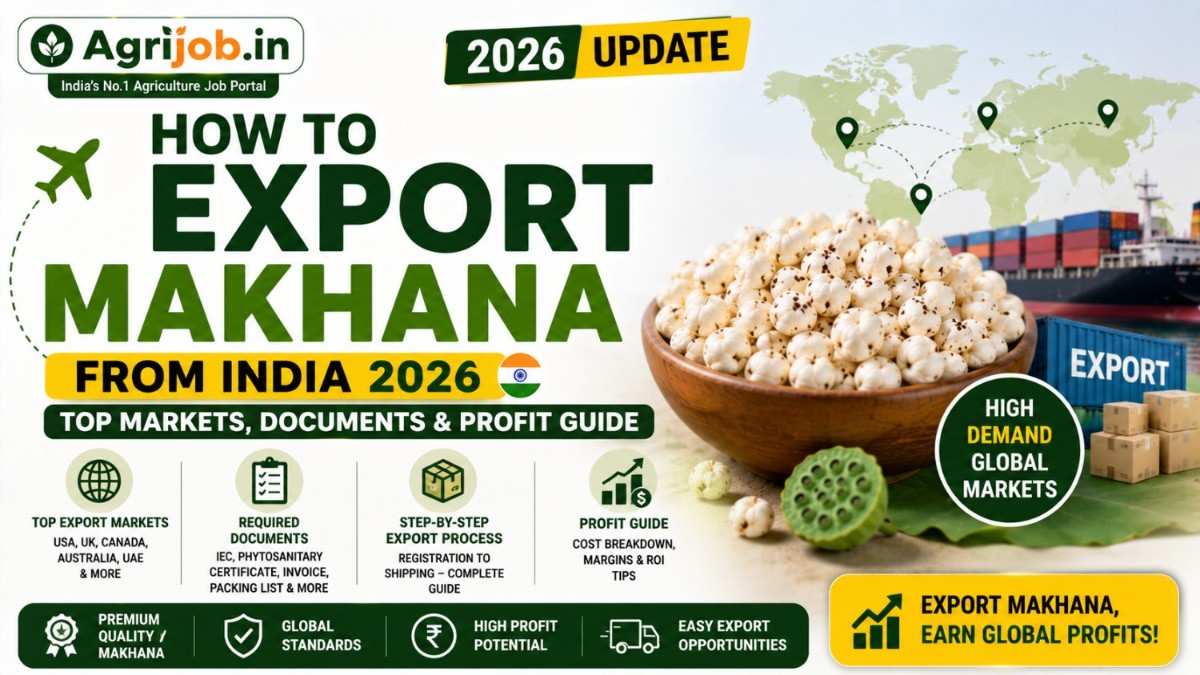
To export makhana from India in 2026, you need an IEC code from DGFT, APEDA registration (RCMC), FSSAI Central License, and a Phytosanitary Certificate. India exported 25,130 metric tonnes of makhana in 2024, earning INR 255 crore ($30.5 million), with export prices ranging from $13–$26 per kg depending on grade and destination market.
- India’s Global Share: 90%+ of world makhana supply
- Total Export Volume (2024): 25,130 metric tonnes
- Total Export Value (2024–25): INR 255 crore ($30.5 million)
- Export Growth Rate: 39% CAGR (2020–2024); 15–18% projected through 2028
- Export Price Range: $13.3/kg (UAE) to $26/kg (Germany)
- Domestic Purchase Price: Rs.700–Rs.1,700/kg (grade-dependent, mid-2026)
- Top Export Markets: USA (40%), Canada (20%), UAE (17%), UK (10%)
- Mandatory Licenses: IEC (DGFT) + APEDA RCMC + FSSAI Central License
- HS Codes: 20081921 (popped/plain) | 20081929 (flavoured/roasted)
- Best Grade for Export: 6 Suta (Bold) and 7 Suta (Premium) — pearl white
- Makhana Board: Announced Union Budget 2025–26, INR 100 crore allocation, Bihar
- GI Tag: Mithila Makhana — commands 10–15% price premium in USA and EU
- What Is Makhana Export and Why India Leads the World
- Who Should Export Makhana from India?
- Makhana Export Price, Grade & Profit Calculation 2026
- Licenses and Eligibility to Export Makhana from India
- How to Export Makhana — 8-Step Process 2026
- Top Export Markets for Indian Makhana 2026
- Makhana Export vs Domestic Sale — Which Is More Profitable?
- Pros and Cons of Exporting Makhana from India
- Important Terms Every Makhana Exporter Must Know
- Important Links for Makhana Export Registration
- Conclusion
- Key Takeaways
- Frequently Asked Questions
What Is Makhana Export and Why India Leads the World in 2026
Makhana export from India means shipping popped fox nut kernels (Euryale ferox) to international buyers in food-safe, certified, properly labeled packaging in compliance with both Indian and destination-country regulations. India is the undisputed global leader in makhana production and export, accounting for over 90% of global supply as of 2026, according to APEDA data published in the official Makhana Monthly Dashboard (November 2025).
Bihar produces 80–85% of India’s total output. The cultivation area has grown from 25,000 hectares in 2020 to nearly 40,000 hectares in 2025 — a 40–50% expansion in just five years. Globally, mainstream health food consumers in the USA, UK, Canada, and Germany now buy makhana as a gluten-free, plant-based, low-calorie snack alternative to popcorn and potato chips. The global market for popped fox nuts is expected to cross USD 500 million by 2026, according to APEDA estimates cited in industry reports.

A critical regulatory update came in July 2025, when APEDA introduced two dedicated HS codes (20081921 and 20081929) exclusively for makhana under Chapter 20 — replacing the old catch-all code 19041090 (cereals) which caused recurring customs disputes in the EU and USA. Every exporter must now file shipping bills with the correct dedicated HS code to avoid clearance delays and correctly claim export incentives.
Who Should Export Makhana from India?
Makhana export is not just for large trading houses. The opportunity is wide open for multiple types of Indian entrepreneurs and producers.
- 🌾 Bihar farmers and FPO members with direct access to fresh harvest who want to cut out middlemen and sell directly to global buyers
- 🏭 Food processing units in Darbhanga, Madhubani, Purnia, or Sitamarhi that can pop, grade, and pack to export quality standards
- 📦 Agri-trading companies registered in India with an existing GST number looking to diversify into agri-export
- 🧑💼 First-time exporters who have a confirmed overseas buyer and need a step-by-step compliance roadmap
- 🏷️ Branded snack companies building flavoured and roasted makhana for USA, UK, and European retail shelves
- 🤝 Export agents and CHAs (Customs House Agents) who handle documentation and customs clearance on behalf of makhana producers
- 💼 OEM and private-label suppliers who produce makhana under international buyer branding specifications
- 🌍 NRI entrepreneurs based in the USA, Canada, or UK who want to import makhana from India and distribute locally
Makhana Export Price, Grade and Profit Calculation 2026
Export price depends entirely on grade (measured in Suta/size), whiteness, organic certification, and destination country. The higher the Suta number, the larger the kernel, and the more it fetches per kilogram on international markets.
| Grade (Suta) | Size | Bihar Wholesale Price (INR/kg) | Export FOB Price (USD/kg) | Best Markets |
|---|---|---|---|---|
| 4 Suta (Standard) | Small | Rs.350–Rs.500 | $10–$13 | UAE, Nepal, domestic |
| 5 Suta (Medium) | Medium | Rs.550–Rs.750 | $13–$16 | UAE, Canada, UK |
| 6 Suta (Bold) | Large | Rs.800–Rs.1,100 | $16–$20 | USA, UK, Australia |
| 7 Suta (Premium) | Extra-Large | Rs.1,200–Rs.1,700 | $20–$26 | USA, Germany, EU |
| Organic Certified (any grade) | Any | +20–35% premium | +20–35% premium | USA, EU, Australia |
| GI-Tagged Mithila Makhana | 6 or 7 Suta | +10–15% premium | +10–15% premium | USA, EU, UK |
Profit calculation example (1 MT shipment of 6 Suta makhana to USA):
Purchase cost at Bihar mandi: Rs.9,00,000 (Rs.900/kg × 1,000 kg)
Freight, packaging, compliance, CHA fees: approx. Rs.2,00,000
Total cost: approx. Rs.11,00,000
FOB export price to USA buyer: $18/kg × 1,000 kg = $18,000 = approx. Rs.15,00,000
Net profit on 1 MT: approximately Rs.4,00,000 (36% margin)
Note: In a standard 20-foot container, only 3–4 metric tonnes of makhana can be loaded due to its volumetric, lightweight nature. Freight cost per kg therefore runs higher than denser commodities — factor this carefully into your pricing calculations.
Licenses and Eligibility to Export Makhana from India
Any individual, partnership firm, LLP, or private limited company registered in India can legally export makhana, provided they hold the following mandatory registrations. There is no minimum turnover or export volume requirement to begin — even small FPOs and individual traders can export.
- IEC Code (Import Export Code) — Issued by DGFT (Directorate General of Foreign Trade). This is your permanent export identity number. Mandatory before any export shipment. Apply at dgft.gov.in. No renewal required once issued.
- APEDA Registration (RCMC) — Registration-cum-Membership Certificate from the Agricultural and Processed Food Products Export Development Authority. Mandatory for agri-food exports. Provides access to export subsidies, buyer-seller meets, and trade fair participation. Apply at apeda.gov.in.
- FSSAI Central License — Issued by the Food Safety and Standards Authority of India. Mandatory for any food business unit exporting food products. Renews every 1–5 years. Confirms your facility meets Indian GMP standards.
- GST Registration — Required for all businesses in India. Exports are zero-rated under GST, but registration is mandatory for documentation compliance and IGST refund claims on inputs.
- HACCP / ISO 22000 (Recommended) — International food safety certifications that many USA and EU buyers mandate before placing bulk orders. Not legally required by Indian law but practically essential for premium markets.
- US FDA Facility Registration — Mandatory for exporting any food product to the United States under the Bioterrorism Act. Register at fda.gov. Prior Notice filing is also required per FDA regulations before each US-bound shipment.
- Organic Certification (Optional — High Value) — APOF, IMO, or USDA NOP certification to command 20–35% price premium. Process takes 12–18 months and requires transition period documentation.
| Document / License | Issuing Authority | Approximate Cost | Processing Time |
|---|---|---|---|
| IEC Code | DGFT (dgft.gov.in) | Rs.500 (online fee) | 1–3 working days |
| APEDA RCMC | APEDA (apeda.gov.in) | Rs.5,000 (one-time) | 7–15 days |
| FSSAI Central License | FSSAI (fssai.gov.in) | Rs.7,500/year | 30–60 days |
| GST Registration | GST Portal (gst.gov.in) | Free | 5–7 working days |
| Phytosanitary Certificate | Plant Quarantine Authority | Rs.1,000–Rs.2,500/shipment | 2–5 days per shipment |
| US FDA Registration | US FDA (fda.gov) | Free (online) | Immediate (online) |
How to Export Makhana from India — 8-Step Process 2026
Follow this exact sequence to legally export makhana from India in 2026. Complete Steps 1–4 before you approach any buyer — these are pre-export setup steps that cannot be skipped.
- Obtain IEC Code from DGFT — Visit dgft.gov.in, register your business (PAN + bank details + company address), and apply for the Import Export Code. The IEC is your permanent export identity. Processing takes 1–3 working days online. Without IEC, no bank will process your export payment.
- Register with APEDA (RCMC) — Log on to apeda.gov.in, submit business documents, and apply for your Registration-cum-Membership Certificate. APEDA registration unlocks export subsidies, access to official buyer-seller meets, and eligibility for Trade Assistance Scheme (TAS) reimbursements on freight and marketing.
- Obtain FSSAI Central License and GST Registration — Apply for FSSAI Central License (not State License) since you are dealing in exports. Simultaneously ensure GST registration is active for tax compliance on domestic purchase of makhana and to claim IGST refunds.
- Source Export-Grade Makhana — Purchase 6 Suta or 7 Suta (Bold or Premium grade) makhana from verified Bihar FPOs, mandis in Darbhanga or Purnia, or GI-Tagged Mithila Makhana certified suppliers. Do NOT use chemically bleached stock — EU labs will detect residues and reject the shipment.
- Find and Confirm International Buyers — Register on B2B platforms (Alibaba, IndiaMART, Tradologie), attend Gulfood (Dubai, February) for UAE-GCC buyers, or apply through APEDA’s virtual buyer-seller meets. USA buyers can be sourced via SIAL trade fair. Get a confirmed Purchase Order (PO) before booking freight.
- Pack, Label and Certify Per Destination Standards — Use food-grade, moisture-barrier, nitrogen-flush vacuum packaging (HDPE or kraft laminate). Label must carry: product name, botanical name (Euryale ferox), weight, manufacturing and best-before date, FSSAI license number, country of origin. For UAE: add Arabic label. For Canada: add bilingual English + French label. Get Phytosanitary Certificate from local Plant Quarantine Authority and Certificate of Origin from your Chamber of Commerce.
- Book Freight and File Shipping Bill — Choose sea freight (FCL or LCL) for bulk shipments; air freight only for small express orders or samples. File shipping bill at the customs port (JNPT Mumbai, Chennai, Kolkata, or AICTSL) using the correct HS code: 20081921 for plain/popped makhana or 20081929 for flavoured or roasted variants. Engage a licensed CHA (Customs House Agent) for smooth filing.
- Clear Export Customs and Dispatch Documents to Buyer — Once shipping bill is filed and cargo loaded, obtain the Bill of Lading from the shipping line. Courier the complete document package to the buyer: Commercial Invoice, Packing List, Bill of Lading, Certificate of Origin, Phytosanitary Certificate, FSSAI License copy, CoA (Certificate of Analysis), and any destination-specific certificates (FDA Prior Notice for USA, CoA for EU).
Always source GI-Tagged Mithila Makhana from certified FPOs in Darbhanga or Madhubani. The GI tag commands a 10–15% price premium in USA and EU markets and builds long-term buyer trust. Contact the Mithila Makhana Producers Company or NABARD’s partner FPOs in Bihar for bulk supply at farm-gate prices, cutting 2–3 intermediary markups from your cost.
Top Export Markets for Indian Makhana 2026 — Prices and Entry Requirements
Choosing the right export destination directly determines your profit margin. High-volume markets like the USA pay moderate prices but offer scale; premium markets like Germany pay the highest per-kg rate but have strict regulatory entry requirements.
| Market | Import Share (2025) | Average Price (USD/kg) | Import Duty | Key Requirement |
|---|---|---|---|---|
| 🇺🇸 USA | 40% | $19.5 | 30% (2025 tariff) | US FDA registration + Prior Notice per shipment |
| 🇨🇦 Canada | 20% | $15.8 | 30% | CFIA Safe Food for Canadians license + bilingual label |
| 🇦🇪 UAE | 17% | $13.3 | 5% (GCC tariff) | Halal certificate + Arabic label + 12-month shelf life |
| 🇬🇧 UK | 10% | $20.0 | 0% (DCTS scheme) | UK FSA compliance + English label |
| 🇩🇪 Germany / EU | 3–5% | $26.0 | Variable by EU | EU Novel Food authorization (Commission Reg. 2023/652) + EU contaminant limits |
| 🇦🇺 Australia | 4% | $21.0 | 12% (ECTA phase-out) | FSANZ compliance + biosecurity declaration |
| 🇳🇵 Nepal | 5% | $21.6 | Low | Basic FSSAI + CoO certificate |
Strategy insight: The USA is the volume king but now carries a 30% import tariff imposed in 2025, which has slightly suppressed growth. The UK offers 0% duty under the Developing Countries Trading Scheme (DCTS) and pays $20/kg — making it the best risk-adjusted market for 2026. Germany at $26/kg is the highest-paying but requires EU Novel Food regulatory clearance documentation, which takes time. For beginners, UAE is the easiest entry point: low documentation burden, fast shipment turnaround from Mumbai or JNPT, and strong diaspora demand.
Makhana Export from India vs Domestic Sale — Which Is More Profitable?
Many Bihar farmers and traders wonder whether selling makhana to domestic wholesalers is safer than exporting. The comparison below uses real 2026 market data for 6 Suta grade makhana.
| Parameter | Domestic Sale (India) | Export Sale (USA/UK) |
|---|---|---|
| Selling Price (6 Suta) | Rs.900–Rs.1,100/kg | Rs.1,400–Rs.1,700/kg ($17–$20) |
| Price Premium | None | 40–70% over domestic rate |
| Compliance Cost | Minimal (FSSAI State) | Rs.1,50,000–Rs.3,00,000 setup (one-time) |
| Payment Risk | Moderate (credit risk) | Low (Letter of Credit or advance TT) |
| Market Size | Competitive (many sellers) | Undersupplied — global demand outstrips Indian export capacity |
| Organic Premium | 10–15% premium | 20–35% premium (USD terms) |
| GI Tag Value | Limited impact | High — 10–15% price premium in USA and EU |
| Volume Scalability | Moderate | High — export orders start at 5 MT, scale to 50+ MT |
| Currency Advantage | INR only | USD/GBP/EUR — benefits from exchange rate |
| Best For | Small producers, instant cash flow needs | FPOs, processors, branded exporters with 3–6 month working capital |
Export makhana from India is significantly more profitable than domestic sale — the price premium is 40–70% in real terms. For farmers and FPOs with access to 6 Suta or 7 Suta grade makhana, the UK and UAE markets offer the best combination of price, duty advantage, and ease of entry in 2026. Domestic sale makes sense only for 4 Suta grade or when you need immediate working capital. Scale gradually: start with one LCL (Less than Container Load) shipment to UAE or UK, establish buyer trust, then graduate to full containers.
Advantages and Disadvantages of Exporting Makhana from India
Makhana export is lucrative but requires upfront investment in compliance and working capital. Here is an honest assessment of both sides.
✅ Advantages:
- India controls 90%+ of world supply — unbeatable competitive advantage as the origin country
- 40–70% higher realisation per kg vs domestic sale, plus currency (USD/GBP) appreciation benefit
- Government support: APEDA subsidies, Trade Assistance Scheme, Makhana Board (INR 100 crore budget), ODOP scheme
- GI Tag (Mithila Makhana) gives a legally protected brand identity that no competitor country can replicate
- Organic certification adds 20–35% premium — growing organic demand in USA, EU, Australia
❌ Disadvantages:
- High compliance cost upfront: FSSAI, APEDA, IEC, HACCP, destination-specific certifications together can cost Rs.2–4 lakhs before first shipment
- USA now imposes 30% import tariff (2025), squeezing margins for the largest buyer market
- Makhana is volumetric and lightweight — a 20-ft container holds only 3–4 MT, making freight cost per kg high compared to denser commodities
- Working capital requirement is significant: 60–90 days between purchase and export payment realisation
Important Terms Every Makhana Exporter Must Know
Understanding export trade terminology prevents costly documentation errors and customs delays.
- IEC (Import Export Code): Your 10-digit permanent export business identity number issued by DGFT (dgft.gov.in). No IEC = no export payment from any Indian bank.
- APEDA RCMC: Registration-cum-Membership Certificate from the Agricultural and Processed Food Products Export Development Authority — mandatory for agri-food exports and for claiming government subsidies.
- HS Code 20081921: The dedicated Harmonized System code for plain/popped makhana introduced by APEDA effective July 2025. Use this on all shipping bills for standard popped makhana.
- HS Code 20081929: For flavoured, roasted, or seasoned makhana variants. Using the wrong HS code causes customs detention and duty miscalculation.
- Phytosanitary Certificate: Issued by Plant Quarantine Authority confirming the consignment is free of pests, diseases, and harmful biological contaminants. Required per shipment.
- Certificate of Analysis (CoA): Lab test report confirming moisture content, microbiology parameters, and residue limits meet destination country standards.
- FOB (Free On Board): Export price quoted up to the point of loading at Indian port. Buyer pays ocean freight from this point forward.
- CIF (Cost, Insurance, Freight): Export price inclusive of ocean freight and insurance to destination port. Generally preferred by larger buyers who want door-to-door pricing.
- CHA (Customs House Agent): Licensed agent who files your shipping bill and handles customs clearance at the export port. Engaging an experienced CHA is critical for first-time exporters.
- Mithila Makhana GI Tag: Geographical Indication tag protecting the authenticity of makhana sourced from Mithila region of Bihar. Commands 10–15% premium in USA and EU.
Important Links for Makhana Export Registration and Data
| Resource | URL |
|---|---|
| DGFT — Apply for IEC Code | www.dgft.gov.in |
| APEDA — RCMC Registration & Schemes | apeda.gov.in |
| FSSAI — Central License Application | www.fssai.gov.in |
| APEDA Makhana Monthly Dashboard (Official Data) | apeda.gov.in (Makhana MIC Dashboard) |
| GST Portal | www.gst.gov.in |
| India Trade Portal (Market Research) | www.indiantradeportal.in |
| Agrijob.in — Agriculture Career & Export Guides | www.agrijob.in |
Conclusion — Is Exporting Makhana from India Worth It in 2026?
Exporting makhana from India in 2026 is one of the highest-margin agri-export opportunities available to Indian producers and traders. With India controlling 90%+ of global supply, a 39% CAGR in export volumes since 2020, and APEDA actively supporting producers through subsidies, buyer-seller meets, and the newly established Makhana Board, the infrastructure to export has never been more accessible. The process requires upfront compliance investment — IEC, APEDA RCMC, FSSAI Central License, and destination-specific certificates — but a single successful 1 MT shipment to the USA or UK can generate a net profit of Rs.3.5–4.5 lakhs. Start with a small LCL trial shipment to UAE or UK, confirm your buyer, get your certifications in order, and scale from there. Bookmark this page — we update it regularly as APEDA and DGFT guidelines change.
- India exports 25,130 MT of makhana annually (2024), earning INR 255 crore ($30.5 million), with 39% CAGR since 2020
- Export prices range from $13.3/kg (UAE) to $26/kg (Germany) — 40–70% higher than domestic mandi prices
- Three mandatory registrations before first export: IEC (DGFT) + APEDA RCMC + FSSAI Central License
- Use HS code 20081921 (plain popped) or 20081929 (flavoured) — new dedicated codes effective July 2025
- UK offers 0% import duty under DCTS and pays $20/kg — the best risk-adjusted market for new Indian exporters in 2026
- GI-Tagged Mithila Makhana and organic-certified stock command 10–35% price premiums in USA and EU markets
Frequently Asked Questions About Exporting Makhana from India
What is the minimum quantity required to export makhana from India?
There is no legally mandated minimum export quantity for makhana. In practice, most freight forwarders offer LCL (Less than Container Load) sea freight options starting from 100–500 kg, making it feasible for small exporters to begin with trial shipments. A full FCL (20-foot container) holds 3–4 MT of popped makhana. Most international buyers prefer trial orders of 500 kg–1 MT before committing to container-level purchases.
How do I get an IEC code to export makhana from India?
The IEC (Import Export Code) is issued by the Directorate General of Foreign Trade (DGFT). Apply online at dgft.gov.in using your business PAN card, bank account details, and company registration address. The processing fee is Rs.500 and the code is typically issued within 1–3 working days. An IEC is valid for the lifetime of the business — no renewal required. Without IEC, no bank in India will process foreign export remittances into your account.
Which HS code should I use for makhana export in 2026?
As of July 2025, APEDA introduced two dedicated HS codes for makhana: 20081921 for plain popped/roasted makhana (plain), and 20081929 for flavoured, seasoned, or value-added makhana variants. These replaced the old HS code 19041090 (cereals), which was causing customs disputes in the USA and EU. Using the correct HS code ensures faster clearance, accurate duty calculation, and correct export incentive claims. Always verify with your CHA before filing the shipping bill.
What documents are required to export makhana from India?
A complete makhana export document set includes: IEC Code, APEDA RCMC, FSSAI Central License, Commercial Invoice, Packing List, Bill of Lading (or Airway Bill for air freight), Certificate of Origin, Phytosanitary Certificate (from Plant Quarantine Authority), Certificate of Analysis (CoA) from an accredited lab, and GST registration. For USA shipments, additionally provide FDA Facility Registration number and Prior Notice filing confirmation. For UAE, include Halal Certificate and Arabic label.
Which country is the best market to export makhana from India in 2026?
For new exporters, the UAE is the easiest entry point — it charges only 5% import duty under the GCC tariff, accepts shipments from JNPT or Mumbai Port in 10–14 days transit, and has strong Indian diaspora demand. For maximum price realisation, Germany pays $26/kg but requires EU Novel Food regulatory compliance. The UK offers the best balance: 0% import duty under DCTS (Developing Countries Trading Scheme) and pays $20/kg, with English-only labeling requirements and straightforward UK FSA compliance standards.
How much profit can I make by exporting makhana from India?
On a 1 MT shipment of 6 Suta makhana to the USA at $18/kg (approximately Rs.1,500/kg), the gross revenue is approximately Rs.15,00,000. After deducting procurement cost (Rs.9,00,000 at Rs.900/kg), freight and compliance costs (approximately Rs.2,00,000), and CHA/documentation fees (approximately Rs.50,000), the net profit on 1 MT is approximately Rs.3.5–4.5 lakhs (30–35% net margin). Margins improve significantly with organic-certified or GI-tagged stock, which can add 10–35% to the base price.
Is FSSAI license mandatory for makhana export from India?
Yes, an FSSAI Central License is mandatory for all food businesses in India that are engaged in export activities. A State License is not sufficient for export purposes. The FSSAI Central License confirms your facility, processing unit, or trading house meets Indian GMP (Good Manufacturing Practice) standards. Apply at fssai.gov.in. The fee is Rs.7,500 per year and the processing time is typically 30–60 days. International buyers — especially in the EU and USA — routinely request a copy of your FSSAI license as part of their supplier verification process.
What is APEDA and how does it help makhana exporters?
APEDA (Agricultural and Processed Food Products Export Development Authority) is the Government of India body under the Ministry of Commerce and Industry that regulates and promotes Indian agri-food exports. For makhana exporters, APEDA provides: mandatory RCMC registration (required to legally export), financial assistance under the Trade Assistance Scheme (TAS) for freight, packaging, and quality certification costs, market intelligence reports including the Makhana Monthly Dashboard, subsidized participation in international trade fairs like Gulfood and SIAL, and direct buyer-seller meet facilitation. Register at apeda.gov.in.
Can a farmer directly export makhana from Bihar without a middleman?
Yes, Bihar farmers can directly export makhana by forming or joining a registered Farmer Producer Organisation (FPO). An FPO can collectively obtain IEC Code, APEDA RCMC, and FSSAI Central License, then export directly to overseas buyers and realise full international prices without paying commissions to traders. The Union Budget 2025–26 announced the Makhana Board in Bihar with INR 100 crore allocation specifically to support farmer-level production, processing infrastructure, and export capability. Contact NABARD or the Bihar government’s agriculture department for FPO formation support and APEDA-linked export facilitation.
What packaging is required to export makhana internationally?
Export-quality makhana must be packed in food-grade, moisture-barrier, nitrogen-flush vacuum packaging to prevent re-absorption of humidity (which causes the kernels to soften and lose crunch). Standard export pack sizes are 500 g, 1 kg, or 5 kg retail packs inside master cartons of 10 kg or 20 kg. The outer carton must carry: product name (Makhana / Fox Nuts / Euryale ferox), net weight, gross weight, FSSAI license number, manufacturing date, best-before date, country of origin (Product of India), and importer/distributor details as required by the destination country. UAE requires an Arabic label as a mandatory secondary label alongside English.
Last Updated: July 2026 | This guide is reviewed and updated regularly as APEDA, DGFT, and destination-country regulations change. Bookmark this page for the latest makhana export information.
Disclaimer: The export prices, duties, and procedural details mentioned in this guide are based on data from APEDA official dashboards, DGFT, and verified trade sources as of July 2026. Regulations, import duties, and government schemes may change. Always verify current requirements with APEDA, your CHA, and the destination country’s food regulatory authority before booking a shipment. This guide is for informational purposes only and does not constitute legal or financial advice.