
Private Label Makhana Brand Online 2026 – Complete Step-by-Step Guide
Private label makhana brand launches are one of the most profitable food business opportunities in India right now — the domestic makhana market was valued at Rs.9,290 crore in 2025 and is projected to reach Rs.19,950 crore by 2034, growing at 8.85% CAGR. This guide is for food entrepreneurs, agriculture graduates, rural entrepreneurs, and D2C brand aspirants aged 22–45 who want to build a branded makhana business online without setting up a manufacturing unit. It covers every step: FSSAI registration, finding a Bihar-based contract manufacturer, designing food-grade packaging, complying with labelling rules, and selling on Amazon, Flipkart, Blinkit, and your own D2C website — all in 2026-updated, actionable detail.

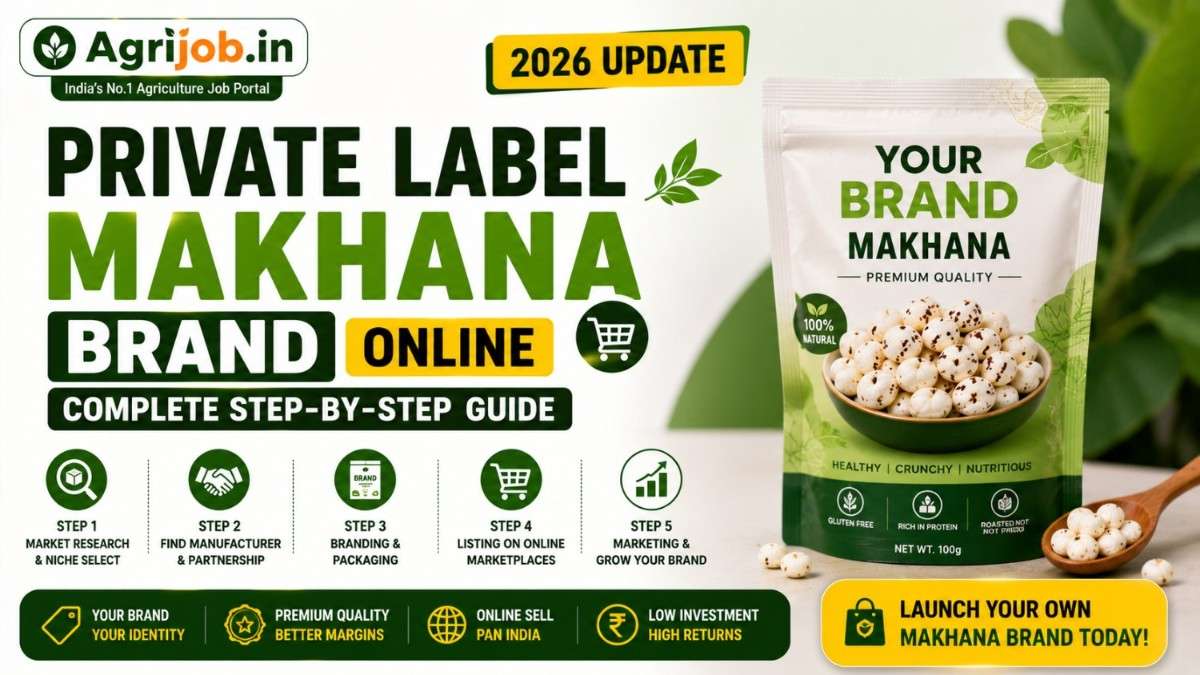
Starting a private label makhana brand online in 2026 requires 4 mandatory steps: (1) FSSAI registration from as low as Rs.100/year via foscos.fssai.gov.in, (2) a contract manufacturing agreement with a Bihar-based makhana processor with MOQ as low as 100 kg, (3) FSSAI-compliant food-grade packaging with a 14-digit license number, and (4) listing on Amazon, Flipkart, or your own Shopify store. Total startup investment ranges from Rs.25,000 to Rs.2,00,000 depending on scale and flavour count.
- India Makhana Market Size (2025): Rs.9,290 crore (IMARC Group)
- Market CAGR 2026–2034: 8.85% — fastest-growing healthy snack category
- FSSAI Registration Fee: Rs.100/year (Basic) · Rs.2,000–5,000/year (State) · Rs.7,500/year (Central)
- FSSAI Validity (2026 update): Perpetual — no renewal needed from April 1, 2026 (annual fee applies)
- Minimum MOQ (Contract Manufacturer): 100 kg flavoured / 500 kg raw (verified suppliers)
- Private Label Startup Cost: Rs.25,000–Rs.2,00,000 (brand launch packages from Rs.4,999)
- Retail Selling Price Range: Rs.120–Rs.350 per 100g (branded, flavoured)
- Raw Makhana Cost (4–5 Suta): Rs.700–Rs.1,200/kg at source (Bihar, 2026)
- Marketplace Commission (Amazon/Flipkart): 15–30% per sale
- GI Tag: Mithila Makhana — GI-certified product carries premium pricing power
- What Is a Private Label Makhana Brand?
- Who Should Start a Private Label Makhana Brand?
- Makhana Market Opportunity and Profit Margins in 2026
- FSSAI Registration for Your Makhana Brand — Complete 2026 Process
- How to Start a Private Label Makhana Brand — 9-Step Process
- Makhana Packaging Design and FSSAI Labelling Rules
- Private Label vs White Label Makhana — Which Is Better for Your Brand?
- Pros and Cons of Starting a Private Label Makhana Brand
- Important Terms and Concepts in the Makhana Business
- Important Dates and Compliance Calendar
- Important Links for Makhana Brand Founders
- Conclusion
- Key Takeaways
- Frequently Asked Questions
What Is a Private Label Makhana Brand?
A private label makhana brand is a business model where you sell makhana (fox nuts) under your own brand name, without manufacturing the product yourself. You source roasted, flavoured, or raw makhana from a contract manufacturer — primarily in Bihar, India’s makhana capital — and sell it in your own custom packaging. The manufacturer handles processing; you handle branding, marketing, and distribution.
This is different from trading in loose makhana. With private labelling, the product carries your brand name, your FSSAI number, your logo, and your flavour identity. Customers buy your brand — not a generic commodity. This model lets founders enter the Rs.9,290 crore makhana market with minimal capital, since there is no investment needed in processing equipment, factory space, or raw material harvesting infrastructure.

Bihar contributes approximately 85–90% of India’s total makhana output, with cultivation concentrated in the Mithila region — covering Darbhanga, Madhubani, Sitamarhi, Saharsa, and Katihar districts. Mithila Makhana received a Geographical Indication (GI) tag in 2022 from India’s GI Registry under the Ministry of Commerce, giving authentic Bihar-origin makhana significant premium pricing power in domestic and international markets.
Who Should Start a Private Label Makhana Brand?
This guide and the private label makhana model in 2026 is ideal for a specific set of people. Check if you match any of these profiles:
- 🌾 Agriculture graduates and agribusiness students who understand the supply chain and want to build a food brand without heavy capital investment
- 🏠 Home-based entrepreneurs and homemakers looking to start a small food brand with Rs.25,000–Rs.1,00,000 startup budget
- 🏭 Bihar or Jharkhand residents with proximity to makhana-growing districts — you get lower MOQ and better sourcing prices than anyone else
- 📱 D2C brand aspirants who want to sell on Amazon, Flipkart, Blinkit, or Zepto and build a recognisable healthy snack label
- 🌐 Export-oriented entrepreneurs targeting the US, Gulf, or UK market where demand for Indian superfoods is rising rapidly
- 🛒 Existing kirana or grocery store owners who want to white-label a product and sell it at higher margins than reselling national brands
- 💼 Agriculture officer and NABARD exam aspirants who also want a side income stream — a private label food brand is one of the most tax-efficient small businesses in India
- 🌱 Agritech and food startup founders looking for a validated product category with proven domestic and export demand before their next funding round
Makhana Market Opportunity and Profit Margins in 2026
The makhana business opportunity in 2026 is backed by hard market data, not speculation. Here is what the numbers look like for a private label brand founder:
| Metric | 2026 Value |
|---|---|
| India Makhana Market Size | Rs.9,290 crore (IMARC, 2025 base) |
| Projected Market by 2034 | Rs.19,950 crore at 8.85% CAGR |
| Raw Makhana (4–5 Suta) — Source Price | Rs.700–Rs.1,200/kg (Bihar, 2026) |
| Branded Makhana Retail Price (100g pack) | Rs.120–Rs.350 (plain to premium flavoured) |
| Gross Margin — Flavoured Branded Pack | 40–60% on MRP (before marketplace commission) |
| Amazon/Flipkart Commission | 15–30% per sale |
| Roasted Makhana Market Share | ~67% of total India market by volume |
| Annual Growth — Makhana Powder/Nutraceuticals | 10%+ per year |
| Bihar’s Share of Global Production | 85–90% of world makhana supply |
| GI Tag Advantage | Premium pricing command — 20–40% above generic |
A flavoured 100g makhana pack sourced at Rs.30–Rs.45 (product cost including manufacturing, flavouring, and packaging) and sold at Rs.199 MRP generates a gross margin of Rs.154 before marketplace fees. Even after paying 20% commission on Amazon and 18% GST, the unit economics remain healthy — especially for flavoured variants like Peri Peri, Himalayan Salt, or Cheese, which command the highest premiums.
FSSAI Registration for Your Makhana Brand — Complete 2026 Process
FSSAI (Food Safety and Standards Authority of India) registration is mandatory for every food business operator in India without exception, including private label brand owners who do not manufacture themselves. As of April 1, 2026, FSSAI has introduced perpetual validity for all new registrations — eliminating traditional renewal cycles, though an annual fee still applies. Operating without a valid FSSAI number attracts fines up to Rs.5 lakh and imprisonment up to 6 months under Section 63 of the Food Safety and Standards Act, 2006.
Your FSSAI registration type depends on your projected annual turnover:
| License Type | Who Needs It | Annual Fee | Processing Time |
|---|---|---|---|
| Basic Registration (Form A) | Turnover up to Rs.12 lakh/year | Rs.100/year | 7–10 days |
| State License (Form B) | Turnover Rs.12 lakh to Rs.20 crore | Rs.2,000–Rs.5,000/year | 30–60 days |
| Central License | Turnover above Rs.20 crore / export / multi-state | Rs.7,500/year | 60–90 days |
For most first-time private label makhana founders, the State License (Form B) is the recommended starting point — even if your current turnover is under Rs.12 lakh — because Amazon and Flipkart’s seller onboarding panels require a State or Central FSSAI license for all packaged food categories. A Basic Registration certificate may limit your ability to list on premium food marketplaces.
Apply 100% online via the FoSCoS portal (foscos.fssai.gov.in). Documents required for State License include: Aadhaar/PAN, address proof, entity constitution documents (proprietorship/LLP), list of food products, premises layout plan, water test report, and NOC from the contract manufacturer. The 2026 FoSCoS portal now mandates geo-tagged photos for Central License applications.
As a private label brand owner, your FSSAI number appears on the label — not your contract manufacturer’s. This means all labelling compliance liability sits with you, not the factory. Review your label against FSSAI’s FSS (Labelling and Display) Regulations, 2020 before printing any packaging. A mislabelled batch means a product recall at your cost, not the manufacturer’s.
How to Start a Private Label Makhana Brand — 9-Step Process
Follow this exact sequence to launch your private label makhana brand online in 2026. Each step builds on the previous one — skipping steps or reversing the order leads to wasted investment in packaging or inventory before compliance is in place.
- Register your business entity. Register as a Sole Proprietorship (simplest), LLP, or Private Limited Company depending on scale. A proprietorship with a current account in your business name is sufficient for starting out. Cost: Rs.0–Rs.500 (proprietorship) to Rs.6,000–Rs.15,000 (LLP/Pvt Ltd via online portals).
- Apply for GST registration. GST registration is mandatory from day one if you plan to sell on Amazon, Flipkart, or Meesho — all e-commerce platforms require it for seller onboarding regardless of turnover. Apply via the GST portal (gst.gov.in). The process takes 5–7 working days and is free of government fee.
- Obtain FSSAI State License. Apply on foscos.fssai.gov.in. Choose “State License” (Form B) and select “Repacker/Relabeller” or “Trader” as your Kind of Business (KoB) if you are not manufacturing. Approval in 30–60 days. Fee: Rs.2,000–Rs.5,000/year.
- Finalise your product range and makhana grade. Choose 1–3 SKUs to launch. Popular entry SKUs: (a) Plain Roasted 4 Suta, (b) Himalayan Pink Salt 5 Suta, (c) Peri Peri Flavoured. Higher Suta grades (5–6) command premium retail prices and position your brand in the healthy snack segment.
- Source a verified contract manufacturer in Bihar. Contact manufacturers in Darbhanga, Katihar, or Madhubani. Verify: FSSAI license of manufacturer, FSMS (Food Safety Management System) plan, food-grade processing facility, and past private label clients. Request a product sample before placing any order. MOQ for flavoured private label starts at 100 kg with verified suppliers.
- Design FSSAI-compliant packaging. Commission a graphic designer to create a standup zipper pouch design (100g, 200g, 500g SKUs are most common). Ensure all 10 mandatory FSSAI label elements are present before printing. Minimum packaging run: 1,000–10,000 pouches (varies by printer). Use food-grade PET or kraft laminated pouches with nitrogen flushing for 6–12 month shelf life.
- Register your brand trademark (recommended, not mandatory for launch). File a trademark application via the IP India portal (ipindia.gov.in) to protect your brand name. Fee: Rs.4,500 for individuals/startups. Trademark registration takes 12–18 months but TM status (™) is valid from filing date. Some marketplaces require a trademark for brand registry enrolment.
- Onboard onto e-commerce marketplaces. Start with Amazon Seller Central (sellercentral.amazon.in) and Flipkart Seller Hub (seller.flipkart.com). Documents needed: GST certificate, FSSAI license, PAN, bank account, brand trademark (for Amazon Brand Registry). Listing approval for food categories takes 3–14 days. Optimise product listings with accurate nutritional info, ingredient list, and high-quality product images.
- Launch D2C store and quick-commerce listings. Build a Shopify or WooCommerce store for direct sales with higher margins (no marketplace commission). List on Blinkit, Zepto, and Swiggy Instamart for impulse-purchase visibility. Run Instagram and WhatsApp marketing simultaneously — makhana is a highly visual product that converts well through social proof and influencer reviews.
Makhana Packaging Design and FSSAI Labelling Rules
Packaging is your biggest brand differentiator on an e-commerce listing page. In 2026, the best-performing makhana packs use standup zipper pouches with matte finish, bold typography, and benefit-led front panels (“High Protein · Gluten Free · Roasted Not Fried”). Here is the complete FSSAI mandatory labelling checklist every makhana pack must pass before printing:
| # | Mandatory Label Element | 2026 Requirement |
|---|---|---|
| 1 | Product Name | Standard/common name — “Roasted Makhana” or “Flavoured Fox Nuts” |
| 2 | List of Ingredients | Descending order by weight; allergens in bold |
| 3 | Nutritional Information | Per 100g: energy (kcal), protein, carbs, sugars, fat, saturated fat, trans fat, sodium |
| 4 | Net Quantity | Metric units only — grams (g) or kilograms (kg) |
| 5 | FSSAI 14-Digit License Number | Starts with 1 or 2; must be printed, not handwritten |
| 6 | Manufacturer Details | Full name and address of contract manufacturer |
| 7 | Brand Owner / Marketer Details | Your brand name, address — “Marketed by: [Your Brand Name]” |
| 8 | Best Before / Expiry Date | “Best Before [Day Month Year]” for shelf life over 3 months |
| 9 | Batch/Lot Number | For traceability in case of recall |
| 10 | Veg/Non-Veg Symbol | Makhana = Green circle inside green square (vegetarian) |
| 11 | FSSAI Logo | Green triangle + “FSSAI” — obtain artwork from FSSAI; do not recreate |
| 12 | MRP / Price (if printed) | MRP inclusive of all taxes, in Indian Rupees |
Common labelling mistakes that cause product recalls or marketplace listing rejection include: using “gms” instead of “g”, claiming “No Preservatives” when INS 202 (potassium sorbate) is present, missing trans fat declaration, wrong veg symbol colour, and not printing Best Before on the label itself (only on the packaging). Non-compliance attracts fines up to Rs.3 lakh and potential product seizure.
For packaging format, the recommended choice for online-first brands is a standup zipper pouch in food-grade PET/aluminium laminated material with nitrogen flushing capability. This preserves makhana freshness for 6–12 months and reduces breakage during courier delivery. Minimum order at most pouch printers: 5,000–10,000 pieces for custom-printed pouches, with costs averaging Rs.4–Rs.12 per pouch depending on size and print complexity.
Private Label vs White Label Makhana — Which Is Better for Your Brand?
Many first-time founders confuse private labelling with white labelling. The distinction directly affects your brand differentiation, margins, and long-term equity.
| Parameter | Private Label Makhana | White Label Makhana |
|---|---|---|
| Product Customisation | High — custom flavour, grade, roast profile | Low — standard product, your label only |
| Minimum Order Quantity (MOQ) | 100–500 kg (slightly higher) | 50–100 kg (lowest entry point) |
| Time to Market | 3–6 weeks (development + approval) | 7–14 days (product already exists) |
| Brand Differentiation | High — unique flavour, grade, story | Low — similar to other white label brands |
| Long-term Margins | Higher — brand commands premium pricing | Lower — commoditised positioning |
| Startup Investment | Rs.50,000–Rs.2,00,000 | Rs.15,000–Rs.50,000 |
| Flavour Innovation | Yes — develop signature flavours | No — pre-existing standard flavours |
| Best For | D2C brands building long-term equity | Quick market test or kirana store launch |
For founders building a scalable online brand, private label makhana manufacturing is the stronger long-term choice. While white label requires lower initial capital and gets you to market faster, private labelling gives you the ability to create a signature flavour, control quality specifications, and build a brand identity that can command Rs.250–Rs.350 per 100g instead of the Rs.120–Rs.150 a generic white label product fetches. Start with 1 white label SKU if your budget is under Rs.25,000 — then migrate to private label once your first 200 orders validate the concept.
Pros and Cons of Starting a Private Label Makhana Brand
A balanced evaluation of the private label makhana business model helps you go in with realistic expectations and plan for the challenges before they become setbacks.
✅ Advantages
- Low capital entry: You do not need a factory, machines, or processing staff. Contract manufacturers handle production while you focus on brand building.
- Proven market demand: Makhana is already a validated product with 8.85% CAGR growth — you are entering a growing category, not creating demand from scratch.
- GI-tag premium: Sourcing from Mithila region gives you the ability to market authentic GI-certified makhana, which commands a 20–40% price premium over generic fox nuts.
- Scalable D2C model: Amazon, Flipkart, Blinkit, and Zepto give instant national distribution on day one without distributor or logistics setup.
- High repeat purchase: Health-conscious consumers who switch to makhana snacking tend to reorder monthly, giving strong customer lifetime value (LTV).
❌ Disadvantages
- Raw material price volatility: Makhana harvest runs June–August annually. Off-season sourcing prices rise by 20–30%, affecting your COGS and margins if you don’t bulk-stock during harvest.
- Packaging MOQ challenge: Custom pouch printers typically require 5,000–10,000 piece minimum runs. For a new brand with 3 SKUs, this creates Rs.60,000–Rs.1,20,000 upfront packaging spend before your first sale.
- High marketplace competition: Over 200 makhana brands now compete on Amazon. Ranking requires continuous ad spend (Amazon PPC) of 15–25% of sales in the first 6 months.
- Labelling compliance complexity: FSSAI labelling for private label brands is strict — you carry full liability for the manufacturer’s product under your label.
Important Terms and Concepts in the Makhana Business
Understanding these 10 high-value terms gives you a vocabulary edge in supplier negotiations, marketplace listings, and investor conversations:
- Suta Grade: The sizing classification for makhana. 3 Suta = small, 4 Suta = standard, 5 Suta = large, 6–7 Suta = jumbo premium. 7 Suta is 40–60% more expensive than 4 Suta and used exclusively for premium retail and export.
- GI Tag (Geographical Indication): Mithila Makhana received GI recognition in 2022. Only makhana grown in 10+ key Bihar districts can be labelled “Mithila Makhana”. This is a brand moat that mass manufacturers cannot replicate.
- FSSAI 14-Digit License Number: Your mandatory food business identifier. Numbers starting with 1 = Basic Registration; starting with 2 = State/Central License. Must appear on every pack you sell.
- Contract Manufacturing: You pay a Bihar-based processor to produce makhana to your specifications — grade, flavour, roast level — under their food-grade facility, but under your brand name.
- MOQ (Minimum Order Quantity): The smallest batch a manufacturer will accept. For flavoured private label, typical MOQ is 100 kg. For bulk raw makhana, 500 kg is standard.
- D2C (Direct-to-Consumer): Selling directly to end customers via your website, bypassing distributors. Higher margins but requires building your own traffic and trust.
- FoSCoS Portal: Food Safety Compliance System — the official online portal (foscos.fssai.gov.in) for all FSSAI licensing, annual returns, and compliance filings.
- Nitrogen Flushing: Replacing oxygen inside the sealed pouch with nitrogen gas to prevent oxidation and extend shelf life to 6–12 months. Essential for flavoured makhana packed in PET pouches.
- Amazon Brand Registry: Amazon’s programme that gives brand owners tools to protect their listings, add A+ content, and run brand-specific ads. Requires a registered trademark to enrol.
- HFSS Labelling (2026–27): FSSAI’s upcoming Front-of-Pack Nutrition Labelling for products high in fat, sugar, or salt. Makhana — being naturally low in fat — is well-positioned to benefit from this regulation as competing snacks face warning labels.
Important Dates and Compliance Calendar
| Date / Period | Event / Action Required |
|---|---|
| April 1, 2026 | FSSAI perpetual validity regime commenced — no renewal needed, annual fee applies |
| May 31 (every year) | FSSAI Annual Return filing deadline via FoSCoS portal (Form D) — penalty for late filing |
| June–August (annual) | Bihar makhana harvest season — best time to negotiate sourcing contracts and bulk stock |
| September–October | Post-harvest price stabilisation — ideal window to finalise packaging orders |
| October–January | Peak makhana demand season (Navratri, Diwali, winter health snacking) — launch before October for maximum D2C sales velocity |
| Before printing packaging | Verify label compliance against FSS (Labelling and Display) Regulations, 2020 — mandatory before any print run |
| 2026–27 (expected) | FSSAI HFSS Front-of-Pack labelling rollout — makhana brands should prepare product positioning accordingly |
Important Links for Makhana Brand Founders
| Resource | Link |
|---|---|
| FSSAI Official Registration Portal (FoSCoS) | foscos.fssai.gov.in |
| FSSAI Helpline (Toll Free) | 1800-11-2100 |
| GST Registration Portal | gst.gov.in |
| Trademark Registration (IP India) | ipindia.gov.in |
| Amazon Seller Central India | sellercentral.amazon.in |
| Flipkart Seller Hub | seller.flipkart.com |
| NABARD Agri-Business Support Schemes | nabard.org |
| ICAR-NRCM (Makhana Research Centre) | icar.org.in |
| AgriJob.in — Agri Business Guide | AgriTech Startups India 2026 Guide |
| AgriJob.in — Bihar Agriculture Careers | Bihar Agriculture Service Exam 2026 |
Conclusion — Your Next Step Toward Launching a Makhana Brand
Starting a private label makhana brand online in 2026 is one of the most accessible food business opportunities for Indian entrepreneurs — with a market growing at 8.85% CAGR, a minimum startup investment under Rs.50,000 for a basic launch, and a full regulatory pathway available through FSSAI’s digital FoSCoS portal. The combination of Bihar’s unmatched sourcing advantage, the Mithila Makhana GI tag, and India’s expanding D2C ecosystem creates a genuinely favourable window for new entrants right now.
Your immediate next step: visit foscos.fssai.gov.in, choose your license type (State License recommended for e-commerce sellers), and begin your application. Simultaneously, contact 2–3 verified contract manufacturers in Darbhanga or Katihar for sample orders. Do not invest in packaging until your FSSAI number is in hand. Bookmark this page — we update it with every regulatory change from FSSAI and every new platform requirement from Amazon and Flipkart.
- India’s makhana market is worth Rs.9,290 crore (2025) and growing at 8.85% CAGR — entry window is now, not later
- FSSAI registration costs as little as Rs.100/year (Basic) to Rs.5,000/year (State License) and is fully online via foscos.fssai.gov.in
- Private label MOQ starts at 100 kg for flavoured makhana — brands can launch with as little as Rs.25,000–Rs.50,000 total investment
- 12 mandatory elements must appear on every FSSAI-compliant makhana label — non-compliance attracts fines up to Rs.3 lakh
- Mithila Makhana GI tag (2022) is a genuine brand moat — source from Bihar’s key districts to command 20–40% premium pricing
- Start on Amazon or Flipkart first — marketplace traffic gives instant national reach while your own D2C store builds organic trust
Frequently Asked Questions About Private Label Makhana Brand Online 2026
What is the minimum investment to start a private label makhana brand in India?
The minimum realistic investment for a private label makhana brand launch in 2026 is approximately Rs.25,000–Rs.50,000 for a white label test batch with basic branded packaging. A true private label launch with custom flavour, premium packaging, and 1–2 SKUs typically requires Rs.75,000–Rs.2,00,000. This covers FSSAI registration (Rs.2,000–Rs.5,000), GST registration (free), custom pouch printing (Rs.20,000–Rs.60,000 for 5,000 units), first product batch (Rs.15,000–Rs.50,000 for 100–200 kg), and marketplace listing and initial PPC budget (Rs.5,000–Rs.20,000).
Do I need FSSAI registration if I use a contract manufacturer who already has FSSAI license?
Yes, absolutely. Your contract manufacturer’s FSSAI license covers their manufacturing premises and operations — it does not cover your brand. As the private label brand owner (the entity whose name appears on the packaging as “Marketed by”), you must obtain your own FSSAI license. The 14-digit FSSAI number printed on the consumer pack must be your license number, not the manufacturer’s. This is a critical compliance requirement under FSS Act 2006 that many first-time private label founders overlook.
Which makhana grade should I choose for a premium D2C brand?
For a premium D2C brand targeting urban health-conscious buyers on Amazon and Instagram, the recommended grade is 5 Suta (large) or 6 Suta (jumbo). These grades have superior visual appeal in packaging — larger puffs look more substantial in product photography — and justify a higher MRP of Rs.200–Rs.350 per 100g. 4 Suta is adequate for mass-market or kirana store positioning but limits your average selling price to Rs.120–Rs.170 per 100g. For a GI-authentic premium line, source specifically from the Mithila region in Bihar and highlight this provenance on your packaging.
Can I sell makhana on Amazon without a trademark?
Yes, you can list and sell makhana on Amazon India without a registered trademark. A trademark is not mandatory for a standard seller account. However, to access Amazon Brand Registry — which unlocks A+ content pages, brand stores, sponsored brand ads, and listing protection — a registered trademark (or at least a pending trademark with an active TM number from ipindia.gov.in) is required. For Flipkart, a trademark is not required for standard onboarding but is recommended for long-term brand protection.
What is the shelf life of packaged makhana and how do I extend it?
Plain roasted makhana in food-grade pouches has a standard shelf life of 3–6 months. Flavoured makhana, due to added seasonings (which may introduce moisture), typically achieves 3–4 months without nitrogen flushing. With nitrogen flushing — where oxygen inside the sealed pouch is replaced with inert nitrogen gas — shelf life extends to 6–12 months. For online businesses shipping across India, nitrogen-flushed packaging is strongly recommended to reduce returns due to staleness. Confirm with your packaging supplier that their standup pouches are compatible with nitrogen flushing equipment at your contract manufacturer’s facility.
How much does a makhana private label brand earn per month?
Monthly earnings depend entirely on sales volume and pricing. A mid-tier private label makhana brand selling 500 units/month at Rs.199 MRP earns Rs.99,500 gross revenue. After Amazon commission (20%, ~Rs.19,900), marketplace ads (15%, ~Rs.14,925), COGS including packaging (Rs.35–Rs.45 per unit = Rs.17,500–Rs.22,500), and GST reconciliation, net monthly profit is approximately Rs.20,000–Rs.35,000 at this scale. Brands selling 2,000+ units/month through a combination of D2C + marketplaces + quick-commerce report monthly net margins of Rs.1.2–Rs.2.5 lakh.
Is the Mithila Makhana GI tag useful for my brand?
The Mithila Makhana GI tag (granted 2022) is one of the strongest brand assets available to any private label makhana business sourcing from Bihar. GI-certified makhana can be labelled and marketed as “Authentic Mithila Makhana”, which commands a significant price premium — typically 20–40% above unbranded or non-GI fox nuts. To use the GI designation legitimately, your makhana must be sourced from authorised producers in the designated Bihar districts. Your contract manufacturer must hold proof of GI-compliant sourcing. Only authorised producers can label their product with the GI designation; misuse of the GI tag is a legal violation.
What are the most common FSSAI label mistakes for makhana brands?
The most common and costly FSSAI labelling mistakes for makhana private label brands include: (1) using “gms” instead of “g” for net weight, (2) claiming “No Preservatives” when flavouring agents include INS 202 or INS 211, (3) missing trans fat in the nutrition table, (4) incorrect veg symbol — the symbol must be a green circle inside a green square, not a leaf or other shape, (5) printing Best Before only on the outer packaging and not on the consumer label itself, and (6) using a manufacturer’s FSSAI number instead of the brand owner’s number. Have your label reviewed by an FSSAI compliance consultant before committing to any print run — corrections post-printing are expensive and delay your launch.
How do I find a verified makhana contract manufacturer in Bihar?
Verified makhana contract manufacturers in Bihar can be found through: (1) IndiaMart and TradeIndia listings (search “private label makhana manufacturer Bihar”), (2) direct outreach to processors in Katihar, Darbhanga, and Madhubani districts, (3) ICAR-National Research Centre for Makhana (ICAR-NRCM) in Darbhanga, which maintains a list of registered processors, and (4) referrals from existing D2C makhana brand founders on LinkedIn and food entrepreneur communities. Before signing any contract manufacturing agreement, verify the manufacturer’s FSSAI license on the FSSAI public portal, visit the facility (or request a video walkthrough), request a product sample across 2–3 batches for quality consistency, and review their past private label client references.
This guide reflects FSSAI regulations as updated April 1, 2026 (perpetual validity regime), marketplace seller requirements as of July 2026, and makhana market data from IMARC Group and MarkNtel Advisors (2026 publications). Bookmark this page — we update it every time FSSAI regulations or platform requirements change.