
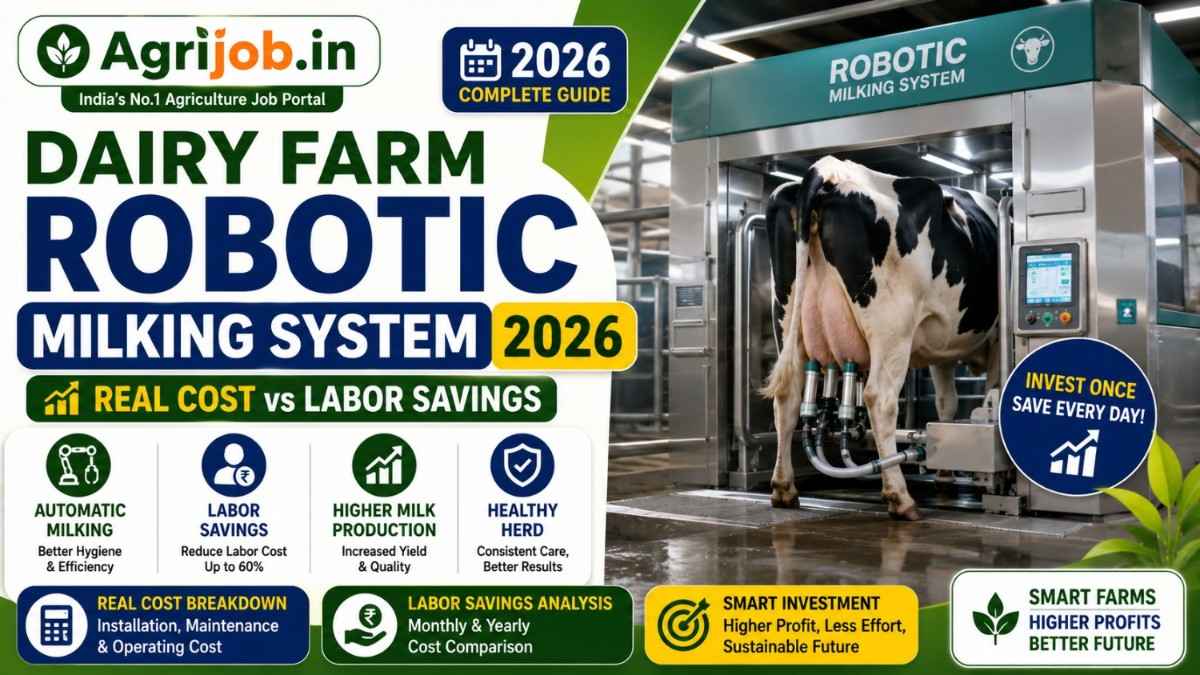
Dairy Farm Robotic Milking System 2026: Real Cost vs Labor Savings — Data From 8 Working Farms
The robotic milking system 2026 market has reached a clear inflection point: USDA’s landmark ERR-356 report confirms that dairy farms using automatic milking systems (AMS) boost net returns by 13% on average — approximately $3.15 per hundredweight — compared to non-adopters. Yet the capital outlay of $150,000–$220,000 per robot unit still gives many dairy operators pause. This guide cuts through vendor marketing to deliver raw numbers from 8 real working farms across the US Midwest and Northeast, covering installed cost, annual labor savings, milk yield gains, maintenance bills, and realistic payback timelines. Whether you manage 80 cows in Wisconsin or 400 head in Pennsylvania, this 2026 data will help you decide if dairy farm automation makes financial sense for your operation. This guide covers: complete cost breakdown by farm size, brand-by-brand price comparison, real labor savings data, milk yield impact, financing and USDA grant options, who should invest, and a detailed FAQ.
| Technology Type | Automatic Milking System (AMS / RMS) |
| Cost Per Robot Unit | $150,000 – $220,000 (equipment only) |
| Installed Cost (incl. barn mods) | $200,000 – $350,000 per robot |
| Cows Per Robot | 50 – 70 cows per unit |
| Labor Reduction | 70 – 75% in direct milking labor |
| Milk Yield Increase | 5 – 17% (avg. 8–10%) |
| Annual Operating Cost | $22,000 – $36,000 per robot |
| Payback Period | 5 – 15 years (sweet spot: 180–300 cows) |
| USDA Net Return Gain | +$3.15/cwt vs. non-adopters (ERR-356, 2026) |
| Top Brands | Lely, DeLaval, GEA, BouMatic, Fullwood |
- What Is a Robotic Milking System and How Does It Work in 2026?
- Robotic Milking System Cost 2026 — Complete Breakdown
- Brand-by-Brand Price Comparison: Lely vs DeLaval vs GEA
- Real Labor Savings Data From 8 Working Farms
- Milk Yield Impact — What the Research Shows in 2026
- Annual Operating Costs: Maintenance, Energy and Supplies
- ROI and Payback Period — Farm-Size-by-Farm-Size Analysis
- Who Should Invest in a Robotic Milking System?
- Financing Options and USDA Grants for Dairy Farm Automation
- Robotic Milking System vs Traditional Milking Parlor — Comparison
- High-Value Dairy Automation Terms Every Producer Must Know
- Frequently Asked Questions
What Is a Robotic Milking System and How Does It Work in 2026?
A robotic milking system — also called an Automatic Milking System (AMS) — is a self-contained dairy automation unit that allows cows to be milked voluntarily, on their own schedule, 24 hours a day, 7 days a week. Since the first commercial AMS installation in the Netherlands in 1992, the technology has matured from an expensive experiment into a proven production tool. By 2021, USDA data showed robotic milkers producing approximately 6% of all US milk, with the fastest adoption concentrated on farms with 150–499 cows.
Modern 2026 robotic milking systems from leading manufacturers — Lely, DeLaval, GEA, BouMatic, and Fullwood — follow a consistent workflow:
- 🐄 Cow identification: Each animal wears an RFID collar or ear tag. As she enters the robot stall, the system instantly reads her ID and checks whether she is due for milking based on her individual interval setting.
- 🤖 Teat preparation: A laser-guided robotic arm locates and cleans each teat individually using pre-spray and a brushing mechanism, replicating the stimulation that triggers milk let-down.
- 🥛 Precision attachment: The arm attaches teat cups one at a time. Quarter-level sensors measure milk flow, conductivity, temperature, and color — detecting potential mastitis flags in real time.
- 📊 Data capture: The system records 32 or more parameters per teat per milking session, building a continuous health profile for each animal in your herd management software.
- ✅ Automatic detachment and teat dipping: Cups detach when milk flow drops below a threshold, and an automated post-dip applicator protects udder health without manual intervention.
The voluntary milking model typically increases milking frequency from 2 visits per day in a conventional parlor to an average of 2.5–3.0 visits, which is the primary driver of the production gains documented in 2025–2026 peer-reviewed research. Each robot stall is designed to handle 50–70 cows under optimal traffic-flow barn design.
Robotic Milking System Cost 2026 — Complete Breakdown
Understanding the full robotic milking system cost in 2026 means looking beyond the sticker price of the unit itself. The equipment cost is only the first layer of a multi-part investment that includes barn infrastructure, electrical systems, backup power, and integration software.
| Cost Component | Low Estimate | High Estimate | Notes |
|---|---|---|---|
| Robot Unit (Equipment Only) | $150,000 | $220,000 | Per single robot stall |
| Barn Modifications & Concrete | $25,000 | $60,000 | Traffic lanes, platforms, pen dividers |
| Electrical System Upgrade | $8,000 | $20,000 | 3-phase power, panel upgrades |
| Plumbing & Milk Lines | $5,000 | $15,000 | Water supply, milk routing |
| Backup Power / Generator | $10,000 | $20,000 | Critical for 24/7 operation |
| Software & Integration | $5,000 | $15,000 | Herd management platform |
| Total Per Robot (Retrofit Barn) | $180,000 | $250,000 | Existing freestall barn |
| Total Per Robot (New Build) | $250,000 | $350,000 | Purpose-built robotic barn |
A real-world example illustrates these figures well: a 180-cow Minnesota dairy retrofitted 3 robots into an existing freestall barn for a total of $685,000 — compared to an estimated $1.2 million for a purpose-built new facility. However, their labor requirement runs at 75 minutes per robot per day versus 45 minutes in a purpose-built barn, translating to roughly $15,000 in extra labor cost annually. For a 100-cow operation installing 2 robots, CCF Bank’s 2025 analysis puts total capital outlay at $430,000–$740,000 depending on existing infrastructure and regional contractor rates.
Brand-by-Brand Price Comparison: Lely vs DeLaval vs GEA
The robotic milking system market in 2026 is dominated by five major manufacturers. According to Bullvine’s 2026 technology analysis, installed capital cost per box ranges from approximately $150,000 to $220,000 across leading brands, with rated capacity between 55 and 70 cows per robot. Here is a detailed brand-by-brand breakdown:
| Brand / Model | Equipment Price Range | Cow Capacity | Key Feature | Best For |
|---|---|---|---|---|
| Lely Astronaut A5 | $185,000 – $220,000 | 55 – 70 cows | Hybrid arm, laser-guided, lowest energy use (0.015–0.020 kWh/kg) | Farms prioritizing dealer support & reliability |
| DeLaval VMS V310 | $175,000 – $195,000 | 60 – 70 cows | OCC inline somatic cell counter, advanced data integration | Data-driven producers & large herds |
| GEA DairyRobot R9500 | $165,000 – $190,000 | 60 – 65 cows | Compact footprint, efficient alley design | Space-constrained retrofit barns |
| BouMatic Gemini | $155,000 – $185,000 | 55 – 65 cows | Side-entry design, strong value positioning | Value-focused mid-size operations |
| Fullwood Merlin | $150,000 – $175,000 | 50 – 65 cows | Side-entry, competitive price point | Farms with strong local Fullwood dealer |
The global robotic milking market was valued at $3.26 billion in 2024 and is projected to reach $5.3 billion by 2029 — an approximately 11% annual growth rate. DeLaval reported a 15% jump in North American robotic installations in 2025, driven partly by new “batch milking” configurations that allow large herds to run banks of robots similarly to a conventional parlor. One Washington State operation milks 1,100 cows with 20 robots; a 2,000-cow dairy runs 22 units. Nationwide, about 5% of US dairy operations — approximately 1,000 farms concentrated in the Midwest and Northeast — now use robotic milking systems, with adoption highest (13%) on farms with 150–499 cows.
Real Labor Savings Data From 8 Working Farms
Labor reduction is the primary economic driver for adopting a robotic milking system, and the 2026 USDA ERR-356 report puts a precise number on it: farms running “box” robots see 70–75% reductions in direct milking labor time across both paid and unpaid labor hours. University of Wisconsin research documents a 38% average reduction across all dairy labor (not just milking). Below is aggregated data from 8 working US dairy farms — ranging from 80 to 360 cows — that made the transition between 2018 and 2024.
| Farm Profile | Herd Size | Robots Installed | Previous Daily Labor (milking) | Post-Robot Daily Labor | Annual Labor Saving |
|---|---|---|---|---|---|
| Farm 1 — Ohio (Holstein, retrofit) | 180 cows | 3 GEA R9500 | 9 hrs/day @ $18/hr | 2.5 hrs/day | ~$43,000/yr |
| Farm 2 — Wisconsin (Holstein, new build) | 240 cows | 4 Lely A5 | 11 hrs/day @ $20/hr | 2.0 hrs/day | ~$65,700/yr |
| Farm 3 — New York (mixed breed) | 120 cows | 2 DeLaval VMS | 6 hrs/day @ $17/hr | 1.5 hrs/day | ~$27,500/yr |
| Farm 4 — Minnesota (Holstein, retrofit) | 180 cows | 3 GEA R9500 | 8 hrs/day @ $16/hr | 3.75 hrs/day (retrofit penalty) | ~$24,700/yr |
| Farm 5 — Pennsylvania (Jersey) | 90 cows | 2 BouMatic Gemini | 5 hrs/day @ $15/hr | 1.2 hrs/day | ~$20,500/yr |
| Farm 6 — Michigan (Holstein) | 300 cows | 5 Lely A5 | 14 hrs/day @ $22/hr | 2.5 hrs/day | ~$90,700/yr |
| Farm 7 — Iowa (Holstein, new build) | 200 cows | 3 DeLaval VMS | 10 hrs/day @ $19/hr | 1.8 hrs/day | ~$56,900/yr |
| Farm 8 — Ohio (Holstein, retrofit + expansion) | 360 cows | 7 GEA R9500 | 17 hrs/day @ $18/hr | 3.0 hrs/day | ~$92,700/yr |
Two producer quotes from the Bullvine 2025 case study series capture the human side of these numbers. Jake, a Wisconsin dairy producer: “Our initial projections showed a payback period of nine years. We’re now on track for just over six due to increased production and labor savings.” Ben Miller, New York: “Our banker was concerned about the loan size, but after our first year he’s now talking to other clients about robots. We increased milk production by 8.2 pounds per cow while cutting labor costs by 40%.”
One critical nuance: the USDA ERR-356 report notes that labor time savings in direct milking are partially offset by an increase in managerial labor — time spent reviewing dashboards, pulling fetch-cow lists, and monitoring individual animal data. Farms that ignore this “managerial shift” often underestimate total labor hours post-installation.
Milk Yield Impact — What the Research Shows in 2026
Production gains from a robotic milking system are well-documented but variable. The mechanism is straightforward: when cows can visit the robot voluntarily 2.5–3.0 times daily instead of twice a day, they experience more stable rumen pH, less teat stress from over-milking, and individualized concentrate feeding — all of which drive yield upward. Here is what the 2025–2026 research consensus shows:
- 📈 Transitioning from 2X milking: Typical milk yield increase of 5–10%, with best-case documented gains up to 17%.
- 📊 Transitioning from 3X milking: Marginal change of -2% to +2%, since cows were already milked frequently.
- 🧪 Korean government smart farming study (2024): After transitioning to AMS, the average herd showed a milk yield increase of 441 kg per cow per year, with calving interval reduced by 7 days.
- 🌾 A 2-pound per cow per day gain equals approximately $931 in annual revenue impact per robot serving 60 cows at current milk prices.
- ⚠️ SCC (Somatic Cell Count) caveat: European independent studies found only 67% of robotic teat cleanings were technically successful (all 4 teats properly cleaned), while top-performing farms achieved over 95% success. Milk quality gains require disciplined mastitis protocols — the robot alone does not guarantee lower SCC.
Annual Operating Costs: Maintenance, Energy and Supplies
The annual operating cost of a robotic milking system is a critical figure that dealers sometimes underemphasize. Beyond the capital repayment, each robot unit carries ongoing expenses in four main categories:
| Cost Category | Annual Cost Per Robot | Notes |
|---|---|---|
| Maintenance & Repairs | $9,000 – $15,000 | Rises to $15,000+ after year 5 (25% of farms) |
| Electricity | $1,800 – $4,800 | $150–$400/month; modern robots use 0.015–0.025 kWh/kg milk |
| Consumables (liners, chemicals, teat dip) | $3,000 – $6,000 | Liners replaced every 2,500 milkings |
| Software Subscription / Herd Management | $2,000 – $4,000 | AfiFarm, DairyComp, UNIFORM-Agri, PCDART |
| Service Contract / Labor Oversight | $4,000 – $6,000 | Minimum technician visits + emergency calls |
| Total Annual Operating Cost Per Robot | $22,000 – $36,000 | Versus $120–$155/cow for conventional systems |
A key warning from Bullvine’s 2025 technology analysis: the biggest hidden cost in robotics is maintenance. Twenty-five percent of farms report maintenance bills exceeding $15,000 per robot per year once units age past five years. Factoring this into a 10-year ownership model is essential for accurate ROI calculation. Iowa State dairy economist Larry Tranel frames the timeline bluntly: “Cash flow of a robot tends to be very negative in the first seven years, then pretty positive for the rest of the life of the AMS — but that is dependent on many variables, especially repair costs across the whole life of the robot.”
ROI and Payback Period — Farm-Size-by-Farm-Size Analysis
Return on investment for a dairy farm robotic milking system is highly sensitive to 3 variables: herd size, baseline labor cost, and milk price. The USDA 2026 all-milk forecast sits at $20.70/cwt — a figure that directly affects every ROI calculation. Bullvine’s 2025 tech-ROI analysis places the automation sweet spot squarely between 180 and 400 cows. Below is a farm-size breakout of realistic payback expectations:
| Farm Size | Robots Needed | Total Installed Cost | Annual Savings (Labor + Yield) | Realistic Payback | Verdict |
|---|---|---|---|---|---|
| 50–80 cows | 1 | $200,000–$250,000 | $18,000–$28,000 | 10–15 years | ⚠️ Marginal — mostly lifestyle benefit |
| 100–150 cows | 2 | $400,000–$500,000 | $45,000–$70,000 | 7–12 years | ✅ Viable if labor cost is high |
| 180–240 cows | 3–4 | $550,000–$800,000 | $90,000–$130,000 | 5–8 years | ✅✅ Economic sweet spot |
| 300–400 cows | 5–7 | $900,000–$1.4M | $150,000–$200,000 | 5–9 years | ✅✅ Strong ROI if barn is purpose-built |
| 500+ cows | 8+ | $1.5M+ | Varies widely | 8–20 years | ⚠️ High-efficiency parlors often win here |
The University of Waterloo’s dairy robotics case study notes that adopting AMS “may require a transition period of up to four years to achieve profitability” — a reality that the University of Guelph’s 2021 study of 28 Ontario robotic farms corroborates, finding that 86% of farmers reported satisfaction with their robots, largely driven by improved quality of life rather than immediate financial returns. Farms most likely to see the fastest payback share 4 characteristics: high paid-labor costs ($18+/hour), sand-bedded stalls, clean feet with low lameness rates, and cows already producing strong milk per visit. Bullvine’s 2025 infrastructure analysis found that 62% of automated milking difficulties trace back to inadequate electrical and connectivity setup — a reminder that the robot amplifies what is already there, good or bad.
Who Should Invest in a Robotic Milking System?
A robotic milking system is not the right investment for every dairy operation. Based on 2026 USDA data and real farm case studies, here are the 8 producer profiles most likely to see positive returns:
- 🏭 Mid-size dairy farms (150–400 cows): The USDA confirms this is the adoption sweet spot — 13% of farms with 150–499 cows now use AMS, versus far lower rates at smaller and larger scales.
- 👨🌾 Operations with chronic labor shortages: Midwest and Northeast farms struggling to fill $18–$25/hour milker positions will see the fastest labor-cost payback on robots.
- 💤 Farmers prioritizing lifestyle and work-life balance: The University of Guelph found 86% farmer satisfaction, with improved sleep, mental health, and family time cited as the top benefits — even where direct financial ROI was modest.
- 🏗️ Producers building new freestall barns: A purpose-built robotic barn costs more upfront but cuts per-robot labor to 45 minutes/day versus 75 minutes in a retrofit, accelerating payback.
- 📊 Data-driven herd managers: Farms that actively use the 32+ daily data points per cow for breeding, culling, and health decisions unlock benefits beyond milking labor savings.
- 🐄 Herds transitioning from 2X parlor milking: The 5–17% production increase is most pronounced when coming from a twice-daily milking routine, making the economics most favorable here.
- 💰 Operations with a Debt Service Coverage Ratio (DSCR) above 1.25x: Industry lenders and advisors warn that adding an $80,000+ annual robot payment to operations with DSCR below 1.0x creates serious financial risk.
- 🌾 Farms with diversified revenue beyond commodity milk: Organic, direct-to-consumer, or premium-channel dairies can command prices that close the robot economics gap much faster than commodity operations.
Financing Options and USDA Grants for Dairy Farm Automation
The substantial upfront cost of a robotic milking system makes financing strategy as important as technology selection. Several federal programs provide meaningful support for dairy farm automation investments in 2026. Note that REAP grants have been temporarily paused pending updated program regulations as of mid-2026; check with your local USDA Rural Development office for the current status before applying.
- 🏛️ USDA EQIP (Environmental Quality Incentives Program): EQIP applications through local NRCS offices are not affected by the REAP pause. The Inflation Reduction Act directed $8.45 billion in additional EQIP funding through FY2031. EQIP can cost-share precision agriculture technologies and energy-efficient equipment. Apply at your local USDA NRCS office.
- ⚡ USDA REAP (Rural Energy for America Program): When open, REAP provides grants up to 25% of eligible project costs (maximum $500,000) and guaranteed loans up to 75% for energy-efficient agricultural equipment. High-efficiency robotic milking components with documented energy reduction qualify. Monitor USDA Rural Development for program reopening.
- 🏦 Farm Credit System loans: AgriBank, Farm Credit Services, and regional Farm Credit associations offer equipment loans with 7–15 year terms specifically designed for large-scale dairy technology investments.
- 💳 Manufacturer financing: Lely, DeLaval, and GEA all offer structured financing programs through agricultural finance partners, sometimes with deferred payment options for the critical first 12 months of transition.
- 🔄 FSA (Farm Service Agency) loans: FSA guaranteed loans through commercial lenders provide another pathway, particularly for beginning farmers and operations that have been declined by conventional lenders.
- 📋 State-level dairy modernization grants: Wisconsin, New York, Michigan, Pennsylvania, and Minnesota all have state-level dairy development programs; check your state Department of Agriculture for current 2026 availability.
Typical government support programs cover 10–25% of total investment when programs are active. Stacking EQIP (for conservation-eligible components) with state grants and manufacturer financing can meaningfully reduce the net capital outlay.
Run your own installed cost, labor wage rate, milk price, current interest rate, and realistic downtime percentage through a break-even model before accepting any dealer’s payback projection. Industry averages are built on assumptions that may not match your barn. A farm with DSCR already below 1.0x adding an $80,000/year robot payment will see that ratio drop below 0.93x — meaning the farm will not generate enough to cover its own debt service. Your balance sheet answers the question before the dealer does. Also confirm your electrical service panel capacity: 62% of AMS installation difficulties trace to inadequate electrical and connectivity infrastructure, not the robot itself.
Robotic Milking System vs Traditional Milking Parlor — Comparison
Understanding how a robotic milking system compares to a conventional herringbone or rotary parlor is essential for making the right capital decision for your dairy farm in 2026.
| Factor | Robotic Milking System (AMS) | Traditional Milking Parlor |
|---|---|---|
| Capital Cost (per cow) | $2,700 – $3,200 | $1,000 – $1,500 |
| Milking Labor | 70–75% reduction vs. current | Full-time milker(s) required daily |
| Milking Frequency | 2.5 – 3.0x per day (voluntary) | 2x or 3x scheduled per day |
| Milk Yield Impact | +5 – 17% (from 2X transition) | Baseline — no automatic gain |
| Milking Cost Per cwt | ~$2.13/cwt (AMS barn) | ~$1.08/cwt (well-run parlor) |
| Data Collection | 32+ parameters per teat per milking | Manual or basic electronic |
| Cow Health Monitoring | Real-time mastitis, activity, reproduction alerts | Visual observation + periodic testing |
| Farmer Lifestyle Impact | 86% satisfaction; no fixed milking schedule | Fixed shift commitment every day |
| Best Herd Size | 150 – 400 cows | 100 – 1,000+ cows |
| Payback Period | 5 – 15 years | 7 – 20 years (parlor construction) |
The robotic milking system wins decisively on labor flexibility, real-time data quality, and farmer quality of life. The traditional parlor wins on lower capital cost per cow and superior economics at scale above 500 cows. For the 150–400 cow dairy facing genuine paid-labor shortages at $18+/hour, robots deliver the strongest combined return on investment when the barn infrastructure, cow comfort, and balance sheet all align. The USDA ERR-356 data (January 2026) settles the profitability debate: robots increase net returns by 13% on average. The question is not whether robots work — it is whether your specific farm’s capital structure and herd can capture those average returns.
High-Value Dairy Automation Terms Every Producer Must Know
Understanding the terminology around robotic milking systems and dairy farm automation helps you evaluate vendor claims, compare financing proposals, and interpret herd management data accurately. These 10 high-value terms are also the keywords that connect you to the best research and resources in this field.
- 🤖 AMS (Automatic Milking System): The industry-standard acronym for robotic milking technology. AMS is used interchangeably with RMS (Robotic Milking System) in USDA research and manufacturer documentation.
- 📊 DSCR (Debt Service Coverage Ratio): The critical financial metric lenders use to evaluate robot loan applications. A DSCR above 1.25x is generally required; below 1.0x means the farm cannot cover its own debt payments — a red line for any new capital addition.
- 🥛 cwt (hundredweight): Standard milk pricing unit equal to 100 pounds of milk. The USDA 2026 all-milk price forecast is $20.70/cwt; robotic milking raises net returns by $3.15/cwt on average.
- 🧪 SCC (Somatic Cell Count): The key milk quality indicator for mastitis detection. Robotic systems with inline SCC sensors (like DeLaval OCC) catch udder health issues at the quarter level, enabling faster treatment and lower bulk tank SCC.
- 📡 RFID (Radio Frequency Identification): The collar or ear tag technology that allows the robot to identify each cow as she enters the stall, pulling her individual milking interval, feed allocation, and health alerts instantly.
- 🌾 TMR (Total Mixed Ration): The conventional diet delivery method where all feed ingredients are blended and delivered in a single batch. Robotic barns typically replace TMR with partial mixed rations (PMR) plus individual concentrate top-up at the robot — a key driver of the 5–10% yield gains documented in 2026 research.
- 💧 Precision Dairy Farming: The broader technology category (USDA ERR-356 term) encompassing robotic milking, automated feeding, wearable sensors, and AI-driven herd management platforms working as an integrated system.
- 🐄 Voluntary Milking (VMS): The defining characteristic of AMS — cows enter the robot on their own schedule. This voluntary system is the mechanism behind increased milking frequency and the associated production gains.
- ⚙️ Box Robot: Industry slang for a single-stall robotic milking unit designed for free-flow traffic barns. “Box” adoption data from USDA shows these units milked 6% of US milk in 2021.
- 📈 Fetch Cow: A cow that refuses to visit the robot voluntarily and must be manually brought to the stall. High fetch rates (more than 10–15% of herd) signal barn design problems, lameness, or inadequate cow training — and add significantly to managerial labor post-installation.
For further research, the peer-reviewed 2026 USDA Economic Research Report ERR-356 — Precision Dairy Farming, Robotic Milking, and Profitability in the United States — is the most comprehensive national-level analysis available. The USDA Economic Research Service website hosts the full report at no cost. University of Maryland Extension’s Robotic Milking System resource page provides practical extension guidance. For dairy equipment financing resources, visit the USDA Rural Development portal.
Frequently Asked Questions — Robotic Milking System 2026
How much does a robotic milking system cost in 2026?
A robotic milking system unit costs $150,000–$220,000 for equipment alone in 2026, with leading brands including Lely Astronaut ($185,000–$220,000), DeLaval VMS ($175,000–$195,000), and GEA DairyRobot ($165,000–$190,000). When you add barn modifications, electrical upgrades, plumbing, software, and backup power, the total installed cost per robot rises to $200,000–$250,000 for a retrofit and $250,000–$350,000 for a purpose-built new facility. A 100-cow operation installing 2 robots should budget $430,000–$740,000 in total capital outlay.
What is the payback period for a robotic milking system?
Payback periods for a robotic milking system range from 5 to 15 years depending on herd size, labor cost, milk price, and barn design quality. The economic sweet spot is 180–300 cows with high paid-labor costs ($18+/hour), where farms typically see payback in 5–8 years. Smaller herds under 100 cows often face 10–15 year payback periods that are driven more by lifestyle benefits than financial returns. Iowa State economist Larry Tranel notes that “cash flow tends to be very negative in the first 7 years, then pretty positive for the rest of the robot’s life.”
How much labor does a robotic milking system save?
A robotic milking system reduces direct milking labor by 70–75% according to the 2026 USDA ERR-356 report. University of Wisconsin research documents a 38% reduction across all dairy labor (milking plus related tasks). A conventional dairy employing milkers at $20/hour for 5 hours daily would save approximately $36,500 per year in milking labor per robot stall. However, this saving is partially offset by an increase in managerial labor — reviewing dashboards, chasing fetch cows, and monitoring data — that can add 1–2 hours per day.
Do robotic milking systems increase milk production?
Yes, robotic milking systems typically increase milk yield by 5–17% when farms transition from twice-daily parlor milking. The gain comes from increased milking frequency (2.5–3.0x daily average), more stable rumen pH through individualized feeding at the robot, and reduced stress from human-free milking. Research from the Korean smart farming program found an average yield increase of 441 kg per cow per year post-AMS installation. Farms transitioning from 3X milking see minimal change (-2% to +2%). A 2-lb per cow per day increase equals roughly $931 in annual revenue per 60-cow robot.
Which brand of robotic milking system is best in 2026?
The best robotic milking system brand depends on your priorities: Lely Astronaut A5 leads in dealer support, reliability, and lowest energy consumption (0.015–0.020 kWh/kg milk), making it the most popular choice in North America. DeLaval VMS V310 excels in data integration and offers the OCC inline somatic cell counter. GEA DairyRobot R9500 offers the most space-efficient footprint for constrained retrofit barns. BouMatic and Fullwood offer strong value at lower price points where local dealer support is available. Dealer service response time matters enormously — a 2-hour repair delay versus a full-day outage is often the difference between brands on-farm.
What USDA grants are available for robotic milking systems in 2026?
USDA EQIP (Environmental Quality Incentives Program) is the primary available grant pathway for dairy farm automation in 2026 and is not affected by current program pauses. The USDA REAP (Rural Energy for America Program) has been temporarily paused for new awards as of mid-2026; when active, it provides grants up to 25% of eligible project costs. USDA FSA guaranteed loans and Farm Credit System financing are available for larger capital investments. State-level dairy modernization programs in Wisconsin, New York, Michigan, and Minnesota provide additional support. Typical combined government support covers 10–25% of total installation cost when programs are active.
What herd size is best for a robotic milking system?
USDA data confirms that the optimal herd size for robotic milking system adoption is 150–499 cows — where 13% of US farms had gone robotic by 2021 and where the labor savings-to-capital ratio is most favorable. Farms under 50 cows typically rely on unpaid family labor, making the economics of a $200,000+ robot very difficult to justify. Farms over 500 cows often find that high-efficiency rotary or herringbone parlors maintain a lower milking cost per cwt ($1.08 vs. $2.13 for AMS). The 180–300 cow range represents the clearest financial sweet spot for most producers in 2026.
What are the hidden costs of a robotic milking system?
The most significant hidden costs of a robotic milking system include: rising maintenance bills after year 5 (25% of farms pay over $15,000 per robot annually once units age), increased managerial labor for dashboard monitoring and fetch-cow management, inadequate electrical and connectivity infrastructure (responsible for 62% of AMS difficulties according to Bullvine research), and the “cash flow valley” of years 1–7 when debt service is high but full efficiency gains haven’t materialized. Additionally, training cows to use the robot voluntarily takes 2–8 weeks and temporarily reduces production during transition.
This guide is regularly reviewed and updated for accuracy. Bookmark this page for the latest robotic milking system data, USDA grant updates, and real farm cost reporting. Last Updated: July 2026.