

FPO Registration 2026 – Rs.15 Lakh Grant, Step-by-Step Guide
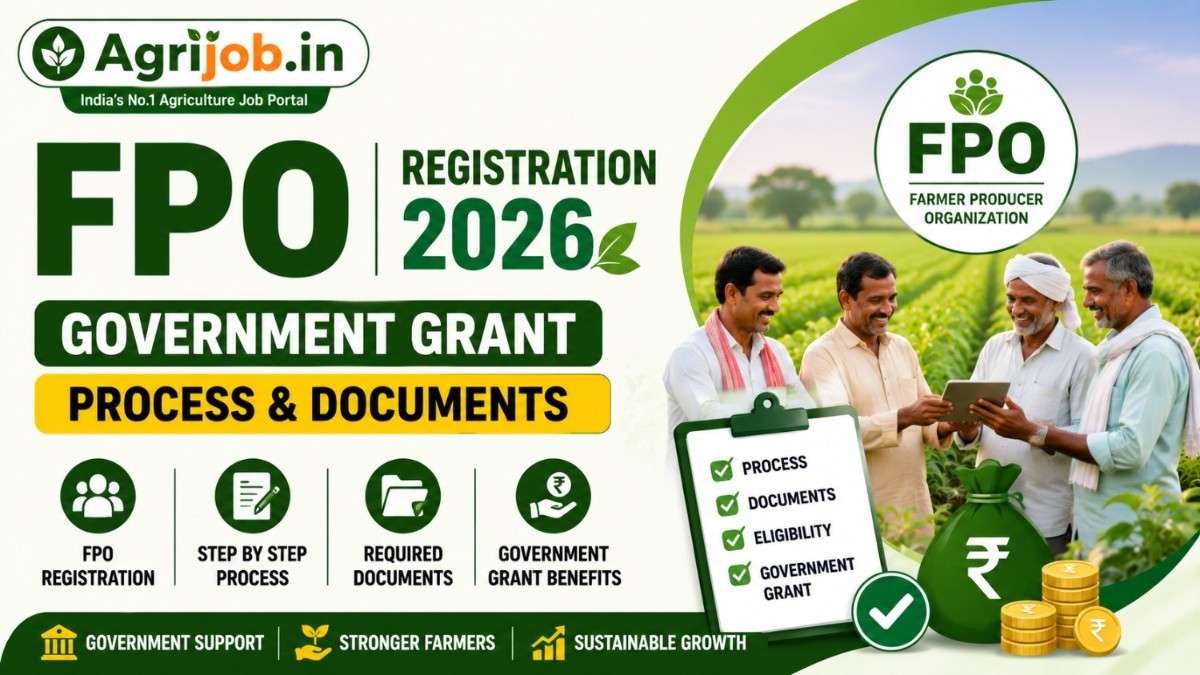
FPO registration in 2026 is the single most important step any group of Indian farmers can take to access Rs.15 lakh equity grant, Rs.18 lakh management support, Rs.2 crore credit guarantee, and lifelong collective bargaining power. If you and your fellow farmers want to stop selling crops at distress prices, buy inputs at wholesale rates, and build a sustainable agri-business — registering a Farmer Producer Organisation is how you start. This complete 2026 guide covers everything: what an FPO is, who can register, full eligibility criteria, required documents, the step-by-step registration process via the MCA portal, how to claim the government grant, common fraud warnings, a comparison table, and an 8-entry FAQ — so you have every answer in one place.

| Scheme Name | Central Sector Scheme for Formation & Promotion of 10,000 FPOs |
| Implementing Agency | SFAC, NABARD, NCDC, NAFED (Ministry of Agriculture & Farmers Welfare) |
| Equity Grant | Up to ₹15 lakh per FPO (Rs.2,000 per farmer member) |
| Management Support | Up to ₹18 lakh over 3 years per FPO |
| Credit Guarantee | Up to ₹2 crore project loan per FPO |
| Minimum Members | 10 farmers (Producer Company) / 300–500 (Cooperative) |
| Registration Time | 15–25 working days via MCA portal |
| Registration Cost | Rs.15,000–Rs.40,000 (govt fees + professional charges) |
| Tax Exemption | 100% for first 5 years under Section 80P |
| Official Portal | mca.gov.in + sfacindia.com |
- What is FPO Registration in India 2026?
- FPO Registration Government Grant & Financial Benefits
- FPO Registration Eligibility – Who Can Apply?
- Documents Required for FPO Registration
- Who Should Apply for FPO Registration 2026?
- Step-by-Step FPO Registration Process via MCA Portal
- How to Claim the Rs.15 Lakh Equity Grant After Registration
- FPO Registration vs Cooperative Society – Which Is Better?
- Key FPO & Agri-Business Terms You Must Know
- FPO Registration Fraud Warning – Red Flags to Avoid
- Frequently Asked Questions (FAQ)
What is FPO Registration in India 2026?
An FPO — Farmer Producer Organisation — is a legally recognised business entity formed exclusively by primary producers: farmers, horticulturists, dairy owners, fishers, and artisans. When you complete FPO registration, your group becomes a corporate body with limited liability, democratic governance (one member, one vote), and the legal power to sign contracts, open bank accounts, buy/sell produce in bulk, and access institutional finance.
In 2026, the most preferred legal structure is the Producer Company registered under Part IXA of the Companies Act, 1956 (Sections 581A to 581ZT), regulated by the Ministry of Corporate Affairs (MCA). This model combines cooperative principles with corporate transparency and is the model mandated under the Government of India’s flagship 10,000 FPO Scheme launched in February 2020, with a total budgetary outlay of Rs.6,865 crore.

Unlike individual farming, an FPO enables collective procurement of seeds, fertilisers, and pesticides at wholesale prices, aggregation of produce for bulk selling, access to eNAM digital trading, and negotiating power with large processors and exporters — advantages that are simply out of reach for the 86% of Indian farmers who are small and marginal with average land holdings under 1.1 hectare.
FPO Registration Government Grant & Financial Benefits 2026
The most compelling reason to complete FPO registration in 2026 is the government’s multi-layered financial support package. Here is a verified breakdown of every benefit available to newly registered FPOs under the Central Sector Scheme:
| Benefit Type | Amount / Value | Conditions | Disbursed By |
|---|---|---|---|
| Equity Grant (Matching) | Up to ₹15 lakh per FPO | Rs.2,000 per member; min. 50 shareholders; paid-up capital ≤ Rs.30 lakh | SFAC (2 tranches over 3 yrs) |
| Management Support | Up to ₹18 lakh over 3 years | Covers CEO salary, accountant, rent, equipment | SFAC via CBBO |
| Credit Guarantee | Up to ₹2 crore project loan | Registered on SFAC/eNAM portal; eligible lending institution | SFAC Credit Guarantee Fund |
| Tax Exemption | 100% for 5 years | Agricultural income; Section 80P of Income Tax Act | Income Tax Dept. |
| AIF Subsidy | 3% interest subvention | Post-harvest infra; Agricultural Infrastructure Fund | Ministry of Agriculture |
| Annual Earning Potential | ₹50 lakh–₹5 crore+ | Depends on member count, commodity, and market linkages | FPO own operations |
Important note on the Rs.15 lakh equity grant: This is a non-repayable matching grant — the government matches the equity raised from your farmer members, rupee for rupee, up to Rs.15 lakh. For example, if 750 members each contribute Rs.2,000 in share capital (total Rs.15 lakh), the government adds another Rs.15 lakh, effectively doubling your FPO’s equity base. These funds do not need to be repaid and directly strengthen your FPO’s balance sheet for bank loan eligibility.
FPO Registration Eligibility – Who Can Apply?
FPO registration eligibility under the Companies Act (Producer Company model) is straightforward. Here are the complete criteria for 2026:
| Eligibility Criterion | Requirement |
|---|---|
| Minimum Members | 10 individual primary producers OR 2 producer institutions (cooperatives, SHGs, other FPOs) |
| Minimum Directors | 5 directors elected from member farmers (max. 15 directors) |
| Producer Status | All members must be engaged in primary production: farming, dairy, horticulture, fishery, handloom, or handicrafts |
| Women Participation | At least 1 woman on the Board of Directors; FPOs with higher women shareholding get grant preference |
| Small/Marginal Farmer % | Minimum 50% of shareholders must be small, marginal, or landless tenant farmers (for equity grant) |
| Educational Qualification | No minimum qualification required for directors or members |
| Age Limit | No age limit under the Companies Act; must be a legal adult (18+) |
| Paid-Up Capital Cap | Must not exceed Rs.30 lakh at time of equity grant application |
| Location | Must operate within an identified Agri-Produce Cluster or “One District One Product” zone (for scheme benefits) |
There is no application fee to register with SFAC or apply for the equity grant. The registration cost of Rs.15,000–Rs.40,000 covers MCA government stamp duty, DSC charges, professional (Company Secretary) fees, and document preparation — these are one-time startup costs, not ongoing fees.
Documents Required for FPO Registration 2026
Collecting the right documents before beginning your FPO registration prevents delays. Here is a categorised checklist of everything you need:
For Each Director (Minimum 5 Directors)
- 🪪 Aadhaar Card — original and self-attested copy
- 📋 PAN Card — mandatory for all directors
- 📸 Passport-size photograph — recent, white background
- 🔑 Class 3 Digital Signature Certificate (DSC) — obtained from eMudhra, Sify, or other licensed Certifying Authority (cost: Rs.1,000–Rs.2,000 per director)
- 🆔 Director Identification Number (DIN) — applied via MCA V3 portal using SPICe+ Form Part B
- 🏡 Residential Address Proof — bank statement, utility bill, or Voter ID (not older than 2 months)
For Each Farmer Member
- 🌾 Proof of Agricultural Activity — land records (Khatauni), Kisan Credit Card, produce sale receipts, or lease agreement for tenant farmers
- 🪪 Aadhaar Card — for identity and demographic verification
- 📋 PAN Card (if available)
- 📸 Passport-size photograph
For the FPO Entity (Registered Office)
- 🏢 Registered Office Address Proof — sale deed or rent/lease agreement in the name of the FPO or any director
- 💡 Utility Bill — electricity or water bill of registered office (not older than 2 months)
- 📄 NOC from Property Owner — written No Objection Certificate allowing use of premises as registered office (if rented)
- 📝 Memorandum of Association (MoA) — drafted per Part IXA objectives; must include primary produce activities
- 📝 Articles of Association (AoA) — internal governance rules: membership, shareholding, dividend, and voting procedures
- 💼 18-Month Business Plan — required for equity grant application; must show a revenue model
- 🏦 Audited Accounts — one full financial year’s audited accounts by a Chartered Accountant (for equity grant; not required at registration stage)
Who Should Apply for FPO Registration 2026?
- 🌾 Small and marginal farmers who sell individually at mandi rates and want to negotiate better prices by aggregating produce — FPO registration gives you collective bargaining power the government supports with ₹15 lakh equity grant.
- 👩🌾 Women farmer groups and self-help groups (SHGs) who are already working collectively — government gives preference in equity grants to FPOs with higher women membership, and 1,175+ women-only FPOs have successfully registered under the 10,000 FPO Scheme.
- 🏡 Village-level farmer clubs or informal cooperatives looking to formalise — FPO registration converts your informal group into a legally recognised corporate entity with limited liability protection.
- 🌿 Organic farming clusters and specialty crop producers (horticulture, spices, medicinal plants) who want to access export markets, eNAM digital trading, and institutional buyers — registration unlocks these connections.
- 🐄 Dairy, poultry, and fishery communities — primary producers beyond crop farming can form FPOs; the Companies Act covers all primary produce activities, and NABARD actively supports dairy and fishery FPOs.
- 🎓 Agriculture graduates and rural entrepreneurs who want to promote an FPO as a Cluster Based Business Organisation (CBBO) or serve as the mandated CEO — FPO management roles offer salaried employment in rural areas.
- 🏗️ FPO promoters and NGOs working in agricultural development who want to aggregate 300–500 farmer members and help them access the full Rs.33 lakh+ benefit package (Rs.15L grant + Rs.18L management support).
- 📦 Agri-entrepreneurs and agro-processing units who want to secure raw material supply at stable prices — forming an FPO with input farmers creates a reliable, legally structured supply chain with government backing.
Step-by-Step FPO Registration Process via MCA Portal 2026
The entire FPO registration process is 100% online through the MCA V3 portal (mca.gov.in). Follow these 10 steps in sequence:
- Form Your Producer Group (PG) — Identify a minimum of 10 primary producers (farmers) from the same geographic area or agri-produce cluster. Document each member’s name, Aadhaar, address, and proof of farming activity (land records or Kisan Credit Card). Elect 5 directors from among the members.
- Obtain Digital Signature Certificates (DSC) — Every proposed director must get a Class 3 DSC from a licensed Certifying Authority (eMudhra, Sify, NSDL, or UTIITSL). This enables electronic document signing on the MCA portal. Cost: Rs.1,000–Rs.2,000 per director. Timeline: 1–3 working days.
- Apply for Director Identification Numbers (DIN) — Use SPICe+ Form Part B on the MCA V3 portal to apply for DIN for all directors. DIN is a unique identification number assigned to each company director in India. DINs are usually allotted within 1–2 working days after document verification.
- Reserve the Company Name via RUN Application — Log in to mca.gov.in and use the RUN (Reserve Unique Name) service to check and reserve your FPO’s proposed name. The name must end with “Producer Company Limited” as a suffix. Ensure it is unique and does not resemble any existing company name or trademark. Cost: Rs.1,000 government fee.
- Draft Memorandum of Association (MoA) and Articles of Association (AoA) — Prepare the MoA (objectives of the FPO: production, procurement, marketing, export) and AoA (internal governance: membership eligibility, share structure, dividend policy, voting). These must comply with Part IXA of the Companies Act. Engage a Company Secretary for accurate drafting.
- File SPICe+ Form on MCA Portal — Submit the incorporation application through SPICe+ (INC-32), along with SPICe MOA (INC-33), AOA (INC-34), and AGILE-Pro form (for PAN, TAN, EPFO, ESIC, GST). Upload all member documents, DSC-signed forms, MoA, AoA, and registered office proof. Pay the applicable government stamp duty.
- Receive Certificate of Incorporation (CoI) — The Registrar of Companies (RoC) under MCA reviews and approves the application. Upon successful verification, you receive the Certificate of Incorporation (CoI) with your Company Identification Number (CIN), PAN, and TAN. Timeline: 15–25 working days from submission.
- Open a Current Bank Account in the FPO’s Name — Use the CoI, PAN, and a board resolution to open a current bank account in the FPO’s name at any scheduled bank. This account is required for receiving the equity grant, managing member transactions, and applying for institutional loans. Deposit the initial paid-up capital (typically Rs.1 lakh or more).
- Register on SFAC and eNAM Portals — Register your FPO on the SFAC portal (sfacindia.com) and the eNAM (electronic National Agriculture Market) portal to become eligible for the equity grant, management support, and digital commodity trading. Connecting with a Cluster Based Business Organisation (CBBO) in your area activates the 3-year hand-holding and capacity building support.
- Complete Post-Registration Compliance — Hold the first Board Meeting within 30 days: appoint the statutory auditor (Chartered Accountant), issue share certificates to all founding members, adopt key registers (member register, share register, director register), and begin annual ROC compliance (Form AOC-4 and MGT-7A filings). Apply for FSSAI licence, APMC licence, or Import-Export Code (IEC) as your business activities require.
Before filing a single form on the MCA portal, contact a Cluster Based Business Organisation (CBBO) empanelled by SFAC in your district. CBBOs are SFAC-approved agencies that provide free hand-holding support for 5 years — including MoA/AoA drafting assistance, member mobilisation, equity grant application guidance, and market linkage help. You can find your nearest CBBO by contacting your local Krishi Vigyan Kendra (KVK), District Agriculture Officer (DAO), or visiting sfacindia.com. Registering under a CBBO significantly increases your chances of qualifying for the full Rs.15 lakh equity grant and Rs.18 lakh management support.
How to Claim the Rs.15 Lakh Equity Grant After FPO Registration
After completing FPO registration, your next step is claiming the matching equity grant. Here is the verified process for 2026:
- Complete at least 1 full financial year of operations — The FPO must have audited accounts for at least one full financial year before applying for the equity grant. Your Board must hold regular meetings and keep proper records.
- Collect member equity contributions — Gather a minimum of Rs.2,000 per farmer member as share capital. For the maximum Rs.15 lakh grant, you need at least 750 members each contributing Rs.2,000 (total member equity: Rs.15 lakh → government matches with Rs.15 lakh).
- Ensure eligibility criteria are met — Minimum 50 individual shareholders; at least 50% small/marginal/landless farmers; maximum individual shareholding ≤ 5% of total equity; total paid-up capital must not exceed Rs.30 lakh at time of application.
- Prepare the equity grant application — Required documents: Application Form signed by authorised representatives, details of share allotment, Board Resolution, CA-audited financial statements, bank statements, KYC documents, CoI, and an 18-month business plan with revenue model.
- Submit application to SFAC via the implementing agency (CBBO) — Applications are processed through the Equity Grant Sanction Committee (EGSC) at SFAC. The committee reviews and sanctions the grant. Funds are directly transferred to the FPO’s bank account in 2 tranches within the 3-year window.
- Issue additional shares to members within 45 days — After receiving each tranche of the equity grant, the FPO must issue additional shares to members equivalent in value to the grant received. This must be certified by a Chartered Accountant and submitted to SFAC.
FPO Registration vs Cooperative Society – Which Is Better in 2026?
| Parameter | FPO (Producer Company – MCA) | Cooperative Society (State Act) |
|---|---|---|
| Governing Law | Companies Act 2013 / Part IXA (Central) | State Cooperative Societies Act (varies) |
| Minimum Members | 10 farmers | 300–500 farmers (state-dependent) |
| Government Interference | None — professionally managed, no govt. control of elections | High — state can supersede board |
| Equity Grant Eligibility | ✅ Fully eligible for Rs.15 lakh + Rs.18 lakh | ⚠️ Limited eligibility in some states |
| Bank Loan Access | Easier — corporate structure preferred by banks | Harder — state-tied, less collateral clarity |
| Limited Liability | ✅ Yes — members protected | ❌ Unlimited liability in most state acts |
| Tax Benefits | 5-year 100% exemption under Section 80P | Some exemptions under cooperative tax rules |
| Registration Time | 15–25 working days (MCA portal) | 30–90 days (state cooperative dept.) |
| Best For | New FPOs wanting government grants, bank finance, and market linkage | Existing state-supported dairy/credit cooperatives |
Key FPO & Agri-Business Terms You Must Know in 2026
- 🏭 Producer Company (FPC) — An FPO registered under Part IXA of the Companies Act. Preferred structure for FPO registration 2026 due to corporate governance and full scheme eligibility. Most FPOs formed under the 10,000 FPO Scheme are FPCs.
- 🤝 SFAC (Small Farmers’ Agribusiness Consortium) — The primary implementing agency under the Ministry of Agriculture that manages equity grants, credit guarantees, and CBBO empanelment for all FPOs in India. Visit sfacindia.com.
- 🌾 CBBO (Cluster Based Business Organisation) — A SFAC-empanelled agency that provides 5 years of on-ground hand-holding support to newly registered FPOs, covering governance, business development, and market linkages.
- 💰 Equity Grant — Government’s matching grant of Rs.2,000 per farmer member, up to Rs.15 lakh per FPO. Non-repayable. Disbursed in 2 tranches over 3 years. Directly transferred to the FPO’s bank account.
- 🔒 Credit Guarantee Fund — SFAC’s guarantee covering up to Rs.2 crore of project loan per FPO, enabling institutional banks to lend without collateral requirement to FPOs.
- 🖥️ eNAM (Electronic National Agriculture Market) — India’s online agricultural trading portal where registered FPOs can list and sell produce digitally to buyers across 1,000+ mandis in 23 states.
- 🏗️ AIF (Agricultural Infrastructure Fund) — Government’s Rs.1 lakh crore fund for post-harvest infrastructure; FPOs can access loans at 3% interest subvention to build warehouses, cold storage, and processing units.
- 📊 SPICe+ Form — Single form filed on the MCA V3 portal (mca.gov.in) for Producer Company registration; covers name reservation, incorporation, PAN, TAN, EPFO, and GST in one go.
- 🌿 One District One Product (ODOP) — Government cluster initiative that groups FPOs around a dominant agricultural commodity in each district, ensuring better market integration and collective brand building.
- 📜 Certificate of Incorporation (CoI) — The legal document issued by the Registrar of Companies (RoC) confirming that the FPO is registered as a Producer Company with a unique Company Identification Number (CIN).
FPO Registration Fraud Warning – Red Flags to Avoid in 2026
As FPO awareness grows, so do scams targeting farmer groups. These are verified red flags you must watch for:
- 🚩 Agents demanding large upfront cash payments (Rs.50,000+) — Legitimate FPO registration costs Rs.15,000–Rs.40,000 covering real government fees and professional charges. Any agent demanding Rs.50,000 or more upfront without a formal invoice is a red flag. Always insist on a written agreement and MCA receipt.
- 🚩 Verbal promises of guaranteed buyback at fixed prices — No legitimate government scheme guarantees your FPO a fixed price for produce. If someone promises you Rs.X per quintal through an FPO scheme in exchange for a registration fee, it is a scam. All market prices are subject to supply-demand conditions.
- 🚩 Unverified “government agents” offering fast-track FPO registration — The MCA registration process takes 15–25 working days regardless of who files it. Anyone promising registration in 2–3 days for an extra fee is likely misrepresenting the process. Verify any consultant on the MCA portal.
- 🚩 Fake SFAC portals or fake grant disbursement calls — SFAC equity grants are processed only through official CBBOs and the SFAC portal (sfacindia.com). Any call or WhatsApp message claiming to disburse your “Rs.15 lakh FPO grant” directly in exchange for a processing fee is fraudulent. Report such calls to the cybercrime portal (cybercrime.gov.in).
- 🚩 FPOs registered on paper but never operational — Some agents charge for FPO registration and deliver a CoI but never help you access actual government benefits or market linkages. Verify that your CBBO is listed on sfacindia.com and that your FPO appears on the SFAC FPO list.
Always verify the authenticity of any FPO consultant through the Ministry of Corporate Affairs (MCA) portal, and access official scheme details only at sfacindia.com, nabard.org, or the Ministry of Agriculture portal at agricoop.nic.in.
Frequently Asked Questions (FAQ) — FPO Registration 2026
What is FPO registration and why is it important in 2026?
FPO registration is the legal process of incorporating a Farmer Producer Organisation as a Producer Company under the Companies Act, 2013 or as a cooperative society. In 2026, FPO registration is critical because it unlocks India’s largest farmer welfare package: a non-repayable Rs.15 lakh equity grant, Rs.18 lakh management support over 3 years, Rs.2 crore credit guarantee, 5-year income tax exemption under Section 80P, and eNAM digital market access — none of which are available to unregistered farmer groups.
How much government grant does an FPO get after registration in 2026?
Registered FPOs receive a matching equity grant of up to Rs.15 lakh (Rs.2,000 per farmer member) directly from the government under the Central Sector Scheme for 10,000 FPOs. Additionally, each FPO receives up to Rs.18 lakh over 3 years for management support (CEO salary, rent, equipment). The credit guarantee facility allows institutional loans of up to Rs.2 crore per FPO without collateral. All 3 benefits combined can provide over Rs.33 lakh in direct support to a newly registered FPO.
What is the minimum number of members required for FPO registration?
For FPO registration as a Producer Company under the Companies Act, a minimum of 10 individual primary producers (farmers) and at least 5 directors is required. However, for full equity grant eligibility under the government scheme, you need at least 50 individual shareholders (with minimum 50% being small/marginal farmers). For registration as a state cooperative society, the requirement is typically 300–500 members.
What documents are required for FPO registration in India?
Core documents for FPO registration include: Aadhaar card and PAN card of all directors and members, passport-size photographs, proof of agricultural activity (land records, Kisan Credit Card), Class 3 Digital Signature Certificate (DSC) for each director, Memorandum of Association (MoA), Articles of Association (AoA), registered office address proof with utility bill, property owner NOC, and board resolution. For the equity grant application, you additionally need CA-audited financial statements and an 18-month business plan.
How long does FPO registration take through the MCA portal?
FPO registration as a Producer Company through the MCA V3 portal typically takes 15 to 25 working days from the date of submission of complete documents. The most common causes of delay are name objections during the RUN application (name too similar to an existing company), incomplete digital signatures, or discrepancies in member documents. Engaging a qualified Company Secretary from the start can reduce processing time significantly.
Is the Rs.15 lakh government equity grant repayable?
No, the Rs.15 lakh equity grant under the 10,000 FPO Scheme is a non-repayable matching grant — it does not need to be returned to the government under any circumstances. The grant is released in 2 tranches through SFAC and is directly transferred to the FPO’s bank account. The only obligation is that within 45 days of receiving each tranche, the FPO must issue additional shares to farmer members equal in value to the grant received (certified by a CA).
Can women farmers form an FPO and get special benefits?
Yes, absolutely. Women farmers can form an FPO and are actively prioritised under the scheme. As of 2026, over 23.55 lakh women farmers are registered under the 10,000 FPO Scheme, and 1,175 FPOs are registered with 100% women members. During equity grant evaluation, FPOs with higher women shareholder participation receive preference. At least 1 woman must be on the Board of Directors. There are no additional fees or separate registration requirements for women-led FPOs.
What is the difference between FPO and FPC?
FPO (Farmer Producer Organisation) is the generic umbrella term for any legally registered farmer collective — whether a Producer Company, cooperative society, or society. FPC (Farmer Producer Company) specifically refers to an FPO registered as a Producer Company under Part IXA of the Companies Act. For 2026 government scheme purposes, the FPC (Producer Company) model is strongly preferred because it offers corporate-grade governance, limited liability protection for members, no state government interference, and full access to SFAC equity grants, credit guarantees, and management support funds.
This guide is regularly reviewed and updated for accuracy. Bookmark this page for the latest 2026 notifications on FPO registration, government grants, and scheme updates.
Last Updated: June 2026